For years, the conversation about artificial intelligence in government focused on model development — how to train algorithms, deploy pilots and integrate machine learning into existing workflows. That foundation remains critical. But today, federal leaders are asking a different question: What does an AI-native government look like?
The answer may lie in AI agents — autonomous, adaptive systems capable of perceiving, reasoning, planning and acting across data environments. Unlike traditional AI models that provide insights or automate discrete tasks, AI agents can take initiative, interact with other systems, and continuously adapt to mission needs. These systems depend on seamless access to 100% of mission-relevant data, not just data in a single environment. Without that foundation — data that’s unified, governed and accessible across hybrid infrastructures — AI agents remain constrained tools rather than autonomous actors. In short, they represent a move from static tools to dynamic, mission-aligned infrastructure.
For federal agencies, this shift opens up important opportunities. AI agents can help agencies improve citizen services, accelerate national security decision-making, and scale mission delivery in ways that were once unthinkable. But realizing that potential requires more than adopting new technology. It requires building the digital foundations (data architectures, governance frameworks and accountability measures) that can support AI agents as core elements of federal digital infrastructure.
A new phase for AI: Why agents are different
Federal agencies have decades of experience digitizing processes: electronic health records at the Department of Veterans Affairs, online tax filing for the IRS, and digital services portals for immigration at Customs and Immigration Services and the Department of Homeland Security. AI has expanded those capabilities by enabling advanced analytics and automation. But most government AI systems today remain tethered to narrowly defined functions. They can classify, predict or recommend, but they do not act independently or coordinate across environments.
AI agents are different. Think of them as mission teammates rather than tools. For example, in federal cybersecurity, instead of just flagging anomalies, an AI agent could prioritize threats, initiate containment steps and escalate issues to human analysts — all while learning from each encounter. In citizen-facing services, an AI agent could guide individuals through complex benefit applications, tailoring support based on real-time context rather than static forms.
This evolution mirrors the shift from mainframes to networks, or from static websites to dynamic cloud platforms. AI agents are not simply another application to bolt onto existing workflows. They are emerging as a new layer of digital infrastructure that will underpin how federal agencies design, deliver and scale mission services.
Building the foundations: Beyond silos
To function effectively, AI agents need access to diverse, distributed data. They must be able to perceive information across silos, reason with context and act with relevance. That makes data architecture the critical enabler.
Most federal data remains fragmented across on-premises systems, multi-cloud environments and interagency ecosystems. AI agents cannot thrive in those silos. They require hybrid data architectures that integrate separate sources, ensure interoperability and provide governed access at scale.
By investing in architectures that unify structured and unstructured data, agencies can empower AI agents to operate seamlessly across environments. For instance, in disaster response, an AI agent might simultaneously draw on Federal Emergency Management Agency data, National Oceanic and Atmospheric Administration weather models, Defense Department logistics systems, and public health records from the Department of Health and Human Services — coordinating actions across federal entities and with state partners. Without hybrid architectures, that level of coordination is impossible.
The second layer: Governance, trust, transparency
Equally as important is governance. Federal leaders cannot separate innovation from responsibility. AI agents must operate within clear rules of transparency, accountability and security. Without trust, their adoption will stall.
Governance begins with ensuring that the data fueling AI agents is accurate, secure and responsibly managed. It extends to monitoring agent behaviors, documenting decision processes, and ensuring alignment with legal and ethical standards. Federal agencies must ask: How do we verify what an AI agent did? How do we ensure its reasoning is explainable? How do we maintain human oversight in critical decisions?
By embedding governance frameworks from day one, agencies can avoid the pitfalls of opaque automation. Just as cybersecurity became a foundational consideration in every IT system, governance must become a foundational consideration for every AI agent deployed in the federal mission space.
For the federal government, trust is also non-negotiable. Citizens are owed AI agents that act fairly, protect their data, and align with democratic values. Transparency through being able to see how decisions are made and how outcomes are validated will be essential to earning that trust.
Agencies can lead by adopting principles of responsible AI: documenting model provenance, publishing accountability standards, and ensuring diverse oversight. Trust is not a constraint; it is a mission enabler. Without it, the promise of AI agents will remain unrealized.
Preparing today for tomorrow
The question for federal leaders is not whether AI agents will shape the future of government service; it is how quickly agencies will prepare for that future. The steps are clear:
Invest in data infrastructure: Build hybrid, interoperable architectures that give AI agents access to 100% of mission-relevant federal data, wherever it resides.
Embed governance from the start: Establish frameworks for transparency, accountability and oversight before AI agents scale.
Cultivate trust: Communicate openly with citizens, publish standards and ensure that AI systems reflect public values.
Experiment with mission scenarios: Pilot AI agents in targeted federal use cases (cyber defense and benefits delivery, for instance) while developing playbooks for broader adoption.
We are at a turning point. Just as networks and cloud computing became indispensable layers of federal IT, AI agents are poised to become the next foundational layer of digital infrastructure. They will not replace federal employees, but they will augment them — expanding capacity, accelerating insight, and enabling agencies to meet rising expectations for speed, precision and personalization.
The future of the federal government will not be built on static systems. It will be built on adaptive, agentic infrastructure that can perceive, reason, plan and act alongside humans. Agencies that prepare today — by investing in hybrid architectures, embedding governance and cultivating trust — will be best positioned to lead tomorrow.
In the coming years, AI agents will not just support federal missions. They will help define them. The question is whether agencies will see them as one more tool, or as what they truly are: the next layer of digital infrastructure for public service.
Dario Perez is vice president of federal civilian and SLED at Cloudera.
AI, Machine learning, Hands of robot and human touching on big data network connection background, Science and artificial intelligence technology, innovation and futuristic.
Punk-rap duo Bob Vylan are suing Irish national broadcaster RTE for defamation, claiming it misrepresented chants led by the band when they played this year's Glastonbury festival.
Terry Gerton You have been in public service and in safety net programs for over 33 years. As we come out of this shutdown, it really exposed both the importance and the fragility of these programs. Give me a sense from your experience what you saw, and maybe, what did we learn about these programs in the last 43 days?
Clarence Carter Well, I hope what we learned is the essential nature of the these programs. The first couple of weeks of the shutdown were pretty lukewarm. But as it got to the place where we saw the potential challenges to the Supplemental Nutrition Assistance Program, things got serious. And quite frankly, I never thought it would get to the moment where we were not in a position to provide the most basic of the safety net services to the 42 million consumers that are desperately in need of those. I am glad that we were able to ultimately clean that up. But having that, if you would, anvil over the head of individuals that desperately need that most basic support I think showcased the importance of the safety net and of some of the programs we administer.
Terry Gerton You’ve just written a book called “Our Net Has Holes in It.” When you look at these programs, I know you’ve worked in housing assistance, now you’re supporting all kinds of human assistance programs there in Tennessee, what are the most enduring lessons that you want to bring forward about making sure these critical programs work for people?
Clarence Carter Terry, the most I would think enduring message that I have is that we clearly in this nation, we have a desire to help our neighbors that are living in the margins. We spend annually, and this is federal government alone, $1.49 trillion annually in service to vulnerable Americans. My argument, and “Our Net” lays out this argument, that what we have to do is shift our intention, shift our design, and shift our execution. It’s not about us not caring enough. It’s not about us not spending enough. It is about flawed intention, design and execution.
Terry Gerton As you think about those three principles, let’s take design first because that’s the structure that we’re working with.
Clarence Carter That’s right.
Terry Gerton What are the core features that need to be reformed?
Clarence Carter The first core feature is that all of the 114 means-tested programs are, they were designed singularly to address one aspect of the human condition. And they weren’t designed to work in conjunction with anything else. But many of the consumers that the system serves has multiple challenges that need to be remediated. And the system wasn’t designed to take that kind of comprehensive approach. And so one of the first things that has to happen is the system has got to be reformed so that all of the programs can be enabled to operate as tools in a toolkit, but that can be connected to allow us to take a more comprehensive approach to the issue of human well being, not simply the administration of programs.
Terry Gerton I’m speaking with Clarence Carter. He’s currently the commissioner of human services for the State of Tennessee. Clarence, that’s a huge design issue. I want to talk also about execution because human services programs and assistance are state-federal partnerships. You’ve worked on both sides of that. What are the execution issues there and how can we overcome them?
Clarence Carter Okay, and so Terry, you lay that out perfectly. And the challenge is the states and localities administer the programs and utilize the funding with some state add-on. And the states administer the programs. And so what ends up at the state level is you end up executing the flaws of design of the federal system. And so the state doesn’t have an opportunity to do it differently. They have to administer the rules of the programs as they have been given. And so my life’s work has been a journey to call out the dysfunction of design that begins at the federal level and then works its way all the way down the food chain until it gets to the consumer, who then is quite frankly in a place where they are being served by a system with great intention, but really poor execution and design.
Terry Gerton Alright, so the third portion that you mentioned was intention and you’ve worked across party lines, you’ve worked with leaders of both parties across the partisan lines. One would think that vulnerable assistance would be an important bipartisan issue, but it gets tangled up in politics. How do we separate the value of the programs and the intent of the programs from the politics around the programs?
Clarence Carter Terry, I think that we have to do that by shifting our focus from the politics to the programs. And I feel like, and we lay this out in “Our Net,” it begins with intention. Our intention has to be that we meet our neighbor in their vulnerability with the intention to grow them beyond the vulnerability, not simply provide benefits, goods and services as long as they meet the criterion to be served. And I believe that if we begin with that intention, we can check our partisan weapons at the door and focus on, okay, if it’s our intention to grow people beyond, then how do we architect the system to achieve that objective? We have to begin with this shared vision of understanding that we will always have, every society known to humankind has, that we will always have neighbors amongst us that suffer from some manner of economic, social, developmental vulnerability. And so we have to design an efficient, effective system that understands vulnerability with the intention to grow our citizenry beyond that vulnerability, and success has to be in a system like that. Not that I delivered a benefit, good or service, but that the consumer got healthier for it. We measure right now, we measure outputs. I can tell you, as a administrator of the SNAP program, what I get held accountable for is, did I deliver the SNAP benefit to who was entitled to receive it? Did I deliver it in the right amount? And did I deliver it in the right time frame? Nobody asks me, did that family get to a place where we grew their capacity so that they don’t need it? I get judged on efficiency measures. I think that we need to add to efficiency measures, we need to add human wellbeing metrics, and that that needs to be the true determinant of success.
Terry Gerton Clarence, you’ve laid out a powerful vision there. What would be the top one or two or even three policy priorities that you would put on the table for Congress to help strengthen the safety net and achieve that vision of wellbeing?
Clarence Carter The first would be connectivity. And what I mean by that is that the 114 means-tested programs of the safety net need to be able to be connected so that they become tools in a toolkit to achieve the objective of growing people beyond. So connectivity is important. But before we get to connectivity, we have to begin with a shared vision. And that shared vision, our argument in “Net” is that that shared vision has to be helping individuals achieve the highest degree of freedom possible. And so if we set out with that intention to help individuals achieve the highest degree of freedom possible, and we connect the tools so that those tools can work together, then we can have a system and we measure what counts. We measure human capacity. Those things coming together can create a profoundly different system of public supports.
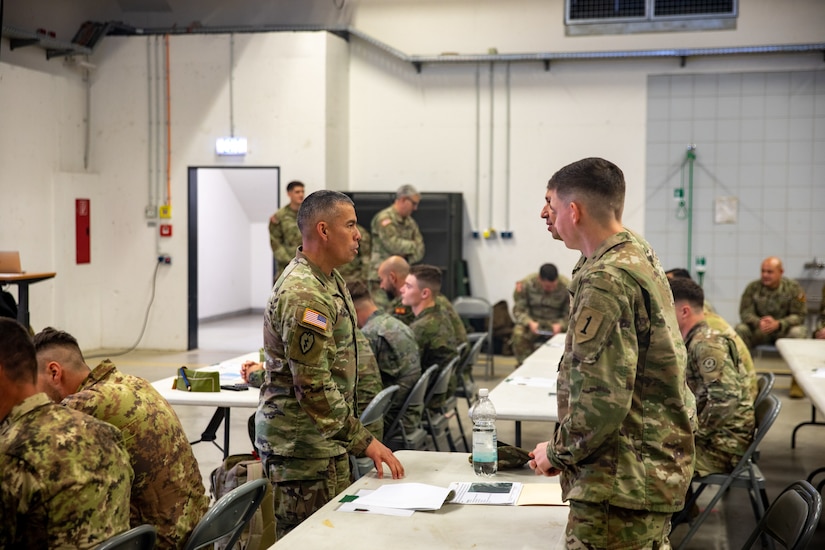
Ten teams are competing in the inaugural U.S. Army Europe and Africa Best Drone Warfighter Competition at the 7th Army Training Command's Grafenwoehr Training Area in Germany.
Donald Trump's bruising assessment of Europe as "weak" and "decaying" is a bitter blow to nations already reeling from the release of his national security strategy.
A "cheap ceasefire" between Ukraine and Russia - with Kyiv forced to surrender land - would create an "expensive peace" for the whole of Europe, Norway's foreign minister has warned.
 Login
Login