The federal ban on gun ownership by marijuana consumers is nonsensical and unconstitutional—and it’s made all the more confounding by the fact that President Donald Trump recently directed the completion of federal cannabis rescheduling process, ACLU attorneys for a man at the center of a U.S. Supreme Court case say.
Hemani’s counsel with the ACLU are contending that the federal statute 18 U.S.C. §922(g)(3) that prohibits cannabis users from possessing firearms lacks adequate historical analogues, fails to clearly define who is considered an “unlawful user” of a drug and flies in the face of evolving marijuana policies at the state and federal level.
“Like tens of millions of Americans, respondent Ali Hemani owned a handgun for self-defense, keeping it safely secured at home,” the brief says. “Like many of those same Americans, he also consumed marijuana a few days a week.”
Stripping cannabis consumers of their gun rights under §922(g)(3) represents a “draconian” policy that violates
Marijuana use appears to be more of a green flag, rather than a red flag, for Americans who are dating, according to a new poll.
Drug Rehab USA surveyed 1,000 people with recent dating experience to learn about how substance use in a potential partner is perceived.
It found that just one in four respondents consider marijuana use a “red flag” in dating. About four in five millennials—and seven in ten Gen Z adults—don’t mind if a partner consumes cannabis.
Compared to marijuana, significantly more respondents (38 percent) said smoking cigarettes is a red flag in dating. “High-risk” illicit drug use was the biggest turn-off, at 73 percent, followed by misused prescription drugs (60 percent).
The only substance that carried less of a stigma than marijuana is alcohol, with 22 percent saying they don’t consider drinking a red flag.
Additionally, 68 percent of those polled said that they don’t believe their relationships would be stronger if their partner stopped using marijuana. Ten percent said such cessation could actually lead them to grow apart.
The survey also found that 22 percent of those who are dating say their partner consumes cannabis daily, which rises to to 35 percent for Gen Z
A top federal health official is again touting the therapeutic “promise” of psychedelics such as psilocybin and MDMA—though she says the drugs’ Schedule I status remains a research barrier to scientifically validating their efficacy.
In a blog post this month, National Institution on Drug Abuse (NIDA) Director Nora Volkow said the “potential use of psychedelics in the treatment of various mental health conditions has made these drugs a hot area of scientific research, as well as growing public interest.”
NIDA, as well as other agencies such as the Food and Drug Administration (FDA), have been particularly interested in tapping into the therapeutic potential of ketamine, psilocybin and MDMA—each of which are undergoing trials that could pave the path to their broader accessibility to patients with serious mental health conditions.
These psychedelics “represent a potential paradigm shift in the way we address substance use disorders,” Volkow said, caveating that “there is much we still do not know about these drugs, the way they work, and how to administer them, and there is danger of the hype getting out ahead of the science.”
The director said the “promise of psychedelic compounds likely centers on their ability to promote rapid neural rewiring,” which
A Democratic congresswoman is pushing the federal government to consider “relaxing” strict drug testing rules for transportation workers that punish people for marijuana use outside of work hours that doesn’t actually lead to being high on the job.
Rep. Emily Randall (D-WA) told colleagues at a hearing this month that current policy is impeding efforts to ensure there’s a “robust workforce” to staff ferries that are a popular form of transportation in her home state of Washington.
The congresswoman, who is a co-chair of the Congressional Ferry Caucus, said lawmakers need to be open to “creative solutions” to the problem.
“Federal regulations require drug testing for some maritime employees in safety-sensitive positions, including ferry workers,” she said. We could consider relaxing the rules around recreational marijuana use in states where it’s legal, as long as it’s not used on the job and outside a certain window before their shift.”
“Right now, you could drug test positive for a month or longer after using legal recreational marijuana in Washington and be unable to work as a ferry operator,” Randall said at the the “member day” hearing before the House Transportation and Infrastructure Committee.
New hemp regulation bill in Congress; MA anti-marijuana campaign challenge fails; Bipartisan lawmakers talk psychedelics; SD cannabis in hospitals
Subscribe to receive Marijuana Moment’s newsletter in your inbox every weekday morning. It’s the best way to make sure you know which cannabis stories are shaping the day.
Your support makes Marijuana Moment possible…
Your good deed for the day: donate to an independent publisher like Marijuana Moment and ensure that as many voters as possible have access to the most in-depth cannabis reporting out there.
As the vast scientific possibilities of cannabis rapidly become more researched, so too does the studying and research behind the fascinating components that are terpenes. These botanical compounds are the building blocks that give cannabis buds their characteristics—everything from the aromas of the bud to the physical appearance to the various feelings and sensations that cannabis strains can provide.
Myrcene gives indica strains their relaxing and “couchlock” feelings, while terpinolene and limonene, for instance, give sativa strains the boost in energy and creativity that they’re commonly known for. Pinene can exude a very forest-like aroma while caryophyllene exudes a pepper-like smell. Truly, the study of terpenes is a marvelous new field of botanical sciences. And a few very innovative companies are not only researching but also creating these unique compounds.
“Terpenes are the aromatic soul of cannabis,” says True Terpenes CEO Daniel Cook. “They’re what give each strain its signature scent and flavor—from citrusy bursts to deep, earthy notes.”
Since 2016, True Terpenes has been at the forefront of terpene science and production. Prior to creating the company, Founder Chris Campagna ran a medical cannabis clinic in Oregon and personally witnessed how drastically inconsistent the terpene profiles in cannabis products could be. Additionally, Campagna observed how many terpenes are destroyed during common extraction methods.
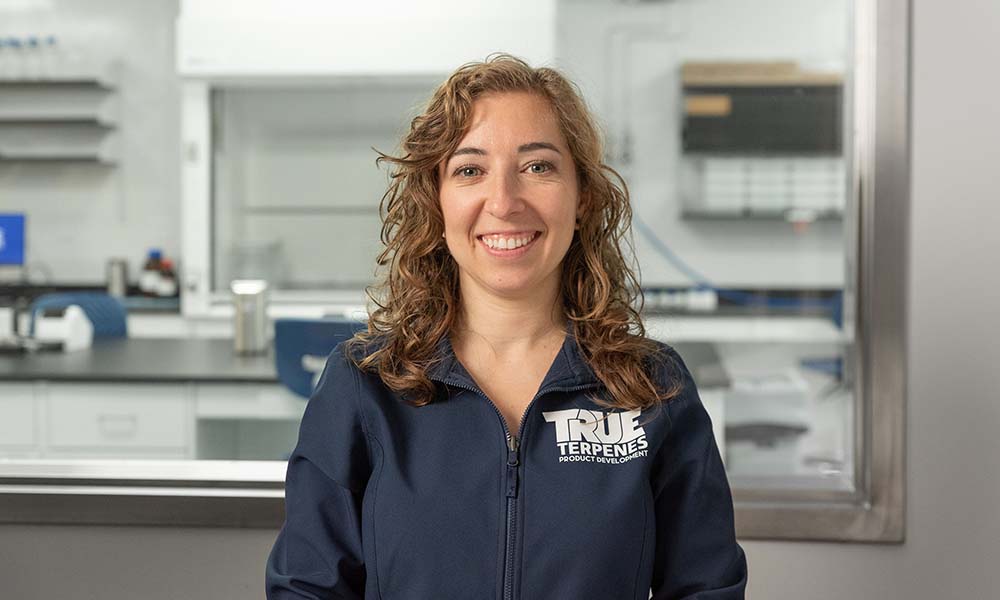
Shawna Vreeke, PhD, DABT, True Terpenes’ Director of Toxicology.
The removal of those crucial terpenes could be very problematic, especially as most states have some form of a medical cannabis program and people from all types of societal demographics have become medical cannabis patients. For instance, if a patient relied on a myrcene-heavy indica to alleviate sleeping issues or anxiety, the destruction of that myrcene could lessen the potency of their medicine. If a patient were using a pinene-dominant strain for muscle pain, the deletion of that terpene could possibly worsen that patient’s pain.
From reading the vast research on the entourage effect of cannabinoids by neurologist Dr. Ethan Russo, Campagna realized the true essential nature of terpenes and how vitally useful they could be for cannabis cultivators and consumers alike.
“That insight led to the creation of True Terpenes, a company dedicated to supplying high-quality, consistent terpene blends to product innovators,” Cook says. “By rebuilding terpene profiles, brands could craft reliable, effective products that honored the complete cannabis experience—not just its THC content.”
There’s a multitude of reasons why terpene solutions such as True Terpenes’ blends have greatly increased in popularity. First, there’s the rapid expansion of the US cannabis industry itself to thank. Despite only being recreationally legal in 24 states, the country’s cannabis industry surpassed $30 billion in sales in 2024, according to the 2025 Vangst Jobs Report. Cultivators and extractors from across the legal markets are very likely coming to the same realization that Campagna did in Oregon and are eager to find ways to strengthen their terpene profiles against damaging manufacturing practices. As the later states legalize and create statewide cannabis industries of their own, diverse terpene blends will almost certainly become of greater necessity.
Next, the awareness of terpenes and their many possibilities became greater common knowledge among cannabis consumers as the retail cannabis industry expanded. Whereas only THC content mostly mattered in the unlicensed market days, an increasing number of consumers now know the difference in feelings and effects between indica versus sativa and between ocimene, terpinolene and linalool.
“The evolution of our terpene solutions mirrors the evolution of the cannabis consumer, from simple curiosity to sophisticated preference,” Cook says. “Early on, the industry leaned into basic flavors and strain mimicry. Today, people expect authenticity, consistency and depth.”
The growing adoption of terpene blend solutions can also be attributed to their inherent flexibility, as they can seamlessly integrate into virtually every cannabis product, from gummies and beverages to vape cartridges and various topicals. This allows brands to fine-tune flavor, aroma and effect with consistency. Because terpene blends can be used across so many product formats, they’re accessible to virtually every type of cannabis consumer. Whether it’s a pack of mini-prerolls enjoyed by someone in their early twenties or a topical chosen by a senior exploring cannabis for the first time, both experiences can be enhanced by the very same terpene profile.
“People want more than just THC or CBD percentages; they’re seeking products that deliver mood, taste and effect with nuance and intention,” Cook says. “Flavor and aroma make that possible.”
As prestigious institutions such as The University of Arizona and privately funded companies continue to advance the overall research and knowledge on terpenes, Cook predicts a bright future for their scientific appeal and usage: “We’re entering the experience economy of cannabis and terpenes are the key to unlocking differentiated, targeted and repeatable experiences. They give products character. They invite the consumer into a ritual. And, most importantly, they’re helping both new users and connoisseurs explore cannabis with more excitement, clarity and control.”
This story was originally published in issue 52 of the print edition of Cannabis Now.
Avocado toast for breakfast? It might sound strange to some but for others this surprisingly refreshing and filling toast is an absolutely perfect way to start the day. The amount of toppings that you can pair with the avocado is simply limitless. Which means you can have a new style of avocado toast every day of the week without the worry of your taste buds becoming bored.
Super Lemon Haze pairs harmoniously with the bright citrus notes of the sun dried tomatoes and fresh avocado. Its fast hitting and powerful high promotes a balanced feeling between the body and mind. It is a great uplifting sativa-dominant strain that provides excellent pain management and energy for the day with long lasting effects. A perfect match for the sustained energy that the ingredients of the dish imparts as well. Are you ready for a new found love of avocado toast?
Mise en place:
1/2 cup fresh sautéed spinach with 1 clove minced garlic and 1 tablespoon Super Lemon Haze olive oil 1 whole ripe avocado 2 slices focaccia 4 slices of pan fried applewood smoked bacon 4 slices of sundried tomatoes in olive oil or soaked in water then blotted with a paper towel 4 slices of fresh mozzarella 1 teaspoon of pesto
Salt and pepper to taste
Directions:
Step 1: Toast the focaccia bread in the oven or toaster very lightly.
Step 2: Mash the avocado in a small bowl with a fork and then season with salt and pepper to taste.
Step 3: Spread the avocado evenly on the lightly toasted focaccia bread slices. Make sure to spread it out to the edges of the bread.
Step 4: Now spread the Super Lemon Haze sautéed spinach and garlic evenly over both slices of the avocado toast.
Step 5: Roll the mozzarella slices in the pesto sauce until coated. Place two slices of pesto mozzarella evenly over the sautéed spinach on both halves.
Step 6: Now place two sundried tomatoes on top of the pesto mozzarella on each slice.
Step 7: Adorn each halve of toast with two pieces of bacon however you choose. It can be in strips, crumbles, or bits.
Step 8: Lightly toast the bread in an oven on a sheet tray until the mozzarella is gooey and bubbly.
Step 9: Enjoy with a friend, by yourself, or place both toast sides together for the ultimate stoney focaccia sandwich.
Dosage:
If one gram of Super Lemon Haze tests at 20 percent THC, twenty percent of 1,000 mg would be 200mg. Sub the number of your THC percentage and do the math to figure out your dosing for the vegetable oil. Remember, this recipe yields two slices of avocado toast or one large sandwich, so be sure to dose accordingly. When you make your canna-oil be sure to dose it by the tablespoon for an accurate dosage. If you want a smaller dose in this recipe, cut the cannabis down to a smaller portion in either the olive oil or the amount of olive oil you put in the pan. If you want a larger dose, add the amount you desire into the olive oil you make or into the pan.
Strain Suggestions:
I would recommend any strains whose terpenes would compliment the citrusy flavor of the avocado and tomatoes. Strains that possess citrus, lemon, or even lime would pair best. Lemon Skunk, Lemon Drop, Lemon Haze, Red Headed Stranger, Lime OG, or Key Lime Pie. Be creative and have fun with it!
“Some licensees believed they were permitted to bring in clones or tissue cultures as well as seeds on an ongoing basis.”
By Rebecca Rivas, Missouri Independent
At least seven marijuana cultivation facilities in Missouri have been fined over the last year for breaking what’s known in the industry as the “immaculate conception rule.”
Marijuana can’t pass over state lines because it’s still federally illegal, and state law mandates that all marijuana must be grown within the state.
However, there is one year after a licensee passes a commencement inspection when the state essentially closes its eyes and puts its hands over its ears on how a cultivation facility starts its inventory.
It’s called the immaculate conception rule, and six facilities were fined up to $500,000 from breaking it last year.
A spokesperson for the Missouri Division of Cannabis Regulation said regulators “discovered some licensees believed they were permitted to bring in clones or tissue cultures as well as seeds on an ongoing basis. However, this practice is a violation of seed-to-sale tracking regulations.”
To keep up with customers’ preferences and demand, these companies had been bringing in clones, or starter plants, and tissue cultures, which is a form of in-vitro
Separate bills to ban the use, possession, sale or consumption of those intoxicating substances advanced out of a Senate committee on Wednesday, but the committee voted to send them to the Senate floor with no recommendation, rather than a recommendation to pass them.
By Senate rules, bills that land on the full chamber’s calendar without a recommendation need the support of a majority of senators before they’re eligible for a debate, and ultimately for a vote.
Sen. Kevin Jensen, R-Canton, moved to put the bills on the Senate’s calendar for Monday. He said both bills had drawn spirited debate and survived attempts by some committee members to defeat them.
On the bill to ban hemp-derived intoxicants for anyone without a medical marijuana card, Senate Bill 61, Jensen said there are amendments in the works to address its opponents’ concerns.
He offered similar comments, without referencing possible amendments, when he moved to place Senate Bill 77’s ban on kratom products on the Senate calendar.
“The people have spoken. I’m proud to see this funding distributed across Ohio and look forward to seeing the ways these funds will benefit local communities.”
By David Beasley, The Center Square
For cities and towns in Ohio that have allowed recreational marijuana dispensaries, it’s payday time.
A 10 percent tax on cannabis products, approved by Ohio voters in 2023, goes to cities and towns with dispensaries at 36 percent rate of the tax revenue, according to state law.
This month, cities and towns with dispensaries are receiving their first checks, a total of $33 million.
The city of Piqua is one of those, with a check for $438,000, which it plans to use for park improvements.
“Local governments—including Piqua—decided to allow recreational marijuana sales within their communities based on the understanding that funds would come back to local control to best serve the individual needs of the community,” city manager Paul Oberdorfer said in a statement.
A small town called Seven Mile Village, which has a population of only 712 people and an annual budget of about $75,000, received a check for $400,000, State Sen. Steve Huffman, R-Tipp City, told The Center Square.
President Donald Trump only talked about medical cannabis in his Dec. 18 executive order directing marijuana be rescheduled. That's instructive, a seasoned attorney argues.
(This is a contributed guest column. To be considered as an MJBizDaily guest columnist, please submit your request here.)
President Donald Trump’s Dec. 18 executive order directed U.S. Attorney General Pam Bondi to take “all necessary steps” to move marijuana to Schedule 3 of the Controlled Substances Act. It also encouraged medical marijuana research, testing and use.
But medical is the key word here. Near-term federal policy changes are expected to apply only to cannabis used for legitimate medical purposes, not adult use.
The U.S. Food and Drug Administration (FDA) would set cannabinoid limits for hemp-derived products under the Hemp Enforcement, Modernization and Protection (HEMP) Act, sponsored by Republican U.S. Rep. Morgan Griffith of West Virginia and Texas Democratic U.S. Rep. Marc Veasey.
ADVERTISEMENT
The bill does not regulate cannabis.
While draft language appears to empower the health secretary to set THC limits, the bill’s intent is limited to CBD, according to a statement from Griffith’s office.
That’s still good news for the U.S. hemp sector, which
Dispensaries rang up $291.1 million in sales in 2025, surpassing the previous record of $283 million set in 2023, according to data from the Arkansas Department of Finance and Administration.
ADVERTISEMENT
That’s a $15 million increase over the prior record of $275.9 million set in 2024 and signals a rebound for the state’s medical cannabis industry, which launched in 2019,
Arkansas medical cannabis sales recover after 2024 stumble
“The industry certainly rebounded in 2025 with a new sales record, following a decrease in sales the previous year,” Scott Hardin, a spokesperson for the Arkansas Department of Finance and Administration, said in a statement.
Arkansas has recorded $1.6 billion in sales since the
Bipartisan congressional lawmakers are stressing the importance of strategically advancing psychedelics reform in a way that mitigates bureaucratic conflict and the influence of outside interests. Even just one misstep could threaten to upend the movement, they say.
At a public forum in Washington, D.C.—hosted by the Psychedelic Medicine Coalition (PMC) and Mission Within Foundation (MWF) last week—Reps. Lou Correa (D-CA), Jack Bergman (R-MI) and Morgan Luttrell (R-TX) spoke about the work ahead to provide access to psychedelics for patients.
Much of the focus centered around the need to give military veterans alternative treatment options for serious mental health conditions such as post-traumatic stress disorder (PTSD). Psychedelics like MDMA and ibogaine could help fill that gap, the legislators said.
Luttrell said a key challenge supporters are up against is the inaccessibility of data from private research institutions that could demonstrate the therapeutic efficacy of psychedelics—something that he argued would likely move the needle for members who are on the fence on the issue.
The congressman said he and colleagues have pressed agencies such as the Department of Defense (DOD), U.S. Department of Veterans Affairs (VA) and U.S. Department of Health and Human Services (HHS) about the problem.
Bipartisan congressional lawmakers have filed a new bill to regulate consumable hemp products—offering a potential alternative to the outright THC ban that was included in a spending bill President Donald Trump signed late last year.
House Energy and Commerce Subcommittee on Health Chairman Morgan Griffith (R-VA) and Rep. Marc Veasey (D-TX) introduced the Hemp Enforcement, Modernization, and Protection (HEMP) Act on Thursday as the future of the market sits in limbo.
“Despite raising repeated concerns about the ongoing confusion regarding the safety, consumption and sale of CBD-containing products until a discussion draft of this bill was circulated, I believe we have yet to see meaningful progress at the federal level,” Griffith said in a press release.
“I am proud to lead the effort in the House along with Representative Veasey to present a path forward for the federal regulation of CBD products,” he said. “After discussions with stakeholders, federal officials and other relevant authorities, I believe the HEMP
The Senate Rehabilitation & Social Services Committee on Friday took up two marijuana sales legalization measures. After amending one of the proposals from Sen. Lashrecse Aird (D) with a substitute version, it passed the panel in a 8-7 vote.
Since legalizing cannabis possession and home cultivation in 2021, Virginia lawmakers have worked to establish a commercial marijuana market—only to have those efforts consistently stalled under former Gov. Glenn Youngkin (R), who twice vetoed measures to enact it that were sent to his desk by the legislature.
“In 2021 Virginia became the first southern state to legalize adult use cannabis, and five years later, Virginia has yet to implement the marketplace we originally envisioned,” Aird said. “Each year that we go without a marketplace, the illicit market grows and health and safety concerns rise for our citizens.”
“The legislation establishes a market, once and for all, that will protect consumers, protect
A South Dakota legislative committee has rejected a bill that would have allowed terminally ill patients to use medical cannabis in hospitals and hospices.
The House Health and Human Services Committee voted 12-1 on Thursday to defer the measure to the 41st day of the session, effectively killing it.
Rep. Eric Emery (D), the sponsor of HB 1053, said it is a “narrow and carefully constructed bill that addresses one specific issue: ensuring that terminally ill patients who are already legally authorized to use medical cannabis under South Dakota law may continue the treatment when they enter the hospital or a hospice facility.”
“Under the current law, a patient may legally use medical cannabis at home with their approved practitioner. But once that same patient is admitted into a hospital or hospice facility, that access is abruptly ended—and not because the doctor has changed their mind, but because the facilities’ policies vary widely across the state,” he said. “For terminally ill patients, this disruption can mean unplanned pain, nausea, anxiety or even loss of appetite when care is no longer focused on the cure but comfort and dignity.”
“I’ve seen firsthand the pain and the suffering that often accompany… this

 Login
Login