Reading view

There are new articles available, click to refresh the page.

Bitcoin Price Prediction: Rich Dad Poor Dad Author Kiyosaki Ignores Price Crash – Here’s Why He’s More Bullish Than Ever

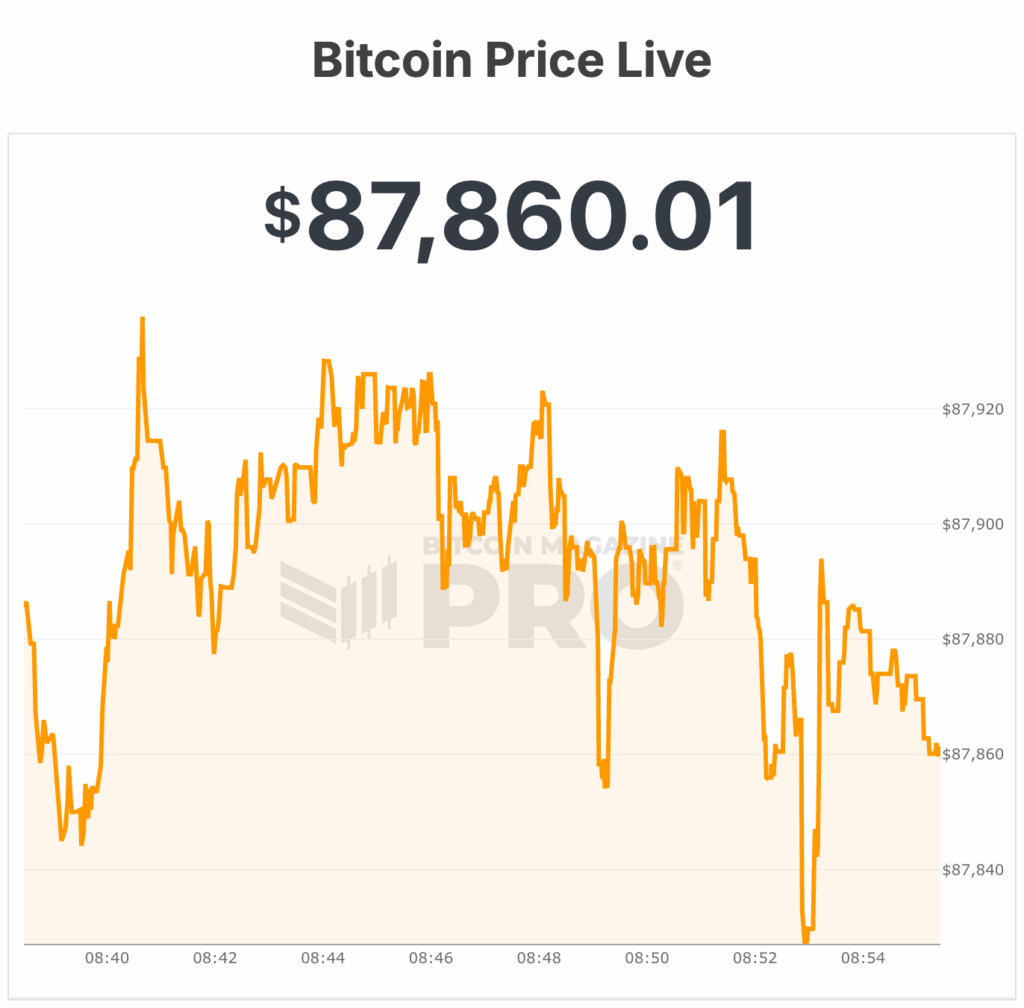
Bitcoin is trading near $87,700, down about 1% on the day, yet Robert Kiyosaki remains unmoved by short-term price swings. The Rich Dad Poor Dad author says he continues buying Bitcoin and Ethereum regardless of volatility, arguing that price matters less than the direction of the global financial system.

In a recent post, Kiyosaki pointed to two forces shaping his strategy: the rising US national debt, now above $38.4 trillion, and the steady erosion of the dollar’s purchasing power. From his perspective, daily price movements are a distraction.

As debt expands and deficits deepen, scarce assets gain relevance. As he put it bluntly, he does not worry about market fluctuations because “the national debt keeps going up and the purchasing power of the US dollar keeps going down.”

Q: Do I care when the price of gold silver or Bitcoin go up or down?

A: No. I do not care.

Q: Why Not?

A: Because I know the national debt of the US keeps going up and the purchasing power of the US dollar keeps going down.

Q: Why worry about the price of gold, silver,…

— Robert Kiyosaki (@theRealKiyosaki) January 23, 2026

That logic explains why Kiyosaki groups Bitcoin with gold and silver, often referring to BTC as “digital gold.” While he has long favored physical metals, he now sees Bitcoin and Ethereum as modern extensions of the same hedge against monetary dilution. His long-term outlook remains bold, with Bitcoin potentially reaching $1 million over the coming years or decade.

Institutional Credibility Weakens as Investors Seek Bitcoin Hedges

Kiyosaki’s stance reflects deep skepticism toward traditional financial authorities. He has repeatedly criticized institutions such as the Federal Reserve and the US Treasury, arguing that policy decisions have fueled debt growth rather than long-term stability.

This view aligns with a broader investor shift. As inflation pressures, rising interest costs, and geopolitical uncertainty persist, capital has increasingly moved toward assets outside the traditional financial system. Bitcoin’s fixed supply of 21 million coins, with more than 19.98 million already in circulation, continues to attract investors who see scarcity as protection rather than speculation.

Bitcoin Price Prediction: $87K Base Forms as Trendlines Hint at a Springboard Move

While the long-term narrative remains intact, Bitcoin’s short-term chart sits at a critical junction. After pulling back from the $95,500–$96,000 zone, BTC is consolidating between $86,000 and $88,000, an area where multiple technical levels converge.

On the 4-hour chart, price is pressing against the lower boundary of a descending wedge while still respecting a rising long-term support line that has guided the broader uptrend since late 2025. Recent candles near $86,100 show long lower wicks, suggesting dip-buying rather than forced liquidation.
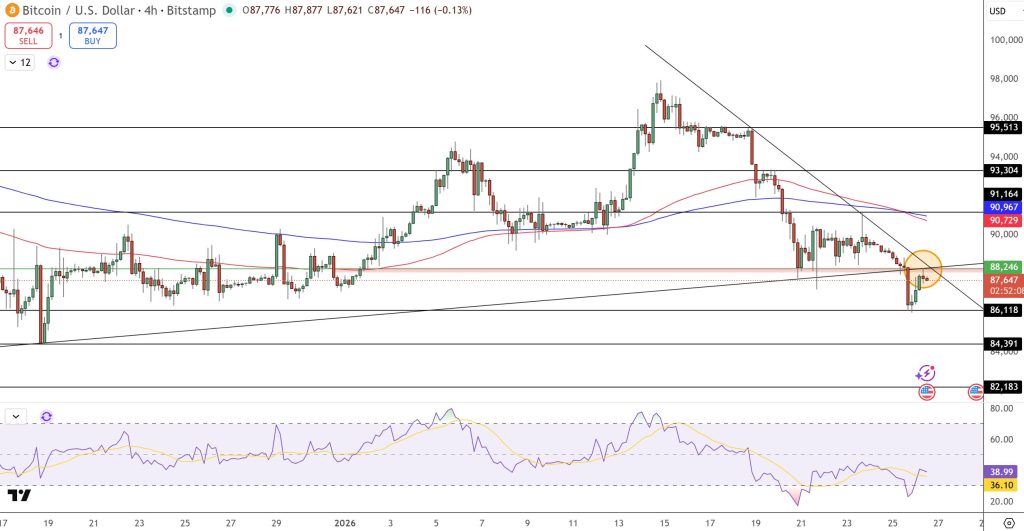
BTC/USD Price Chart – Source: Tradingview

Momentum remains soft, with RSI hovering near 39–40, but it has begun to turn higher. A sustained hold above $88,000 would open a path toward $90,700 and $93,300, with a potential retest of $95,500. A break below $86,000 would delay that recovery and expose $84,300, without undermining the broader structure.

Taken together, Kiyosaki’s long-term conviction and Bitcoin’s developing technical base suggest the market is pausing, not peaking. For investors focused beyond short-term noise, this consolidation may be the kind of quiet reset that precedes the next expansion phase.

Bitcoin Hyper: The Next Evolution of BTC on Solana?

Bitcoin Hyper ($HYPER) is bringing a new phase to the BTC ecosystem. While BTC remains the gold standard for security, Bitcoin Hyper adds what it always lacked: Solana-level speed. The result: lightning-fast, low-cost smart contracts, decentralized apps, and even meme coin creation, all secured by Bitcoin.

Audited by Consult, the project emphasizes trust and scalability as adoption builds. And momentum is already strong. The presale has surpassed $31 million, with tokens priced at just $0.013635 before the next increase.

As Bitcoin activity climbs and demand for efficient BTC-based apps rises, Bitcoin Hyper stands out as the bridge uniting two of crypto’s biggest ecosystems. If Bitcoin built the foundation, Bitcoin Hyper could make it fast, flexible, and fun again.

Click Here to Participate in the Presale

The post Bitcoin Price Prediction: Rich Dad Poor Dad Author Kiyosaki Ignores Price Crash – Here’s Why He’s More Bullish Than Ever appeared first on Cryptonews.

Billionaire Michael Saylor’s Strategy Buys 2,932 Bitcoin for $264M

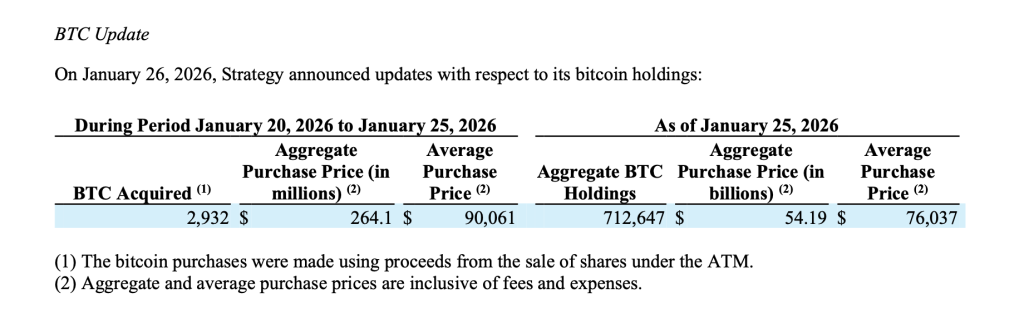
Michael Saylor’s Strategy has expanded its Bitcoin treasury again, acquiring an additional 2,932 BTC for approximately $264.1 million during the period from Jan. 20 to Jan. 25.

Strategy has acquired 2,932 BTC for ~$264.1 million at ~$90,061 per bitcoin. As of 1/25/2026, we hodl 712,647 $BTC acquired for ~$54.19 billion at ~$76,037 per bitcoin. $MSTR $STRC https://t.co/RooLfEvniX

— Michael Saylor (@saylor) January 26, 2026

The company disclosed that the purchases were made at an average price of $90,061 per bitcoin, inclusive of fees and expenses.

The update reinforces Strategy’s position as the largest corporate holder of Bitcoin globally, continuing its multi-year accumulation strategy that has become central to its balance sheet approach.

Total Bitcoin Holdings Reach 712,647 BTC

Following the latest acquisition, Strategy reported that it now holds a total of 712,647 BTC as of Jan. 25.

The company said its aggregate Bitcoin purchases total roughly $54.19 billion, with an average acquisition price of $76,037 per bitcoin. The figures highlight the scale of Strategy’s long-term bet on Bitcoin as a treasury reserve asset, accumulated across multiple market cycles.

Strategy’s growing holdings show its belief that Bitcoin represents a superior store of value over time, particularly amid concerns around currency debasement and global macro uncertainty.

Purchases Funded Through Share Sales Under ATM Program

Strategy disclosed that the recent Bitcoin purchases were funded through proceeds generated from the sale of shares under its at-the-market offering program.

During the Jan. 20–25 period, the company sold approximately 1.57 million shares of its Class A common stock, generating net proceeds of about $257 million. Strategy also issued roughly 70,201 shares of its variable rate preferred stock, raising an additional $7 million.

In total, the company generated about $264 million in net proceeds, which were then deployed toward Bitcoin accumulation.

The disclosure also shows that Strategy retains significant remaining capacity for future issuances, including billions of dollars available across multiple stock and preferred equity programs.

Corporate Bitcoin Accumulation Continues Into 2026

Strategy’s continued purchases come as institutional adoption of Bitcoin remains a major theme entering 2026, with more companies exploring crypto as a long-term balance sheet asset.

The firm has consistently framed Bitcoin as a scarce, inflation-resistant reserve that can outperform cash and traditional holdings over extended time horizons. While the strategy remains controversial due to Bitcoin’s volatility, Strategy has maintained its commitment to accumulation even during periods of market weakness.

With over 712,000 BTC now on its balance sheet, Strategy’s exposure to Bitcoin price movements is unmatched among public companies, making it a key bellwether for corporate crypto adoption.

As the company continues leveraging equity issuance to fund purchases, investors will closely watch how its aggressive treasury strategy evolves alongside broader market conditions in 2026.

The post Billionaire Michael Saylor’s Strategy Buys 2,932 Bitcoin for $264M appeared first on Cryptonews.

Crypto Wallet Maker Ledger Preps $4B US IPO – Can It Win Wall Street?

Ledger is preparing for a potential U.S. initial public offering that could value the crypto wallet maker at more than $4 billion, according to reports.

The Paris-based company has enlisted major Wall Street banks, including Goldman Sachs, Jefferies, and Barclays, to advise on the deal, with a potential listing later this year.

The move comes as Ledger increases its presence in the U.S., where capital markets activity and institutional interest in digital asset firms are especially concentrated in New York.

❗@Ledger eyes U.S. IPO at a $4B+ valuation: @FT

Hardware #wallet maker #Ledger is preparing for a potential U.S. #IPO, reportedly working with Goldman Sachs, Jefferies, and Barclays on the deal, which could take place as early as this year pic.twitter.com/hjJQcnXxfh

— Charged Ventures (@ChargedVentures) January 23, 2026

Wall Street Banks Line Up for Ledger’s IPO Push

Ledger’s IPO ambitions reflect a belief that it has reached sufficient scale to withstand public-market scrutiny from Wall Street.

In an earlier interview, CEO Pascal Gauthier said the company had grown to a point where a listing was realistic, adding that the U.S. stood out as the natural venue.

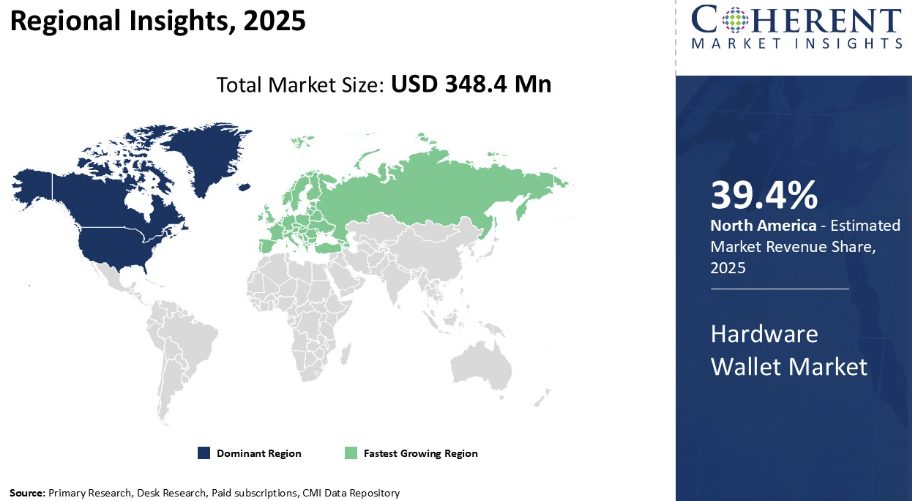
Roughly 40% of Ledger’s business now comes from North America, a figure that has shaped both its listing strategy and operational expansion in New York.

Ledger US IPO - Regional Insights 2025 map
Source: Coherent Market Insights

Gauthier has also said the firm is weighing a U.S. IPO alongside a potential private funding round, keeping multiple capital-raising paths open.

“Money is in New York today for crypto, it’s nowhere else in the world, certainly not in Europe,” Gauthier told the Financial Times.

He reiterated that view in November 2025 when the company first flagged the IPO plans, emphasizing that his increased time in New York was driven by where crypto financing is now concentrated.

From Nano Wallets to Triple-Digit Millions in Revenue

Founded in 2014 by Éric Larchevêque, Joël Pobeda, and Thomas France, Ledger built its reputation on hardware wallets designed to keep private keys offline.

Its early success came from the Ledger Nano series, which gained traction as hacks and exchange failures highlighted the risks of custodial storage.

The company has since broadened its product lineup, launching the Ledger Stax, a touchscreen device aimed at long-term holders and institutional users.

It has also rolled out an iOS app for enterprise clients and recently completed a major rebranding alongside the release of the Ledger Nano Gen5.

Ledger said its revenues reached triple-digit millions in 2025, marking its strongest performance to date, with further growth expected this year.

Over the past decade, the firm estimates it has sold more than seven million devices globally and now safeguards around 20% of global crypto assets, including over $100 billion worth of bitcoin.

Potential Ledger IPO closing market cap?

– raised $3m in 2019, $380m in 2021, $109m at $1.4b in Mar 2023
– seeking $4b valuation in IPO (~3x valuation from last raise)

currently the liquidity for this market on @Polymarket is limited, though interesting to see how high it goes… https://t.co/Pmv5JIR4XA pic.twitter.com/k5G6UGHf9E

— cs_defier (@cs_defier) January 23, 2026

The company was last valued at $1.5 billion in 2023 after raising a $108 million extension to its Series C round, bringing total funding in that round close to $500 million.

While Ledger has since said its valuation has increased, it has not disclosed an updated figure ahead of the reported IPO preparations.

Fees, Data Exposure, and the Self-Custody Debate

As Ledger expands beyond pure hardware, it has reframed its devices as “Ledger signers,” positioning them as tools for securing digital assets and online identities in an AI-driven environment.

That shift has not been without controversy, particularly around new monetization features.

Last October, Ledger revealed that its Multisig app would charge a flat $10 fee per transaction, excluding token transfers, which would instead incur a 0.05% variable fee.

😡 @Ledger’s new Multisig app sparked backlash for adding a $10 flat fee per transaction and a 0.05% token transfer fee, on top of gas costs.#Ledger #Cryptohttps://t.co/b72bb5ZwXw

— Cryptonews.com (@cryptonews) October 26, 2025

The charges are applied on top of standard blockchain gas fees, prompting backlash from users who argue that self-custody should not come with recurring platform costs.

Security concerns have also resurfaced following a recent data exposure incident involving a third-party provider.

On January 5, 2026, blockchain researcher ZachXBT said personal information of Ledger customers was accessed in a hack on Global-e, a payment processor used by the company.

While no funds were compromised, researchers warned that the exposure heightens the risk of phishing and social engineering attacks.

The post Crypto Wallet Maker Ledger Preps $4B US IPO – Can It Win Wall Street? appeared first on Cryptonews.

XRM could dip below the January low of $413: Check forecast

Key takeaways

  • Monero is down 4.5% in the last 24 hours and risks dropping below the January low.
  • The coin has lost 42% of its value since hitting an all-time high price of $798 twelve days ago.

XMR continues to decline as the market remains bearish

XMR, the native coin of the Monero blockchain, is one of the worst performers among the top 20 cryptocurrencies by market cap in the last 24 hours. It has lost 4.5% since Sunday and now trades below $460.

The bearish performance comes as the broader cryptocurrency market continues to underperform. XMR defied market conditions in December and early January, rallying to a new all-time high of $798 on January 14.

Its rally was fueled by growing demand for privacy-focused cryptocurrencies, with DASH, ZEC, and ZCash also rallying during that period.

However, the rally has died, and XMR has lost 42% of its value since then. It is currently trading at $459 and risks dropping below the January low of $413 if the bearish trend continues. 

Monero could dip below the 100-day EMA support

The XMR/USD 4-hour chart is bearish and efficient as it has lost 42% in the last two weeks, suggesting reduced demand for the privacy coin.

Currently, XMR is hovering above $450, stabilizing above the 100-day EMA at $437, after a 10% drop on Sunday. 

If the bearish trend continues, XMR could drop below the January low of $413, wth the 200-day EMA at $383 still the primary trend floor. 

XMR/USD4H Chart

The MACD line stays below the signal with both falling toward the zero line, flagging firm bearish momentum. Furthermore, the RSI at 32 indicates a bearish shift as sellers retain the near-term edge without oversold conditions. 

On the flip side, if the bulls regain control, XMR could rally above the 50-day EMA at $485, clearing the path for further pump above $500.

The post XRM could dip below the January low of $413: Check forecast appeared first on CoinJournal.

Metaplanet boosts forecasts despite Bitcoin write-down clouding annual results

  • The company lifted its 2025 operating income guidance to $40 million.
  • A non-cash Bitcoin impairment of $680 million to $700 million is expected for 2025.
  • Metaplanet projected a $632 million ordinary loss and $491 million net loss for 2025.

Metaplanet, a Tokyo-listed Bitcoin treasury company, has raised its revenue and operating income forecasts for 2025 and issued much higher guidance for 2026, even as it flagged a large non-cash Bitcoin write-down that is set to dominate its annual results.

In a notice released on Monday, the company said its Bitcoin income generation business is expected to deliver stronger-than-expected performance, particularly in the final quarter of the year.

However, Metaplanet also projected a steep ordinary loss and net loss for 2025, driven largely by accounting adjustments tied to Bitcoin’s valuation at year-end.

The company is scheduled to file its full-year results on Feb. 16.

Revenue upgrade driven by Bitcoin income generation

Metaplanet said it now expects 2025 revenue of 8.905 billion Japanese yen, or around $58 million, based on its updated guidance.

The company also raised its operating income forecast to $40 million, signalling improved performance at the operating level despite broader market volatility affecting its holdings.

Management said Q4 2025 revenue from its Bitcoin income generation business “is expected to significantly exceed initial projections,” which led it to lift full-year revenue guidance for that segment to about $55 million.

That compares with around $40 million previously announced, showing a sharp upgrade in the contribution from its Bitcoin-linked revenue stream.

Large impairment set to drive headline loss

Even with the stronger operating forecasts, Metaplanet expects to report a deep annual loss for 2025.

The company projected an ordinary loss of $632 million and a net loss of $491 million. These figures are largely attributed to a Bitcoin impairment loss estimated at roughly $680 million to $700 million, which is expected to be recognised in its year-end reporting.

Metaplanet explained that the impairment is a “non-cash accounting adjustment reflecting period-end price fluctuations” and said it has no direct impact on its cash flows or day-to-day operations.

The notice linked the impairment to quarter-end mark-to-market accounting treatment and referenced Bitcoin holdings valued at year-end prices, with Bitcoin shown at $87,876 in the disclosure.

BTC holdings and treasury metrics expand sharply

Metaplanet also reported rapid growth in its Bitcoin treasury business during 2025, underlining how the company has built up its exposure to Bitcoin while developing income generation activities around its holdings.

BTC holdings rose from 1,762 BTC at the end of 2024 to 35,102 BTC at the end of 2025, showing a significant increase in the company’s balance sheet allocation.

It also reported BTC yield per diluted share of 568% for the year. The company uses this metric to measure how much Bitcoin backing each diluted share has increased, offering a per-share view of its Bitcoin accumulation.

While the impairment is expected to weigh heavily on reported net results, Metaplanet’s updated figures suggest it is still expanding its treasury position and Bitcoin-linked operations at a pace.

2026 guidance rises but earnings remain uncertain

For 2026, Metaplanet forecast revenue of around $103 million and operating income of $73 million, representing a sharp step up from its 2025 targets.

The company said almost all of its 2026 revenue is expected to come from the Bitcoin income generation business, reinforcing the segment’s central role in its business model.

Metaplanet also projected selling, general and administrative expenses of about $29 million for 2026 as it ramps up operations.

However, it said it will not provide guidance for ordinary income or net income for 2026 due to the difficulty of forecasting Bitcoin prices, signalling that future reported earnings could remain volatile even if operating performance strengthens.

The company added that it publishes daily data on its BTC holdings, unrealised gains and losses, and related metrics, offering investors regular visibility into how price swings affect its treasury position.

The post Metaplanet boosts forecasts despite Bitcoin write-down clouding annual results appeared first on CoinJournal.

Zilliqa (ZIL) price slides amid exchange delistings and supply update

  • Zilliqa price drops 3.6%, extending a 7-day downtrend amid weak market sentiment.
  • Binance delisting and Upbit supply increase reduce liquidity and add pressure.
  • Technicals show ZIL below key EMAs with RSI near oversold levels.

Zilliqa (ZIL) has seen a sharp dip in its price over the past 24 hours.

The token is currently trading at $0.004822, down 3.6%, underperforming the broader cryptocurrency market, which fell by 0.9%.

This decline extends a seven-day downtrend of approximately 7.75%, signalling sustained bearish sentiment.

Exchange delistings and market liquidity

One of the main drivers behind ZIL’s recent weakness is exchange delistings.

On January 23, 2026, Binance removed the ZIL/BTC spot trading pair as part of its market quality optimisation.

This followed a prior delisting of the ZIL/BTC margin pair in June 2025.

Delisting reduces liquidity and arbitrage opportunities for traders.

It also signals declining exchange support, often prompting sell-offs as market participants adjust their positions.

With fewer direct BTC and ETH trading pairs, ZIL now relies heavily on USD-stable pairs like ZIL/USDT for trading volume.

Traders are closely watching whether liquidity consolidates or further fragments on these remaining pairs.

Supply update adds to the downward pressure

Another factor influencing ZIL’s decline is a recent circulating supply update.

Upbit reported an increase of 443,195,861 ZIL in the first quarter of 2025.

This adjustment raised the circulating supply from roughly 19.905 billion to 20.349 billion ZIL.

The increase, representing about 2.2% of the quarterly supply, reflects staking rewards, protocol inflation, and team token unlocks.

A larger supply can dilute the value of each token if demand does not increase proportionally.

Public confirmation of the supply increase often renews focus on potential sell-side pressure, especially during periods of market weakness.

Combined with reduced exchange liquidity, the supply update has amplified bearish sentiment among traders.

ZIL technical analysis

Technical indicators further reinforce ZIL’s short-term bearish trend.

The token is trading below all major exponential moving averages on the daily chart.

Its 7-day simple moving average sits at $0.00497, while the 30-day SMA is at $0.00519, both above the current price.

The 14-day relative strength index (RSI) is 38.37, suggesting that the token is approaching oversold conditions.

Zilliqa price analysis
Zilliqa price chart | Source: TradingView

Meanwhile, the weekly RSI stands at 47.00, indicating neutral market conditions.

The MACD histogram is negative at –0.000095, confirming continued bearish momentum.

These technical signals suggest that selling pressure remains, although short-term consolidation could occur due to the oversold conditions.

Zilliqa price forecast

Traders should keep a close eye on key support and resistance levels in the coming days.

The immediate support is near the recent swing low of $0.0045846, which may act as a floor for further declines, according to analysts.

On the upside, the first significant resistance is at $0.0669, a level that ZIL must close above to trigger a potential trend reversal.

Market participants should also monitor trading volumes on remaining pairs to gauge whether the sell-off is stabilising.

Short-term price action will likely be influenced by liquidity trends, supply dynamics, and technical momentum.

Until a bullish catalyst emerges, ZIL may continue to face pressure, with consolidation around current levels being the most probable scenario.

The post Zilliqa (ZIL) price slides amid exchange delistings and supply update appeared first on CoinJournal.

XRP Ledger Congestion Could Burn 1 Billion Coins A Year, Developer Claims

Software Engineer and founder of various AI start ups Vincent Van Code (@vincent_vancode) argues on X that most XRP burn projections are understated because they assume today’s low transaction fees persist even under heavy network usage. In his framing, sustained congestion on the XRP Ledger (XRPL) could push fees higher via the protocol’s load-scaling mechanics, potentially destroying on the order of one billion XRP annually.

XRPL Load Factor Could Turn Fees Into A Major XRP Burn

In a thread titled “The ‘Supply Meltdown’ Simulation,” Vincent Van Code claimed “everyone is calculating the XRP burn wrong,” starting with the premise that the commonly cited base fee of 0.00001 XRP only reflects a quiet network. “But what happens if the world actually starts using the XRPL at its 3,400 TPS limit?” he wrote, positioning load-driven fee escalation as the pivotal variable rather than raw throughput alone.

Van Code’s simulation walks through multiple fee regimes at the same headline activity rate, emphasizing that burn changes dramatically when the ledger is full and the “Load Factor” increases fees to deter spam. “As the ledger fills up, the Load Factor kicks in to stop spam,” he wrote. “Fees don’t just stay low; they scale exponentially.”

He anchored the thread with four scenarios and daily burn estimates, starting with what he called a “standard day” of 1.2 million transactions and roughly 450 XRP burned per day. From there, he modeled “global adoption” at the stated 3,400 TPS ceiling, translating to about 293 million transactions per day at base fee and an estimated 2,937 XRP burned daily.

The more aggressive claims come when he holds transaction volume constant at that 293 million-per-day level but lifts the effective fee via congestion. In his “congestion hike” case, he assumes the load-scaled fee rises to 0.001 XRP, implying about 293,760 XRP burned per day. In a “full gridlock” case at 0.01 XRP per transaction, he estimates 2,937,600 XRP burned daily.

The thesis leans on a structural feature of XRPL fees: they are not paid out to validators or any sponsoring entity, but removed from circulation. Van Code underscored that distinction directly. “The fees aren’t paid to miners. They aren’t paid to Ripple. They are destroyed forever.”

The “Supply Meltdown” Simulation 🌋 Headline: Everyone is calculating the $XRP burn wrong. 🧵 The “base fee” (0.00001 XRP) only exists when the network is quiet. But what happens if the world actually starts using the XRPL at its 3,400 TPS limit? The Congestion Math: As the…
— Vincent Van Code (@vincent_vancode) January 24, 2026

From that, he draws his headline conclusion: “Under extreme global utility, we aren’t burning a few hundred tokens. We could be wiping 1 BILLION $XRP out of existence every year,” framing network demand—and the congestion it creates—as “the ultimate deflationary engine.”

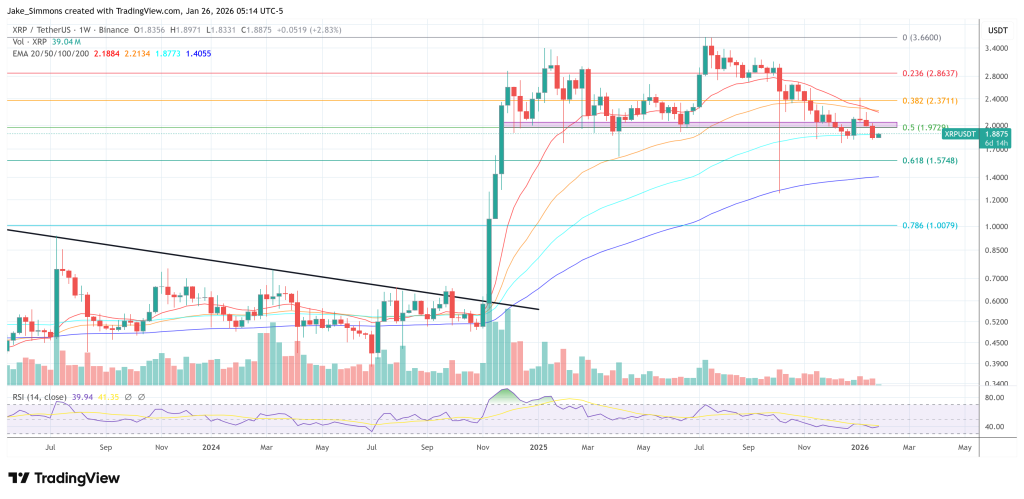
At press time, XRP traded at $1.88.

XRP price chart

Major Reasons Why The XRP Price Could Recover And Surge Again

Crypto analyst Darkfost has highlighted reasons why the XRP price could soon witness a bullish reversal and potentially reach new local highs. This comes amid bearish sentiment in the market, which on-chain analytics platform Santiment said could set the stage for a reversal in the altcoin’s price.  

Why The XRP Price Could Soon See A Bullish Reversal 

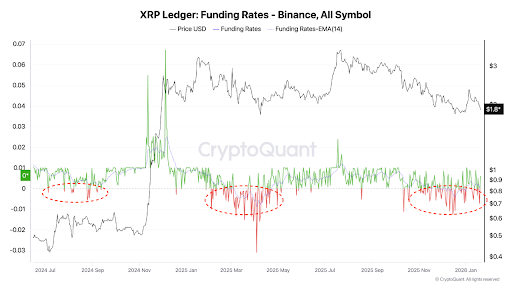
In a CryptoQuant blog post, Darkfost stated that negative funding rates signal a potential XRP price reversal. The analyst noted that the altcoin is currently trading around 47% below its all-time high (ATH) set in July last year. Furthermore, the altcoin is said to have naturally entered a phase of distribution and correction after a gain of over 600% since November 2024. 

Darkfost assured that this type of movement is healthy after such a strong rally for the price. He further remarked that what stands out is the timing of the bearish consensus, as it did not form at the top but rather during a drawdown of more than 50%. Now, there are predominantly short positions on XRP, with funding rates on Binance mostly negative since December, indicating that leveraged short positions have the upper hand. 

XRP

The analyst noted that historically, the market tends to move against a late consensus. As such, while the accumulation of shorts creates short-term selling pressure, it also builds latent buying pressure. Darkfost said that if the XRP price starts to rise, these short positions could be liquidated, fueling the upward move. 

He revealed that a similar pattern has occurred for the token price since 2024. The first was between August and September 2024, and the second was during the April 2025 correction, when funding rates turned negative for a period before a bullish rebound occurred. The analyst stated that this price rebound was due to a shift in investor sentiment and funding rates returning to positive territory. 

A Rally Starter For XRP

In an X post, Santiment stated that XRP traders are showing major FUD, which they claimed is usually a rally starter for the XRP price. The on-chain analytics platform revealed that the altcoin has fallen into ‘Extreme Fear’ territory, with small retail traders becoming pessimistic about the token after a 19% decline from its recent high on January 5th. 

Santiment noted that historically, this level of bearish commentary has led to price rallies. This is based on the belief that prices move in the opposite direction to retail’s expectations more often than not. The altcoin has dropped again following the recent decline in the broader crypto market, led by Bitcoin. BTC fell below $87,000 yesterday on the back of U.S. political tensions, government shutdown risk, and ahead of this week’s FOMC meeting. 

At the time of writing, the XRP price is trading at around $1.88, down in the last 24 hours, according to data from CoinMarketCap.

XRP

Strategy ($MSTR) Sells $257 Million in Stock to Buy 2,932 Bitcoin

Bitcoin Magazine

Strategy ($MSTR) Sells $257 Million in Stock to Buy 2,932 Bitcoin

Bitcoin proxy Strategy announced Monday that it acquired an additional 2,932 bitcoin for approximately $264 million between Jan. 20 and Jan. 25, according to a filing with the U.S. Securities and Exchange Commission. 

The purchases were executed at an average price of $90,061 per coin, lifting the company’s total bitcoin holdings to 712,647 BTC.

At current market prices, Strategy’s bitcoin treasury is valued at roughly $62.5 billion, reinforcing its position as the world’s largest publicly traded corporate holder of the asset. 

The company’s aggregate purchase price for its holdings stands at approximately $54.2 billion, including fees and expenses, translating to an average acquisition price of $76,037 per bitcoin.

The latest purchases were funded through proceeds generated under Strategy’s at-the-market (ATM) offering program. According to the filing, the firm sold 1,569,770 shares of its Class A common stock, MSTR, for approximately $257 million in net proceeds during the five-day period. 

It also sold 70,201 shares of its perpetual preferred stock, STRC, raising an additional $7 million, bringing total ATM proceeds to roughly $264 million.

As of Jan. 25, Strategy said it still has substantial capacity remaining across its ATM programs, including approximately $8.17 billion available for future issuance under its common stock offering. The company also maintains multiple preferred stock programs, including STRK, STRF, STRC and STRD, which collectively represent tens of billions of dollars in potential future capital raises.

With more than 712,000 BTC now on its balance sheet, Strategy controls roughly 3.4% of bitcoin’s fixed 21 million supply. 

At current prices, the company is sitting on an estimated $8.3 billion in unrealized gains.

Strategy’s MSCI inclusion 

Earlier this month, Strategy was relieved of some selling pressure when MSCI concluded its review of digital asset treasury companies and decided not to exclude them from its major global equity indexes.

The index provider said bitcoin-heavy firms will remain eligible under existing rules while it conducts further research on how to distinguish operating companies from investment-like entities.

The decision eased months of market anxiety after MSCI had proposed reclassifying companies with more than 50% of assets in digital assets as fund-like and therefore ineligible for inclusion.

Companies like Strategy, along with industry groups, pushed back strongly, warning that exclusions could trigger billions of dollars in forced passive selling.

At the time of writing, Bitcoin is trading near $89,000. 

strategy

This post Strategy ($MSTR) Sells $257 Million in Stock to Buy 2,932 Bitcoin first appeared on Bitcoin Magazine and is written by Micah Zimmerman.

❌