Reading view

There are new articles available, click to refresh the page.

Tether Posts Largest Crypto Revenue in 2025: $5.2B From Stablecoin Dominance

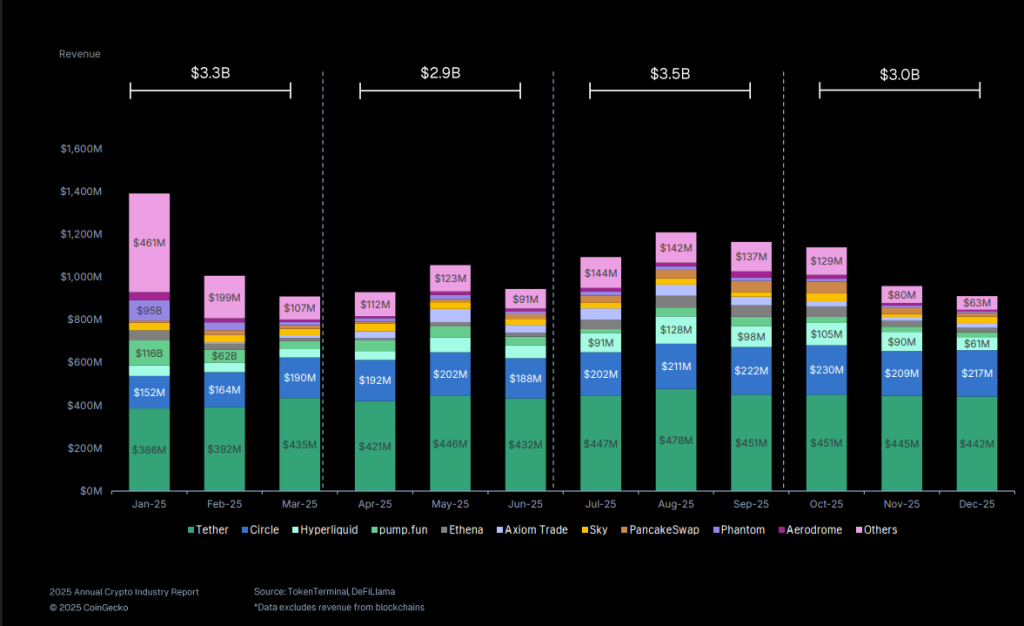
Tether emerged as the most profitable crypto entity in 2025, generating an estimated $5.2 billion in revenue as stablecoins overtook all other protocol categories in earnings.

According to the latest Coingecko annual crypto industry report, Tether alone accounted for 41.9% of all stablecoin-related revenue in 2025, outpacing competitors such as Circle, Hyperliquid, Pump.fun, Ethena, Axiom, Phantom, and PancakeSwap.

The results show that dollar-backed digital currencies have become the most durable revenue engine in crypto, even as market conditions fluctuated throughout the year.

Tether Leads Stablecoin Issuers To Capture Crypto Revenue Crown

Among more than 168 crypto protocols tracked in 2025, stablecoin issuers collectively generated the highest revenue, with Tether firmly at the center.

INSIGHT: Stablecoins generated $5.2B in revenue in 2025, accounting for 41.9% of total protocol revenue. pic.twitter.com/fjJrAn9k7B

— CoinGecko (@coingecko) January 25, 2026

Its $5.2 billion haul placed it well ahead of Circle and other major players, reinforcing USDT’s position as the industry’s primary settlement asset.

Within the top ten revenue-generating protocols, just four entities, led by Tether and Circle, produced 65.7% of total earnings, equivalent to roughly $8.3 billion.
Tether Crypto Revenue 2025 - CoinGecko Chart
Source: Coingecko

The remaining six protocols in the top ten were all trading-focused platforms, highlighting a sharp divide between stable revenue streams and market-dependent income.

That contrast became clear as trading revenues swung widely with investor sentiment during the year.

Phantom, for example, recorded $95.2 million in revenue in January at the height of the Solana meme coin frenzy, only to see earnings fall to $8.6 million by December as speculative activity cooled.

USDT Claims 60% Share Of $311B Stablecoin Market

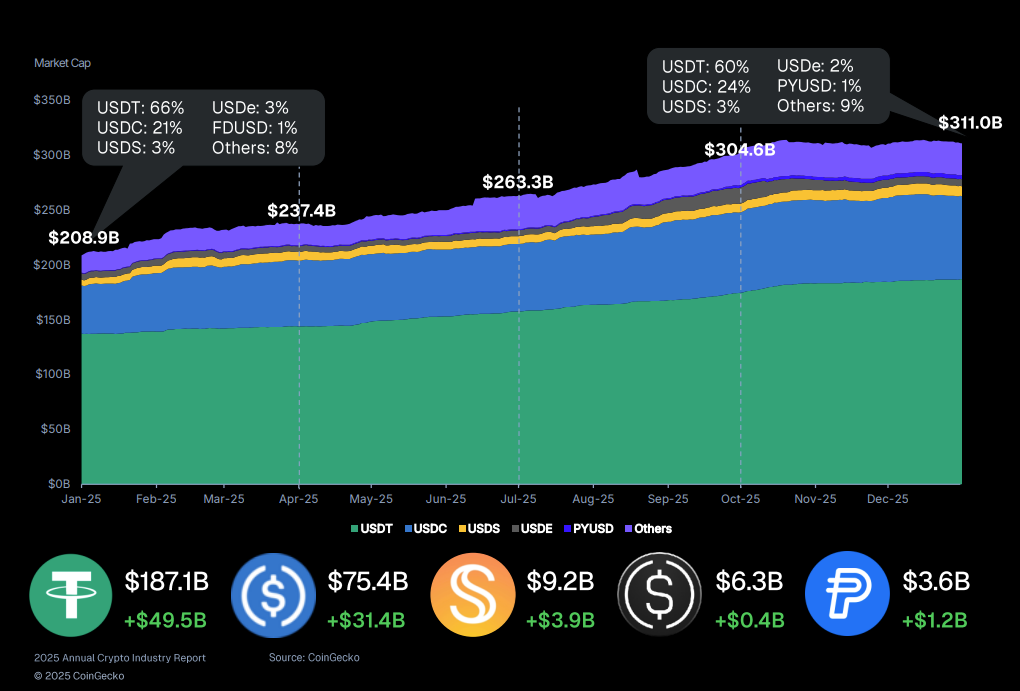
The broader stablecoin market expanded rapidly, with total market capitalization rising by $6.3 billion in the fourth quarter alone to reach a record $311.0 billion.

That marked a 48.9% year-over-year increase, adding $102.1 billion as adoption accelerated across regions.

Tether maintained clear leadership with 60.1% of the total stablecoin market cap, or about $187.0 billion, followed by Circle’s USDC at 24.2%, equivalent to $72.4 billion.
Tether Crypto Revenue 2025 - CoinGecko Chart
Source: Coingecko

Tether is now the world’s third-largest digital asset by market value at $186.8 billion, up roughly 50% from a year earlier.

While the top players strengthened their grip, shifts within the top five reflected changing risk appetites.

Ethena’s USDe experienced the sharpest reversal, with its market cap plunging 57.3%, or $6.5 billion, after a mid-October depeg on Binance undermined confidence in high-yield looping strategies.

Other stablecoins posted mixed but notable moves as capital rotated within the sector.

PayPal’s PYUSD surged 48.4%, adding $1.2 billion to reach $3.6 billion and briefly claiming the fifth spot before World Liberty Financial’s USD1 reclaimed it by nearly $1.

Additional high-growth tokens included Ripple’s RLUSD, which expanded 61.8% to add $488.2 million, and USDD, which climbed 76.9% with a $366.8 million increase.

Inside Tether’s $500B Valuation Path and Expanding Investment Empire

Looking ahead, Bitwise CIO Matt Hougan recently suggested that Tether could become the world’s most profitable company if its trajectory continues.

“There’s a chance that many emerging market countries will convert from primarily using their own currencies to using USDT,” Hougan said, pointing to Tether’s near-total dominance outside Western markets.

Based on projected interest income, calculations indicate that custody of $3 trillion in assets could generate annual revenue exceeding the $120 billion earned by Saudi Aramco last year.
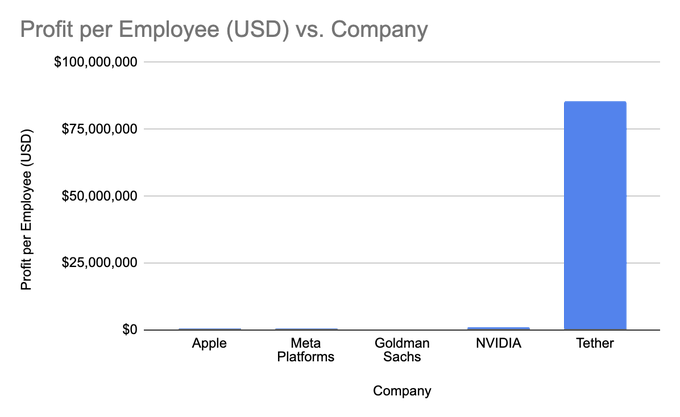
Source: Electric Capital

Tether CEO Paolo Ardoino previously told Cryptonews he remains confident USDT will retain its lead due to the company’s deep understanding of real-world usage.

Beyond stablecoins, Tether has expanded aggressively into traditional assets and investments.

⚽ @Tether_to has launched an all-cash bid to acquire Italy’s @juventusfcen, an offer that was reportedly swiftly turned down.#Tether #Cryptohttps://t.co/4iTBXWjo5V

— Cryptonews.com (@cryptonews) December 13, 2025

The company recently became the second-largest shareholder in Italian football club Juventus and has reportedly explored raising $20 billion for a 3% stake, a deal that would imply a valuation near $500 billion and place Tether among the world’s most valuable firms.

The post Tether Posts Largest Crypto Revenue in 2025: $5.2B From Stablecoin Dominance appeared first on Cryptonews.

Ethereum Builds Team To Guard Against Quantum Threat

Reports say the Ethereum Foundation has started a new team to prepare the network for possible quantum computer attacks. These machines could one day break the math behind wallets and signatures. The team’s work is moving from research into practical tests and experiments, which has drawn attention across the crypto community.

Ethereum Launches Post-Quantum Team

Based on reports, Thomas Coratger will lead the effort. The team includes cryptographers and engineers already testing new systems on devnets. Some work ties into a project called leanVM and a researcher named Emile, who focuses on building simple quantum-safe tools. The goal is to test new algorithms in real software while keeping current transactions running smoothly.

Today marks an inflection in the Ethereum Foundation’s long-term quantum strategy.

We’ve formed a new Post Quantum (PQ) team, led by the brilliant Thomas Coratger (@tcoratger). Joining him is Emile, one of the world-class talents behind leanVM. leanVM is the cryptographic…

— Justin Drake (@drakefjustin) January 23, 2026

$2 Million In Prizes Encourage Development

A $1 million prize has been set for improvements to the Poseidon hash function. Another $1 million prize supports broader post-quantum research. In total, roughly $2 million are being offered to labs and independent developers to design and test quantum-resistant solutions. Reports say this funding is meant to speed up work and show what can realistically replace current signatures.

Early Tests And Community Involvement

Multi-client devnets are already active. Developers are experimenting with new signature types to see what works and what fails. Biweekly sessions led by researchers like Antonio Sanso let teams share results and update code. A Post-Quantum Day is scheduled for March 2026 before ETHCC, with a larger event planned in October 2026 to show progress and plan next steps.

Quantum computers could, in theory, break the ECDSA and secp256k1 schemes used today. That risk is not immediate but serious enough that Ethereum is acting now. Reports note users should watch for official guidance, follow wallet updates, and avoid reusing addresses once upgrades roll out.

Community reaction has been mixed. Some online discussions praised the careful planning, while traders noticed a small dip in ETH price. Others questioned how upgrades would reach millions of wallets and what happens to old keys. The Foundation’s approach is to test solutions early so users and services are better protected when changes happen.

This step is part of Ethereum’s long-term plan for safety. Tests will continue, standards will be debated, and progress will be shared publicly. By acting now, Ethereum aims to reduce risk and make future transitions smoother for everyday users and the network as a whole.

Featured image from Unsplash, chart from TradingView

Bitcoin Whale Demand Hits Extreme Levels As Next Rally Loads Up

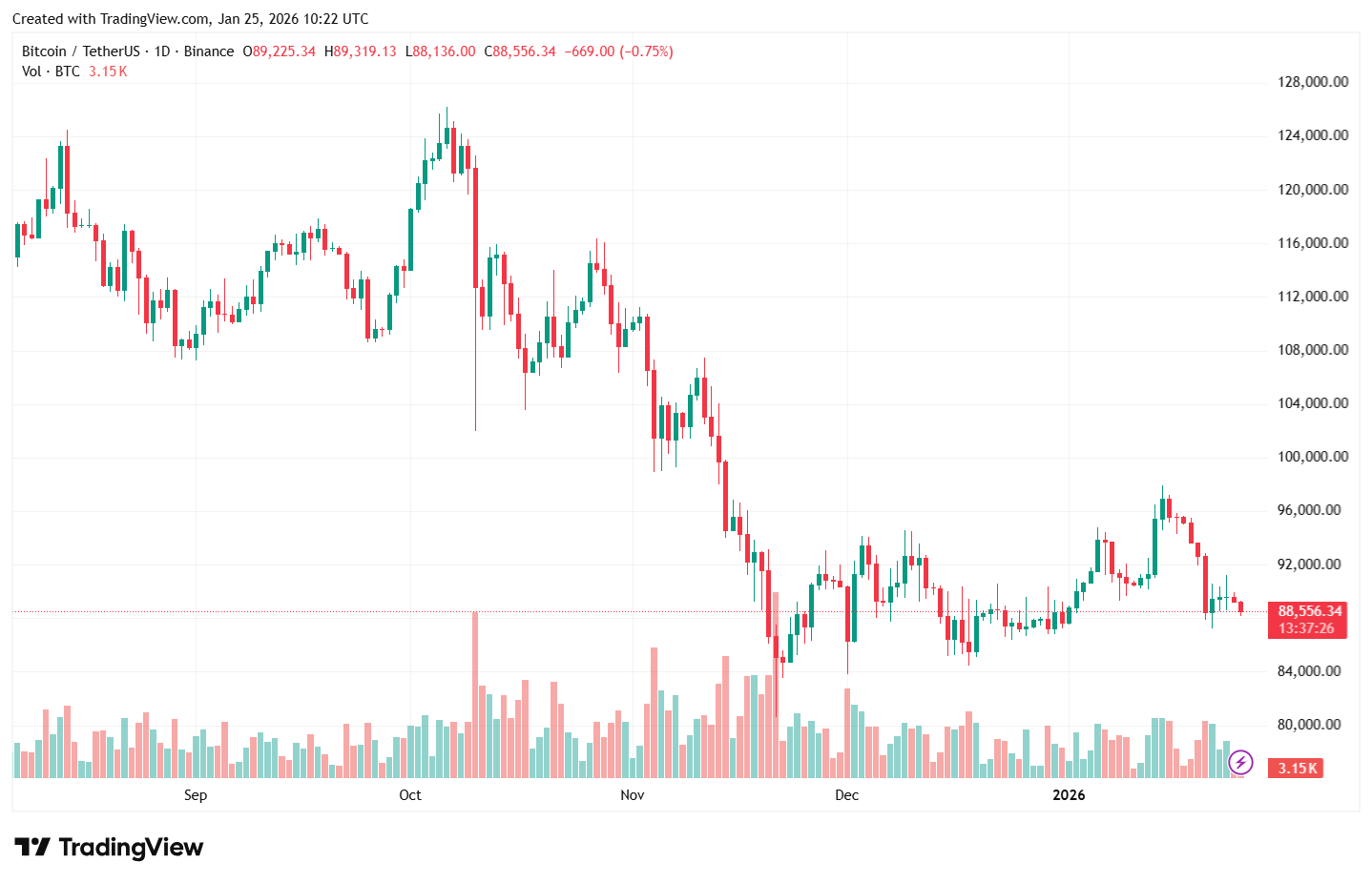
The Bitcoin price action has been muted over the past few days, trading within the $90,000 and $88,000 levels. Classically, consolidation periods often precede major moves either to the upside or downside of the market.

As such, questions on the next trajectory of the flagship cryptocurrency are being asked. A latest on-chain evaluation has offered a positive prognosis on the next direction for the Bitcoin price. 

Accumulation Demand Metric Surges To All-Time-High 

In a Quicktake post on CryptoQuant, on-chain analyst CoinNiel hypothesized that the Bitcoin price could be at the beginning of a bullish trend. The market quant based this prognosis on two metrics — the Accumulator Address Demand and the Liquidity Inventory Ratio (month). 

The Accumulator Address Demand metric monitors the net buying pressure coming from addresses that buy Bitcoin consistently, and without any significant selling. This behavior (of buying and rarely selling) is typical of the large-scale Bitcoin holders, commonly known as the whales. 

Notably, CoinNiel also pointed out that when major withdrawals from exchanges occur, they are rarely ever incited by retailers, but by whales. As such, when the Bitcoin whales withdraw their holdings from exchanges, their buying pressure translates into an increase in the Accumulator Address Demand. 

Bitcoin

From the chart above, the indicator has reached an all-time high level. According to the crypto pundit, this could be a sign that the whales are currently experiencing, on intense levels, the “fear of missing out.”

The second metric, the Liquidity Inventory Ratio (Month), also reinforces CoinNiel’s bullish outlook. This metric tracks and compares existing Bitcoin demand to the supply available on exchanges, showing whether demand can overwhelm available supply

When this ratio rises sharply, it is usually a sign that demand is absorbing newly created supply. From the data shared by the analyst, the Liquidity Inventory Ratio has also reached an extreme value of 3.8.

However, this extreme reading is only a reflection of what is happening on US exchanges. Hence, CoinNiel implied that, for the first time in years, US exchanges are recording exceptionally high demand relative to the coins available.

In theory, a 3.8 reading implies the imminence of a supply shock in the scenario where current conditions prevail. But, the analyst highlighted that it may not necessarily happen, as a 3.8 reading is more a sign of intensified whale demand than a surefire means to predict supply shocks. 

The big picture, especially when these two metrics are looked at together, appears to be distinctly bullish. This is because available data points out that the whales are likely positioning for what could be a resumed bullish trajectory for the Bitcoin price.

Bitcoin Price At A Glance

As of this writing, Bitcoin is valued at $88,520, reflecting an over 1% decline in the past 24 hours.

Bitcoin

Hackers Impersonate X Staff Using Compromised Scroll Founder Account

Scroll co-founder Ye Chen’s X account was hijacked in a sophisticated phishing operation where attackers posed as platform employees to target crypto industry figures.

The compromised account, which commands substantial influence among crypto leaders, began distributing fraudulent messages claiming copyright violations and threatening account restrictions unless users clicked on malicious links within 48 hours.

The hackers transformed Chen’s profile to mimic X’s official branding, updating the bio to reference Twitter and nCino while warning followers about security breaches.

Scroll Founder Account Hack - Changed Profile Info
Screenshot from X

The attackers flooded the feed with reposts from X’s verified accounts to enhance perceived legitimacy, then launched their phishing campaign via direct messages.

Sophisticated Attack Mirrors Growing Pattern

The breach follows established tactics where hackers exploit trusted accounts to distribute malicious links disguised as urgent platform notifications.

Recipients received messages appearing to come from X’s rights management team, complete with fake compliance warnings and time-sensitive appeals processes designed to create panic and bypass security awareness.

Blockchain security researcher Wu Blockchain first identified the compromise and alerted the community to ignore any communications from the account.

The warning emphasized particular concern given Chen’s extensive network of high-profile cryptocurrency executives, developers, and investors who might trust messages from his verified account.

Scroll co-founder @shenhaichen's X account has been hacked and is currently sending phishing private messages impersonating X employees. This account has a large following among prominent figures in the crypto industry; the community and users are advised to be aware of the… pic.twitter.com/ctXk2G0bQm

— Wu Blockchain (@WuBlockchain) January 25, 2026

The attack represents the latest escalation in social media compromises targeting crypto industry leaders, in which hackers increasingly leverage delegated account access and expired domain registrations to bypass security measures, including two-factor authentication.

Industry Faces Relentless Social Engineering Wave

BNB Chain’s official account suffered a similar breach in October when hackers posted fake reward programs with phishing links after Binance co-founder CZ warned followers against clicking suspicious content.

The compromised account promoted fraudulent BSC token distributions, promising early payouts to users who voted on reward dates through malicious URLs designed to drain digital wallets.

Binance co-CEO Yi He’s WeChat account was also hijacked in December to promote meme coin schemes, with attackers conducting a coordinated pump-and-dump operation around the token MUBARA.

Two wallets created hours before the breach accumulated 21.16 million tokens before dumping holdings as retail traders flooded in, netting attackers approximately $55,000 while leaving later buyers exposed to price collapse.

🚨Changpeng Zhao @cz_binance warned that new co-CEO Yi He’s @heyibinance abandoned WeChat account was hacked and used to push a meme coin called MUBARA.#Binance #Memecoins https://t.co/sdyH325OMD

— Cryptonews.com (@cryptonews) December 10, 2025

Among other notable accounts hacked were ZKsync and Matter Labs, which were compromised in May through what the team described as “delegated accounts” with limited posting privileges.

Hackers published false claims about an SEC investigation alongside fake airdrop promotions, triggering a 5% drop in the ZK token price despite a prior 38.5% weekly rally.

The prominent crypto media company, Watcher.Guru also confirmed its account breach in March after fake Ripple-SWIFT partnership claims spread across connected Telegram, Facebook, and Discord channels through automated content bots.

The team suspects the compromise originated from a suspicious link containing unusual query strings shared in their Telegram group weeks earlier.

Record Theft Year Exposes Escalating Threats

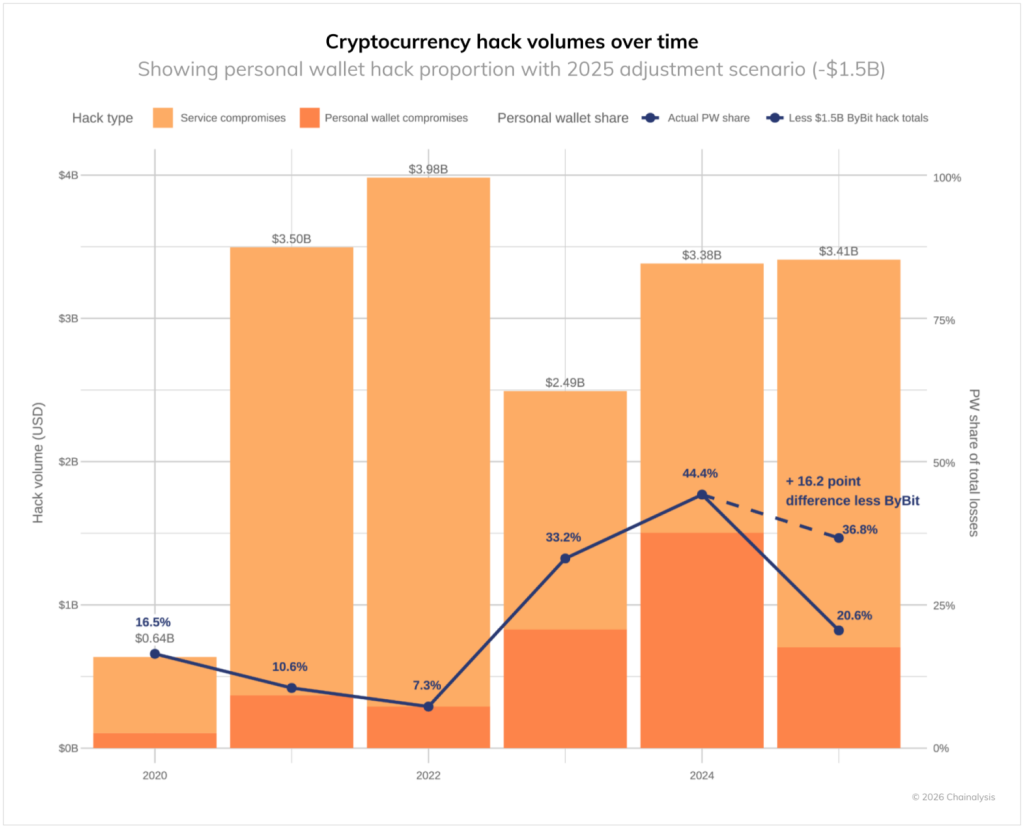
The crypto ecosystem witnessed over $3.4 billion stolen in 2025, according to Chainalysis’s 2026 Crypto Crime Report, with North Korean state-backed hackers accounting for a record $2.02 billion across fewer but increasingly sophisticated attacks.

Scroll Founder Account Hack - Chainalysis Chart
Source: Chainalysis

The Democratic People’s Republic of Korea now represents 76% of all service compromises, bringing cumulative DPRK cryptocurrency theft to $6.75 billion since operations began.

Personal wallet compromises surged to 158,000 incidents affecting at least 80,000 unique victims, triple the 54,000 cases recorded in 2022.

Address poisoning scams drove December’s single-largest loss, when one victim transferred $50 million to a fraudulent wallet mimicking their intended destination, while private key leaks resulted in $27.3 million stolen from multi-signature wallets.

Personal Security Breaches Surge Across Platforms

Most recently, Ubuntu developer Alan Pope warned that attackers are hijacking Snap Store publisher accounts by registering expired domains linked to legitimate developers, then pushing malicious updates to previously trusted packages.

The technique exploits automatic update systems and established trust signals, with at least 2 confirmed cases of wallet-stealing malware distributed through seemingly normal applications.

⚠ Hackers are exploiting trusted Snap Store packages to steal cryptocurrency by hijacking existing publisher accounts.#Hack #Cryptohttps://t.co/YV5Yoiwb0F

— Cryptonews.com (@cryptonews) January 21, 2026

Given these growing, multifaceted attack vectors, Better Business Bureau officials are warning consumers about phishing campaigns that lock X users out of their accounts and are subsequently used for cryptocurrency promotions.

Kentucky journalist Jennie Rees described receiving direct messages from apparent colleagues requesting contest votes, only to find her account posting fake Audi purchase claims tied to crypto earnings after clicking the malicious link.

The post Hackers Impersonate X Staff Using Compromised Scroll Founder Account appeared first on Cryptonews.

Coinbase CEO Shares 6 Takeaways From WEF Davos 2026 – Details

While Binance co-founder and former CEO Changpeng “CZ” Zhao made the headlines following his interview at the just-concluded World Economic Forum, where he called a Bitcoin supercycle in 2026, his crypto counterpart and Coinbase CEO, Brian Armstrong, has come forward with feedback from the global event held in Davos, Switzerland.

Coinbase CEO Praises Trump-Led White House As Most Crypto-Forward Government 

In a January 24 post on the social media platform X, Armstrong shared a few key “themes and takeaways” from the latest edition of WEF. After admitting that the conference offered a productive time of meeting people one-on-one, the Coinbase CEO revealed that the major focus was on pushing crypto adoption globally.

Starting his list of takeaways, Armstrong highlighted that everyone was talking about tokenization, which is beginning to expand to every asset class in the world. The crypto leader said to expect some major progress in the tokenization sector in 2026, especially as the Fortune 500 business leaders continuously lean in.

Secondly, the Coinbase CEO shared that crypto legislation and the CLARITY Act were another area of focus, as the government of the day looks to make the United States the crypto capital of the world. According to Armstrong, most of the bank CEOs he met at the WEF in the past week are actually pro-crypto.

Armstrong wrote on X:

One CEO of a top 10 global bank told me crypto is their number one priority, and they view it as existential.

Furthermore, the Coinbase CEO lauded the Trump administration as the most crypto-forward government in the world at the moment. Armstrong acknowledged their progress with the crypto market structure, stating that these clear rules are crucial for global competitiveness and will put money back in people’s pockets.

In what seemed like a cheeky tone, Armstrong mentioned that ESG (Environmental, Social, and Governance) and DEI (Diversity, Equity, and Inclusion) topics didn’t come up throughout the forum. According to the crypto founder, the week felt productive, as it centered around real, global progress — all thanks to BlackRock CEO and new WEF co-chair Larry Fink.

The Coinbase leader touted crypto and AI (artificial intelligence) as the most talked-about technologies in today’s world. Highlighting their compatibility, Armstrong stated that AI agents will eventually default to using stablecoins for payments, as they cannot be KYC’d like human beings.

Finally, Armstrong revealed that the Coinbase, Circle, and Bermuda partnership to build a fully on-chain economy was announced at WEF Davos 2026. “Excited to make progress on this and create a compelling case study for other nations to follow,” the crypto CEO concluded.

Total Crypto Market Cap At $3.09 Trillion

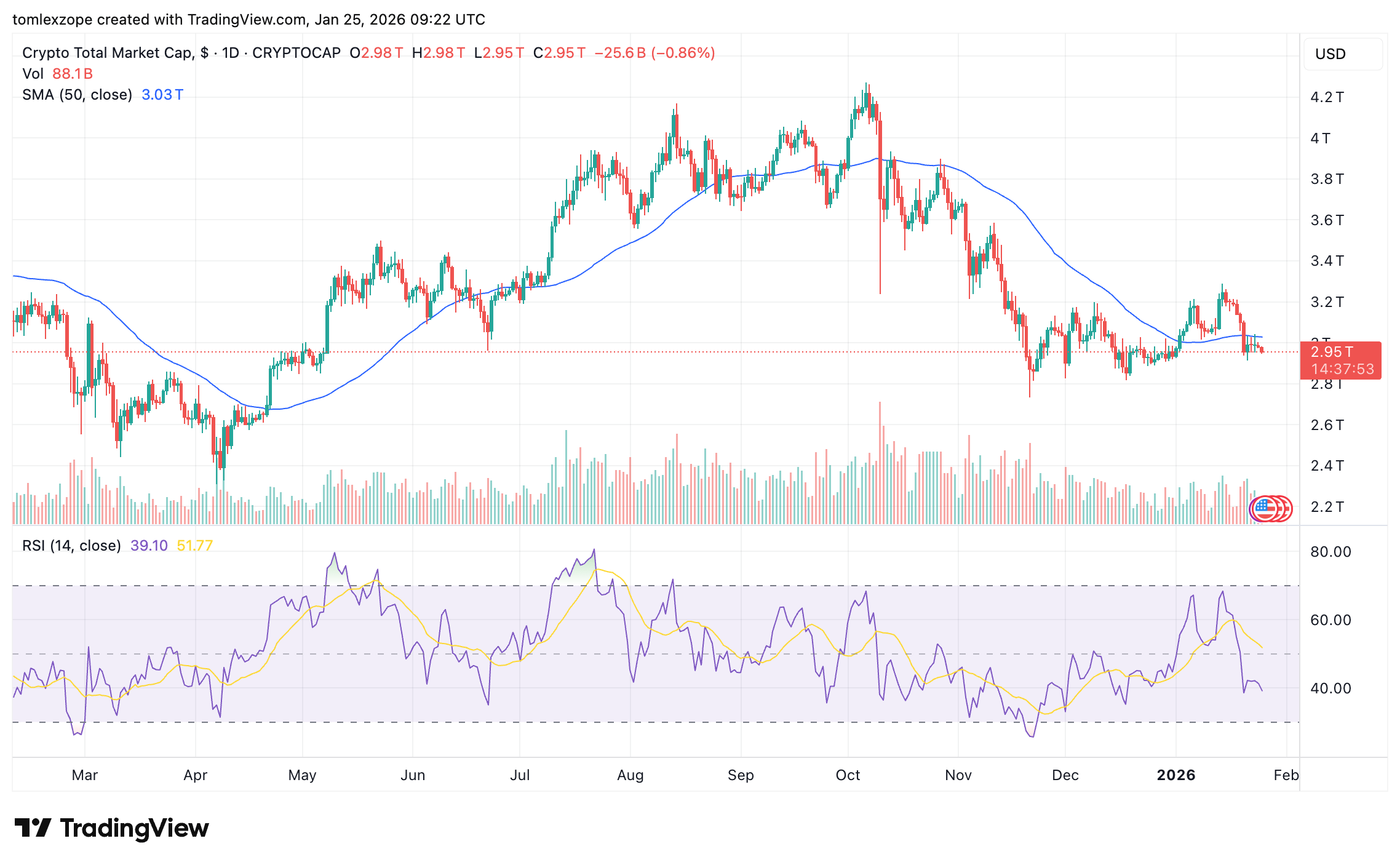
As of this writing, the global cryptocurrency market has a total capitalization of $3.086 trillion, with Bitcoin retaining its spot as the world’s largest cryptocurrency.

Coinbase

From Boom To Goodbye: NFT Marketplace Nifty Gateway To End Operations

Nifty Gateway, the marketplace that once helped bring NFT drops to a wider audience, will stop running its marketplace on February 23, 2026. The company put the site into a withdrawal-only mode the same day it made the announcement, and users were told they must move any remaining funds and NFTs off the platform before that date.

Withdrawal Window Opens

According to the company, withdrawal tools are available now. Reports note users can pull USD or ETH balances through a linked Gemini Exchange account or send funds to their bank via Stripe.

Emails with step-by-step instructions will be sent to account holders, and a shutdown notice already appears on the Nifty Gateway homepage. The aim, as described by the owner, is to let people retrieve what they own before the platform goes dark.

Today, we are announcing that the Nifty Gateway platform will be closing on February 23, 2026. Starting today, Nifty Gateway is in withdrawal-only mode.

Nifty Gateway was launched in 2020 with the vision of revolutionizing digital art. Since launching, Nifty supported dozens of…

— Nifty Gateway Studio (@niftygateway) January 24, 2026

A Decision To Reassign Resources

Based on reports from Gemini, the closure is meant to let the parent firm concentrate on building one bigger app for customers. The move highlights how interest and trading activity in many NFT markets have cooled from the highs seen in earlier years.

Some collectors and artists are left scrambling to rehome items they once sold or stored on Nifty Gateway.

End Of An Early Player

Nifty Gateway helped make buying NFTs easier for people who preferred credit cards and familiar checkout flows. It launched as a high-profile marketplace and hosted major drops from well-known creators.

The platform supported hundreds of millions in sales at its peak and played a clear part in bringing NFT art into mainstream headlines. Its exit marks the end of an important chapter for that wave of marketplaces.

What Owners Must Do Now

Owners should check their inboxes for the official instructions, confirm where their tokens are stored, and move assets before the deadline. If NFTs are stored in custodial wallets on the site, they will need to be transferred out.

USD and ETH balances should be withdrawn or moved into a connected Gemini account if that option suits the owner. Waiting past the closure date will reduce options.

A Quiet Turning Point

For many collectors, this will feel like another sign that the early boom years have passed. For creators, the change raises questions about where drops and secondary sales will happen next.

Gemini says it will keep supporting NFTs through its other products, including the Gemini Wallet, but the specific ways that creators and buyers reconnect with those audiences will depend on new tools and services that arrive in the next months.

Featured image from Unsplash, chart from TradingView

XRP Price Prediction: $1.88 Triple-Bottom Support as ETF Money Pulls Back – What’s Next?

XRP is trading near $1.89–$1.91 as January draws to a close, holding a well-defined triple-bottom support around $1.88 after slipping below the $2.00 mark earlier this week. The pullback has coincided with ETF outflows and a sharp drop in trading volume, but price action suggests stabilization rather than renewed selling pressure.

With volatility compressing and buyers repeatedly defending the same demand zone, XRP is approaching a technical decision point that could define its next directional move.

ETF Outflows Ease Short-Term Momentum Without Breaking the Thesis

Short-term pressure has been driven largely by institutional flows. According to data reported by CryptoQuant, U.S. spot XRP ETFs recorded their first weekly net outflows, totaling approximately $40.6 million toward the end of January. Trading volume has also declined sharply, with some estimates showing a 50%+ drop in 24-hour activity, signaling trader hesitation rather than aggressive selling.

That said, the flow data points to rotation and profit-taking, not abandonment. XRP remains one of the few large-cap tokens with clear regulatory positioning in the US, and earlier ETF inflows north of $1 billion underscore that institutional interest hasn’t disappeared. The current reset appears more about leverage clearing than confidence breaking.

Core Adoption Trends Remain Unchanged Despite Price Weakness

Fundamentally, Ripple’s long-term thesis remains unchanged. XRP continues to underpin on-demand liquidity (ODL) across Ripple’s global payments network, offering faster and cheaper settlement compared to legacy systems.

More than 300 financial institutions remain connected to RippleNet, and ongoing regulatory clarity following 2025 rulings continues to distinguish XRP from many peers.

While no major partnership headlines have emerged this week, the absence of negative ecosystem news reinforces the view that the current weakness is market-driven, not fundamental.

XRP Price Prediction: Volatility Shrinks at $1.90 – Breakout or Breakdown Ahead?

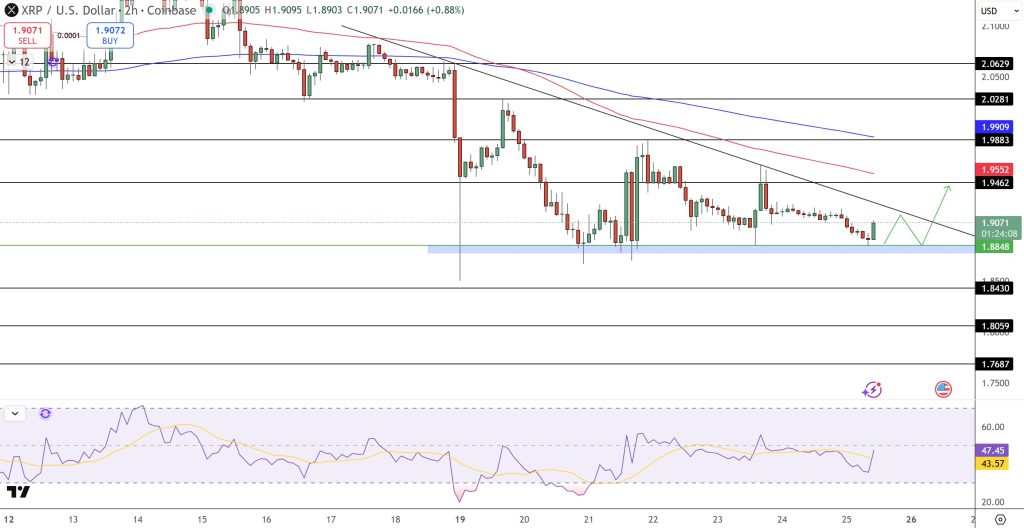
From a technical perspective, XRP price prediction remains cautiously neutral near term. On the 2-hour chart, price is stabilizing inside a descending channel, capped by a falling trendline near $1.95. XRP is trading below the 50-EMA and 100-EMA, while the 200-EMA near $1.99 continues to act as firm resistance.

XRP Price Chart – Source: Tradingview

Support is clearly defined between $1.88 and $1.85, where repeated long lower wicks suggest responsive buying. RSI has recovered into the mid-40s after oversold readings, indicating easing downside pressure. Volatility has contracted, forming a descending wedge, a structure that often resolves higher if support holds.

A successful break above $1.95 would expose $2.03–$2.06, signaling structural repair. Conversely, a decisive loss of $1.85 would open downside toward $1.80 and $1.77.

XRP Trade setup: Accumulate near $1.88–$1.85, target $2.03–$2.06, invalidation below $1.80.

Bitcoin Hyper: The Next Evolution of BTC on Solana?

Bitcoin Hyper ($HYPER) is bringing a new phase to the BTC ecosystem. While BTC remains the gold standard for security, Bitcoin Hyper adds what it always lacked: Solana-level speed. The result: lightning-fast, low-cost smart contracts, decentralized apps, and even meme coin creation, all secured by Bitcoin.

Audited by Consult, the project emphasizes trust and scalability as adoption builds. And momentum is already strong. The presale has surpassed $30.9 million, with tokens priced at just $0.013635 before the next increase.

As Bitcoin activity climbs and demand for efficient BTC-based apps rises, Bitcoin Hyper stands out as the bridge uniting two of crypto’s biggest ecosystems. If Bitcoin built the foundation, Bitcoin Hyper could make it fast, flexible, and fun again.

Click Here to Participate in the Presale

The post XRP Price Prediction: $1.88 Triple-Bottom Support as ETF Money Pulls Back – What’s Next? appeared first on Cryptonews.

Stablecoin Trading Surges 62% in Korea as Dollar Strengthens Against Won

South Korean crypto exchanges recorded a 62% surge in stablecoin trading volumes as the won fell to multi-year lows against the dollar, prompting platforms to intensify marketing campaigns around dollar-pegged tokens.

According to The Korea Times, trading volume in Tether (USDT) across the nation’s five major won-based exchanges climbed to 378.2 billion won ($261 million) when the exchange rate exceeded 1,480 won per dollar last Wednesday, citing CryptoQuant data.

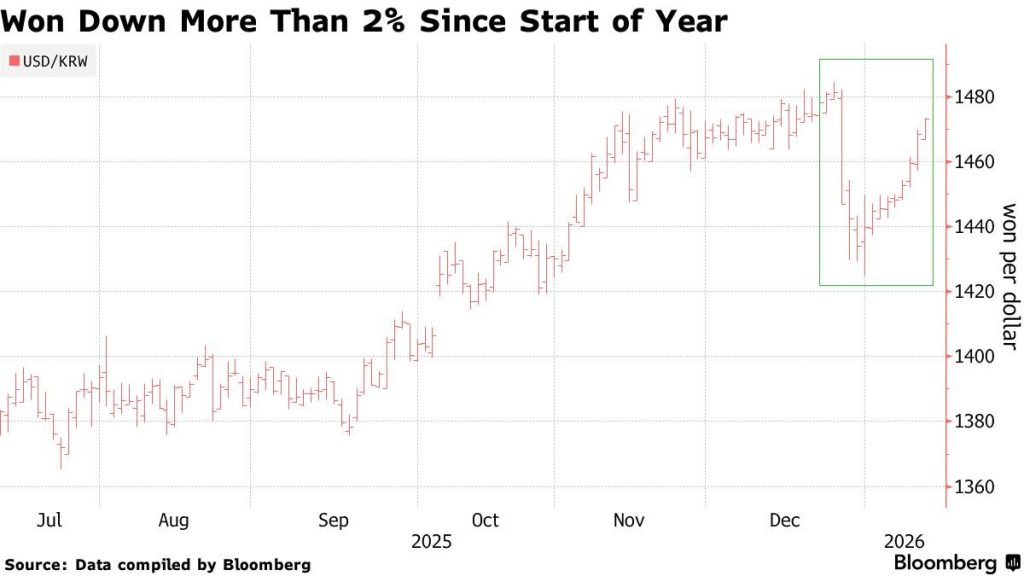
The spike follows mounting currency pressures that pushed the won through nine consecutive days of declines against the dollar, marking its longest losing streak since 2008, Bloomberg reported.

Stablecoin Korea Dollar WON/USD Chart Bloomberg
Source: Bloomberg

Major exchanges, including Korbit, Coinone, Upbit, and Bithumb, launched aggressive promotional campaigns centered on stablecoins, including USDC and USDe, waiving trading fees and distributing rewards to boost volumes during what industry officials described as a downturn in broader crypto markets.

Banks Slash Dollar Rates as Government Defends Currency

According to The Chosun Daily, South Korea’s major commercial banks slashed dollar deposit interest rates to near zero in response to government pressure to defend the exchange rate.

Shinhan Bank cut its annual rate from 1.5% to 0.1% starting January 30, while Hana Bank reduced rates from 2% to 0.05% for its Travelog Foreign Currency Account.

The coordinated move followed the authorities’ summoning of bank executives and their request that they “refrain from excessive marketing that encourages foreign currency deposits such as dollars.

Banks responded by introducing incentives for won conversion, with Shinhan offering a 90% preferential rate for customers converting dollar deposits back to won, plus an additional 0.1 percentage point rate boost for those subscribing to won-term deposits afterward.

Dollar deposit balances at the five major banks fell 3.8% from month-end to 63.25 billion dollars as of January 22, marking the first decline after three consecutive months of surges.

Corporate deposits, which account for 80% of all dollar holdings, dropped sharply from 52.42 billion dollars at year-end to 49.83 billion dollars, suggesting that the authorities’ recommendation to sell dollars spot, combined with perceptions that the exchange rate had peaked, was driving the decline.

Individual dollar deposits grew at a significantly slower pace, rising just 109.64 million dollars, compared with the previous month’s 1.09 billion dollar surge.

Presidential Intervention Accelerates Won Stabilization

President Lee Jae-myung delivered a rare verbal intervention on the exchange rate during a January 21 press conference, stating authorities predicted the rate would drop to around 1,400 won within one to two months.

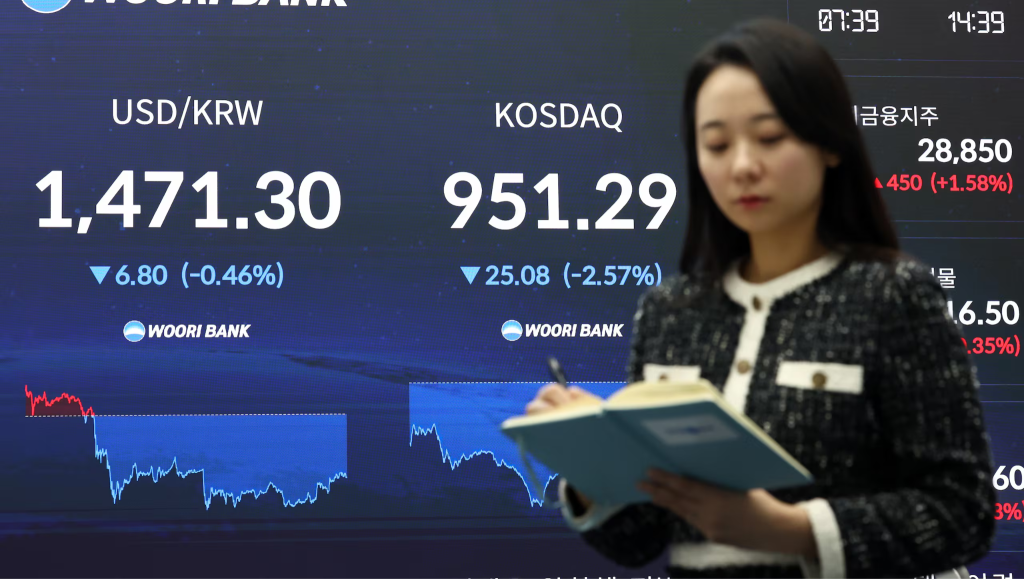
The won-dollar rate immediately fell from 1,481.4 won to 1,467.7 won following his remarks, closing at 1,471.3 won.

Stablecoin Korea Dollar
Source: TheChosunDaily

Market observers noted the unprecedented nature of a sitting president specifying both an exchange rate target and timeline, with Lee’s statement carrying significantly more weight than U.S. Treasury Secretary Scott Bessent’s earlier comment that the won’s recent decline was “inconsistent with Korea’s strong fundamentals.

Meanwhile, demand for dollar exchange slowed as average daily won-to-dollar conversions reached 16.54 million dollars from January 1-22, while dollar-to-won conversions surged to 5.2 million dollars daily, significantly exceeding last year’s 3.78 million dollar average and indicating increased profit-taking.

In fact, according to CNBC, South Korea’s fourth-quarter GDP growth slowed to 1.5% year over year, missing economists’ forecasts of 1.9%, as construction investment shrank 3.9% and exports pulled back 2.1% from the previous quarter.

The won has lost nearly 2% against the greenback this year, making it one of Asia’s worst-performing currencies, while South Korean retail investors bought approximately 2.4 billion dollars of U.S. equities on a net basis through mid-January, up roughly 60% from the same period last year.

The broader economic slowdown comes as Seoul advances major crypto policy reforms despite regulatory gridlock over stablecoin governance.

Earlier this month, South Korea ended its nine-year corporate crypto trading ban, permitting listed companies to invest up to 5% of equity capital in top-20 cryptocurrencies, while lawmakers passed amendments to the Capital Markets Act and Electronic Securities Act establishing legal frameworks for tokenized securities trading beginning January 2027.

🇰🇷South Korea has launched guidelines, allowing listed companies and professional investors to invest up to 5% of their equity capital crypto.#SouthKorea #CorporateCryptoInvestment #CryptoInvestmenthttps://t.co/d55u3TDsBF
— Cryptonews.com (@cryptonews) January 12, 2026

Korea Exchange Chairman Jeong Eun-bo pledged to launch spot Bitcoin ETFs and extend trading hours to 24/7 as part of efforts to eliminate the “Korea discount,” though comprehensive digital asset legislation remains stalled amid disputes between the Financial Services Commission and the Bank of Korea over stablecoin issuance rules.

The post Stablecoin Trading Surges 62% in Korea as Dollar Strengthens Against Won appeared first on Cryptonews.

Ethereum Open Interest Declines Across Exchanges, Binance Stands Out — Details

For most of the week, the Ethereum price has remained in a range-bound spell, putting in no significant movement outside of the $3,000 and $2,880 price boundaries. Amid rising speculations, an on-chain analysis has recently been put out, which provides an answer to the question.

Open Interest Across Exchanges Falls To $17 Billion

In their latest QuickTake post on CryptoQuant, analytics platform Arab Chain reveals that there has been a fall in active Ethereum derivatives contracts across major exchanges, as indicated by data from the Ethereum: Open Interest-All Exchanges, All Symbol metric. Typically, rising Open Interest (OI) across exchanges indicates that more traders are entering leveraged positions. On the other hand, falling OI reflects more exits of leveraged positions, and by extension, reduced aversion to risk.

In the Quicktake post, Arab Chain highlights that open interest across exchanges has dipped to about $16.9 billion, marking the lowest level reached since mid-December last year. This, in turn, reflects an overall reduction in risk appetite across the Ethereum derivatives market. Because there is less speculative activity, there are also reduced risks of liquidations. Hence, the Ethereum price stands a higher chance of consolidating.


Bitcoin

What’s Happening On Binance?

While exchanges in general are recording significant pull-outs from the derivatives market, Binance has shown an outlier performance. Arab Chain highlights that the world’s largest exchange by trading volume has instead recorded about $7.5 billion in Open Interest. Interestingly, this reading slightly exceeds the December average range of $6.8–$7.4 billion. 

The divergence between the Open Interest values across all exchanges and that of Binance suggests that, while market participants are reducing their risk exposure, there is still liquidity in the derivatives market. Rather than a blatant exit, it has been repositioned toward the deeper and more liquid venue.

Arab Chain also explains that this behavior indicates a change in market operations from a higher-risk trading environment to one more price and risk efficient. In conclusion, the large traders are yet to make their exits but are merely reducing their exposure, while holding high-quality positions on Binance.

In addition, Ethereum’s proximity to the $3,000 price — especially as OI declines — shows that the market has been absorbing the deleveraging events while showing little selling pressure. Ultimately, Binance’s OI retaining levels above December’s support the idea that the market still has strong derivatives backing. Hence, the broader picture remains bullish. As of this writing, Ethereum trades at $2,958, reflecting a 0.33% growth since the past day, according to CoinMarketCap data.

Ethereum

Featured image from Pexels, chart from Tradingview.com

Money Keeps Leaving: Bitcoin ETFs Shed $1.72 Billion In Just 5 Sessions

US-based spot Bitcoin exchange-traded funds pulled funds for a fifth straight trading day, and the totals added up quickly. According to Farside data, about $103.5 million left on Friday, bringing the five-day sum to roughly $1.72 billion.

Bitcoin was trading near $89,160 at the time of these reports — still well below the $100,000 mark it last reached on November 13. This movement has sent a clear signal: many investors are stepping back right now.

ETF Flows And Who Is Selling

Reports note that ETF flows are often on the radar as a quick read on investor mood, but the picture is not always simple. Large outflows can reflect institutional rebalancing or tactical moves by funds, not only mass retail selling.

The US market had a four-day trading week because of Martin Luther King Jr. Day on Monday, which may have concentrated trades into fewer sessions and amplified the numbers. Still, losing more than a billion dollars in a few days will get attention.

Market Mood And Metals

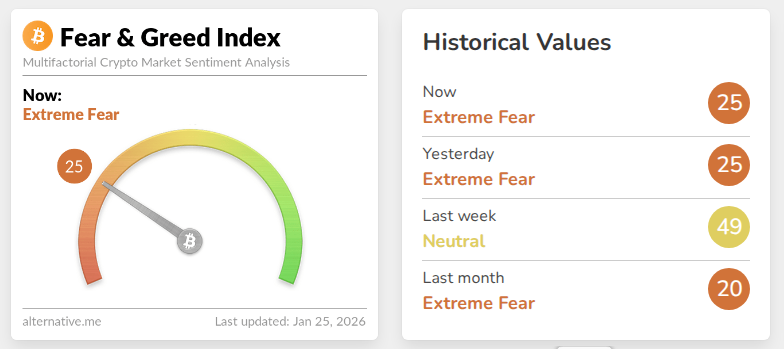
The wider mood has soured. The Crypto Fear & Greed Index registered an Extreme Fear score of 25, and sentiment trackers have been flashing caution. Reports say Santiment believes retail traders are pulling back while attention drifts toward more traditional assets.

Meanwhile, metals have been strong. Reports disclose that with gold trading near $5,000 and silver approaching $100, some market players feel Bitcoin has been left out of a rally that lifted metals, which has weighed on confidence in the crypto market.

Bitcoin Price Action

Bitcoin has struggled to find a steady rhythm over the past week. Prices slipped below the $89,000 to $90,000 range as traders reacted to fresh geopolitical tension and renewed trade worries, before stabilizing as nerves eased.

This was driven higher after some soft political indicators around tariff threats, only to substantiate the idea that markets rarely react to conflict but rather to changes in tone and expectations.

Signals That Could Matter

These movements illustrate how Bitcoin behaves more like a risk asset rather than an asset shelter, falling in tandem with equities when unexpected financial shocks hit the globe, before rebounding when the fever subsides to gather fresh buyers.

Current price patterns indicate caution, where traders are weighing short-term political risks against medium- and long-term macro patterns, as well as institutional interests.

There are some quieter indications that the rout could be losing steam. To this effect, there are assertions suggesting that supply distribution on-chain and social chatter can be circumstantial evidence showing there is less selling pressure.

Featured image from Money; Shutterstock, chart from TradingView

Bitcoin Bears Record Fall In Market Strength — Is A Trend Reversal On?

In the past three days, the price of Bitcoin has moved between $88,000 to $90,000, indicating a rather stable market with little volatility. This ongoing price consolidation comes after the leading cryptocurrency suffered a significant setback in its goal to reclaim its psychological six-figure valuation.

During the week, Bitcoin prices fell from around $96,000 to below $88,000, establishing a new yearly low for 2026. However, amid this discouraging price action, the underlying on-chain data suggests a developing exhaustion among market bears, thus hinting at a highly-anticipated trend reversal.

Market Optimism Despite Negative Reading

In a recent QuickTake post, popular analyst Burak Kesmeci shares insight on a potential bullish reversal in the Bitcoin market following recent changes in the Growth Rate Difference – an on-chain metric that measures variation between the asset’s market cap growth rate and realized cap growth rate. 

For context, the market cap reflects the total market value of an asset, determined by price and circulating supply. Therefore, it’s often a speculative indicator. Conversely, the realized cap measures the actual capital inflows to an asset. It’s a slow-moving, structural metric, and it’s best for ascertaining capital commitment and the underlying market strength.

When the Bitcoin Growth Rate Difference is positive, it indicates a bull market, as speculative demand exceeds actual capital inflows. On the other hand, a negative value suggests that price growth is slower than real money inflows, which are characteristic of a bearish or consolidatory market.


Bitcoin

According to Kesmeci, the Bitcoin Growth Rate Difference has been negative since October 30, suggesting investors have been in a bear market over the last three months. During this time, prices have famously crashed by over 17%. 

However, the Growth Rate Difference has also increased from -0.0013 on November 22nd to -0.0009 on January 24, suggesting a budding resurgence in speculation and price growth. Moreover, this development also indicates that bearish fatigue is setting in, paving the way for a bullish market rebound. Nevertheless, a clean break above the 0 midline to confirm entry into bull territory and on-chain support for upside momentum.

Bitcoin Price Overview

At press time, Bitcoin is valued at $89,223, reflecting a minor loss of 0.25% in the last day. Meanwhile, the daily trading volume is down by 58.72,% indicating that most market participants are less willing to engage the market at the moment, thus explaining the sluggish price action. 

Bitcoin

SEC To Dismiss 3-Year Lawsuit Against Gemini – Details

In a major development, the US Securities and Exchange Commission has filed a joint stipulation with defendant Gemini Trust Company, LLC to terminate its long-running civil enforcement action with prejudice, effectively ending the three-year legal battle over the Gemini Earn crypto lending program.

SEC Vs Gemini

In January 2023, the SEC instituted one of the most controversial crypto-related lawsuits against Gemini Trust Company and its partner, Genesis Global Capital LLC, accusing both parties of illegally offering and selling unregistered securities through the Gemini Earn lending program, a financial product that operated between 2021 and 2022, which allowed customers to lend crypto for interest at 7.4% per annum. 

Following the FTX crash in 2022, Genesis, which had a significant financial exposure to the now-defunct crypto exchange, halted withdrawals on the Gemini Earn Program, effectively locking up $940 million in investor assets. Since then, a series of events has unfolded, including Genesis entering bankruptcy proceedings, and through that process, all Earn investors ultimately recovered 100 percent of their crypto assets in kind. In addition, Gemini has settled related matters with state and federal regulators, paying over $50 million in civil fines. 

In the joint stipulation filed this week, the SEC noted that its decision to seek dismissal “in the exercise of its discretion” took into account the full investor recovery and those regulatory settlements. The dismissal is with prejudice, preventing the SEC from re-filing the same claims, and represents the formal end of one of the most high-profile enforcement actions in the US crypto industry.

US Crypto Regulatory Turnaround

The dismissal of the Gemini case comes amid a broader recalibration of the US crypto regulatory approach under the Donald Trump administration. Several high-profile SEC actions against major platforms, involving Coinbase, Kraken, and Binance, have been dropped or paused, reflecting a shift from a forceful regulatory approach seen under the former chairman, Gary Gensler. 

At the same time, Congress and the White House continue to pursue pro-crypto legislative and policy initiatives. In July 2025, US President Donald Trump signed the GENIUS Act into law, a landmark bill establishing a comprehensive federal framework for stablecoins, aimed at boosting consumer protection and supporting broader adoption of digital assets.

Alongside the GENIUS Act, the highly anticipated Clarity Act, passed by the US House, aims to delineate regulatory responsibilities between agencies like the SEC and the Commodity Futures Trading Commission (CFTC) based on how digital assets function. The US Senate Agriculture Committee is set to observe a markup session of the bill on January 27, indicating steady progress despite recent concerning events, including public outrage by Coinbase founder Brian Armstrong and the Banking Committee’s continued postponement of its own hearing session.

SEC

Bitcoin Spot ETFs Record $1.33 Billion Outflow In 2026 See-Saw Performance

The Bitcoin Spot ETFs continue to witness a volatile start to 2026, with back-to-back weeks showing sharply contrasting performance. After netting a staggering $1.42 billion in weekly netflows on January 16, market momentum soon swung the opposite way in line with a Bitcoin decline, forcing a net outflow of $1.33 billion over the last week. A similar phenomenon was seen in the first two weeks of the year, after an initial net deposit of $458.77 million by January 2 was followed by a net outflow of $681.01 million by January 9. This investor behavior suggests a highly reactive market with little long-term confidence.

No Positive Performance In Bitcoin Spot ETF Market Onslaught

In analyzing the most recent wave of withdrawals in the Bitcoin Spot ETF market, data from SoSoValue shows that the fourth trading week of January recorded no single day with a positive netflow. The heaviest outflows totaled $708.71 million on January 21, followed by the smallest daily outflow of $32.11 million on January 22.

Looking at individual funds, BlackRock’s IBIT, the market leader, suffered the largest net outflows valued at $537.49 million. As usual, Fidelity’s FBTC ranks a close second with redemptions surpassing deposits by $451.50 million. Other Bitcoin Spot ETFs with heavy net outflows also included Grayscale’s GBTC, Bitwise’s BITB, and Ark Invest’s ARKB, which suffered losses estimated at $172.09 million, $66.25 million, and $76.19 million, respectively. 

Meanwhile, VanEck’s HODL, Valkyrie’s BRRR, and Franklin Templeton’s EZBC also experienced net outflows between $6 million and $11 million. Notably, Grayscale’s BTC, Invesco’s BTCO, WisdomTree’s BTCW, and Hashdex’s DEFI recorded the least activity with zero netflows. At press time, total net assets for the Bitcoin Spot ETFs stand at $115.88 billion, with BlackRock’s IBIT accounting for over 54% of these holdings, as the undisputed market leader. Meanwhile, total cumulative net inflow is presently valued at $56.49 billion.

Related Reading: Monero, Zcash, And Dash Prohibited In India Amid Money-Laundering Crackdown

Ethereum Spot ETFs Register $611M Outflows In Market Bloodbath

According to more data from SoSoValue, the Ethereum Spot ETFs also witnessed massive levels of redemptions in the last trading week, resulting in a net outflow of $611.17 million. Similar to its Bitcoin counterpart, the BlackRock ETHA also produced the largest net withdrawals valued at $431.50 million. Presently, the total net assets for the Ethereum Spot ETFs are valued at $17.70 billion, representing 4.99% of Ethereum’s market cap. Meanwhile, the cumulative total net inflow is valued at $12.30 billion.

Bitcoin Spot ETF

GameStop Transfers $420M in Bitcoin to Coinbase, Sparking Exit Speculation

By: Amin Ayan

GameStop has transferred its entire Bitcoin stash to Coinbase Prime, triggering fresh speculation that the video game retailer may be preparing to unwind its short-lived Bitcoin treasury strategy.

Key Takeaways:

  • GameStop moved its entire 4,710 BTC stash to Coinbase Prime, sparking speculation of a potential exit from its Bitcoin treasury.
  • If sold near current prices, the company would realize an estimated $75M–$85M loss on its Bitcoin holdings.
  • The transfer comes as corporate crypto treasury strategies face pressure amid falling digital asset prices.

Blockchain analytics firm CryptoQuant flagged the move on Friday after identifying a wallet labeled as belonging to GameStop that sent all 4,710 BTC, worth roughly $420 million at current prices, to Coinbase’s institutional trading platform.

“GameStop throws in the towel?” CryptoQuant asked in a post on X, suggesting the transfer was “likely to sell.”

GameStop Faces Potential $75M–$85M Loss on Bitcoin Bet if Sold

If liquidated near recent market prices, the sale would lock in a sizable loss.

CryptoQuant estimates GameStop accumulated its Bitcoin in May at an average price of around $107,900 per coin, implying unrealized losses of roughly $75 million to $85 million, depending on execution price.

GameStop announced its Bitcoin purchase earlier this year after CEO Ryan Cohen met with Strategy chairman Michael Saylor in February to discuss corporate crypto treasury models.

At the time, the move aligned the meme-stock retailer with a growing group of public companies experimenting with digital assets as balance-sheet holdings.

GameStop throws in the towel?

Their on-chain wallets just moved all BTC holdings to Coinbase Prime, likely to sell.

Between May 14–23, 2025, they bought 4,710 BTC at an avg. price of $107.9K, investing ~$504M.

Now selling for around $90.8K, potentially realising approximately… pic.twitter.com/Bp7MwRVQ43

— CryptoQuant.com (@cryptoquant_com) January 23, 2026

Since the transfer, GameStop has not publicly confirmed whether it has sold or intends to sell the Bitcoin.

While moving funds to Coinbase Prime often precedes a sale, given the platform’s deep liquidity and execution tools, such transfers do not always signal imminent liquidation.

Coinbase Prime also provides custody and wallet management services through its regulated trust business, leaving open the possibility of an internal restructuring.

The timing has fueled debate. Corporate Bitcoin treasuries surged in popularity throughout 2024 and early 2025, but the model has faced growing scrutiny as crypto prices pulled back sharply in recent months.

Several firms that adopted similar strategies are now sitting on steep paper losses, prompting some to trim holdings to shore up balance sheets.

Ethereum-focused ETHZilla, for example, recently disclosed selling part of its Ether reserves to reduce debt.

Cohen Stock Purchase Lifts GameStop Shares as Bitcoin Questions Swirl

The transfer also coincides with renewed activity from Cohen himself.

A regulatory filing this week revealed the CEO purchased an additional 500,000 GameStop shares worth more than $10 million, helping push GME shares up over 3% on Thursday.

The stock move added another layer of intrigue, with some investors viewing the buy as a vote of confidence amid uncertainty around the company’s crypto exposure.

Despite the recent pressure, corporate crypto treasuries remain embedded in traditional markets.

Earlier this month, MSCI opted not to remove digital asset treasury companies from its indexes, a decision that spared firms like Strategy from potential billions in passive outflows.

The post GameStop Transfers $420M in Bitcoin to Coinbase, Sparking Exit Speculation appeared first on Cryptonews.

Proposal to Temporarily Cap Bitcoin Transaction Data Gains Support From 583 Nodes

By: Amin Ayan

Support is growing for a Bitcoin proposal that would temporarily limit the amount of data embedded in transactions, as a debate over network spam and node decentralization intensifies.

Key Takeaways:

  • BIP-110 has gained early traction, with 583 Bitcoin nodes signaling support for a temporary cap on transaction data.
  • The proposal seeks to reverse recent Bitcoin Core changes that removed OP_RETURN limits.
  • Supporters argue stricter data limits are needed to curb spam and preserve node decentralization.

Bitcoin Improvement Proposal 110 (BIP-110) is currently signaling support from 583 nodes, or about 2.38% of the network, according to data from The Bitcoin Portal.

Out of roughly 24,481 reachable nodes, those backing the proposal are primarily running Bitcoin Knots, an alternative node implementation often favored by operators critical of recent changes to Bitcoin Core.

BIP-110 Proposes One-Year Cap on Bitcoin Transaction Data

BIP-110 proposes a temporary soft fork that would reintroduce strict limits on transaction data at the consensus level.

Specifically, it caps transaction output sizes at 34 bytes and restricts OP_RETURN data, a script used to embed arbitrary information into transactions, to 83 bytes.

The soft fork is designed to last for one year, after which the limits could be extended, modified or allowed to expire.

The proposal emerged in response to changes introduced in Bitcoin Core version 30, released in October 2025.

That update removed the long-standing 83-byte limit on OP_RETURN data following a pull request first introduced earlier in the year.

The move was controversial and met with widespread criticism from parts of the Bitcoin community, which argued the change was made without sufficient consensus.

OP_RETURN has long been a flashpoint in Bitcoin governance debates. While it enables use cases such as timestamping and metadata anchoring, critics say uncapped data fields encourage blockchain spam and non-financial use of block space.

Larger data payloads increase storage and bandwidth requirements for nodes, raising concerns that running a full node could become cost-prohibitive for everyday users.

BIP-110 RC3 🫡 pic.twitter.com/5KeoTCyhWV

— Justin (@innerhat) January 21, 2026

Critics of the Core update argue that higher hardware demands risk undermining one of Bitcoin’s defining features, which is the ability for individuals to verify the network using consumer-grade hardware.

As node operation becomes more expensive, they warn, the network could drift toward greater centralization.

Bitcoin educator Matthew Kratter compared unchecked data usage to a parasitic threat. He has argued that excessive spam could overwhelm the network’s underlying structure, weakening Bitcoin’s resilience over time.

BIP-110 Backers Frame Proposal as Temporary Fix

Supporters of BIP-110 see the proposal as a corrective measure rather than a permanent policy shift.

By making the soft fork explicitly temporary, its authors aim to give the network time to assess the impact of restored limits without locking Bitcoin into a long-term rule change.

Others remain unconvinced. Bitcoin Core contributor Jameson Lopp has defended the removal of OP_RETURN limits, arguing that artificial caps do little to deter spam and may instead push unwanted activity into other parts of the protocol.

From this view, market fees should determine how block space is used.

The post Proposal to Temporarily Cap Bitcoin Transaction Data Gains Support From 583 Nodes appeared first on Cryptonews.

❌