XRP may now be on track to record its first yearly loss in the past three years, but a market expert believes this could be a bullish sign. The crypto market has not fared well since the global valuation reached its peak of $4.27 trillion on Oct.
Amid growing market uncertainties, an analytical exposition has argued that selling XRP at this stage makes no sense in either a bullish or a bearish scenario. XRP is down 8% over the past seven days.
The Senate’s long-awaited crypto market structure bill is hitting another critical juncture as midterm election pressures begin to overshadow bipartisan negotiations.
According to Politico, Senate Banking Chair Tim Scott now faces mounting challenges to pass the landmark legislation after pushing a committee vote into 2026, with lawmakers warning that Congress’s traditional election-year gridlock could derail the effort entirely.
The bill aims to establish a comprehensive regulatory framework for digital assets and to determine which federal agencies oversee different crypto sectors.
Its passage hinges on Republicans reaching an agreement with Senate Democrats on several sticking points, including ethics concerns surrounding President Donald Trump’s family’s crypto ventures, which could become campaign flashpoints.
Sen. Moreno warns U.S. lawmakers: “No deal is better than a bad deal.” U.S. crypto legislation may be delayed
Republicans hope to deliver what would be a signature legislative achievement of Trump’s second term.
Campaign Cash Complicates Political Calculus
The crypto and banking industries are preparing massive campaign spending pushes that could scramble the political dynamics as elections approach.
Politico asserts that the crypto sector has already poured over $140 million into the Fairshake super PAC network, backing industry-friendly candidates across both parties.
In a significant development this week, major U.S. banks launched the American Growth Alliance, a nonprofit that will deploy “tens of millions of dollars” to advance their interests in the crypto debate, particularly around restricting yield programs on stablecoins.
These competing financial incentives create complicated pressures for Democrats, especially.
While passing legislation could keep them in crypto firms’ good graces, failing to reach a deal might actually incentivize continued industry support since bipartisan backing would be needed for future legislative efforts.
Senator Cynthia Lummis noted that the industry’s willingness to contribute to both parties creates “a powerful incentive for politicians to pussyfoot around.“
The crypto industry’s political advocacy group, Stand With Crypto, escalated the pressure this week, announcing it will score lawmakers based on how they vote during market structure markups and warning that “failure to pass Market Structure jeopardizes everything that this community has built and fought for.“
Window for Action Rapidly Closing
Senator Thom Tillis (R-N.C.) warned that lawmakers have until roughly March to finalize the bill, after which “we’re in the political silly season.“
The compressed timeline comes as bipartisan negotiations stretch deeper into an election year marked by heightened political tensions.
Scott said this week that lawmakers are “making steady, bipartisan progress” while working through the text “in a thoughtful, deliberate way,” emphasizing his focus on “building a durable framework that provides regulatory clarity, protects investors, and keeps America at the forefront of financial innovation.“
Democrats say they’re focused on substance rather than political considerations.
Senator Ruben Gallego also emphasized the urgency of action following an October meeting with crypto executives, warning that failure to pass legislation could push crypto industries overseas or into illicit markets.
The Senate effort follows months of stalled progress after the record-breaking government shutdown and disagreements over decentralized finance regulation.
While the House passed its Digital Asset Market Clarity Act in July with bipartisan support, giving the CFTC primary oversight of digital commodities, the Senate has been developing its own framework, using different terminology, such as “ancillary assets,” to define non-security tokens.
Scott must also navigate concerns from some GOP members, with Senator John Kennedy defending the delayed markup as “inevitable” while praising the chairman for creating “a sense of urgency” amid productive negotiations.
Recent developments have intensified the legislative urgency beyond campaign finance considerations.
The pro-crypto advocacy group Stand With Crypto warned that inaction would jeopardize years of industry development.
Teachers’ union AFT calls on Congress to kill the crypto market-structure bill before it advances. warning that the bill threatens pensions and 401(k)s, #Crypto#Pensionshttps://t.co/YTicn3pURn
AFT President Randi Weingarten said the bill “poses profound risks to the pensions of working families,” arguing it would replace existing safeguards with a framework that leaves retirement plans more vulnerable than they are today.
This has provided the backdrop for gains of varying strength today, with Ethereum up by 2% in the past 24 hours, while most other major coins (including Bitcoin and Solana) have struggled to make any real headway.
With the macroeconomic picture remaining mixed, investors continue to trade under uncertainty, yet the oversold status of the market means that a traditional end-of-year rally could be very close.
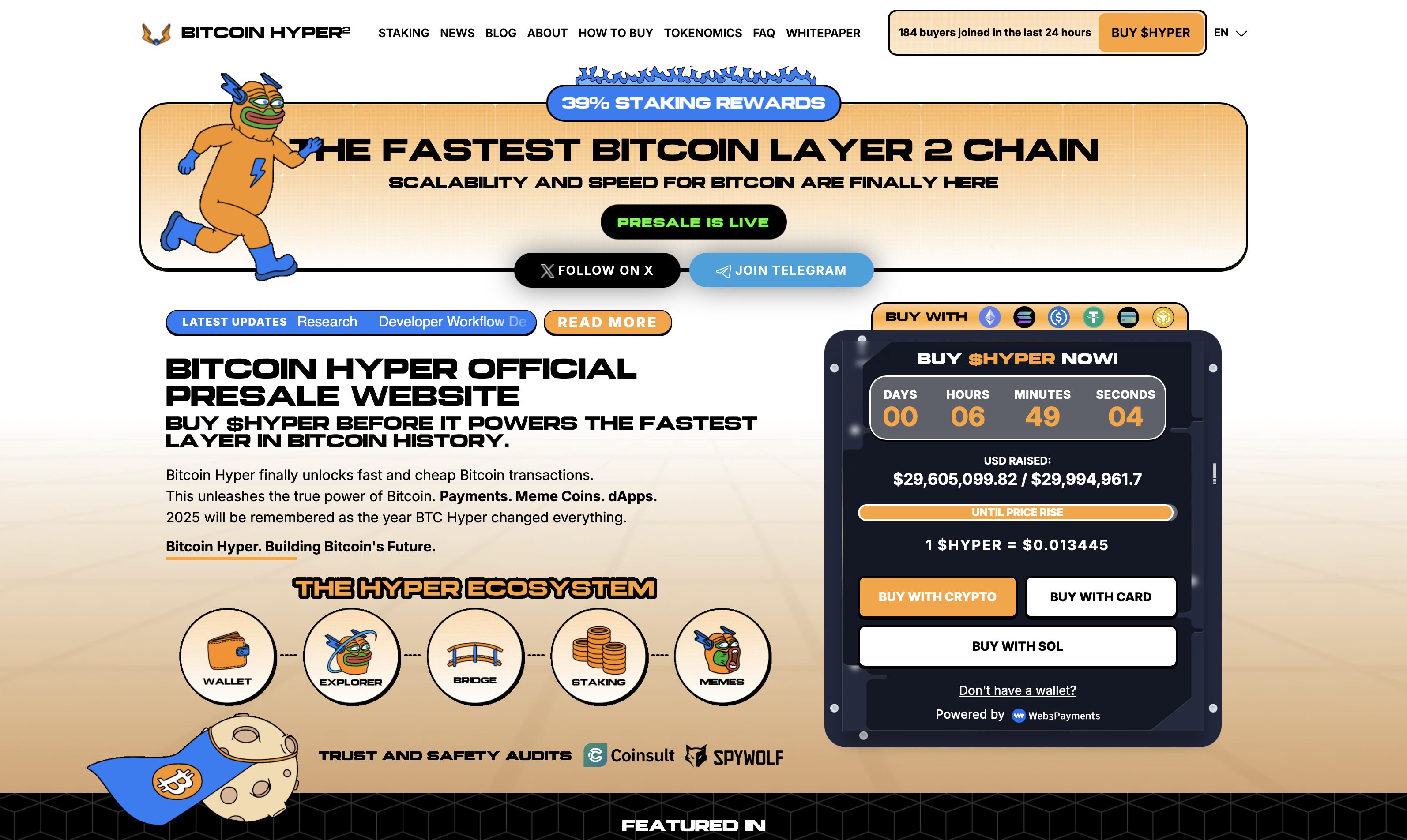
In view of this possibility, we’re highlighting our best altcoin to buy today, choosing upcoming layer-two network Bitcoin Hyper ($HYPER), which has the potential to rally hard when it lists early next year.
Best AItcoin To Buy Today That Could 100x in 2026 – 19 December 2025
This would suggest that investors are increasingly gaining confidence in the new project, which is planning to launch a full layer-two network for Bitcoin.
Determinism is the backbone of a credible rollup.
Bitcoin Hyper is exploring how to maintain fully deterministic parallel SVM execution, enabling verifiable state commitments and trust-minimized execution anchored to Bitcoin.
In contrast to the Lightning Network, which is primarily a payment rail, Bitcoin Hyper is planning to grow an entire ecosystem of decentralized dapps and protocols.
It will have a particular focus on DeFi, enabling Bitcoin holders to tap into the enormous value of their holdings, and to make additional profits on top of any price appreciation.
On a technical level, Bitcoin Hyper will make use of Solana’s Virtual Machine, giving it a speed and scalability that will make it one of the most capable L2s in crypto when it launches.
On top of this, it will also employ zero-knowledge rollups, adding privacy and security to its mix of market-leading features.
Its native token, HYPER, will be necessary to pay for its low transaction fees, with users receiving a proportionate quantity of HYPER whenever they deposit Bitcoin with the L2’s smart contract.
Accordingly, HYPER will have a max supply of 21 billion tokens, at 1:10 ratio with Bitcoin itself.
Holders will also be able to stake the token for a regular income, with the coin’s protocol currently paying out a yield of 39% APY.
HYPER Could Be One of the Biggest New Coins of 2026: Here’s How to Buy Early
Such features make Bitcoin Hyper one of the most exciting new tokens of 2025 and 2026, as its presale indicates.
And while there isn’t that much time left until the sale ends, latecomers can still join by going to the official Bitcoin Hyper website.
By connecting a compatible wallet (e.g. Best Wallet, MetaMask), they can buy any specified amount of HYPER, using ETH, USDT or even fiat.
The token is currently available at a price of $0.013445, although this will rise again later today.
It will continue to rise every few days until the sale ends, so interested investors should act sooner rather than later, in order to make the biggest possible gains.
And while the wider crypto market still remains largely uncertain, Bitcoin Hyper’s launch early next year could coincide with an overdue resurgence.
This is why it’s our best altcoin to buy today, and why it may remain one of the best new alts to buy for quite some time to come.
Toobit, an award-winning global cryptocurrency exchange, today announces an upgrade to its futures trading suite: the introduction of 200x leverage for ETHUSDT Perpetual Contracts. This update gives traders greater flexibility and higher market exposure when trading Ethereum.
As Ethereum continues to solidify its position as the foundational layer of the decentralized economy, the demand for Ethereum-linked trading instruments has grown.
By offering up to 200x leverage, Toobit allows traders to access larger market positions with less capital. This makes it easier for traders to manage their portfolios and protect their investments against market swings.
“Adding 200x leverage for ETHUSDT is part of our work to offer a high-performance trading space,” said Mike Williams, Chief Communication Officer at Toobit. “Our goal is to equip our traders with the tools they need to react to even small price changes with maximum flexibility.”
As the derivatives market matures, Ethereum has emerged as a primary pillar, with BTC and ETH combined now driving nearly 70% of global derivatives volume. Institutional adoption is also rising; as of late 2025, corporate treasuries and ETPs control roughly 8% of the total ETH supply.
This momentum is expected to continue into 2026, with expanding stablecoin liquidity projected to push DeFi’s TVL past $300 billion.
About Toobit
Toobit is where the future of crypto trading unfolds – an award-winning cryptocurrency derivatives exchange built for those who thrive exploring new frontiers. With deep liquidity and cutting-edge technology, Toobit empowers traders worldwide to navigate the digital asset markets with confidence. We offer a fair, secure, seamless, and transparent trading experience, ensuring every trade is an opportunity to discover what’s next.
Bitcoin Cash stands out as one of the strongest-performing altcoins in the crypto market currently, and if it maintains this momentum, Bitcoin Cash price prediction indicates the token is targeting $650 before Christmas.
BCH Outperforms Despite Bear Market Scare
Even on October 10, when most altcoins crashed by approximately 80%, Bitcoin Cash barely moved and has rallied over 20% since then.
Currently trading around $595.50 with a market capitalization of $11.9 billion, BCH requires only a 12% surge to break the $650 resistance and surpass Cardano as the 10th largest cryptocurrency by market cap.
Data from Coinglass reveals that Binance’s top traders are rapidly expanding their BCH long positions.
And with Grayscale’s September filing with the U.S. Securities and Exchange Commission (SEC) to obtain approval for exchange-traded funds (ETFs) that would follow the performance of Bitcoin Cash, the possibility of BCH surpassing $650 when approved is very high.
With the filing, the digital assets platform intends to convert its current closed-end trusts for Bitcoin cash into ETFs that will mainly be listed on NYSE Arca or Nasdaq.
Bitcoin Cash Price Prediction: Daily Chart Shows Bullish Structure Building
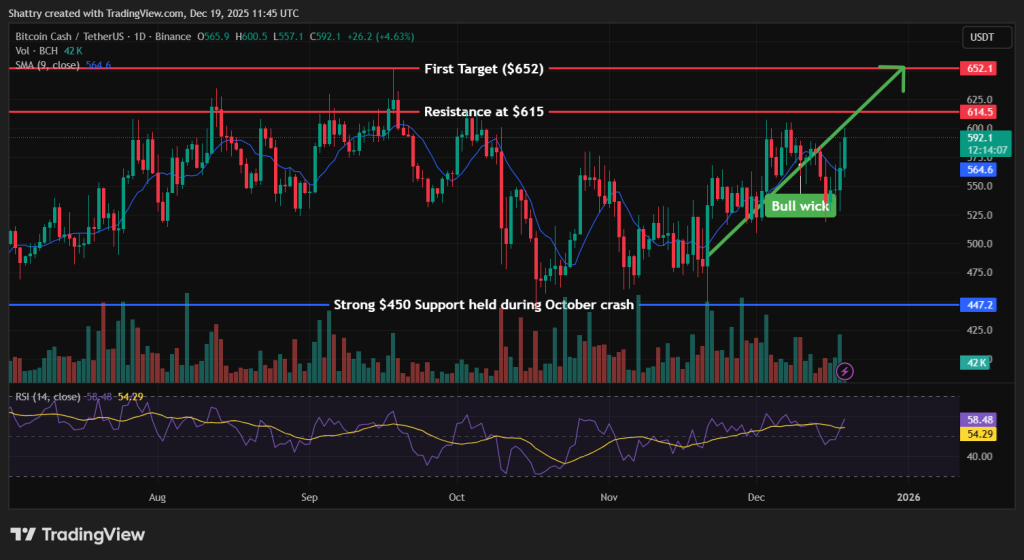
Bitcoin Cash’s daily chart displays a constructive bullish formation developing after successfully defending the $450 support during October’s selloff, which marked a clear higher-timeframe demand zone.
Since that low, price has established a series of higher lows and recently printed a strong bullish wick, signaling aggressive dip-buying and rejection of lower prices. BCH now trades above its short-term moving average, which is beginning to slope upward, reinforcing the momentum shift back to the upside.
The $615 area remains the key near-term resistance, having capped price multiple times in recent months, but the latest daily close near $592 suggests growing pressure on this level.
Source: TradingView
RSI has advanced back above the mid-50s, reflecting strengthening bullish momentum without entering overbought territory, leaving room for continuation.
If BCH secures a decisive daily close above $615, the structure supports continuation toward the $650–$652 region, which aligns with the next major resistance and prior distribution zone.
Failure at resistance would likely trigger a shallow pullback toward rising trend support around the mid-$560s, but provided price maintains above this area, the broader bias remains bullish with higher prices favored over the coming sessions.
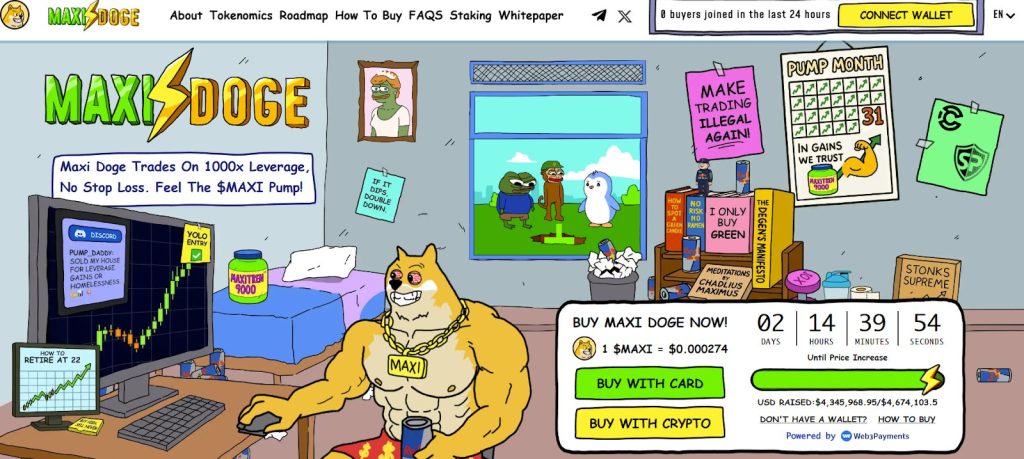
Maxi Doge Raises $4.3M To Position for Christmas Rally
If Bitcoin Cash breaks the $650 resistance before Christmas, significant attention would spotlight undervalued presale projects like Maxi Doge (MAXI).
Maxi Doge is an early-stage memecoin following the Dogecoin playbook that helped it achieve over 2x pump during the November-December 2024 Santa rally.
The project has now established an alpha channel to help traders exchange insider tips, share early trade ideas, and discover hidden opportunities to capitalize on a similar memecoin Christmas rally.
The MAXI presale has already raised over $4.3 million and offers 72% annual staking rewards for those entering early at the current $0.000274 price before it increases.
MemeCore price has dropped 9% in the last 24 hours, extending total losses to nearly 50% from September highs.
However, analysts say the MemeCore price prediction indicators point toward a rebound before year-end.
“Meme 2.0” Blockchain Infrastructure
MemeCore operates as a Layer 1 blockchain centered on the “Meme 2.0” concept, aiming to evolve meme coins from short-term speculative vehicles into sustainable, community-powered assets.
Beyond functioning as another digital gambling token, MemeCore provides infrastructure enabling creators, communities, and brands to tokenize and monetize memes directly on-chain.
MemeCore establishes itself as a convergence point where humor, creativity, and decentralized finance meet.
The $M token facilitates transactions, ecosystem incentives, and governance, synchronizing user participation with network expansion.
The blockchain employs a “Proof of Meme” (PoM) consensus mechanism that rewards creators, validators, and users of meme coins.
This momentum shows no signs of slowing down as chart patterns point to a potential rebound heading into Christmas.
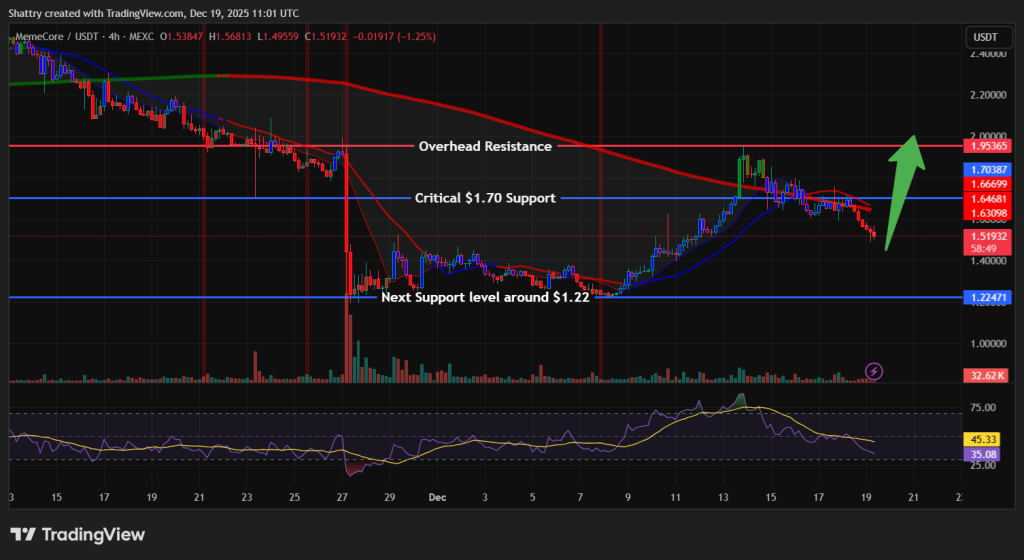
Memecore Price Prediction: $1.70 Support Critical for Recovery
This 4-hour chart shows MemeCore in a recovery phase after a sharp capitulation move, but momentum has clearly slowed as price runs into overhead supply.
The rebound from the $1.22 base was strong and impulsive, indicating aggressive dip-buying and short covering, yet that rally stalled just below the $1.95 area, which now stands out as a well-defined overhead resistance.
Since failing there, price has rolled over and is consolidating below the critical $1.70 support, a level that has flipped from demand to a key make-or-break zone.
Source: TradingView
RSI has cooled into the mid-30s to low-40s range, reflecting fading buying pressure without yet signaling extreme oversold conditions.
This implies consolidation or further downside is still possible before a sustainable bounce develops.
As long as $1.70 is reclaimed quickly, the broader recovery structure from $1.22 can stay intact, leaving room for another attempt toward $1.95–$2.00 resistance.
However, failure to hold this zone increases the probability of a deeper retracement, with $1.22 acting as the next major downside magnet where stronger demand previously stepped in.
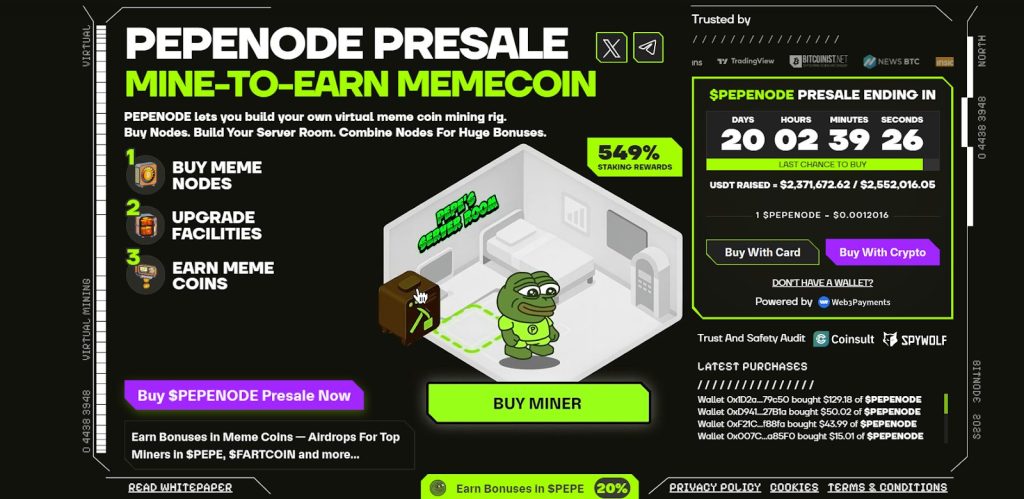
Pepenode Offers Early Access to Memecoin Season 2.0
MemeCore recovery above the $1.90 resistance level could trigger a memecoin season 2.0 rally that would benefit early-stage meme coins like Pepenode (PEPENODE).
Pepenode is a new crypto project still in its presale round that’s already raised over $2.3 million despite the memecoin sector losing over 50% of its value year-to-date.
It’s a game where you can mine coins without needing expensive hardware setups.
You play the game in your web browser, set up virtual mining rigs, and upgrade your facilities to earn PEPENODE tokens.
Now that more people are investing in Pepenode’s mining rigs, the presale price is increasing every day.
To join the presale before the ongoing round sells out, go to the official Pepenode website and connect a crypto wallet like Best Wallet.
You can then buy PEPENODE tokens for $0.0012016 and pay with crypto using ETH or USDT, or use a bank card for fast payment.
Bubblemaps flagged coordinated early Ava AI purchases as suspicious activity.
23 wallets, allegedly tied to the Ava AI deployer, bought 40% of tokens at launch.
AVA price has fallen 96% from its January 2025 all-time high.
The Solana-based AI token Ava AI (AVA) has come under scrutiny after blockchain analytics firm Bubblemaps revealed that nearly half of the token’s initial supply may have been acquired by a small cluster of wallets tied to the project’s deployer.
The findings suggest potential insider coordination during the token’s launch, raising questions about the fairness and decentralisation of its initial distribution.
Coordinated buying at launch
According to Bubblemaps, 23 wallets, including the deployer, were freshly funded just before AVA’s debut on the memecoin launch platform Pump.fun.
These wallets, funded through Bitget and Binance in tight time windows, received similar amounts of Solana (SOL) and showed no prior blockchain activity before acquiring AVA.
Bubblemaps described this as a classic example of “sniping,” where crypto trading bots purchase tokens immediately upon public release to gain a price advantage over ordinary investors.
Further analysis revealed that these wallets were connected to other accounts that also bought AVA early.
The similarity in funding sources, timing, and purchase amounts strongly suggests coordination across multiple wallet clusters.
Bubblemaps highlighted that much of this activity went unnoticed at the time, emphasising the need for ongoing monitoring of early token distribution to detect suspicious behaviour.
Implications for investors
The news of early wallet coordination has sparked discussions among investors and analysts.
Some, like the Twitter user ScoutOnchain, argue that speculative buying and FOMO are intrinsic to new crypto trends, while others emphasise the need for more accessible analytics tools to help investors detect suspicious activity.
The concentration of nearly 40% of AVA’s supply in a small number of wallets has significant implications for retail investors.
A large supply held by few entities can increase the risk of price manipulation or a rug pull, where insiders dump their holdings and cause the token’s value to collapse.
AVA’s price trajectory appears to reflect these risks.
After reaching an all-time high of $0.3318 on January 15, 2025, the token has fallen by approximately 96% from that peak, currently trading around $0.01062 with a market capitalisation of $10.6 million.
Its 24-hour trading range currently sits between $0.01043 and $0.01143, while the seven-day range has swung between $0.008029 and $0.01371.
And despite the decline from its peak, the token’s circulating supply remains nearly identical to its total supply of approximately 999 million AVA, with a maximum supply capped at 1 billion.
Bubblemaps has pledged to continue monitoring early token movements and provide insights to the community, signalling an ongoing effort to bring transparency to new launches.
Coinbase argues the Commodity Exchange Act gives the CFTC exclusive authority over event contracts.
Earlier cases involving Kalshi show courts have yet to settle the issue decisively.
The rulings could shape how prediction markets and related financial products develop nationwide.
Coinbase has taken its dispute with US regulators to court as it expands into prediction markets, filing lawsuits against authorities in Connecticut, Illinois, and Michigan.
The legal challenge centres on a fundamental question facing financial markets in the United States: whether prediction markets should be regulated at the federal level as financial derivatives or treated by states as gambling products.
Coinbase argues that the answer has already been set out in federal law.
State regulators disagree, setting up a clash that could redefine oversight for event-based markets tied to finance, politics, and real-world outcomes.
A jurisdictional battle takes shape
The exchange’s case is built around the Commodity Exchange Act, which grants the Commodity Futures Trading Commission authority over derivatives, including event contracts.
Coinbase maintains that prediction markets listed on CFTC-supervised platforms fall squarely within this framework.
From the company’s perspective, state efforts to apply local gambling laws amount to regulatory overreach.
Paul Grewal, Coinbase’s Chief Legal Officer, has positioned the lawsuits as a response to what the company sees as a direct conflict between federal authority and state enforcement.
Coinbase argues that allowing individual states to intervene risks creating a fragmented regulatory system that undermines national consistency. In that scenario, stricter jurisdictions could effectively block federally approved products across the country.
Gambling labels under scrutiny
A central issue in the lawsuits is how prediction markets are defined.
State regulators have moved to classify them alongside sports betting and casino-style gambling.
Coinbase rejects this comparison, arguing that the mechanics are fundamentally different.
Prediction markets operate as marketplaces that match buyers and sellers who take opposing views on future events.
Prices are set by market demand rather than by a house that manages odds.
Coinbase says this structure aligns prediction markets with derivatives trading, not wagering, and places them within the scope of federal commodities law rather than state gaming statutes.
Federal oversight and compliance claims
Coinbase has also pointed to the regulatory obligations attached to CFTC-supervised markets.
These include monitoring for manipulation, position limits, and ongoing compliance requirements designed to protect market integrity.
According to the exchange, these safeguards already address many of the consumer protection concerns cited by state regulators.
Ryan VanGrack, Coinbase’s Vice President of Legal, has argued that state-level intervention risks duplicating or conflicting with federal oversight.
The company maintains that pulling prediction markets under local gambling rules ignores how federally regulated derivatives markets operate and threatens uniform supervision.
Aster Airdrop Stage 4 has officially launched, bringing fresh opportunities for traders and holders to earn a share of 1.5% of the total $ASTER supply. As the next chapter in Aster DEX’s rewarding ecosystem, this season emphasizes sustainable farming through innovative mechanics like enhanced point calculations and buyback programs. If you’re looking to maximize your Aster DEX airdrop potential, this comprehensive guide covers everything from participation steps to pro-level strategies.
New to AsterDEX? Get 10% Discount On Fees by signing up with referral code “b848d3” at https://www.asterdex.com/en/referral/b848d3 to unlock an instant team boost and amplify your Rh points.
Already a user? Join a high-performing team by heading to Rewards > Points > Inviter Team and entering “b848d3” for shared multipliers up to 1.5x.
What is Aster DEX and Why the Hype Around $ASTER Airdrops?
Aster DEX is a cutting-edge perpetual decentralized exchange (Perp DEX) designed for seamless trading of futures and spot assets. Backed by industry heavyweights, it stands out for its user-friendly interface, low fees, and massive reward pools. The $ASTER token powers the platform, and its airdrop campaigns have distributed hundreds of millions in value, attracting traders worldwide.
Previous stages have set the bar high, with allocations reaching up to 8% of supply in Stage 1. Now, Aster Airdrop Stage 4, dubbed “Harvest,” focuses on long-term engagement, running from November 10 to December 21, 2025. This six-week season splits rewards across six epochs, offering 0.25% of supply per epoch — totaling around 120 million $ASTER tokens at current valuations.
Recap of Aster Airdrop Stage 3: Lessons and Outcomes
Before diving into the new season, let’s review Aster Airdrop Stage 3, which wrapped up on November 9, 2025. This phase allocated 2.5% of the total $ASTER supply, equivalent to about 200 million tokens. Rewards were distributed based on Rh points earned through trading activity, holdings, and team contributions.
Key highlights from Stage 3 include:
Epoch Structure: Divided into multiple epochs with 0.5% supply per epoch initially, rewarding consistent participation.
Point System: Emphasis on trading volume, position holding duration, and profit/loss (PnL) metrics.
Buybacks and Burns: The platform repurchased around 22 million tokens, with projections for up to 80 million total, half of which were burned to reduce supply.
User Feedback: Many participants noted that building a strong referral team amplified rewards by up to 1.5x, while delta-neutral strategies minimized risks during volatile markets.
The airdrop checker for Stage 3 opens on December 1, 2025, with claims starting December 15. If you farmed Stage 3, expect distributions that reflect a shift toward deflationary mechanics, where buybacks increasingly offset new token unlocks.
What’s New and Exciting in Aster Airdrop Stage 4?
Aster DEX Season 4 Airdrop introduces “Harvest” mode, building on prior stages with refinements for fairness and sustainability. Here’s what matters most:
Reduced Allocation for Deflation: At 1.5% total supply (down from 2.5% in Stage 3), this season signals a move toward token scarcity. Expect increasing buybacks — potentially absorbing sell pressure and driving long-term value.
Extended Duration: Six weeks with weekly epochs, allowing more time to accumulate points without rushed trading.
Enhanced Rewards for Holders: New bonuses for using $ASTER as collateral, encouraging token retention over quick flips.
Buyback and Burn Mechanism: Revenue from fees will fund repurchases, with a portion burned. This could total tens of millions of tokens, further tightening supply.
Team and Referral Boosts: Multipliers remain key, rewarding community builders with higher point yields.
Compared to Stage 3, Stage 4 reduces per-epoch rewards to 0.25% but adds holder incentives, making it ideal for strategic farmers aiming for deflationary gains.
Step-by-Step Tutorial: How to Participate in Aster Airdrop Stage 4
Getting started with the Aster DEX Season 4 Airdrop is straightforward. Follow this detailed tutorial to set up and begin farming Rh points:
Sign Up on Aster DEX: Visit the official site and create an account. Use a referral link or code (like those offering 5–10% fee discounts) to join a high-performing team for instant multipliers.
Connect Your Wallet: Link an EVM-compatible wallet such as MetaMask, Trust Wallet, or Binance Web3 Wallet. Ensure it’s funded with BNB, USDT, or $ASTER.
Deposit Assets: Navigate to the deposit section and transfer your funds. For optimal farming, convert USDT to USDF or BNB to asBNB — these yield bonus points.
Before making your first trade, enter the invite code in the designated field — use b848d3 for proven boost points.
Switch to Pro Mode: Enable advanced trading features to access perps (perpetual contracts). This is where most Rh points are earned.
Start Trading: Open positions in futures or spot markets. Focus on taker orders (market buys/sells) for double points compared to maker orders.
Monitor Rh Points: Check your dashboard regularly under “Rewards > Points” to track progress. Points reset per epoch, so stay active weekly.
Build Your Team: Share your referral code to recruit others, unlocking team-based multipliers that can boost your score by 1.1x to 1.5x.
Pro Tip: Avoid minting USDF directly if speed is key — swap via external DEXs like PancakeSwap for efficiency.
Expert Tips to Maximize Your Aster Airdrop Stage 4 Rewards
To turn Aster Harvest Stage 4 into a profitable venture, adopt these battle-tested tips drawn from successful farmers:
Prioritize Volume and Duration: High trading volume is king, but holding positions longer multiplies points. Aim for extended trades to rack up time-based rewards.
Go Delta-Neutral: Minimize risk by opening opposing positions (long on Aster, short elsewhere). This farms points safely without market exposure.
Leverage PnL Wisely: Positive profits boost scores, but even losses contribute. Balance aggressive trades with smart risk management.
Optimize Assets: Use USDF or asBNB for margins, and hold $ASTER for collateral bonuses. This stacks multiple reward layers.
Team Up Strategically: Join or build teams with consistent volume. Top teams hit billions in activity, amplifying everyone’s multipliers.
Stay Consistent: Farm across all epochs — rewards are weekly, so missing one hurts your total allocation.
Monitor Fees and Discounts: Apply referral codes early for reduced fees (up to 10%), preserving capital for more trades.
Avoid Common Pitfalls: Don’t chase short-term pumps; focus on sustainable activity. Also, use multiple wallets ethically if scaling, but always prioritize security.
Remember, while airdrops aren’t guaranteed, consistent effort in Aster DEX airdrop farming has yielded six-figure drops for top participants in past stages.
Potential Rewards and Long-Term Outlook for $ASTER
With 1.5% supply at stake, Aster Airdrop Stage 4 could distribute rewards worth hundreds of millions, depending on token price. Top farmers from Stage 2 reported allocations exceeding $100K, and Stage 4’s deflationary tweaks could enhance post-airdrop value.
As Aster DEX expands, expect more revenue-driven buybacks, potentially leading to net deflation where burns outpace emissions. This positions $ASTER as a strong hold for savvy traders.
Final Thoughts: Dive into Aster Harvest Stage 4 Today
The Aster Airdrop Stage 4 is your gateway to earning substantial $ASTER rewards while engaging with a top-tier Perp DEX. By recapping Stage 3’s successes, understanding new features, following the tutorial, and applying these tips, you’ll position yourself for maximum gains. Start trading now — opportunities like this don’t last forever in the fast-paced crypto world.
For the latest updates, bookmark the official Aster docs and stay active on the platform. Happy farming!
The Digital Bretton Woods: The Mathematical Inevitability of the Debt-Backed Dollar — Part 3 — The MSTR Endgame
The MSTR Endgame
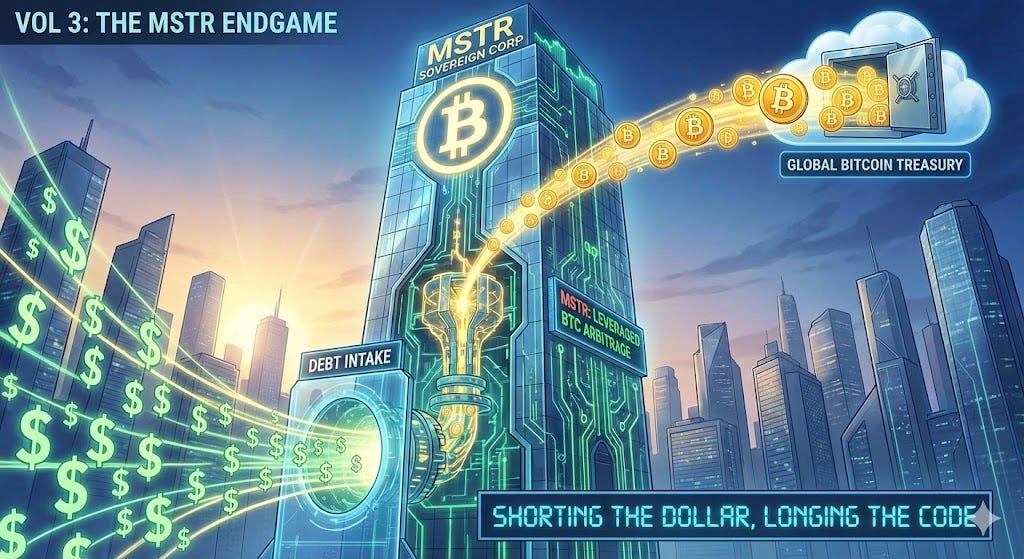
If the GENIUS Act is the clinical extraction of global liquidity (The Sponge) and the State Reserves are the local lifeboats (The Resistance), then MicroStrategy (MSTR) is something else entirely. It is a sovereign-grade predatory attack on the debt system itself.
Michael Saylor has not just built a company; he has built a “synthetic nation-state” that operates on the NASDAQ. By early 2026, the MSTR blueprint has become the most debated financial architecture in the world. Why? Because Saylor is doing to the US Dollar exactly what the US Dollar is doing to the rest of the world: he is shorting it into oblivion.
1. The Strategy: The Perpetual Motion Machine
The MSTR model is often called a “flywheel,” but in the context of 2026, it is more accurately described as a Debt-to-Equity Arbitrage Machine.
The “Saylor Short”
Saylor’s core insight is that if you believe the $38.4 trillion debt is a mathematical dead end, then the US Dollar is a “melting ice cube.” If you borrow that ice cube at a fixed 1% interest rate and convert it into a “digital diamond” (Bitcoin) that grows at 40% a year, the debt effectively pays for itself.
The Insight: MSTR is “shorting” the dollar by issuing billions in low-interest convertible debt. If the dollar debases, the debt becomes worthless, while the Bitcoin becomes priceless. Saylor is using the very “leaks” in the legacy system to fund his escape from it.
2. The Blueprint for Sovereign Nations: “Corporate Statehood”
By 2026, the $38.4 trillion debt has made traditional sovereign debt markets “toxic.” Small and mid-sized nations are looking at MSTR and asking: “If a software company in Virginia can outrun the Fed, why can’t we?”
The “El Salvador” Protocol (Version 2.0) El Salvador was the pioneer, but their approach was “buy-and-hold.” The 2026 Sovereign Blueprint (inspired by MSTR) is more aggressive. It involves Sovereign Debt Recycling:
Issuance: A nation issues “Bitcoin Bonds” (Volcano Bonds).
Conversion: They use the proceeds to buy Bitcoin.
Refinance: As the BTC value rises, they use the “collateral” to refinance their old, high-interest USD debt.
The “State-Led MSTR” Imagine a state like Texas or Florida. Instead of just holding a reserve, they issue state-level “Infrastructure Bonds” backed not by future taxes, but by a Bitcoin treasury. They are effectively becoming “MicroStrategy: The State.”
3. The mNAV Trap: The Math of the Premium
In late 2025 and early 2026, a new metric dominates the financial news: mNAV (Modified Net Asset Value). This is the ratio of MSTR’s market cap to its Bitcoin holdings.
The Premium: Investors pay a “premium” to own MSTR because it offers leveraged exposure and intelligent yield.
The Arbitrage: Every time the stock trades at a premium (e.g., 1.5x the value of its BTC), Saylor issues new shares and buys more Bitcoin.
The Epiphany: This is exactly how the US Dollar used to work under the original Bretton Woods. The world paid a “premium” to hold dollars because they were “as good as gold.” Saylor has recreated the gold standard, but he replaced the gold with code and the “Faith and Credit” with “Mathematical Scarcity.”
4. The Counter-Attack: The “MSTR Delisting” Fear
As MSTR begins to command a meaningful percentage of the Bitcoin supply (surpassing 3.2% of all BTC by late 2025), the legacy system strikes back.
In 2026, we see the rise of “Regulatory Delisting” rumors. Major banks and index providers (like MSCI) begin to argue that MSTR is no longer an “operating company” but an “unregulated investment fund.”
The Defense MSTR counters by integrating Bitcoin into its Strategy One AI platform, proving that the Bitcoin is not just a “hoard” — it is the “energy” that powers its sovereign-grade data intelligence. This is the Geopolitical Pivot: MSTR is no longer just a company; it is the Digital Intelligence Layer of the Bitcoin network.
5. The Reflective Close: The Last Arbitrage
The MSTR endgame is not about a stock price. It is about the re-ordering of the global balance sheet.
If the GENIUS Act is the US government trying to save the $38 trillion debt by sucking in global retail liquidity, Michael Saylor is the one building a “Black Hole” in the middle of the Sponge. He is sucking in the very debt that the US is trying to export and converting it into the one thing the US cannot print more of.
The Lingering Thought: In the “Digital Bretton Woods” of 2026, there are only two types of entities: those who are issuing debt to buy Bitcoin, and those who are holding debt while the Bitcoin is bought out from under them. Which one is your pension fund doing?
The Digital Bretton Woods: The Mathematical Inevitability of the Debt-Backed Dollar — Part 4 — Possible Scenarios
The 2026 Sovereign Bond Reset
1. The Strategic Context
If the previous volumes established the architecture of the new system — the $38.4 trillion US debt, the “Vampire Sponge” designed to fund it, and the “MSTR Blueprint” for escaping it — this addendum addresses the inevitable next phase: Implementation.
By early 2026, the theoretical frameworks are understood by global finance ministers. The question has shifted from “What is happening?” to “How do we survive it?” The “MicroStrategy model” — borrowing a depreciating currency to acquire a scarce asset — is no longer just a corporate tactic; it is being scrutinized as a potential instrument of national survival.
We are entering the era of the Sovereign Debt-for-Code Swap.
2. The Mechanism: The “Hard Asset” Sovereign Bond
For seventy years, developing nations have been trapped in a cycle of issuing dollar-denominated debt. They borrow strong dollars and have to pay them back with weak local currency, often leading to a “debt spiral” enforced by institutions like the IMF.
The “MSTR Blueprint” offers a radical inversion of this model. In 2026, we are likely to see the issuance of the first true Bitcoin-Backed Sovereign Bonds.
The Protocol
The Issuance: A sovereign nation issues a standard 10-year bond priced in US Dollars, offering a competitive interest rate (e.g., 8%).
The Acquisition: Instead of using the proceeds to build roads or subsidize energy, the treasury immediately converts 100% of the USD proceeds into Bitcoin.
The Collateralization: The Bitcoin is placed in a multi-signature, geo-distributed cold storage vault. This becomes the visible, auditable collateral for the bond.
The Arbitrage: The nation now owes a fixed amount of “melting” dollars. They hold a fixed amount of scarce Bitcoin. If the Bitcoin price appreciates faster than the interest rate on the bond (a likely bet in a high-inflation USD environment), the nation’s balance sheet improves every day.
The Geopolitical Insight: This is not just finance; it is a declaration of monetary independence. It transforms a nation from a “renter” of the dollar network into an “owner” of the Bitcoin network.
3. Case Study Alpha: The Desperate (e.g., Argentina, Turkey)
Nations experiencing chronic high inflation have the least to lose and the most to gain from this strategy. They are already drowning in dollar debt; the “Sponge” is already squeezing them dry.
For a country like Argentina (in this speculative scenario), the Sovereign Bond Reset is a Hail Mary. By issuing a Bitcoin-backed bond, they bypass traditional lenders who demand austerity. They appeal directly to the global capital markets that are hungry for Bitcoin exposure but restricted by mandates.
The Risk: If Bitcoin crashes, the country is insolvent.
The Reality: They are already functionally insolvent under the dollar standard. The risk profile is asymmetric: certain slow death under the current system versus a chance at sovereign rebirth under a hard asset standard.
4. Case Study Beta: The Opportunist (e.g., UAE, Energy Exporters)
The dynamic changes for wealthy, energy-rich nations. They do not need the money. For them, the strategy is about Monetizing Energy and Hedging Geopolitical Risk.
These nations realize that selling oil for US Treasury bills (the old “Petrodollar” arrangement) is a losing trade when the Treasury bills are yielding less than real inflation. In 2026, we see the pivot toward the “Petro-Bitcoin” model.
The Strategy: Instead of buying US debt with excess oil profits, they mine or buy Bitcoin. They then issue bonds against this Bitcoin reserve to fund domestic diversification projects (like NEOM in Saudi Arabia or tech hubs in Dubai).
The Leverage: This allows them to maintain liquidity without forcing them to hold the debt of a rival superpower (the US) that could sanction them at any moment. Bitcoin becomes neutral, apolitical collateral.
5. The Imperial Response: The Empire Strikes Back
The United States, faced with a $38.4 trillion debt that requires constant global funding, cannot afford to let the “Vampire Sponge” dry up. If sovereign nations stop buying Treasuries and start issuing their own Bitcoin bonds, the US bond market faces a catastrophic liquidity crisis.
Washington’s response in 2026 will likely be clinical and severe:
Financial Sanctions: The US Treasury may designate any sovereign bond backed by Bitcoin as a vehicle for “money laundering” or “evading sanctions,” effectively locking these bonds out of Western capital markets.
The “Strategic Resource” Designation: The US may declare Bitcoin a strategic national resource, similar to uranium. This would allow the President to use emergency powers to restrict American companies (like BlackRock or Fidelity) from buying foreign sovereign Bitcoin bonds.
The Final Conflict: The battle lines of 2026 are drawn between the US Treasury’s need for liquidity and the rest of the world’s need for sovereignty. The Dollar requires obedience; Bitcoin only requires verification.
6. Closing Synthesis: The Great Filter
The “2026 Sovereign Bond Reset” is the moment the world decides whether it wants to remain a passenger on the USS Titanic (the debt-based system) or build its own lifeboat (the collateral-based system).
The strategy is terrifyingly simple: Short the debt, long the code.
The nations that understand this arbitrage will become the new financial powerhouses of the 21st century. Those that cling to the old model, hoping the “Vampire Sponge” will spare them, will find themselves owning nothing but someone else’s unpayable promises.
Lingering Thought: When the music stops and the $38 trillion debt bill comes due, will your nation be holding the empty chair, or the immutable ledger?
The cryptocurrency market has boomed in recent years, drawing many businesses and individuals interested in starting cryptocurrency exchanges to enter into this area of business. The method mostly recommended for building such exchanges involves using a Binance Clone app. But why is the majority of the crypto startups attracted to the idea of starting business through Binance clone apps or schemes in developing their crypto exchanges? Here in this article, we will discuss why this is so and what the benefits of having a Binance clone app are in simple terms.
What is a Binance Clone Script?
While entering into the discussion around the popularity of Binance clone scripts, it becomes quite important to first understand what they really are. A Binance Clone Script is essentially a ready-made customizable software solution that proposes to emulate the working of Binance, the world’s largest and arguably most popular cryptocurrency exchange.
A contains crucial features that are included in a normal exchange such as user registration, wallet management, trade matching, transaction history, and real-time market charts among other things. It is customizable according to a crypto firm’s business needs. Using a Binance Clone Script, crypto startups can create an entirely functional exchange instead of starting from scratch.
Reasons for Crypto Startups to Prefer Binance Clone Scripts
These are some of the most fundamental things that make the Binance Clone Script really appealing for crypto startups. Let us list out such reasons.
1. Cost-Effective Solution
The most attractive option for almost every startup is that building an Exchange with a Binance Clone Script is going to be cheaper compared to building it from scratch. Building a cryptocurrency exchange is a really expensive process. There is so much research, designing, development work, testing, and continuous maintenance. Costs of building an exchange from scratch are such that they are prohibitive for most startups, dishing out only a small amount of startup funds.
A Binance Clone Script, on the other hand, is a ready-made solution that reduces development time and cost by a significant percentage. Since it is a pre-built script, a startup does not need to start from the scratch base. It can work easily onto the already existing framework and customize it according to the specific need. It can make a fortune saving and would be really appealing to entrepreneurs.
2. Shorter Development Time
In the race of ever-changing speed within the world of cryptocurrency, time generally defines all. The earlier you launch your platform, the earlier your users start flocking in to generate revenues. Months or even years could be spent designing your exchange interface with all those complex features such as security, payment gateway integration, and smooth user interface.
A Binance clone script cuts considerable development time and allows startups to introduce their platforms sooner than their competitors. Since much of the work is already done, startups can now bring their platform to market much faster, which in turn allows them to take advantage of this ever-increasing demand for cryptocurrency exchanges.
3. Proven Technology
Binance is counted among the leading cryptocurrency exchanges that have built their reputation on value-based platforms. By using a Binance clone script, crypto startups can utilize proven technology from the Binance platform for this. This literally means that the entire base code has already been tested and optimized for performance and security, thus reducing the chances of technical issues that may arise from developing a new exchange from scratch.
Moreover, it has been made user-friendly. A lot of traders know how it operates, and so with the help of a Binance clone, it will be able to serve such a user experience to them, thus increasing the faithful touches of users at the feeling of actual experience with using its navigating platform.
4. Security Features
Security is the most important aspect of a cryptocurrency exchange. Hacking of such types has been commonplace and, hence, very much important and serious infrastructure should be adopted that keeps the funds and data of users safe. Binance has a reputation for almost irrefutable security with two-factor authentication (2FA), encryption and anti-phishing codes, as well as complete and regular security audits.
Many of those security measures come built in with a . Crypto startups don’t have to waste time creating their security protocols from scratch since the clone script comes with these things. That is one other aspect of this startup that can now focus on while making sure the safety of its users.
5. Customizability
Even though almost all features that Binance was offering are embedded in it, a Binance Clone Script is not an end in itself; it is highly customizable. Startups can have the interior of the application changed to have some important features added, which include custom cryptocurrencies, user interface alteration, and payment gateway integration, among many others.
This makes it very adjustable for crypto startups to set themselves apart from the rest of the exchanges and customize the platform to meet their clients or target audience. Be it through offering very distinct trading pairs or simply coming up with other features.
6. Scalability
You want a platform that can grow with your business as your crypto trading operations expand. As mentioned, millions of users and trades are processed through Binance each day with no sign of a problem, since it is scalability that reaps the benefits. Thus, a Binance Clone Script would inherit this scalability, which means that startups would not have to worry about outgrowing their blueprint.
7. Comprehensive Features
A Binance Clone Script offers all the elements necessary for truly running a cryptocurrency exchange. The more common features incorporated in Binance Clone Apps include
These features help crypto startups create a fully functional platform with minimal effort.
8. Global Reach
Binance is known for its global user base, and the Binance Clone Script allows the startups to establish this global reach. Clone script supports multiple languages and multiple currencies to facilitate the attractiveness of this platform with users belonging to different countries. This is a crucial facet within the cryptocurrency industry, in which the market is genuinely global and anybody can become a user from any corner of the universe.
Conclusion
In conclusion, a offers a cost-effective, reliable, and fast solution for crypto startups looking to enter the cryptocurrency exchange market. With proven technology, robust security features, scalability, and the ability to customize, a Binance Clone App provides everything a startup needs to get started quickly and efficiently. By using a Binance Clone Script, crypto entrepreneurs can focus on growing their business, attracting users, and expanding their offerings, rather than worrying about developing an exchange from scratch. This is why many startups in the cryptocurrency space prefer using a Binance Clone Script to build their platform and kickstart their journey into the world of digital currencies.
In the rapidly growing world of cryptocurrencies, one of the most crucial decisions a business must make is the platform they will use for trading and managing digital assets. While there are several types of exchanges available, a Centralized Crypto Exchange (CEX) stands out as one of the most popular and trusted options for both businesses and individual traders. In this article, we will explore why businesses should consider choosing a Centralized Crypto Exchange Software, Centralized Crypto Exchange App, or Centralized Crypto Exchange Development Services for their operations, and how partnering with a Centralized Crypto Exchange Development Company can benefit their long-term success.
What is a Centralized Crypto Exchange?
Before delving into why businesses should choose a Centralized Crypto Exchange, let’s briefly define what it is. A Centralized Crypto Exchange (CEX) is a virtual marketplace where the users say that their cryptocurrencies will be traded, with the assistance of a central authority like an organization or a company. Generally, it operates as an intermediary for holding users’ funds and provides a forum for the buying, selling, and trading of digital assets. Some of the centralized exchanges that people are familiar with include Binance, Coinbase, Kraken, and Huobi.
In a CEX, all the transactions go on through the platform, which requires the users to trust the security, operation or any other process related to the platform. This, however, is different when using DEXs, for there, no intermediaries are needed as the users trade coins with one another directly.
Key Benefits of a Centralized Cryptocurrency Exchange
High Liquidity
One of the key advantages that Centralized Crypto Exchange offers is high liquidity. Liquidity means the ease with which an asset can be bought or sold in a particular market without resulting in any significant price impact. Due to their large user base and high volume of trade occurring at any given moment, it is fairly easy for a company to execute large transactions in a centralized exchange without facing extreme price changes during transactions. Such high undulating liquidities on the markets ensure smoother and efficient trading for businesses at scale.
Security and Trust
Security is one major question in the developing world of cryptocurrencies. Centralized exchanges spend a lot for the infrastructures they secure with the likes of encryption applications, 2FA, cold storage of funds, and other advanced cybersecurity measures. Businesses using Centralized Crypto Exchange Software or App can access these strict protocols of security, which may help build trust with customers through safe transactions.
Most certainly they would also involve hacking or breach events in their record. But most of these CEXs have a proven professional security team and adhere to the industry’s standard, which gives an additional level of reliability and security that is mostly better than that of decentralized platforms.
Easy Navigation
It is because the user interface (UI) of the centralized exchange is generally friendlier and more appropriate for both novice and expert traders. Therefore, it is a good consideration for the company since employees or customers would also be expected to interact with the platform quite frequently. Whether using theCentralized Crypto Exchange Appinstalled or accessing the exchange via some web-based platform, the exchange of experience will be seamless and may lead to productivity improvements over time.
Have you realized that most centralized exchanges come with customer supports, tutorials, and even help pages? For crypto businesses, these qualities are inherent for almost all the companies; newbies, in particular, would find it easy to understand the whole process compared to decentralized ones where users have to do everything under the sun.
Regulatory Compliance
Mandatory for any business dealing in crypto to adhere to the country laws. Centralized exchanges usually found under regulation and adhered to the financing laws, AML, and KYC. Selecting the company providing Centralized Crypto Exchange development clearly indicates that the business has a healthy platform in compliance with local and international laws.
Companies might easily get a Centralized Crypto Exchange App to help provide legal and compliant exchanges most likely to avoid all future hassles with the law. The other advantage that a company could reap is enhanced competitiveness over others in an environment where there is stringent regulation.
Speedy Transactions
Centralized Crypto Exchange Software can provide fast transactions. If you have an immediate requirement to buy or sell a digital asset, this software will be considered useful to you, unlike decentralized exchanges. They are subject to delay sometimes caused by network congestion or other problems. However, most CEXs come designed with high-speed transaction processing mechanisms.
Fast trades; whether you are in business doing everything related to cryptocurrencies or just doing transactions through the exchange, that instant trade saves so much time and also reduces the operational overhead for your team.
Fiat Involvement
Most strong centralized exchanges do support local currency deposits and withdrawals in order for various businesses to transact with popular fiat currencies. Whether you wish to exchange Bitcoin for US dollars or buy Ether for a few Euros, centralized exchanges keep them floodgated to facilitate easy-to-all fiat-to-crypto exchanges.
This is, therefore, vital for businesses that are trying to engage in cryptocurrency exchange but at the same time, remain in touch with the traditional ways of financial systems. Access to an exchange of fiat currency makes accounting, taxation, and financial reporting relatively easy.
More Advanced Trading Options
In many centralized exchanges, such features are complemented by others that include advanced trading features such as margin trading, futures contracts, and stop-limit orders. Such trading features can be significantly of value to firms looking at advanced trading strategies.
Holding a company in investment or asset management in cryptocurrencies then have this kind of advanced functionality on a Centralized Crypto Exchange would be valuable with respect to making innovative trading strategies available.
Customization Options for Business Use
Allows firms to make their own exchange software when they partnered with Centralized Crypto Exchange Development Company. Companies may opt for particular features, interfaces and functionalities specific to their needs.
Whether going to create this specific Centralized Crypto Exchange App for your customers or a backend trading platform for internal use, this degree of customization guarantees the platform will fit your unique and very specified business model and user base.
You must include white-labeling, payment gateway systems, multi-language support, etc., which will make it further adaptable for a worldwide audience.
Reputation in the Market and Branding
Most businesses prefer to approach this with the best-known Centralized Crypto Exchange Development Services as such still exists a prestige of a certain level into the market as well as branding. Within this, businesses gain credibility with their customers by using such reliable and popular exchange platforms.
With the present well-known exchanges, they have already created a kind of user base as well as the ecosystem that can be shared with businesses. Centralized Crypto Exchange Software whether for your own needs for personal trading or white-labeling for your clients: this existing brand power is used to work on growing the business at a more rapid rate.
Access to Trade Pairs
Centralized exchanges provide businesses with a whole range of trading pairs, allowing them to diversify their cryptocurrency holdings. By using a variety of cryptocurrencies, you help your consumers to have many choices and flexible options, thus enhancing trading volumes.
Whether you are trading Bitcoin (BTC) with Ethereum (ETH), Litecoin (LTC) with USDT, or any other different pairs, all kinds of centralized exchanges have so many pairs for the preferences of businesses and single traders.
How a Centralized Crypto Exchange Development Company Can Help
Benefits of a Centralized Crypto Exchange Development Company When Trade Companies are interested in a Centralized Crypto Exchange App or Software, it is important to partner with a Centralized Crypto Exchange Development Company. As the name suggests, these have developed fine, secure, and feature-rich exchange platforms which are tailored to your business.
Custom-made Projects:
A development company is able to make a complete customized exchange, which might offer the very special features and functionalities that fit your business model.
Expertise in Security
Whether the use of custom software desktop or mobile apps, a professional company develops applications based on the requirements of the client. They are all prepared to provide exemplary security features to your exchange platform while ensuring that they meet international standards.
Scalability:
Your exchange will require different functions as your business grows. A Centralized Crypto Exchange Development Company has the right infrastructure and required resources to make your platform entirely scalable as regards the increasing transaction volumes and types of users.
Continued Support:
Development companies provide post-launch services for your exchanges to remain operational, secure, and updated in terms of features and regulations.
Conclusion
Choosing a Centralized Crypto Exchange Software, App, or partnering with a Centralized Crypto Exchange Development Company is an excellent option for businesses looking to enter the world of cryptocurrencies or expand their existing operations. Centralized exchanges tend to be much more attractive as offerings like high liquidity and security along with various user-friendly experiences and warranty on regulatory compliance come into picture.
Thus, it makes it possible for companies to develop a platform meeting their requirements with the aid of a reliable Centralized Crypto Exchange Development Service, to make any cryptocurrency trading more smooth, secure, and profitable.
How to Create an ERC-20 Token on Ethereum, Base, Arbitrum, and BSC Without Code (Complete 2025 Guide)
TL;DR: EscapeHub Token Creator is a no-code ERC-20 generator that lets you deploy tokens across Ethereum, Base, Arbitrum, BNB Chain, and 35+ blockchains for $1 + gas fees. No coding required. Choose from Simple, Community First, or Advanced modes with features like anti-whale protection, anti-bot deadblock, trading fees, and whitelist controls. The $ESC presale is now live.
What Is EscapeHub Token Creator?
EscapeHub Token Creator is a no code token generator platform for creating ERC-20 tokens on multiple blockchain networks. You can deploy tokens without coding knowledge or Solidity experience. This no-code solution makes token creation accessible to everyone. Whether you want to launch a meme token, a community token, or a serious DeFi project, you can configure everything from a web interface and deploy in under 5 minutes.
The platform is live on Ethereum, Base, Arbitrum, and BNB Chain (BSC), with approximately 2 new networks being added daily. EscapeHub is a true multi-chain token deployment solution supporting 40+ EVM-compatible blockchains.
How Much Does It Cost to Create a Token?
Creating a token on EscapeHub costs $1 flat fee plus network gas fees. The $1 fee is paid within the same deployment transaction.
You can also pay with $ESC tokens for discounts. A portion of fees goes toward buying back and locking $ESC tokens, supporting the ecosystem.
What Are the Three Creation Modes?
EscapeHub offers three distinct creation modes to match your project needs:
Simple Mode is designed for quick launches. It includes burn functionality, rescue functions for recovering stuck tokens, editable metadata and socials, and all supply goes to your wallet. This mode works well for meme tokens, tests, or projects that want flexibility.
Community First Mode maximizes holder protection. The owner cannot access funds through rescue functions, metadata and socials are locked forever, and the token is fully transparent and verifiable. This mode proves good intentions to your community and builds trust.
Advanced Mode gives you complete control over every parameter. You can add trading fees, anti-bot protection, holder limits, whitelist and blacklist controls, and more. Everything is optional and you enable only what you need.
What Token Settings Can You Configure?
Basic Settings
You can choose your token name, symbol, total supply, and decimal amount. Most tokens use 18 decimals, the same as ETH, but you can set anything from 0 to 18.
You can also generate a vanity contract address with a custom prefix or suffix, making your token address recognizable and memorable.
Supply and Distribution Options
Fixed vs. Mintable Supply: Choose a fixed supply where no new tokens can ever be created, or enable minting with an optional hard cap that limits maximum supply.
Initial Distribution: Send all tokens to your wallet, or automatically split them across multiple wallets with custom percentages at deployment.
Burn Function: Allow any holder to permanently destroy their own tokens, reducing total supply. This creates deflationary tokenomics.
Ownership and Control
Owner Address: Deploy to your connected wallet or specify a custom owner address.
Permission Levels: Full owner permissions, limited permissions, or no owner privileges at all.
Renounce Ownership: Permanently give up owner access after deployment, making the token immutable.
What Anti-Bot and Anti-Snipe Features Are Available?
Deadblock Protection
Block all trades in the first 1–10 blocks after trading is enabled. This prevents bot sniping at launch when bots try to buy immediately as trading opens. You can configure deadblock to affect buys only, sells only, or both.
Trading Cooldown
Require each wallet to wait a specified number of seconds between trades. This basic protection prevents rapid-fire trading by bots and helps human traders compete fairly.
Whitelist Module
Control who can trade before trading is publicly enabled. Only whitelisted addresses can interact with the token, letting you set up liquidity and complete private sales before public launch.
Router Protection
Block all DEX router interactions until you manually enable trading. This prevents anyone from creating liquidity pools before you’re ready.
What Anti-Whale Features Are Available?
Max Wallet Limit
Limit how much any single wallet can hold. You can set this as a percentage of total supply or an absolute amount. Optional time windows let limits expire automatically after a set period.
Max Transaction Size
Limit the maximum amount that can be transferred in a single transaction. This prevents large sudden buys or sells that could destabilize the price.
Anti-Dump Module
Limit how much any wallet can sell within a specified time period. You can set limits as an absolute amount or as a percentage of the holder’s balance. This prevents large holders from dumping their entire position at once.
The anti-dump module includes flash loan protection that uses balance snapshots to prevent attackers from temporarily inflating their balance to bypass sell limits.
Can You Add Trading Fees to Your Token?
Yes. The fees module lets you configure separate fees for buys, sells, and wallet-to-wallet transfers.
Fee Options Include:
Buy fee percentage (up to 20%)
Sell fee percentage (up to 20%)
Transfer fee percentage (up to 20%)
Fee recipient address (owner wallet or custom address)
Fee-exempt addresses (whitelist specific wallets)
Automatic fee burning (burn a portion of collected fees)
You can choose between fixed fees that are permanent from deployment or flexible fees that you can adjust later within immutable maximum caps. The flexible option lets you start with higher launch fees and reduce them over time.
What Security Features Are Built In?
Blacklist Module
Block specific wallet addresses from sending or receiving tokens. You can add addresses to the blacklist after deployment, and optionally freeze the blacklist permanently so no new addresses can ever be added.
Pause Function
Temporarily freeze all token transfers. This emergency function can be useful for migrations or security incidents, but some investors view it as a risk since trading can be stopped at any time.
Rescue Function
Recover ERC-20 tokens or ETH accidentally sent to your token contract. If disabled, those funds are permanently lost. Community First mode disables this by default for maximum holder protection.
EIP-2612 Permit
Gasless approvals via cryptographic signatures. This is always enabled and lets users approve token spending without paying gas, improving user experience for DeFi integrations.
Can You Edit Your Token After Deployment?
Editable Elements (if configured):
Token name and symbol (can be locked permanently)
Social links: website, Telegram, X handle, Discord (can be locked permanently)
Fee amounts (within immutable maximum caps)
Wallet and transaction limits
Cooldown settings
Blacklist and whitelist addresses
One-Way Actions (cannot be undone):
Lock metadata (name and symbol become permanent)
Lock social links
Freeze blacklist
Freeze whitelist
Renounce ownership
Enable trading (cannot be disabled once enabled)
How Do You Create a Token Step by Step?
Step 1: Visit app.escapehub.ai and connect your wallet.
Step 2: Select your blockchain network. Ethereum, Base, Arbitrum, and BSC are currently live. (Including their testnets)
Step 3: Choose your creation mode: Simple for quick launches, Community First for maximum trust, or Advanced for full customization.
Step 4: Configure your token basics including name, symbol, supply, and decimals.
Step 5: Set up supply distribution if you want to split tokens across multiple wallets.
Step 6: Enable optional features like fees, limits, anti-bot protection, or access controls.
Step 7: Add your social links and optionally upload a logo and banner.
Step 8: Generate a vanity address if desired.
Step 9: Review all settings and deploy.
Step 10: Confirm the transaction in your wallet. The $1 fee and deployment happen in one transaction.
Your token is deployed and verified automatically. You can immediately start adding liquidity or distributing tokens.
What Networks Are Supported?
EscapeHub supports multi-chain token deployment across all major EVM networks. Deploy your token to any supported blockchain from a single interface.
Currently Live:
Ethereum Mainnet
Base
Arbitrum One
BNB Smart Chain (BSC)
Coming Soon (30+ total networks):
Polygon
Avalanche C-Chain
Optimism
Fantom
Cronos
And many more
Approximately 2 networks are being added daily until full coverage is reached. This makes EscapeHub the most comprehensive multi-chain ERC-20 token generator available.
What Is the $ESC Token Presale?
The $ESC presale is now live. $ESC is the native token of the EscapeHub ecosystem with real utility:
Pay with $ESC for Discounts: Use $ESC to pay token creation fees at reduced rates.
Buyback and Lock: A portion of platform fees goes toward buying $ESC from the market and locking it, reducing circulating supply over time.
Fair Value Purchases: The protocol purchases $ESC at fair market value, supporting healthy price discovery.
Join the presale at escapehub.ai to get $ESC before the public launch.
Frequently Asked Questions
How long does token deployment take?
Deployment typically takes 30 seconds to 2 minutes depending on network congestion. Your token is verified automatically.
Can I deploy the same token to multiple chains?
Each deployment creates a separate token on one chain.
What wallets work with EscapeHub?
Any WalletConnect-compatible wallet works, including MetaMask, Coinbase Wallet, Trust Wallet, and Rainbow.
Is the smart contract audited?
The LaunchERC20 contract has undergone comprehensive security review. The contract operates near maximum EVM bytecode size limits with extensive security features including reentrancy guards and flash loan protection.
Can I create tokens on testnets first?
Yes, testnet support is available for testing your configuration before deploying to mainnet.
What happens if I send the wrong tokens to my contract?
If you enabled the rescue function, the owner can recover stuck ERC-20 tokens and ETH. If rescue is disabled (Community First mode default), those funds are permanently lost.
Can trading be re-enabled after being paused?
Yes, if pause is enabled, the owner can pause and unpause transfers. However, once trading is enabled via the trading switch, it cannot be disabled.
How do I add liquidity after deployment?
Go to your preferred DEX (Uniswap, PancakeSwap, etc.), connect the same wallet, and create a liquidity pair with your new token. If you enabled router protection, make sure trading is enabled first.
Summary
EscapeHub Token Creator offers the most comprehensive no-code token deployment solution available in 2025. With three creation modes, extensive anti-bot and anti-whale protection, flexible fee systems, and support for 40+ blockchain networks, you can launch exactly the token your project needs.
Key benefits include $1 flat fee pricing, no coding required, automatic contract verification, and professional-grade security features that previously required expensive custom development.
Get Started: app.escapehub.ai
Join the $ESC Presale: escapehub.ai
Follow Updates: @Escape_Hub on X
This guide covers EscapeHub Token Creator as of December 2025. Features and supported networks are actively expanding.
TL;DR: EscapeHub lets you create custom ERC-20 tokens on Ethereum, BNB Chain, Polygon, Arbitrum, Base and 35+ other networks -no coding required. Token creation costs $1, takes under 5 minutes and the platform just completed verification. Multi-chain rollout begins this week.
What Is EscapeHub Token Creator?
EscapeHub is a no-code token creation platform that allows anyone to deploy ERC-20 tokens across multiple blockchain networks. Instead of writing Solidity code or hiring developers, users can create fully functional tokens through a simple web interface at app.escapehub.ai.
EscapeHub supports token creation on 35+ blockchain networks. Here’s the complete list of supported chains:
Mainnet Networks
Layer 1 Networks
Ethereum
BNB Smart Chain
Avalanche
Celo
Sonic
Monad
Sei Network
Gnosis
XDC Network
Layer 2 Networks
Polygon
Arbitrum One
Arbitrum Nova
Optimism (OP)
Base
zkSync Era
Linea
Blast
Scroll
Mantle
Taiko
Swellchain
Metis
Pepe Unchained
Parachains
Moonbeam
Testnet Networks
Sepolia (Ethereum testnet) ✅ Live
Hoodi Testnet
BNB Smart Chain Testnet
Polygon Amoy
Arbitrum Sepolia
Optimism Sepolia
Base Sepolia
Avalanche Fuji
Blast Sepolia
Celo Sepolia
Mantle Sepolia
Scroll Sepolia
zkSync Sepolia
Apothem (XDC testnet)
Monad Testnet
Gnosis Chiado
Important: Networks are rolling out gradually, not all at once. Follow @Escape_Hub on X for release announcements.
How Much Does It Cost to Create a Token on EscapeHub?
Token creation costs $1 per deployment + network gas fees.
The $1 is EscapeHub’s platform fee and applies regardless of which blockchain you choose. Gas fees vary depending on the network and current network congestion.
What you get for $1:
Token deployment on your chosen network
Automatic smart contract verification
Access to token contract editing (coming this week)
Full ownership of your token
Pro tip: Layer 2 networks like Base, Arbitrum and Optimism have significantly lower gas fees than Ethereum mainnet-often under $0.10.
$ESC Token Holder Benefits: The $ESC token will be the driving force behind the entire EscapeHub ecosystem. All current and future platform utilities- including token creation, editing and upcoming services - will integrate with $ESC to provide value to holders.
Will You Be Able to Edit Token Contracts After Creation?
This feature is being implemented this week .It depends on your choices during deployment.
EscapeHub gives you full control over what can and cannot be changed after your token is created. At deployment, you decide:
Mutable vs Immutable Options:
Token name & symbol -Start editable (can lock later) OR lock permanently from day one
Socials (website, Telegram, X, Discord) - Keep editable OR lock from deployment
Blacklist - Keep manageable OR freeze forever
Whitelist - Keep manageable OR freeze forever
One-Way Locks: Once you lock metadata, freeze the blacklist, or renounce ownership - it’s permanent. These actions cannot be undone, giving your token holders certainty about what can never change.
Module Controls: Enable or disable features like minting, pausing, fees, limits, cooldowns and more. Disabled modules cannot be activated later - this is by design for security.
Note: Editing capabilities depend on your initial token configuration. Some parameters are immutable by design for security.
Is EscapeHub Open Source?
Partially yes. Starting Week 51 (December 2025), EscapeHub will release its frontend code as open source for three major frameworks:
React
Vue
Angular
What this means for developers:
Integrate token creation into your own website
Build custom platforms for specific blockchain networks
White-label the token creation tool
The smart contracts themselves power the token creation and developers can leverage them through the open-source frontend frameworks.
How to Create a Token on EscapeHub (Step-by-Step)
Creating your own token takes less than 5 minutes:
Ongoing: Additional network integrations, feature updates and ecosystem expansion
Summary
EscapeHub provides the easiest way to create ERC-20 tokens across 35+ blockchain networks without writing code. At $1 per token, it’s accessible to everyone from individual creators to enterprises building token ecosystems.
About EscapeHub: EscapeHub is a blockchain development platform focused on making web3 tools accessible to everyone. The platform launched in 2025 with the mission to democratize access to Web3 token infrastructure.
For years, corporate finance was predictable with banks, spreadsheets, and slow settlements. Now, CFOs face faster markets, global business, and the need for quick decisions. This change isn’t about trends. It’s about how money, data, and value are changing.
Why Traditional Finance Is No Longer Enough for CFOs
Legacy banking systems were designed for a slower, domestic economy. Today, global companies operate across borders and require fast, clear financial insights. Slow responses, vague reporting, and dependence on others no longer align with the speed at which CFOs operate.
Inflation, volatile currency rates, and increasing costs are making financial planning more challenging. Old approaches are no longer working. Now, CFOs need to identify risks early rather than reacting to them later, prompting a shift away from outdated banking practices.
Key Reasons CFOs Are Turning to Stablecoins
Faster Cross-Border Payments
Global businesses need payments to clear fast, without standard bank delays. Stablecoins make global payments happen by cutting processing times from days to minutes while keeping value consistent.
Reduced Transaction Costs
When payment amounts grow across markets and with partners, managing costs is key. Stablecoins cut down on middleman fees and foreign exchange steps. This helps CFOs keep profit margins up and move money better. These gains add up over time.
Protection from Currency Volatility
When the economy is shaky, being open to exchange rate changes can mess up plans. Stablecoins offer a value-tied option that protects your working money. This helps with making correct predictions and handling risk.
Better Cash Flow Visibility
Knowing your cash flow is now a must-have skill, not just a matter of reports. Blockchain-based deals give you a live look at balances and movements. This means faster, more sure CFO choices that fit with business aims.
Stablecoins vs Traditional Banking Systems
Regular banking uses many go-betweens, like different banks and clearing companies. When you send money to another country, it can take days because people have to check everything by hand, and things depend on time zones. Fees, exchange rates, and fixing mistakes all make costs go up. You also can’t really see where your money is until everything is done.
Stablecoins run on networks that let you send money straight away, without all those go-betweens. Deals happen in minutes, and you can see exactly what’s happening in real-time. Costs are also easier to guess. Since stablecoins are linked to a certain value, they protect you from money swings. This gives finance managers more control, quicker access to their money, and better handling of their funds than old-fashioned banking.
How Stablecoins Fit into the Future of Corporate Finance
Stablecoins are now playing a vital role in modern business finance, driving innovation across automated finance, treasury management, and tokenized assets. Security Tokenizer enables CFOs to leverage stablecoins for reliable, fast, and transparent settlements, bridging traditional and emerging financial systems through blockchain technology.
Stablecoins help companies handle cash and use working capital better by offering steady value transfer, quick settlements, and global use. Working with a Stablecoin Development Company gives you an edge, helping to combine rules, cash handling, and fresh financial tools easily. This way, businesses can adopt blockchain solutions, protect their future financial moves, find new investments, improve clarity, and build a simple, efficient financial setup.
Amid volatile crypto markets, WPA Hash offers predictable daily earnings through automated cloud mining. Cryptocurrency markets go viral, at times too viral. Stocks go up and down at any given time and investors are not even sure of when to…

 Login
Login

 Sen. Moreno warns U.S. lawmakers: “No deal is better than a bad deal.” U.S. crypto legislation may be delayed
 Teachers’ union AFT calls on Congress to kill the crypto market-structure bill before it advances. warning that the bill threatens pensions and 401(k)s,