Reading view

There are new articles available, click to refresh the page.

Ripple President Monica Long Says Stablecoins to Move From Pilot to Production by 2026

Stablecoins are poised to become a foundational layer of global finance over the next two years, according to Ripple President Monica Long, who says the asset class is shifting from experimental pilots to full-scale production across mainstream payments.

In commentary outlining her expectations through 2026, Long argues that stablecoins are no longer a niche crypto innovation but are on track to become the default infrastructure for cross-border payments, embedded directly into legacy financial rails used by banks, merchants, and corporates worldwide.

Stablecoins Embedded Into Global Payment Rails

Long points to recent developments from traditional payment giants as evidence that stablecoins are being “hard-wired” into incumbent systems.

Visa and Stripe going live with USDC settlement for merchants, she says, marks a turning point where blockchain-based rails are being adopted within existing corporate payment flows rather than operating in parallel.

💳 Visa Inc. is set to allow stablecoin-based settlement across its US payments network, expanding its suite of crypto-related services.$USDC #Visa https://t.co/i6vVCqWAiH

— Cryptonews.com (@cryptonews) December 16, 2025

“In 2026, stablecoins will integrate with legacy financial rails and, within the next five years, become fully integrated into global payment systems,” Long said, adding that cross-border payments are likely to be the first area where stablecoins emerge as the default settlement mechanism.

B2B Payments Drive the Next Adoption Wave

While early stablecoin growth was dominated by retail trading and remittances, Long said she expects business-to-business payments to lead the next phase of adoption.

B2B payments already account for the majority of stablecoin flows, a trend she believes will accelerate as corporates seek efficiency gains.

Beyond faster settlement, Long highlighted the impact on corporate balance sheets, particularly in Europe, where she estimates €1.3 trillion remains trapped in working capital across payables, receivables, and inventory.

Stablecoins, she said, have the potential to unlock this capital by enabling real-time settlement and improved cash-flow management.

Crypto Shifts From Speculative to Structural

Long also outlines a structural shift underway across the crypto sector. She expects crypto to evolve from an alternative asset class into the operating layer of modern finance, with institutional balance sheets holding more than $1 trillion in tokenized and digital assets by the end of 2026.

Regulatory clarity is a key enabler of this transition. Long cites frameworks such as the EU’s Markets in Crypto-Assets (MiCA) regulation as laying the legal groundwork for a compliant stablecoin market.

By 2027, she expects banks and financial institutions in regulated regions to issue and hold their own regulated stablecoins.

Custody and M&A to Accelerate

As institutional interest grows, Long predicts increased consolidation across crypto infrastructure, particularly in custody services.

The commoditisation of custody, she explains, is likely to drive a new wave of mergers and acquisitions as traditional banks, service providers, and crypto firms seek to accelerate their blockchain strategies.

She expects more than half of the world’s top 50 banks to formalise at least one new digital asset custody relationship in 2026.

Looking ahead, Long believes crypto M&A will increasingly extend beyond the sector itself as firms pursue usability and scale.

“To acquire the next billion users, especially institutions, crypto must get radically easier to use and move outside the echo chamber,” she said.

The post Ripple President Monica Long Says Stablecoins to Move From Pilot to Production by 2026 appeared first on Cryptonews.

Bitcoin Price Prediction: Cathie Wood Says the Bottom Might Be In – Are Institutions About to Trigger the Next Bull Run?

Cathie Wood, founder of ARK Invest, believes the post-October 10 crash bottom for Bitcoin may already be established as prices stabilize around $86,000.

Bitcoin price prediction metrics indicate institutions are positioned to lead the next bull cycle heading into 2026.

Institutions Now Hold Nearly 30% of Bitcoin Supply

Wood emphasized that Bitcoin represents a revolutionary global monetary system and asset class, functioning as institutions’ preferred gateway into cryptocurrency and deserving frontline status in institutional portfolios.

🚨 CATHIE WOOD SAYS THE BITCOIN $BTC 4 YEAR CYCLE IS DEAD AND THAT THE BOTTOM IS ALREADY IN

WE ARE BACK 🔥 pic.twitter.com/m21Y8riEx3

— BlockNews (@blocknewsdotcom) December 9, 2025

Glassnode data reveals institutions now control 29.8% of the total Bitcoin circulating supply. Public companies alone custody over 1 million BTC, U.S. spot ETFs hold 1.31 million, and exchanges maintain nearly 3 million BTC.

Despite Bitcoin trading beneath the Short-Term Holders’ realized price of $104,000, placing recent market participants under sustained loss pressure, institutions continue accumulating.

Just yesterday, Bitcoin advocate Michael Saylor’s MicroStrategy doubled down on its conviction, announcing another massive Bitcoin purchase worth nearly $1 billion.

In a Form 8-K filing dated December 15, MicroStrategy disclosed acquiring 10,645 BTC between December 8 and December 14, spending $980.3 million at an average price of $92,098 per coin.

Additionally, Eric Trump’s World Liberty Financial recently purchased 416 Bitcoin worth $38 million, expanding the company’s holdings to 5,000 BTC.

Bitcoin Price Prediction: Daily Chart Shows Early Stabilization Signs

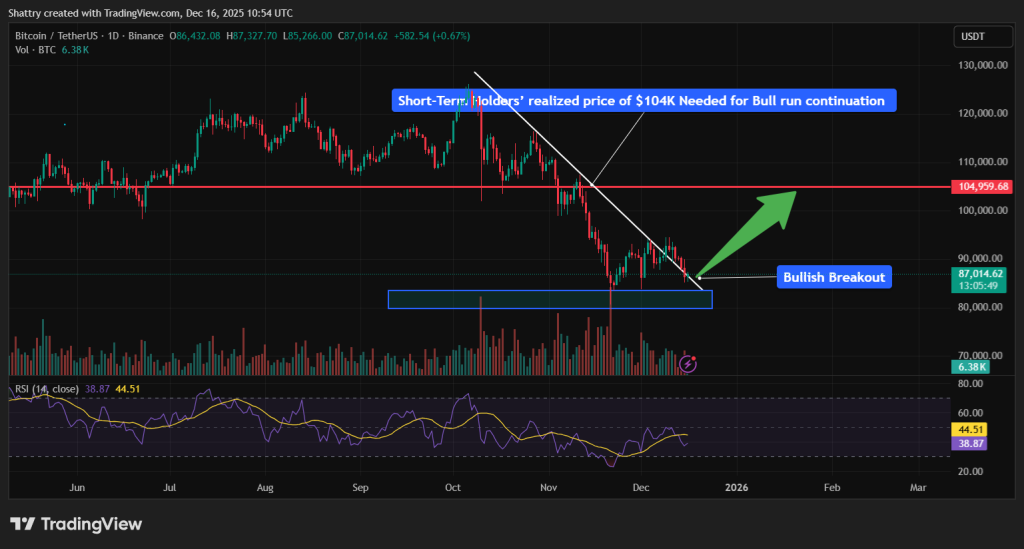
Bitcoin’s daily chart displays price attempting recovery after a sharp corrective downtrend, with the market recently breaking above a short-term descending trendline.

This movement signals potential transition from bearish control to early stabilization, particularly as price maintains above the highlighted demand zone in the low-$80,000 region, which previously absorbed substantial selling pressure.

The most crucial overhead level sits at the short-term holders’ realized price near $104,000, aligning with prior range support turned resistance.

Bitcoin Price Prediction - Bitcoin Price Chart
Source: TradingView

While Bitcoin trades below this zone, upside attempts will likely encounter supply from trapped buyers, restricting follow-through.

The RSI has risen from oversold conditions but stays below the 50 midpoint, suggesting improving momentum without a complete bullish reset.

This favors a scenario where price can advance toward the $92,000–$98,000 region near term, but a sustained bull run remains unlikely unless Bitcoin reclaims and maintains above $100,000–$104,000 on strong volume.

Maxi Doge Offers Investors 72% APY Ahead of Institutional Rally

Increased institutional buying could drive Bitcoin above $100,000 soon, and when this occurs, presale projects like Maxi Doge ($MAXI) would benefit from the massive demand surge.

Maxi Doge is an early-stage meme coin following the Dogecoin playbook that generated over 1000x gains in the years since its launch.

The MAXI presale has raised over $4.3 million and offers 72% annual staking rewards for those entering early at the current price of $0.000273 per token.

Bitcoin Price Prediction - Maxidoge banner

The project offers an alpha channel where traders exchange insider tips, share early trade ideas, and discover hidden opportunities to capitalize on the upcoming bull run.

To buy early, visit the official Maxi Doge website and connect a crypto wallet like Best Wallet.

You can pay with existing crypto like USDT and ETH, or use a bank card to complete your purchase in seconds.

Visit the Official Maxi Doge Website Here

The post Bitcoin Price Prediction: Cathie Wood Says the Bottom Might Be In – Are Institutions About to Trigger the Next Bull Run? appeared first on Cryptonews.

With institutional capital returning, Investor Hash drives reliable wealth growth through AI-powered trading, strong security, and transparent settlement

As institutional capital returns to crypto, Investor Hash emerges as a secure, AI-driven cloud mining platform. As institutional capital becomes active again in the cryptocurrency market, digital asset trading is increasingly vibrant. Investors are seeking efficient, secure, and transparent investment…

XRP Price Is Not Going To $100 By End Of Year, ‘You Need A Reality Check’

Despite the recent crash that saw the XRP price fall below $2, many analysts claim that the cryptocurrency could still skyrocket to $100 by the end of the year. However, one expert has thoroughly dismissed these projections, urging investors to temper expectations and warning that those who believe such predictions need a “reality check.”

Why XRP Can Never Reach $100 By Year’s End

Crypto market expert Zach Humphries has delivered a detailed assessment of XRP, calling out extreme price predictions and overly optimistic expectations, especially during the current downtrend. In a video on X, he warns that claims suggesting XRP will reach $100 by the end of 2025 are unrealistic and potentially misleading for investors and traders. 

Humphries emphasized that while he supports XRP and believes in its long-term potential, the spread of exaggerated price targets in the crypto space is harmful. He explained that many investors assume that owning 100 XRP tokens will make them wealthy quickly, holding on to false hope and unrealistic financial expectations.

The analyst points out the need for realism in the crypto space, arguing that viral hype posts and overinflated price forecasts can hoodwink people into making genuine financial decisions that could lead to losses. He noted that investors need to understand market structure and the underlying math behind XRP’s price action before believing in any extreme predictions. 

Humphries stated a $100 XRP price would imply a $5 trillion market capitalization, surpassing the size of Apple, Microsoft, and even the entire crypto market at some historical peaks. He noted that reaching this seemingly impractical price target would require XRP achieving overnight global adoption, full-scale replacement of existing payment rails, and massive sustained institutional inflows.

The analyst also highlighted a common misunderstanding about liquidity. Humphries explained that for XRP to reach $100, it would require substantial global liquidity. He noted that despite XRP Spot ETFs recording over $1 billion in inflows recently, the cryptocurrency’s price did not rise; instead, it declined further. He highlighted that this is because institutional investors prioritize stability, deep liquidity, and predictability over volatile, high-risk payment assets. 

Although his statements may seem like a critique of XRP’s outlook, Humphries emphasized that the cryptocurrency has genuine strengths, including robust cross-border payment capabilities, strong enterprise relationships, and liquidity. He pointed out that, ironically, the more XRP succeeds as a payment rail, the less explosive its price becomes. 

Analyst Says XRP Could Still Outperform Many Assets

In his video, Humphries stated that XRP has survived many market cycles, making it one of the rare resilient cryptocurrencies. Under the right conditions, he believes that the XRP price could outperform many digital assets, which is why it remains a top altcoin in his portfolio. 

The analyst emphasized the importance of realistic growth driven by gradual institutional adoption, ETF integration, regulatory clarity, and steady price increases tied to actual usage and utility. He highlighted that these factors could help XRP perform very well, potentially reaching new all-time highs.

XRP

Shiba Inu Scores US Regulated Derivatives Entry Via Coinbase

According to reports, Coinbase has launched regulated futures linked to Shiba Inu, opening the token to trading on a US derivatives venue.

The new products include perpetual-style contracts and monthly futures tied to what Coinbase calls the 1k SHIB index (a 1,000 token index), with trading scheduled to run 24/7.

The rollout began on December 5, 2025, as part of a broader push by the exchange to add altcoin derivative listings under US rules.

Regulated Futures Hit The Market

Reports have disclosed that the perpetual contracts operate like offshore swaps in form but are offered through Coinbase’s regulated platform and are designed to include a funding-rate mechanism to keep prices close to spot.

Now live: Trade US Perpetual-Style Futures for all altcoins on Coinbase Derivatives, available 24/7.

→ Shiba Inu $SHIB → Avalanche $AVAX → Bitcoin Cash $BCH → Cardano $ADA → Chainlink $LINK → Dogecoin $DOGE → Hedera $HBAR → Litecoin $LTC → Polkadot $DOT → SUI $SUI →… pic.twitter.com/yjS2XsQ2jN

— Coinbase Markets 🛡 (@CoinbaseMarkets) December 15, 2025

Monthly contracts were made available as an initial phase. Clearing and settlement are handled inside systems compatible with US oversight, and the products are described as compliant with Commodity Futures Trading Commission frameworks.

What Traders And Institutions Might Do

Market participants say having regulated futures can change who trades a token. Institutional desks and some large funds often need regulated venues and clearer custody paths before they increase exposure.

Added liquidity and round-the-clock pricing may attract more active traders, and that could raise volume. At the same time, access to futures also makes it easier to bet against the token, which can push volatility up. Reports note that immediate moves in spot markets have been mixed, showing that access to derivatives does not automatically lift the token’s price.

Because SHIB has regulated futures on Coinbase (“1k Shib Index”), it qualifies for spot ETF consideration under the same SEC pathway Bitcoin and Ethereum followed.

The big picture for SHIB

•SHIB now joins the “ETF-watchlist club” with other futures-backed cryptos. •If/when… pic.twitter.com/cZPxUWWhBn

— 𝐋𝐔𝐂𝐈𝐄 (@LucieSHIB) September 18, 2025

Market Context And Exchange Strategy

Coinbase’s decision follows steps the exchange has taken to grow its derivatives arm. Company filings and public letters in 2025 framed derivatives growth as a strategic priority, and the firm has pursued deals and product launches to expand those capabilities.

One notable deal disclosed earlier involved an agreement valued at close to $3 billion to strengthen derivatives know-how and infrastructure. This background helps explain why Coinbase is offering altcoin futures that trade continuously, under a regulated roof.

Featured image from Gemini, chart from TradingView

Banks Can Soon Issue Stablecoins: FDIC Begins Rulemaking Under GENIUS Act

The Federal Deposit Insurance Corporation (FDIC) has announced a new framework that outlines how banks can apply to issue payment stablecoins through subsidiaries as part of the implementation of the country’s stablecoin bill, the GENIUS Act. 

FDIC’s First Move On GENIUS Act

In a statement, Acting Chair Travis Hill emphasized that the proposed process is tailored to allow the FDIC to thoroughly evaluate the safety and soundness of applications from banks seeking to enter the stablecoin market. 

According to a summary from FDIC staff, banks wishing to issue payment stablecoins will need to submit detailed applications outlining various aspects of their proposed activities.

Each application must include a description of the intended payment stablecoin, along with a comprehensive overview of the subsidiary’s activities. 

Additionally, institutions must provide financial information, details regarding the ownership and control structure of the subsidiary, and pertinent policies related to customer agreements, including provisions for custody. Applicants will need to submit an engagement letter from a registered public accounting firm.

30-Day Review Period For Stablecoin Applications

The FDIC aims to promptly review submissions, notifying stablecoin applicants within 30 days whether their application has been deemed substantially complete. Following that, the agency must make a decision on approval within 120 days from the time the application reaches this status.

“This proposed rule is the FDIC’s first action to implement the GENIUS Act,” stated Acting Chairman Travis Hill. He added that in the coming months, the agency plans to introduce proposals to establish the required management standards for subsidiaries of FDIC-supervised institutions that are approved to issue payment stablecoins. 

The FDIC is also committed to providing comprehensive regulatory clarity regarding activities associated with digital assets and tokenized deposits. The plan will undergo a public consultation period before it can be finalized.

Stablecoins

Featured image from DALL-E, chart from TradingView.com 

XRP Traders Reducing Exposure? Estimated Leverage Ratio Slides Deeper – What This Means For Price

Following the sudden pullback observed across the cryptocurrency market, the price of XRP has fallen sharply, causing it to revisit the $1.8 threshold. With XRP’s price facing heightened bearish pressure, traders appear to be stepping back, raising questions about the current price action.

Leverage Unwinds Across XRP Markets

XRP’s waning price action is starting to trigger a crucial shift in investors’ action and sentiment toward the leading altcoin. A widely monitored derivatives metric outlined by Arab Chain, an author at CryptoQuant, is still trending lower, suggesting that the market risk balance for the altcoin is subtly recalibrating.

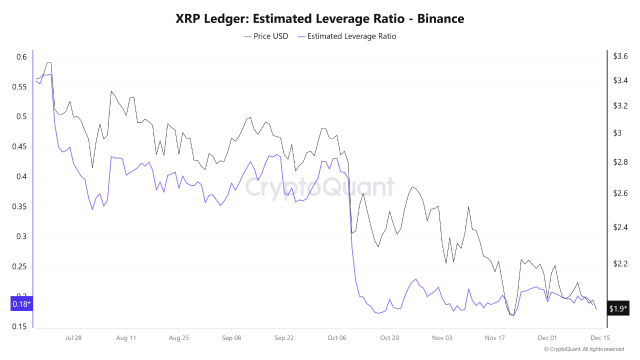
Specifically, the Estimated Leverage Ratio (ELR) for XRP, a metric that monitors the amount of borrowed capital traders use in relation to exchange balances, is showing a persistent downtrend. Typically, a continued decline in the measure is a clear sign of reduced risk in the derivatives market.

After examining the XRP’s ELR on Binance, the world’s largest cryptocurrency exchange, Arab Chain found a persistent decrease to roughly 0.18, reflecting a clear sign of caution in the XRP market on Binance. It is worth noting that this position is one of the lowest levels recorded during the ongoing period, as the price of the token trades close to the $2.00 mark.

XRP

Arab Chain highlighted that the drastic decline in the ELR suggests that investors’ reliance on decrease is decreasing, meaning that most of the funded positions have been closed or limited. Structurally, a decline in leverage is seen as an indication of reduced market fragility.

When this occurs, it lowers the likelihood of forced liquidations, which are caused by sudden price movements. As the market tends to lower risk and reset open positions, this behavior usually happens following times of increased volatility or price corrections. 

Interestingly, the drop is occurring along with a downward trend in XRP’s price compared to its previous levels above $3.00. This synchronicity is a sign that the accumulation of highly leveraged positions does not fuel the price decline. Rather, it is riven by the unwinding of such positions.

In the past, environments like these typically marked transitional phases. During this period, the market transitions from active speculation to a calmer phase concentrated on rebalancing. 

A Stabilization To Kickstart A Rally

Once the metric starts to stabilize again at a relatively low level, Arab Chain noted that it could lay the foundation for more substantial XRP price movements in the future. However, this is expected to happen once liquidity slowly returns to the derivatives market in the absence of excessive leverage.

In other words, low leverage would make any future rally less likely to see a dramatic reversal. While the ELR sits at 0.18, the market is still reconstructing itself and creating a more balanced base prior to calculating its next major direction. Whether it resumes its upside direction or enters a prolonged consolidation phase depends heavily on the metric’s movement.

XRP

RedotPay Raises $107M Series B as Stablecoin Payments Surge to 6M Users Worldwide

RedotPay, a stablecoin payment fintech, has raised $107 million in an oversubscribed Series B funding round showing investor confidence in the role of stablecoins in everyday payments.

This latest funding raise brings RedotPay’s total capital secured in 2025 to $194 million as the company continues to scale rapidly.

Thrilled to share that we’ve successfully closed our Series B funding round, a major step in our mission to make digital finance accessible, secure, and efficient for everyone. 🚀

By building on #blockchain rails, we’re moving beyond traditional #fintech to deliver a faster,… pic.twitter.com/gEvONlLZzO

— RedotPay Official (@RedotPay) December 16, 2025

Rapid User Growth and Surging Payment Volumes

RedotPay said it now serves more than 6 million registered users across over 100 countries. As of November 2025, the platform has surpassed $10 billion in annualized payment volume, with transaction volumes nearly tripling year-on-year.

According to RedotPay more than 3 million new users joined the platform during 2025 through November showing rapid adoption of stablecoin-powered financial services among both crypto-native and mainstream users.

The company said it has also reached a key milestone in monetization, generating over $150 million in annualized revenue while maintaining a profitable, scalable business model.

RedotPay says its growth is driven by infrastructure and strong demand for predictable, borderless payments in markets facing currency volatility, inflation, or limited banking access.

Series B Led by Goodwater, Backed by Crypto Heavyweights

The Series B round was led by Goodwater Capital, with participation from Pantera Capital, Blockchain Capital, and Circle Ventures, alongside continued backing from existing investors including HSG.

“Stablecoin has the potential to disrupt global money flow and strengthen financial inclusion,” said Jin Oh, Partner at Goodwater Capital, adding that RedotPay has demonstrated “remarkable traction” across major markets. Investors highlighted the platform’s ability to translate blockchain infrastructure into real-world payment utility at scale.

Building Stablecoin-Powered Financial Services

RedotPay said it is focused on making fund movement instant, predictable, and borderless through a suite of stablecoin-powered products. These include a stablecoin-based card that allows users to spend digital assets globally, stablecoin payout rails for fast international transfers, and access tools that bridge traditional finance with digital assets via multi-currency accounts and peer-to-peer marketplaces.

“Our goal is to help users manage their finances with confidence through stablecoin-powered financial services,” said Michael Gao, Co-Founder and CEO of RedotPay. He notes that the new funding will accelerate product innovation while expanding the company’s global footprint in a compliance-focused manner.

Scaling Compliance, Talent, and Global Reach

RedotPay plans to deploy the new capital toward strategic acquisitions, licensing, and compliance expansion to support entry into new markets.

The company will also accelerate global hiring across engineering, product, and compliance teams. Looking ahead, RedotPay said it aims to deepen its presence in key growth regions.

The post RedotPay Raises $107M Series B as Stablecoin Payments Surge to 6M Users Worldwide appeared first on Cryptonews.

❌