Leading investment platform Digital Wealth Partners (DWP) has launched a new algorithmic trading strategy for XRP holders. Notably, the initiative enables XRP investors to manage their digital asset exposure within tax-advantaged retirement accounts.
The Marshall Islands has launched a nationwide universal basic income (UBI) program that allows citizens to receive payments via cryptocurrency.
Key Takeaways:
Marshall Islands launches UBI with crypto and traditional payment options.
Payments aim to boost inclusion without replacing jobs.
Most recipients still choose banks or checks over digital wallets.
Under the initiative, every resident citizen is entitled to quarterly payments of roughly $200, or about $800 annually, as the government seeks to offset rising living costs and slow outward migration, according to a report from The Guardian.
The first payments were distributed in late November, with recipients given the option to receive funds through bank deposits, paper checks, or a government-backed digital wallet that delivers payments on the blockchain.
Marshall Islands Says UBI Aims to Boost Inclusion, Not Replace Work
Finance Minister David Paul said the scheme was designed to ensure broad inclusion rather than replace employment income.
“We the government want to make sure no one is left behind,” Paul told the Guardian, adding that the payments are intended to act as a social safety net and a morale boost rather than a substitute for work.
The Marshall Islands, a Pacific nation of around 42,000 people located between Hawaii and Australia, faces unique economic and geographic challenges.
Many communities are spread across remote atolls, complicating the delivery of public services and financial assistance. Officials say the cryptocurrency option was introduced to help overcome those logistical barriers.
The program is funded through a trust established under a long-standing agreement with the United States, partly aimed at compensating the Marshall Islands for decades of US nuclear testing.
The fund holds more than $1.3 billion in assets, with Washington committed to contributing an additional $500 million through 2027.
HISTORIC NEWS
We’re helping tokenize a nation.
The Marshall Islands is launching blockchain-based UBI, giving citizens dollar-denominated tokens they can receive, store, and send peer-to-peer from their phones.
Dr. Huy Pham, an associate professor and crypto-fintech lead at RMIT University, said the initiative represents a global first.
“This is the world’s first national rollout of a UBI program,” he said, noting that the use of blockchain technology at a countrywide level is highly unusual.
The crypto payments are made using a US dollar-pegged stablecoin, a choice officials say provides price stability while allowing fast, traceable transfers across hundreds of islands.
Still, uptake of the digital option remains limited. According to the Marshall Islands Social Security Administration, about 60% of the first payments were made via bank deposits, with most of the remainder issued as checks.
Only around a dozen people have opted to receive their UBI through the digital wallet so far.
Sam Altman’s World Aspires to Create a Global UBI Mechanism
Sam Altman’s World, originally launched as Worldcoin, has also positioned its blockchain initiative as a path toward a global UBI mechanism.
The project’s core idea is to verify each person’s unique human identity using biometric scans. The “Orb” device creates a World ID that proves a user is real and not a bot, enabling fair distribution of its native token, WLD.
Verified users receive allocations of WLD, which some view as a form of UBI within the network, aimed at expanding financial inclusion and economic participation worldwide.
World also launched World Chain, an Ethereum layer-2 blockchain, last year. The network serves its 15 million verified users with a “World ID” obtained via iris scanning.
Digital asset platform Exodus has partnered with crypto payments firm MoonPay to roll out a US dollar-backed stablecoin designed for everyday use.
Key Takeaways:
Exodus and MoonPay plan to launch a fully reserved US dollar stablecoin for everyday payments in early 2026.
The stablecoin will power Exodus Pay, enabling global digital dollar spending with self-custody.
MoonPay and M0 will handle issuance and infrastructure.
The Exodus Movement, known for its self-custodial crypto wallet, said Tuesday that the fully reserved digital dollar is scheduled to launch in early 2026.
The asset will be issued and managed by MoonPay and built using M0, a stablecoin infrastructure platform that enables companies to create and operate custom fiat-backed tokens.
Exodus Pay to Bring Self-Custodial Digital Dollar Spending to Global Users
The yet-to-be-named stablecoin will be integrated into Exodus Pay, a forthcoming payments feature within the Exodus app.
The goal is to allow users to spend and send digital dollars globally while maintaining self-custody, without requiring technical knowledge of cryptocurrencies or blockchain networks.
“Stablecoins are quickly becoming the simplest way for people to hold and move dollars onchain, but the experience still needs to meet the expectations set by today’s consumer apps,” said JP Richardson, co-founder and CEO of Exodus.
He added that the project aims to make digital dollar payments as seamless as traditional financial apps, starting with Exodus Pay.
MoonPay will distribute the stablecoin across its global network, supporting buying, selling, swapping, deposits and checkout services.
According to the companies, this broad integration is intended to give the digital dollar immediate real-world utility for consumers, merchants and partner applications.
The collaboration comes as MoonPay expands its enterprise stablecoin business, launched in November, which focuses on issuing and managing compliant digital dollars across multiple blockchains.
Its integration with M0 allows stablecoins to be programmable and interoperable while remaining tailored to specific product use cases.
“Enterprises want stablecoins that are programmable, interoperable and tailored to a specific product experience,” said Luca Prosperi, co-founder and CEO of M0.
“Our infrastructure is built to support that flexibility at scale.”
GENIUS Act Sparks Renewed Stablecoin Push Across Banks and Crypto Firms
The announcement lands amid a renewed surge of interest in stablecoins following the passage of the GENIUS Act in July, which established a federal regulatory framework for fiat-backed stablecoins in the US.
Since then, banks and crypto firms alike have accelerated their efforts to launch proprietary digital dollars.
This year alone has seen the Trump family-linked World Liberty Financial introduce the USD1 stablecoin, Stripe roll out stablecoin-based accounts in more than 100 countries, and Tether announce plans for a regulatory-compliant token dubbed USAT.
Despite the influx of new entrants, the market remains heavily concentrated. Tether’s USDT dominates with roughly 60% market share and about $186 billion in circulation, while Circle’s USDC holds around 25% with a market capitalization of $78 billion.
Together, the two account for roughly 85% of the $310 billion global stablecoin market.
As the crypto market recovers from the latest pullback, XRP is attempting to climb up from its recent lows. Some analysts have suggested that the cryptocurrency must defend its current levels or risk a 50% drop to levels not seen since 2024.
XRP At Make-Or-Break Level
Amid the start-of-week market correction, XRP recorded a 6% drop toward its lowest level in weeks. The price lost $2.00 support on Monday morning and continued to lose key levels despite uninterrupted institutional interest.
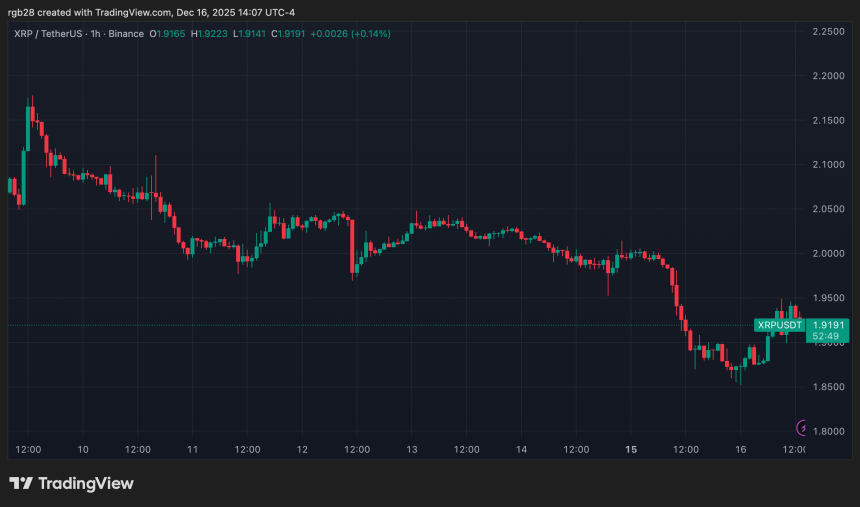
The cryptocurrency has been trading within the $2.00-$2.25 price range over the past month, only losing its lower boundary during the late November pullback. Monday’s correction sent the altcoin below the range’s lower support again, hitting a multi-week low of $1.88 before bouncing around an area that has been crucial for the past year.
Notably, XRP has bounced from the $1.85-$1.90 support zone after every major correction since the November 2024 breakout, climbing back above the $2.00 level each time. However, some market observers have suggested that the price risks a significant correction if it is unable to hold the current levels.
Ali Martinez pointed out that the cryptocurrency has fallen below its one-year price range, between the $1.92-$3.27 levels, which could lead to a 50% drop below this area. To the analyst, XRP’s price must secure a daily close above $1.92 to prevent a drop to the $1.00 support, which has not been seen in over a year.
Similarly, Cheds Trading affirmed that XRP is “flirting with a high time frame breakdown.” Per the chart, the altcoin appears to be forming a high-timeframe rounding top or double top pattern with a higher high.
The analyst noted that in the case of the latter, the M formation would be confirmed if the $1.88 level, where the pattern’s neckline is situated, is lost. This could lead to a “measured move to roughly [the] MA 200 area/$1.00 range.”
Price Ready For 2026 Markup Phase?
Despite the warnings, other market watchers shared a positive outlook for XRP in the coming months. Trader Niels affirmed that the leading altcoin is “looking good” at the current levels.
According to the post, the cryptocurrency is “sweeping the $1.8 support zone again” while showing a bullish divergence on the daily timeframe, which suggests that the price could soon move to higher levels.
To the trader, once XRP breaks above $2.20 resistance, it could surge 27%-37% towards the $2.80-$3.00 area “within a month.”
Meanwhile, analyst ChartNerd highlighted that XRP appears to be repeating its 2023-2024 price action, which led to its massive breakout in November 2024. The chart shows that the altcoin accumulated for a year and a half, bouncing between the range’s lower and upper boundaries before its markup phase in late Q4 2024.
Following this expansion period, the cryptocurrency is showing a similar accumulation range, leading the analyst to suggest that XRP may continue consolidating within its current range before another markup phase occurs.
“Regardless of scenarios, or how ugly/beautiful it gets, a massive markup phase similar to November 2024 is likely between now and late 2026,” he stated.
As of this writing, XRP is trading at $1.92, a 1.65% increase in the daily timeframe.
The US Securities and Exchange Commission (SEC) has officially concluded its investigation into the decentralized finance (DeFi) protocol Aave (AAVE), marking a significant development in the ongoing evolution of regulatory approaches within the cryptocurrency industry.
Stani Kulechov, the founder and CEO of the Aave protocol, confirmed the end of the four-year investigation in a post on social media, expressing relief and optimism about the future of DeFi.
Aave Founder Celebrates End Of SEC Investigation
In his announcement, Kulechov emphasized the considerable effort and resources invested by the Aave team throughout this process. He stated, “We are finally ready to share that the SEC has concluded its investigation into the Aave Protocol.”
Highlighting the impact of regulatory scrutiny on DeFi, he added, “This process demanded significant effort… to protect Aave, its ecosystem, and DeFi more broadly.”
Kulechov expressed hope for a new chapter in which developers can freely innovate and contribute to the future of finance, asserting, “DeFi will win.”
This conclusion is notable against the backdrop of heightened regulatory pressure that DeFi projects have faced in recent years. Under the previous SEC chair, Gary Gensler, the agency made a concerted effort to enforce regulations in the crypto space.
In 2021, the SEC initiated 19 enforcement actions related to cryptocurrency in just the first nine months. However, recent patterns reveal a substantial shift in the commission’s stance on crypto enforcement.
SEC Eases Crypto Enforcement Actions By Over 60%
Since President Donald Trump returned to the White House, the SEC has reportedly eased enforcement actions in over 60% of ongoing cryptocurrency cases.
A New York Times investigation published recently analyzed thousands of government documents and court records, revealing that the SEC has either dismissed, paused, or reduced penalties for a significant majority of active crypto cases since January 20, 2021.
While Trump’s first term saw an average of one high-profile cryptocurrency case per month—including the notable action against Ripple Labs—the current landscape indicates a less aggressive regulatory approach for major players like Binance, Ripple, and Gemini.
Following the administration shift, enforcement actions against these companies have either been withdrawn or significantly softened.
Paul S. Atkins, the newly appointed SEC chair under the Trump administration, has labeled this regulatory shift a “new day” for the cryptocurrency industry.
At the time of writing, the protocol’s native token, AAVE, was trading at $187, having only surged by 1% following the announcement. However, on a year-to-date basis, the AAVE token has seen a significant 52% drop, with prices currently 72% down from the all-time high of $661 reached in May 2021.
Featured image from DALL-E, chart from TradingView.com
Despite recent positive closes from spot XRP ETFs, the cryptocurrency’s price action is sending a clear warning to traders. Market structure remains weak, and without signs of a confirmed reversal, short-term risks persist. XRP’s current behavior highlights that bullish sentiment from ETFs alone isn’t enough to drive a sustained rally, making caution essential for anyone entering the market.
New Year Volatility Hits Crypto Markets Hard
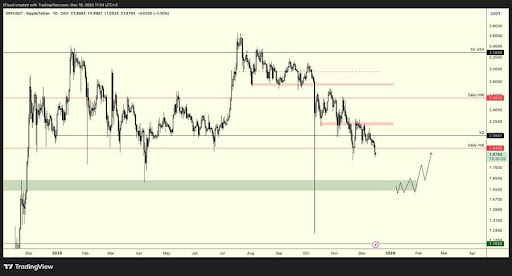
Efloud, in a recent update, highlighted that with the start of the new year and continued uncertainty across the markets, cryptocurrencies have once again been among the hardest hit. Low trading volume and a lack of clear direction have kept pressure on the sector, and without an obvious reversal signal, altcoins continue to grind lower day by day.
Given this backdrop, caution remains essential. As emphasized in previous analyses, any attempt to trade against the prevailing trend at support levels should be backed by clear bullish breakout structures on lower timeframes. Without such confirmation, moves higher are more likely to be short-lived reactions rather than meaningful reversals.
From a technical standpoint, XRP’s price has now lost the “Daily Imb” zone, weakening the overall structure. If price dips below the most recent swing low and then attracts buying interest, the $1.98 area is expected to act as the first major resistance. As previously noted, the outlook remains negative unless the YO region is reclaimed.
Beyond $1.98, another key resistance lies within the red boxed zone. Together, $1.98, the YO area, and the red boxed region form three critical hurdles where price is likely to face selling pressure in the near term.
Price Action Still Outweighs ETF Optimism
According to Efloud, while spot XRP ETFs have posted positive closes for 18 consecutive days, this development alone does not outweigh what the chart itself is signaling. He emphasized that price action and market structure remain the most important factors. Until these begin to shift in a clearly bullish direction, any purchases are better seen as part of a gradual accumulation strategy rather than a confirmation of a trend reversal.
From this perspective, these buys are primarily aimed at averaging down while the market searches for a more stable structure. Efloud added that if market suppression continues and a sharper correction unfolds, the area around $1.53 could emerge as a potential buy zone. However, this scenario depends on broader market behavior and is not a certainty.
Finally, the analyst clarified that the $1.53 level was illustrated as a hypothetical example. Efloud warned that entering positions at support zones or key levels without observing clear breakout or reversal structures carries added risk and should be approached with caution.
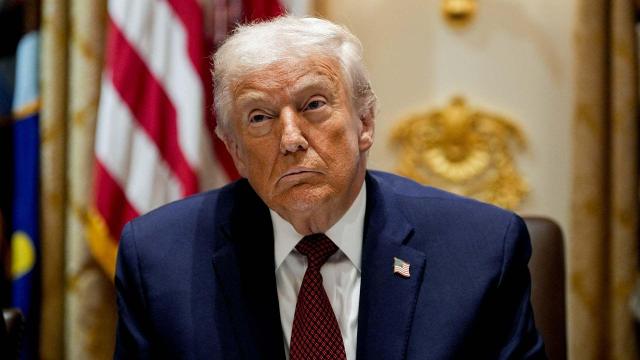
United States President Donald Trump said he would review the case of Keonne Rodriguez, a co-founder of the Samourai Wallet, and signaled he might consider clemency.
According to reporters present at a White House exchange, Trump said he would “take a look” and asked that the matter be examined by the Attorney General.
The comment came after federal prosecutors secured guilty pleas and later sent Rodriguez to prison.
Statement On A High-Profile Sentencing
According to the US Attorney’s Office for the Southern District of New York, Rodriguez and a co-defendant, William Lonergan Hill, pleaded guilty to charges tied to running an unlicensed money-transmitting business and related conspiracy counts.
Reports have disclosed that the service was linked to more than $230 million in criminal proceeds. Prosecutors said those transfers were connected in their factual recitation to narcotics trafficking, darknet markets, cyber intrusions, frauds, sanctioned jurisdictions and other criminal activity.
Sentencing And Legal Outcomes
Based on court filings and public notices, the guilty pleas were entered in late July 2025 and sentencing took place on November 19, 2025.
The Department of Justice has also pursued forfeiture tied to the amounts it described in court, and fines were assessed at the time of sentence.
These actions were carried out by federal prosecutors in Manhattan, who handled the investigation and prosecution.
Responding to Trump’s remarks, Rodriguez said “This President knows all about lawfare.”
I have always said that the most challenging aspect of getting a pardon for me and Bill would be getting the attention of @realDonaldTrump. He is very busy with many people competing for his attention. Today, thanks to the journalist at Decrypt, the President is aware of our… https://t.co/lmYljfFax9
Trump Pardon: How A Presidential Review Might Move Forward
The process for clemency typically involves the Office of the Pardon Attorney at the Justice Department, which vets petitions and may seek input from prosecutors and judges.
The president, however, has broad constitutional authority to grant pardons or commutations for federal offenses.
In this case, press accounts say the president asked that the Attorney General examine the matter, which could lead to a formal review of any clemency petition.
Political And Public Reactions
Reports have varied in tone, with some outlets focusing on the scale of the funds prosecutors said were moved — $237 million — and others highlighting the unusual nature of a president publicly saying he would “look into” an active clemency matter shortly after sentencing.
Legal experts note that public comments from a sitting president can speed attention to a case, but they do not guarantee relief.
Opinions among commentators are mixed; some urge careful review while others stress that federal sentences reflect convictions from established court processes.
Featured image from Bloomberg via Getty Images, chart from TradingView
Join RSBN in a Medal Presentation for defending the Mexican Border at the Oval Office with President Donald TrumpTune in at 1:00 pm EDT on December 15, 2025....
Quantitative Bitcoin and digital asset fund Capriole says the price of Bitcoin could plummet if the network doesn’t develop resistance to quantum computing.
It’s estimated that Bhutan has around 11,286 Bitcoin in total, a stash worth over $986 million, making it the fifth-largest known holder among countries.
While it may be possible for a public company to catch up to Michael Saylor’s Strategy Bitcoin holdings, it is probably unlikely, Bitcoin entrepreneur Anthony Pompliano says.
Recent developments suggest that XRP may be moving toward a fully connected, multi-chain future that could massively change its role in the crypto market. In a recent video commentary, Brad Kimes of Digital Perspectives called attention to multiple developments that may lead to growing interoperability for XRP across dozens of blockchain networks.
HashKey Holdings started trading in Hong Kong on Wednesday with an early pop that quickly cooled, as investors weighed the exchange’s long term pitch against a jittery crypto backdrop.
The company’s shares rose about 6% in the opening stretch, then gave back most of the move and dipped slightly below the IPO price of HK$6.68 later in the morning.
Founded in 2018, the firm runs the city’s largest licensed crypto exchange and also offers brokerage, tokenization and asset management services.
Filings showed strong demand across the book. The institutional tranche drew subscriptions about 5.5 times the stock available, while the retail portion was nearly 394 times oversubscribed.
HashKey Secures Top-Tier Investors As Bitcoin Pulls Back
Investors also stepped into the deal through cornerstone allocations, including Fidelity, UBS, CDH Investments and Cithara Fund. JPMorgan and Guotai Haitong acted among the joint bookrunners.
HashKey Holdings Limited is officially listed on the Main Board of HKEX!
As Asia’s first publicly listed digital asset company via an IPO in Hong Kong, this milestone marks the company's entry into a new stage of development and establishes a stronger foundation for its… pic.twitter.com/fV0IfsRCCu
The debut arrived as crypto prices swung sharply in recent months after earlier record highs. Bitcoin fell as much as 36% in about a month after reaching an all time peak above $126,000 in early October.
Xiao Feng, HashKey’s chairman and chief executive, said he remained upbeat on where digital assets are headed even as prices whipsaw. “My confidence is only growing stronger and I am more optimistic than 10 years ago because there’s more regulation and compliance guidelines for us to follow which will allow the industry to grow further,” he said.
Beijing Curb Meets Hong Kong Embrace Of Digital Assets
Hong Kong has leaned into digital assets even as mainland China keeps a tighter grip after Beijing banned cryptocurrency trading in 2021 and renewed warnings about virtual assets.
Xiao said mainland measures targeted pyramid schemes and fraud using stablecoins, and he framed Hong Kong’s approach as distinct.
“Hong Kong continues to promote policies regarding digital assets and we have benefited from that,” he said. “We should firmly adhere to ‘one country’, but wisely take advantage of ‘two systems.’”
IPO Funds Earmarked For Infrastructure And Expansion
HashKey currently remains loss-making and Xiao said the firm will focus on cash flow in the near term while continuing to invest as the sector develops. The prospectus said it plans to use IPO proceeds on technology infrastructure, market expansion and partnerships, and operational and risk management.
HashKey secured one of the earliest licences under Hong Kong’s 2022 digital asset regime, and research cited in its filing said it accounts for more than 75% of the city’s onshore digital asset trading volume.
Beyond spot trading, it runs on-chain services such as staking, tokenization and custody, and manages billions in client assets through funds and structured products aimed at institutional and high net worth investors.
Robinhood Markets is expanding its sports event contracts to include additional sports wagering capabilities. The platform lets users wager on precise football stats, including the number of touchdowns a player can make, receiving and rushing yards for a player.
The online brokerage unveiled a list of updates to its sports-focused prediction markets business, Reuters reported. The rollout comes just in time for the NFL playoffs, scheduled in January 2026.
Robinhood Launches Enhanced ‘Preset Combos’
According to Robinhood’s official announcement, customers can trade what it calls “preset combos” for individual professional football games. These combine multiple event contracts and only pay out if each event within the combination resolves correctly.
These combos resemble parlay bets in traditional gambling, JB Mackenzie, VP and general manager of futures and international at Robinhood, told CNBC.
“We’re trying to build new customer experiences that make it easier and, in some cases, provide them more advanced order types and trading capabilities to meet the needs that they’re asking us for,” Mackenzie said.
You’ve made trades. You’ve made moves. Now, it’s time to make a choice. Robinhood Presents: YES/NO, streaming live 12/16 at 6:00pm PT / 9:00pm ET on Robinhood X, YouTube, and in-app. pic.twitter.com/QhiBvZt80C
New Player Contracts Let Customers Track, Trade Individual Pro Player
Besides, Robinhood has announced player contracts, which let users track and trade individual pro football player performances.
Player contracts for other sports are forthcoming, Robinhood noted. “These tools give traders greater precision, control, and access to the events they care about most,” the company added.
Event contracts have exploded in popularity since the U.S. presidential election. Since its launch in 2024, Robinhood’s prediction markets has reported 11 billion contracts traded by more than 1 million customers.
“There are a plethora of competitors. But with us being early to market, we’ve been able to fine-tune our product,” said Adam Hickerson, senior director of futures at Robinhood, told Reuters.
The most popular contracts have been in sports. According to the Pew Research Center, 22% of adults in the US said they’ve personally bet money on sports in the past year.
On Tuesday, Robinhood also announced new features for its brokerage platform, including updates to Robinhood Cortex, its AI-powered investing assistant.
Crypto markets staged a tentative rebound even as macro warning signs continued to flash. Bitcoin climbed 2% to reclaim the $87,000 level, while Ethereum remained range-bound near $2,900, according to SoSoValue data. Gains were broad-based across SocialFi, PayFi, RWA, and Layer 1 sectors, with standout moves in TON, TEL, OM, and SUI, though AI and NFT tokens lagged. The rebound comes against a cautious backdrop highlighted by 10x Research, which warned that widespread optimism around 2026 is increasingly disconnected from underlying data. Despite the bounce, the crypto fear and greed index sits at 16, firmly in “extreme fear,” suggesting investor confidence remains fragile.
But what else is happening in crypto news today? Follow our up-to-date live coverage below.
U.S. banks are moving closer to issuing dollar-backed stablecoins after the Federal Deposit Insurance Corporation (FDIC) approved a proposed rule that sets out how FDIC-supervised institutions can apply to do so under the GENIUS Act, a stablecoin law signed earlier this year.
The proposal marks the FDIC’s first concrete step toward implementing the legislation and shows a broader shift in how U.S. regulators are bringing digital payment instruments into the traditional banking system.
The FDIC’s Stablecoin Blueprint: Who Gets In, Who Stays Out
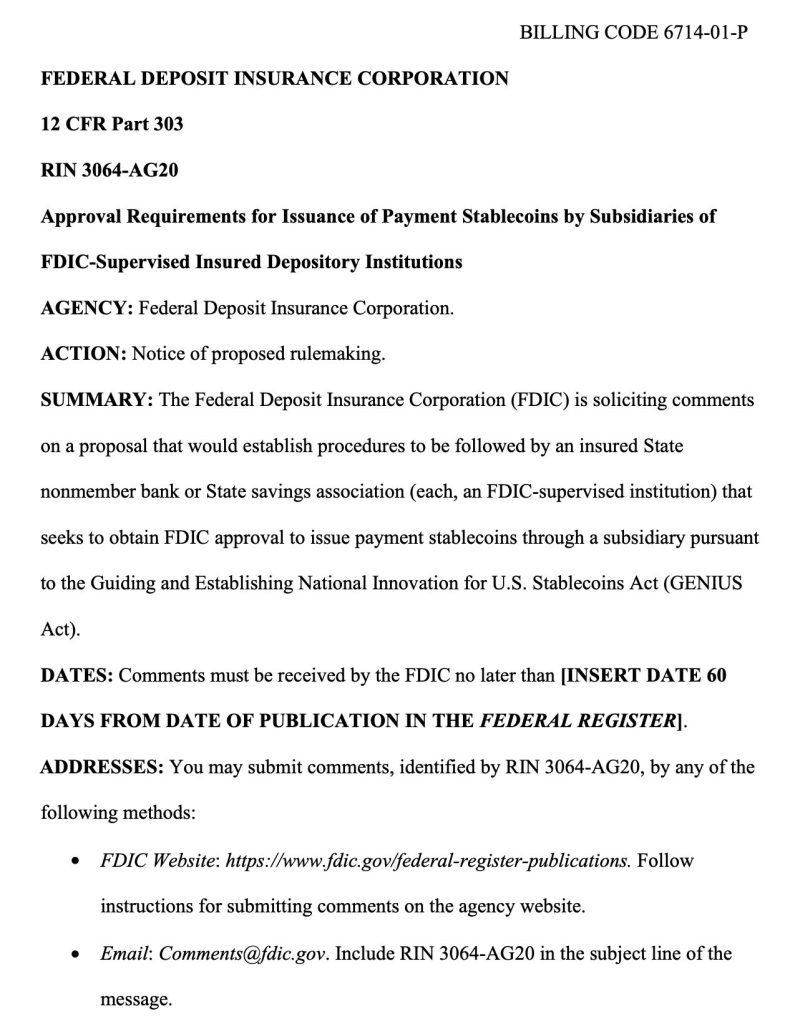
The proposed rule, approved unanimously by the FDIC board on Tuesday, would create a formal application process allowing certain state-chartered banks to issue payment stablecoins through separately capitalized subsidiaries.
The framework applies to state nonmember banks and state savings associations supervised by the FDIC.
These banks would not be permitted to issue stablecoins directly on their balance sheets but could do so through a subsidiary that receives prior approval from the agency.
Under the GENIUS Act, only approved entities known as Permitted Payment Stablecoin Issuers are allowed to issue payment stablecoins in the United States.
A payment stablecoin is defined as a digital asset intended for payments or settlement that maintains a stable value, typically backed one-to-one by cash or highly liquid assets such as U.S. Treasury securities.
The law explicitly states that these stablecoins are not deposits, legal tender, or securities.
Here is the FDIC’s Blueprint for Bank-Issued Tokens
The FDIC’s proposal lays out a detailed application process. Banks would be required to submit written requests explaining the structure of the subsidiary, the design of the stablecoin, and how it would maintain price stability.
Applicants must disclose reserve composition, liquidity arrangements, capital levels, governance structures, redemption policies, and reliance on third-party service providers.
The agency also requires information on ownership, management, and control, and bars approval if key personnel have histories of serious financial crimes.
Reserve requirements form a central pillar of the proposal. Stablecoins issued by approved subsidiaries must be fully backed on a one-to-one basis, with clear policies governing reserve management and asset segregation.
Subsidiaries would also need to explain how users can redeem stablecoins for dollars in a timely and transparent manner, including fee disclosures and advance notice of any changes.
To reinforce oversight, each issuer must retain an independent public accounting firm to verify reserve balances through monthly attestations.
What Happens If Regulators Don’t Act? FDIC’s Stablecoin Timer Explained
The timeline outlined in the rule sharply limits regulatory delay.
The FDIC has 30 days to determine whether an application is substantially complete and 120 days to approve or deny it. If the agency fails to act within that period, the application would be deemed approved by operation of law.
Denials must be justified on safety and soundness grounds, and applicants would have access to a dedicated appeals and hearing process.
Notably, the proposal also includes a temporary safe harbor that allows early applicants to request limited waivers of certain GENIUS Act requirements for up to 12 months.
The FDIC will accept public comments on the proposal for 60 days after it is published in the Federal Register.
The move comes amid a broader recalibration of U.S. crypto and digital-asset policy.
OCC authorizes US banks to facilitate client crypto trades through riskless principal transactions, removing structural barriers to digital asset services.#OCC#USbanks#Cryptohttps://t.co/e2BCyJG9hc
Canada is moving closer to putting rules around stablecoins, and the Bank of Canada wants the guardrails tight.
Governor Tiff Macklem said Tuesday that any future Canadian stablecoins should look and behave like reliable money, not a speculative token with a promise attached.
Macklem’s message was simple. If stablecoins are going to circulate as a payment tool, they must hold their value at par, and they must remain redeemable when it matters most. “We want stablecoins to be good money, like bank notes or money on deposit at banks,” he said.
To get there, he set out two core conditions. “A stablecoin must be pegged at a one-to-one ratio to a central bank currency and be backed by high-quality liquid assets so that it can always be converted to cash at par,” he told the Montreal Chamber of Commerce said.
In practice, that means reserve assets that can be sold quickly without taking big losses, typically government-backed instruments such as treasury bills and government bonds.
Bank Of Canada Calls For Clear, Fee-Free Stablecoin Exit Paths
Macklem also pushed for clarity on the user experience, not just the balance sheet. He said issuers should fully disclose the conditions for redeeming stablecoins, including the timing and any fees, so consumers and businesses know exactly what they are buying into before they rely on the token for payments.
Ottawa wants to modernize Canada’s financial system, and it has pointed to stablecoins as one piece of a broader push to keep pace with other economies, including the United States, that are already building rules for fiat-pegged digital tokens.
Canada will introduce its first federal framework for fiat-backed stablecoins under the 2025 budget, following the US model.#Canada#Stablecoinhttps://t.co/PjX4xPix3x
Canada’s urgency also reflects a wider shift. Stablecoins have pushed further into mainstream finance after the GENIUS Act in the United States created a clearer framework for dollar-backed stablecoins, a move that supporters say could accelerate adoption.
Stablecoins Get Rules, Not Endorsements, From Canada’s Central Bank
As more dollar stablecoins circulate globally, policymakers in other countries have started to worry about monetary sovereignty and what happens if local users default to foreign digital dollars for everyday transactions.
That is why Macklem framed his stance as pragmatic rather than promotional. “It’s not really up to the Bank of Canada to encourage stablecoins or discourage stablecoins. What is up to the Bank of Canada is to ensure that if Canadians, Canadian businesses want to use stablecoins, they are, in fact, stable,” he said in a news conference after his speech.
Stablecoin Oversight Tied To Canada’s Payments Modernization Push
The finance ministry has argued that a proper framework would build trust so fiat-backed stablecoins are safe and secure for consumers and businesses to use, and it has said the central bank will act as the regulator.
Macklem tied the stablecoin conversation to a larger upgrade cycle in Canadian payments. He said 2026 should bring more innovation as the country modernises infrastructure, including the Real-Time Rail system designed to enable instant settlement for consumers and businesses, including cross-border use cases.
He also pointed to open banking as another pillar, saying the Bank of Canada intends to work on implementation that would make it easier for customers to compare services and switch banks.
Securitize will introduce a new onchain trading experience for public stocks in early 2026, blending traditional market access with blockchain-based settlement and trading. Securitize is preparing to offer the first fully compliant, onchain trading of natively tokenized public stocks in…
The Hyper Foundation has proposed treating all HYPE held in its Hyperliquid Assistance Fund as permanently burned, removing the tokens from supply via validator vote. A governance proposal released by the Hyper Foundation would exclude all HYPE held in the…
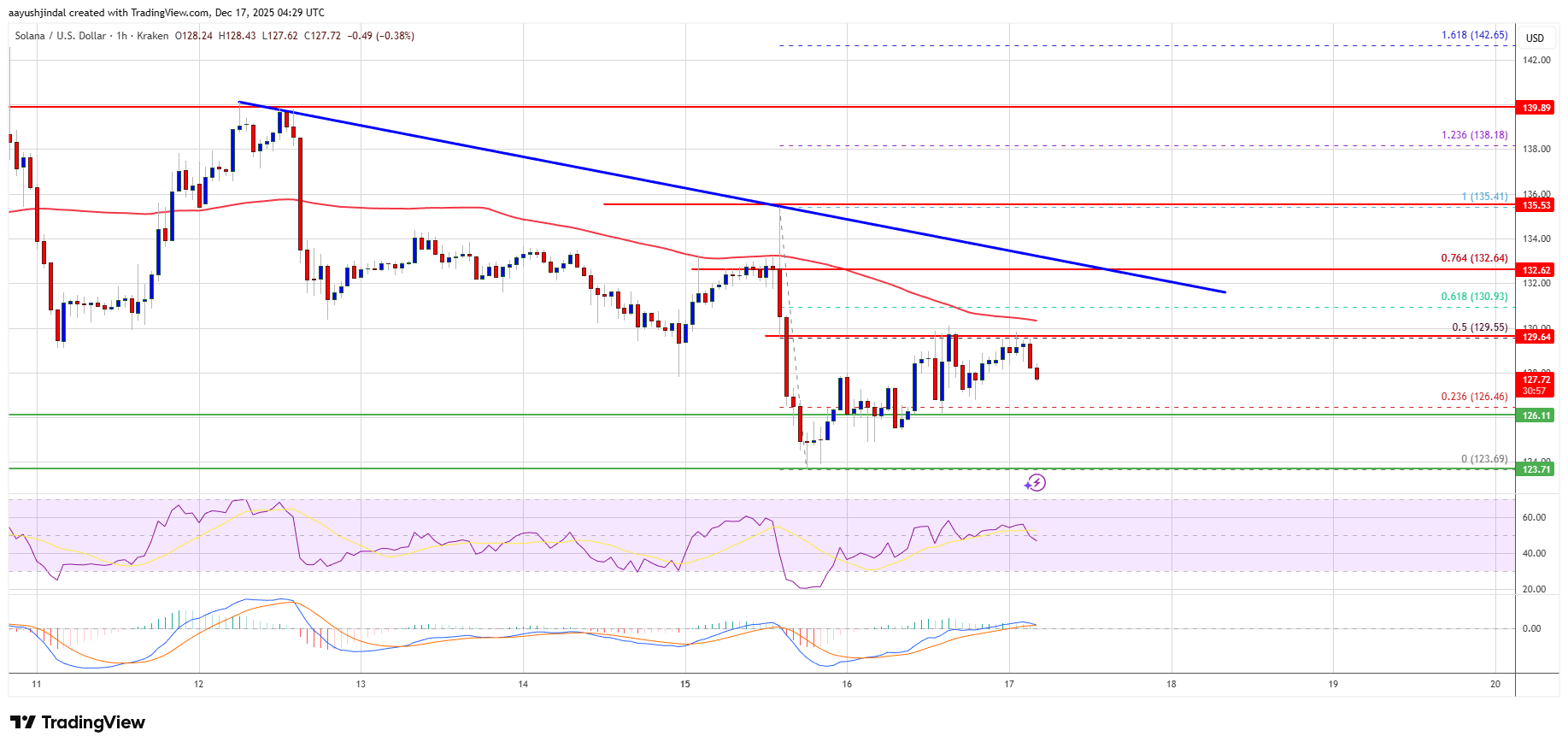
Solana started a recovery wave above the $126 zone. SOL price is now consolidating and faces hurdles near the $132 zone.
SOL price started a decent recovery wave above $126 and $128 against the US Dollar.
The price is now trading below $130 and the 100-hourly simple moving average.
There is a key bearish trend line forming with resistance at $132 on the hourly chart of the SOL/USD pair (data source from Kraken).
The price could continue to move up if it clears $130 and $132.
Solana Price Faces Resistance
Solana price remained stable and started a decent recovery wave from $124, like Bitcoin and Ethereum. SOL was able to climb above the $126 level.
There was a move above the 23.6% Fib retracement level of the downward move from the $136 swing high to the $124 low. The bulls even pushed the price above $130. However, the bears remained active near $130. There is also a key bearish trend line forming with resistance at $132 on the hourly chart of the SOL/USD pair
Solana is now trading below $130 and the 100-hourly simple moving average. On the upside, immediate resistance is near the $130 level, the 100-hourly simple moving average, and the 61.8% Fib retracement level of the downward move from the $136 swing high to the $124 low.
The next major resistance is near the $132 level. The main resistance could be $135. A successful close above the $135 resistance zone could set the pace for another steady increase. The next key resistance is $144. Any more gains might send the price toward the $150 level.
Another Decline In SOL?
If SOL fails to rise above the $132 resistance, it could continue to move down. Initial support on the downside is near the $126 zone. The first major support is near the $124 level.
A break below the $124 level might send the price toward the $116 support zone. If there is a close below the $116 support, the price could decline toward the $108 zone in the near term.
Technical Indicators
Hourly MACD – The MACD for SOL/USD is gaining pace in the bearish zone.
Hourly Hours RSI (Relative Strength Index) – The RSI for SOL/USD is below the 50 level.
Bitcoin, Ethereum, and other digital assets have witnessed a sharp retrace during the last 24 hours, which has resulted in a long squeeze on derivatives exchanges.
Crypto Long Liquidations Have Neared $600 Million During The Past Day
According to data from CoinGlass, the latest sharp price action in the cryptocurrency market has accompanied a huge amount of liquidations over at the derivatives side of the sector.
“Liquidation” here naturally refers to the forceful closure that any open contract has to undergo after it has amassed losses of a certain degree. For long investors, this happens when the asset’s price drops, while for shorts, liquidation occurs after a surge.
How much the cryptocurrency will have to move in one direction to liquidate a specific position comes down to the percentage threshold defined by the platform and the amount of leverage that the trader has opted for. During sharp price swings, positions with high amounts of leverage attached are the first to go.
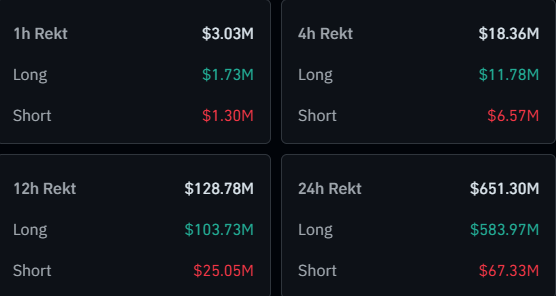
Bitcoin and other assets have faced some notable volatility during the past day, which has once again caught out traders on the derivatives market. As the table below shows, liquidations have crossed $650 million over the last 24 hours.
About $584 million of these liquidations involved long positions alone. That’s equivalent to almost 90% of the total, showcasing how disproportionate the price volatility has been during this period.
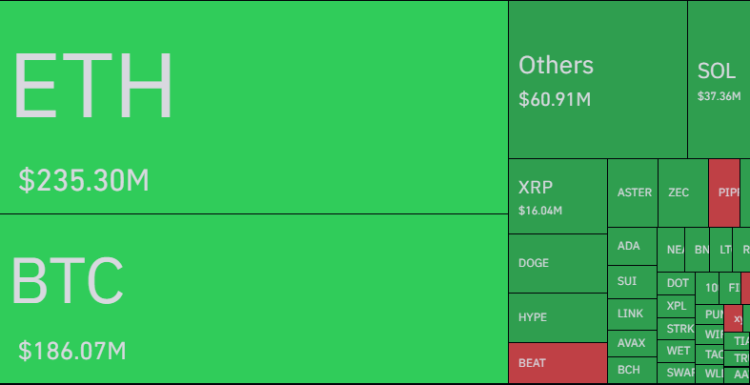
In terms of the individual symbols, the largest contributor to the liquidation event has been Ethereum, not Bitcoin, as is often the case.
With over $235 million in contracts involved, Ethereum has notably outpaced Bitcoin, which has witnessed $186 million in liquidations. ETH facing more liquidations is likely due to the fact that its price drawdown has been stronger during the past day.
Out of the altcoins, Solana has come out on top with $37 million in positions flushed, ahead of XRP ($16 million) and Dogecoin ($12 million). Interestingly, SOL has outperformed the two despite its losses being more limited.
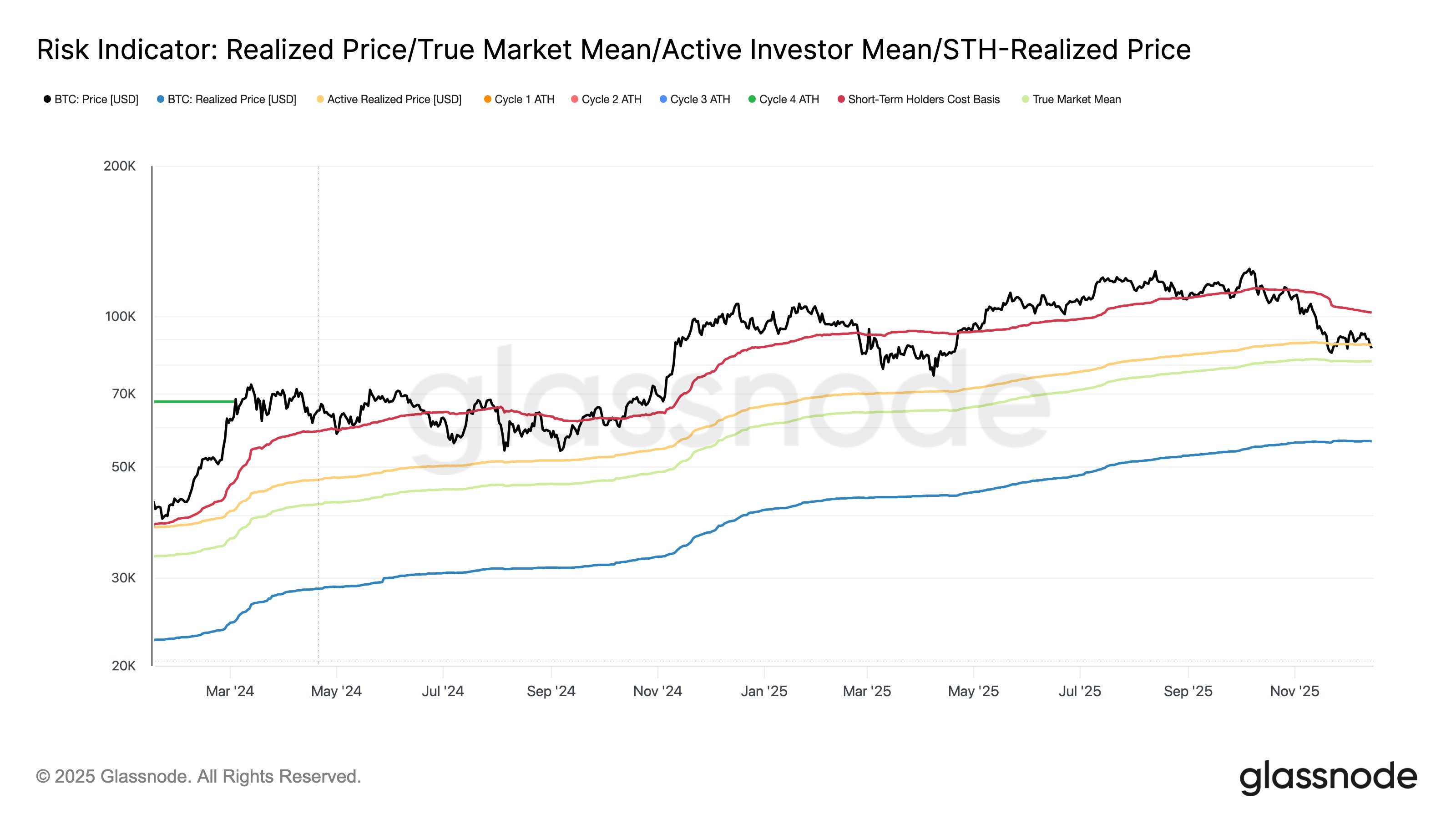
In some other news, the latest Bitcoin decline has meant that its price has fallen back under a key on-chain price level, as the chart shared by analytics firm Glassnode shows.
The level in question is the Active Realized Price, corresponding to the cost basis of the active participants on the Bitcoin network. Currently, it’s located at $87,900, which is above the cryptocurrency’s spot price.
Thus, it would appear that the latest dip has put the active investors as a whole into a state of net unrealized loss.
Bitcoin Price
At the time of writing, Bitcoin is floating around $87,200, down more than 3% over the last seven days.

 Login
Login


 (@moonpay)







 HashKey Holdings Limited is officially listed on the Main Board of HKEX!


 OCC authorizes US banks to facilitate client crypto trades through riskless principal transactions, removing structural barriers to digital asset services.
 Canada will introduce its first federal framework for fiat-backed stablecoins under the 2025 budget, following the US model.