Reading view

There are new articles available, click to refresh the page.

Bonk Price Prediction: BONK ETP Launches in Europe – Could This Spark the First Institutional Meme Coin Run?

The Bonk price has risen to $0.000009452 today, marking an 8.5% gain in a week as the market prepares for a possible FOMC rate cut on Wednesday.

BONK is now also up by 5.5% in the past fortnight, yet it remains down by 28% in a month and by a worrying 79% in a year.

However, there are strong signs that it may be about to turn a corner, with Bonk partnering with Bitcoin Capital to launch Europe’s first-ever BONK exchange-traded product last week.

This could invite substantial institutional investment in the token, allowing for a very positive Bonk price prediction as we move into 2026.

Bonk Price Prediction: BONK ETP Launches in Europe – Could This Spark the First Institutional Meme Coin Run?

Bonk and Switzerland-based ETP issuer Bitcoin Capital launched the Bonk Exchange Traded Product on SIX Swiss Exchange, which is the third-largest stock exchange in Europe.

As Bitcoin Capital explains in its accompanying blog, the new ETP enables institutional and retail investors to buy and sell Bonk just like a traditional stock, something which could help to expand demand for the popular meme coin, which first launched in December 2022.

Bonk highlights a major ecosystem milestone! 💥Launch of regulated BONK ETP on SIX Swiss Exchange (@sixgroup) powered by @Bitcapital_ch!

Another step in bridging the gap between traditional finance and the BONK ecosystem. 🤝

🔗 Read the press release for full details:… pic.twitter.com/K19pwwdf3z

— Bonk, Inc. (@bonkincBNKK) December 8, 2025

The ETP’s arrival may have come at just the right time, since the Solana-based BONK has declined by 83.7% since reaching an ATH of $0.00005825 in November 2024, not long after Donald Trump won the U.S. presidential election.

Since then, it has gone through two cycles of boom and bust, with the coin rising to a seven-month high of $0.00003877 in July, only to its current level.

If we look at its chart today, we see that it has been in a heavily oversold position since August.

However, its relative strength index (yellow) has begun to rise towards 50 after plunging below 30 in late November, a sign of an impending recovery.
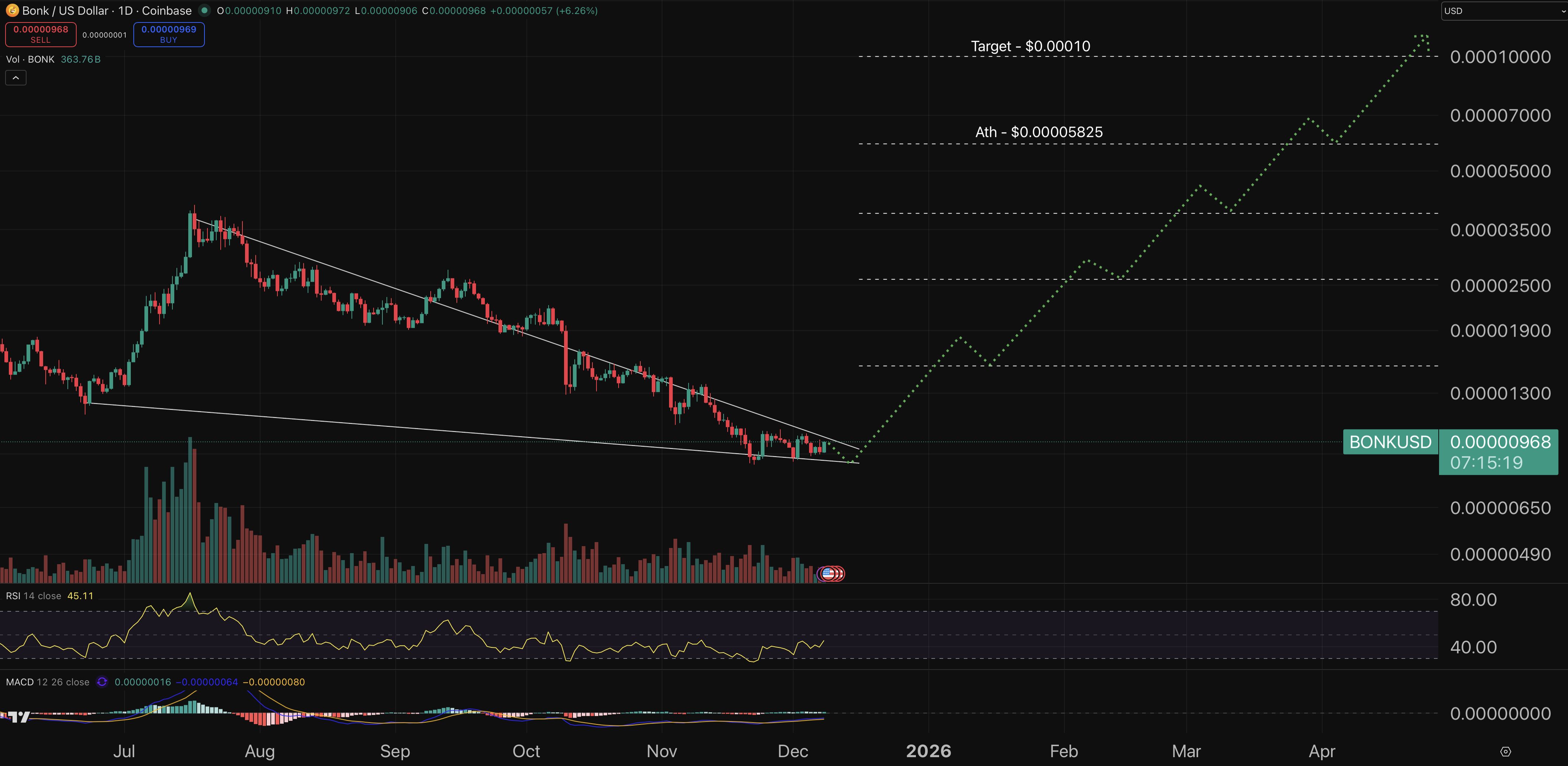
BONK price prediction chart.
Source: TradingView

We can say something similar about its MACD (orange, blue), which has also been negative since August.

Normally, this would mean that a more positive phase of growth is long overdue, and the launch of the Bonk ETP may be the catalyst that sets off a recovery.

The aforementioned FOMC meeting could be another catalyst, with analysts expecting the Fed to cut rates by another 0.25% Wednesday.

Combined with the ETP launch, and with the arrival of other altcoin ETFs in the States, this could help push the Bonk price higher.

It has the potential to reach $0.0000150 by the end of January, and to pass its current ATH of $0.00005825 by H2 2026.

PEPENODE Raises $2.3 Million As Presale Hots Up: Is This 2026’s Big Winner?

While BONK certainly has the potential to recover strongly in the coming months, unconvinced traders may want to seek alternatives.

One possibility is to look at presale coins, since these can rally strongly when they list for the first time, especially if they’ve had popular sales.

An example that fits this bill is PEPENODE ($PEPENODE), a new Ethereum-based token that’s planning to shake up cryptocurrency mining.

Whatever it takes to get the Node Upgrade. 🔥⛏https://t.co/FaKIaBpf4I pic.twitter.com/oxKHfS1QBY

— PEPENODE (@pepenode_io) December 1, 2025

It has now raised just over $2.3 million in its presale, which will end in 30 days.

PEPENODE will enable users to participate in mining without having to invest in expensive mining hardware and facilities, as you’d have to with proof-of-work tokens such as Bitcoin.

Instead, PEPENODE invites users to build and operate their own virtual mining rigs, which they can expand by spending PEPENODE tokens on more virtual nodes.

More nodes result in greater words, while users can also upgrade their nodes and combine them in novel ways, increasing their rewards even further.

PEPENODE will pay out mining rewards in the form of external tokens, such as the original Pepe and Fartcoin (more coins will be added in the future).

This should create a strong incentive to buy more PEPENODE tokens, pushing its price up over time.

Investors can buy it now, before it potentially surges, by going to the official PEPENODE website and connecting a compatible wallet (e.g. Best Wallet).

The token currently costs $0.0011873, which is its final presale price before the sale ends.

Interested investors should therefore act quickly, since the available signs suggest that PEPENODE could be one of 2026’s biggest new coins.

Visit the Official Pepenode Website Here

The post Bonk Price Prediction: BONK ETP Launches in Europe – Could This Spark the First Institutional Meme Coin Run? appeared first on Cryptonews.


BlackRock Expands Beyond $11B ETH Fund With Staked Ethereum ETF Filing

BlackRock is advancing further into digital asset investment products with a filing for the iShares Staked Ethereum Trust ETF, its first U.S. product that offers direct staking exposure for institutional investors.

The official prospectus filing for ishares Staked Ethereum ETF, their fourth crypto filing. Spot btc, eth, btc income and now this. pic.twitter.com/M6vRxiGm78

— Eric Balchunas (@EricBalchunas) December 8, 2025

The move expands upon the firm’s existing Ethereum fund, which now exceeds $11 billion in assets, and reflects the growing market appetite for yield-generating crypto strategies.

The preliminary prospectus, dated December 5, describes a vehicle that will reflect ETH price performance while also capturing rewards from staking a portion of its holdings.

The trust will issue shares representing fractional beneficial interests in its ether assets, which will be held in custody on behalf of investors. Staking rewards, once received, are intended to enhance net asset value, though the filing cites regulatory and operational risks that could impact distribution and performance.

Multi-Custodian Structure Anchored by Coinbase and BNY Mellon

The filing outlines a layered custody and administration model. Coinbase Custody Trust Company is slated to serve as the ETH custodian, while The Bank of New York Mellon will act as cash custodian and administrator.

Anchorage Digital Bank is listed as an additional custodian, strengthening the trust’s regulated oversight and redundancy. BlackRock Fund Advisors will serve as trustee, and iShares Delaware Trust Sponsor LLC is listed as the sponsor of the trust. The structure indicates a clear intention to position the product as a compliant infrastructure designed for institutional comfort and risk management.

Provider-Facilitated Staking, Not Validator Operation

Instead of running validator infrastructure directly, the trust will rely on approved third-party staking service providers. The sponsor will determine how staking is allocated based on provider performance, reliability, and reputation.

Staking operations may be executed through affiliates of the custodians or other regulated partners, with the prospectus noting both reward potential and slashing risk as material considerations for investors.

The trust intends to issue shares continuously and list on NASDAQ under the ticker “ETHB”, with creation and redemption occurring in standardized baskets of 40,000 shares.

Institutional Demand Shifts Toward Yield-Bearing Crypto Products

BlackRock’s filing indicates a strategic shift as institutional investors increasingly seek exposure beyond price-only products and toward yield-bearing, tokenized financial instruments. If approved, the ETF may help define how staking rewards are classified, a topic still evolving in U.S. regulatory circles.

The staked ETH ETF positions BlackRock at the center of this transition, reflecting its ambition to shape the next phase of digital asset adoption, one in which exposure is not merely speculative but grounded in the operational economics of blockchain networks.

BlackRock’s Bitcoin ETF Bleeds $2.7B

Meanwhile, BlackRock’s iShares Bitcoin Trust has logged its longest stretch of weekly withdrawals since the fund launched in January 2024, marking a sharp turn in institutional sentiment toward Bitcoin even as prices steady. Investors pulled more than $2.7 billion from the fund over the five weeks ending Nov. 28, according to data from SoSoValue.

Redemptions continued on Thursday with an additional $113 million, putting the ETF on track for a sixth consecutive week of outflows.

The post BlackRock Expands Beyond $11B ETH Fund With Staked Ethereum ETF Filing appeared first on Cryptonews.

Aave price could explode above $200: here’s the forecast

  • Aave price jumped to highs of $200 as cryptocurrencies recorded an uptick on December 8, 2025.
  • While market sentiment is weak, bulls could dominate price action toward $300.
  • Decentralized finance and overall bullish conditions will be key to the AAVE price.

Aave is in the green on the day as the decentralized finance heavyweight’s token captures renewed investor attention.

On Monday, AAVE traded at $193 at the time of writing, having touched highs of $200 and reflecting a robust recovery from recent dips.

With bullish forecasts for Bitcoin and the broader market, it appears gains position AAVE for a potential explosive growth.

AAVE price gains amid altcoin surge

AAVE has been in a downtrend for over three months and remains constrained.

However, the DeFi token has posted a slight uptick over the past week, and current prices are well above the lows of $147 reached on November 21, 2025.

On Monday, the token climbed to highs of $200 before paring gains to around $193.

The Aave token’s uptick coincides with a broader altcoin bounce on Dec. 8.

As Bitcoin showed resilience above $90k, Ethereum broke above $3,100, Solana touched $136, and Chainlink advanced above $13.

For Aave, gains over the week stood at 17%, coming amid major stablecoin transfers and increased buzz around DeFi growth.

Aave is proving what stablecoin adoption at scale looks like.

→ $5B in USDC current supply on Ethereum V3
→ +138% USDC growth YTD on Ethereum
→ USYC live in Horizon, Aave’s RWA market

All figures from Jan '25 – Dec.

USDC is becoming a collateral layer for the next era of… pic.twitter.com/GkLd6fAyr3

— Circle (@circle) December 5, 2025

On Dec. 5, the Aave lending pools witnessed huge USDT transactions, moves that highlight increased borrowing demand and liquidity.

Analysts see this and whale activity as potential catalysts for further gains.

AAVE price forecast

The current market outlook for cryptocurrencies aligns with broader risk asset and seasonal trends.

December has historically delivered notable gains for investors amid “Santa rallies”.

Aave’s 17% surge in the past week mirrors this outlook, even if it’s still early days.

Investors are also eyeing the Federal Reserve’s anticipated rate cut this week.

Bulls could sparkle above the $200 mark. However, volatility remains a concern, and support levels could be much lower.

From a technical point of view, key indicators point to short-term advantage for Aave bulls.

Price is above the critical resistance and support level at $178.

As can be seen on the chart below, buyers breached this level as the AAVE price pumped to highs of $385 between May and August 2025.

However, declines from the year-to-date peak also saw bears plunge the token’s value past $178 to lows of $147 in November. Prior to this, AAVE had crashed to $128 on October 10, 2025.

This means the token is in a descending channel.

AAVE Price Chart
Aave price chart by TradingView

The Relative Strength Index (RSI) reading currently hovers at 52. It’s upsloping and indicative of likely further room for upside movement. Bulls can do this without immediately entering the overbought territory.

Notably, the token recently broke above its 50-day exponential moving average (EMA) as bulls rallied.

This happened as part of a classic bullish confirmation move that has historically preceded significant upside action.

Aave’s daily chart shows the 50EMA is at $201.

Bearish risks, such as a Bitcoin correcting below $90,000, could cap gains at this mark.

However, bulls riding an upward wave could break higher, with $227 and $320 key levels.

The post Aave price could explode above $200: here’s the forecast appeared first on CoinJournal.

Crypto Market On Alert As This Week’s Fed Decision Isn’t Just About Rates

Crypto markets head into this week’s Federal Reserve meeting focused less on rate cut and more on whether Jerome Powell quietly declares the start of quantitative easing (QE). The key question on Wednesday for macro-sensitive traders is whether the Fed shifts into a bill-heavy “reserve management” regime that starts rebuilding dollar liquidity, even if it refuses to call it QE.

Futures markets suggest the rate decision itself is largely a foregone conclusion. According to the CME FedWatch Tool, traders are assigning roughly 87.2% odds to a 0.25 percentage point cut, underscoring that the real uncertainty is not about the size of the move, but about what the Fed signals on reserves, T-bill purchases and the future path of its balance sheet.

Former New York Fed repo specialist and current Bank of America strategist Mark Cabana has become the focal point of that debate. His latest client note argues that Powell is poised to announce a program of roughly 45 billion dollars in monthly Treasury bill purchases. For Cabana, the rate move is secondary; the balance-sheet pivot is the real event.

Cabana’s argument is rooted in the Fed’s own “ample reserves” framework. After years of QT, he contends that bank reserves are skirting the bottom of the comfortable range. Bill purchases would be presented as technical “reserve management” to keep funding markets orderly and repo rates anchored, but in practice they would mark a turn from draining to refilling the system. That is why many in crypto describe the prospective move as “stealth QE,” even though the Fed would frame it as plumbing.

What This Means For The Crypto Market

James E. Thorne, Chief Market Strategist at Wellington Altus, sharpened the point in X post. “Will Powell surprise on Wednesday?” he asked, before posing the question that has been echoing across macro desks: “Is Powell about to admit on Wednesday that the Fed has drained the system too far and now has to start refilling the bathtub?” Thorne argues that this FOMC “is not just about another token rate cut; it is about whether Powell is forced to roll out a standing schedule of bill-heavy ‘reserve management’ operations precisely because the Fed has yanked too much liquidity out of the plumbing.”

Thorne ties that directly to New York Fed commentary on funding markets and reserve adequacy. In his reading, “By Powell’s own framework, QT is done, reserves are skirting the bottom of the ‘ample’ range bordering on being too tight, and any new bill buying will be dressed up as a technical tweak rather than a confession of error, even though it will plainly rebuild reserves and patch the funding stress that the Fed’s own over-tightening has triggered.” That framing goes to the heart of what crypto traders care about: the direction of net liquidity rather than the official label.

Macro analysts followed closely by digital-asset investors are already mapping the next phase. Milk Road Macro on X has argued that QE returns in 2026, potentially as early as the first quarter, but in a much weaker form than the crisis-era programs.

They point to expectations of roughly 20 billion dollars a month in balance-sheet growth, “tiny compared to the 800bn per month in 2020,” and stress that the Fed “will be buying treasury bills, not treasury coupons.” Their distinction is blunt: “Buying treasury coupons = real QE. Buying treasury bills = slow QE.” The takeaway, in their words, is that “the overall direct effect on risk asset markets from this QE will be minimal.”

That distinction explains the tension now gripping crypto markets. A bill-only, slow-paced program aimed at stabilizing short-term funding is very different from the broad-based coupon buying that previously compressed long-term yields and turbo-charged the hunt for yield across risk assets. Yet even a modest, technically framed program would mark a clear return to balance-sheet expansion.

For Bitcoin and the broader crypto market, the immediate impact will depend less on Wednesday’s basis-point move and more on Powell’s language around reserves, Treasury bill purchases and future “reserve management” operations. If the Fed signals that QE is effectively starting and the bathtub is starting to be refilled, the liquidity backdrop that crypto trades against in 2026 may already be taking shape this week.

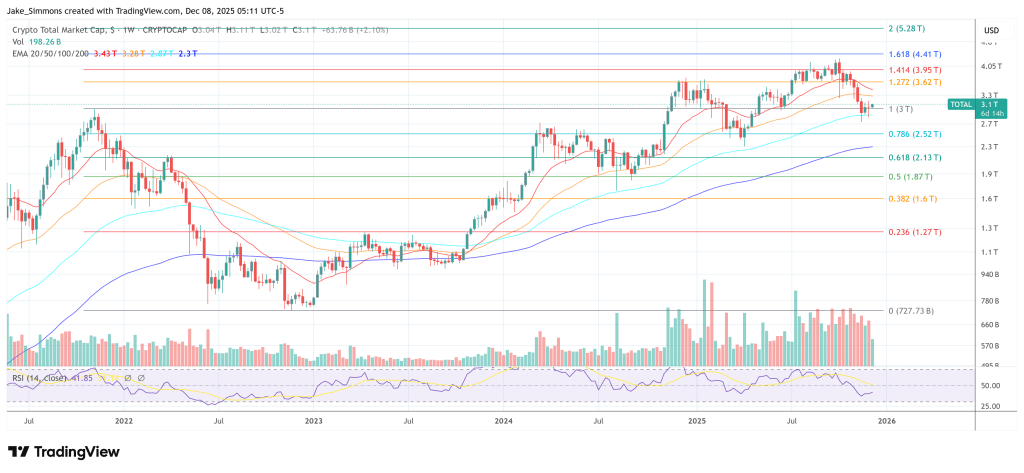
At press time, the total crypto market cap was at $3.1 trillion.

Total crypto market cap

Bitcoin Bulls Eye $94K Breakout Ahead of Crucial FOMC Rate Cut Decision

Bitcoin Magazine

Bitcoin Bulls Eye $94K Breakout Ahead of Crucial FOMC Rate Cut Decision

Bitcoin Price Weekly Outlook

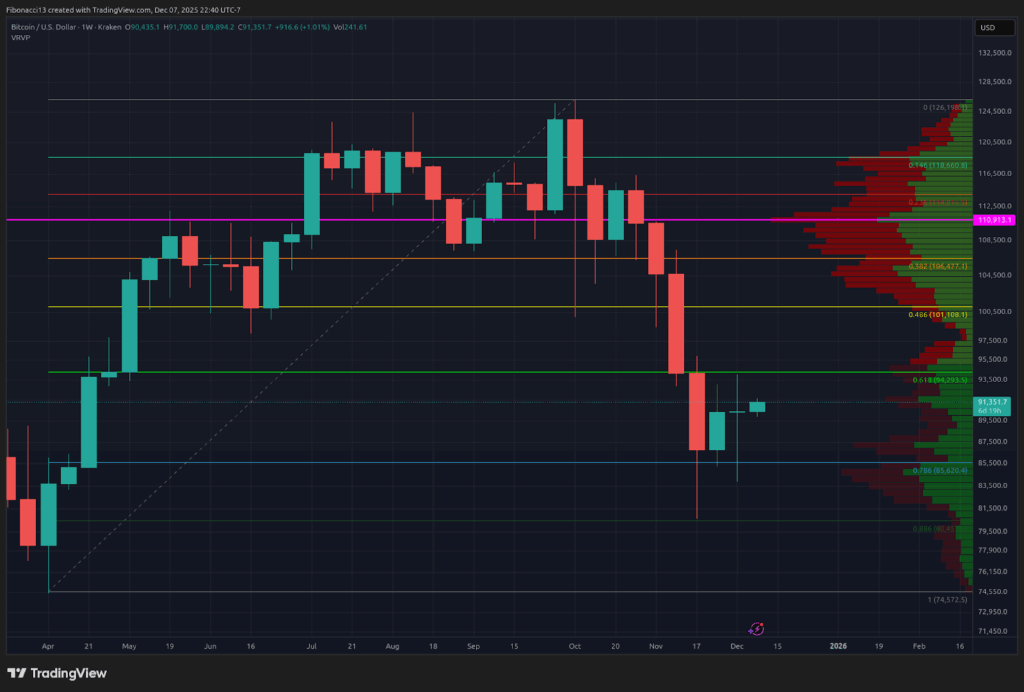
Last week was a bit of a roller coaster ride, while bears kicked the price down to the $84,000 support level early in the week, bulls stepped in down there to rally the price up to the $94,000 resistance level. From there, the price dropped once again, just below $88,000 on Sunday morning, before seeing a small rally to close the week out at $90,429. This week, bitcoin bulls will look to the FOMC meeting on Wednesday to produce a much-anticipated rate cut to help facilitate a better investment environment for bitcoin and other assets. Climbing above $94,000 will be key for the bulls this week, if they hope to sway the market more in their favor.

Key Support and Resistance Levels Now

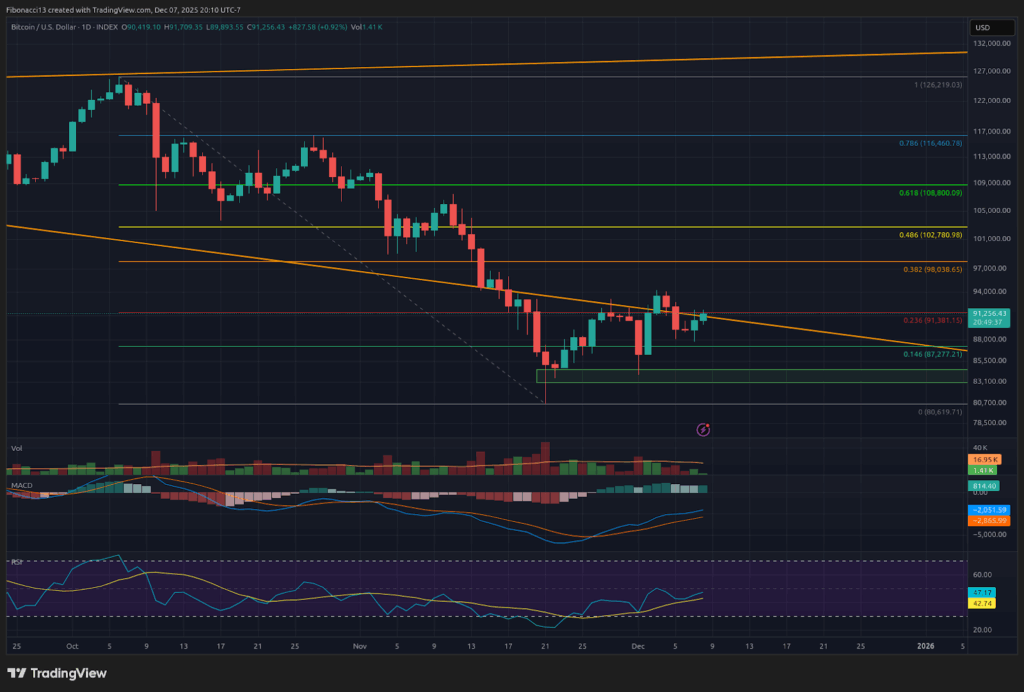
Bitcoin closed the week as a doji candle on Sunday, indicating indecision between buyers and sellers. The short-term outlook is slightly in the bulls’ favor, who will look to conquer the $94,000 resistance level. If they can establish this level as support, they will look to $101,000 as the next major resistance level, with sellers likely to begin slowing momentum down above $96,000. Beyond $101,000, we look to $104,000 and then a resistance zone between $107,000 and $110,000. Resistance gets very thick above $100,000.

Looking down to support levels, bulls will want to see $87,200 hold any daily closes to avoid another test of the $84,000 support level below. Any further touches of $84,000 will weaken it and make it less likely to remain in place as a floor. There is a $72,000 to $68,000 support zone, which will look to buoy the price below here. Below $68,000 would likely see the price chop around some, but look to hang onto the 0.618 Fibonacci retracement at $57,700. It is unlikely we would test this lower level for at least several weeks, though, if it even comes.

Bitcoin Bulls Eye $94K Breakout Ahead of Crucial FOMC Rate Cut Decision

Outlook For This Week

Short-term momentum slightly favors the bulls early this week. The relative strength index (RSI) on the daily chart is showing some positive progress, generating higher highs off the 13 SMA support. This week, bulls will look for the 13 SMA to continue to act as support and help push the RSI above 60 into bullish territory. As long as bulls can remain above support levels heading into Wednesday’s FOMC meeting, they have a chance to tackle higher levels on a rate cut. If the FOMC meeting surprises everyone with no rate cut announcement, expect $84,000 support to fail.

Bitcoin Bulls Eye $94K Breakout Ahead of Crucial FOMC Rate Cut Decision

Market mood: Very Bearish – Bulls have managed to put in a small rally here over the prior two weeks, but the price action has been lackluster and is still favoring the bears.

The next few weeks
The bearish cross in place on the monthly MACD oscillator will continue to weigh on price throughout December and likely into January as well, barring any major moves up in price to undo it. Bitcoin price will need to continue to climb higher and maintain closes above the 100-week simple moving average (SMA), which sits at $84,700 heading into this week. Even if bulls can manage to keep momentum going over the coming weeks, there is heavy resistance sitting at $110,000 and above, and the price is very likely to pull back from that level (or lower) on the weekly chart. Doing so would put in a convincing lower high on the weekly chart and provide the bears with renewed conviction on a longer-term top being in place.

Terminology Guide:

Bulls/Bullish: Buyers or investors expecting the price to go higher.

Bears/Bearish: Sellers or investors expecting the price to go lower.

Support or support level: A level at which the price should hold for the asset, at least initially. The more touches on support, the weaker it gets and the more likely it is to fail to hold the price.

Resistance or resistance level: Opposite of support.  The level that is likely to reject the price, at least initially. The more touches at resistance, the weaker it gets and the more likely it is to fail to hold back the price.

SMA: Simple Moving Average. Average price based on closing prices over the specified period. In the case of RSI, it is the average strength index value over the specified period.

Fibonacci Retracements and Extensions: Ratios based on what is known as the golden ratio, a universal ratio pertaining to growth and decay cycles in nature. The golden ratio is based on the constants Phi (1.618) and phi (0.618).

Oscillators: Technical indicators that vary over time, but typically remain within a band between set levels. Thus, they oscillate between a low level (typically representing oversold conditions) and a high level (typically representing overbought conditions). E.G., Relative Strength Index (RSI) and Moving Average Convergence-Divergence (MACD).

RSI Oscillator: The Relative Strength Index is a momentum oscillator that moves between 0 and 100. It measures the speed of the price and changes in the speed of the price movements. When RSI is over 70, it is considered to be overbought. When RSI is below 30, it is considered to be oversold.

MACD Oscillator: Moving Average Convergence-Divergence is a momentum oscillator that subtracts the difference between 2 moving averages to indicate trend as well as momentum.

This post Bitcoin Bulls Eye $94K Breakout Ahead of Crucial FOMC Rate Cut Decision first appeared on Bitcoin Magazine and is written by Ethan Greene - Feral Analysis and Juan Galt.

Argentina Moves to Let Banks Offer Bitcoin and Crypto Services

Bitcoin Magazine

Argentina Moves to Let Banks Offer Bitcoin and Crypto Services

Argentina is considering a major shift in its approach to bitcoin. 

Argentina’s central bank, the Banco Central de la República Argentina (BCRA), is reportedly drafting rules that would allow commercial banks to offer bitcoin and crypto trading and custody services to customers.

If approved, the new regulations could take effect as early as April 2026.

The potential change would reverse a ban put in place in May 2022. At that time, the BCRA prohibited banks from carrying out or facilitating operations involving digital assets, citing concerns about financial stability and money laundering. 

Since then, crypto activity in Argentina has largely taken place through informal channels or offshore exchanges.

Under the proposed framework, banks in Argentina could integrate crypto services directly into their apps and accounts, allowing for the trading and custody of select cryptocurrencies, including Bitcoin.

These operations would be conducted through separate legal units subject to higher capital, security, and liquidity requirements. Additionally, banks would be required to fully comply with know-your-customer (KYC) and anti-money-laundering (AML) standards, in alignment with regulations set by Argentina’s National Securities Commission (CNV).

Bitcoin as a combat to inflation

Officials have signaled that the move is part of a broader effort to modernize financial services. Argentina has experienced years of high inflation and strict currency controls, pushing citizens to use cryptocurrencies as a way to preserve savings. 

According to Chainalysis, Argentina ranks 15th globally for active crypto wallet users, with around 10 million accounts. Between July 2023 and June 2024, the country processed an estimated $91 billion in on-chain transactions, more than 60% of which involved stablecoins.

Bitcoin-friendly president Javier Milei has influenced the policy shift since taking office in December 2023. 

He has advocated for broader financial freedom, including access to alternative currencies. Under his administration, the BCRA has signaled a willingness to rethink prior restrictions.

Local banks have shown interest in re-entering the crypto market. Some had already experimented with in-app trading tools before the 2022 ban. Now, they are preparing systems that could support regulated crypto services once approval is granted.

Argentina is following the US SEC’s lead

The move mirrors regulatory trends in other regions. In the U.S., the repeal of the Securities and Exchange Commission’s SAB121 in January 2025 allowed major banks like Citi and State Street to plan crypto custody services. European banks have also increasingly integrated crypto offerings for retail clients.

Argentina’s draft framework is not yet final. Authorities are evaluating risk controls, reporting standards, and which assets banks may support. They have emphasized the need to balance innovation with consumer protection and market stability.

If implemented, Argentina could become a model for combining traditional banking with digital assets in a high-inflation economy. Observers note that the country’s experience could offer lessons for other nations where citizens rely on crypto to hedge against currency devaluation.

The BCRA has not confirmed a final timeline, but internal sources suggest a decision could come by April 2026, per reports. 

This post Argentina Moves to Let Banks Offer Bitcoin and Crypto Services first appeared on Bitcoin Magazine and is written by Micah Zimmerman.

❌