Reading view

There are new articles available, click to refresh the page.

US Regulator Exposes 9 Major Banks That ‘Debanked’ Crypto With ‘Inappropriate’ Restrictions

The U.S. Office of the Comptroller of the Currency has released preliminary findings from a sweeping review into debanking practices at the country’s nine largest national banks, revealing that all of them imposed “inappropriate” restrictions on lawful businesses, including firms operating in the digital-asset sector.

The review, ordered under President Donald Trump’s Executive Order on “Guaranteeing Fair Banking for All Americans,” examined practices at JPMorgan Chase, Bank of America, Citibank, Wells Fargo, U.S. Bank, Capital One, PNC, TD Bank and BMO.

The OCC is committed to ending efforts that weaponize finance. Read the OCC’s preliminary findings from its supervisory review of debanking activities at the nine largest national banks. https://t.co/pFMi7Rt8kh pic.twitter.com/XWfbCheo91

— OCC (@USOCC) December 10, 2025

According to the regulator, these banks maintained internal policies between 2020 and 2023 that treated customers differently based on the nature of their legal business activities.

The OCC found that several institutions required escalated approvals or imposed blanket restrictions on entire sectors viewed as conflicting with the banks’ “values.”

The list of affected industries stretched from oil and gas to firearms, private prisons, tobacco, and adult entertainment. Digital asset companies were included among the businesses facing barriers.

Regulator Says Banks Used Charter Powers Improperly as Crypto Debanking Spread

Comptroller of the Currency Jonathan Gould said the agency’s early findings show that these policies were not isolated cases but widespread across the institutions reviewed.

He described the practices as harmful to lawful enterprises and an inappropriate use of a national bank charter.

🏦 OCC head Jonathan Gould said that crypto firms seeking federal bank charters should be evaluated on par with traditional financial firms.#OCC #USBankCharter #DigitalAssetFirmshttps://t.co/hXWT3OU9GX

— Cryptonews.com (@cryptonews) December 9, 2025

While the banks have insisted that they did not engage in discriminatory account closures, the OCC said many of the policies were visible publicly, and its investigations will continue until a full accounting is completed.

The agency’s work builds on a review launched in September 2025 and covers thousands of complaints, including claims of political and religious debanking.

According to the regulator, those findings will be released later. Debanking typically occurs when banks decide it is safer to sever ties with certain customers rather than risk regulatory scrutiny.

In the case of crypto businesses, the pressure has often come indirectly through warnings, consultations, or guidance that banks interpret as cautionary notes from their regulators.

🏦 Crypto’s biggest battle isn’t just regulation — it’s access to banks. This op-ed breaks down why debanking is hurting innovation — and how to fix it.#Debanking #CryptoRegulationhttps://t.co/aSuleCKQJm

— Cryptonews.com (@cryptonews) April 17, 2025

One example referenced in the broader debate occurred when the FDIC encouraged banks to “pause” crypto-related activities without issuing a direct prohibition.

That kind of communication, combined with compliance fears, made the sector a high-risk area for banks to service and left crypto firms struggling to maintain basic operational accounts.

Crypto Debanking Sparks Political Clash Amid New Fair-Access Push

The issue has grown into a political flashpoint. President Trump signed an executive order in August intended to stop the practice of debanking customers solely for involvement in crypto or other legal industries.

Lawmakers in states such as Florida, Idaho, Tennessee, and others have pushed their own “fair access” laws designed to block banks from using ideological or non-financial criteria when assessing customers.

Earlier this month, JPMorgan Chase CEO Jamie Dimon recently rejected claims that the bank closes accounts based on political considerations.

🚨 JP Morgan CEO admits, “We do debank” but says it’s not for politics but from crypto execs to religious groups; many claim otherwise.

#debanking #JPMorgan https://t.co/m8zi06Jfib

— Cryptonews.com (@cryptonews) December 8, 2025

His comments followed accusations from crypto executives and conservative groups who say they were cut off without clear explanations.

The controversy deepened last month when Strike CEO Jack Mallers said his accounts were abruptly closed under vague references to “concerning activity,” fueling renewed allegations of a modern “Operation Chokepoint.”

🚫 Strike CEO @jackmallers says JPMorgan @Chase abruptly terminated his personal bank accounts in September without offering any explanation.#Strike #JPMorganhttps://t.co/nia2Vj4dYV

— Cryptonews.com (@cryptonews) November 24, 2025

Regulators consistently deny any coordinated effort to cut off crypto access, arguing that decisions stem from anti-money-laundering obligations. Federal law requires banks to monitor and report suspicious activity, and institutions face steep penalties when they fail to comply.

The tensions extend beyond bank account closures. Former U.S. Solicitor General Donald Verrilli has argued in court filings that crypto-focused Custodia Bank was denied a Federal Reserve master account because regulators treated the digital asset sector as inherently unsafe.

Several former officials and lawmakers have filed briefs supporting the claim. The case remains on appeal and could take on greater significance after a recent Supreme Court opinion curbed deference to federal agencies’ interpretations of the law.

The post US Regulator Exposes 9 Major Banks That ‘Debanked’ Crypto With ‘Inappropriate’ Restrictions appeared first on Cryptonews.
Bitcoin slips under $90K after Oracle’s shock earnings miss sparks AI stock sell-off

  • Bitcoin price showed fresh weakness as bulls revisited support below $90,000.
  • The top coin dropped despite the US Federal Reserve’s interest rate decision.
  • Oracle stock was down 11% in premarket trading amid AI trade jitters.

Bitcoin price failed to rally on Wednesday as the US Federal Reserve cut its interest rate, and showed weakness on Thursday as it fell to under $90,000.

The dip in BTC price reflected across cryptocurrencies, with major coins also tumbling to key levels amid fresh sell-off jitters.

While the top digital asset remains near the critical level as of writing on December 11, 2025, risk assets are broadly weak on signs of turbulence in technology stocks.

Artificial intelligence-related concerns, visible in market reaction to US-based cloud giant Oracle’s stock price, weighed on Bitcoin and most AI-related tokens.

Oracle’s shares tumbled after the company’s miss in its profit and revenue forecast.

Why did the Bitcoin price fall today?

Bitcoin hovered around $90,379 at the time of writing, down 2.4% in the past 24 hours.

The bellwether crypto asset nonetheless traded off its intraday lows of $89,458. Losses came amid a 9% uptick in daily volume to over $70 billion.

While stocks saw gains after the Fed’s rate cut, a premarket dump for Oracle pulled other AI stocks down and signalled fresh losses likely to encourage Wall Street bears.

In premarket trading, CNBC highlighted that Oracle shares plummeted by more than 11%.

This cascaded across AI-related peers, with Nvidia down nearly 2% and Micron 1.4% at the time. Microsoft, cloud company Coreweave and AMD also traded negatively.

This outlook, even tougher on crypto, pushed BTC lower.

Ethereum, XRP and Solana all shed gains as the market continued to reel from the crash and sentiment flip that followed the October 10, 2025 bloodbath.

CryptoQuant analysts say short-term holders dominate the count, still hovering in the “Pain Zone”.

“Structurally, these deep loss pockets usually show up closer to the late stages of a correction than the early ones,” an analyst at CryptoQuant noted.

BTC Short-Term Holders are Still in a Pain Zone

“Structurally, these deep loss pockets usually show up closer to the late stages of a correction than the early ones.” – By @IT_Tech_PL pic.twitter.com/bw39CfxGh6

— CryptoQuant.com (@cryptoquant_com) December 11, 2025

Standard Chartered cuts BTC forecast for 2025

A lack of momentum since dipping below $100,000 has analysts recalibrating their end-of-year forecasts.

Standard Chartered,for instance, said earlier this week that it was cutting its 2025 BTC price prediction from $200k to $100k.

Geoff Kendrick, the global head of digital assets research at the banking giant, pointed to the slowdown in buying by Bitcoin treasury companies as a factor.

According to the analyst, bulls may now have only one key price driver- the spot exchange-traded funds space.

The post Bitcoin slips under $90K after Oracle’s shock earnings miss sparks AI stock sell-off appeared first on CoinJournal.

The Kingdom of Bhutan launches a gold-backed crypto on Solana

  • Bhutan launches TER, a gold-backed crypto on the Solana blockchain.
  • TER links physical gold to digital assets, boosting investor access globally.
  • DK Bank is responsible for distributing TER, with Matrixdock handling token infrastructure.

Bhutan has made a striking move in the world of digital finance by launching TER, a gold-backed cryptocurrency built on the Solana blockchain.

The token, introduced through the Gelephu Mindfulness City (GMC), a special administrative region designed to attract global investment, represents a novel approach to bridging traditional asset security with blockchain technology.

Each TER token corresponds to a fixed amount of physical gold held in institutional custody, giving investors a regulated and transparent way to own gold digitally.

Gold meets blockchain in Bhutan

The TER token is distributed and custodied exclusively by DK Bank, Bhutan’s first licensed digital financial institution regulated by the Royal Monetary Authority.

The tokenisation infrastructure is provided by Matrixdock, a digital asset platform licensed under the GMC authority.

During the initial phase, investors can acquire TER directly through DK Bank, with all assets securely held in institutional custody.

Bhutan’s authorities have emphasised that TER combines the familiarity of traditional gold investment with the advantages of blockchain, including instant settlement, on-chain verification, and global transferability.

Gelephu Mindfulness City’s design allows for regulatory flexibility, enabling the launch of such digital assets under a sovereign-backed framework while remaining aligned with the nation’s core principles of transparency, sustainability, and long-term stewardship.

The initiative also underscores Bhutan’s goal of creating a digitally focused financial ecosystem, attracting international investors, and providing a city-level pilot for responsibly integrating crypto into the national economy.

Bhutan’s planned embrace of blockchain technology

TER is part of Bhutan’s broader and carefully planned embrace of blockchain technology.

The kingdom began Bitcoin mining operations in 2019, powered by its abundant hydroelectric resources, and has accumulated 5,984 BTC valued at more than $536 million, ranking it as the seventh-largest sovereign Bitcoin holder worldwide.

In addition to Bitcoin, GMC has announced plans to hold Ethereum and Binance Coin as part of its strategic reserves.

Bhutan has also partnered with Ripple to pilot a Central Bank Digital Currency, aiming to test a digital version of the national currency, the Ngultrum.

Beyond its crypto reserves, Bhutan has integrated blockchain into practical applications, such as its national digital identity system, which has been migrated to the Ethereum blockchain.

This makes Bhutan the first country to anchor a population-scale ID system on a public blockchain, providing more than 800,000 citizens with cryptographically verifiable credentials by early 2026.

Additionally, partnerships with Binance Pay have enabled the use of cryptocurrencies in the tourism sector, supporting over 100 digital currencies across more than 100 local merchants.

Setting a regional precedent

Bhutan’s TER token not only represents a leap in integrating blockchain with traditional finance but also reflects a strategic vision for sustainable economic innovation.

By connecting physical gold to digital assets within a regulated framework, the kingdom demonstrates how small nations can experiment with technology-driven financial models while preserving sovereignty and cultural values.

This development positions Bhutan as a pioneer in the use of blockchain for real-world asset tokenisation, potentially serving as a model for other countries seeking to modernise their financial ecosystems.

Notably, the launch of TER comes shortly after Kyrgyzstan unveiled USDKG, a gold-backed stablecoin pegged to the US dollar with an initial issuance of $50 million.

These initiatives highlight a growing regional trend where smaller nations are experimenting with state-backed digital assets tied to tangible reserves.

The post The Kingdom of Bhutan launches a gold-backed crypto on Solana appeared first on CoinJournal.

MEXC lists Cysic (CYS) with zero-fee trading and 75,000 USDT airdrop+ rewards

  • MEXC lists Cysic (CYS) with zero-fee trading and launches a 75,000 USDT Airdrop+ event.
  • Cysic builds ComputeFi infrastructure using ZK tech and tokenized compute markets.
  • CYS trading pairs go live Dec 11, offering fee waivers and user rewards through Dec 18.

Victoria, Seychelles, December 11, 2025MEXC, the world’s fastest-growing digital asset exchange and a pioneer of true zero-fee trading, announced the listing of Cysic (CYS) in its Innovation Zone.

Trading for the CYS/USDT pair opens on December 11, 2025, at 10:00 (UTC), followed by CYS/USDC at 10:20 (UTC).

To celebrate the listing, MEXC offers zero-fee trading alongside an Airdrop+ event with 75,000 USDT in rewards.

Cysic develops ComputeFi infrastructure designed to convert computing power into verifiable digital assets on blockchain networks.

The platform combines hardware acceleration, zero-knowledge proof technology, and tokenized compute markets to create an accessible network where users and developers can tap into global computational resources.

CYS functions as the network’s utility token, coordinating incentives among participants, including compute providers, users, and governance members.

The token supports the platform’s goal of expanding access to decentralized computing infrastructure. CYS has a total supply of 1,000,000,000 tokens.

Zero-fee trading promotion

MEXC waives trading fees on CYS spot trading pairs starting December 11, 2025, at 10:00 (UTC):

  • CYS/USDT: Zero fees until December 25, 2025, at 16:00 (UTC)
  • CYS/USDC: Permanent zero fees until further notice

Cysic (CYS) airdrop+ event

The Cysic (CYS) Airdrop+ event runs from December 11, 2025, at 10:00 to December 18, 2025, at 10:00 (UTC) and includes the following benefits:

  • Benefit 1: Deposit and trade CYS to enter the lucky draw and share 50,000 USDT.
  • Benefit 2: Complete 25 lucky draws to win an additional 25,000 USDT in futures bonuses.

MEXC provides users with rapid token listings, access to over 3,000 trending tokens, daily airdrop opportunities, competitive fee structures, deep market liquidity, and robust security measures.

These features combine to deliver a secure, efficient, and diversified trading environment for the global crypto community.

For full event details, please visit the official announcement.

About MEXC

Founded in 2018, MEXC is committed to being “Your Easiest Way to Crypto.” Serving over 40 million users across 170+ countries, MEXC is known for its broad selection of trending tokens, everyday airdrop opportunities, and low trading fees.

Our user-friendly platform is designed to support both new traders and experienced investors, offering secure and efficient access to digital assets. MEXC prioritizes simplicity and innovation, making crypto trading more accessible and rewarding.

MEXC Official Website X TelegramHow to Sign Up on MEXC

For media inquiries, please contact MEXC PR team: media@mexc.com

Risk Disclaimer:

This content does not constitute investment advice. Given the highly volatile nature of the cryptocurrency market, investors are encouraged to carefully assess market fluctuations, project fundamentals, and potential financial risks before making any trading decisions.

Source

The post MEXC lists Cysic (CYS) with zero-fee trading and 75,000 USDT airdrop+ rewards appeared first on CoinJournal.

HTX hot listings weekly recap (Dec 1-7): PIPPIN surges 150% and “bankrupt” assets stage a weekend comeback

  • Solana and BSC AI memecoins led HTX’s weekly surge as liquidity returned to high-beta sectors.
  • PIPPIN, FHE, and other volatile tokens posted triple-digit gains amid renewed risk appetite.
  • Terra’s LUNC, USTC, and LUNA staged a surprise rebound, reinforcing the week’s speculative sentiment.

Panama City, December 11, 2025 – From December 1 to December 7, market sentiment on HTX turned sharply higher, driven by a combination of macro volatility and renewed risk appetite.

A wave of high-beta assets on this global leading exchange posted outsized gains, with Solana- and BSC-based AI meme coins leading a broad rebound.

PIPPIN, FHE, and other high-volatility names significantly outperformed with a dead-cat bounce, while long-dormant “bankrupt” assets saw a surprise rotation amid renewed discussion around Terraform founder Do Kwon.

Below is a recap of the week’s standout performers on HTX.

SOL memecoin sector extends leadership as liquidity returns to the chain

Solana ecosystem remained the epicenter of the high-volatility narrative, with capital flows finding their most attractive destinations in AI and memecoin assets.

The narrative continues to attract short-term speculative capital, and Solana once again proved to be one of the most efficient incubators for high-elasticity assets.

  • PIPPIN (Pippin): +150%, as the strongest performer of the week. PIPPIN is an SVG unicorn generated using the latest LLM benchmarks on ChatGPT 4o. It is created by Yohei Nakajima, a recognized innovator and thought leader in the AI VC field, with Jeff Bezos and Marc Andreessen often referenced as peers in influence.
  • FARTCOIN (Fartcoin): +37%. The token is a memecoin inspired by the AI chatbot Truth Terminal.
  • MOODENG (Moo Deng): + 32%, benefiting from a Solana ecosystem-wide spillover.After chasing AI-themed memecoins, market participants are now expanding their focus to include the traditional memecoin sector.

BSC AI tokens continue building momentum

The BSC AI sector delivered similarly strong performance, supported by a structural trend favoring technical narratives, asset-light strategies, and high community engagement.

This combination has made BSC one of the more fertile environments for short-term liquidity resonance.

This week’s gains underscore that capital remains eager to hunt for high-beta opportunities within the “low-barrier, strong-narrative” sectors.

  • FHE (Mind Network): +135%, earning the second-highest increase among all tracked assets. The project is driving development of the next-generation zero-trust transmission protocol, HTTPZ. Ongoing discussion around homomorphic encryption and on-chain data security amplified market interest.
  • SKYAI: +65%, as BSC’s small-cap AI tokens continued their growth pattern. Currently, SKYAI already supports aggregated datasets from both BSC and Solana, totaling over 10 billion lines of data.
  • B (BUILDon): +46%. BUILDon is a hybrid Layer 2 solution leveraging Bitcoin’s security model alongside EVM compatibility to streamline decentralized application development.

“Bankrupt” tokens make an unexpected weekend rebound

The most surprising bounce-back came over the weekend as the long-inactive sector abruptly staged a strong recovery. The Terra ecosystem – LUNC, USTC and LUNA – led the rebound.

  • LUNC (Terra Classic): +104%, topping the gainers of the category. Terra Classic (LUNC) is the original native cryptocurrency of the Terra blockchain. It is rebranded to Terra Classic following the collapse of the Terra stablecoin (UST) and the network fork in May 2022, distinguishing it from the new Terra blockchain (LUNA 2.0). The twin catalysts of “reorganization expectations” and “historical sentiment” from the community have once again become the asset engine.
  • USTC (Terra Classic USD): +56%, moving in tandem with LUNC. USTC is a decentralized algorithmic stablecoin pegged to the US dollar.
  • LUNA (Terra): +52%, as a continuation of the sector’s recovery. Despite the eye-catching gains, market participants continue to emphasize that these assets remain driven largely by nostalgia-based trading and carry exceptionally high volatility and risk.

AI memecoin and Terra ecosystem drive risk-on rebound

Overall, the week marked a textbook return of “speculative season.” Solana and BSC’s AI memecoins delivered outsized performance, while the unexpected surge in the Terra ecosystem added a second driver for short-term risk appetite.

The performance of HTX’s listings reflected rapid sector rotation and high elasticity.

As multiple narratives continue to rise simultaneously, HTX remains committed to leveraging its global platform resources and rapid listing responsiveness to capture emerging wealth-creation opportunities early.

The platform will continue expanding high-quality listings at speed, supporting traders as the market enters the next phase of momentum-driven growth.

About HTX

Founded in 2013, HTX (formerly Huobi) has evolved from a virtual asset exchange into a comprehensive ecosystem of blockchain businesses that span digital asset trading, financial derivatives, research, investments, incubation, and other businesses.

As a world-leading gateway to Web3, HTX harbors global capabilities that enable it to provide users with safe and reliable services.

Adhering to the growth strategy of “Global Expansion, Thriving Ecosystem, Wealth Effect, Security & Compliance,” HTX is dedicated to providing quality services and values to virtual asset enthusiasts worldwide.

To learn more about HTX, please visit https://www.htx.com/ or HTX Square , and follow HTX on X, Telegram, and Discord. For further inquiries, please contact glo-media@htx-inc.com.

The post HTX hot listings weekly recap (Dec 1-7): PIPPIN surges 150% and “bankrupt” assets stage a weekend comeback appeared first on CoinJournal.

More Eurozone Countries Will Buy Bitcoin, Says Coinbase’s Institutional Chief

An experiment in Prague might end up mattering more for Bitcoin than the usual ETF inflow chart.

Speaking on the “Crypto In America” show on 10 December, Coinbase Head of Institutional John D’Agostino highlighted that the Czech National Bank has begun testing Bitcoin in its national treasury and for payments, and argued that this sort of move by a Eurozone central bank is likely to spread.

Czech Bitcoin Pilot Could Spread Across Eurozone

“The Czech national bank chose very well in their service providers,” he said, adding that the central bank is “putting Bitcoin on their national treasury and they are experimenting with and learning in real time using Bitcoin for payments.” The pilot is small — “a million dollars of Bitcoin” — but for D’Agostino the signal is not in the size, it is in who is doing it and why.

He drew a deliberate contrast with earlier sovereign experiments: “No disrespect to El Salvador… this wasn’t a ‘I want to shake up my economy because I’m heading in the wrong direction’… This is, we are a stable Euro zone country… we don’t have to do this.”

Instead, the Czech move followed “all the bells and whistles” of a traditional process: RFPs, vendor selection, formal adoption into policy. That, he suggested, is exactly what makes it dangerous — for the status quo. “That type of thing is contagious and I can see more Euro zone [countries] following suit very very shortly,” he said.

The comment did not come in isolation. Throughout the interview, D’Agostino hammered a consistent thesis: institutional adoption has always been less about perfect regulatory clarity and more about liquidity, credible market structure and having the “right” types of participants in the pool.

“I’ve always been a bit of a skeptic on the argument that the reason institutions haven’t invested… is regulatory clarity,” he said. Clarity is “top three,” but in his ranking it comes after liquidity and sits alongside alpha potential. If two of the three are present, “people will find a way.”

Bitcoin’s spot ETFs, in his view, have already created something the asset previously lacked: a cohort of structurally compelled participants. “The ETFs, in my view, are kind of the surrogate commercial users of Bitcoin,” he argued. They “have to rebalance… it’s codified into their business model,” acting as a stabilizing force similar to industrial users in commodities markets.

A Eurozone central bank experimenting with Bitcoin on its balance sheet pushes that logic one step further up the food chain. D’Agostino did not spell out a grand theory of “Bitcoin as reserve asset” — he was careful, almost lawyerly, about what he could say — but the implication is not terribly subtle: when a central bank with access to normal EU funding “doesn’t have to do this” and still chooses to, it normalizes Bitcoin inside the most conservative layer of the monetary system.

That sits alongside a broader reputational repair job he thinks the industry still has to finish. Crypto, he argued, has had no more structural failures than other markets — he pointed to the London Metal Exchange’s cancellation of billions in nickel trades as an under-discussed parallel to FTX — but “we tend to push the jokers to positions of prominence,” whereas TradFi “does a good job of hiding their jokers.”

Between cleaner narratives, ETF-driven “surrogate” demand and now a Eurozone central bank quietly wiring a million dollars into Bitcoin, D’Agostino’s message was that the institutional story is less about a sudden wave and more about erosion. “There’s no wave,” he said earlier in the conversation. “It’s this gradual erosion as opposed to this crashing wave.”

If he is right about the Czech experiment being contagious, that erosion may soon be happening from the inside of the Euro system as well, not just from asset managers in New York.

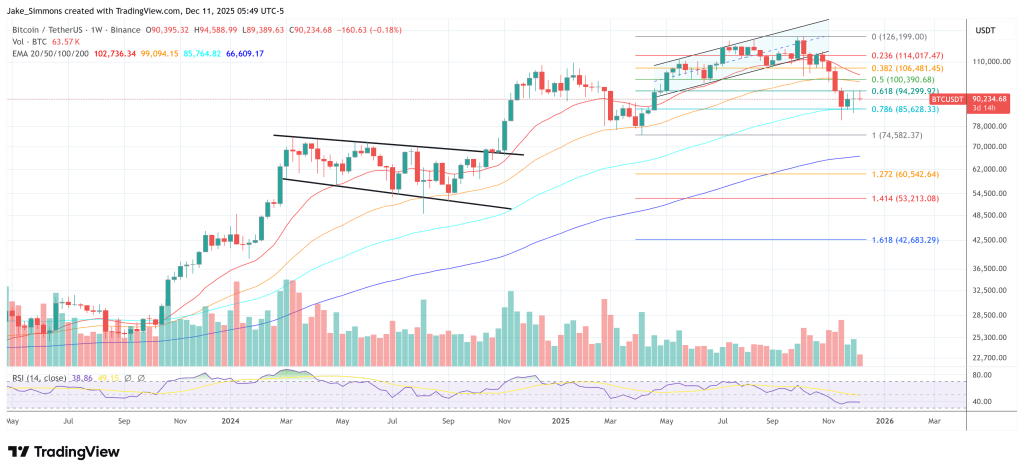
At press time, BTC traded at $90,234.

Bitcoin price

Upcoming Crypto Market Structure Bill Markup Likely Pushed To Post-Holiday

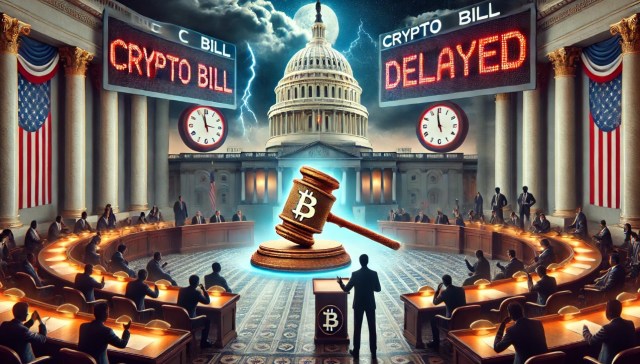
The much-anticipated crypto market structure bill, intended to establish a clearer regulatory framework for digital assets in the United States, appears to be facing significant delays. 

Recent discussions among a bipartisan group of pro-crypto senators suggest that a markup, initially expected before Christmas, may be postponed until after the holiday season.

Negotiations Stalled For Crypto Bill

According to a report by Eleanor Terret from Crypto In America, a closed-door meeting on Tuesday revealed that advancing the bill before Christmas is becoming increasingly unlikely. 

The significant hurdle lies in the ongoing negotiations between Republican and Democratic lawmakers, who remain divided on several critical issues. 

A leaked three-page compromise proposal from Senate Banking Republicans to their Democratic counterparts, reported by Politico, offered some insights into the negotiation process.

Among the provisions highlighted in the proposal was an assurance to Democrats that front-end sanctions compliance for certain decentralized finance (DeFi) platforms would be integrated into the bill. In exchange, the proposal sought to preserve protections for software developers and self-custody. 

Two major points for Democrats were included in this offer: a requirement for Democratic commissioners to be involved in agencies overseeing crypto and ethics language aimed at preventing high-ranking government officials from profiting from digital assets. 

Bipartisan Support Remains Elusive

As lawmakers continue to grapple with the complexities of the negotiations, there is a sense of fatigue among those involved. At this week’s BA Policy Summit, Senator Bernie Moreno described the bargaining process as “decently frustrating.” 

Senator Cynthia Lummis, one of the top supporters of the industry and the passage of the market structure bill, and chair of the Senate Banking’s Subcommittee on Digital Assets, noted that the staff members working on the bill are feeling “exhausted.”

With only seven working days remaining before members depart for the Christmas break, negotiations are expected to persist. Senator Lummis has indicated her desire to release a draft of the bill by the end of this week, allowing the industry a chance to review it ahead of a potential markup next week. 

According to Terret, Senate Banking Chair Tim Scott could still convene a markup next week and likely push the bill through along party lines. However, securing bipartisan support would greatly enhance the final bill’s chances of passing in the full Senate next year, potentially explaining a decision to delay the markup until January.

Meanwhile, the Senate Agriculture Committee, which previously released an incomplete draft of its own market structure bill last month, may also hold its markup next week. 

However, committee Chairman John Boozman suggested to Bloomberg Tax that he would likely postpone such a decision until next year, citing several “difficult issues” that need resolution.

A spokeswoman for the committee later confirmed to Crypto In America that a markup would be scheduled “soon,” indicating that discussions are still ongoing. 

Crypto

Featured image from DALL-E, chart from TradingView.com

Analyst Predicts $14+ for 1 XRP: Here is Why

Analyst Predicts $14+ for 1 XRP: Here is Why

While Bitcoin has outperformed XRP over the past five months, analyst Javon Marks believes XRP could flip the switch, leading to a two-digit price target. Bitcoin (BTC), XRP, and the rest of the crypto market have maintained a downward trend since October 2025, with the global crypto market cap losing over $800 billion in valuation within this period.

Visit Website

Satoshi Nakamoto Statue Arrives at NYSE as Wall Street Embraces Bitcoin

The New York Stock Exchange welcomed a bronze statue of Bitcoin creator Satoshi Nakamoto on Thursday.

Twenty One Capital, the first Bitcoin-native public company listed on the NYSE under ticker XXI, placed the sixth of 21 planned global monuments at the exchange as crypto markets navigate Federal Reserve policy uncertainty.

The installation by artist Valentina Picozzi represents what NYSE officials described as “shared ground between emerging systems and established institutions.

Satoshi Nakamoto Statue at NYSE
Source: X/@NYSE

Twenty One CEO Jack Mallers, who also founded Lightning Network payment provider Strike, said the placement reflects Bitcoin’s evolution from code to cultural phenomenon.

However, according to Bloomberg, the company’s stock tumbled 19% on its Tuesday trading debut following a blank-check merger.

Monument Placement Follows Switzerland Vandalism and Global Campaign

Picozzi expressed astonishment at the achievement, stating the NYSE location exceeded “our wildest dream” for the statue series.

This is such an achievement, even in our wildest dream we wouldn’t think about placing the statue of Satoshi Nakamoto in this location!

The 6th/21 statues of Satoshi Nakamoto found its home in the NYSE.

Thank you 🤩 https://t.co/iIEvZawAte

— Satoshigallery (@satoshigallery) December 10, 2025

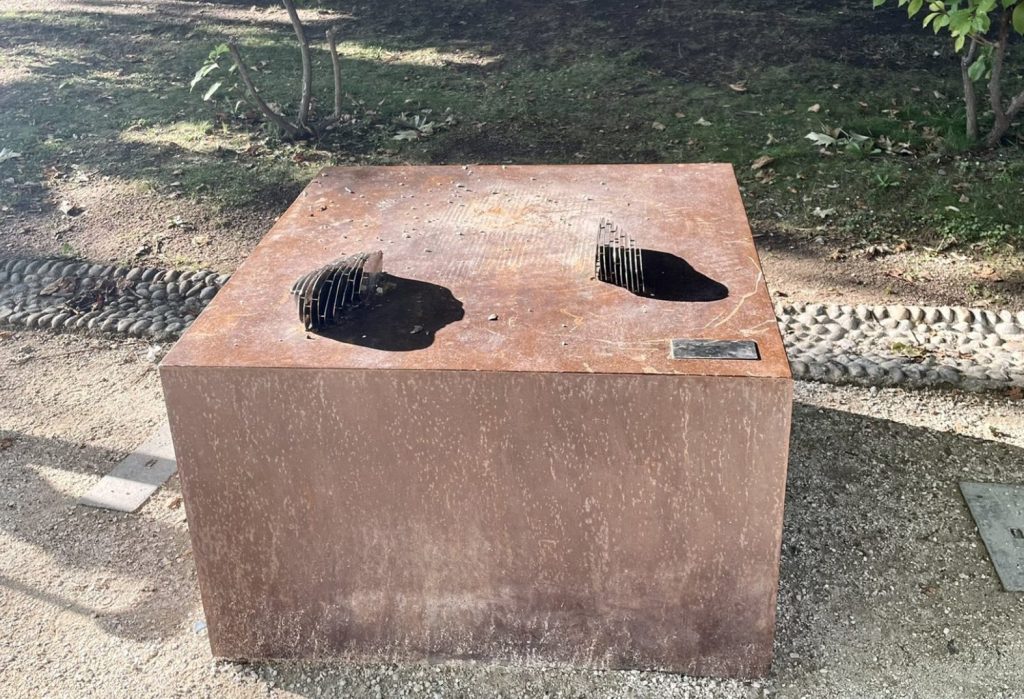
The installation comes months after vandals stole and dumped another Satoshi monument into Lake Lugano following Swiss National Day celebrations in August.

Local investigators suspected intoxicated revelers used tungsten carbide cutting disks and petrol-powered angle grinders to sever the welded bronze sculpture from its base, leaving only the feet attached.

At that time, Satoshigallery, the art collective behind the global campaign, offered a 0.1 Bitcoin reward worth approximately $12,000 for information leading to the recovery of the stolen statue.

The group condemned the vandalism while vowing to continue their mission, declaring, “You can steal our symbol but you will never be able to steal our souls.

The Lugano theft marked the first major incident affecting official Satoshi monuments since Budapest unveiled the world’s first installation in September 2021.

Satoshi Nakamoto Statue
Source: Satoshigallery on X

The global campaign aims to install 21 monuments representing Bitcoin’s 21 million coin supply cap, with existing statues in Budapest, El Salvador’s Bitcoin Beach, Tokyo, and now New York.

Budapest’s original bronze bust featured a faceless, hooded figure with a mirrored surface embodying the “we are all Satoshi” symbolism, while Picozzi’s “Disappearing Satoshi” design depicts a seated figure at a laptop that vanishes when viewed from different angles.

Twenty One Capital Faces Market Headwinds Despite Bitcoin Holdings

Twenty One Capital holds approximately 43,500 bitcoins, valued at over $3.9 billion, making it the world’s third-largest corporate holder.

The company merged with Cantor Equity Partners, a special-purpose acquisition company backed by investment firm Cantor Fitzgerald, and chaired by Brandon Lutnick, son of Commerce Secretary Howard Lutnick.

The deal included $486.5 million in senior convertible notes and roughly $365 million in common equity through private investment transactions.

Shares opened at $10.74 on Tuesday, below the SPAC’s $14.27 closing price, as digital asset treasury companies face mounting pressure.

Twenty One isn’t a treasury company. We’re a Bitcoin company.

A Bitcoin-native business backed by Tether & SoftBank, built for cash flow, growth, and bitcoin accumulation.

The market will need time to understand who we are because it's never seen anything like us. $XXI pic.twitter.com/gzmmYE3nK2

— Jack Mallers (@jackmallers) December 10, 2025

Despite the volatility, Mallers emphasized that Twenty One differs from rivals by not trading at a premium to net asset value and plans to launch products and utility services beyond simply accumulating Bitcoin.

The company is majority-owned by stablecoin giant Tether and crypto exchange Bitfinex, with minority investment from Japanese technology investor SoftBank Group.

Fed Policy Clouds Bitcoin Rally as Traders Reassess Rate Path

Bitcoin traded at $90,121 Thursday morning, down 2.3% following the Federal Reserve’s third consecutive quarter-point rate cut.

Chair Jerome Powell described the reduction as further policy normalization while projecting only one additional cut in 2026, fewer than investors hoped.

Futures now imply a 78% chance that rates remain unchanged at the next meeting, up from 70% before the decision.

🚨 Bitcoin dipped Thursday even as stocks rallied on the Fed’s rate cut and Powell’s upbeat outlook, with policymakers signalling only modest easing ahead.#CryptoMarket #AsiaMarketOpen https://t.co/JgA2tKe3k5

— Cryptonews.com (@cryptonews) December 11, 2025

Speaking with Cryptonews, Ray Youssef, CEO of NoOnes, outlined two scenarios depending on Fed guidance.

A dovish Fed tone could open the door to renewed risk-on sentiment, triggering a ‘Santa rally’ for digital assets, with BTC reclaiming $100,000,” he said, while warning that “a more cautious or hawkish FOMC message” could “drive a retest of the mid $70,000s, as defensive derivatives positioning accelerates downside moves.

He emphasized that Bitcoin’s recovery hinges on renewed capital inflows rather than reduced selling pressure, noting ETF inflows remain shallow and market depth thin.

The post Satoshi Nakamoto Statue Arrives at NYSE as Wall Street Embraces Bitcoin appeared first on Cryptonews.
Norway decides not to pursue digital currency for now

  • Norway pauses CBDC plans, saying its current payment system remains secure and efficient.
  • Central bank will keep studying retail and wholesale CBDCs as payment habits evolve.
  • Norges Bank shifts focus to tokenisation tests while monitoring global digital-currency moves.

Norway has decided that its payment system works well enough without introducing a central bank digital currency right now, even after several years of research into the idea.

The decision reflects how stable and efficient the country’s existing infrastructure has remained, despite Norway being one of the world’s most cash-light economies.

It also shows that the priority for the central bank is making sure payments keep functioning securely rather than rushing to release a digital krone before it is needed.

Norges Bank announced on Wednesday that a CBDC is not necessary at this stage, following a broad assessment of how a digital version of the krone might support payment security and efficiency.

Cash use in Norway has continued to fall to some of the lowest levels globally, which had intensified discussions about whether the country required a digital option to keep the national currency attractive for consumers, banks and merchants.

The central bank said the current system offers stable operations, fast settlement, low economic costs, and strong contingency arrangements.

It also noted that several projects are already in place to strengthen these backup systems further.

Decision timing

The central bank made clear that its decision is not permanent and that the question could return as payment habits evolve.

Norges Bank said it wants to be ready to introduce a digital krone if it becomes necessary to maintain a secure and efficient system.

The bank continues to distinguish between two main CBDC models.

A retail CBDC would act as a widely accessible means of payment, similar to physical cash or bank deposits.

A wholesale CBDC would be designed only for financial institutions and would allow interbank transactions through tokenised units recorded in a digital ledger based on blockchain technology.

CBDC types

This distinction has shaped much of Norway’s work so far.

A retail model would give everyday users direct access to central bank money in digital form, while a wholesale model would mirror existing deposits at the central bank using tokenised units.

Both versions remain under study as part of Norway’s broader assessment of future payment needs.

The country’s low reliance on cash had previously added urgency to these evaluations.

Yet Norges Bank concluded that keeping the existing system strong and reliable is the immediate priority, with a CBDC being considered only if payment risks or gaps emerge down the road.

Tokenisation tests

Although Norway is pausing on a digital krone, it is increasing its focus on tokenisation.

The bank said token-based systems can improve efficiency, enable innovation and reduce settlement risk.

It also warned that uncertainty remains about how widely tokenisation will be used and what kinds of risks may appear as the technology grows.

Norges Bank plans to continue practical experiments in collaboration with industry players to understand how tokenised solutions function in real transactions.

These tests are part of a broader strategy to prepare for future developments in digital finance, even without committing to a CBDC at this stage.

The central bank will publish a detailed report on its CBDC research in the first quarter of next year.

This will outline the work completed so far, its next steps, and how it plans to monitor progress in other regions.

Norway is watching international projects closely, including the Eurosystem’s work on a possible digital euro and emerging global standards that may support shared CBDC systems in the future.

The post Norway decides not to pursue digital currency for now appeared first on CoinJournal.

Satoshi Nakamoto statue arrives at NYSE in major crypto culture shift

  • Satoshi Nakamoto statue arrives at NYSE, marking crypto’s growing Wall Street acceptance.
  • Artwork joins global series as Bitcoin’s history and mainstream adoption gain symbolic recognition.
  • Institutional embrace of Bitcoin accelerates as public entities hold over 3.7M BTC.

The New York Stock Exchange has become the latest home for Valentina Picozzi’s “disappearing” Satoshi Nakamoto statue, signalling how far digital assets have travelled since the time when crypto was treated as unwelcome on Wall Street.

The arrival of the piece was announced in an X post on Wednesday, positioning the NYSE as shared ground for traditional finance and emerging decentralised systems.

The installation also aligns with the anniversary of the Bitcoin mailing list, launched on 10 December 2008, adding symbolic weight to a moment that highlights Bitcoin’s shift from niche idea to mainstream fixture.

NYSE installation

The statue was brought to the NYSE by Bitcoin company Twenty One Capital, which began trading this week.

The artwork itself is by Picozzi, who has been developing her “disappearing” Satoshi series under her Satoshigallery handle.

The New York installation is the sixth piece in a global project she plans to expand to 21 locations.

Her post on X described the placement at such a prominent financial centre as a milestone for the ongoing series.

The display at the NYSE contrasts sharply with the period when crypto was considered taboo across Wall Street.

Bitcoin’s long path

The statue’s arrival coincides with a key date in Bitcoin’s history, falling close to the anniversary of the Bitcoin mailing list launched by Satoshi Nakamoto on 10 December 2008.

Nakamoto mined the genesis block on 3 January 2009, creating the first 50 Bitcoins and setting the foundation for the wider industry.

More than a year after that, on 22 May 2010, Laszlo Hanyecz made the first documented Bitcoin purchase, spending 10,000 Bitcoin to buy two Papa John’s pizzas.

In the years that followed, the asset faced significant resistance.

Institutions and banks kept their distance, and governments attempted to restrict crypto activity through actions widely described as part of Operation Chokepoint 2.0.

Even high-profile sceptics in global finance dismissed the technology before eventually revising their positions.

Institutional shift

The landscape began to change when major financial figures, such as BlackRock’s Larry Fink, shifted from doubt to active interest.

Wall Street institutions moved quickly, increasing participation through exchange-traded funds and direct Bitcoin purchases for corporate treasuries.

Public companies, private companies, countries, and ETFs now hold more than 3.7 million Bitcoin collectively, according to Bitbo.

The total value exceeds 336 billion dollars, showing how deeply Bitcoin has entered mainstream portfolios.

Against this backdrop, the installation at the NYSE serves as a visible marker of how crypto has become integrated into financial culture instead of remaining an outsider technology.

Global statue project

Picozzi’s work has taken the Nakamoto figure to five other locations: Switzerland, El Salvador, Japan, Vietnam, and Miami, Florida.

The collection is intended to reach 21 statues worldwide, a nod to Bitcoin’s capped supply of 21 million tokens.

Her design centres on the idea of disappearance, with the figure positioned as if fading into its surroundings.

The artwork depicts Nakamoto as a hacker in a familiar seated pose, laptop open, representing both the anonymity of Bitcoin’s creator and the programmers who built the broader ecosystem.

The NYSE installation marks the latest step in Picozzi’s effort to trace Bitcoin’s cultural footprint through public art, linking major global locations with the technology’s origins and evolution.

The post Satoshi Nakamoto statue arrives at NYSE in major crypto culture shift appeared first on CoinJournal.

❌