Login
LoginCFTC Approves Bitcoin, Ethereum as Collateral in Derivatives Pilot Program
The U.S. CFTC has unveiled a pilot that allows Bitcoin, Ethereum, and USDC to serve as collateral in regulated derivatives markets.

The U.S. CFTC has unveiled a pilot that allows Bitcoin, Ethereum, and USDC to serve as collateral in regulated derivatives markets.

After weeks of speculation, BlackRock, the world’s largest asset manager, has officially filed for a staked Ethereum (ETH) Exchange-Traded Fund (ETF) with the US Securities and Exchange Commission (SEC). Amid the bullish news, the King of Altcoins’ price is attempting to break out of a two-month resistance, which could set the stage for a retest of higher levels.
BlackRock has submitted an S-1 form with the US SEC to get approval for its iShares Ethereum Staking Trust (ETHB), which “seeks to reflect generally the performance of the price of ether and rewards from staking a portion of the Trust’s ether, to the extent the Sponsor in its sole discretion determines that the Trust may do so without incurring undue legal or regulatory risk.”
Filed on December 5, BlackRock’s registration statement explains that, if approved, the proposed fund aims to stake 70% to 90% of its Ethereum holdings, distributing staking rewards to stakeholders at least quarterly.
Coinbase Custody Trust will serve as the custodian for the Trust’s ETH holdings, the filing noted, while Anchorage Digital Bank will be an available alternative custodian for the Trust’s ether holdings. Meanwhile, the Bank of New York Mellon will serve as the custodian for the Trust’s cash holdings and the administrator of the Trust.
Notably, BlackRock’s ETHB will operate separately from its spot ETH fund, the iShares Ethereum Trust ETF (ETHA), which is the largest in its category with $11 billion in assets under management (AUM).
It’s worth noting that the crypto community began speculating about BlackRock’s upcoming staked ETH fund after the leading asset manager registered the name in Delaware last month.
In a November report, 10x Research argued that the potential introduction of a staked Ethereum ETF by BlackRock would bring “increased scrutiny” to “the economics of DATs” as retail investors would reallocate to a low-cost source of yield.
The report added that many investors are unaware that Digital Asset Treasury (DATs)’s embedded costs “far exceed” the management fee charged by asset managers like BlackRock on its Bitcoin (BTC) and ETH ETFs.
Ethereum’s price started the week attempting to reclaim a crucial area after managing to hold the $3,000 level as support despite the volatility during the weekend. The cryptocurrency surged nearly 3% in the daily timeframe, hitting $3,180 before retracing on Monday.
Amid this performance, analyst Ali Martinez suggested that “it’s time to pay attention to ETH,” noting that it nears a key level that could push the price to higher zones. Per the chart, Ethereum briefly broke out of its two-month downtrend line, which has served as resistance since early October.
Over this period, the King of Altcoins has attempted to break out of this level twice, but has ultimately been rejected during each attempt. On Monday morning, ETH briefly broke above the trendline before being rejected a third time.
However, if Ethereum reclaims the $3,120-$3,130 levels and turns the downtrend into support, it could build the base for a retest of the $3,200-$3,300 horizontal levels, which marks the lower boundary of its Q3 and early Q4 price range.
Meanwhile, Rekt Capital asserted that Ethereum Dominance (ETHDOM) continues to move within its macro consolidation range, holding support at the 11.67% level. He previously affirmed that if “ETHDOM can maintain itself above 10.05% then it should be positioned for higher market dominance levels over time.”
The analyst added that although history suggests a potential 2.5% drop to the consolidation range lows, this dip would occur “in the context of a macro move to 18%-20%” in the future.
As of this writing, Ethereum is trading at $3,114, a 13.7% increase on the weekly timeframe.


As Bitcoin (BTC) experienced significant volatility throughout the year, reaching new all-time highs (ATHs) before enduring sharp corrections of up to 30%, the cryptocurrency community has become increasingly polarized regarding its future direction.
Many analysts are raising concerns about a potential bear market emerging in 2026; however, market expert Shanaka Anslem has offered a different perspective on social media platform X (formerly Twitter), questioning whether 2025 has already represented the real bear market.
In his analysis, Anslem highlights key evidence. For the first time in history, Bitcoin breached its all-time high prior to the Halving event in April of this year, which he argues isn’t a bullish signal but rather an indication of the cycle inverting.
According to him, 2024 should not be viewed as the beginning of a new bull run; instead, it was a period of what he calls “political repricing” as the market factored in a pro-crypto administration with President Donald Trump’s reelection.
The characteristics of a bear market have been evident in 2025, according to Anslem. Bitcoin’s dominance has reached multi-year highs while altcoins continue to struggle, leading to quarter-after-quarter declines in their values.
Additionally, a massive $3.5 billion in exchange-traded fund (ETF) outflows occurred within just one month. This year saw a significant 29% drawdown from its October highs, paired with extreme fear readings on various sentiment indices.
Anslem insists that while the four-year Halving cycle remains relevant, its impact has evolved. With $120 billion in ETF interconnected with the Federal Reserve’s (Fed) liquidity, the Halving continues to dictate BTC’s supply, but demand now aligns with broader economic narratives rather than the more crypto-specific factors.
What does Anslem’s “cycle inversion” theory implies for 2026? If the bear market has already transpired, masked by nominal highs, the next logical phase might be a genuine blow-off top.
His predictions suggest Bitcoin’s price could soar to between $150,000 and $200,000, particularly as global liquidity continues to expand and directs capital toward hard assets. Anslem believes that many in the market are currently positioned for a downturn that has already occurred.
However, dissenting opinions exist. Analyst Mr. Wall Street argues that the bottom for Bitcoin has not yet arrived and won’t be realized in the coming weeks or months.
He highlights that the critical support level has been breached, indicated by the weekly exponential moving-average (EMA50) closing below the threshold.
He asserts that the market has entered the early stages of a substantial bear market, predicting that it will only abate once Bitcoin reaches the $54,000 to $60,000 range, which he expects might occur in the fourth quarter of 2026.
Despite this bearish outlook, he remains cautiously optimistic about Bitcoin in the short term. He expects a potential upward movement to retest the EMA50 Weekly, which currently stands at approximately $100,000, while maintaining that mid-term targets are much lower.
At the time of writing, BTC was trading at $90,352, which represents a 28% difference between current valuations and ATH levels.
Featured image from DALL-E, chart from TradingView.com

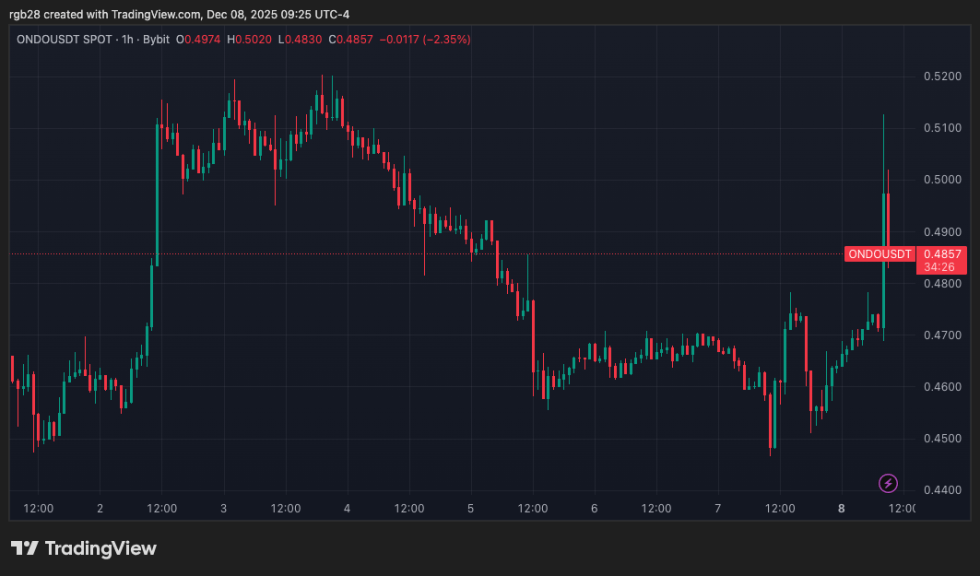
The US Securities and Exchange Commission (SEC) concluded its Biden-era probe into DeFi platform Ondo Finance, and whether its tokenized products complied with federal securities laws, without any charges, following the Trump administration’s pro-industry approach and focus on tokenization.
On Monday, Ondo Finance announced it had received formal notice that the US SEC’s two-year investigation into the platform, which started during the Biden administration, had concluded in late November with no charges.
The platform now joins the list of crypto companies that have seen their cases and probes dismissed or closed without any enforcement actions this year, including Gemini, Kraken, Ripple, Coinbase, and Uniswap Labs.
The SEC initiated the probe in 2024 to examine whether firms’ tokenization of Real-World Assets (RWA) complied with federal securities laws, the platform explained. Additionally, it sought to determine whether the ONDO token was a security.
“Ondo’s growth and leadership in the emerging tokenization category made us a focus, but not a justified target,” the announcement added. At the time, the US regulatory environment was characterized by a “regulation by enforcement” approach, which led to caution and confusion.
Nonetheless, they “remained steadfast in its conviction that regulated, transparent tokenization models like Ondo’s are not only compatible with investor-protection principles, but can strengthen them.”
To Ondo Finance, this marks a “meaningful milestone” for the broader tokenization industry, which will push innovation, compliance, security, and investor protection forward, as the sector gains momentum and becomes a priority on the federal agency’s agenda.
It’s worth noting that Ondo has solidified its position as a leader in the RWA sector with strategic partnerships, expansions, and the launch of its own Layer-1 blockchain, which aims to bridge the gap between traditional finance and decentralized finance.
As reported by Bitcoinist, the firm aims to advance its mission to “democratize” access to high-quality US financial assets and ensure tokenized assets move seamlessly across major blockchains.
In the Monday statement, the platform also highlighted that the SEC’s decision reflects a broader shift in US policy, with regulators reassessing the methods used during the Biden era for the crypto industry. Earlier this year, a White House report recognized the sector as foundational to the future of the global financial system and named Ondo Finance among the key players.
Notably, the regulatory agency has added tokenization to its formal agenda. In the SEC’s Investor Advisory Committee meeting last week, the regulatory agency affirmed it is evaluating tokenization to modernize the issuance, trading, and settlement of public equities.
In his remarks, SEC chairman Paul Atkins stated, “Distributed ledger technology and the tokenization of financial assets, including securities, have the potential to transform our capital markets. Our financial markets have long been the envy of the world, and to ensure that they remain so, U.S. firms and investors must have the opportunity to leverage this technology as they lead the future of global capital markets.”
Atkins added that the agency’s role is to enable market participants to operate and innovate under clear guardrails, ensuring that the US markets remain the most dynamic, transparent, and trusted in the world.
“The resolution of the SEC inquiry marks the end of one chapter for Ondo and the beginning of another. Put simply, the time is now for tokenized securities to become a core part of U.S. capital markets. The future of global finance, including U.S. capital markets, will be onchain and Ondo will help lead that transition,” the announcement concluded.

Digital asset exchange Coinbase has restarted crypto trading in India after a two-year absence, with fiat deposits planned to arrive in 2026.
As reported by TechCrunch, Coinbase has resumed user onboarding in India for the first time since pulling out of the country back in 2023, more than two years ago. The American crypto exchange ranks as the largest public digital asset company in the world, hosting around $516 billion in assets on its platform.
Initially, the exchange first entered India in 2022, but only a few days after beginning services, it had to suspend UPI payments. UPI, short for Unified Payments Interface, is the most widely adopted real-time digital payments instrument in India. The National Payments Corporation of India (NPCI) had said shortly after Coinbase’s launch that it wasn’t aware of any crypto exchange using UPI.
With UPI access gone, Coinbase users no longer had a way to purchase digital assets on the platform using fiat. The exchange stopped new user signups in June 2023, with a complete discontinuation of services happening in September 2023.
“We had millions of customers in India, historically, and we took a very clear stance to off-board those customers entirely from overseas entities, where they were domiciled and regulated,” said Coinbase’s APAC director, John O’Loghlen, at India Blockchain Week (IBW). O’Loghlen added that the decision to pull out didn’t come without hesitation.
Fast-forward to 2025, and Coinbase announced in March that it had registered with India’s Financial Intelligence Unit (FIU), allowing it to provide crypto services in the country. The platform opened in early access in October, and now, it has seen a full public launch. So far, users can only access crypto-to-crypto trading, but according to O’Loghlen, a fiat on-ramp is planned to become available next year. This would allow users to buy digital assets using the Indian Rupee (INR).
While India isn’t closed off to cryptocurrencies like its northern neighbor, China, it still has a relatively strict digital-asset regulation regime. The nation collects a 30% tax on investor crypto profits and allows for no offsets against losses. Additionally, it charges a 1% Tax Deducted at Source (TDS) on all transactions, as a method of tracking digital asset activity.
Naturally, this taxation regime isn’t ideal for crypto companies, as it directly affects adoption. O’Loghlen said that Coinbase is hoping the Indian government will relax the tax to make it more convenient for investors to hold digital assets.
Reopening its exchange isn’t the only move that Coinbase has made in the subcontinent recently. As announced on its blog, the platform has made an investment in Indian crypto exchange CoinDCX. “Taken together, these steps reflect a clear commitment: we believe India and its neighbors will help shape the future of the global onchain economy,” noted the post.
At the time of writing, Bitcoin is trading around $91,800, up more than 7% over the last week.


Blockchain analytics platform Santiment warns that Shiba Inu could experience significant volatility in the coming days amid whale activity. In its analysis today, Santiment highlights that Shiba Inu has just logged its highest number of whale-sized transactions since June 6, 2025.

The Ripple CEO recently disclosed that the XRP ETF products have hit the $1 billion AuM milestone, making it the fastest to reach this milestone since Ethereum. Following the launch of the spot Bitcoin ETFs in January 2024, which showed Wall Street how successful crypto products can get when they command enough attention, the focus shifted to altcoin ETFs.
The U.S. SEC has officially closed its two-year investigation into Ondo Finance without recommending charges.
A prominent market analyst has identified two important resistance levels XRP would have to breach above before it can reach its Wave 3 high. Since October, XRP has struggled to hold $2 support, amid intense bearish pressure across the crypto market.
Circle has secured a major regulatory win in the United Arab Emirates, gaining a Financial Services Permission (FSP) license from the Abu Dhabi Global Market’s Financial Services Regulatory Authority (FSRA).
Key Takeaways:
The approval allows Circle to operate as a fully regulated Money Services Provider within the UAE’s capital market free zone, the company said in a Tuesday’s press release.
The license grants Circle the ability to offer regulated payment, settlement, and digital-asset services tied to USDC, giving the company a formal operating presence inside one of the world’s fastest-growing hubs for compliant crypto activity.
The move comes as the UAE continues to position itself as a global center for digital-asset regulation, with ADGM leading efforts to attract firms seeking clear rules for fiat-referenced tokens and tokenized financial services.
As part of its expansion, Circle appointed Dr. Saeeda Jaffar as Managing Director for the Middle East and Africa.
Dr. Jaffar, currently a senior executive at Visa overseeing the GCC region, will join Circle to guide its strategy, build regional partnerships, and push for broader adoption of USDC in business payments and financial infrastructure across the UAE and beyond.
Circle expands its regulatory footprint in the UAE
— Circle (@circle) December 9, 2025
Announced at Abu Dhabi Finance Week:
→ Secured an @ADGlobalMarket FSRA Financial Services Permission to operate as a Money Services Provider
This milestone builds on USDC and EURC being the first stablecoins recognized by… pic.twitter.com/BCSDOpo3mb
“Regulatory clarity is the foundation of a more open and efficient internet financial system. We are honored to work with the FSRA in ADGM,” Circle co-founder and CEO Jeremy Allaire said.
With the license in hand, Circle plans to expand regulated USDC use in corporate payments, settlement rails and developer infrastructure across the region.
The announcement also follows Dubai’s earlier recognition of USDC and EURC under the DFSA’s crypto token regime, giving Circle regulatory footing across both of the UAE’s major financial zones.
Stablecoins have also surged in mainstream adoption since President Donald Trump signed the GENIUS Act into law in July, establishing a federal framework for their issuance and oversight.
The law’s passage triggered a wave of new stablecoin initiatives from major financial institutions, including Bank of America, Morgan Stanley, and Robinhood.
As reported, Tether’s USDT stablecoin has also secured regulatory recognition as an approved fiat-referenced token across a wide range of blockchains inside the ADGM.
Tether said ADGM now permits licensed institutions in the financial free zone to conduct regulated activities involving USDT across Aptos, Celo, Cosmos, Kaia, Near, Polkadot, Tezos, TON and TRON.
These approvals expand on earlier recognition for USDT on Ethereum, Solana and Avalanche.
On Monday, Binance disclosed that it has also secured full authorization to operate its flagship Binance.com platform under ADGM oversight, a milestone that comes after years of regulatory scrutiny.
Binance will operate through three distinct legal entities in the zone, an exchange, a clearing house and a broker-dealer, reflecting a traditional financial-market structure designed to enable regulated trading, custody, settlement and off-exchange services.
The post Circle Wins Full ADGM License to Expand USDC Across the UAE appeared first on Cryptonews.

Tether’s USDT stablecoin has secured regulatory recognition as an approved fiat-referenced token across a wide range of blockchains inside the Abu Dhabi Global Market (ADGM), marking another step in the UAE’s accelerating push to position itself as a global center for regulated digital assets.
Key Takeaways:
In a statement on Monday, Tether said ADGM now permits licensed institutions in the financial free zone to conduct regulated activities involving USDT across Aptos, Celo, Cosmos, Kaia, Near, Polkadot, Tezos, TON and TRON.
These approvals expand on earlier recognition for USDT on Ethereum, Solana and Avalanche, broadening the stablecoin’s jurisdictional and technical reach across the region.
Paolo Ardoino, Tether’s CEO, said the move underscores the role of stablecoins in the modern financial system.
“Introducing USDT within ADGM’s regulated digital asset framework reinforces the role of stablecoins as essential components of today’s financial landscape,” he said, adding that extending recognition across multiple chains helps strengthen Abu Dhabi’s standing as a hub for compliant digital finance.
ADGM operates as a special economic zone and international financial center with its own legal, regulatory and judicial system.
Its Financial Services Regulatory Authority (FSRA) oversees licensing and supervision for firms active within the jurisdiction.
Under the newly issued recognition, ADGM-licensed entities can support USDT across nearly all major chains where the token circulates, creating a broader multichain foundation for settlement, trading and decentralized-application activity.
Tether’s USD₮ Recognised as Accepted Fiat-Referenced Token in Abu Dhabi’s ADGM for Use on Several Major Blockchains
— Tether (@Tether_to) December 8, 2025
Learn more: https://t.co/PKmF7w5aUx
The announcement arrives as Abu Dhabi intensifies its campaign to attract global digital-asset firms.
On the same day, Binance disclosed that it has secured full authorization to operate its flagship Binance.com platform under ADGM oversight, a milestone that comes after years of regulatory scrutiny.
Binance will operate through three distinct legal entities in the zone, an exchange, a clearing house and a broker-dealer, reflecting a traditional financial-market structure designed to enable regulated trading, custody, settlement and off-exchange services.
Co-CEO Richard Teng said the approval demonstrates Binance’s adherence to what he described as ADGM’s “gold-standard” regulatory expectations.
Pending final operational steps, Binance.com is slated to begin regulated activity under the ADGM regime on Jan. 5, 2026, reinforcing the UAE capital’s strategy of pairing stringent oversight with an open stance toward digital-asset innovation.
As reported, Tether has faced renewed scrutiny after BitMEX founder Arthur Hayes warned that a 30% decline in the company’s Bitcoin and gold holdings could erase its equity.
However, CoinShares’ James Butterfill rejected the alarm, noting that Tether holds more than $181 billion in reserves against $174.45 billion in liabilities, leaving a surplus of roughly $6.78 billion.
His comments arrive amid broader market unrest tied to volatility in Japanese bonds and weak US labor data.
CEO Paolo Ardoino also directly challenged Hayes’s claims, revealing that Tether Group’s total assets are closer to $215 billion, supported by around $7 billion in excess equity and an additional $23 billion in retained earnings.
He emphasized that Bitcoin and gold make up only 12.6% of reserves, with more than 70% held in short-term US Treasuries.
Ardoino accused critics of misreading the company’s attestation data, pointing to Tether’s roughly $500 million per month in interest income.
The post Tether’s USDT Gains Regulatory Recognition as Fiat-Referenced Token in Abu Dhabi Global Market appeared first on Cryptonews.


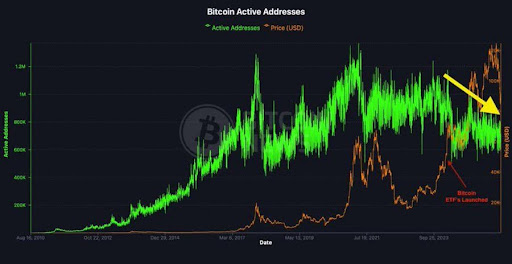
Bitcoin’s on-chain activity has shown a sharp slowdown since spot Bitcoin exchange-traded funds (ETFs) launched. While institutional inflows into these products have accelerated, the number of active BTC addresses has declined. As Wall Street embraces BTC exposure, the network’s grassroots participation appears to be undergoing a significant transformation.
In an X post, the CEO of SwanDesk, financial analyst Jacob King, pointed out that Bitcoin active addresses have been in a steady decline since the US spot BTC ETFs launched in January 2024, and the irony is obvious.
For years, BTC maximalists have pushed for Wall Street adoption, believing institutional involvement would unlock the next wave of mass usage. Instead, on-chain participation has dropped sharply as retail lost interest.
King noted that these Bitcoiners have piled into the ETF for a quick, early FOMO bump, and then bailed, leaving behind a market where the asset is increasingly traded by proxy. According to King, ETF investing kills BTC’s core principles. While investors no longer hold or control their own assets as banks do, which is the very system BTC was designed to challenge, greed always beats ideology.
Market watcher Crypto Seth has revealed that the net inflows into BlackRock and Fidelity’s spot BTC ETFs have been relatively subdued since October 10, when the largest liquidation events happened. Seth believes that this might turn into a momentum reversal soon, as the US stock market is at 1% below new highs despite retail sentiment remaining stuck in extreme fear.
Seth also pointed out that the macro backdrop is shifting in BTC’s favor. This is because the Federal Reserve ended its Quantitative Tightening (QT) program on December 1, 2025, wrapping up a multi-year effort that shaved nearly $3 trillion from the balance sheet since 2022.
Since the US Fed rate is still at 4.00%, more interest rate cuts are on the horizon, which is higher than both Europe and China. The BlackRock iShares BTC Trust (IBIT), which was launched in January 2024, is currently the firm’s most profitable exchange-traded fund (ETF) based on annual fee revenue, despite being less than two years old.
Bitcoin is seeing key initiatives that improve its ecosystem. Every market cycle that has promise to unlock Bitcoin for decentralized finance (DeFi), RioSwap is one of the few products built on infrastructure that was capable of unlocking it in a truly decentralized way.
According to Mintlayer, this was powered by Mintlayer’s native HTLC architecture, as RioSwap introduces a Decentralized Exchange (DEX) that allows BTC to move directly into decentralized markets without wrapping, unbridging, and is fully in the user’s control. With the RioSwap testnet now live, Mintlayer sees this as the start of a new liquidity phase for BTC where the asset will become an active participant in the decentralized market on its own terms.

Argentina’s central bank is preparing to let commercial banks offer regulated cryptocurrency services, ending a three-year restriction that kept traditional lenders out of the market, according to recent reports.
The change would allow banks to handle trading and custody of a limited set of digital assets under tighter rules and monitoring.
Reports have disclosed that the Banco Central de la República Argentina (BCRA) is reviewing a regulatory framework that would permit banks to provide crypto trading and custody, but only within a controlled, licensed setup.
The move responds to heavy use of Bitcoin and stablecoins by many Argentines as a shield against peso weakness and inflation.
Analysts say banks would likely need separate units, stronger custody systems and clear compliance checks before they can serve customers.
ARGENTINA’S CENTRAL BANK JUST ANNOUNCED BANKS CAN OFFER #BITCOIN AND CRYPTO SERVICES
HERE WE GO!! pic.twitter.com/0yCYXLT4MA
— Vivek Sen (@Vivek4real_) December 8, 2025
The prohibition dates back to May 2022, when the central bank barred banks from transacting in or offering services for cryptocurrencies that were not formally regulated by the authorities.
BREAKING: Argentina’s central bank is drafting rules to let banks offer crypto trading and custody, putting them in direct competition with exchanges under tighter KYC rules.
Huge move for Argentina
pic.twitter.com/RMz2icnC81
— Conor Kenny (@conorfkenny) December 8, 2025
That rule effectively prevented lenders from listing crypto products inside their apps or taking custody on behalf of clients. The ban pushed most retail activity toward registered Virtual Asset Service Providers (VASPs) and overseas platforms.
Based on reports, any shift would build on the country’s recent steps to regulate VASPs. The Comisión Nacional de Valores (CNV) has already issued registration criteria and AML/CFT requirements for local crypto firms, including technical rules on custody and “travel rule” compliance.
Those existing rules are likely to form the baseline for the bank licensing regime, with extra safeguards for depositors and liquidity.

For everyday savers who turned to digital coins to protect savings, a bank-led service could mean easier access through familiar apps and possibly stronger institutional custody — though it would not erase price risk.
Regulators are expected to insist on explicit risk disclosures and limits; client holdings in crypto would not automatically carry the same guarantees as insured bank deposits.
Market players say initial offerings may focus on major assets such as Bitcoin and established stablecoins, rather than a wide array of tokens.
Featured image from Unsplash, chart from TradingView


Wide crypto-tracking funds will become more popular as investors will seek exposure as the market becomes more complex, says Bitwise’s Matt Hougan.
Matrixport says Bitcoin may be stabilizing for now, but sentiment remains cautious as traders brace for the upcoming FOMC meeting. The firm notes that despite the brief pause in selling, current options pricing still reflects roughly 5% downside risk, with funds actively hedging against further pullbacks. With year-end deleveraging in full swing, Matrixport argues that short-term bounces are being treated as opportunities to lighten positions rather than signals of a new rally. Liquidity typically tightens heading into Christmas, adding pressure to the market. The key level to watch is $91,500, but Matrixport expects volatility to keep compressing, making a decisive post-FOMC breakout unlikely.
But what else is happening in crypto news today? Follow our up-to-date live coverage below.
The post [LIVE] Crypto News Today: Latest Updates for Dec. 09, 2025 – Bitcoin Steadies but Holiday Liquidity, FOMC Risks Keep Traders Defensive: Matrixport appeared first on Cryptonews.

Jonathan Gould, the head of the US Office of the Comptroller of the Currency (OCC), has pushed back on banker complaints about allowing digital asset firms seeking to establish national trust bank charters.
Speaking at an industry event in Washington, he said that crypto companies seeking federal bank charters should be evaluated no differently than traditional financial institutions.
Limiting digital asset activities would “undermine the dynamic and evolving nature of the federal banking system,” he said.
Further, he highlighted the OCC’s long history of chartering national trust banks and their activities. The OCC received about 14 charter applications since the start of the year, including digital asset firms.
“Although the proposed activities of some new charter applicants, specifically those in the digital or fintech spaces, could be viewed as new activities for a national trust bank, custody and safekeeping services have been happening electronically for decades,” the OCC chief said. “There is simply no justification for considering digital assets differently.”
Gould also dismissed concerns from certain existing banks regarding OCC’s lack of supervisory capacity to oversee new applicants’ activities.
In remarks at the 2025 Blockchain Association Policy Summit, Gould noted that the agency is hearing daily from existing banks about their own initiatives for innovative products and services.
“The OCC has also had years of experience supervising a crypto-native national trust bank,” Gould added. “All of this reinforces my confidence in the OCC’s ability to effectively supervise new entrants as well as new activities of existing banks in a fair and even-handed manner.”
Besides, he emphasized the need to evolve the banking system from historical technologies like the telegraph to modern blockchain innovations.
In October, Coinbase filed an application with the US OCC for a National Trust Company Charter to expand financial services under clear regulations.
Despite the move, Coinbase was clear that it has no plans to become a traditional bank. If granted, the license would allow the crypto exchange giant to offer payments without depending on third-party banks.
Circle and Ripple have filed similar applications. For instance, Ripple intended to bring its dollar-backed stablecoin, RLUSD, under federal supervision by seeking a national banking license.
Additionally, Circle is looking to launch a federally regulated entity named First National Digital Currency Bank that would allow the company to offer crypto custody.
The post OCC Head Advocates for Equal Treatment of Crypto Firms in Bank Chartering Process appeared first on Cryptonews.

HashKey is bidding to become Hong Kong’s first listed crypto exchange, launching an initial public offering that will gauge how much public market appetite remains for regulated digital asset platforms after the latest leg of the cycle.
The company plans to sell about 240.6M shares in a global offering, with roughly 24.1M reserved for Hong Kong investors and the rest for international buyers
The price range runs from HK$5.95 to HK$6.95 a share, which would raise up to HK$1.67B, about $215M, and value HashKey at around HK$19B at the top end.
Books are open through Friday, with trading scheduled to start on Dec. 17, according to a prospectus.
— Cryptonews.com (@cryptonews) December 5, 2025
HashKey Holdings is preparing to open its order books next week for a Hong Kong initial public offering that aims to raise $200 million.#HashKey #IPOhttps://t.co/9OczOnw5M5
HashKey positions itself in the prospectus as a digital asset ecosystem rather than a single exchange, tying together trading, custody, tokenisation and asset management under a licensed, onshore structure.
The group operates what it describes as Hong Kong’s largest licensed crypto exchange by trading volume and was among the first platforms approved under the city’s dedicated virtual asset regime, which went live in 2022.
According to research cited in the filing, HashKey holds more than 75% of Hong Kong’s onshore digital asset trading volume, giving it a dominant share of a market that regulators have been trying to pull onshore after years of activity on offshore venues.
The company also runs one of Asia’s biggest on-chain services businesses, offering staking, tokenization and custodial technology for a range of protocols, and manages billions in client assets through funds and structured products.
The financials show how that expansion has fed into the top line. Revenue rose from about HK$129M in 2022 to about HK$208M in 2023, then jumped to roughly HK$721M in 2024 as trading volumes and on-chain activity scaled.
The first half of 2025 brought a further HK$284M in revenue, although the prospectus also flags heavy spending on research, development and marketing as the group builds out its platform.
HashKey’s business model splits into three main pillars, transaction facilitation, on-chain services and asset management. Transaction facilitation covers the core exchange, over the counter trading, fiat on and off ramps, custody, foreign exchange conversion and institutional services.
On-chain services include staking infrastructure, tokenisation of assets and HashKey Chain, the group’s own network that aims to host compliant real world asset projects, stablecoins and decentralised applications.
Asset management spans venture investing in Web3 projects and secondary market products such as exchange-traded funds and actively managed crypto funds.
The company expects to receive net proceeds of about HK$1.43B after fees and expenses if the deal prices at the top of the range.
It plans to spend a large share on product innovation and new offerings, including more regulated derivatives and yield products, and on building shared liquidity across venues and upgrading its custody systems to support more chains and tokens.
Another portion is earmarked for on-chain innovation, such as a crypto as a service platform for institutions and further investment in staking infrastructure, as well as hiring engineering and research talent.
HashKey also intends to devote capital to infrastructure and cloud services so its trading platforms can handle spikes in activity without outages, and to strengthening risk management and compliance systems in line with Hong Kong’s virtual asset rules.
Management argues that this combination of scale, licensing and infrastructure will help the group capture the next wave of institutional adoption as more investors rotate from loosely supervised exchanges into onshore, regulated venues.
The listing lands at a delicate time for both Hong Kong and the crypto market. The city has approved licences for 11 exchanges under its new framework but has not yet brought in global giants such as Binance or Coinbase, even as it tries to position itself against Singapore, Dubai and other centres competing for crypto firms.
The post Crypto Exchange HashKey Plans Hong Kong IPO, Targets $215M Capital Raise appeared first on Cryptonews.