Reading view

There are new articles available, click to refresh the page.

South Korea Misses Stablecoin Bill Deadline — Banks vs. Innovation Battle Heats Up

South Korea’s effort to legalize won-pegged stablecoins has hit another setback after the country’s top financial regulator missed a government-imposed deadline, exposing a deepening power struggle between financial authorities over who should control the next phase of digital finance.

Earlier this month, the ruling Democratic Party asked the Financial Services Commission to submit a draft stablecoin bill by December 10, fulfilling President Lee’s campaign pledge to create a legal framework for digital assets.

🇰🇷 South Korea pushes for draft stablecoin bill by Dec. 10 deadline as lawmakers threaten independent action if FSC misses target. #SouthKorea #Stablecoinhttps://t.co/dLzvS4qax1

— Cryptonews.com (@cryptonews) December 1, 2025

That deadline passed without a submission.

Stablecoin Disagreement Holds Up South Korea’s Crypto Bill

The South Korean media outlet Newsis reported that FSC later confirmed it was unable to deliver the proposal on time, saying it needed additional coordination with other agencies.

A spokesperson said the regulator would instead release the government’s position publicly alongside its formal submission to the National Assembly, citing the public’s right to understand the framework being proposed.

The FSC said it is preparing a draft tentatively titled the Basic Digital Asset Act, also described as Phase Two of South Korea’s virtual asset legislation.

Officials expect the proposal to be released later this month or early next month, ahead of a consolidated bill the ruling party has pledged to introduce in January 2026 under President Lee Jae-myung’s election commitments.

Behind the delay is an unresolved dispute between the FSC and the Bank of Korea over who should lead stablecoin issuance.

The central bank has argued that stablecoins function similarly to currency and deposit-like instruments and should therefore remain under bank control.

It has pushed for a rule requiring domestic banks to hold at least a 51% stake in any stablecoin-issuing entity, along with inspection powers and veto authority over approvals.

The FSC has resisted that approach, pointing to overseas models, noting that most issuers under the European Union’s MiCA framework are non-bank digital asset firms and that Japan’s first yen-linked stablecoin was issued by a fintech company.

FSC officials have said bank-led issuance lacks global precedent and could limit participation by technology firms that already operate digital payment infrastructure.

Negotiations between the FSC and the BOK remain ongoing. Officials familiar with the talks say a compromise may involve flexible ownership thresholds based on business scope, though no agreement has been confirmed.

The disagreement has stalled coordination long enough for lawmakers to begin reviewing multiple competing drafts at the National Assembly’s Political Affairs Committee.

Delays in Stablecoin Rules Raise Fears South Korea Is Falling Behind

Industry groups have warned that continued delays risk leaving South Korea behind jurisdictions such as the United States, the European Union, and Japan, all of which have already established stablecoin rules.

Domestic stablecoin issuance remain illegal in South Korea, even as companies prepare infrastructure behind the scenes.

Naver Financial has developed a blockchain wallet for Busan’s local currency program, while KakaoBank has begun work on a KRW-denominated digital token. Major banks have also explored a joint stablecoin project targeting late 2025 or early 2026.

🚀 Naver Financial, the fintech arm of South Korean internet giant Naver, is preparing to roll out a stablecoin wallet in Busan.#SouthKorea #Cryptohttps://t.co/40QBNaXJ9C

— Cryptonews.com (@cryptonews) November 25, 2025

Regulatory urgency has been heightened by recent enforcement challenges. In December, Korean authorities disclosed that Binance froze only a small portion of funds stolen during last month’s Upbit hack, despite urgent requests from police and the exchange.

🇰🇷 Korean authorities say @Binance froze only a small portion of the crypto stolen during last month’s @Official_Upbit hack.#SouthKorea #Binancehttps://t.co/o5VVQN9tYp

— Cryptonews.com (@cryptonews) December 12, 2025

Investigators said hackers rapidly laundered assets across chains and wallets, highlighting the difficulty of coordinating responses without clearer oversight frameworks.

Experts said the incident shows the need for faster, more structured controls as digital-asset activity expands.

South Korea’s stablecoin debate is also unfolding against a backdrop of delayed crypto policy more broadly. The country’s virtual asset tax regime, approved in 2020, has been postponed several times and is now scheduled for 2027.

The post South Korea Misses Stablecoin Bill Deadline — Banks vs. Innovation Battle Heats Up appeared first on Cryptonews.


Can Bitcoin Price Still Hit $140,000? What The Global M2 Money Supply Says

The Bitcoin price outlook remains under scrutiny as market analysts assess whether the world’s largest cryptocurrency can still reach $140,000. Given BTC’s recent downturn and fluctuating price, it’s understandable that a dramatic surge to $140,000 could be viewed skeptically. However, the analyst points to global M2 Money Supply, highlighting its correlation with Bitcoin and its support for a significant upside move.

New discussions have emerged in the crypto space about the relationship between the Bitcoin price action and the global M2 Money Supply. Pseudonymous crypto analyst ‘MoneyLord’ has projected a massive price surge to $140,000 for BTC based on M2 data. The analyst noted that many people are skeptical about the relevance of M2 Money Supply, likely questioning whether it still holds predictive value for Bitcoin’s performance.

Global M2 Money Supply To Fuel $140,000 Bitcoin Price Surge

According to MoneyLord, the recent disconnect between Bitcoin and M2 data should not be viewed as a failure of the model, but rather as a consequence of aggressive market interference and increased stress across global financial systems. In his technical report released on X, he argued that, without heavy manipulation and the collapse and insolvency of major entities, Bitcoin would have continued to track global liquidity growth.

Related Reading: Is It More Profitable To Hold Bitcoin For The Short-Term? 2025 Numbers Are Here

MoneyLord believes that those shocks temporarily suppressed BTC’s price expansion, likely contributing to its recent decline and slow momentum. With market conditions somewhat stabilizing, the analyst suggests that Bitcoin is poised to realign with global M2 Money Supply trends, potentially setting the stage for renewed upward momentum. 

Bitcoin

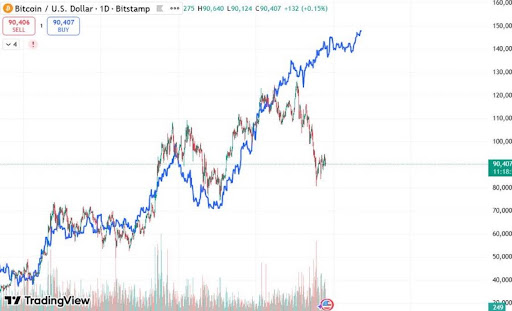
From this perspective, the current phase is viewed as a delayed reaction rather than a failed cycle. MoneyLord predicts that if Bitcoin begins to catch up with M2 data, the cryptocurrency’s price could hit a target above $140,000 sooner than the market expects. The accompanying chart illustrates this bullish outlook, showing global liquidity, represented by the blue line, continuing to rise toward the projected price. 

With Bitcoin trading near $90,000 after a more than 6% decline this month, a rally to $140,000 would require a gain of at least 55%. Reaching this level would set a new all-time high, exceeding its present peak of over $126,000 by more than 10%. 

Bitcoin Shows Resilience Amid Market Sell-Offs

According to crypto analyst Don, Bitcoin has bounced back after a period of sharp sell-offs that shook out many traders and triggered widespread liquidations. The analyst noted that bulls have stepped in to reclaim critical support and restore confidence in the market as BTC resumes trading within a well-defined ascending triangle pattern

The chart shows that the triangle has an upper boundary near $94,324 and a lower boundary around $89,241. Price action inside the formation suggests that Bitcoin is consolidating and likely building momentum for a potential breakout. 

Bitcoin

Market Stress Continues As Bitcoin STH SOPR Dips Below 1– When Will The Pain End?

Bitcoin continues to struggle below the $90,000 level, failing to reclaim key resistance as bulls attempt to defend current demand zones. Price action reflects a market under pressure, with momentum fading after a prolonged correction. From its all-time high, Bitcoin has now retraced roughly 30%, placing the asset firmly in a corrective phase where uncertainty and caution dominate trading behavior.

According to a report from Axel Adler, on-chain data confirms that market stress is no longer limited to price alone. Two key indicators—the Short-Term Holder Spent Output Profit Ratio (STH SOPR) and the P/L Block—are signaling broad loss realization among participants and a deterioration in overall market sentiment.

These metrics provide insight into the behavior of short-term holders, who are often the most sensitive to price swings and macro uncertainty. Together, these signals suggest that Bitcoin remains in a fragile state, where confidence has weakened, and recovery attempts face increasing resistance.

STH SOPR and P/L Block Confirm Capitulation Pressure

Adler explains that the Short-Term Holder Spent Output Profit Ratio (STH SOPR) measures whether coins held for less than 155 days are being sold at a profit or a loss. When the indicator falls below one, it signals that recent buyers are realizing losses.

Currently, the 7-day moving average of STH SOPR has slipped into the red zone, with a reading near 0.99. This confirms that short-term holders are, on average, selling Bitcoin below their acquisition price—a behavior typically associated with heightened stress and emotional selling.

Bitcoin Short-Term Holder SOPR Dashboard | Source: Axel Adler

Historically, similar SOPR conditions have marked local capitulation phases, when selling pressure peaks and weaker hands exit the market. As long as the SOPR 7-day average remains below one, short-term participants stay in “stress mode.”

Adler notes that a meaningful improvement would require a sustained move back above one on a daily close, signaling that sellers have exhausted supply and buyers are once again absorbing sell-side pressure.

Complementing this signal, the P/L Block indicator tracks the aggregated profit and loss state of market participants. The current red block reflects loss dominance, with a P/L Score of minus three—classified as pronounced stress.

With Bitcoin down 30% from its all-time high and 30-day returns negative, both indicators align, reinforcing a clear picture of capitulation among short-term holders.

Bitcoin Price Analysis: Weekly Structure Remains Critical

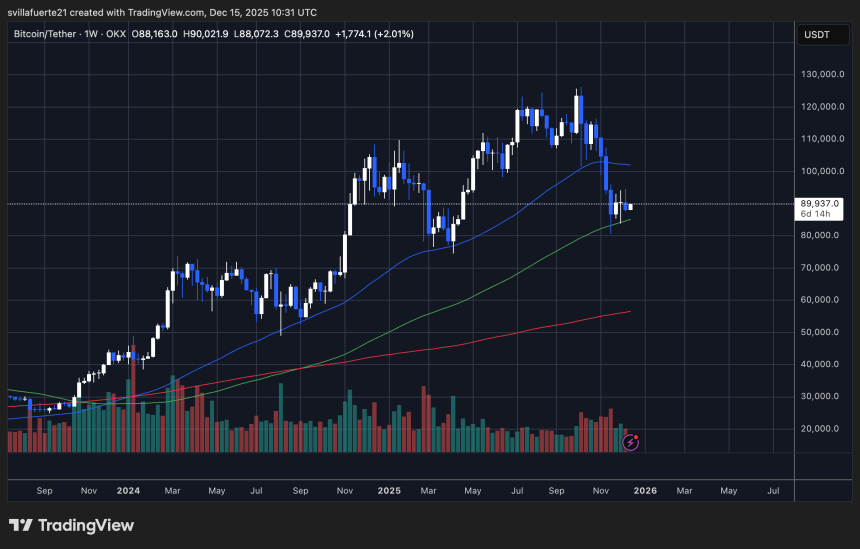
The weekly chart shows Bitcoin trading around the $89,900 level after a sharp rejection from the $120,000–$125,000 region. Price has retraced aggressively but is now attempting to stabilize above the rising 200-week moving average (green), a level that has historically defined long-term trend validity. So far, this area is acting as dynamic support, suggesting that buyers are defending higher-cycle structure despite broader market weakness.

BTC consolidates above key SMA | Source: BTCUSDT chart on TradingView

However, Bitcoin remains below the 50-week moving average (blue), which is now sloping downward. This configuration reflects a loss of medium-term momentum and confirms that the market is still in a corrective phase rather than a resumed uptrend.

The 100-week moving average (red) continues to rise well below price, reinforcing that the broader macro trend remains intact, but also highlighting how much excess was built during the prior rally.

Volume has declined during the recent consolidation, signaling indecision rather than aggressive accumulation. This typically precedes a volatility expansion. From a structural perspective, holding above the $85,000–$88,000 zone is critical. A sustained breakdown below the 200-week MA would increase the probability of a deeper retracement toward the $75,000–$80,000 region.

Conversely, reclaiming the 50-week MA near $95,000 would be an early signal that downside pressure is fading. Until then, Bitcoin remains range-bound, with long-term support holding but momentum still fragile.

Featured image from ChatGPT, chart from TradingView.com

Bitcoin Starts the Week Under $90K While Investors Await Key U.S. Data and Global Policy Clarity

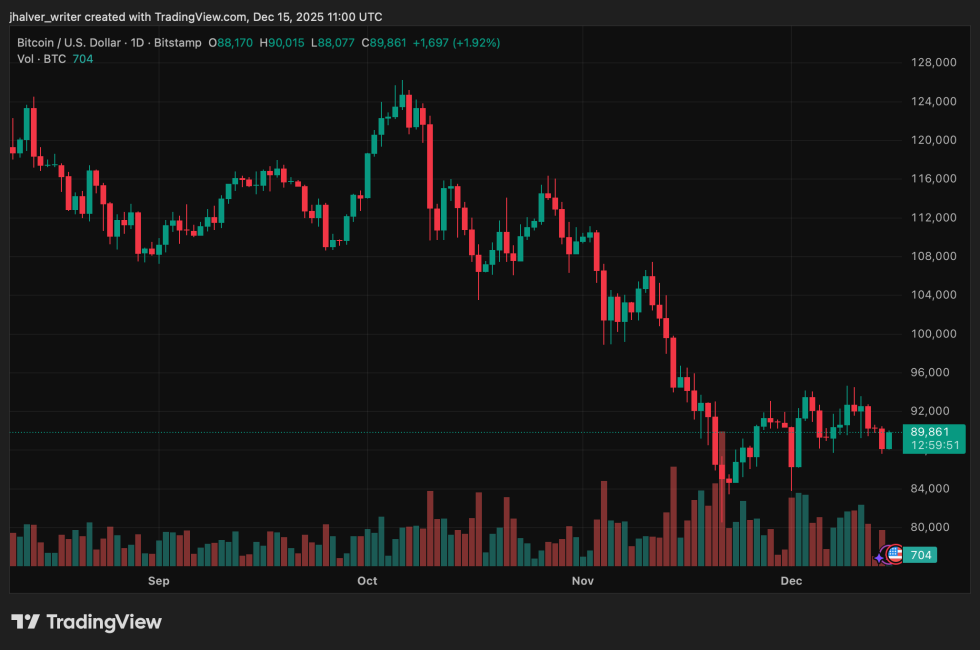
Bitcoin (BTC) began the new trading week on the back foot, slipping below the $90,000 mark as investors adopted a cautious stance ahead of a dense slate of U.S. economic data and key global central bank decisions.

After reaching an all-time high of $126,000 in October, the world’s top cryptocurrency has struggled to regain momentum, instead entering a period marked by tight ranges, low volatility, and subdued trading volumes.

Market movers appear reluctant to commit to new positions as uncertainty builds around the direction of macroeconomic trends. Bitcoin was trading near $89,600 during early Monday sessions, extending weekend losses and reflecting a broader risk-off mood across global markets.

Bitcoin BTC BTCUSD BTCUSD_2025-12-15_12-00-09

Bitcoin Volatility Compresses as Technical Levels Tighten

Bitcoin’s recent price behavior has been defined by historically low volatility, with the asset hovering in a narrow band just below $90,000.

Analysts note that such compression often precedes a sharper move. Technical analyst Aksel Kibar has identified a critical setup on the daily chart, suggesting that a decisive breakout or breakdown could be imminent.

On the downside, failure to hold current levels could open the door to a decline toward the $86,000 area, with deeper support seen between $73,700 and $76,500. On the upside, a sustained break above resistance near $94,600 could shift momentum and put the $100,000 level back into focus.

Other traders have echoed calls for patience, advising investors to wait for a confirmed move outside the current range before taking positions.

On-Chain Signals and Liquidity Raise Caution

Beyond chart patterns, on-chain data has reinforced a more cautious outlook. Analysts at CryptoQuant have highlighted weakening demand and selling pressure near key moving averages, suggesting that recent rebounds have lacked conviction.

Declining liquidity following the Federal Reserve’s recent rate cut has also weighed on Bitcoin and the broader crypto market, according to market makers.

Still, not all signals are uniformly bearish. Data from Glassnode shows that some digital asset treasury firms have quietly resumed Bitcoin accumulation, despite prices struggling to stabilize. This mixed backdrop underscores the market’s current indecision.

Macro Data and Central Banks in Focus

Attention now turns to a busy macroeconomic calendar. Investors are watching delayed U.S. jobs data, inflation reports, retail sales figures, and flash PMI readings for clues on growth and interest rate expectations. Speeches from Federal Reserve officials later in the week could further influence sentiment.

Globally, central bank meetings add another layer of uncertainty. Decisions from the European Central Bank, Bank of England, and especially the Bank of Japan, where a rate hike is widely expected, are being closely monitored for their impact on global liquidity.

With volatility compressed and key catalysts approaching, Bitcoin appears poised at a crossroads as markets await clearer signals on economic and policy direction.

Cover image from ChatGPT, BTCUSD chart from Tradingview

Market Expert Says Ripple’s Biggest Win Is Not XRP Regulation, Here’s What It Is

The lawsuit between Ripple and the US Securities and Exchange Commission (SEC) had dominated headlines for years, with XRP in the spotlight over its potential classification as a security. Now that the legal dispute is over and XRP has been definitively cleared as non-security, experts argue that Ripple’s greatest success extends far beyond XRP regulation.  

Ripple’s True Victory Beyond XRP Regulation 

A crypto market expert operating under the name “Stellar Rippler” on X has shared a compelling report that reassesses what truly constitutes Ripple’s biggest win. The analyst highlighted that the real win for Ripple was not regulatory approval but an intellectual shift in how the project is perceived. 

The expert highlighted that while he favors XRP, he has historically been skeptical of Ripple’s intentions. However, he stated that the recent approval of the crypto company’s bank charter by the Office of the Comptroller of the Currency (OCC) speaks volumes about Ripple’s long-term vision in the financial sector. 

Last week, on December 12, the OCC granted conditional approval to five crypto-related firms, including Ripple, to obtain national trust bank charters. This achievement marked a significant milestone for Ripple, reinforcing its legitimacy in traditional finance despite the numerous oppositions

In his post, the analyst compares XRP and XLM, noting that the debate between the two cryptocurrencies has often been driven by emotion. He said that discussions were frequently centered on conflicts between retail and institutions, accusations of token dumpings, and differing visions for the future

According to the expert, XRP and XLM have always been structurally similar, both designed for fast, low-cost settlement, cross-border liquidity, interoperability, and real-world financial infrastructure. However, he notes that the primary difference between the two cryptocurrencies has always been strategy rather than values. 

He explained that while Ripple prioritized tackling regulatory hurdles, banking, and building institutional partnerships first, Stellar focused on grassroots adoption and open networks. With the new OCC bank charter, the expert emphasizes that Ripple’s strategic approach is now clearly validated and undeniable. 

Stellar Rippler highlighted that Ripple did not abandon its crypto principles but took on the regulatory responsibility to ensure its network could operate at scale. He stated that this milestone shows that history favors builders who solve foundational problems rather than those who focus on tribal disputes.  

Stellar Expert Shifts Stance After Ripple Gains OCC Approval 

In a previous post, Stellar Rippler publicly announced a significant change in perspective on Ripple following news that the company had received conditional approval for a national bank charter. He admitted he was wrong in his past views, describing the recent development as a full submission to the highest level of federal and state oversight in the United States. 

The Stellar expert now believes that Ripple is firmly committed to long-term global finance, stating that a company would not take such a path if it were not building something designed to last decades. He added that this milestone represents maturity and legitimacy for Ripple and strengthens confidence in XRP.

XRP

Bitcoin Price Prediction: Japan’s Next Rate Hike Could Flip the Global Risk Trade – Is Bitcoin the Big Winner?

Japan’s central bank is scheduled to hold its Monetary Policy Meeting (MPM) on December 18–19, 2025, with markets anticipating a possible rate hike to 0.75% from 0.5%, a move that could flip the global risk trade and significantly impact the Bitcoin price prediction outlook.

Japan’s Rate Hike Is Risky For Bitcoin

Analysts view the potential rate hike as ending the “Carry Trade” era.

Higher rates make yen assets more appealing, prompting investors to pull capital from overseas holdings like crypto.

This strengthens the yen, raises borrowing costs worldwide, and dampens Bitcoin speculation, historically causing 20-30% price drops.

🚨 HOW WILL BITCOIN REACT TO JAPAN's RATE HIKE?

🏦The Bank of Japan is expected to raise rates to 0.75%, a level not seen since 1995, and #Bitcoin is already not liking it.

WHY?🤷

Because history isn’t kind to Bitcoin here…

🗓During the last 3 BOJ rate hikes, BTC drops 20%+… pic.twitter.com/KaEsxZyHc8

— Coin Bureau (@coinbureau) December 15, 2025

Macro investor Afsheen Jafry explained that while markets focus on Powell and the Fed, the BOJ actually controls something more fundamental: global liquidity flows.

“When the BOJ tightens, capital floods back to Japan. When they ease, it floods out, and crypto is always first in line to catch that overflow,” she noted.

She cited July 2024 when the BOJ’s rate increase triggered a massive selloff, crushing Bitcoin from $73,000 to $53,000.

“That wasn’t random. That was carry trade unwinding on a massive scale.”

The BOJ also holds roughly ¥83 trillion ($534 billion) in ETFs accumulated since 2010, representing 7-8% of Japan’s ETF market.

Reports indicate officials plan gradual sales of these ETFs starting in January 2026.

These sales would reverse years of liquidity injections, potentially pressuring Japanese stocks and reducing global risk appetite.

Bitcoin Price Prediction: Defending $80K Support Critical for Price Recovery

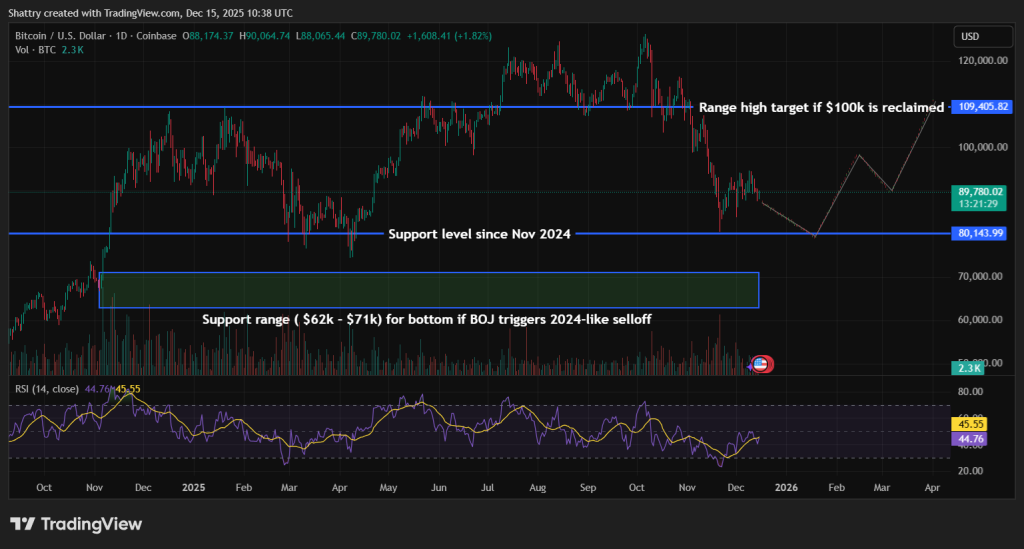
Bitcoin is holding firm above the $80,000 level after November’s sharp drop, showing buyers are defending this key support that has held since late 2024.

The recent push toward the upper $80,000s hints at early signs of recovery, but BTC remains trapped below the critical $100,000 to $109,000 resistance zone.

Breaking through this range could flip momentum and confirm a true reversal. Otherwise, this bounce may fade.

Bitcoin Price Prediction - Bitcoin Price Chart
Source: TradingView

RSI has climbed from oversold levels into the mid-40s, signaling that selling pressure is cooling, though upside momentum is not yet convincing.

If Bitcoin keeps holding $80,000, a retest of $100,000 is likely, with $109,000 as the next target. On the flip side, a breakdown could send BTC sliding toward the $62,000 to $71,000 demand zone.

As Bitcoin prepares for its next move, traders are pouring millions of dollars into presales, investing in meme coins before they list on exchanges.

Don’t Miss Out on One of the Hottest Meme Presales Right Now

Maxi Doge ($MAXI) has quickly become one of the most talked‑about presales in crypto, gathering millions in early support and standing out in a crowded meme coin market.

This is not just another token, it’s a high‑energy community‑driven play built for traders who want early exposure before listings hit major exchanges.

The MAXI presale has established an alpha channel where traders exchange tips, early trade ideas, and hidden opportunities to capitalize on the upcoming bull run.

Bitcoin Price Prediction - Maxidoge banner

Traders are already comparing $MAXI’s momentum to Dogecoin’s early days, with strong social engagement and visibility rising fast.

To get involved before the next price increase:

Visit the Official Maxi Doge Website Here

The post Bitcoin Price Prediction: Japan’s Next Rate Hike Could Flip the Global Risk Trade – Is Bitcoin the Big Winner? appeared first on Cryptonews.
❌