As 2025 winds down, market watchers are now focusing on what the new year could bring for leading crypto assets like XRP and Bitcoin. This year, several crypto assets set new peaks following Bitcoin’s lead, including XRP and Ethereum.
A 69-million-year-old triceratops fossil has become the newest trophy among crypto’s wealthy investors amid a shift from digital collectibles.
Key Takeaways:
Wintermute’s Yoann Turpin and other crypto investors bought a rare triceratops fossil, signaling a shift from NFTs to ultra-scarce physical assets.
The fossil sits in Singapore’s Le Freeport alongside tokenized gold, fine art and major crypto holdings.
As some chase prestige collectibles, others push forward with regulated stablecoin projects in Malaysia.
Wintermute co-founder Yoann Turpin and a small group of crypto investors have quietly purchased a fully intact dinosaur fossil, according to a recent Bloomberg report.
The fossil, one of only 24 known specimens, now sits inside Le Freeport in Singapore, a fortress-like storage facility owned by crypto billionaire Jihan Wu and often described as “Asia’s Fort Knox.”
Inside the Vault Where Crypto Wealth Meets Dinosaur Bones
When Bloomberg’s Suvashree Ghosh visited the vault with Turpin and co-owners including collectibles entrepreneur Chaw Wei Yang, the dinosaur wasn’t the only surprise.
The halls were lined with tokenized gold bars, fine art, rare wine, and hard drives holding hundreds of millions in digital assets, a real-world archive of crypto wealth that has spilled far beyond the blockchain, per the report.
Turpin told the media that the splurge was partly passion, partly prestige, echoing a trend that has swept through the upper tiers of the industry.
Just last year, Citadel’s Ken Griffin paid $44.6 million for a near-complete stegosaurus, the highest price ever for a fossil at auction.
For crypto’s nouveau riche, the shift from NFTs to fossils marks a broader turn toward ultra-scarce, tangible collectibles, assets that can’t suddenly vanish in a protocol upgrade.
However, while some crypto figures are digging up dinosaurs, others are building new digital-asset infrastructure.
BAYC falls below 5 ETH for the first time since August 2021
NFTs had been down bad and its poster child, BAYC, is no exception
But there’s a catalyst beyond the broader NFT market that’s leading to BAYC being down below 5ETH…
Malaysia’s crown prince, Tunku Ismail Ibrahim, recently launched RMJDT, a ringgit-backed stablecoin under his firm Bullish Aim.
AirAsia parent Capital A and Standard Chartered Bank Malaysia are also exploring a ringgit-pegged token as part of the country’s digital asset pilot programs, signaling growing interest in regulated stablecoin projects.
Meta Retreats From Metaverse as AI Glasses Take Center Stage
As reported, Meta is reducing investment in its metaverse division and shifting its focus to AI-powered glasses and wearable devices, reflecting one of its biggest strategic resets in years.
The move follows rising investor skepticism over the commercial viability of virtual worlds and large-scale VR platforms.
The company has spent more than a decade and billions of dollars building out its metaverse vision, including rebranding to Meta in 2021.
However, user growth on Horizon Worlds has stagnated, and headset sales have repeatedly fallen short of expectations.
Bloomberg reported that metaverse spending may be cut by as much as 30%, a signal to markets that the company is rebalancing priorities.
Meanwhile, NFT sales have slumped to their lowest levels of the year, with monthly volume dropping to $320 million in November, roughly half of October’s total.
Early December data shows only $62 million in sales during the first week, signaling that the slowdown is likely to continue as demand for digital collectibles weakens.
The downturn reflects a steep drop in NFT valuations across the board. CoinGecko data shows the sector’s market capitalization has fallen to $3.1 billion, a 66% decline from January’s $9.2 billion peak.
The LUNC price has dived by over 45% from its highest point this week, a move that has erased millions of dollars in market value. Terra Luna Classic (LUNC) token dropped to a low of $0.00004587, its lowest level since…
Solana’s network took a notable step this week as Firedancer, a validator client developed by Jump Crypto, began running on the mainnet, and markets reacted quickly.
According to Solana’s announcement, the client moved out of a controlled testing phase and is now active for real-world validation.
Traders pushed SOL up about 5%, with the token trading close to $140 during the initial move.
Firedancer Goes Live On Mainnet
During more than 100 days of controlled tests, a small set of validators produced more than 50,000 blocks without downtime, according to reports. Built in C and C++, Firedancer was made to handle heavy workloads and to lower the chance of network interruptions.
Test environments reportedly showed the client processing over 1 million transactions per second, a figure that far exceeds current mainnet throughput.
BREAKING: After 3 years of development, Firedancer is now live on Solana Mainnet, and has been running on a handful of validators for 100 days, successfully producing 50,000 blocks pic.twitter.com/Y0WxxEj2WL
That high number comes from lab-style tests, not live traffic, and should be read as experimental performance rather than everyday capability.
Solana co-founder Anatoly Yakovenko marked the transition as a step out of a long beta cycle for the network.
Early Adoption And Stake
Adoption is still small in terms of stake. The first Firedancer nodes hold under one percent of total staked SOL, and that share is expected to grow as operators add it to their setups.
Reports have disclosed that a December rollout prompted more than 20% of validators to move from earlier experimental clients, showing a rapid shift among some operators.
Running multiple validator clients reduces dependence on a single software implementation. If one client encounters a bug, others can keep block production running. That diversity mirrors how other large proof-of-stake chains operate.
Why This Matters For Validators And Apps
Validators and developers stand to benefit if Firedancer keeps meeting its goals. Faster or more reliable validation could mean more capacity for apps that need many transactions per second.
For node operators, the option to mix clients offers an added safety net. Still, the network’s real-world load will be the true test, and watchers say they will be looking at uptime and performance over the coming weeks.
Market Moves And Technical Signals
The announcement coincided with a clear market flow into SOL. Reports have disclosed $11 million in inflows to Solana ETFs on the day of the news, while Bitcoin saw outflows of $77.30 million and Ethereum $42.35 million.
Featured image from Phantom, chart from TradingView
A market expert suggests that investors who have accumulated up to 10,000 XRP tokens may not understand how free they'll be. Edoardo Farina, XRP community figure and founder of Alpha Lions Academy, suggested this while speaking on XRP's future prospects.
The US Office of the Comptroller of the Currency has opened the doors of the federal banking system to a new wave of digital-asset firms, clearing five crypto companies, including Circle and Ripple, to launch national trust banks.
Key Takeaways:
The OCC has conditionally approved five crypto firms, including Circle and Ripple, to launch national trust banks.
The charters give digital-asset companies a single federal rulebook instead of navigating state-by-state regulations.
Paxos is cleared to issue stablecoins under federal oversight, while Ripple’s charter excludes RLUSD issuance.
The approvals, announced Friday, mark one of the most aggressive moves yet by the Trump administration to pull crypto deeper into the regulated banking framework.
Crypto Firms Win Conditional Approval for National Trust Banks
Circle and Ripple were among the applicants granted conditional approval to build national trust banks, a charter that allows them to custody assets and offer select banking services without taking deposits or issuing loans.
The entrants now have 18 months to raise capital, assemble staff and build compliant infrastructure before facing a final exam from the OCC.
Trust charters have historically been the realm of asset managers and insurers, but the crypto sector has increasingly sought them as a regulatory foothold that can streamline operations and remove intermediaries.
The OCC also approved BitGo, Fidelity Digital Assets and Paxos to convert existing state trust companies into federally chartered banks.
JUST IN: The OCC just approved conditional national trust bank charters: Ripple. Paxos. BitGo. Fidelity Digital Assets. Circle.
A national trust charter means federal supervision, 50-state reach, and the credibility to custody assets for ETFs, treasuries, and institutions… pic.twitter.com/DWQyX6jKsm
The shift gives the firms the ability to operate under a single national standard rather than juggling a patchwork of state rules, a longstanding pain point for digital-asset custodians.
For Paxos, the approval explicitly permits stablecoin issuance under federal oversight, while Ripple’s charter states it will not issue its US dollar-pegged RLUSD through the bank.
Crypto firms argue that a national trust bank charter brings clarity and boosts client confidence, especially for custody and settlement services.
Stablecoin issuers, in particular, view federal oversight as a way to assure corporate partners and distance themselves from lightly regulated competitors.
Jonathan Gould, the Comptroller of the Currency, said the new entrants would help ensure that the federal banking system “keeps pace with the evolution of finance.”
Crypto’s Push for Legitimacy Grows as Approvals and Listings Surge
The approvals come as the crypto industry seeks broader legitimacy in Washington.
The digital asset space has seen several notable public listings in 2025. Last month, tZero Group, a New York–based blockchain infrastructure firm focused on tokenized securities and real-world assets, announced that it is preparing to go public in 2026.
Before that, BitGo officially filed for an initial public offering, becoming the first dedicated crypto custodian to pursue a listing on a US stock exchange.
Stablecoin issuer Circle made a splash with its IPO in June, surging more than sevenfold since going public.
Online trading platform Etoro, which offers crypto trading among its services, debuted in May.
Gemini, the exchange founded by the Winklevoss twins, filed confidentially for a U.S. IPO in June, signaling strong market confidence in crypto exchanges going public.
The recent crypto crash resumed today, Dec. 13, with Bitcoin and most altcoins being in the red and the market capitalization falling by over 2% in the last 24 hours. Bitcoin (BTC) price dropped from this week’s high of $94,000…
Polygon price continued its steady downtrend this week, even as the network’s activity surged after the Madhugiri hard fork. Polygon (POL) token slumped to a new fresh low after it transitioned to POL from MATIC last year. It was trading…
Ran Neuner, Host of CNBC's "Crypto Trader" show, insists he will never get along with the XRP community despite recent developments surrounding the XRP and Solana ecosystems. Neuner (@cryptomanran), who has been a persistent XRP critic, is not ready to extend an olive branch just yet.
While XRP has struggled with the rest of the crypto market, analyst EGRAG shows its linear regression model still points to bullish long-term targets. Specifically, after a strong showing in July 2025, when it rallied by an impressive 35% to cross the $3 mark, XRP slipped into a bearish position the following months, collapsing by as much as 8.15% in August to lose the $3 mark.
According to CryptoSlam data, NFT sales volume has plunged by 15.72% to $64.95 million, down from last week’s $77.10 million. Market participation has crashed, with NFT buyers plummeting by 68.41% to 154,955 and sellers dropping by 71.48% to 115,051. NFT…
According to a report from CNBC, Coinbase (COIN), the largest cryptocurrency exchange in the US, is preparing to launch its own prediction market in collaboration with Kalshi, one of the largest federally regulated financial exchanges in the country.
Coinbase Teases Major Updates
The anticipation surrounding the prediction market has been building for nearly a month. Recently, a screenshot of what appears to be Coinbase’s prediction markets dashboard was shared by Silicon Valley researcher Jane Manchun Wong in a post on social media site X (previously Twitter), shedding some light on the features of the forthcoming product.
The Information first indicated on November 19 that Coinbase planned to introduce these prediction markets powered by Kalshi, with a formal unveiling set for the “Coinbase System Update” event scheduled for December 17. Formal announcements regarding this new platform are expected soon, potentially as early as next week.
Bloomberg corroborated this report, stating that the cryptocurrency exchange is also likely to announce a tokenized stock offering during the same event, in line with Tether’s same vision reported earlier this week.
While Coinbase has refrained from confirming these developments directly to CNBC, the company has encouraged stakeholders to tune in to its upcoming event for more details. The firm did not disclose a specific timeline for when the prediction markets will become available to users.
‘Everything Exchange’ Status
Coinbase’s push to launch a prediction market is part of a broader strategy to transform itself into an “everything exchange”—a comprehensive platform for trading a wide variety of assets, including cryptocurrencies, tokenized stocks, and event contracts.
CEO Brian Armstrong articulated this vision earlier in May, stressing that the cryptocurrency exchange aims to evolve into a leading financial services application within the next decade.
This development comes as Coinbase faces increasing competition from rivals like Robinhood (HOOD), Gemini (GEMI), and Kraken, all of whom have introduced tokenized equity offerings for users outside the US and are exploring prediction markets to varying extents.
Coinbase is expanding its range of financial instruments while making a series of acquisitions this year. These include major deals such as the purchase of the crypto derivatives exchange Deribit and the on-chain advertising firm Spindl, as well as seven other major acquisitions.
This also follows a shift in investor sentiment in the digital asset space, with the largest cryptocurrencies — including Bitcoin (BTC) — having retraced by over 30% since October amid fears of a new bear market beginning.
Over the past months, the exchange’s stock, which trades under the ticker name COIN, has also seen a significant drop of over 39%, with the current valuation standing at $267 per share.
Featured image from DALL-E, chart from TradingView.com
How high could the XRP price surge if XRP captured a slice of the $2.3 trillion capital Franklin Templeton confirmed moved from banks to new financial rails? Notably, a recent interview between Paul Barron and Franklin Templeton executive Sandy Kaul highlighted a major change in how younger generations move and grow their money.
Widely followed XRP commentator Armando Pantoja has revived the discussion around whether XRP could eventually reach a price of $10,000. He acknowledged that many often dismiss this figure as unrealistic due to concerns over market capitalization.
What could be the impact on XRP price if SWIFT corridors migrated to RippleNet, Ripple's XRPL-based payment network? Over the past few years, XRP proponents and industry leaders have discussed whether XRP might eventually work with SWIFT or even replace the network.
XRP is in a mild undervalued zone according to the 30-day MVRV Ratio. Here’s how other cryptocurrencies like Bitcoin and Ethereum compare.
XRP 30-Day MVRV Ratio Shows Negative Returns
In a new post on X, on-chain analytics firm Santiment has talked about how the 30-day Market Value to Realized Value (MVRV) Ratio is currently looking for the different top coins in the cryptocurrency sector like Bitcoin and XRP.
The “MVRV Ratio” is a popular indicator that keeps track of the ratio between an asset’s market cap and its Realized Cap. The latter capitalization model calculates the cryptocurrency’s total value by assuming the value of each individual token is equal to the spot price at which it was last transacted on the blockchain.
The Realized Cap can be thought of as an estimate of the capital that the investors as a whole used to purchase their tokens. In contrast, the market cap is the value that they are carrying in the present. As the MVRV Ratio takes the ratio between the two, it essentially contains information about the profit-loss balance of the investors.
In the context of the current topic, a very specific form of the MVRV Ratio is of interest: the 30-day version. This metric only tracks the profit-loss balance for the traders who got into the market during the past month.
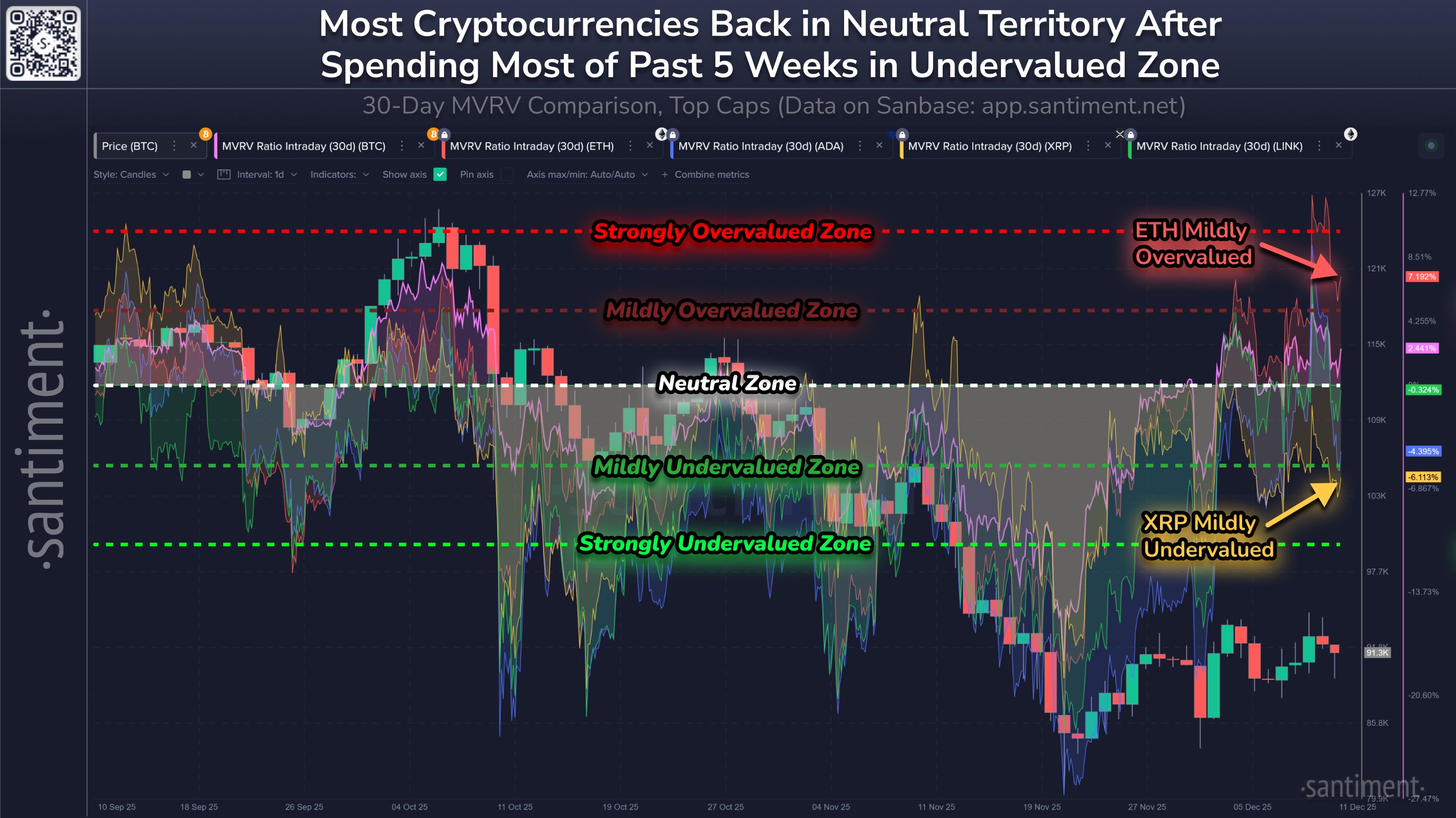
Now, here is the chart shared by Santiment that shows the trend in the 30-day MVRV Ratio for six assets: Bitcoin, Ethereum, Cardano, XRP, and Chainlink.
As is visible in the above graph, the 30-day MVRV Ratio hasn’t displayed a uniform behavior across the top cryptocurrencies, indicating that the situation of the 30-day buyers is different for the various assets.
Ethereum currently has the metric at a positive value of 7.2%. This means that market entrants from the past month are sitting on a gain of 7.2% on the network. Bitcoin also has a positive value, but at just a level of 2.4%, the 30-day traders are more-or-less breaking even.
Chainlink also has a very neutral trend with the 30-day MVRV Ratio at a value of -0.3%. Cardano 30-day traders are also in the red, but in its case, the losses are more notable at -4.4%.
Finally, new XRP investors are down 6.1%, implying that the network currently hosts the worst trader profitability. This fact, however, may not actually be negative for the cryptocurrency.
Generally, the higher investor gains get, the more likely they become to participate in a selloff with the aim of profit realization. This can make a top more probable for the asset when its MVRV Ratio is at a high level. Similarly, a deep negative value can be bullish instead, as it suggests profit-takers have probably become depleted.
In the chart, the analytics firm has defined overvalued and undervalued zones based on the 30-day MVRV Ratio. XRP is currently the only one in an undervalued zone, while Ethereum is inside a mild overbought region.
XRP Price
At the time of writing, XRP is floating around $2.04, up 1.5% over the last 24 hours.
As Pakistan continues to deepen its involvement in the digital asset landscape, the country has signed a memorandum of understanding (MoU) with crypto exchange Binance, aiming to explore the tokenization of up to $2 billion in sovereign bonds, treasury bills, and commodity reserves to enhance liquidity and attract foreign investors.
$2 Billion Asset Tokenization Initiative
According to Reuters, the agreement sets the stage for a potential collaboration focused on allowing the tokenization and blockchain-based distribution of various real-world assets (RWAs) held by the Pakistani government.
These assets may include sovereign bonds, treasury bills, and a range of commodity reserves such as oil, gas, metals, and other raw materials.
The country’s finance ministry, Muhammad Aurangzeb, indicated that while the initiative could involve assets valued at up to $2 billion, final approval is still pending. The goal is to improve liquidity, transparency, and access to international markets for these assets.
Aurangzeb remarked that the memorandum of understanding signifies Pakistan’s commitment to a reform-oriented economic trajectory and establishes a long-term partnership with Binance.
Binance founder Changpeng Zhao expressed optimism about the agreement, calling it “a great signal for the global blockchain industry and for Pakistan.” He suggested that this partnership marks the beginning of a significant shift toward fully implementing the tokenisation initiative.
PVARA Provides Initial Clearance For Binance And HTX
In addition to this MoU, Pakistan has granted initial clearance for Binance and cryptocurrency exchange HTX, to register with local regulators as part of their efforts to establish domestic subsidiaries. This step allows both companies to prepare applications for full exchange licenses.
Chairman Bilal bin Saqib indicated that these clearances initiate Pakistan’s phased licensing process, emphasizing that the strength of compliance will play a crucial role in determining which exchanges will proceed.
This move comes as Pakistan accelerates its digital finance overhaul, which has included the formation of the Pakistan Crypto Council and the establishment of the PVARA, alongside the drafting of a formal licensing regime.
As Bitcoinist reported at the time, Pakistan’s growing involvement in digital assets drew the attention of industry leaders such as Michael Saylor, co-founder of the Bitcoin proxy firm Strategy, who praised the country’s efforts and described it as a sign that the country understands how to handle this new market.
Notably, Pakistan ranks as the world’s third-largest cryptocurrency market by retail activity, according to Saqib. The government is also planning a pilot program for a central bank digital currency (CBDC) and a comprehensive Virtual Assets Act.
At the time of writing, the exchange’s native cryptocurrency, Binance Coin (BNB), is trading at $878, down 35% from all-time highs just above $1,369.
Featured image from DALL-E, chart from TradingView.com

 Login
Login






 JUST IN: The OCC just approved conditional national trust bank charters: Ripple. Paxos. BitGo. Fidelity Digital Assets. Circle.