In most cases, crypto prices perform well when the Fed and other central banks cut interest rates. Not this time... the latest crypto crash is bucking the trend.
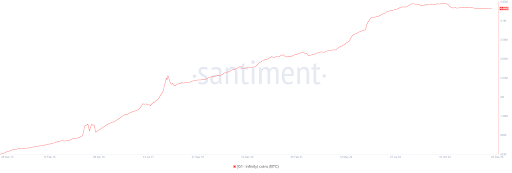
Since Bitcoin’s launch, the number of addresses holding more than 0.1 BTC has climbed steadily through every market cycle, until now. Data shows that addresses in this cohort haven’t grown at all over the past two years, breaking a trend that held for more than a decade.
The stagnation indicates a change in how smaller and mid-sized investors engage with Bitcoin, even as broader institutional activity in the market continues to rise.
Small Holder Participation Reaches A Standstill
The 0.1 BTC threshold has historically represented an important milestone for retail holders, large enough to signal commitment but small enough to remain widely attainable. For more than a decade, wallets crossing that line grew year after year, even during drawdowns when long-term buyers were accumulating quietly.
That pattern is no longer intact. The number of addresses with more than 0.1 BTC has flattened since 2023 and is showing no signs of returning to its previous trajectory. Particularly, data from the on-chain analytics platform Santiment shows that the number of these addresses has stalled at around 4.44 million for the past year. This suggests that fewer new participants are choosing to build self-custodied Bitcoin positions at this level.
The stagnation becomes more notable considering Bitcoin’s rising mainstream visibility and repeated pushes toward new all-time highs this year. In earlier cycles, such conditions have led to a surge in retail accumulation. This time, the address count has stayed frozen, and this means retail addresses holding Bitcoin might actually be plateauing.
How Bitcoin’s Holder Base Is Changing
Although on-chain data points to a slowdown in the growth of overall Bitcoin addresses holding more than 0.1 BTC, it doesn’t necessarily signal a decline in overall adoption. For many market participants, Bitcoin exposure now happens entirely off-chain.
Larger investor cohorts, from high-net-worth individuals to funds and corporate entities, are buying huge amounts of Bitcoin. For instance, Santiment data shows that large Bitcoin holders controlling more than 100 BTC have increased their balances throughout 2024 and 2025, even as smaller address cohorts have stalled.
At the same time, more investors are choosing to access Bitcoin through custodial avenues instead of managing their own wallets. Spot Bitcoin ETFs have become one of the most important gateways for new BTC exposure. In the US alone, Spot Bitcoin ETFs now control almost $120 billion worth of Bitcoin, with BlackRock’s IBIT consistently recording the strongest demand.
Together, these developments point to a new phase in Bitcoin’s development. What was once dominated by individual self-custodied users is now increasingly shaped by institutions, ETFs, funds, and professionally managed capital. Therefore, the numbers from on-chain wallet metrics reflect a smaller portion of the actual user base.
Circle’s slow but steady expansion into the Middle East has taken a decisive step forward, as the USDC issuer secured a Financial Services Permission (FSP) license from Abu Dhabi Global Market (ADGM).
The move positions the company at the center of the UAE’s growing digital-asset ecosystem, strengthening its ability to scale stablecoin adoption across the region.
For a market actively developing clearer regulatory frameworks and attracting global crypto players, Circle’s entry underscores the central role stablecoins have come to play in payment infrastructure and cross-border finance.
Circle Secures ADGM Approval and Expands Regional Strategy
This follows preliminary approval earlier this year and gives the firm formal permission to offer USDC-powered payment, settlement and on-chain financial tools to businesses and institutions across the UAE.
Alongside the approval, Circle appointed Dr. Saeeda Jaffar as managing director for the Middle East and Africa. A long-time payments executive with leadership experience at Visa and major consulting firms, she will guide Circle’s expansion efforts, deepen local partnerships, and help integrate USDC into regional prospects.
Her appointment reflects Circle’s intent to localize operations and strengthen ties with banks, enterprises, and government entities.
UAE Supports Push Toward Regulated Digital Finance
Circle’s regulatory milestone comes as the UAE increases its efforts to build an institutional-grade digital asset ecosystem. ADGM and Dubai’s DIFC have both issued stablecoin and token frameworks designed to offer clarity for companies operating in the sector.
USDC and EURC were recognized earlier this year under Dubai’s crypto token regime, providing Circle with visibility across both major financial zones in the country.
The approval also coincides with a wave of regulatory progress for other major players. Binance received full authorization to operate its global platform under ADGM oversight this week, while Tether secured recognition for USDT across multiple blockchain networks.
These developments show how Abu Dhabi is positioning itself as a global hub for regulated stablecoin activity, driven by remittance demand, trade flows, and a growing emphasis on compliance.
Stablecoin Adoption Enters New Phase
The UAE’s structured approach comes at a time when stablecoins are gaining broader acceptance in global finance.
With regulatory guardrails expanding internationally and stablecoins increasingly used for cross-border payments, Circle’s license opens the door for wider USDC adoption in corporate finance, developer applications, and digital-asset settlement.
For Circle, the ADGM license marks a pivotal foothold in one of the world’s fastest-moving regulatory environments. For the UAE, it reinforces an ambition to lead in compliant digital-asset innovation while shaping standards for a rapidly evolving sector.
Cover image from ChatGPT, ETHUSD chart from Tradingview
In the broadening blockchain sector, the Ethereum network remains a dominant force, heavily utilized and constantly selected by crypto players to carry out their on-chain operations. A recent report shows that Ethereum is transitioning from blockchain to the big league, as the network overtakes dollar-denominated transactions across digital payments.
A Leader In Dollar Transactions
With a surge in stablecoin transfer volume, Ethereum is no longer only a rival in the cryptocurrency space. In a post on the X platform, Leon Waidmann, a market expert and head of research at On-Chain Foundation, reported that ETH is currently surpassing some of the largest traditional payment networks in the world in terms of raw transaction volume.
Data from the post reveals a surge in dollar-denominated transactions on Ethereum, which has triggered new conversations about its increasing prominence as a layer of global settlement. This spike shows that the blockchain’s changing role in finance is becoming more difficult for institutions to ignore as volumes surge past expectations.
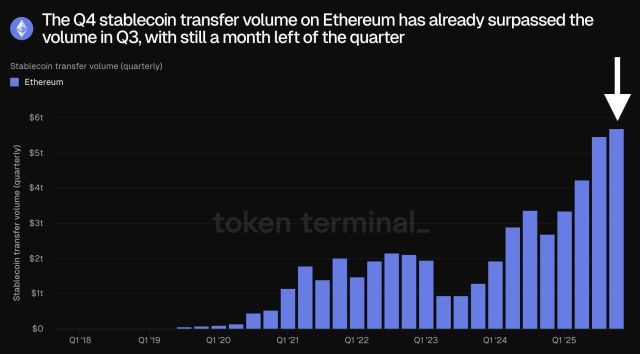
With one month remaining in the year, the amount of ETH stablecoin transfers in Q4 has already exceeded that of Q3. According to the data, the leading network has recorded nearly $6 trillion in stablecoin volume in the fourth quarter of this year alone, reflecting its growing demand for payment settlement.
When it comes to dollar-dominated transaction volume, the blockchain has already outpaced both Visa and Mastercard transaction volumes in the current quarter. Given the surge in stablecoin transfer volume, Ethereum is gradually becoming the major settlement layer for digital dollars.
Waidmann stated that the size makes early Decentralized Finance (DeFi) activity appear insignificant by comparison. In the meantime, the conventional financial infrastructure is being surpassed by the on-chain economy.
As demand for Ethereum as the main settlement layer grows, the network is also quietly entering a new phase of its evolution. This change is one that is characterized by accessibility, efficiency, and quickness rather than traffic jams and soaring costs.
Waidmann highlighted that ETH scaling is rising, alongside growing throughput and declining transaction costs. With transaction prices continuously declining and network throughput surging, the blockchain is demonstrating concrete evidence that its long-promised scaling vision is coming to pass.
As a result, Ethereum will be able to handle an increasing amount of activity over time. However, the network’s usage cost continues to decline, drawing close to zero. Currently, Layer 2s take care of the heavy execution while the mainnet settles the valuable transactions. Should these two lines continue to move in opposite directions, ETH is scaling just as planned.
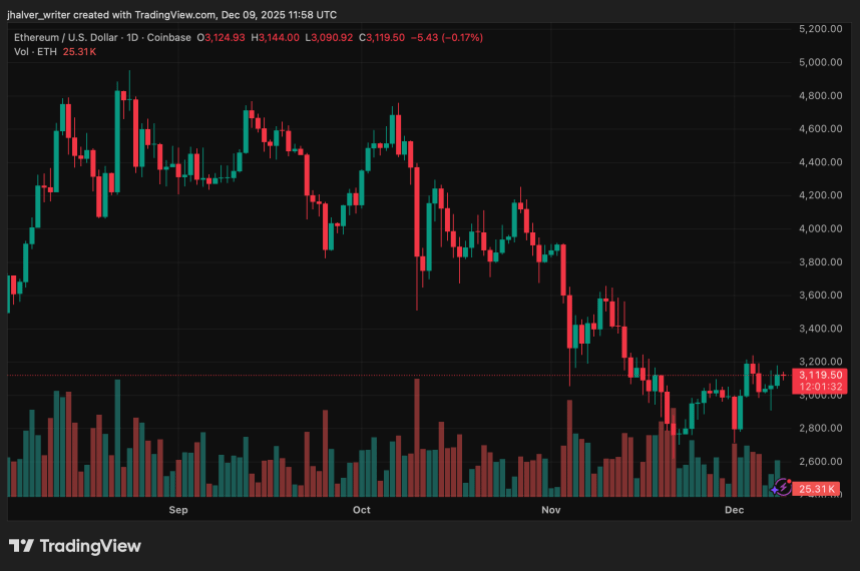
At the time of writing, the price of ETH was still holding above the $3,100 level despite recording a more than 1% decline in the last 24 hours. Its trading volume has also witnessed a bearish action, dropping by over 4% in the past day.
A 22-year-old California resident has pleaded guilty to his role in a multi-state social engineering scheme that stole roughly $263 million in crypto.
Evan Tangeman of Newport Beach, California, admitted laundering $3.5 million in crypto for the criminal enterprise, the U.S. Attorney’s Office announced Monday.
Tangeman pleaded guilty to participating in a Racketeer Influenced and Corrupt Organizations (RICO) conspiracy before U.S. District Court Judge Colleen Kollar-Kotelly.
Sentencing is scheduled for April 24, 2026. He is the ninth defendant to enter a guilty plea in this specific investigation.
The court also unsealed the Second Superseding Indictment, adding three more defendants. Nicholas Dellecave, also known as “Nic” or “Souja,” Mustafa Ibrahim, also known as “Krust,” and Danish Zulfiqar, also known as “Danny” or “Meech,” face charges of RICO conspiracy along with the other members of the Social Engineering Enterprise (SE Enterprise).
Dellecave was arrested in Miami on Dec. 3, 2025. Ibrahim and Zulfiqar were recently arrested in Dubai.
According to prosecutors, the enterprise began in October 2023 and continued through at least May 2025. It originated from friendships formed on online gaming platforms. The group included individuals in California, Connecticut, New York, Florida, and abroad.
Details of the rampant crypto crime
The scheme involved database hackers, organizers, target identifiers, callers, and residential burglars who targeted hardware wallets containing cryptocurrency. Hackers used stolen databases to identify high-value targets.
Callers impersonated crypto exchange staff or email providers to trick victims into revealing account credentials.
Burglars physically broke into homes to steal hardware wallets.
Tangeman acted as a money launderer. He converted stolen cryptocurrency into cash using a bulk-cash converter. Tangeman then used the cash to obtain rental homes for members of the group, often listing false names on the leases.
Some properties rented for $40,000 to $80,000 per month. He secured homes in Los Angeles and Miami.
The largest known theft occurred on Aug. 18, 2024. Tangeman’s co-conspirators, including Malone Lam and Danish Zulfiqar, deceived a victim in Washington, D.C., into transferring over 4,100 Bitcoin. At the time, the crypto was valued at $263 million. The same amount is now worth more than $368 million.
Tangeman also helped Lam obtain roughly $3 million in cash from stolen cryptocurrency to secure a rental property.
After Lam’s arrest on Sept. 18, 2024, Tangeman accessed home security systems to screenshot FBI agents during searches. He also asked another member to retrieve and destroy digital devices from Lam’s Los Angeles residence.
Prosecutors said the enterprise spent stolen funds on a lavish lifestyle. Purchases included nightclub services up to $500,000 per night, luxury handbags, watches valued between $100,000 and $500,000, designer clothing, rental homes, private jets, security guards, and a fleet of at least 28 exotic cars ranging from $100,000 to $3.8 million.
Three additional defendants unsealed
With Tangeman’s guilty plea, prosecutors have unsealed charges against three additional defendants. The Second Superseding Indictment shows the investigation is ongoing. Authorities have not disclosed whether any of the stolen Bitcoin has been recovered or whether restitution will be sought.
The SE Enterprise relied on social engineering rather than sophisticated hacking techniques. The group’s operations originated from online friendships, but the stolen funds funded high-profile purchases and drew attention.
Authorities said the defendants’ extravagant spending played a role in exposing their activities.
Tangeman remains free pending sentencing.
Federal penalties for RICO conspiracy and money laundering carry significant prison terms. The Justice Department has indicated that additional charges may follow as the investigation continues.
A RICO conspiracy occurs when individuals agree to take part in a pattern of criminal activity, or racketeering, through an ‘enterprise.’ Under the Racketeer Influenced and Corrupt Organizations Act (RICO), prosecutors can connect separate crimes and individuals under a single charge.
The focus is on proving a shared criminal objective, not that every participant committed every act.
Wall Street’s biggest Bitcoin bulls are cutting near-term price targets after the latest market pullback. Their longer-term outlook remains intact. Standard Chartered, one of crypto’s most prominent backers, halved its Bitcoin forecasts in a note published Tuesday.
The bank now sees Bitcoin reaching $100,000 by the end of 2025, down from $200,000, and $150,000 by the end of 2026.
Its long-term target of $500,000 remains, though the timeline has been pushed to 2030 from 2028.
The downgrade reflects a shift in demand. Corporate treasury buying, once a major driver, has faded. Exchange-traded fund flows have slowed.
Geoffrey Kendrick, Standard Chartered’s global head of digital asset research, said aggressive corporate accumulation has “run its course.”
“Future price gains will be driven by one leg only,” Kendrick wrote, referring to ETF inflows. He expects consolidation rather than broad selling.
Bernstein analysts struck a similar tone. They forecast Bitcoin at $150,000 by the end of next year and near $200,000 by late 2027, according to Bloomberg.
The firm dropped its call for a $200,000 peak this year but argues Bitcoin is no longer bound by its historical four-year cycle. Analysts say institutional participation has added durability to the market.
The revisions follow a rough stretch for prices. Bitcoin has fallen almost 30% from its October peak above $126,000.
Spot Bitcoin ETFs posted $60 million in net outflows on Monday. BlackRock’s iShares Bitcoin Trust lost about $2.3 billion in November, its largest monthly redemption since launch.
Those outflows represent about 3% of the fund’s assets. Bernstein notes that total ETF withdrawals remain below 5% of assets under management. Retail investors still hold most ETF shares, though institutional ownership has climbed to 28%.
Bitcoin price rebound
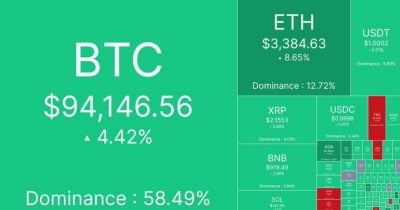
Despite these predictions, Bitcoin rose more than 4% today to near $94,640, pushing market capitalization to about $1.86 trillion as trading volume climbed to $46 billion and prices hit a seven-day high.
Institutional momentum continued with Twenty One ringing the NYSE opening bell holding over 43,500 BTC, while PNC became the first major U.S. bank to offer direct spot bitcoin trading to private clients and Bank of America encouraged limited digital asset allocations.
Investors are also weighing supportive macro signals, with expectations of Federal Reserve rate cuts and comments from Cathie Wood suggesting Bitcoin’s cycle lows may already be in.
At the time of writing, Bitcoin is trading near $94,000.
Ethereum’s base layer demand softened in November, but ETH’s underlying price supports and strong layer-2 growth show the network still has momentum despite a drop in fees and TVL.
ETF analyst Eric Balchuas said there was a chance that such an investment vehicle “could put up better [returns]” based on BTC price moves after trading hours.
The guidance confirms that facilitating customer crypto trades falls within the “business of banking,” expanding the range of activities that national banks may offer under existing law.
The Fartcoin price has been stuck in a narrow range today, trading between $0.3619 and $0.4035. It’s currently sitting at $0.3616 — more than a 10% drop for the day. Even so, the overall trend hasn’t broken, since Fartcoin is…
As stablecoin oversight tightens, SolStaking’s automated payouts and insured custody draw investors seeking steady income. The United States is entering a major regulatory shift. The FDIC is finalizing its first proposal under the GENIUS Act, a new federal framework that…
 Login
Login