A crypto market analyst and trader has projected how much lower XRP could still drop from here, identifying what he believes is behind the current market struggles. The crypto market tried to rebound earlier this month, but that momentum faded prematurely.
Despite Shiba Inu bearish performance, early community member Zach Humphries argues that SHIB still has a realistic path back to its explosive 2021 momentum. In a nine-minute video shared on X, Humphries outlined critical changes he believes the team must implement for SHIB to break out of its prolonged stagnation and regain the 2021 price levels that defined its legendary rise.
Coinbase has reinstated new user registrations in India after more than two years of suspension. This initiative represents its most concerted effort to reestablish a significant presence in one of the world’s most active cryptocurrency markets.
Coinbase has reopened registration in India following a two-year operational hiatus, marking the crypto giant’s return to the world’s second-largest internet market with plans to introduce fiat currency integration by 2026.
The exchange currently offers crypto-to-crypto trading while working toward full-service restoration, which will allow Indian customers to deposit rupees and purchase digital assets directly on the platform.
The San Francisco-based company first entered India in April 2022 but was forced to suspend operations within days after the National Payments Corporation refused to recognize its use of the Unified Payments Interface.
By September 2023, Coinbase had withdrawn entirely from India, requiring existing customers to liquidate their holdings and transfer funds elsewhere.
@coinbase suspended trading service in India “because of some informal pressure from the Reserve Bank of India”, said Coinbase CEO Brian Armstrong.
Coinbase’s willingness to completely exit the market represented a significant commercial risk, John O’Loghlen, the exchange’s Asia-Pacific regional director, told TechCrunch.
Speaking at India Blockchain Week, O’Loghlen explained that forcing existing customers to close their accounts ran counter to typical business strategy but established a clean regulatory slate.
Global crypto exchange Coinbase has registered with India’s FIU—paving the way to resume trading and launch retail services later this year. #India#Coinbasehttps://t.co/fEEOzAC4aT
The exchange now joins other global platforms like Binance, KuCoin, and Bybit in receiving Financial Intelligence Unit authorization.
These competitors faced similar regulatory obstacles after the government agency cracked down on offshore exchanges in January 2024 for violating anti-money laundering provisions, blocking their websites, and removing their applications from digital storefronts.
Most secured compliance approvals and paid substantial penalties to resume operations.
The American firm employs over 500 people nationwide. It continues hiring for positions serving both domestic and international operations, while chief legal officer Paul Grewal recently joined the U.S.-India Business Council board to strengthen bilateral commercial relationships.
Tax Structure Creates Operational Headwinds
India’s cryptocurrency taxation framework remains among the world’s most punitive, imposing a 30% levy on profits without allowing traders to offset losses against gains.
The government additionally deducts 1% from every transaction, discouraging frequent trading activity and pushing an estimated 90% of Indian crypto volume to offshore platforms.
When combined with mandatory surcharges and additional fees, the effective tax burden reaches 42.7% for high-income traders.
O’Loghlen acknowledged these fiscal barriers while expressing hope that authorities will eventually ease restrictions to make digital asset ownership less burdensome.
The Reserve Bank of India has consistently opposed cryptocurrencies, citing concerns about macroeconomic stability, financial system risks, and vulnerabilities to money laundering.
India stalls full crypto framework due to systemic risk fears. Officials plan to maintain partial oversight with strict taxation rules. #Crypto#India#RBIhttps://t.co/hH14ySucmR
Despite these regulatory headwinds, India consistently ranks among the top countries in global crypto adoption indices, with citizens holding approximately $4.5 billion in digital assets.
Tax authorities have recently intensified scrutiny, investigating over 400 high-net-worth individuals suspected of evading payment obligations through peer-to-peer transactions on platforms like Binance and demanding regional office reports by mid-October.
Building Trust Through User Experience
Coinbase aims to differentiate itself through security and accessibility, according to O’Loghlen, who emphasized the need for intuitive interfaces comparable to popular Indian consumer applications.
“We want to be known as that trusted exchange, ensure that your funds are safe with us,” he stated.
“We’re not going to get out to the masses if you can’t have a really nice UI, a trusted experience that allows you to onboard in a matter of minutes.“
The company’s return coincides with India’s emergence as a major blockchain development hub, with its share of global Web3 developers growing substantially in recent years.
However, the operational environment remains complex, as government officials continue promoting the Reserve Bank’s digital rupee while heavily taxing private cryptocurrencies that lack sovereign backing.
Robinhood Markets has announced two key acquisitions, marking its official entry into the Indonesian market. The American financial services firm has entered into agreements to acquire Indonesian brokerage Buana Capital and OKJ-licensed crypto trader PT Pedagang Aset Kripto.
Announced Monday, the move expands Robinhood’s presence in one of the leading crypto markets in the Southeast Asian region.
“Indonesia represents a fast-growing market for trading, making it an exciting place to further Robinhood’s mission to democratize finance for all,” said Patrick Chan, Head of Asia at Robinhood.
Besides, Pieter Tanuri, the majority owner at both Buana Capital and PT Pedagang Aset Kripto, will serve as the strategic advisor to Robinhood.
However, the company did not disclose the deal price, which is expected to close in H1 2026, Reuters reported.
Robinhood is coming to Indonesia. We're excited to work with the Buana Capital and PT Pedagang Aset Kripto teams to democratize finance for this fast-growing market.
Indonesia already has more than 19 million capital market investors and 17 million crypto investors, and we look…
Indonesia is home to about 17 million crypto traders and has more than 19 million capital market investors, per a recent report.
Besides, Chainalysis ranks Indonesia as a top global crypto market, placing it 7th in the world and 1st in Southeast Asia for crypto adoption in its 2025 index.
Further, the World Bank’s report on Global Findex 2025 noted that financial account ownership in Indonesia has increased from about 20% of adults in 2011 to roughly 60% by 2024.
With the expansion, Robinhood aims to bring its crypto trading services to Indonesia.
“We look forward to bringing Indonesians the same innovative services that have earned the trust of Robinhood customers globally,” Patrick Chan added.
The nation recently tightened its grip on crypto trading with a tax overhaul, hitting offshore platforms with a fivefold rate increase.
Additionally, crypto mining operations saw VAT rates double from 1.1% to 2.2%, along with an increase in taxes on domestic crypto sales and overseas exchange transactions separately.
GoTyme Bank, one of the Philippines’ fastest-growing digital banks, has launched crypto trading for its 6.5 million customers through a new partnership with US fintech firm Alpaca.
Key Takeaways:
GoTyme Bank has launched in-app crypto trading for 6.5 million users, offering 11 assets including BTC, ETH, SOL and DOT.
The service is designed for beginners, emphasizing simplicity and seamless access without external exchanges.
GoTyme plans regional expansion to Vietnam and Indonesia as it prioritizes rapid user growth over short-term profitability.
The rollout allows users to buy and store 11 crypto assets directly inside the GoTyme mobile app, with purchases auto-converted from Philippine pesos to US dollars.
Supported assets include Bitcoin (BTC), Ether (ETH), Solana (SOL), Polkadot (DOT) and several other major altcoins.
GoTyme Targets Beginners With Simple In-App Crypto Trading
While GoTyme has not indicated whether more advanced trading tools will be added later, the bank says the service is intentionally designed for newcomers.
“Our product focuses on simplicity and reliability, designed for people who want to buy crypto confidently without complicated technical analysis or managing multiple apps,” CEO Nate Clarke said.
GoTyme, launched in October 2022 through a joint venture between Singapore’s Tyme Group and the Philippines’ Gokongwei Group, has seen rapid user growth.
The bank promotes a frictionless onboarding process, allowing users to open a bank account and debit card in as little as five minutes, a feature that now extends to crypto access as well.
The digital bank is also setting its sights beyond the Philippines. Clarke recently said GoTyme plans to expand into Vietnam and Indonesia, aiming to capture a larger share of Southeast Asia’s fast-growing digital banking market.
He noted that profitability is not yet a priority. “We are very much still in a growth phase. We are not optimizing for profitability at the moment.
What matters to us is building a growing and engaged customer base,” Clarke told The Digital Banker.
The Philippines continues to be one of the most active crypto markets globally. It ranks ninth on Chainalysis’ 2025 Global Crypto Adoption Index, while local policymakers are considering a proposal to create a national strategic reserve backed by 10,000 BTC.
Philippine Senator Pushes to Put National Budget on Blockchain
As reported, Philippine Senator Bam Aquino is preparing a bill that would place the country’s entire national budget and government financial transactions on a blockchain system, aiming to make public spending fully transparent and easily traceable by citizens.
In August, Aquino said the proposal would allow “every peso” to be logged on-chain, creating what he hopes will become the world’s first fully blockchain-based national budget.
The Philippines is emerging as a testing ground for public-sector blockchain initiatives.
Congressman Miguel Luis Villafuerte recently introduced a separate bill to establish a strategic Bitcoin reserve of up to 10,000 BTC over five years.
According to the bill, the holdings could only be sold under strict conditions, such as retiring sovereign debt, and no more than 10% of the reserve may be liquidated in any two-year period after the minimum holding period expires.
As of November 2024, the Philippines’ debt had risen to ₱16.09 trillion ($285 billion), with domestic obligations accounting for nearly 68% of the total.
VTB, Russia’s second-largest bank, will test spot crypto trading for wealthy clients in 2026 as Moscow slowly formalizes regulated access to digital assets. VTB Bank, Russia’s second-largest lender, plans to introduce spot cryptocurrency trading for wealthy clients in 2026, marking…
Scammers used a fake DBS crypto trading app and WhatsApp group to steal over $130,000 from a retired engineer, prompting cybercrime warnings from authorities. Authorities have issued warnings about fraudulent crypto trading investment schemes following an incident in which a…
Crypto prices today show a steady rebound after a sharp weekend drop, with the total market up 1.7% in the past 24 hours to $3.2 trillion. As of press time, Bitcoin was trading at $91,091, up 1.6%, while Ethereum gained…
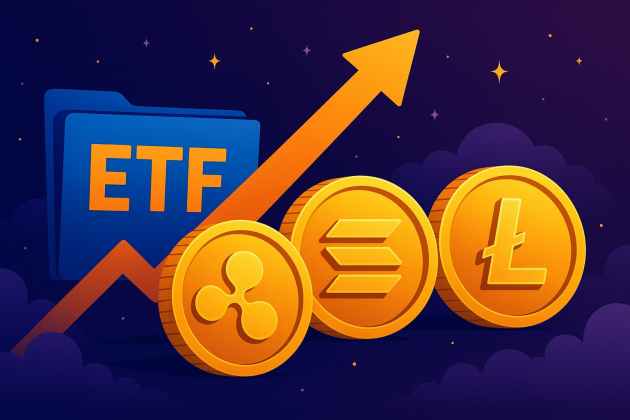
Trong khi mọi ánh mắt đổ dồn vào các ETF Solana (SOL) với tổng dòng vốn vào khoảng $682 triệu, thì ETF XRP âm thầm vượt mặt với $874 triệu — dù các sản phẩm SOL ra mắt trước. Cùng lúc đó, một loạt ETF altcoin mới liên quan đến LTC, HBAR, DOGE và LINK cũng đã chính thức gia nhập cuộc chơi, mỗi quỹ đều ghi nhận dòng vốn khiêm tốn nhưng ổn định kể từ khi ra mắt.
Thực đơn “Altcoin Buffet” chính thức xuất hiện trên Wall Street
Bảy ETF Solana riêng biệt đã tạo ra $618,62 triệu dòng vốn ròng kể từ khi niêm yết, và với $915,08 triệu tổng tài sản quản lý, các quỹ này hiện chiếm khoảng 1,15% vốn hóa Solana.
Trong khi đó, XRP đã thu hút $874,28 triệu, theo dữ liệu từ sosovalue.com.
Chỉ có bốn ETF XRP xuất hiện trên bảng điều khiển của nền tảng này — do Grayscale, Franklin Templeton, Canary và Bitwise quản lý. ETF của Canary, với mã XRPC, dẫn đầu với $357 triệu dòng vốn kể từ ngày đầu tiên. Riêng ngày hôm qua, cả nhóm thu hút $50,27 triệu, trong đó Grayscale GXRP đóng góp lớn nhất.
Tổng cộng, bốn ETF này đang nắm giữ $906,46 triệu giá trị XRP, tương đương 0,68% vốn hóa của XRP.
Đối với các nhà đầu tư muốn tiếp cận LINK, HBAR, LTC và DOGE, những ETF mới ra mắt này cũng đã ghi nhận tổng cộng $133,46 triệu dòng vốn ròng. Riêng DOGE có hai ETF — Grayscale GDOG và Bitwise BWOW — thu hút $2,85 triệu.
ETF Floodgates Open: Altcoin ngập tràn lựa chọn
Grayscale GLNK đã thu hút khoảng $40,90 triệu, trong khi LTCC của Canary (theo dõi Litecoin) thu về $7,67 triệu. ETF HBAR của Canary (HBR) đã ghi nhận $82,04 triệu dòng vốn ròng.
Khi nhà đầu tư có thể dễ dàng “nhảy giữa các quỹ”, thị trường nhiều khả năng sẽ biến động mạnh hơn khi dòng vốn luân chuyển liên tục.
Và mặc dù XRP và SOL ETF đang bám đuổi sát sao nhau, cả hai vẫn còn rất xa so với BTC và ETH ETF — những quỹ đã được triển khai sớm hơn một năm và đang tiến gần mốc hai năm hoạt động.
Khi ngày càng nhiều ETF altcoin được tung ra thị trường, dòng vốn sẽ tiếp tục phân tán. Thách thức lớn nhất sẽ là liệu sự hào hứng của nhà đầu tư có theo kịp tốc độ mở rộng của danh sách quỹ hay không. Hiện tại, các ETF mới đang cạnh tranh quyết liệt với nhau, nhưng hành trình để đạt tới tầm vóc của BTC và ETH ETF vẫn còn rất dài.
Tuy nhiên, sự mở rộng này cho thấy thị trường đang chuyển sang giai đoạn mới — một giai đoạn của sự lựa chọn đa dạng, cạnh tranh mạnh mẽ và dòng vốn mới tràn vào.
Bitcoin Hyper – ứng viên altcoin tiềm năng giữa làn sóng ETF mới
Dù bài toán ETF đang chi phối dòng tiền tổ chức, nhà đầu tư nhỏ lẻ và trung hạn vẫn đang tìm kiếm altcoin tiềm năng có thể bứt phá ngoài phạm vi ETF truyền thống.
Một trong những cái tên ngày càng nổi bật là Bitcoin Hyper (HYPER) — dự án Bitcoin Layer-2 chạy trên Solana Virtual Machine (SVM), tạo ra sự kết hợp giữa tốc độ Solana và bảo mật Bitcoin.
Với gần $29 triệu huy động được từ presale, tổng cung cố định 21 tỷ token, và APY staking 40%, HYPER đang thu hút sự chú ý mạnh mẽ từ cả trader lẫn nhà đầu tư tổ chức nhỏ.
Mô hình này mở ra khả năng giúp lượng BTC “nằm im” có thể tham gia DeFi — điều mà các nhà phân tích coi là một trong những cơ hội tăng trưởng mạnh nhất ngoài ETF, giúp Bitcoin Hyper trở thành một trong những đồng altcoin tiềm năng đáng theo dõi nhất trong năm tới.
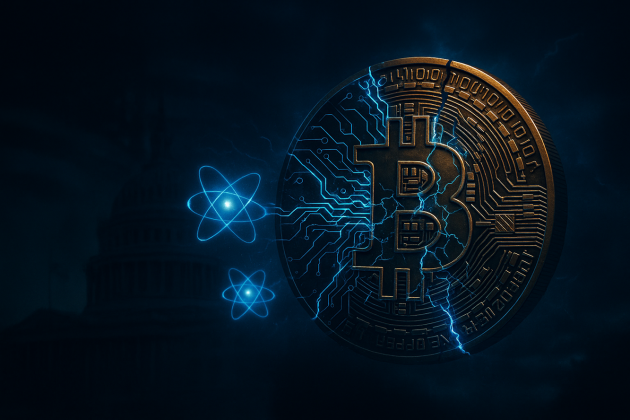
A new a16z crypto research paper argues that apocalyptic narratives about quantum computers instantly killing Bitcoin are badly misaligned with reality, and that the real risk for blockchains lies in long, messy migrations rather than a sudden “Q-Day” collapse. The piece has already triggered a sharp rebuttal on X from investors who say the threat is closer and harder than a16z suggests.
Bitcoin Isn’t Doomed By Quantum Computing: a16z
In the article “Quantum computing and blockchains: Matching urgency to actual threats,” a16z research partner and Georgetown computer science professor Justin Thaler sets the tone early, writing that “Timelines to a cryptographically relevant quantum computer are frequently overstated — leading to calls for urgent, wholesale transitions to post-quantum cryptography.” He argues that this hype distorts cost–benefit analyses and distracts teams from more immediate risks such as implementation bugs.
Thaler defines a “cryptographically relevant quantum computer” (CRQC) as a fully error-corrected machine capable of running Shor’s algorithm at a scale where it can break RSA-2048 or elliptic-curve schemes like secp256k1 in roughly a month of runtime. In his assessment, a CRQC in the 2020s is “highly unlikely,” and public milestones do not justify claims that such a system is probable before 2030.
He stresses that across trapped-ion, superconducting and neutral-atom platforms, no device is close to the hundreds of thousands to millions of physical qubits, with the required error rates and circuit depth, that would be needed for cryptanalysis.
Instead, the a16z piece draws a sharp line between encryption and signatures. Thaler argues that harvest-now-decrypt-later (HNDL) attacks already make post-quantum encryption urgent for data that must remain confidential for decades, which is why large providers are rolling out hybrid post-quantum key establishment in TLS and messaging.
But he insists that signatures, including those securing Bitcoin and Ethereum, face a different calculus: they do not protect hidden data that can be retroactively decrypted, and once a CRQC exists, the attacker can only forge signatures going forward.
On that basis, the paper claims that “most non-privacy chains” are not exposed to HNDL-style quantum risk at the protocol level, because their ledgers are already public; the relevant attack is forging signatures to steal funds, not decrypting on-chain data.
Bitcoin-Specific Headaches
Thaler still flags Bitcoin as having “special headaches” due to slow governance, limited throughput and large pools of exposed, potentially abandoned coins whose public keys are already on-chain, but he frames the time window for a serious attack in terms of at least a decade, not a few years.
“Bitcoin changes slowly. Any contentious issues could trigger a damaging hard fork if the community cannot agree on the appropriate solution,” Thaler writes, adding “another concern is that Bitcoin’s switch to post-quantum signatures cannot be a passive migration: Owners must actively migrate their coins.”
Moreover, Thalen flags a “final issue specific to Bitcoin” which is its low transaction throughput. “Even once migration plans are finalized, migrating all quantum-vulnerable funds to post-quantum-secure addresses would take months at Bitcoin’s current transaction rate,” Thaler says.
He is equally skeptical of rushing into post-quantum signature schemes at the base-layer. Hash-based signatures are conservative but extremely large, often several kilobytes, while lattice-based schemes such as NIST’s ML-DSA and Falcon are compact but complex and have already produced multiple side-channel and fault-injection vulnerabilities in real-world implementations. Thaler warns that blockchains risk weakening their security if they jump too early into immature post-quantum primitives under headline pressure.
Industry Split On The Risk
The most forceful pushback has come from Castle Island Ventures co-founder Nic Carter and Project 11 CEO Alex Pruden. Carter summed up his view on X by saying the a16z work “wildly underestimates the nature of the threat and overestimates the time we have to prepare,” pointing followers to a long thread from Pruden.
Pruden begins by stressing respect for Thaler and the a16z team, but adds, “I disagree with the argument that quantum computing is not an urgent problem for blockchains. The threat is closer, the progress faster, and the fix harder than how he’s framing it & than most people realize.”
He argues that recent technical results, not marketing, should anchor the discussion. Citing neutral-atom systems that now support more than 6,000 physical qubits, Pruden points out that “we now have a non annealing system with more than 6000 physical qubits in the neutral atom architecture,” directly contradicting any implication that only non-scalable annealing architectures have reached that scale. He notes that work such as Caltech’s 6,100-qubit tweezer array shows large, coherent, room-temperature neutral-atom platforms are already a reality.
On error correction, Pruden writes that “surface code error correction was experimentally demonstrated last year, moving it from a research problem into an engineering problem,” and points to rapid advances in color codes and LDPC codes.
He highlights Google’s updated “Tracking the Cost of Quantum Factoring” estimates, which show that a quantum computer with about one million noisy physical qubits running for roughly a week could, in principle, break RSA-2048 — a twenty-fold reduction from Google’s own 2019 estimate of twenty million qubits.
“Resource estimates for a CRQC running Shor’s algorithm have dropped by two orders of magnitude in six months,” he notes, concluding, “To say that this trajectory of progress might potentially deliver a quantum computer before 2030 is not an overstatement.”
Where Thaler emphasizes HNDL as an encryption problem, Pruden reframes blockchains as uniquely attractive quantum targets. He stresses that “public keys used in digital signatures are just as easy to harvest as encrypted messages,” but in blockchains those keys are directly tied to visible value. He points out that “these public keys are distributed & directly associated with value ($150B for Satoshi’s BTC alone),” and that once a quantum adversary can forge signatures, “If you can forge a signature, you can steal the asset regardless of when that original UTXO/account was created.”
For Pruden, this economic reality means “the economic incentives simply and clearly point to blockchains as being the first cryptographically relevant quantum use case,” even if other sectors also face HNDL risks. He adds that “blockchains will be far slower to migrate than centralized systems. A bank can upgrade its stack. Blockchains must reach global consensus, absorb performance trade-offs from PQ signatures, and coordinate millions of users to migrate their keys.”
Invoking Ethereum’s multi-year shift from proof of work to proof of stake, he writes, “The closest thing was the ETH 1.0 to 2.0 transition which took years, and as complex as that was, a PQ migration is much harder. Anyone who thinks this is a matter of swapping a few lines of signature code has simply never shipped, deployed, or maintained a production blockchain.”
Pruden agrees with Thaler that panic is dangerous, but flips the conclusion: “I agree that rushing is dangerous. But that is exactly why work must begin now. The most likely failure mode is that the industry waits too long, and then a major QC milestone triggers a panic.” He closes by saying he disagrees that “quantum computing is progressing slowly,” that “blockchains are less vulnerable than systems exposed to HNDL risk,” or that “the industry has years of slack before action is needed,” arguing that “All three assumptions are at odds with reality.”
Binance’s international operations and liquidity will now be supervised end-to-end by the Financial Services Regulatory Authority in the financial free zone in Abu Dhabi.
Investors holding 1,000, 5,000, and 10,000 XRP tokens could see massive profit if the XRP price rallies in a scenario where XRP powers the global payroll industry. XRP trades at $2.18 today with a market value of about $131.8 billion.
Market participants have continued to anticipate a scenario where an XRP price spike pushes their holdings to $1 million. XRP has struggled over the past few months.
Binance has secured three new licences in Abu Dhabi, tightening its grip on one of the most ambitious digital asset hubs in the Middle East and giving the exchange a powerful regulatory base as it pushes to keep institutional money on side.
The Financial Services Regulatory Authority of Abu Dhabi Global Market has approved Binance.com to operate through a trio of regulated entities that together cover exchange, clearing and broker dealer activities.
The authorizations were granted during Abu Dhabi Finance Week and apply to Binance’s global platform, not just a regional offshoot, which is a key point for professional traders watching where the exchange can legally serve them.
Major milestone #Binance is the first-ever digital assets trading platform to secure a full suite of licenses from FSRA under @ADGlobalMarket.
This marks a breakthrough moment that raises global standards for regulation, security, and trust.
Binance Builds Multi-Entity Structure For Exchange, Clearing And Trading
Under the new structure, Nest Services Limited, which will be renamed Nest Exchange Limited, has been approved as a recognized investment exchange with permission to run a multilateral trading facility. It will host Binance’s on exchange business, including spot and derivatives markets.
Nest Clearing and Custody Limited has been approved as a recognized clearing house with added custody and securities depository permissions, putting it in charge of clearing, settlement and safekeeping of digital assets.
A third entity, BCI Limited, set to become Nest Trading Limited, holds a broker dealer licence that covers dealing and arranging in investments, asset management, custody arrangements and money services, including over the counter trading and conversion.
Binance Leans On ADGM Regime To Reinforce Compliance And Global Reach
Binance has described the package as a comprehensive regulatory framework for Binance.com and a global first for the platform. The company says the approvals give it a cleaner path into multiple markets beyond the UAE and help it present itself as a more predictable counterparty to institutions that have grown wary of loosely regulated venues after a series of blow ups.
Richard Teng, Binance’s co-chief executive and a former senior executive at Abu Dhabi Global Market, said in a statement that working under the authority’s regime reflects a commitment to compliance, transparency and user protection.
He argued that the licence brings regulatory clarity and legitimacy and allows Binance to support its global operations from Abu Dhabi while keeping a distributed operating model that taps talent around the world.
Rising Crypto Investments Show Abu Dhabi Positioning Itself As Digital Finance Hub
For Abu Dhabi, the deal fits neatly into a broader push to turn its oil wealth and sovereign funds into long term exposure to digital assets and financial technology. The emirate, which sits on roughly $2 trillion in sovereign wealth, has been steadily increasing its footprint in crypto.
The Abu Dhabi Investment Council, an independently run arm of Mubadala Investment, more than tripled its holding in BlackRock’s iShares Bitcoin Trust during the third quarter, taking the position to almost 8m shares as of Sept. 30, worth about $518m at the time.
Binance also has direct financial ties to the city. In March, the exchange secured a $2b investment from AI-focused investor MGX, chaired by Sheikh Tahnoon bin Zayed Al Nahyan, one of the most influential figures in the emirate’s financial and security establishment.
That backing and the new licences deepen the sense that Abu Dhabi sees Binance as a core piece of its digital finance strategy.
The exchange has not yet named a global headquarters, but Teng has previously called the UAE an attractive option. With Abu Dhabi Global Market now authorised to host Binance.com’s regulated activities from January 5, 2026, the city will remain high on the list of possible long term bases, especially as more institutional clients demand clear regulatory anchors.
Binance Looks To Rebuild Trust As New Licences Follow Turbulent Period
The approvals come after a difficult period for Binance on the enforcement front. Founder Changpeng Zhao stepped down as chief executive in 2023 after pleading guilty to breaking US anti money laundering laws.
The company agreed to pay more than $4.3b to settle a years long US investigation. Zhao was pardoned by President Donald Trump in October this year, removing a major legal cloud for the former CEO, but regulators and counterparties still expect Binance to prove that it can operate with tighter controls.
Binance says it now has more than 300m registered users and over $125 trillion in cumulative trading volume. It argues that operating under Abu Dhabi’s rules will give both retail and institutional users stronger comfort on oversight and consumer protection as it pushes toward its long stated goal of serving 1b people.
The leadership team is shifting as the regulatory architecture firms up. Last week, Teng named Binance co founder Yi He as the company’s new co-chief executive.
He described her as a driving force since the exchange’s launch, and credited her with shaping its culture, vision and user focused approach. Her formal elevation signals that Binance wants to present a more structured leadership bench as it leans further into regulated markets.
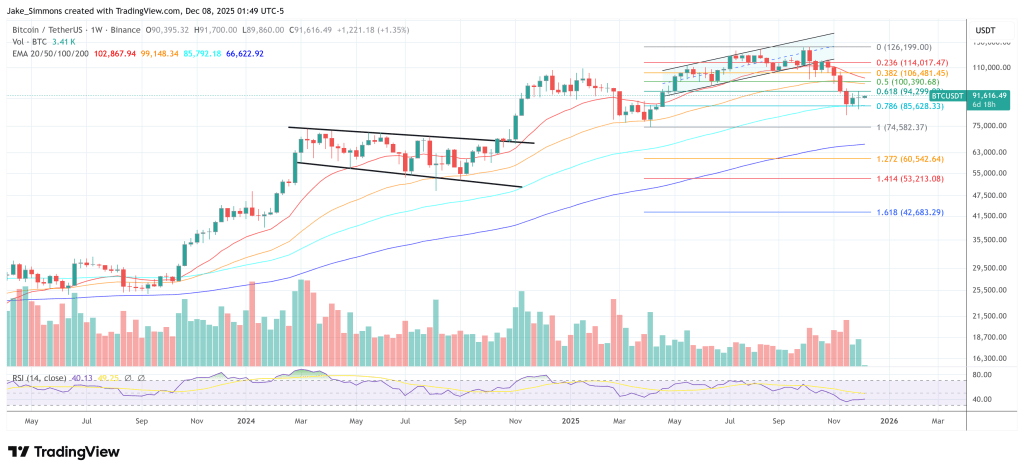
10x Research says Bitcoin may look calm on the surface, but the derivatives market is flashing signs of brewing volatility. In its latest weekly report, the firm notes that options traders are buying volatility, downside skew has returned, funding rates have softened, and futures open interest is diverging, all while spot ETFs continue to see net outflows. Despite bullish macro hopes around U.S. liquidity, 10x warns that market structure remains unsupportive, suggesting traders should brace for unexpected moves in the coming 1–2 weeks. Currently, Bitcoin is trading above $91,200, 1.8% up in the last 24 hours.
But what else is happening in crypto news today? Follow our up-to-date live coverage below.
Binance moved into a new phase of regulatory certainty after confirming that Abu Dhabi had approved a complete suite of licenses for Binance.com. Binance has taken a major regulatory step that could reshape how its global platform operates in 2026. …
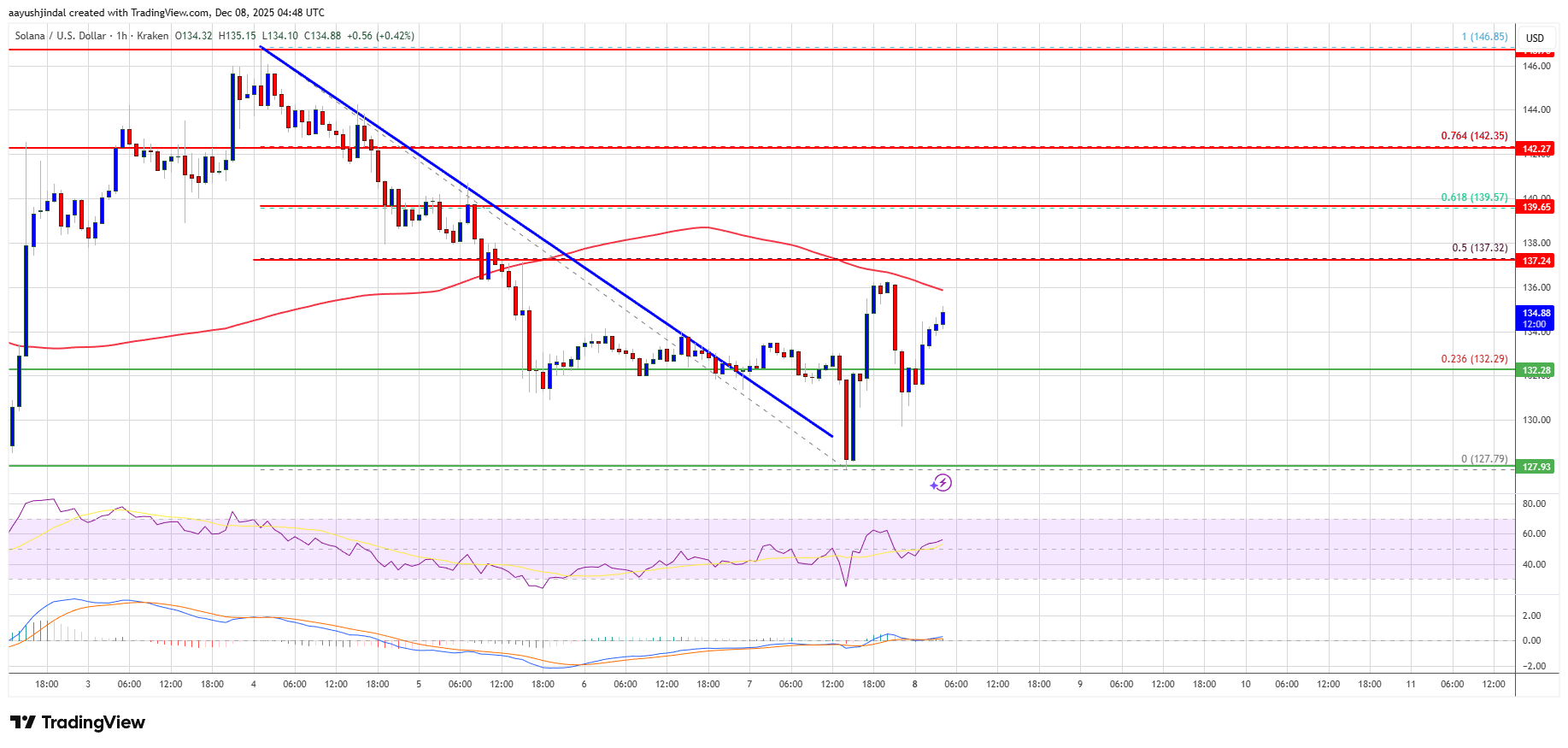
Solana started a recovery wave above the $132 zone. SOL price is now consolidating and faces hurdles near the $138 zone.
SOL price started a decent recovery wave above $130 and $132 against the US Dollar.
The price is now trading below $138 and the 100-hourly simple moving average.
There was a break above a key bearish trend line with resistance at $132 on the hourly chart of the SOL/USD pair (data source from Kraken).
The price could continue to move up if it clears $138 and $140.
Solana Price Eyes Upside Break
Solana price remained stable and started a decent recovery wave from $128, like Bitcoin and Ethereum. SOL was able to climb above the $130 level.
There was a move above the 23.6% Fib retracement level of the downward move from the $147 swing high to the $128 low. Besides, there was a break above a key bearish trend line with resistance at $132 on the hourly chart of the SOL/USD pair.
Solana is now trading below $138 and the 100-hourly simple moving average. On the upside, immediate resistance is near the $137 level, the 100-hourly simple moving average, and the 50% Fib retracement level of the downward move from the $147 swing high to the $128 low.
The next major resistance is near the $140 level. The main resistance could be $142. A successful close above the $142 resistance zone could set the pace for another steady increase. The next key resistance is $150. Any more gains might send the price toward the $155 level.
Another Decline In SOL?
If SOL fails to rise above the $140 resistance, it could continue to move down. Initial support on the downside is near the $132 zone. The first major support is near the $130 level.
A break below the $130 level might send the price toward the $128 support zone. If there is a close below the $128 support, the price could decline toward the $120 zone in the near term.
Technical Indicators
Hourly MACD – The MACD for SOL/USD is gaining pace in the bullish zone.
Hourly Hours RSI (Relative Strength Index) – The RSI for SOL/USD is above the 50 level.

 Login
Login


 Global crypto exchange Coinbase has registered with India’s FIU—paving the way to resume trading and launch retail services later this year.
  India stalls full crypto framework due to systemic risk fears. Officials plan to maintain partial oversight with strict taxation rules.