American Bitcoin has further expanded its Bitcoin holdings, adding 416 BTC in its latest accumulation round. The update, released Wednesday, confirms that the company’s total reserve has climbed to 4,783 BTC as of December 8.
SpaceX has executed yet another major Bitcoin transfer, moving 1,021 BTC worth $94.48 million to Coinbase Prime. Lookonchain and SwanDesk called attention to the transaction via social media.
EGRAG Crypto suggests Bitcoin is entering phase 2 of a radical uptrend, citing the similarities between the current market conditions and 2019. The market technician attempted to correct widespread sentiment that the current Bitcoin price action resembles the 2021 bull-cycle top.
Sentiment across the market shows a mild improvement today, with the Fear and Greed Index rising to 30 after spending much of the past two weeks in the lower twenties and briefly touching extreme fear levels that had pushed many participants into defensive positioning.
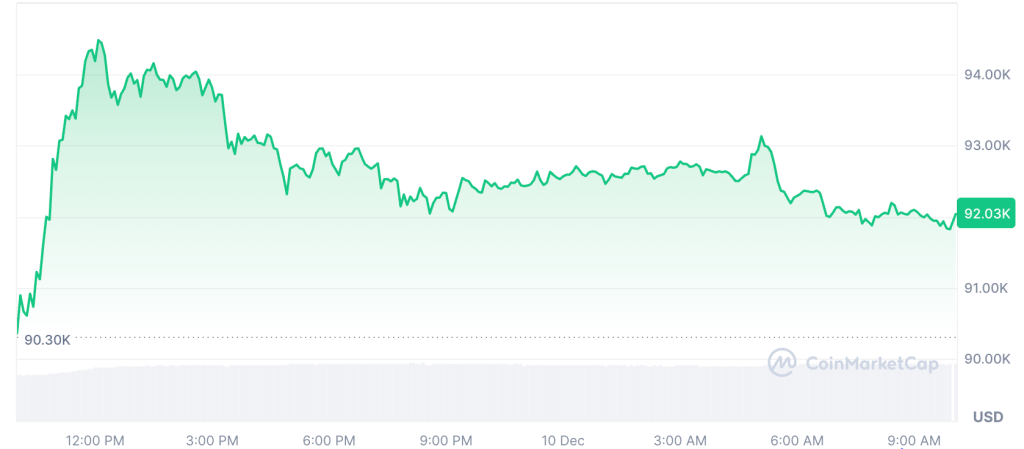
Bitcoin is trading near $92,000 after a stretch of uneven activity that began in late November, and the steadier tone around the largest asset has created a backdrop in which a small group of altcoins can advance without relying on abrupt, flow-driven bursts.
Bitcoin Price (Source: CoinMarketCap)
Ethereum sits at the center of that shift as its performance often sets expectations for how much risk the market is willing to take.
Ethereum Extends Its Climb On Firmer Market Structure
Ethereum (ETH) is currently trading around $3,330, up by about 7% over 24 hours, and the increase is supported by an improvement in both spot and derivatives participation, with deeper books and steadier bidding in ranges that had previously struggled to hold during last week’s retreat.
Activity across major venues indicates that traders who had reduced exposure during the November drawdown are gradually re-entering positions, not because sentiment has shifted dramatically, but because the asset’s day-to-day usage and continued demand for block space provide a degree of stability even when the wider environment remains cautious.
This pattern allows Ethereum to function as an early gauge of whether the current relief has staying power, since its liquidity and scale often give it the ability to recover before smaller assets regain enough confidence to follow.
Monero Gains As Privacy Demand Holds Steady
Monero (XMR) is trading near $404, up by roughly 12% in 24 hours, and the climb aligns with periods in which privacy-oriented tokens receive renewed attention from communities that maintain consistent usage regardless of broader sentiment shifts.
The MAGIC Monero Fund has started a second fundraiser to further increase Monero's fuzzing harnesses!
'The goal of this proposal is to continue working with AdaLogics to improve the overall code coverage of Monero in general.' https://t.co/8QMBp9XeVm
Depth across several exchanges shows more orderly conditions than last week, with a distribution of bids that implies steady interest rather than isolated buying, which is notable because privacy assets often strengthen when markets search for tokens with established user bases and reliability rather than speculative catalysts.
Mantle Tracks Layer 2 Engagement As Liquidity Improves
Mantle (MNT) is trading near $1.20, up by about 7% in 24 hours, supported by consistent throughput and engagement across the Layer 2 ecosystem that underpins its value.
The token has climbed back above ranges that came under pressure during last week’s downturn, and turnover now sits noticeably higher than the levels seen during the most severe portion of the recent selloff.
This behavior aligns with the tendency for infrastructure and scaling tokens to recover earlier than many smaller assets when sentiment begins to ease, because they rely on live activity and measurable network growth rather than short-term narrative swings.
Altcoin Season Still Out Of Reach Despite Signs Of Relief
The rise in the market sentiment and today’s scattered gains among Ethereum, Monero, and Mantle demonstrate that the market is willing to experiment with selective positioning, yet the structure of flows suggests that a broad altcoin season remains distant.
Bitcoin continues to anchor sentiment near $92,000, and most major tokens remain confined to narrow ranges while participants wait for clearer macro signals, steadier global liquidity conditions, and confirmation that the recent improvement does not fade with the next shift in funding or equities.
For now, the recovery resembles the early-stage attempt to stabilize rather than the altcoin season ready for wide rotation, although the presence of consistent activity in a few established networks shows that the market has not fully retreated from altcoin exposure even as caution remains the prevailing influence.
Strategy Inc., the world’s largest Bitcoin treasury company, has submitted a detailed response to MSCI’s consultation on how to classify Digital Asset Treasury Companies (DATs).
Strategy has submitted its response to MSCI’s consultation on digital asset treasury companies. Index standards should be neutral, consistent, and reflective of global market evolution. Read our letter and share your support: https://t.co/QVmKAkwRCP
MSCI has proposed excluding from its Global Investable Market Indexes any company whose digital asset holdings represent 50% or more of total assets.
In a letter dated December 10, sent by Executive Chairman Michael Saylor and CEO Phong Le, Strategy argues the move is “misguided” and would have “profoundly harmful consequences” for capital markets, innovation, and U.S. leadership in digital assets.
“DATs Are Operating Companies, Not Investment Funds”
The core of Strategy’s argument is that DATs like itself are operating businesses, not passive investment funds. Strategy stresses that it does not simply sit on a Bitcoin hoard; instead, it runs a Bitcoin-backed corporate treasury and capital markets program, issuing a range of equity and fixed-income instruments that provide investors with varying degrees of Bitcoin exposure.
It compares this model to banks and insurers that capture a spread between financing costs and returns on underlying assets.
The company notes that many traditional firms—such as oil majors, REITs, timber companies and media groups—are also heavily concentrated in a single asset type, yet are not treated as funds or excluded from indices. Singling out digital-asset-heavy balance sheets, it says, would be discriminatory and inconsistent.
Strategy Warns of Index Instability and Policy Bias
Strategy contends that MSCI’s proposed 50% digital asset threshold is both arbitrary and unworkable. Given crypto price volatility and divergent accounting standards (GAAP vs. IFRS), companies could “whipsaw on and off” MSCI indices as market values fluctuate, undermining index stability and investor confidence.
The letter also accuses MSCI of improperly injecting policy judgments into index construction, departing from its stated role as a neutral provider of “exhaustive” benchmarks that reflect market evolution rather than deeming certain business models “good or bad.”
Excluding DATs, Strategy argues, would structurally under-represent a fast-growing segment of the economy and call into question the neutrality of MSCI’s indices.
Conflict with U.S. Digital Asset Strategy and Call for Extended Review
Strategy further argues that the proposal conflicts with the current U.S. administration’s pro-innovation digital asset agenda, including initiatives like a Strategic Bitcoin Reserve and efforts to expand access to digital assets in retirement plans.
Excluding DATs from major benchmarks, the company says, would choke off access to passive capital, chill innovation, and weaken U.S. competitiveness in a strategically important sector.
Concluding, Strategy urges MSCI to reject the proposal outright or, at minimum, extend the consultation and undertake a longer, more deliberate review as digital asset treasury models continue to mature. “The wiser course,” the letter states, “is for MSCI to remain neutral and let the markets decide the course of DATs.”
Dogecoin’s (DOGE) price action is entering a crucial phase as the asset presses deeper into a descending triangle pattern, a structure defined by declining highs and a stable support base.
Ripple (XRP) token dropped to a low of $2.0640, down from this week's high of $2.1780. Other altcoins held steady ahead of the Fed's interest rate decision.
The Bitcoin price is hovering near $91.8K, gaining a small 0.6% in the past 24 hours, even though it’s still down for the week. Traders are basically holding their breath as the Fed is likely to lower interest rates later…
Bitcoin climbed to a three-week high on Tuesday before slipping back, a move that has traders and analysts watching closely.
According to TradingView data, Bitcoin price topped out at $94,600 late in the session — its highest level since November 25 — then eased to about $92,450 at the time of reporting.
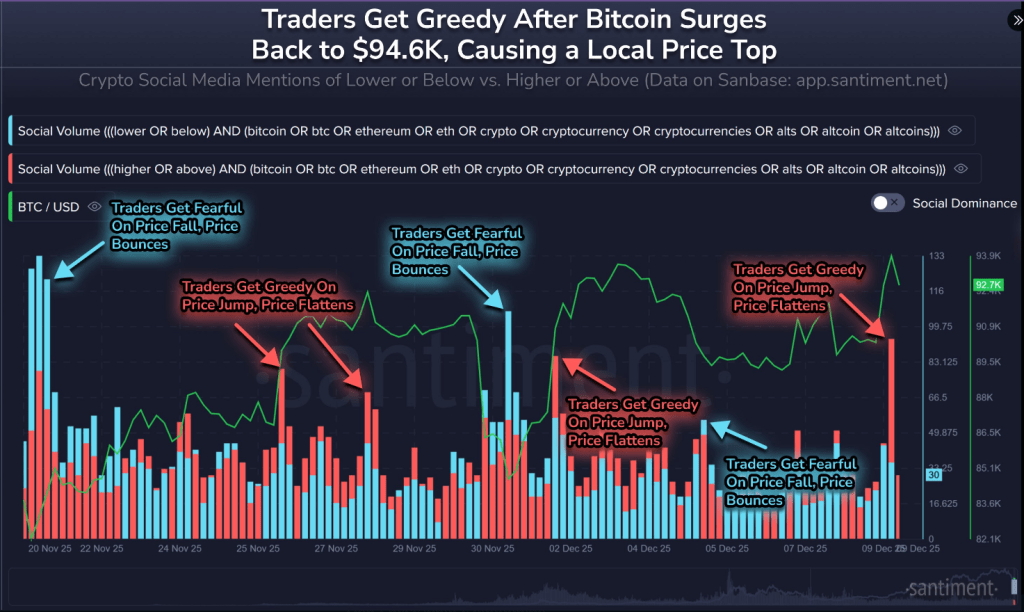
Santiment, a blockchain analytics firm, said social chatter calling for “higher” and “above” exploded during the spike, but market action remained uneven.
Bitcoin: Trader Frenzy And Skepticism
Reports have disclosed that the surge drew heavy retail attention and a flurry of social-media posts urging more buying.
Some market watchers questioned how organic the rise was. A well-known long-term investor using the handle “NoLimit” told his 53,000 X followers that the $94,000 push looked engineered: big buys packed into a few minutes, thin order books, then little follow-through.
Bitcoin enjoyed a much needed rebound back to $94.6K today, reinvigorating traders, causing them to FOMO back in and expect higher prices. According to our social data scraping X, Reddit, Telegram, & other data, calls for “higher” & “above” exploded.
That pattern, he argued, is how larger traders can create short-term fear of missing out so they can sell into strength.
Santiment also highlighted a behavioral twist: smaller traders appear to pile in after spikes, often leaving them on the wrong side of moves.
Volatility followed the high, as prices pulled back by a couple thousand dollars within hours. Exchange order depth and timing of large blocks, analysts say, matter a lot when liquidity is shallow.
Fed Decision Could Shift Momentum
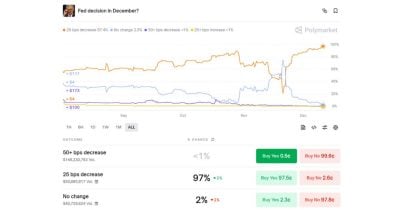
The US central bank meeting this week is a key wildcard. Market pricing on CME Group futures showed an 88% chance of a 0.25% rate cut, which many traders think helped fuel the rally. Yet some analysts warned that any sign of hesitation about future cuts could dampen risk appetite.
Beyond US policy, next week’s potential Bank of Japan rate action is being watched because a tighter stance there could lift yields and pull capital back to Japan, tightening global liquidity. That kind of flow can pressure risky assets across markets.
Liquidity, Institutions And The Bigger Picture
Meanwhile, long-term holders pared back supply after a 36% correction from the all-time high, and some addresses now hold levels seen in March.
Jessica Gonzales, an analyst cited in reports, said M2 money supply sits at about $22.3 trillion and stablecoin reserves remain elevated, suggesting there is capital around but not necessarily evenly distributed in markets.
Institutional moves also feature: big firms such as BlackRock and Strategy have expanded crypto exposure, which could add a steadier buyer base — or simply shift where risk sits.
What Traders Should Watch
Short-term traders should track order-book depth, large trade clusters, and how price reacts to any Fed wording about future cuts.
The next 25 days were flagged as especially important by several observers because liquidity swings and regulatory updates could flip the narrative fast. If a true broad-based bid forms, prices could move quickly. If the Fed signals caution, the opposite could happen.
Featured image from Gemini, chart from TradingView
Many major companies continue to lock in on Ethereum, the second-largest digital asset, despite the ongoing volatile action of the altcoin’s price. One of the methods currently adopted by these companies to grow their ETH portfolios is via Ethereum Staking, where they earn notable rewards.
SharpLink Scores Another Major Ethereum Staking
In the ever-evolving world of cryptocurrency, the Ethereum staking economy is still demonstrating its durability. As the staking economy gains traction, SharpLink Gaming, a leading public company, is once again at the center of this wave, with massive rewards from its ETH staking positions.
Being the first publicly traded company to adopt ETH as its primary treasury reserve asset, SharpLink continues to increase its exposure to Ethereum, as evidenced by its staking gains. A recent post on the X platform by the company reveals another round of significant staking rewards in the past week.
This development showcases the power of ETH’s proof-of-stake network in general as well as the company’s increasing yield performance. Furthermore, the most recent gains are bolstering confidence in long-term staking plans, which comes at a time when investors are keeping a closer eye on on-chain returns than ever.
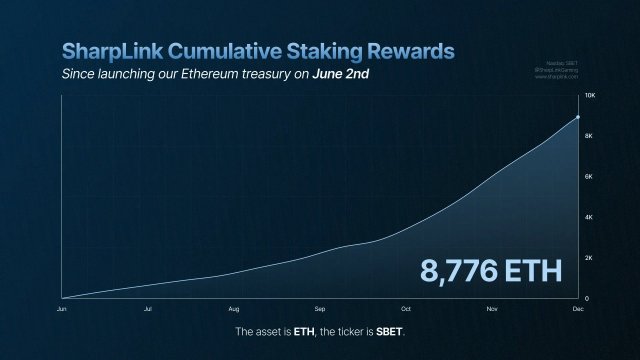
As seen in the latest report, SharpLink scooped in over 446 ETH from staking rewards just last week. It was worth noting that since the company launched its ETH treasury in June 2025, they has experienced a persistent rise in their cumulative staking rewards.
Following the recent gains, the total cumulative rewards have reached 8,776 ETH, which seems to have ignited a frenzy in the community. The firm’s ETH holdings remain 100% staked in an institutional-grade manner and maintain compounding value for the treasury.
Mlik Road, a crypto enthusiast, highlighted that at current prices and holdings, SharpLinks’ latest staking reward in one week is valued at $1.38 million. Interestingly, this amounts to around $70 million in income for the gaming firm annually.
As rewards keep rolling in, the important part of this development is that this figure is only expected to continue growing. When the price of ETH rises, the staking revenue of SharpLink will increase. In addition, when the firm’s ETH holdings increase, its staking income will multiply.
Whales Are Adding More ETH To Their Wallets
Ethereum’s bounce appears to have shifted the sentiment of investors, especially large investors or whales, toward a bullish standpoint. According to Santiment, a leading market intelligence and on-chain data analytics platform, ETH was a notable gainer on Tuesday, with a rise of +8.5% and an optimistic accumulation trend from whales and sharks.
While these big investors have resumed ETH accumulation, retail holders have been offloading their holdings at a fast rate. Data shared by Santiment shows a massive accumulation of 949,240 ETH worth $3.15 billion in the past 3 weeks by whales. Meanwhile, small retail investors have gone on a selling spree, dumping 1,041 ETH over the past week.
Strategy, the world’s largest Bitcoin treasury company, has submitted a formal response to MSCI’s consultation on digital asset treasury companies (DATs), urging the index provider not to exclude companies whose digital asset holdings exceed 50% of total assets.
In its detailed letter to the MSCI Equity Index Committee, Strategy argued that the proposed threshold is “misguided” and would have “profoundly harmful consequences” for both investors and the broader digital asset industry.
Founded in 1989, the company operates as a corporate treasury and capital markets business with significant Bitcoin holdings, offering investors a range of equity and fixed-income securities backed by its digital assets.
According to the company, its model is fundamentally different from a passive investment fund. Strategy actively uses its Bitcoin reserves to generate returns for shareholders, providing novel financial instruments akin to traditional bank and insurance products.
The company emphasized that “DATs are operating companies, not investment funds,” noting that its operational flexibility allows it to adapt its business model as the technology evolves.
Strategy calls MSCI’s logic “arbitrary, and unworkable.”
Strategy criticized MSCI’s proposal for introducing a digital-asset-specific 50% threshold, calling it “discriminatory, arbitrary, and unworkable.”
The company highlighted that many traditional businesses — including oil companies, timber operators, REITs, and media firms — also maintain concentrated holdings in single asset types but are not treated as investment funds.
The company warned that price volatility, differing accounting standards, and asset valuation changes would create index instability, causing DATs to whipsaw in and out of MSCI’s indices.
The letter further argued that the proposal would inappropriately inject policy considerations into index construction.
“MSCI has consistently held itself out as providing indices that accurately and objectively measure market performance,” Strategy wrote.
JUST IN: Strategy officially asks MSCI to revoke its proposal to exclude #Bitcoin treasury companies like $MSTR from its indexes. pic.twitter.com/3k1RlJDZjX
Excluding DATs based on the type of assets they hold, rather than the underlying business model, could compromise MSCI’s neutrality and mislead investors about how these companies operate.
Strategy noted that its investors buy exposure to the company’s management and innovation capabilities, not merely to Bitcoin itself, citing historical trading patterns in which the company’s stock often outperformed the underlying value of its digital holdings.
Strategy: Digital assets are popular in government policy
The company also framed the debate in the context of U.S. economic policy. Strategy noted that the federal government, under President Trump, has made digital assets central to national economic endeavors, including the establishment of a Strategic Bitcoin Reserve and promoting access to digital assets in retirement accounts.
Excluding DATs from MSCI indices would, the letter argued, conflict with these policies and chill innovation in a nascent sector.
Analysts cited in the letter estimate that Strategy alone could face up to $2.8 billion in stock outflows if MSCI implements the exclusion, with broader implications for the emerging digital asset economy.
Strategy positioned itself within a historical context, comparing the rise of digital asset treasuries to earlier industrial leaders.
The letter highlighted examples like Standard Oil, AT&T, Intel, and NVIDIA, noting that these companies made concentrated investments in emerging technologies that were initially viewed as risky but ultimately became foundational to economic growth.
Similarly, the letter argued, digital asset treasuries are building critical infrastructure for a new financial system.
Don’t succumb to ‘short-sightedness’
The letter concluded by urging MSCI to reject the 50% threshold, citing the risk of stifling innovation, damaging index integrity, and undermining federal strategy. Strategy recommended that MSCI allow the market to continue evolving and conduct more thorough consultation before considering any policy that would differentiate DATs from other operating companies.
The company invoked MSCI’s precedent in reorganizing the Communication Services sector after nearly two decades of industry evolution, suggesting a measured, deliberative approach.
“History shows that when foundational technologies have emerged, institutions that prospered allowed markets to test them rather than throttling them in advance,” Strategy wrote. “MSCI can either succumb to short-sightedness or allow its indices to reflect, neutrally and faithfully, the next era of financial technology.”
Elsewhere, companies like Strive and Bitcoin For Corporations also challenged MSCI’s decision.
Bitcoin’s reaction to FOMC decisions often conflicts with traders’ predictions. Will today’s Federal Reserve interest rate outcome lead to a rally or sell-off?
A blockchain wallet that participated in Ethereum's 2015 ICO and stayed dormant for over a decade has suddenly reawakened, realizing an extraordinary 10,684x profit. The unexpected activity immediately caught the attention of major blockchain analytics platforms, including Lookonchain and Whale Alert, both of which reported the awakening on X.
Lawmakers in the U.S. Senate continue to work through the Clarity Act, but one section of the bill could force Ripple to cut down its large XRP escrow holdings.

 Login
Login











 Bitcoin enjoyed a much needed rebound back to $94.6K today, reinvigorating traders, causing them to FOMO back in and expect higher prices. According to our social data scraping X, Reddit, Telegram, & other data, calls for “higher” & “above” exploded.
 High bars indicate…