Reading view

There are new articles available, click to refresh the page.

Japan Moves Crypto to Securities Law – Tighter Rules & Platform Crackdowns Coming

Japan is preparing its most sweeping overhaul of crypto oversight in almost a decade, setting the stage for a system that would treat digital assets far more like traditional investment products.

The move follows months of government deliberations and a series of regulatory proposals that have emerged steadily across 2024 and 2025.

Together, they show a decisive shift in how the country intends to manage trading activity, exchange operations, and investor protection.

FSA Pushes for Stricter Token Disclosure to Address Speculation and Risk

The latest step came this week after the Financial Services Agency released a detailed report from the Financial System Council’s Working Group.

The document lays out a plan to move crypto regulation away from the Payment Services Act, which has governed the sector since 2016, and into the Financial Instruments and Exchange Act.
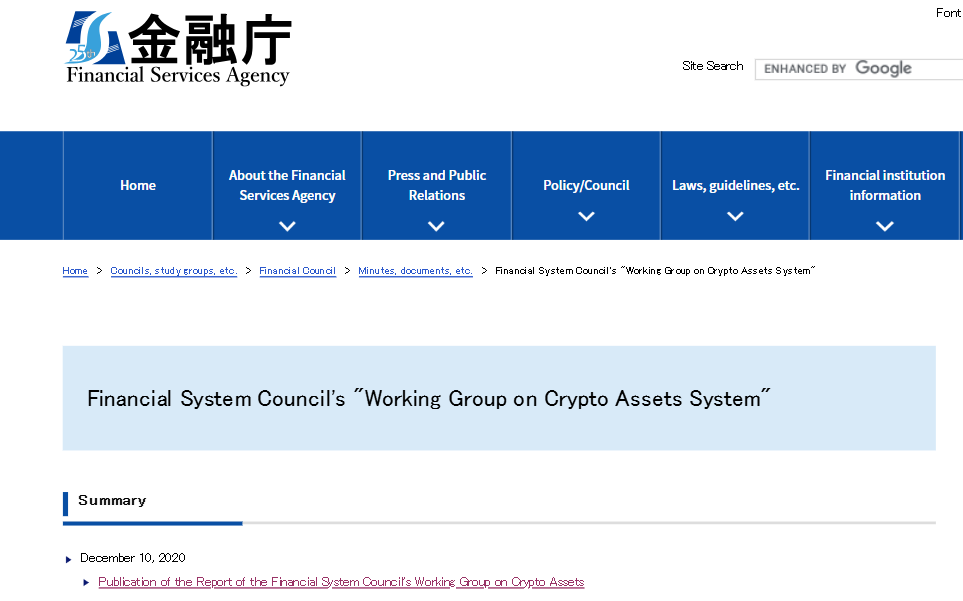
Source: Japan FSA

This change would place cryptocurrencies under the same legal umbrella used for securities trading, disclosures, and market conduct rules. Regulators said the shift reflects how the market has changed, noting that most users now engage with crypto as an investment.

Government data shows more than 86% of domestic users trade with an expectation of long-term price gains, while deposits across registered platforms have surpassed five trillion yen.

The Working Group concluded that the current framework no longer matches the risks posed by a sector dominated by speculative trading, large investor inflows, and complex token issuance schemes.

By placing crypto inside the securities rulebook, authorities intend to impose stricter disclosure requirements, particularly for token sales conducted by exchanges.

🚩金融審議会「暗号資産制度に関するワーキング・グループ」報告書を公表しました。#金融庁
▼詳細は以下をご覧ください。https://t.co/oNnsy4QYO9

— 金融庁 (@fsa_JAPAN) December 10, 2025

The report singles out initial exchange offerings, stressing the need for pre-sale information, independent code audits, and clearer descriptions of who controls a project.

Even fully decentralized assets would come under closer scrutiny, with exchanges responsible for giving users neutral risk assessments based on verifiable data.

The recommendations also call for explicit insider-trading rules covering events such as token listings, major system breaches, and large-scale sales by issuers.

🇯🇵 Japan plans to classify crypto as financial products under insider rules, cut profit taxes and tighten disclosure on 105 listed assets.#Japan #CryptoRegulations https://t.co/i9qXS0DnJA

— Cryptonews.com (@cryptonews) November 17, 2025

These provisions would apply to exchange employees, token developers, and other related parties who may access undisclosed information.

The approach mirrors ongoing reforms in Europe and South Korea, where authorities have already introduced insider-trading standards for the digital asset sector.

Japan Opens Door for Financial Giants’ Subsidiaries Under the New Rule

Exchanges operating in Japan would face standards similar to brokers dealing in securities. They would be required to assess users’ risk tolerance before permitting complex or highly volatile trading.

The plan also introduces investment limits for token offerings that have not completed financial audits, an effort to prevent retail users from being exposed to sudden selling pressure once trading begins.

Traditional financial institutions are expected to play a greater role as well. While banks and insurers will remain barred from running exchanges directly, regulators intend to let their subsidiaries offer crypto trading through highly supervised channels.

The planned transition comes alongside a series of related policies that have unfolded over recent months.

In November, the FSA proposed a registration system for custody providers and outsourced trading software firms after last year’s DMM Bitcoin breach exposed weaknesses in third-party systems.

🔐Japan intends to require crypto exchanges to hold reserves to cover customer losses, tightening safeguards against hacks and operational failures.#Japan #CryptoRegulations https://t.co/g9rmxG2kbw

— Cryptonews.com (@cryptonews) November 25, 2025

Days before that, officials confirmed support for a joint stablecoin pilot involving Japan’s three largest banks, an effort that would create a shared framework for issuing yen-backed digital tokens.

Other proposals under review include allowing banking groups to register as exchange operators, expanding access for retail investors, and bringing crypto management closer to the structure used for stocks and government bonds.

Tax reform is also advancing. The government is preparing to replace the current progressive tax rate, which can rise to 55%, with a flat 20% levy on crypto gains beginning in 2026.

The post Japan Moves Crypto to Securities Law – Tighter Rules & Platform Crackdowns Coming appeared first on Cryptonews.

SEI soars on Xiaomi deal for pre-installed crypto wallets

  • SEI token, native to the high-performance layer-1 blockchain network Sei, climbed on December 10, 2025.
  • This came amid news of a strategic partnership with Xiaomi Corporation.
  • One of the world’s leading smartphone manufacturers will integrate the Sei crypto wallet.
While most top cryptocurrencies traded lower, the SEI price jumped more than 6% in intraday gains.
The token hit a high of $0.15 amid a collaboration to embed a Sei crypto wallet application directly into new Xiaomi smartphones.

The market reaction to the news could see the token jump to highs last seen in early November.

Sei announces partnership with Xiaomi

Sei Labs, the development team behind the Sei blockchain, officially announced its huge collaboration with Xiaomi on December 10, 2025.

Xiaomi is one of the world’s largest smartphone makers, and Sei’s deal looks to tap into this to bring crypto to users.

A new era of mobile finance is coming to Xiaomi's global user base.

A next-gen finance app powered by Sei and designed for stablecoin payments, will be integrated into the Xiaomi mobile ecosystem, coming pre-installed on new devices.

Money made instant — built into your phone. pic.twitter.com/75ly01AHB3

— Sei (@SeiNetwork) December 10, 2025

The two companies eye adoption via an everyday consumer device, specifically through a next-generation crypto wallet and discovery app.

Per details, the integration will feature a pre-installed crypto wallet on all new Xiaomi smartphones. The first target is for devices distributed outside mainland China and the United States.

As such, initial rollout targets Xiaomi’s formidable global footprint across Europe, Latin America, Southeast Asia, and Africa.

The regions boost notable crypto traction and Sei wants to build on this. Xiaomi’s presence accounts for over 36% of the smartphone market in Greece and over 24% in India.

The smartphone sold over 168 million devices in 2024, accounting for 13% of the global market share.

The integration via a pre-installed wallet will allow for effortless onboarding, with support available for Google or Xiaomi account credentials.

As well as decentralized applications (dApps), the partnership targets peer-to-peer transfers and consumer-to-business transactions.

Sei and Xiaomi plan to enable stablecoin transactions, leveraging assets like USDC natively on the Sei network.

Stablecoin payments will roll out starting in Hong Kong and the European Union by the second quarter of 2026.

“This collaboration with Xiaomi represents a watershed moment for blockchain adoption,” said Jeff Feng, co-founder of Sei Labs. “By embedding Sei’s high-performance infrastructure directly into one of the world’s most popular smartphone ecosystems, we’re not just solving the onboarding problem—we’re reimagining how billions of users will interact with digital assets in their daily lives.”

Why is this big for SEI?

To further catalyze innovation, Sei has committed $5 million to a Global Mobile Innovation Program.

This initiative will fund developers and startups building real-world blockchain applications tailored for consumer devices, fostering a broader ecosystem around mobile-centric web3 solutions.

But for Sei, the partnership with Xiaomi transcends mere distribution.

Xiaomi’s traction and the pre-installation of the Sei app could onboard tens of millions of new users annually.

Other than dramatically expanding Sei’s wallet base in emerging markets, it positions SEI at the forefront of real-world utility.

SEi’s price gains mirror this sentiment.

The post SEI soars on Xiaomi deal for pre-installed crypto wallets appeared first on CoinJournal.

Bitcoin’s Market Structure Strengthens Despite Slower Trading Activity — Here’s Why

Despite a noticeable cooldown in trading volumes, Bitcoin’s underlying market structure has continued to strengthen. The price action has stabilized within a narrow range as long-term holders maintain firm conviction. As more BTC flows into cold storage and supply on exchanges tightens, the market is transitioning from hype-driven swings to steady structural support.

How The Price Compression Builds Energy For A Larger Move

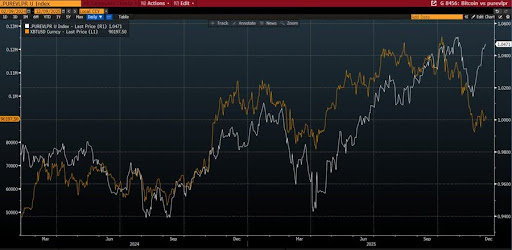
CIO and founder of MNFund and MNCapital, CryptoMichNL, emphasized that Bitcoin shares a strong correlation with the Nasdaq. While Nasdaq continues to show steady resilience, BTC has stalled behind. This mismatch creates a mispricing and market divergence, which is why the path toward $100,000 remains wide open and why the 4-year cycle thesis doesn’t hold up.

Recently, BTC saw a massive correction, dropping from $115,000 to $80,000 in just two weeks. During that same liquidation period, what LVisserLabs calls the rotation between Pure Vol vs. Pure Profitability or Beta vs. Quality has fallen sharply. Beta here refers to high-volatility, high-beta stocks, which are essentially tech stocks that drive the markets. Meanwhile, Quality means more risk-off assets, including high-quality, profitable, and stable companies. 

Bitcoin

Currently, BTC has stalled after the sell-off, and the Beta assets have recovered substantially, implying that the stocks have inverted their loss with the big drop and are now grinding upwards, signaling that risk-on appetite is clearly back. With this kind of structural divergence, it’s likely that in the coming weeks or months, BTC will grind upward to $110,000 and $115,000 levels, reversing the drop as the entire correction was a little dubious.

CryptoMichNL advised that instead of relying on a time-based sounding the 4-year cycle assumption, it is better to focus on the charts and macro relationships that directly influence BTC price.

On-Chain Activity Shows Clear Confidence From Big Money

The ambassador of StandXOfficial and the KOL of Binance, who is also an advisor at KOLsAgency, Investor Ucan, has highlighted that the evidence of Bitcoin’s latest upward move is already on-chain. The last six hours have revealed a clear surge of institutional demand. On-chain data shows that Binance purchased 7,298 BTC, Coinbase bought 1,362 BTC, Wintermute bought 2,174 BTC, BlacRock bought 1,362 BTC, and an unknown whale bought 6,192 BTC. In total, 20,438 BTC were purchased in just six hours, valued at approximately $1.9 billion.

Ucan noted that the timing of this purchase is what stands out. These inflows hit the market hours before the Federal Reserve’s upcoming employment data was released. Institutional is clearly expecting a supportive outcome. A positive print refers to easing expectations and fresh liquidity on the horizon. Retail traders are reacting, and the institutions are anticipating early. If the Fed confirms what these flows imply, today’s buying won’t look like simple momentum, but preparation.

Bitcoin

XRP’s Long-Term Path Gains Clarity After Major DAS Research Revelation – Here’s Where It’s Headed

A fresh update from a crypto expert has emerged regarding XRP and Ripple’s next trajectory, sparking a debate in the community. In recent years, this update has turned out to be one of the most accurate in determining the future of the leading altcoin, reinforcing the significance of the update.

New Research Outlines XRP’s Direction

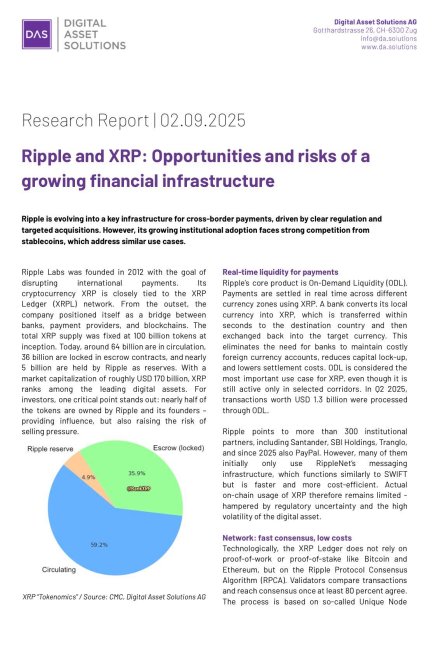
In a post on the X platform shared by Stern Drew, a crypto expert, Digital Asset Solutions (DAS) Research has delivered what many XRP watchers have been waiting for and finding difficult to determine. The Research seems to have offered insights and provided a clear data-driven signal that breaks through months of conjecture and market noise.

According to the expert, DAS Research just presented the most convincing evidence so far of where XRP is headed. While their analysis offers a clear view of the future direction, it shows that the altcoin and Ripple, an American-based payment firm, are no longer competing in crypto. 

Ripple and XRP are shifting into a global payment infrastructure, one that is used by banks, Fintechs, and cross-border networks that seek speed, scale, and settlement transparency. Looking at the Research, there are 3 core realities that are likely to shape the next trajectory of the asset and the payment firm.

XRP

The first scenario is that XRP boosts the structural advantage, which includes fast settlement, low cost, neutral bridge asset, globally distributed ledger, and institutional-grade reliability. Drew stated that this is the reason adoption is growing in the midst of enterprises that seek predictable value transfer, and not speculation.

Secondly, the Research highlights the transformation of stablecoins, as these coins are becoming strategic assets, not competitive ones. Instead of opposing them, Ripple is absorbing stablecoins, which are becoming a key part of the crypto and financial landscape

Ripple’s integration of stablecoins is evidenced by its RLUSD, a dollar-pegged token acting as the fiat anchor. Meanwhile, XRP serves as the liquidity and bridge asset that ties everything together. In the current landscape, this connection is precisely how scaled settlement ecosystems develop.

Catalysts To Drive The Next Future

With key updates and achievements of Ripple, the Research noted that the catalysts to spur the next phase are already forming. Some of these catalysts include RippleNet’s partnership expansion, RLUSD corridors opening, and institutional custody maturing. Even Exchange-Traded Fund (ETF) structures are entering the conversation.

Each of these catalysts raises the likelihood that regulated financial plumbing will incorporate XRP. Meanwhile, direct bank-level chain utilization is the only sector that is currently lagging behind. However, this is exactly what worldwide licensing pushes, ZK-enabled identity layers, Ripple Prime, and RLUSD are meant to open.

Drew believes that DAS is creating awareness of what investors are unable to see. Behind the scenes, XRP is cementing its position as infrastructure, not a trade, and the competition is not other tokens, but the existing payment system, which is starting to shift.

XRP

Ethereum Founder Buterin Slams Elon Musk As Anti-Europe Attacks Ignite

Ethereum founder Vitalik Buterin has issued a sharp public warning to Elon Musk over how X is being used to direct increasingly aggressive rhetoric at Europe, arguing that the platform is drifting from a free-speech ideal toward orchestrated hostility.

Ethereum Founder Calls Out Elon Musk

In a series of posts on X, Buterin said that “the attacks on Europe I’ve seen here the last couple of days, including from people I’ve generally considered interesting and sophisticated, have been getting unhinged.”

He acknowledged that the European Union has serious shortcomings, listing “GDPR clickthroughs are dumb, Chat Control is awful, they need to be less bureaucratic and supportive toward entrepreneurs,” and criticizing what he called Europe’s selective moral stance, noting that its “kindness toward Ukraine often doesn’t extend well to Gaza or Sudan or other places.” He also described “people saying mean things about criminals getting longer sentences than the criminals” as “just crazy.”

Despite that, the Ethereum founder argued that the way some users on X are talking about Europe has moved well beyond legitimate criticism. He described “the apocalyptic attitude about the issues, evoking imagery of barbarians pillaging Rome etc,” as “really over the top” and said it “feels more like a coordinated attempt to delegitimize than constructive criticism.”

He rejected the idea that the real target is only Brussels-based institutions, writing: “I don’t believe the line that ‘the target is not Europe, it’s the EU’: I’ve seen many instances of London specifically being targeted in the hate session, so no, much of it is an attack on Europe.” This, he argued, does not match his experience from “spending an average of two months every year there for the last decade.”

The central confrontation came in a direct reply to Musk. Addressing the X owner’s self-positioning as a defender of free speech, the Ethereum founder wrote: “I think you should consider that making X a global totem pole for Free Speech, and then turning it into a death star laser for coordinated hate sessions, is actually harmful for the cause of free speech. I’m seriously worried that huge backlashes against values I hold dear are coming in a few years’ time.”

Buterin Hints At Russian Involvement

The thread sparked pushback from some users who argued that his framing underplays European complicity in current conflicts. One critic responded that “’not extending kindness’ is an incredible way to frame funding, arming and politically backing a genocide,” and claimed that it is “hilarious to think the US doesn’t suffer from many of the same things or worse that Americans say about the EU.”

The Ethereum founder replied that Europe is “a genuinely mixed bag,” emphasizing that “different countries in Europe have very different policies,” and pointing out that the continent “also hosts ICC, which is under a lot of pressure (see: judges being financially deplatformed).”

Other replies widened the lens to geopolitics. Commenting on a suggestion that the current discourse looks like “a coordinated campaign due to the Kremlin liking the new US ‘going back to Monroe’ global security policy,” Buterin answered “yeah basically” and added that “a lot of powerful people really like the vision that the world should just be 5–20 adults who have their spheres and sometimes get together in a room to hash out any differences, and everyone else can be shut out because they are annoying and inconvenient.”

At the same time, Buterin restated his support for the European project as an institutional experiment. “I have a lot of respect for the idea of EU, as an experiment in trying to get the benefits of a superstate, without the homogenization, becoming an aggressive ‘great power’, and other downsides,” he wrote, while stressing that “the experiment does need to be adjusted in a lot of ways; eg. we see not enough unity in its external policy and too much unity on top-down bureaucracy and surveillance at the same time.” If improved, he argued, “it’s a model that could set a really good example for the world.”

On the technical side, the Ethereum founder used the debate over “gdpr clickthroughs” to propose a different approach to online control, calling for “more sophisticated user-side software (browsers, local LLMs…) that helps the user navigate the internet and make intelligent decisions about what requires confirmations from the user.” In contrast to the centralized dynamics he criticizes on X, he is effectively pointing back to user-empowering, decentralized tools as the way to reconcile regulation, usability and free expression.

Musk Vs. The European Union

Notably, Musk’s anti-EU outburst comes after the Commission has issued a fine of €120 million to X for breaching its transparency obligations under the Digital Services Act (DSA). Musk wrote via X that “The ‘EU’ imposed this crazy fine not just on @X, but also on me personally, which is even more insane!” and says it would be “appropriate to apply our response not just to the EU, but also to the individuals who took this action against me.”

In subsequent posts he escalated further, declaring that “The EU should be abolished and sovereignty returned to individual countries,” calling to “Dissolve the EU and return power to the people,” and even asserting that “The EU commissars are responsible for the murder of Europe.”

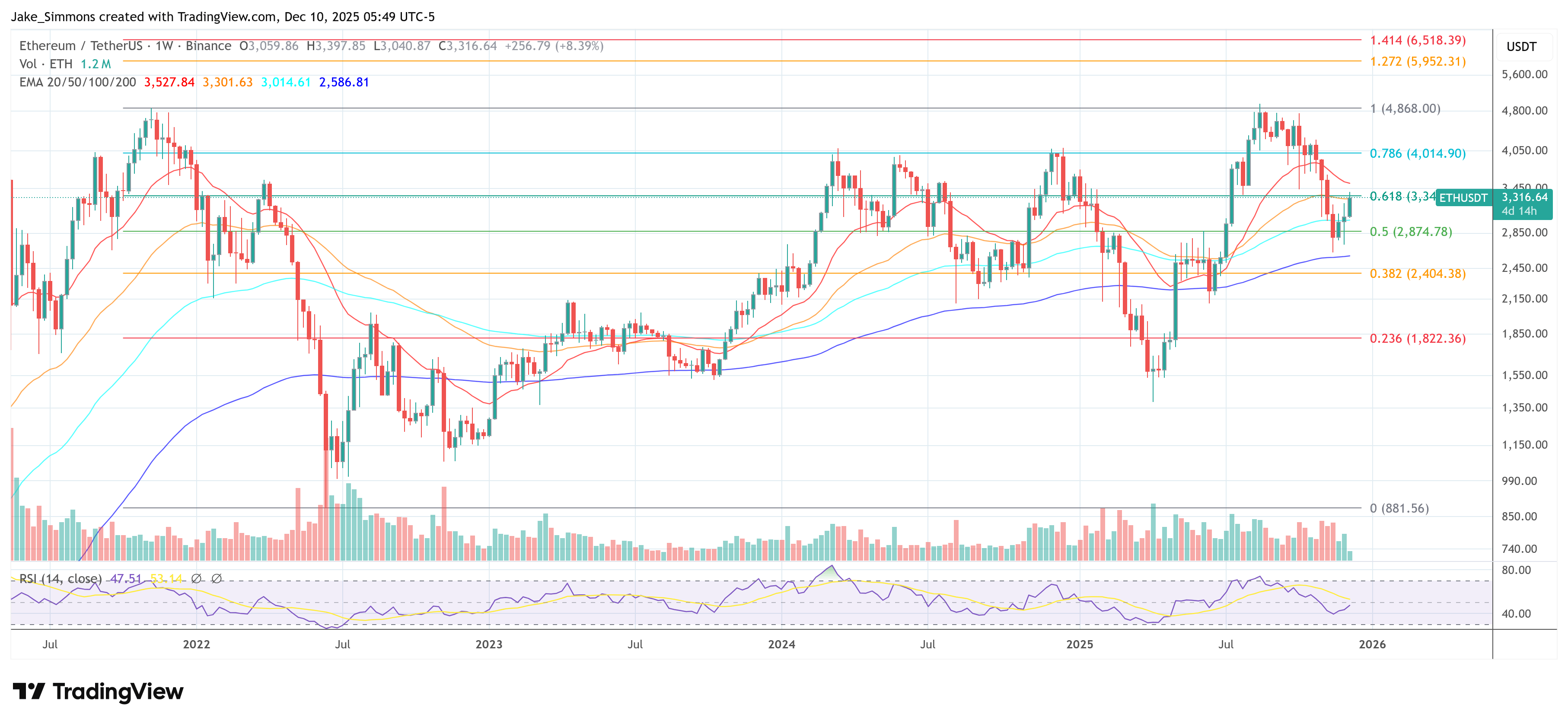
At press time, Ethereum traded at $3,316.

Ethereum price

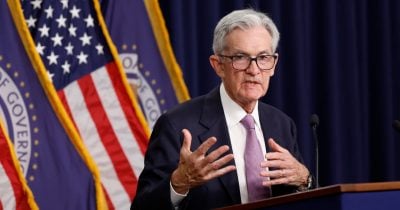
Federal Reserve Cuts Interest Rates by 25 Basis Points

Bitcoin Magazine

Federal Reserve Cuts Interest Rates by 25 Basis Points

The Federal Reserve cut its benchmark interest rate by 25 basis points today, lowering the federal funds target range to 3.50%–3.75%. The move marked the central bank’s third rate cut of the year and its first since October.

The Federal Reserve said they made the cuts to support maximum employment and return inflation to 2%. Economic activity is expanding moderately, job gains have slowed, and inflation remains somewhat elevated, the Fed said.

Most officials voted for the cut, with three dissenting—one preferring a larger cut and two preferring no change. Policymakers said the decision reflects easing inflation pressures and a desire to support economic activity as growth moderates. The Fed had kept rates unchanged for several meetings after its October cut.

Fed officials also left their rate forecasts unchanged, signaling modest 25-basis-point cuts in 2026 and 2027, with expected 2026 unemployment at 4.4%, PCE inflation at 2.4% and GDP growth at 2.3%.

The 10-year Treasury yield has climbed this month even as expectations for a rate cut grew, signaling investor concern that easing policy now could reignite inflation and force rates higher later. 

The Fed’s internal divisions add to that tension, as Jerome Powell heads up what is probably his final meeting as chair before President Trump names a successor, ending a tenure defined by consensus-building amid unusual discord.

Lower interest rates reduce borrowing costs for households and businesses. They can encourage spending, investment, and risk-taking across financial markets. 

BREAKING: 🇺🇸 Federal Reserve cuts interest rates by 25bps. pic.twitter.com/kiXG9hhVXM

— Bitcoin Magazine (@BitcoinMagazine) December 10, 2025

Before these cuts, some said that inflation was easing, but regardless, the market widely expected a 25 basis-point rate cut.

At the same time, rate cuts can also signal concern about the economy’s trajectory.

The Fed’s last rate cut

In October, The Federal Reserve cut its benchmark interest rate by 25 basis points to a range of 3.75%–4% at its October meeting, following its previous cut in September. At the time, the Bitcoin price slipped from around $116,000 to lows of $111,000 that week.

Since then, Bitcoin has plunged to lows of $80,000. 

Bitcoin’s response to rate cuts has varied in the past, with sharp volatility during the Fed’s emergency easing in 2020 and a more muted reaction to the September 2025 cut.

At the time, Chair Jerome Powell also signaled that the central bank is nearing the end of its quantitative tightening program, with balance-sheet runoff expected to stop by December. QT has been draining liquidity by allowing bonds to mature without reinvestment, pushing yields higher and tightening financial conditions. 

At the time of writing, Bitcoin is showing lots of volatility and is trading near $92,500. 

This post Federal Reserve Cuts Interest Rates by 25 Basis Points first appeared on Bitcoin Magazine and is written by Micah Zimmerman.

Bitcoin Price Prediction: US Bank Now Lets Clients Buy BTC Directly – Could This Be the Start of a Banking Domino Effect?

PNC Bank, the sixth-largest commercial bank in the United States, has launched direct spot Bitcoin trading for eligible private bank clients, becoming the first major U.S. bank to offer native Bitcoin exposure.

Crypto analysts say the domino effect of this direct custody could positively impact the trajectory of the Bitcoin price prediction.

U.S Banks Break Down Barriers to Bitcoin Access

The new PNC bank service enables qualified private banking clients to purchase, hold, and sell Bitcoin without relying on external cryptocurrency exchanges.

Today marks a major milestone for institutional crypto adoption.@Coinbase’s Crypto-as-a-Service platform is now powering @PNCBank’s launch of direct bitcoin trading for PNC Private Bank clients – the first to market with such an offering among the major U.S. banks. pic.twitter.com/wwuOIRuBfK

— Coinbase Institutional 🛡 (@CoinbaseInsto) December 9, 2025

This development follows a crucial regulatory milestone from the Office of the Comptroller of the Currency, which recently confirmed that national banks may conduct riskless principal crypto-asset transactions.

The decision permits U.S. banks to function as intermediaries in crypto trades by simultaneously buying from one customer and selling to another without maintaining inventory.

Last week, Bank of America authorized its 15,000 wealth management advisers to recommend 1%–4% crypto allocations for client portfolios, signaling a broader institutional embrace of mainstream Bitcoin exposure.

In October, Citibank announced plans to launch crypto custody services in 2026, after developing the infrastructure over two to three years.

Meanwhile, Cryptonews reported in September that BNY Mellon is advancing toward offering custody services for Bitcoin and Ethereum, specifically targeting exchange-traded product clients.

If other major banks replicate PNC’s approach, BTC could establish stronger support levels in the coming months and position itself for a further push toward the $100,000–$130,000 range heading into 2026.

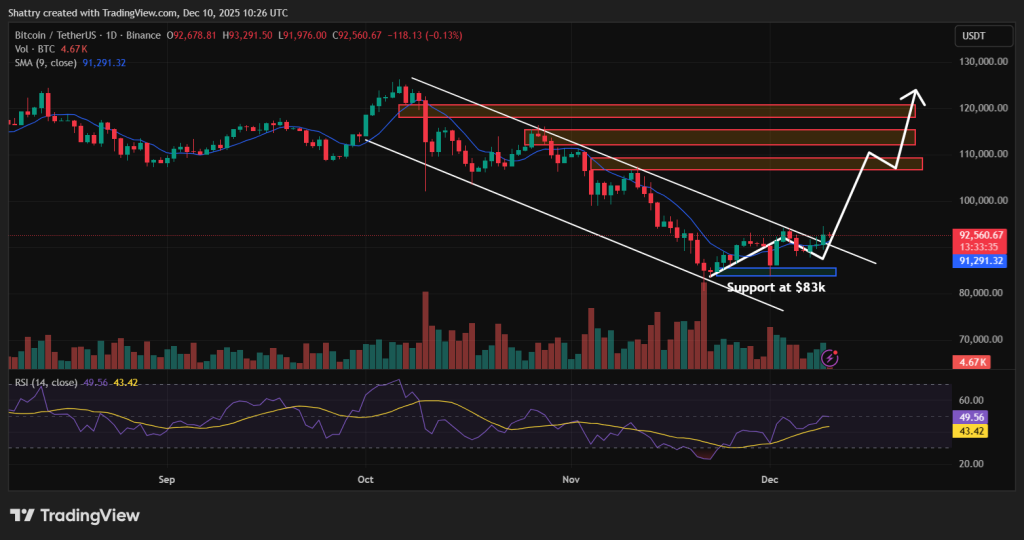
Bitcoin Price Prediction: Breakout Targets $105K, $110K, $120K

Bitcoin is attempting to escape a multi-week descending channel after defending critical support near $83,000.

The recent bounce pushed the price back above the 9-day simple moving average, demonstrating early momentum, though it remains near the channel’s upper boundary.

The RSI has climbed out of oversold territory and is now approaching the mid-50s, indicating recovering bullish momentum following a prolonged downtrend.

Bitcoin Price Prediction - Bitcoin Price Chart
Source: TradingView

If Bitcoin closes decisively above the descending channel and maintains support above $90,000–$92,000, charts suggest upside continuation toward resistance clusters at $105,000, $110,000, and potentially $120,000.

However, failure to sustain this breakout zone risks a retest of $83,000 support.

This New Meme Coin Raised $4.3M Fast – Is It the Next Dogecoin?

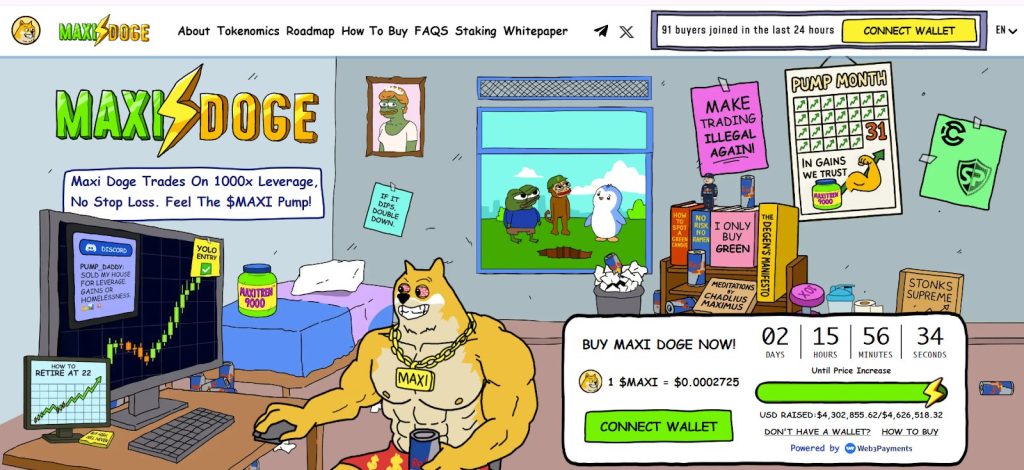
As Bitcoin gears up for its next major move, early-stage projects like Maxi Doge ($MAXI) are quickly gaining traction among investors looking for high-upside plays.

Inspired by Dogecoin’s explosive 1,000x rally, $MAXI is building a high-energy community where traders share alpha, early setups, and hidden gems before they go mainstream.

Since launching only a few months ago, the presale has already pulled in over $4.3 million, with strong momentum.

Bitcoin Price Prediction - Maxidoge Banner

This could be one of the cycle’s most relatable, community-first opportunities, and early backers still have time to get in before the next price increase kicks in.

To buy early, visit the official Maxi Doge website and connect a crypto wallet like Best Wallet.

You can swap existing crypto or use a bank card to make the purchase in seconds.

Visit the Official Maxi Doge Website Here

The post Bitcoin Price Prediction: US Bank Now Lets Clients Buy BTC Directly – Could This Be the Start of a Banking Domino Effect? appeared first on Cryptonews.

XRP Price Prediction: $100M Whale Dump Hits Just Before Breakout – Can Retail Buying Stop the Bleed?

XRP whales have dumped a significant volume of tokens ahead of today’s FOMC meeting and may have delayed the token’s recovery. However, long-term holders are still not selling and continue to show the kind of commitment that favors a bullish XRP price prediction.

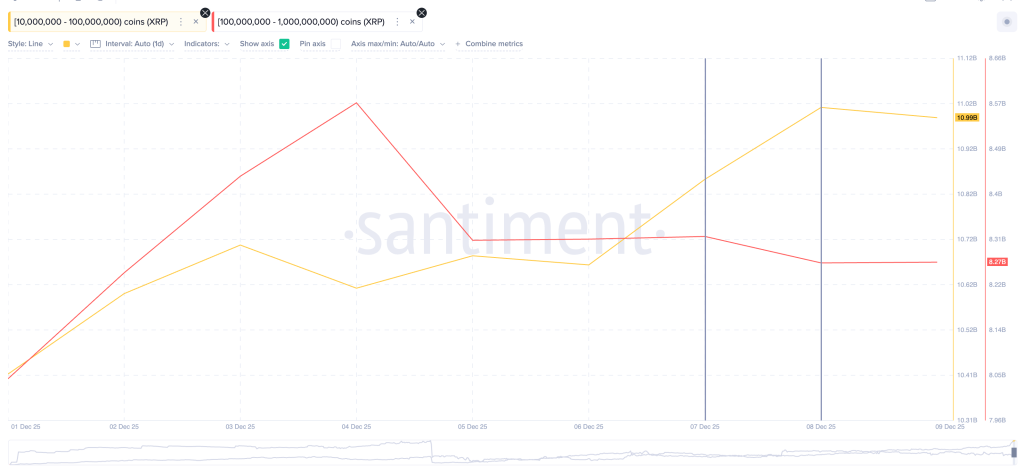
According to data from Santiment, whale wallets holding between 100 million and 1 billion XRP have sold nearly $600 million worth of tokens since December 5.

xrp whale activity

Meanwhile, since December 7, whales dumped over $100 million, showing that deep-pocketed investors are still selling even though the price has recovered.

This explains why XRP has struggled to move past the $2 mark. The token has accumulated a 5% in the past 7 days as the Federal Reserve prepares to make a decision on interest rates today.

Meanwhile, trading volumes have jumped by 60% in the past 24 hours, reaching nearly $4 billion. This accounts for 3% of the token’s circulating market cap and reflects a spike in trading activity ahead of the Fed’s interest rate decision.

XRP Price Prediction: XRP Could Fully Recover If It Breaks This Key Resistance

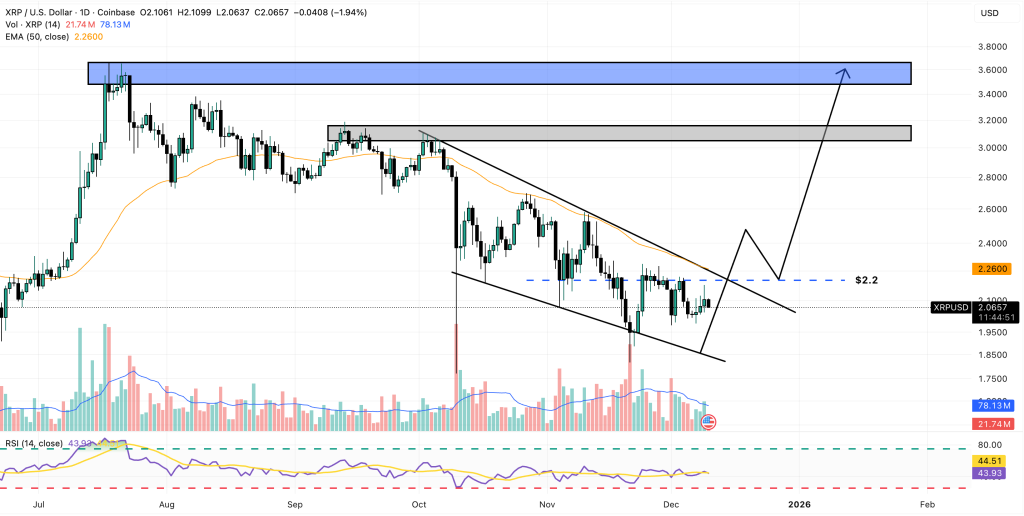
XRP needs to clear the $2.20 level to reverse its downtrend. The FOMC meeting could provide the necessary catalyst for this to happen, as traders will be reassured about what the future holds once Powell speaks.

bitcoin hyper presale

Such a bullish breakout would also push XRP above its 200-day exponential moving average (EMA).

The Relative Strength Index (RSI) needs to rise past the mid-line and above the 14-day moving average as well. This is typically interpreted as confirmation that bullish momentum is accelerating.

If XRP breaks through its current resistance, the $3 level could be the first major target, backed by strong psychological significance and historical price action.

As broader sentiment improves, high-upside crypto presales like Bitcoin Hyper ($HYPER) could rally even harder.

With nearly $30 million raised in its ongoing presale, the project is bringing Solana’s technology to the Bitcoin blockchain.

Bitcoin Hyper ($HYPER) Supercharges BTC with Solana Speed – Early Investors Are Piling In

Bitcoin’s biggest strength is security, but its biggest weakness is speed.

That’s where Bitcoin Hyper ($HYPER) comes in.

This new Layer 2 solution uses Solana’s cutting-edge technology to fix Bitcoin’s biggest limitations, unlocking fast transactions, low fees, and full support for DeFi, meme coins, NFTs, and more.

The project is built around the Hyper Bridge, which lets BTC holders safely move funds onto the Hyper L2.

Once transferred, users instantly receive a 1:1 amount on the L2 network with near-instant finality.

This opens the door to a fast-growing ecosystem where BTC users can finally access staking, payments, and high-yield opportunities.

Bitcoin Hyper has already raised nearly $30 million from early investors who believe this will be the breakthrough that finally brings smart contracts to Bitcoin at scale.

As more top wallets and platforms integrate with Hyper L2, demand for its native token, $HYPER, is expected to surge.

To join the presale, visit the official Bitcoin Hyper website and connect a supported wallet like Best Wallet.

You can buy $HYPER using crypto or a bank card at the current price of $0.013375, before the next price rise in less than 32 hours.

Visit the Official Bitcoin Hyper Website Here

The post XRP Price Prediction: $100M Whale Dump Hits Just Before Breakout – Can Retail Buying Stop the Bleed? appeared first on Cryptonews.
Bitcoin Selling Pressure Eases as Exchange Inflows Drop: CryptoQuant

Bitcoin’s market dynamics have shifted sharply in recent weeks, offering signs of short-term resilience as selling pressure eases and investors reduce deposits to exchanges ahead of a highly anticipated Federal Reserve policy meeting.

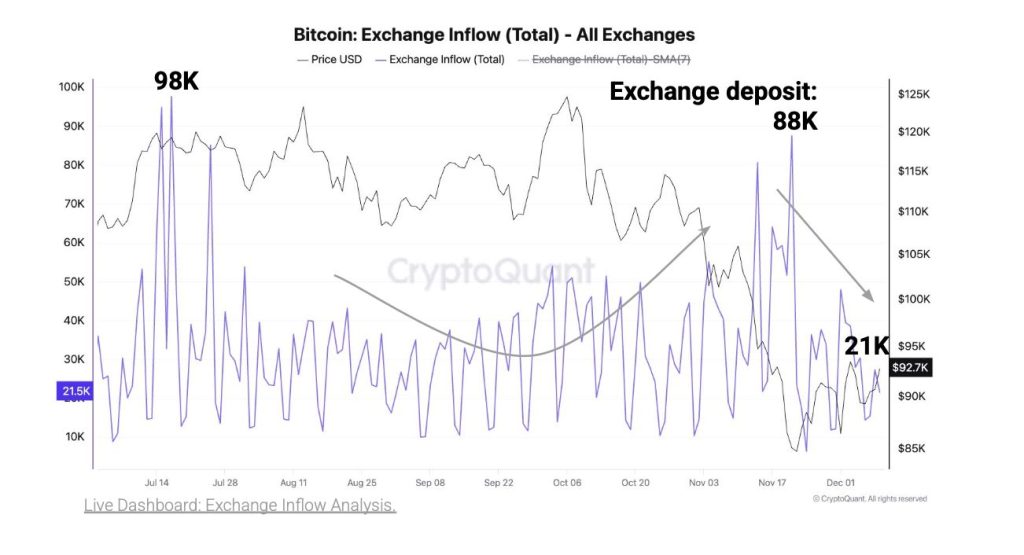
According to the latest research report from CryptoQuant, after briefly falling to $80,000 on November 21, Bitcoin has rebounded to a one-month high of $94,000, supported by declining exchange inflows and reduced selling activity from large holders.

Exchange Deposits Fall, Easing Price Pressure

A major driver behind Bitcoin’s recent price stabilization is the sharp decline in BTC transferred to exchanges. Deposits have fallen to 21,000 BTC today, compared with 88,000 BTC on November 21, marking a 76% decrease in sell-side supply over the past three weeks, according to CryptoQuant.

This decrease indicates that holders, especially short-term traders, are less inclined to sell immediately into the market. Lower exchange inflows traditionally reduce downward pressure, creating more opportunity for price recovery in the near term.

Large Holders Pull Back: Lower Deposits, Smaller Transfers

Institutional-scale investors and whales have played a major role in the shifting environment. The share of exchange deposits linked to large holders dropped from 47% in mid-November to 21% today, while the average transfer size fell 36%, from 1.1 BTC to 0.7 BTC.

These patterns suggest that major players are stepping back rather than accelerating sell-offs. Large holders tend to dictate market direction during periods of volatility, and their reduced activity typically supports more orderly price behavior.

Loss Realization Peaks, Reducing Future Sell-Side Pressure

Bitcoin’s recent rebound also comes after a wave of realized losses, often a turning point in market psychology. On November 13, as Bitcoin broke below $100,000, whales and short-term holders realized $646 million in losses, the highest since July.

Across the last several weeks, that figure has climbed to $3.2 billion in net losses, likely flushing out weaker hands and reducing forced selling. Loss realization can fuel capitulation in bear phases, but once completed, it can set a foundation for more stable price action.

Key Levels to Watch: $99K, $102K, and $112K

If selling remains muted, analysts say Bitcoin could advance toward $99,000, marking the lower band of the Trader On-chain Realized Price indicator, typically a major resistance during market drawdowns. Beyond that, major resistance levels stand near $102,000 (one-year moving average) and $112,000 (Trader On-chain Realized Price) reports CryptoQuant.

Market uncertainty remains, particularly ahead of the Federal Reserve’s decision, but Bitcoin’s latest trend suggests a market catching its breath—the calm before the next wave of volatility.

📈 BTC neared $94K and ETH hit $3,250 early December, driven by MSTR’s buy and Fusaka anticipation, per Laser Digital.#Bitcoin #Cryptohttps://t.co/pMYuzVS329

— Cryptonews.com (@cryptonews) December 9, 2025

The post Bitcoin Selling Pressure Eases as Exchange Inflows Drop: CryptoQuant appeared first on Cryptonews.

Crypto Tax Bill Targeted for Passage by Next August, House Tax Writer Says

Talks over how the United States should tax digital assets are moving into a new phase, as Rep. Max Miller, a member of the House Ways and Means Committee, told attendees at the Blockchain Association’s policy summit on Tuesday that he believes the bill can move before the August 2026 recess.

He said the draft has already been circulated among several committee members and that he hopes to announce a lead Democratic co-sponsor soon.

Miller’s timeline marks the most concrete sign yet that Congress is preparing to revisit an issue that has lingered for nearly a decade, dating back to the IRS’s 2014 declaration that cryptocurrencies are taxed as property.

The decision created a system where every sale, swap, or payment counts as a taxable event.

Congress Moves Toward Long-Awaited Update to Crypto Tax Code

Miller and his Democratic counterpart, Rep. Steven Horsford of Nevada, say they are working on language to simplify reporting and give taxpayers clearer rules.

Miller said the 43-day government shutdown earlier in the fall wiped out nearly two months of legislative time, making it impossible to push the proposal before year-end.

🇺🇸 Trump signs bill ending 43-day shutdown. ETFs await approvals, and markets eye potential weekend momentum.#Shutdown #Bitcoinhttps://t.co/zzvrf2SqdN

— Cryptonews.com (@cryptonews) November 13, 2025

He added that the Ways and Means and Senate Finance committees, which held hearings in July and October, will use the first half of 2026 to firm up the framework.

A Republican on the Finance Committee, Sen. Steve Daines, echoed the timeline, noting that a draft should be ready by next August.

He also warned that ongoing uncertainty in the tax code is slowing down U.S. competitiveness, as digital-asset firms are hesitant to expand without statutory clarity.

Push for Small-Transaction Crypto Tax Relief Intensifies

Lawmakers are debating whether crypto should remain fully classified as property or if small everyday transactions could be treated more like currency.

Industry groups have long advocated for a de minimis rule, which would let people use crypto for small purchases without calculating capital gains.

A bill introduced earlier this year by Sen. Cynthia Lummis proposed a $300 exemption with a $5,000 annual cap.

✅ @SenLummis has responded to @jack's call for a Bitcoin tax exemption for small transactions, stating she is "Working on it." #CryptoTax #Bitcoinhttps://t.co/6S4GtW7Vpf

— Cryptonews.com (@cryptonews) October 9, 2025

Other technical issues under review include how exchanges should report cost basis, how foreign platforms should share data with the IRS, and whether staking rewards should be taxed when received or when sold.

The IRS currently treats staking rewards as ordinary income upon receipt, but the industry wants taxation deferred until disposition.

Stablecoin payments, business receipts over $10,000, and new international reporting standards under the Crypto-Asset Reporting Framework (CARF) are also part of the negotiations.

IRS Ramps Up Crypto Scrutiny as New Rules Near

Between May and June, crypto tax platforms and lawyers reported a sharp rise in IRS warning letters sent to U.S. investors.

The surge resembles earlier crackdowns in 2020 and 2021, when the agency secured transaction records from major exchanges.

With new third-party reporting requirements taking effect on January 1, 2026, centralized exchanges will issue 1099-DA forms for the first time, giving the government the clearest view yet of trading activity.

Congress is also juggling broader crypto policy efforts. Negotiations over a separate market-structure bill have slowed in recent weeks, with Sen. Bernie Moreno describing talks as “frustrating” and saying he will not support a weak compromise.

🇺🇸 Sen. Moreno warns U.S. lawmakers: “No deal is better than a bad deal.” U.S. crypto legislation may be delayed

#Regulation #CLARITYActhttps://t.co/Z9QlO4yiD4

— Cryptonews.com (@cryptonews) December 9, 2025

Lawmakers are still debating how to divide oversight between the SEC and CFTC, how to define non-security tokens, and how to regulate decentralized finance.

Several senators have warned that if progress stalls into February, the election season could freeze the agenda.

The post Crypto Tax Bill Targeted for Passage by Next August, House Tax Writer Says appeared first on Cryptonews.
❌