Ethereum saw a flurry of big moves that traders say could matter for its next price swing. In just a few hours, major accounts pulled large sums off an exchange and big wallets opened sizable margin longs. Market watchers are parsing those moves for clues.
Institutions Shift Big Stakes
According to Arkham Intelligence, Amber Group and Metalapha pulled out 9,000 Ether from Binance in a short span, a haul worth more than $28 million at current prices.
Based on reports, institutional flows have been heavy for months — nearly 4 million ETH has been accumulated by institutions over five months. Those kinds of transfers are often linked to custody setups or long-term holdings rather than quick trades.
Whales Add Margin Bets
Several large wallets added roughly $426 million in margin long exposure. Wallets named 1011short and Anti-CZ are among the accounts that expanded long bets.
That kind of activity raises the chance of sharper moves in either direction: if prices rise, longs can feed a rapid upswing; if a pullback hits, forced selling could amplify losses. Market structure is tighter now than it was several months ago.
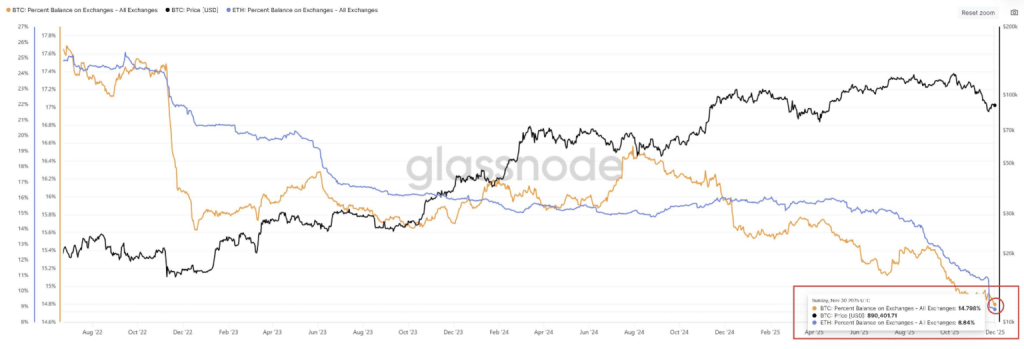
On-chain data shows only 8.7% of ETH is currently held on exchanges. More than 28 million ETH is locked up in staking, custody, and what reports call long-term storage.
Staking inflows remain high, with over 40,000 ETH added per day on average. Less supply on exchanges can lower immediate selling pressure, making price swings more dependent on fresh buy orders.
Price Range And Key Levels
Ethereum has gained 2.5% in the last 24 hours and is trading near $3,050. According to an analyst’s chart, ETH has been moving inside a tight range between $3,050 and $3,200, with $3,100 acting as a support line.
Traders say a clear break above the $3,300–$3,400 band could open the way toward $3,700 to $3,800. Failure at that resistance would likely push prices back toward $3,000, where buyers may step in again.
Regulatory Step Could Matter
In a related development, the US Commodity Futures Trading Commission has launched a pilot that allows Ethereum, USDC and Bitcoin to be used as collateral in regulated derivatives venues.
Acting Chair Caroline Pham unveiled the plan in Washington and said the move will let regulators observe how tokenized collateral behaves in stressed conditions.
The program sets rules for custody, segregation, and valuation tests inside a controlled environment.
Featured image from Unsplash, chart from TradingView
Bitcoin is currently holding steady, trading water around the critical $90,000 level as the market enters a period of high compression. With ETF inflows slowing down, the price lacks the momentum to break through overhead resistance. The highly anticipated FOMC meeting is expected to provide the necessary catalyst to end the current consolidation and dictate Bitcoin’s next major directional move.
BTC Compression Intensifies: Scaling Back Intraday Scalps
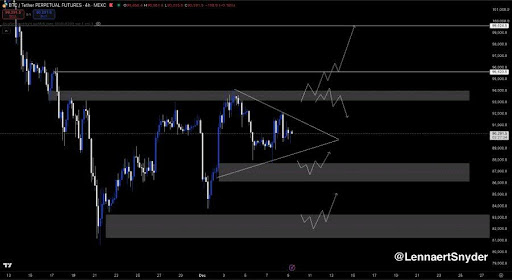
According to a recent update from Lennaert Snyder, Bitcoin continues to tighten within a compression phase. The market has been trading in an increasingly narrow range, signaling that a larger move is approaching. Snyder noted that the scalp long and short setups from his previous analysis played out well.
He explained that as compression increases, the reward-to-risk ratio naturally declines. While the trades were profitable, they still fell into the category of “C-setups,” meaning they lacked the cleaner momentum and clarity found at range boundaries. Snyder emphasized that the best trading opportunities always emerge at the edges of a range.
With the current setup, his focus remains on the key resistance area around $94,000. A breakout above that level could offer long opportunities, while a failure there may open the door for shorts. On the downside, if price sweeps the lows and returns to the $87,400 support region, long entries are likely following signs of reversal.
However, he added that if Bitcoin fails to show strength during this phase, he is not eager to take new long positions. A deeper retest of the $83,200 zone could become the next area of interest, though he expects any move toward that level to come with a liquidity sweep.
Snyder also mentioned that he remains in shorts as a hedge, with scalp shorts still acceptable for traders who understand the increased risk at this stage. He concluded by highlighting the importance of the upcoming FOMC meeting, noting that the market is likely to stay muted until then.
Upcoming FOMC Meeting Dictates Bitcoin’s Next Major Move
Analyst Ted, in a recent update, revealed that BTC is currently in a state of consolidation around the $90,000 level. This tight range-bound movement suggests that while selling pressure is not dominant, buyers are also struggling to push the price higher aggressively.
Ted attributed the market’s current stagnation and its inability to break above major resistance levels to a slowdown in institutional investment. Specifically, he noted that recent ETF inflows have slowed down, removing a major source of directional buying pressure that typically drives breakouts.
Furthermore, the analyst highlighted that a critical macroeconomic event is pending: the FOMC meeting is scheduled for tomorrow, and the market’s next significant directional move will be heavily dependent on the outcome.
The latest S-1 registration submitted to the US Securities and Exchange Commission has placed Ethereum back at the center of market speculation. A recent SEC document shows that BlackRock’s iShares division has formally filed to launch a staked ETH exchange-traded fund, a move that would give traditional investors access not only to ETH price exposure but also to staking rewards through a regulated product.
A New ETF Structure That Brings Staking Into Traditional Finance
The proposed trust, which is called the iShares Staked Ethereum Trust ETF (ETHB), differs from previous Ethereum filings because it incorporates staking into its core design. According to the S-1 filing, the ETF would hold ether directly while delegating most of its balance to external validators, allowing staking rewards to feed into the trust’s net asset value. This approach offers institutions a pathway to access ETH’s yield component without interacting with on-chain staking infrastructure themselves.
The structure is bullish for Ethereum, as it shows that major asset managers like BlackRock are looking beyond basic price exposure and toward products that reflect how Ethereum now operates after its transition to proof-of-stake.
The first indication of BlackRock’s interest in ETH staking was in July, when it filed an application to add ETH staking in its iShares Ethereum Trust (ETHA). It seems the fund issuer is now taking proactive action on the staking trust with the recent standalone filing. Under SEC procedure, the new filing begins the review period, although a formal approval timeline does not start until the exchange responsible for listing the ETF submits a Form 19b-4.
If approved, the ETF could influence Ethereum’s circulating supply over time. The plan is to stake between 70% and 90% of the trust’s ETH, and this means that large inflows would steadily route more ether into long-term staking, reducing the volume actively available on the open market.
What This Could Mean For ETH’s Price Outlook
The potentially smaller liquid supply is going to contribute to a bullish ETH price, particularly during periods when demand for ETH rises. The filing itself does not change ETH’s price in the short term, nor does it signal any immediate regulatory approval.
What the filing does provide is a clearer picture of how ETH might fit into the next generation of institutional investment products. A staked ETH ETF would formalize staking as an investable feature and increase the types of investors who consider the altcoin a viable long-term asset.
Any eventual impact on Ethereum’s price will depend on how the approval process unfolds and how much capital flows into the product once it launches. BlackRock’s existing footprint in the Ethereum ETF niche shows how influential those inflows can be. Its iShares Ethereum Trust (ETHA) has consistently led other spot issuers, including over the past 24 hours, when ETHA recorded $23.66 million in inflows compared to Grayscale’s $11.83 million, while other issuers saw no inflows at all.
Once approved, shares of the iShares Ethereum Staking Trust are expected to trade on Nasdaq under the ticker ETHB.
Strive, co-founded in 2022 by American entrepreneur Vivek Ramaswamy, launched a $500 million preferred stock offering to acquire more Bitcoin and Bitcoin-related products.
Investors have been steadily pouring capital into SOL-linked exchange-traded funds (ETFs) for six consecutive weeks.
With technical indicators also flashing buy signals, the question now is whether this consistent inflow will fuel a breakout and shift the current Solana price prediction toward new highs.
Last week, $20 million flowed to Solana ETFs despite the latest decline that the token has experienced.
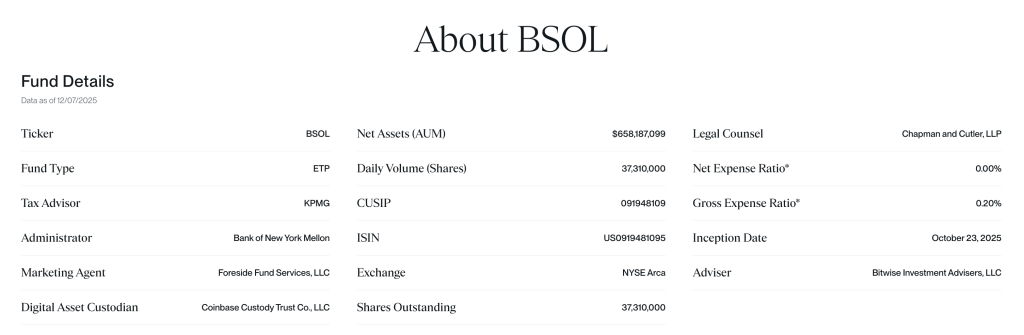
The Bitwise Solana Staking ETF (BSOL) is currently the largest of these vehicles with assets under management of $660 million, followed by Grayscale’s Solana Trust ETF (GSOL), with nearly $160 million in assets.
The staking rewards offered by the Solana blockchain make these vehicles quite attractive for passive investors, especially now that the token has hit an 8-month low at around $125.
The odds that the downturn will continue are much lower than they were a couple of months ago.
Hence, buying Solana at this level could offer both an attractive opportunity to generate passive income and capital gains if the token starts to recover after the upcoming FOMC meeting.
Solana Price Prediction: SOL Needs a Bullish Breakout Above $160 to Start Recovering
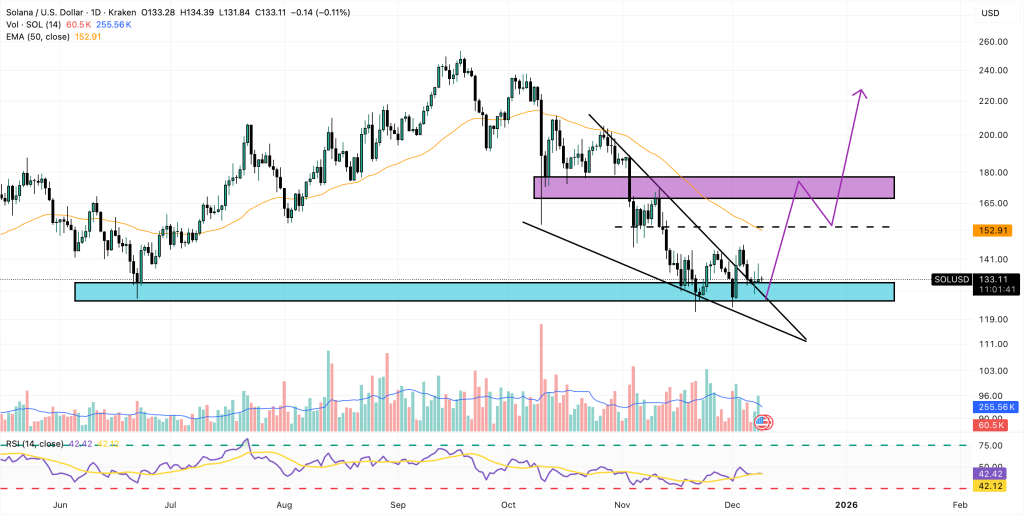
SOL rose near the $140 level yesterday, but the selling pressure is once again pushing the token back to the low 130s.
Trading volumes remain relatively low at $4 billion, accounting for less than 6% of the asset’s circulating market cap.
Historically, SOL needs trading volumes above $10 billion to get moving.
Thus far, SOL has found strong support at $130. However, volumes need to confirm that buying interest is picking up its pace before jumping to conclusions.
Ideally, the price should break through the $160 level to reverse its downtrend and confirm a bullish outlook for the next few weeks.
If that happens, the next stop will likely be $200 as SOL may commence a new uptrend as a result of this move.
Top meme coins in the Solana ecosystem had their moment earlier this year, and now seems to be the time for crypto presales to shine. One of this cycle’s hidden gems could be Maxi Doge ($MAXI), a project that has raised $4 million by tapping into the same energy as Dogecoin’s early days.
Maxi Doge Is Reviving Dogecoin’s Early Hype And $4 Million Says It’s Working
Maxi Doge ($MAXI) has already raised $4 million by channeling the same breakout energy that fueled Dogecoin in its early days.
More than just a meme coin, MAXI is creating a hub where holders can share early opportunities, trading setups, and alpha.
By building a high-energy, community-driven ecosystem, MAXI is designed to thrive in the next crypto cycle.
Through fun competitions like Maxi Ripped and Maxi Gains, traders will get the chance to earn rewards and bragging rights by sharing their best-yielding traders.
In addition, the project plans to invest up to 25% of the presale’s proceeds in promising projects, using the returns to reinvest in Maxi Doge for marketing purposes.
A supply shock scenario is brewing, fuelling bullish Ethereum price predictions as centralized exchanges now hold their lowest share of circulating supply in a decade.
The altcoin is growing in scarcity this market cycle, with adoption channels like staking, restaking, layer-2s, digital asset treasuries, and private wallets siphoning off exchange liquidity.
These pipelines have created the tightest supply conditions to date. Exchanges now control just 8.7% of circulating Ethereum, the lowest share since Ethereum went live in 2015.
Fresh exposure through U.S. TradFi products such as ETFs deepens the trend. Institutional-grade demand has driven aggressive accumulation under long-term holding strategies.
With fewer tokens available, traders are watching for signs of a supply squeeze. Scarcity could trigger sharp upside volatility as demand collides with shrinking liquidity.
Ethereum Price Prediction: Is ETH Ready To Surge?
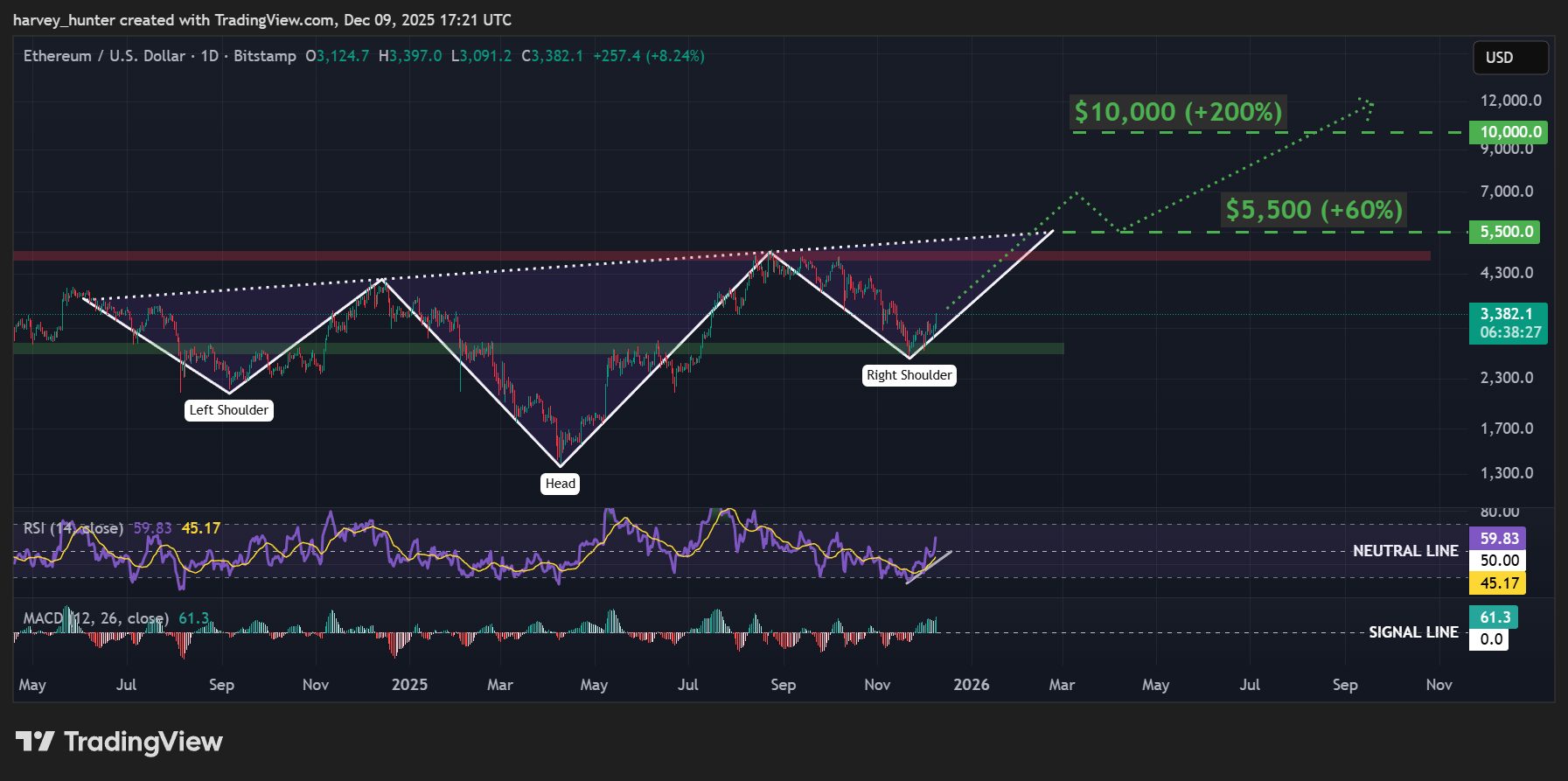
This scarcity could help fuel the breakout of a bullish head and shoulder pattern, now unfolding.
The Ethereum price has confirmed a local bottom at $2,750, forming higher lows in a fresh uptrend that solidifies the right shoulder.
ETH USD 1-day chart, bullish head-and-shoulders pattern. Source: TradingView.
Momentum indicators add validity to the trend. The RSI has made a decisive move above the 50 neutral line for the first time since the downtrend began in October, a telling sign of a bottom.
The MACD follows suit, continuing to widen its lead above the signal line and demonstrating a lasting uptrend.
A fully realised pattern breakout could see the neckline reclaimed around $5,500, reclaiming past all-time highs and entering new price discovery in a 60% move.
But as the bull market matures, scarcity only stands to increase, compounding the effects of mainstream adoption and use cases. The move could extend 200% to $10,000.
SUBBD: Mainstream Adoption Could Send This Coin Parabolic
With a shift to pro-crypto regulation, the transition to Web3 has been accelerated. And with it, platforms based in real-world utility like SUBBD ($SUBBD) are gaining traction.
Positioned as an AI-powered content platform, SUBBD is redefining the $85 billion subscriber economy by giving creators true ownership and fans genuine access.
Never miss a sale again.
As a top creator, your audience is global. It's just not possible to cater to everyone – you can't be online 24/7
That's where your personal AI Assistant comes in, to handle requests and secure payments. Sleep peacefully knowing you're making money… pic.twitter.com/ju9VjLBmea
By cutting out the middlemen, $SUBDD puts control back in the hands of those who create real value.
Creators can monetize directly, while fans gain access to exclusive content, early releases, and meaningful interactions through token-gated perks.
The project has already raised almost $1.3 million in presale, and post-launch, even a small share of the industry could push its valuation significantly higher.
With SUBBD, both sides of the community win — creators earn more, and fans get closer while embracing the decentralization use cases crypto was built for.
As noted above, its unique selling point is that it takes a unique approach to mining, enabling users to mine tokens without having to invest in expensive mining equipment and facilities.
It will launch a virtual mining platform in which users can build and run their own virtual rigs, complete with virtual nodes that they can buy and sell.
By buying more nodes using PEPENODE tokens, users will increase their mining rewards, which they can increase even further by upgrading nodes and combining them in novel ways.
Because the PEPENODE token is necessary to build mining rigs, it could attract massive demand, pushing up its price over time.
Demand will also come from the fact that holders can stake the token, earning themselves a passive income in the process.
The Shiba Inu price has jumped by 5% in the past 24 hours, moving up to $0.0000090 as the crypto market bounces ahead of tomorrow’s FOMC meeting.
Most analysts are expecting the Federal Reserve to cut rates, something which has increased positivity in the crypto market after a difficult couple of months.
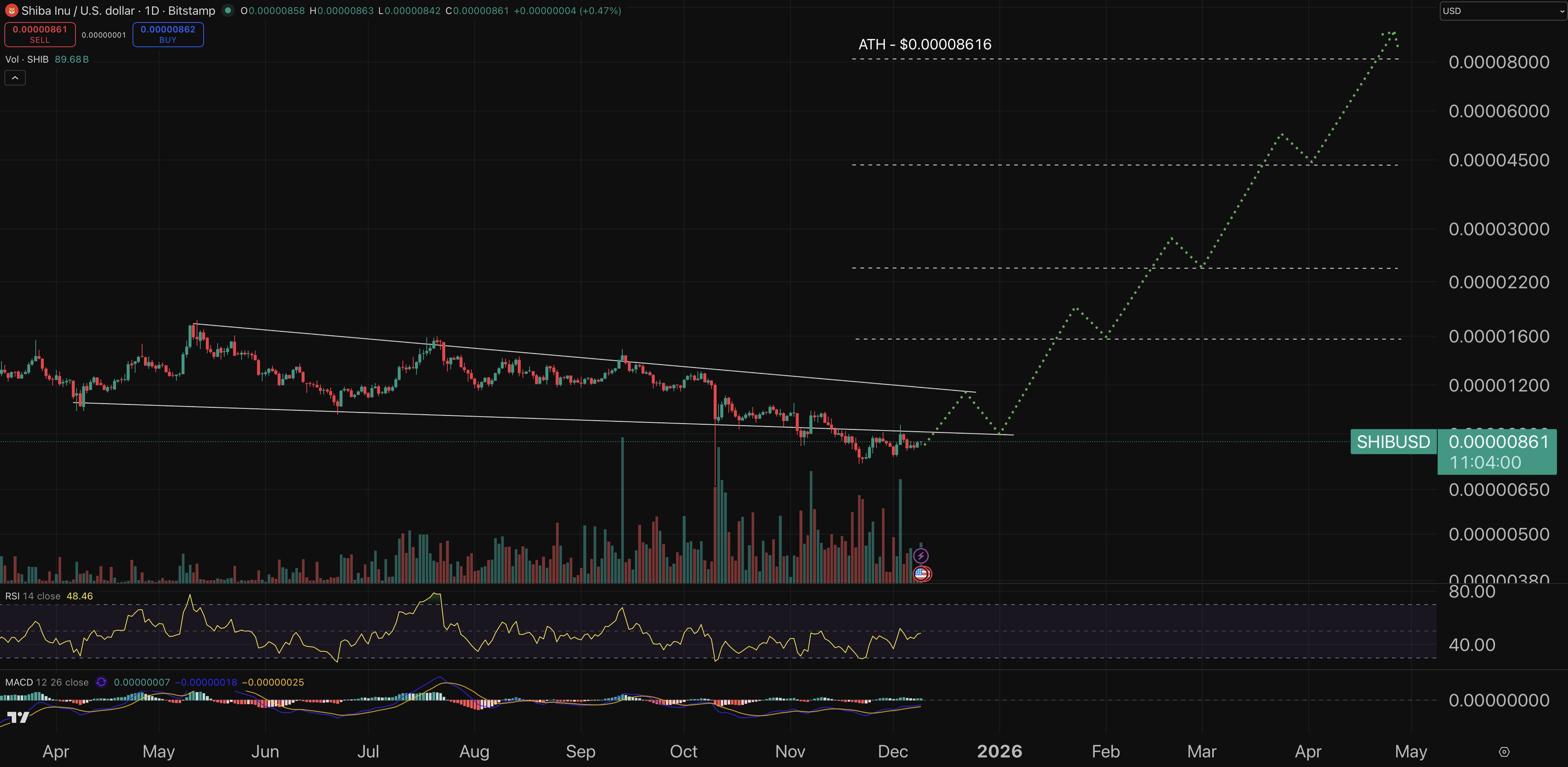
This suggests that a recovery could be on the way, and when combined with some bullish chart patterns, the Shiba Inu price prediction is starting to look very good.
Shiba Inu Price Prediction: Market Thinks SHIB Is Dead – But This Chart Pattern Says a Monster Move Is Coming Soon
As the Shibburn X account revealed today, Shiba Inu has burned 75.7 million SHIB tokens in the past week and 14.3 million SHIB tokens in the past 24 hours.
Such a launch could drive considerable interest in SHIB, although so far there’s no indication of how much of an allocation the meme coin would receive, if any.
Otherwise, Shiba Inu has been having a problem attracting significant investment, with its price down by 71.5% in the past 12 months.
Despite attempts to make itself fundamentally stronger and more valuable (e.g., by launching layer-two network Shibarium in 2023), the market seems to have lost interest, with shibariumscan.io recording only 2,635 transactions on Shibarium in the past 24 hours.
Hopefully, upcoming upgrades can make layer two more attractive next year, boosting the Shiba Inu price over the longer term.
Shibarium aiming for a privacy upgrade in 2026 says something bigger than just SHIB news.
It shows where the entire industry is heading: 𝗲𝗻𝗰𝗿𝘆𝗽𝘁𝗲𝗱 𝗲𝘅𝗲𝗰𝘂𝘁𝗶𝗼𝗻, 𝗰𝗼𝗻𝗳𝗶𝗱𝗲𝗻𝘁𝗶𝗮𝗹 𝗰𝗼𝗻𝘁𝗿𝗮𝗰𝘁𝘀, 𝗿𝗲𝗮𝗹 𝗽𝗿𝗶𝘃𝗮𝗰𝘆 𝗿𝗮𝗶𝗹𝘀.
For now, the SHIB price could reach $0.000010 by the end of the year, and $0.0000250 by Q2 2026.
$2.3 Million PEPENODE Presale Is Ending in 30 Days: How to Buy Before It Lists on Exchanges
While SHIB does have the potential to make big gains in the coming weeks, traders may also want to diversify into newer tokens, including presale coins.
What’s exciting about presale coins is that, if they generate enough momentum during their sales, they can often rally hard when they list for the first time.
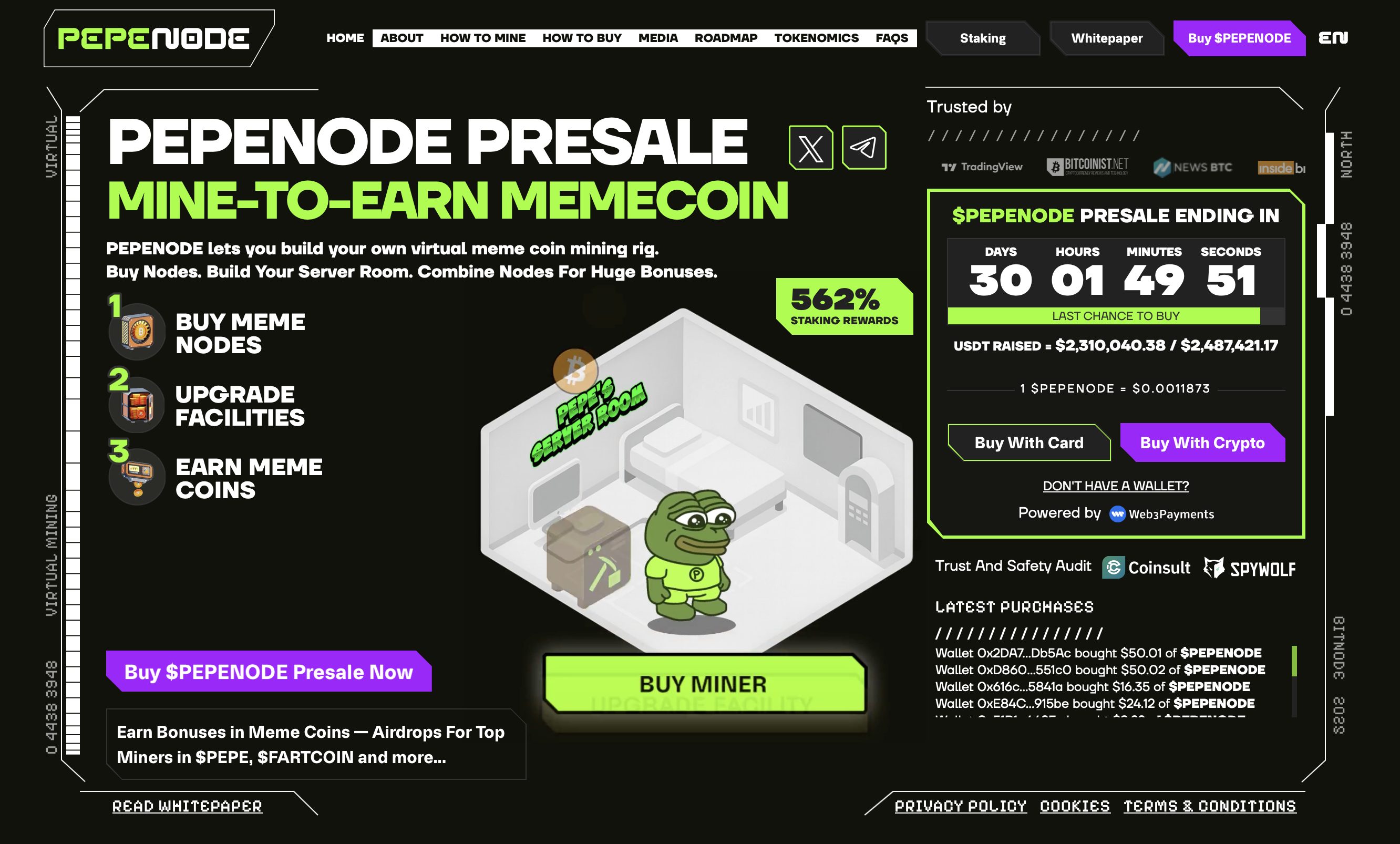
Accordingly, one of the most interesting presale tokens available right now is PEPENODE ($PEPENODE), an ERC-20 token that has raised just over $2.3 million.
Its sale will end in just under 30 days, giving newcomers only a limited window in which to buy the token at what could end up being a steep discount.
It has attracted lots of interest by virtue of its unique slant on mining, with its platform giving users the opportunity to grow and operate virtual mining rigs.
Rather than needing expensive – and power-hungry – physical hardware, PEPENODE enables users to mine simply by spending PEPENODE tokens on virtual nodes.
By purchasing more nodes and upgrading, users can earn more mining rewards, which PEPENODE will pay out in external tokens, such as Fartcoin and Pepe.
This system could make PEPENODE incredibly profitable and popular, with demand potentially surging for the PEPENODE token.
Holders will also be able to stake the token for a regular income, making the coin doubly profitable.
Latecomers to the sale can join it by going to the PEPENODE website, but should remember that it will end in 30 days.
The token is currently selling for its final presale price of $0.0011873, although this could rise much higher once it goes live in the next few weeks.
At the ongoing Bitcoin MENA Conference in Abu Dhabi, Binance founder Changpeng Zhao (CZ) suggested a crypto “supercycle” could emerge in 2026.
Analysts believe this could push the Bitcoin price prediction beyond the current cycle high of $126,000.
CZ’s Bold Vision Sees Bitcoin Catching Up with Gold
Just four days earlier at Binance Blockchain Week 2025, CZ debated the Bitcoin value proposition opposite Peter Schiff, senior economist and founder of Euro Pacific Asset Management.
During the discussion, CZ projected Bitcoin could experience a significant rally in 2026, potentially matching gold’s performance, which has surged over 60% year-to-date compared to Bitcoin’s 5.7% decline over the same period.
Moreover, the Bitcoin hash ribbon indicator has now flashed green, historically signaling favorable entry points for market participants.
The hash chart reveals the 30-day moving average of hashrate dropping below the 60-day MA, a pattern indicating miner capitulation that typically coincides with major price discounts and long-term accumulation opportunities.
This comes as Bitcoin experienced a short squeeze that propelled the price through the $94,000 resistance level.
Crypto analyst Trader Mayne notes Bitcoin is currently testing the yearly open around $93,000, with potential to extend gains toward $98,000 and subsequently $106,000.
Bitcoin Price Prediction: $106K Next as MACD Flips Bullish
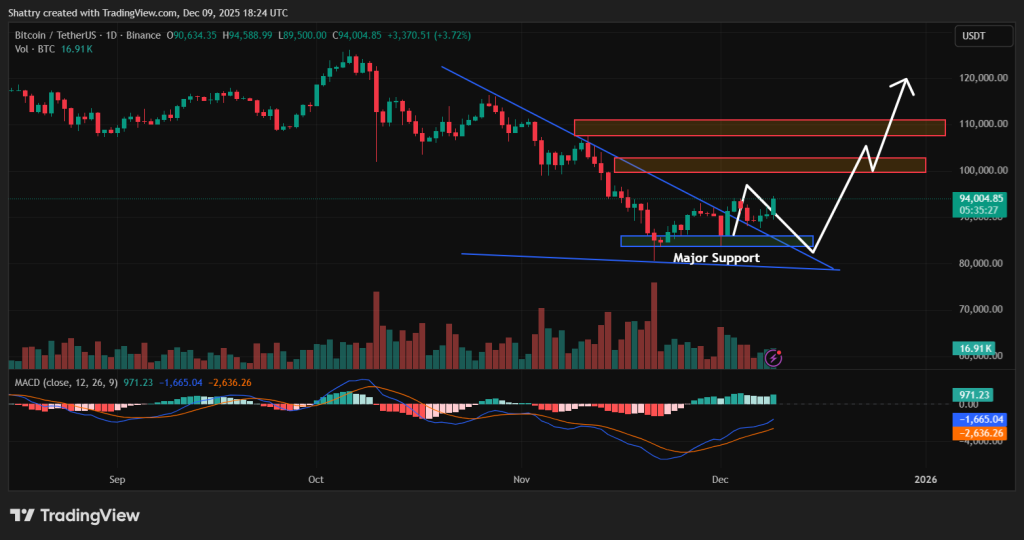
The daily chart shows Bitcoin attempting to break free from a multi-week descending trendline after spending most of November in controlled decline.
Price is now pushing above diagonal resistance with noticeably increased volume, indicating buyers are re-entering the market.
The MACD has crossed bullish and is accelerating upward from deeply oversold levels, a configuration that typically precedes mid-term reversals rather than temporary bounces.
Price is also reclaiming the daily pivot zone, suggesting momentum is shifting from defensive consolidation toward early recovery.
Source: TradingView
If this breakout holds, Bitcoin is positioned to retest major pivot levels around $98,000–$100,000, which will serve as the first significant barrier to trend reversal.
A decisive close above that range would unlock movement toward $105,000–$110,000.
However, failure to maintain support above the trendline would pull the price back toward the $85,000–$82,000 support band, where lower pivot levels align with the former breakdown zone.
Bitcoin’s First Real Layer 2 Token $HYPER Could Skyrocket Next
Bitcoin isn’t the only asset investors anticipate experiencing a supercycle in 2026
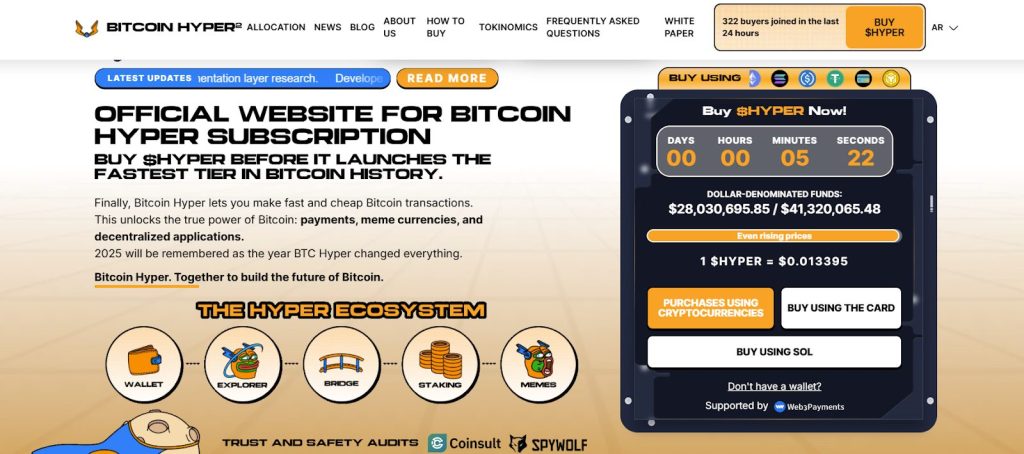
Bitcoin Hyper ($HYPER) is another project generating substantial attention as it develops the first genuine Layer 2 solution for Bitcoin, utilizing Solana-based technology to deliver speed and scalability while preserving Bitcoin’s security model.
Powered by a fast and scalable Solana-based Layer 2 infrastructure, the project has raised over $29M to enable developers to launch Bitcoin-native decentralized applications.
This provides BTC holders with new opportunities to deploy their assets productively, using on-chain tools built specifically for the Bitcoin ecosystem.
As leading wallets and exchanges integrate this scaling solution, demand for $HYPER is anticipated to go up very fast.
Dogecoin (DOGE) is, in another consecutive week, settling into a familiar pattern: holding firm at a crucial support zone while market participants weigh technical signals, shifting adoption trends, and the ever-present influence of its community.
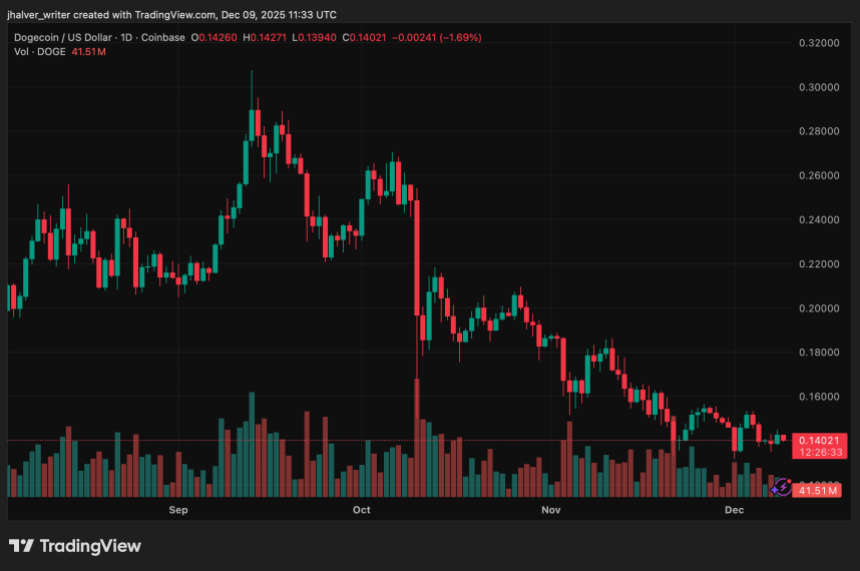
As the token trades around $0.14, its price behavior reflects a broader phase of consolidation, characterized by tighter volatility and increasing on-chain engagement. With new real-world use cases emerging and traders watching for a breakout, DOGE’s long-term trajectory is becoming a point of renewed discussion.
Network Activity Strengthens as Dogecoin Price Holds Key Support
Despite muted market reaction to Dogecoin’s 12th anniversary, activity on the network continues to rise.
Daily active addresses reached over 67,000 earlier in December, marking the second-highest level in three months. This increase comes as DOGE repeatedly defended the $0.14 support, forming a tight compression range between $0.1406 and $0.1450.
Short-term charts indicate multiple rebounds from the $0.14 level, accompanied by decreasing sell volume, an early sign of accumulation.
Analysts identify $0.16 as the threshold that would shift DOGE from range-bound movement into a potential trend continuation. Failure to hold support, however, could expose deeper downside toward $0.081, an area highlighted by realized on-chain distribution clusters.
Adoption Expands Beyond Market Narratives
Recent developments show Dogecoin slowly expanding beyond its memecoin label. In Argentina, certain taxes can now be paid using DOGE, while Alternative Airlines has begun accepting the token for ticket purchases. These integrations, although still modest, indicate real-world traction that supports a longer-term use case narrative.
Broader sentiment, however, remains closely tied to macroeconomic conditions. Analysts note that liquidity trends, regulatory developments, and institutional risk appetite continue to shape DOGE’s outlook.
The launch of the first Dogecoin ETF in November drew little initial inflow, signaling that large investors remain cautious despite the token’s growing visibility.
Long-Term Structure Points to Potential Upside
From a structural standpoint, Dogecoin continues to follow a multi-year pattern that some analysts view as constructive. Long-term charts show price action moving within a large triangle formation dating back to 2021, with a cup-and-handle structure still intact on higher timeframes.
Weekly RSI levels near 50 resemble conditions seen before DOGE’s 2021 rally, while MACD indicators approach bullish crossovers on both weekly and monthly charts.
Forecasts place Dogecoin’s path toward $1 as a possibility later in the decade, with projections suggesting a climb toward that level by 2030. In the near term, the $0.145–$0.16 zone remains the defining barrier that could determine whether DOGE transitions into a stronger upward phase or remains confined to its current band.
As Dogecoin stabilizes above key support and real-world adoption increases, traders are closely watching for the next catalyst, whether it be network expansion, macroeconomic shifts, or renewed community-driven momentum.
Cover image from ChatGPT, DOGEUSD chart from Tradingview
XRP spent the past week caught between rising institutional demand and stagnant price action, creating a compression zone that traders say is becoming increasingly difficult to ignore.
Even as U.S. spot XRP ETFs approach the $1 billion AUM milestone, the asset continues to trade within a narrow band, leaving market participants to question whether the prolonged consolidation is setting the stage for a larger move.
The disconnect between inflows and price has become one of the week’s most notable themes. Analysts note that while institutional capital continues to accumulate, XRP’s chart remains muted, indicating heavy profit-taking following November’s rally and lingering sell-side pressure across higher timeframes.
ETF Momentum Builds as XRP Price Stalls
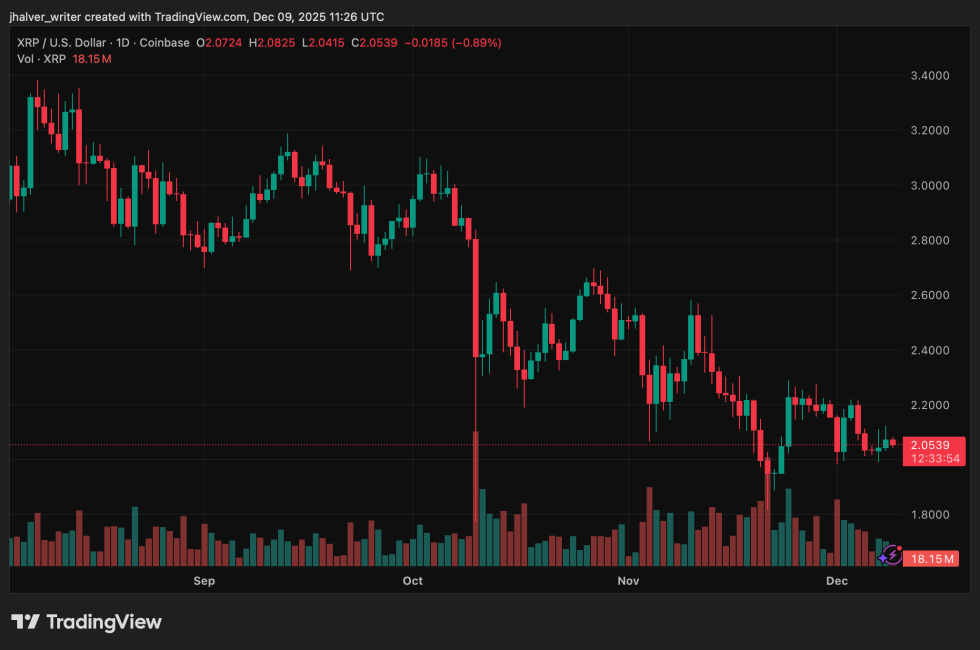
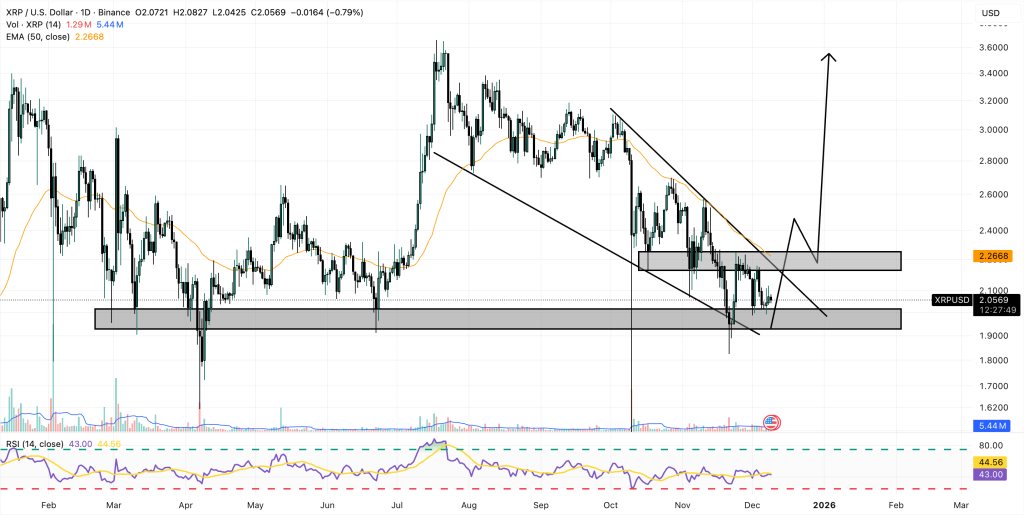
The XRP price is hovering near $2.06, slipping slightly despite consecutive days of ETF inflows. Analysts highlight that large holders likely sold into strength, offsetting the fresh demand entering through regulated products.
Even so, XRP ETFs have outperformed Bitcoin ETFs in terms of relative inflow strength, indicating that institutions are positioning themselves early.
Ripple CEO Brad Garlinghouse noted that XRP became one of the fastest-growing U.S. crypto ETFs of the year, arguing that broader access through traditional investment accounts is expanding the asset’s investor base.
The market reaction remains mixed, with some traders viewing ETFs as a stabilising force, while others see them as limiting upside volatility.
Regulatory and Structural Developments Add New Variables
Beyond market flows, regulatory commentary added another layer of attention. Former SEC Chair Paul Atkins emphasized tokenization as a practical path forward, highlighting its benefits, including increased transparency and faster settlement.
His remarks sparked debate within the XRP community, particularly among those who argue that the XRP Ledger is well-positioned for enterprise-grade tokenization systems.
Meanwhile, Ripple’s recent $500 million equity round, structured with downside protection for Wall Street investors, reinforced how closely the company’s valuation is tied to its XRP holdings.
Funds reportedly concluded that around 90% of Ripple’s net worth derives from its XRP treasury, underscoring the token’s central role in the firm’s long-term outlook.
Technical Picture Shows Compression, Not Capitulation
On the charts, XRP remains locked between the $2.07 support level and the $2.18 and $2.30 resistance levels.
Analysts note weakening momentum indicators but stable underlying demand. If XRP breaks above these levels, a move toward Wave 3 targets near $2.73 becomes more likely, though failure to do so could trigger another retest of lower support.
The XRP price continues to compress, supported by some of the strongest ETF inflows of the year, but constrained by steady selling and broader market caution. Whether this tension resolves upward or downward is the question traders will carry into the next week.
Cover image from ChatGPT, XRPUSD chart from Tradingview
Last week, XRP exchange-traded funds (ETFs) attracted the highest inflows among all altcoins, signaling rising institutional interest in the token.
With nearly $900 million now allocated across XRP-linked ETFs, investors are beginning to ask: how might this growing momentum influence the XRP price prediction going into 2026?
According to data from SoSo Value, XRP ETFs have a 16-day streak of positive inflows despite the latest downturn.
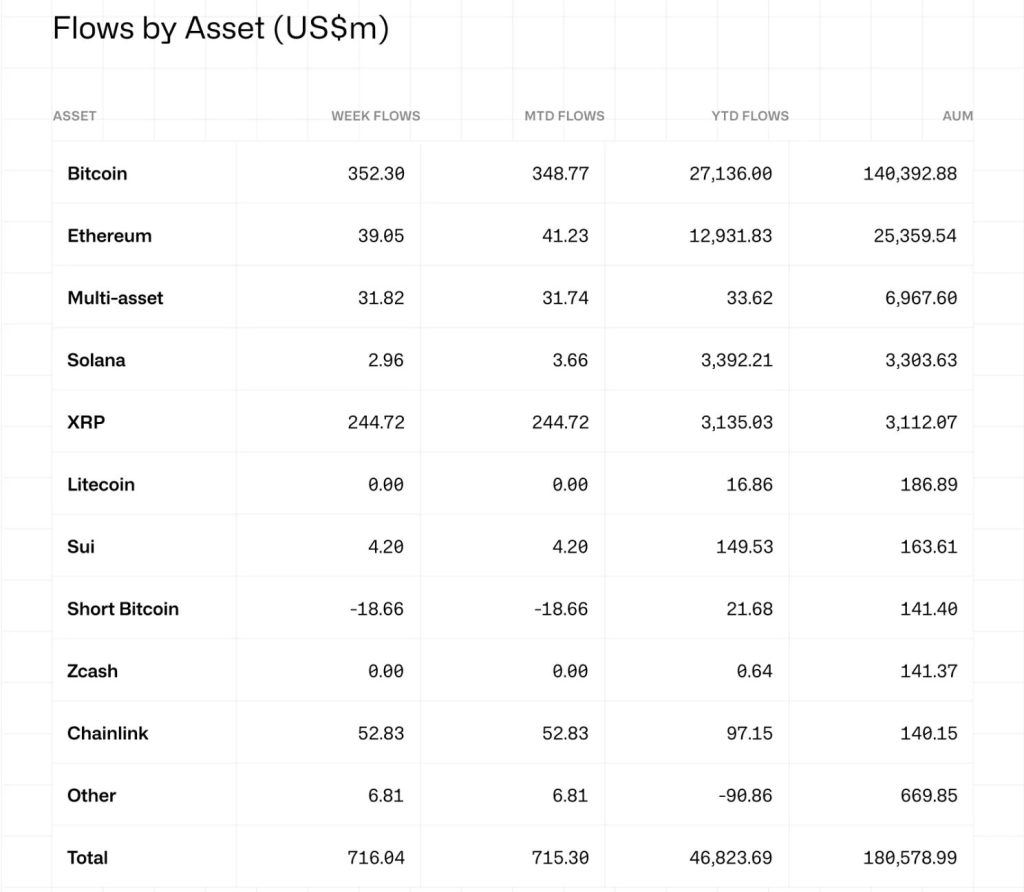
As a result, the total assets held in these vehicles have surged to $935 million. Meanwhile, data from CoinShares shows that XRP exchange-traded products (ETPs), a list that includes over-the-counter (OTC) funds, brought in $245 million in funds last week.
Compared to Ethereum and Solana ETPs, XRP emerged as the indisputable winner, as the latter took in a combined total of just $35 million during this same period.
Following its legal victories against the U.S. Securities and Exchange Commission (SEC), XRP has been rapidly expanding its ecosystem through the launch of Ripple USD (RLUSD), Ripple Prime, and more.
As institutional adoption accelerates, XRP could be poised to make a strong comeback, especially now that the token has hit a key support at $2.
XRP Price Prediction: XRP Consolidates Ahead of FOMC Meeting
Today, the token has retreated by 2% but trading volumes have subsided.
The Relative Strength Index (RSI) is showing clear signs that the price has entered a stage of consolidation ahead of tomorrow’s FOMC meeting.
This important gathering will likely set the market’s tone for the rest of the month. A bullish post-FOMC breakout above $2.20 would effectively reverse the token’s downtrend and set XRP on track to hit $2.50 first and then $3 if the rally gains traction.
Meanwhile, if the price breaks below the $2 mark, we could witness a much deeper correction to at least $1.65.
Apart from well-established tokens, top crypto presales like Bitcoin Hyper ($HYPER) have attracted millions from investors. HYPER is bringing Solana technology to Bitcoin and its fundraising is still ongoing.
Bitcoin Hyper ($HYPER) Nears $30M Raised to Launch Its Solana-Based Bitcoin L2
BTC can be much more than just digital gold, but it needs railways to allow developers to launch attractive decentralized apps (dApps) that offer staking, yield-farming, lending, and other similar decentralized services.
Bitcoin Hyper ($HYPER) is the answer to this problem. This project introduces a safe, fast, and cheap L2 that gives BTC holders the chance to earn passive income on their investment without leaving the OG blockchain.
Investors will send their BTC tokens to the Hyper Bridge and instantly get the corresponding amount of assets in the Hyper L2 to access a growing list of applications.
As top wallets and exchanges adopt this solution, the demand for its utility token, $HYPER, is expected to surge.
The market is recovering as one of the worst months for crypto comes to an end. Heading into Christmas, we asked the newly launched Chinese AI named Kimi K2 for its price predictions for XRP, Shiba Inu, and Dogecoin toward the end of 2025, and it delivered a dramatic outlook.
2025 has been a negative year for Bitcoin. At the time of writing, year-to-date performance shows BTC down more than 7%, starting the year near 99K and now looking likely to finish below that level.
Even so, the bigger picture stays constructive. Analysts still expect durable altcoins such as XRP to perform well, with Shiba Inu and Dogecoin leading the memecoin comeback over the long term. Once market conditions settle, each project could regain upward momentum, and below is how Kimi AI expects it to play out.
Kimi AI Expects XRP To End The Year Where It Is Now Before a 250% Rally
Kimi AI says XRP is set to end 2025 at $2.30 to 2.36 as Ripple’s legal clarity fuels Asian bank adoption and RLUSD stablecoin flows. This means 2025 would still be a negative year for XRP.
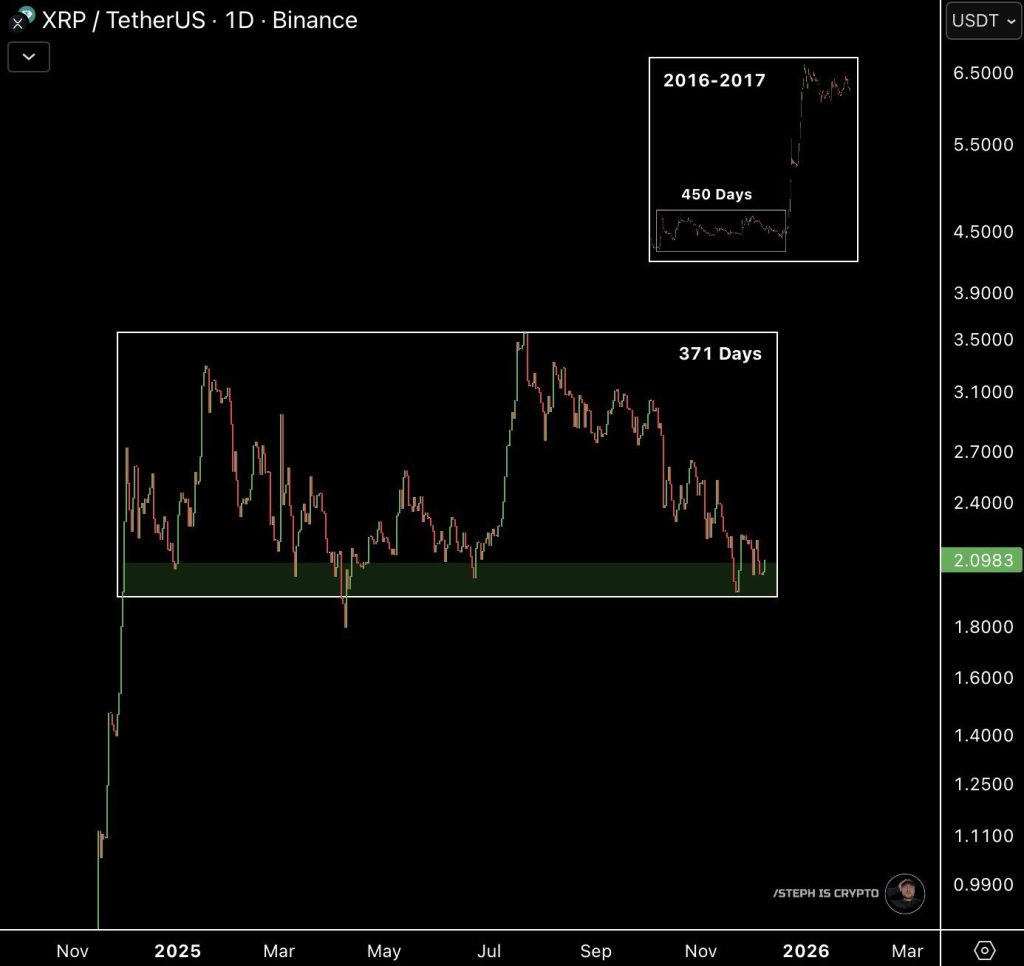
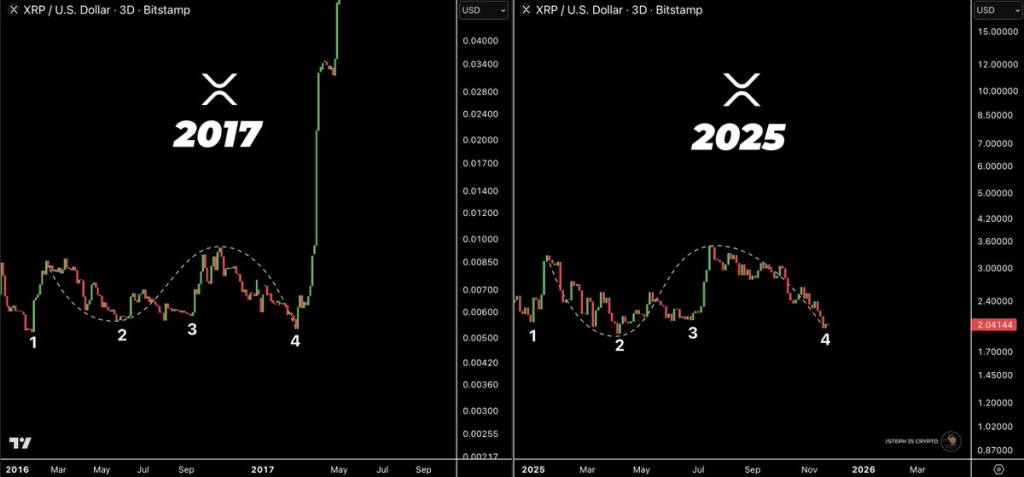
However, it still expects the same scenario that played out in 2017 to repeat. The AI considers the current dips an accumulation zone that could set XRP up for a possible run in 2026 toward $5 to $8.
This depends on XRP holding the $2.00 support level, an important area that keeps the prediction valid.
Kimi AI Predicts A Memecoins Comeback Led By Dogecoin And Shiba Inu
Statistically, 2025 was one of the worst years for memecoins, with retail interest dropping to almost nothing. However, the sector has started to recover, jumping from a $38 billion market cap to more than $42 billion in the past few days.
Kimi AI predicts Dogecoin will close 2025 at a minimum of $0.18. With the Grayscale ETF and steady support from Elon Musk, the AI expects Dogecoin to reach a new all-time high in 2026 between $0.70 and $1.30. Kimi also believes this could mark the start of a new meme rotation.
If this happens, it could lead to another similar narrative coin, Shiba Inu, exploding as well, especially since it has been going through a difficult period for a long time now.
The AI predicts Shiba Inu will end 2025 near its current price, as the coin continues leaving exchanges, which could cause a supply shock once the Shibarium privacy upgrade becomes ready in 2026.
Shiba Inu price is slowly rising after hitting its yearly low in November. The next target is the resistance at 0.00000910. If Shiba manages to break above it, it could be a clear sign of a positive shift and new bullish momentum forming.
Maxi Doge: The Memecoin Positioned To Lead the Next Rotation
With Kimi AI projecting a major memecoin comeback led by Dogecoin and Shiba Inu in 2026, early investors are searching for the next breakout contender. Maxi Doge is quickly becoming that name. As retail interest returns and liquidity shifts back into high-energy meme assets, Maxi Doge is emerging as one of the most promising early-stage plays on the market.
Maxi Doge takes inspiration from classic Dogecoin culture and upgrades it with a modern twist. The project revolves around a jacked, high-leverage, obsessed Doge that perfectly fits today’s crypto humor. There is no fake utility pitch, just pure meme identity backed by real community features such as staking, contests, and long-term engagement incentives.
The presale has already gained strong traction, raising millions as investors position themselves ahead of the next meme rotation. Roughly 40% of the total supply has been allocated directly to the public with no insider or private rounds, reducing the risk of whale manipulation when the token lists.
Maxi Doge also offers a high-yield staking program, giving presale buyers a chance to earn rewards before the token even launches. As the memecoin sector recovers from its 2025 lows and prepares for another surge, MAXI sits at the center of that early opportunity.
Visit the Maxi Doge website to join the presale and follow what smart traders are moving into. You can buy using ETH, USDT, BNB, or even a credit card.
Crypto is bouncing nicely with BTC reclaiming 90K, which is a solid bullish signal as we head into the usual pre-FOMC chop until Wednesday. These are the conditions where altcoins usually suffer the most.
Many analysts see these dips as potential buying opportunities, especially for coins that have proven themselves throughout this cycle. XRP, Solana, and Zcash are all sitting on clean pullbacks and have been accumulating in steady price ranges for a while. Their moment might be coming next.
Solana Is the Main Altcoin to Watch in December
For 16 weeks, DeFiLlama data shows that SOL has led all chains in decentralized exchange activity, doubling Ethereum’s volume. With $634 million in net inflows this year and growing cross-chain adoption, the Solana DeFi ecosystem continues to attract liquidity and users.
The market cap of Solana stablecoins also climbed from 5 billion dollars in January 2025 to more than 15 billion dollars as of December. This is more than 200 percent year-to-date growth. It is one of the most important metrics to monitor because of the critical role stablecoins now play in the crypto market.
Institutional interest is rising as well. Solana ETFs continue to see positive inflows, now totaling more than $593 million in net flow.
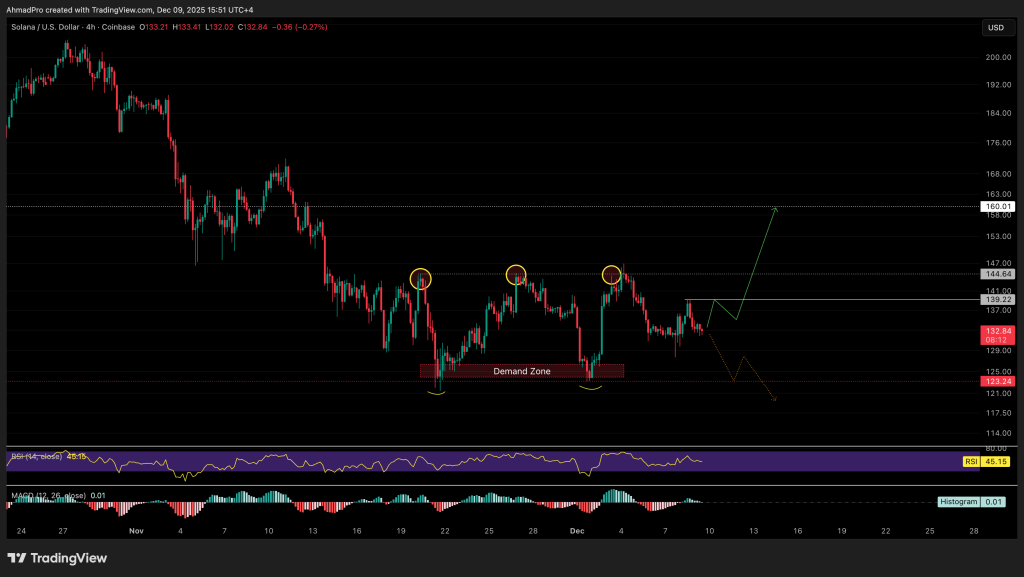
When you look at the chart, all of this becomes clear. Solana has been moving in a range between $160 and $120 since October. Many analysts see this as an accumulation zone before a breakout.
The wall at $144 is currently the hardest to break, with three retests in the past 30 days. If price manages to break through it, Solana could be setting up for a strong first quarter of 2026.
XRP Could Repeat History After Testing a Multi-Month Low
XRP price recently hit $1.90, a level it has not reached since April. What stood out is the bounce and recovery that pushed XRP back above the key $2.00 support level.
XRP ETFs are now on 13 consecutive days of positive inflows, bringing total ETF-held net assets to $861.23 million. This signals rising institutional interest in the coin.
That said, XRP is currently showing one of the strongest short positions among major assets. Most traders are leaning heavily toward the short side, and the data shows very little long support right now. The odds of a new all-time high by December 31, 2025, have dropped to 3%.
This bearish sentiment around XRP has pushed the price into a pattern similar to what happened before the explosive 2017 pump. If XRP manages to hold the $2.00 support level, a new all-time high could form by 2026, just like CZ predicted.
If You Believe In Privacy, You Believe In ZCASH
This is what most of the Zcash community will tell you. Zcash is not having the best time right now, with a lot of FUD circulating. The coin is currently trading at $416, more than 40% below its all-time high.
Arkham recently exposed Zcash chain activity and claimed to have identified 53% of the chain’s private transactions. They introduced new on-chain tracking for ZEC, resulting in $420 billion of volume analyzed and more than half of all ZEC transactions linked to people or institutions.
However, the community argues that Arkham only tracked transparent addresses, not the private ones.
The Zcash chart recently bounced after dropping below $300, a move that shook many investors. If Zcash manages to break above $450, the chart could be setting up for a move toward higher levels.
Bitcoin Hyper Presale Is Nearing $30M Raised, Best Crypto To Buy?
As the market starts to recover and top altcoins like Solana, XRP, and Zcash hover in critical accumulation zones, one project is quietly pulling massive interest from early investors. Bitcoin Hyper is emerging as a standout narrative heading into 2026, blending meme culture with real Bitcoin layer 2 infrastructure in a way that is catching serious attention.
Bitcoin Hyper is built on the Solana Virtual Machine, giving it high-speed performance, ultra-low fees, and full smart contract capability on top of Bitcoin’s settlement layer. It also introduces decentralized governance and a Canonical Bridge that allows smooth movement of BTC across chains, something that Bitcoin users have been waiting for.
The presale has already raised more than $29.2 million, showing strong confidence from early adopters. Analysts such as Borch Crypto expect the token could rally as much as one hundred times once it lists on exchanges. A fresh audit from Coinsult reported zero contract vulnerabilities, which further boosts trust in the project.
HYPER tokens are used for staking, gas fees, and governance, and presale buyers can earn up to 40% APY. With the full platform rollout scheduled for 2026, investors have the chance to position themselves early in what could become one of the most important upgrades to Bitcoin’s utility.
While other coins consolidate and prepare for their next big move, Bitcoin Hyper is already capturing momentum and standing out as one of the strongest new plays in the market.
Senator Cynthia Lummis said she wants the Senate Banking Committee to move ahead with a markup of the long-delayed crypto market structure bill as early as next week, showing that negotiations in Washington have reached another pressure point.
Speaking at the Blockchain Association Policy Summit on Tuesday, Lummis said she hoped the Responsible Financial Innovation Act, the committee’s version of market structure legislation, would be ready for a formal markup before Congress leaves for the holidays.
Lummis said the industry had begun to worry about the pace of progress, noting that bipartisan drafts had been rewritten repeatedly in recent weeks.
She described a process that has strained both Republican and Democratic staff members, adding that the constant revisions were no longer sustainable.
“Our staffs are exhausted,” she said, explaining that she and Senator Kirsten Gillibrand wanted to present a draft by the end of this week, circulate it to industry and lawmakers, and then bring the bill to a markup next week.
A markup hearing would allow senators to amend the legislation before sending it to the full Senate. Also, Lummis said in September that she expected the bill to be signed into law by 2026.
Crypto Bill Stalls in Senate as Lawmakers Restart Negotiations
The House legislation, formally introduced in May by Chairman French Hill, gives the Commodity Futures Trading Commission primary oversight of digital commodities while preserving the Securities and Exchange Commission’s authority over fundraising and token issuance.
A report from Politico on Monday indicated that bipartisan negotiations had picked up again, with plans to hold a markup in December. That aligns with Senator Cynthia Lummis’ push to keep the timeline on track.
However, not everyone is pleased with how slow things have been moving. At the same policy event on Monday, Senator Bernie Moreno said the process had become “decently frustrating,” adding that he would rather see no bill at all than one that leaves major regulatory gaps untouched.
Sen. Moreno warns U.S. lawmakers: “No deal is better than a bad deal.” U.S. crypto legislation may be delayed
He plans to meet with Democratic lawmakers this week in an effort to break the stalemate.
Lawmakers Race Clock as Crypto Bill Risks Election-Year Freeze
Earlier this year, Congress managed to push a stablecoin bill through with support from both parties, but the broader market structure package has been a far tougher lift.
One point of tension lies in how the House and Senate drafts define which tokens should not be regulated as securities.
The Senate version uses the term “ancillary assets,” while the Agriculture Committee’s proposal expands the CFTC’s authority instead. Both drafts still need markups, revisions, and formal votes before they can move forward.
There was a brief moment of optimism last week when Banking Committee Chair Tim Scott said a markup could take place on December 17 or 18.
But Senator Mark Warner suggested that wrapping everything up before the holiday recess would be difficult, noting that the White House still hadn’t provided final language on quorum and ethics rules.
Investors are stepping back as a $10 million lawsuit accuses Pi Network of a large-scale fraud scheme, casting a shadow over bullish PI coin price predictions.
Questions of unauthorized transaction, a secret 2 billion Pi token dump, and deliberately delayed network migration have sparked an exodus, with the altcoin down 5%.
According to court filings, plaintiff Harro Moen claims the scheme unfolded over several years and caused significant financial damage. He is seeking $10 million in damages.
Is a lawsuit really going to be filed against #PiNetwork?
I don't know if this is true or false, but I do know that its value will soon decrease, and people's trust in it will also diminish.@PiCoreTeam needs to respond now. pic.twitter.com/fMDQj5ouCD
Moen credits an April 10, 2024 unauthorized transfer of 5,137 PI tokens from his verified wallet to an unknown address to a scheme to dump over 2 billion PI of user funds.
He further added that the situation was worsened by the failure to migrate his remaining 1,403 tokens to the Pi Network Mainnet, exposing him to heavy unrealised losses.
The complaint also argues that despite marketing Pi Network as decentralized, the defendants allegedly maintained centralized control by operating only three validator nodes.
These accusations threaten to worsen Pi Network’s biggest pain point: adoption. The project already lacks a meaningful use case to sustain long-term growth, and now builders may sideline the layer-1 entirely.
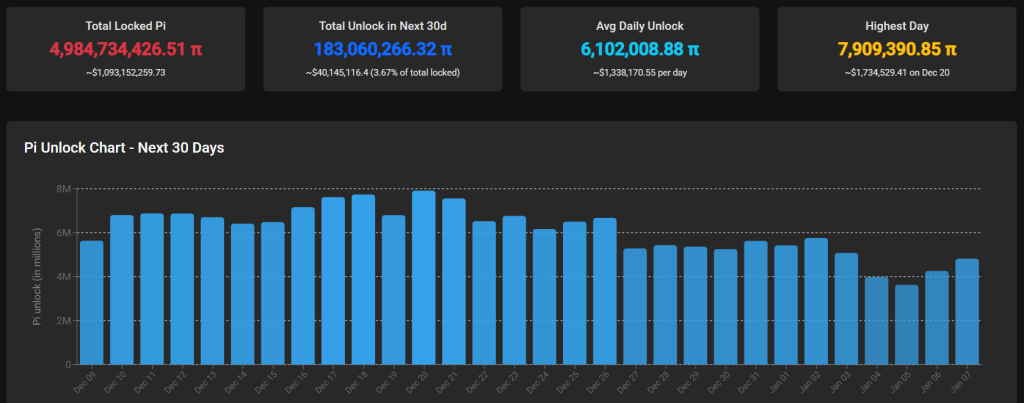
Its liquidity strain may deepen further, with short-term speculative trading amplifying deflationary pressure as token unlocks continue at an average pace of 6.1 million PI per day.
Pi Coin Price Prediction: Is a Recovery Still Possible?
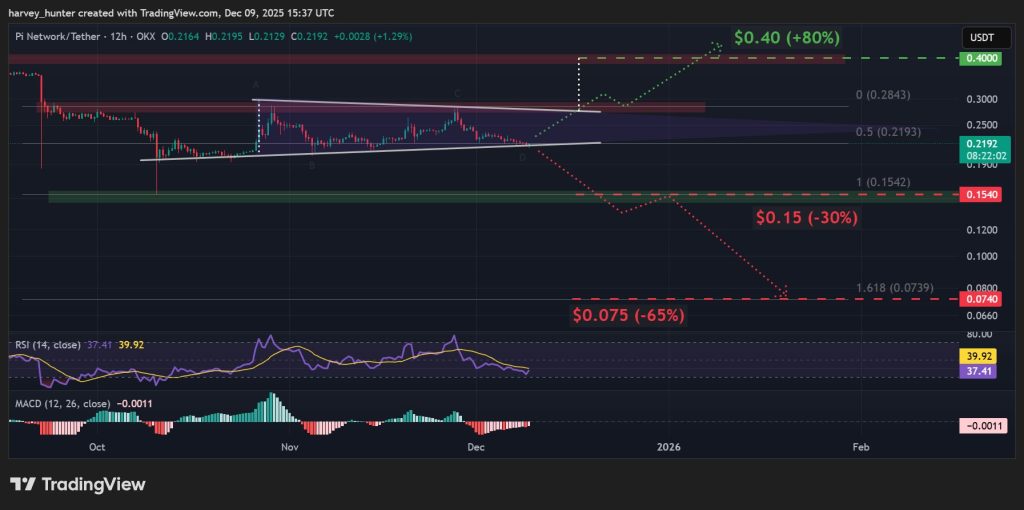
The controversy comes as the PI coin price tests a strong confluence of support with the lower boundary of a 2-month ascending triangle and the 0.5 Fib retracement level.
PI USDT 12H chart, symmetrical triangle pattern. Source: TradingView.
Momentum indicators show bullishness peeking through. The RSI has bounced from near-oversold levels, typically a bottom marker in corrections.
The MACD also slowly closes in on a golden cross above the signal line, a sign of growing strength.
As a launchpad, this support could set up a breakout to the patterns $0.40 target, an 8-% gain from current prices.
Still, the lawsuit could dent bearish sentiment enough to disrupt the slow growth. A breakdown targets all-time lows, 30% lower at $0.15.
And below that lies a dangerous gap area, with little historical support to cushion downside, which opens the door to a 65% decline to the 1.618 Fib retracement at $0.075.
Bitcoin Hyper: A Layer-2 Attracting Talk For Better Reasons
Those who jumped to Pi Network as an alternative Layer 1 to the leading crypto may be forced to reconsider, as the Bitcoin ecosystem finally addresses its biggest limitation: ecosystem growth.
Bitcoin Hyper ($HYPER) is bridging Bitcoin’s security and stability with Solana’s speed, creating a new Layer-2 network that unlocks scalable and efficient use cases Bitcoin couldn’t support alone.
The project has already raised almost $30 million in presale, and post-launch, even a small share of Bitcoin’s trading volume could push its valuation significantly higher.
Bitcoin Hyper is fixing the slow transactions, high fees, and limited programmability that have capped Bitcoin’s potential – just as the market turns bullish.

 Login
Login

 INSTITUTIONS ARE ACCUMULATING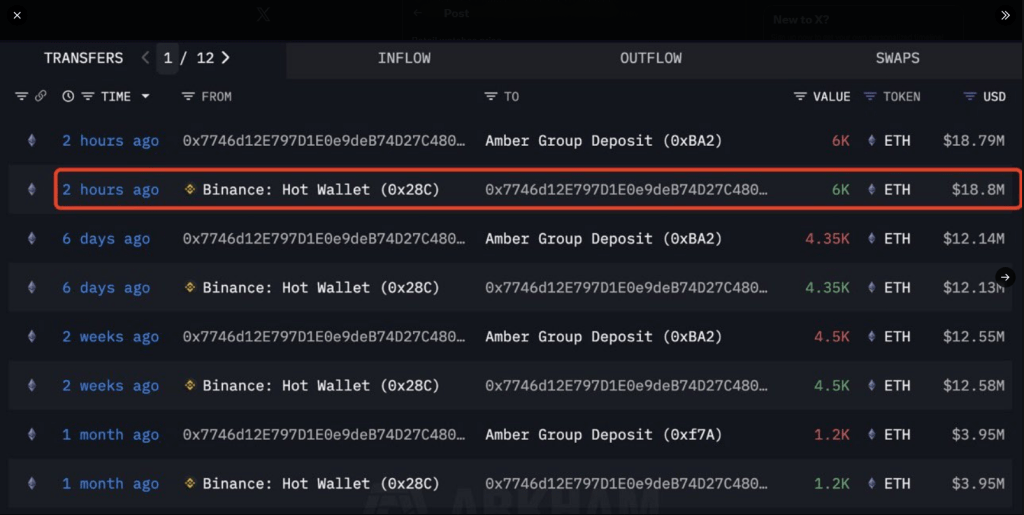















 GENIUS Act, Anti-CBDC Act, and CLARITY Act pass crucial procedural vote 215-211 in Congress after Trump's decisive Oval Office intervention rescues stalled crypto agenda.