Reading view

There are new articles available, click to refresh the page.

Bitcoin Price Prediction: US Bank Now Lets Clients Buy BTC Directly – Could This Be the Start of a Banking Domino Effect?

PNC Bank, the sixth-largest commercial bank in the United States, has launched direct spot Bitcoin trading for eligible private bank clients, becoming the first major U.S. bank to offer native Bitcoin exposure.

Crypto analysts say the domino effect of this direct custody could positively impact the trajectory of the Bitcoin price prediction.

U.S Banks Break Down Barriers to Bitcoin Access

The new PNC bank service enables qualified private banking clients to purchase, hold, and sell Bitcoin without relying on external cryptocurrency exchanges.

Today marks a major milestone for institutional crypto adoption.@Coinbase’s Crypto-as-a-Service platform is now powering @PNCBank’s launch of direct bitcoin trading for PNC Private Bank clients – the first to market with such an offering among the major U.S. banks. pic.twitter.com/wwuOIRuBfK

— Coinbase Institutional 🛡 (@CoinbaseInsto) December 9, 2025

This development follows a crucial regulatory milestone from the Office of the Comptroller of the Currency, which recently confirmed that national banks may conduct riskless principal crypto-asset transactions.

The decision permits U.S. banks to function as intermediaries in crypto trades by simultaneously buying from one customer and selling to another without maintaining inventory.

Last week, Bank of America authorized its 15,000 wealth management advisers to recommend 1%–4% crypto allocations for client portfolios, signaling a broader institutional embrace of mainstream Bitcoin exposure.

In October, Citibank announced plans to launch crypto custody services in 2026, after developing the infrastructure over two to three years.

Meanwhile, Cryptonews reported in September that BNY Mellon is advancing toward offering custody services for Bitcoin and Ethereum, specifically targeting exchange-traded product clients.

If other major banks replicate PNC’s approach, BTC could establish stronger support levels in the coming months and position itself for a further push toward the $100,000–$130,000 range heading into 2026.

Bitcoin Price Prediction: Breakout Targets $105K, $110K, $120K

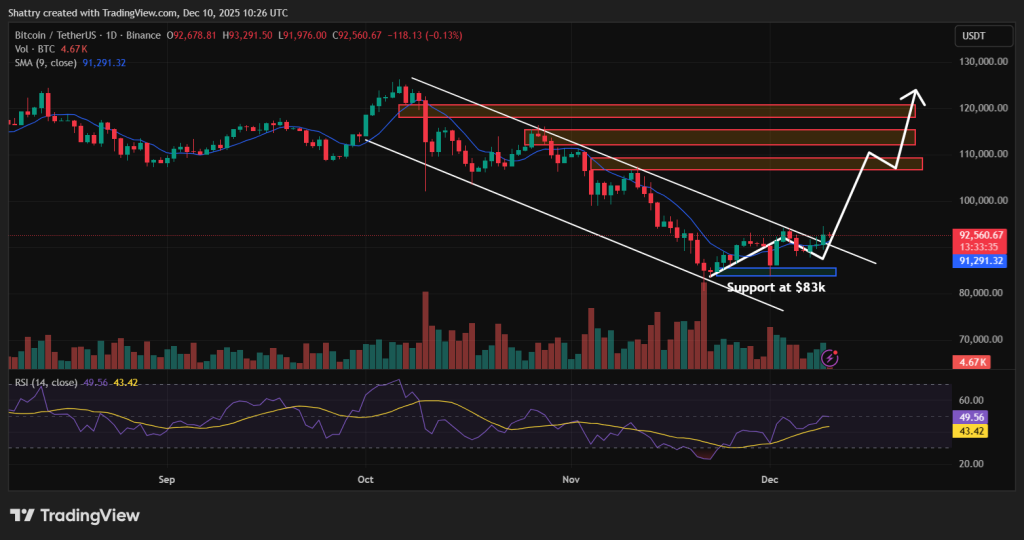
Bitcoin is attempting to escape a multi-week descending channel after defending critical support near $83,000.

The recent bounce pushed the price back above the 9-day simple moving average, demonstrating early momentum, though it remains near the channel’s upper boundary.

The RSI has climbed out of oversold territory and is now approaching the mid-50s, indicating recovering bullish momentum following a prolonged downtrend.
Bitcoin Price Prediction - Bitcoin Price Chart
Source: TradingView

If Bitcoin closes decisively above the descending channel and maintains support above $90,000–$92,000, charts suggest upside continuation toward resistance clusters at $105,000, $110,000, and potentially $120,000.

However, failure to sustain this breakout zone risks a retest of $83,000 support.

This New Meme Coin Raised $4.3M Fast – Is It the Next Dogecoin?

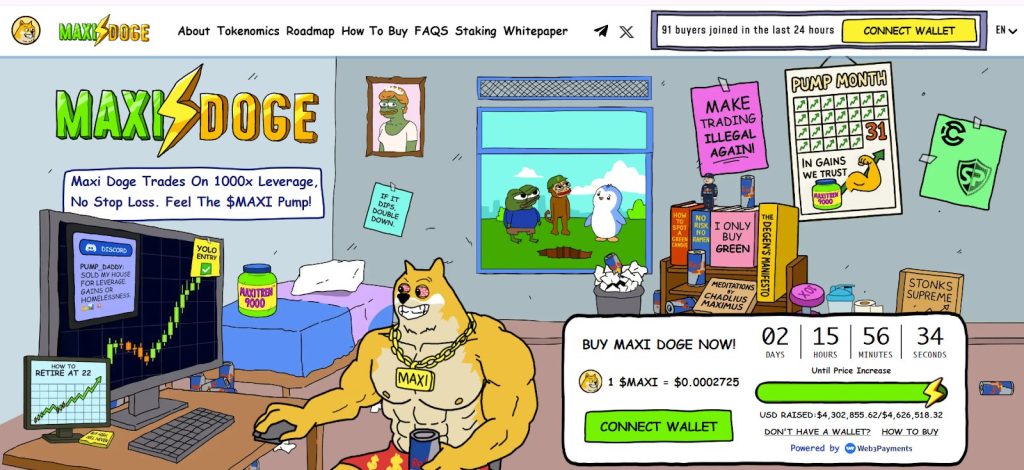
As Bitcoin gears up for its next major move, early-stage projects like Maxi Doge ($MAXI) are quickly gaining traction among investors looking for high-upside plays.

Inspired by Dogecoin’s explosive 1,000x rally, $MAXI is building a high-energy community where traders share alpha, early setups, and hidden gems before they go mainstream.

Since launching only a few months ago, the presale has already pulled in over $4.3 million, with strong momentum.
Bitcoin Price Prediction - Maxidoge Banner

This could be one of the cycle’s most relatable, community-first opportunities, and early backers still have time to get in before the next price increase kicks in.

To buy early, visit the official Maxi Doge website and connect a crypto wallet like Best Wallet.

You can swap existing crypto or use a bank card to make the purchase in seconds.

Visit the Official Maxi Doge Website Here

The post Bitcoin Price Prediction: US Bank Now Lets Clients Buy BTC Directly – Could This Be the Start of a Banking Domino Effect? appeared first on Cryptonews.
XRP Price Prediction: $100M Whale Dump Hits Just Before Breakout – Can Retail Buying Stop the Bleed?

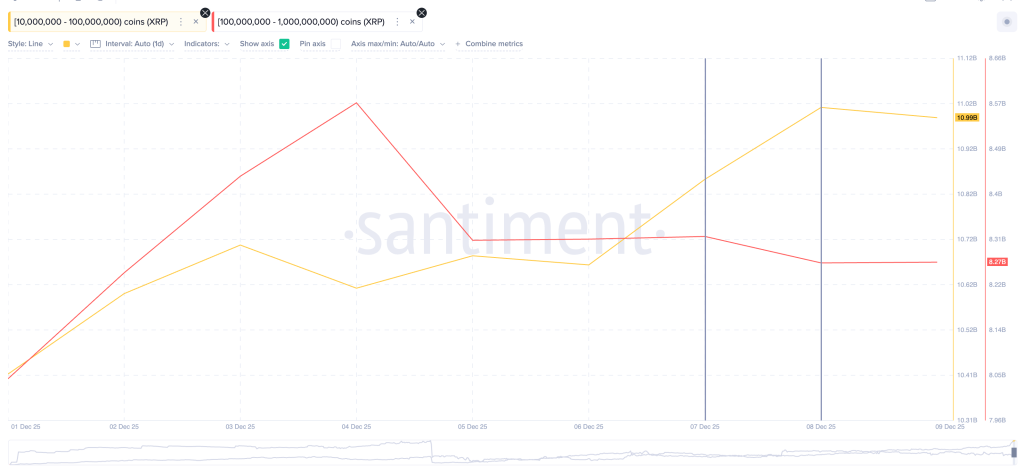
XRP whales have dumped a significant volume of tokens ahead of today’s FOMC meeting and may have delayed the token’s recovery. However, long-term holders are still not selling and continue to show the kind of commitment that favors a bullish XRP price prediction.

According to data from Santiment, whale wallets holding between 100 million and 1 billion XRP have sold nearly $600 million worth of tokens since December 5.

xrp whale activity

Meanwhile, since December 7, whales dumped over $100 million, showing that deep-pocketed investors are still selling even though the price has recovered.

This explains why XRP has struggled to move past the $2 mark. The token has accumulated a 5% in the past 7 days as the Federal Reserve prepares to make a decision on interest rates today.

Meanwhile, trading volumes have jumped by 60% in the past 24 hours, reaching nearly $4 billion. This accounts for 3% of the token’s circulating market cap and reflects a spike in trading activity ahead of the Fed’s interest rate decision.

XRP Price Prediction: XRP Could Fully Recover If It Breaks This Key Resistance

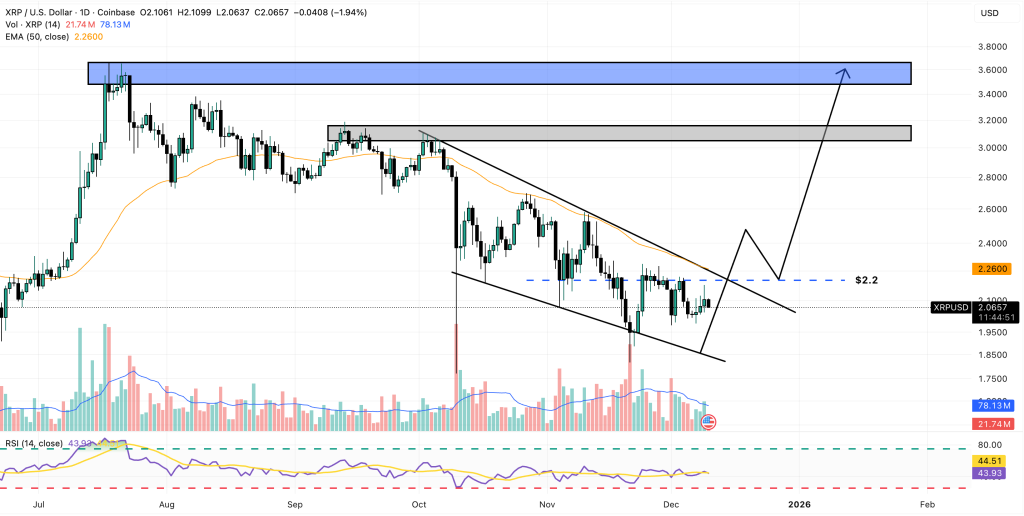
XRP needs to clear the $2.20 level to reverse its downtrend. The FOMC meeting could provide the necessary catalyst for this to happen, as traders will be reassured about what the future holds once Powell speaks.

bitcoin hyper presale

Such a bullish breakout would also push XRP above its 200-day exponential moving average (EMA).

The Relative Strength Index (RSI) needs to rise past the mid-line and above the 14-day moving average as well. This is typically interpreted as confirmation that bullish momentum is accelerating.

If XRP breaks through its current resistance, the $3 level could be the first major target, backed by strong psychological significance and historical price action.

As broader sentiment improves, high-upside crypto presales like Bitcoin Hyper ($HYPER) could rally even harder.

With nearly $30 million raised in its ongoing presale, the project is bringing Solana’s technology to the Bitcoin blockchain.

Bitcoin Hyper ($HYPER) Supercharges BTC with Solana Speed – Early Investors Are Piling In

Bitcoin’s biggest strength is security, but its biggest weakness is speed.

That’s where Bitcoin Hyper ($HYPER) comes in.

This new Layer 2 solution uses Solana’s cutting-edge technology to fix Bitcoin’s biggest limitations, unlocking fast transactions, low fees, and full support for DeFi, meme coins, NFTs, and more.

The project is built around the Hyper Bridge, which lets BTC holders safely move funds onto the Hyper L2.

Once transferred, users instantly receive a 1:1 amount on the L2 network with near-instant finality.

This opens the door to a fast-growing ecosystem where BTC users can finally access staking, payments, and high-yield opportunities.

Bitcoin Hyper has already raised nearly $30 million from early investors who believe this will be the breakthrough that finally brings smart contracts to Bitcoin at scale.

As more top wallets and platforms integrate with Hyper L2, demand for its native token, $HYPER, is expected to surge.

To join the presale, visit the official Bitcoin Hyper website and connect a supported wallet like Best Wallet.

You can buy $HYPER using crypto or a bank card at the current price of $0.013375, before the next price rise in less than 32 hours.

Visit the Official Bitcoin Hyper Website Here

The post XRP Price Prediction: $100M Whale Dump Hits Just Before Breakout – Can Retail Buying Stop the Bleed? appeared first on Cryptonews.

Bitcoin Selling Pressure Eases as Exchange Inflows Drop: CryptoQuant

Bitcoin’s market dynamics have shifted sharply in recent weeks, offering signs of short-term resilience as selling pressure eases and investors reduce deposits to exchanges ahead of a highly anticipated Federal Reserve policy meeting.

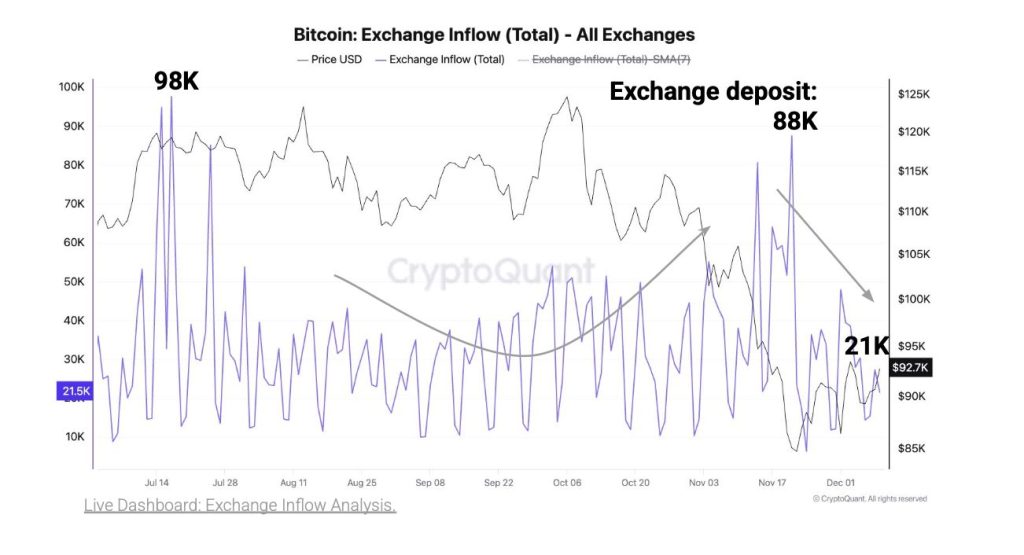
According to the latest research report from CryptoQuant, after briefly falling to $80,000 on November 21, Bitcoin has rebounded to a one-month high of $94,000, supported by declining exchange inflows and reduced selling activity from large holders.

Exchange Deposits Fall, Easing Price Pressure

A major driver behind Bitcoin’s recent price stabilization is the sharp decline in BTC transferred to exchanges. Deposits have fallen to 21,000 BTC today, compared with 88,000 BTC on November 21, marking a 76% decrease in sell-side supply over the past three weeks, according to CryptoQuant.

This decrease indicates that holders, especially short-term traders, are less inclined to sell immediately into the market. Lower exchange inflows traditionally reduce downward pressure, creating more opportunity for price recovery in the near term.

Large Holders Pull Back: Lower Deposits, Smaller Transfers

Institutional-scale investors and whales have played a major role in the shifting environment. The share of exchange deposits linked to large holders dropped from 47% in mid-November to 21% today, while the average transfer size fell 36%, from 1.1 BTC to 0.7 BTC.

These patterns suggest that major players are stepping back rather than accelerating sell-offs. Large holders tend to dictate market direction during periods of volatility, and their reduced activity typically supports more orderly price behavior.

Loss Realization Peaks, Reducing Future Sell-Side Pressure

Bitcoin’s recent rebound also comes after a wave of realized losses, often a turning point in market psychology. On November 13, as Bitcoin broke below $100,000, whales and short-term holders realized $646 million in losses, the highest since July.

Across the last several weeks, that figure has climbed to $3.2 billion in net losses, likely flushing out weaker hands and reducing forced selling. Loss realization can fuel capitulation in bear phases, but once completed, it can set a foundation for more stable price action.

Key Levels to Watch: $99K, $102K, and $112K

If selling remains muted, analysts say Bitcoin could advance toward $99,000, marking the lower band of the Trader On-chain Realized Price indicator, typically a major resistance during market drawdowns. Beyond that, major resistance levels stand near $102,000 (one-year moving average) and $112,000 (Trader On-chain Realized Price) reports CryptoQuant.

Market uncertainty remains, particularly ahead of the Federal Reserve’s decision, but Bitcoin’s latest trend suggests a market catching its breath—the calm before the next wave of volatility.

📈 BTC neared $94K and ETH hit $3,250 early December, driven by MSTR’s buy and Fusaka anticipation, per Laser Digital.#Bitcoin #Cryptohttps://t.co/pMYuzVS329

— Cryptonews.com (@cryptonews) December 9, 2025

The post Bitcoin Selling Pressure Eases as Exchange Inflows Drop: CryptoQuant appeared first on Cryptonews.

Crypto Tax Bill Targeted for Passage by Next August, House Tax Writer Says

Talks over how the United States should tax digital assets are moving into a new phase, as Rep. Max Miller, a member of the House Ways and Means Committee, told attendees at the Blockchain Association’s policy summit on Tuesday that he believes the bill can move before the August 2026 recess.

He said the draft has already been circulated among several committee members and that he hopes to announce a lead Democratic co-sponsor soon.

Miller’s timeline marks the most concrete sign yet that Congress is preparing to revisit an issue that has lingered for nearly a decade, dating back to the IRS’s 2014 declaration that cryptocurrencies are taxed as property.

The decision created a system where every sale, swap, or payment counts as a taxable event.

Congress Moves Toward Long-Awaited Update to Crypto Tax Code

Miller and his Democratic counterpart, Rep. Steven Horsford of Nevada, say they are working on language to simplify reporting and give taxpayers clearer rules.

Miller said the 43-day government shutdown earlier in the fall wiped out nearly two months of legislative time, making it impossible to push the proposal before year-end.

🇺🇸 Trump signs bill ending 43-day shutdown. ETFs await approvals, and markets eye potential weekend momentum.#Shutdown #Bitcoinhttps://t.co/zzvrf2SqdN

— Cryptonews.com (@cryptonews) November 13, 2025

He added that the Ways and Means and Senate Finance committees, which held hearings in July and October, will use the first half of 2026 to firm up the framework.

A Republican on the Finance Committee, Sen. Steve Daines, echoed the timeline, noting that a draft should be ready by next August.

He also warned that ongoing uncertainty in the tax code is slowing down U.S. competitiveness, as digital-asset firms are hesitant to expand without statutory clarity.

Push for Small-Transaction Crypto Tax Relief Intensifies

Lawmakers are debating whether crypto should remain fully classified as property or if small everyday transactions could be treated more like currency.

Industry groups have long advocated for a de minimis rule, which would let people use crypto for small purchases without calculating capital gains.

A bill introduced earlier this year by Sen. Cynthia Lummis proposed a $300 exemption with a $5,000 annual cap.

✅ @SenLummis has responded to @jack's call for a Bitcoin tax exemption for small transactions, stating she is "Working on it." #CryptoTax #Bitcoinhttps://t.co/6S4GtW7Vpf

— Cryptonews.com (@cryptonews) October 9, 2025

Other technical issues under review include how exchanges should report cost basis, how foreign platforms should share data with the IRS, and whether staking rewards should be taxed when received or when sold.

The IRS currently treats staking rewards as ordinary income upon receipt, but the industry wants taxation deferred until disposition.

Stablecoin payments, business receipts over $10,000, and new international reporting standards under the Crypto-Asset Reporting Framework (CARF) are also part of the negotiations.

IRS Ramps Up Crypto Scrutiny as New Rules Near

Between May and June, crypto tax platforms and lawyers reported a sharp rise in IRS warning letters sent to U.S. investors.

The surge resembles earlier crackdowns in 2020 and 2021, when the agency secured transaction records from major exchanges.

With new third-party reporting requirements taking effect on January 1, 2026, centralized exchanges will issue 1099-DA forms for the first time, giving the government the clearest view yet of trading activity.

Congress is also juggling broader crypto policy efforts. Negotiations over a separate market-structure bill have slowed in recent weeks, with Sen. Bernie Moreno describing talks as “frustrating” and saying he will not support a weak compromise.

🇺🇸 Sen. Moreno warns U.S. lawmakers: “No deal is better than a bad deal.” U.S. crypto legislation may be delayed

#Regulation #CLARITYActhttps://t.co/Z9QlO4yiD4

— Cryptonews.com (@cryptonews) December 9, 2025

Lawmakers are still debating how to divide oversight between the SEC and CFTC, how to define non-security tokens, and how to regulate decentralized finance.

Several senators have warned that if progress stalls into February, the election season could freeze the agenda.

The post Crypto Tax Bill Targeted for Passage by Next August, House Tax Writer Says appeared first on Cryptonews.

Stellar’s December Outlook Brightens as Network Use Cases Grow, but Major Resistance Still Looms

Surging about 4% in the past 24 hours, Stellar (XLM) goes through December with a mix of optimism and caution as new payment integrations and institutional pilots draw attention back to the network’s utility.

However, despite signs of growing real-world use, XLM continues to trade near a critical long-term support level, leaving traders divided on whether the token is preparing for a recovery or facing another downward leg.

Recent activity across payments, banking pilots, and data-infrastructure upgrades show how Stellar’s ecosystem is expanding at a time when the token sits at a pivotal market position. The tension between strengthening fundamentals and fragile price structure is shaping the month’s outlook.

Stellar XLM XLMUSD XLMUSD_2025-12-10_11-49-55

Rising Utility Gives Stellar a Boost

Network usage has climbed following several developments in November. Wirex activated USDC and EURC card-settlement on Stellar for more than seven million users, shifting everyday transactions onto the blockchain and increasing stablecoin throughput.

Days later, U.S. Bank began testing a programmable stablecoin on Stellar, adding an institutional layer to the network’s growing settlement activity.

The recent integration of Space and Time (SxT), which now indexes the full Stellar network and provides cryptographically verified data to institutions, also strengthens the chain’s infrastructure.

Together, these upgrades position Stellar as a functioning payments network rather than a speculative asset alone. Early market reaction has been modest, but analysts note that expanding stablecoin flows could support stronger demand for XLM over time.

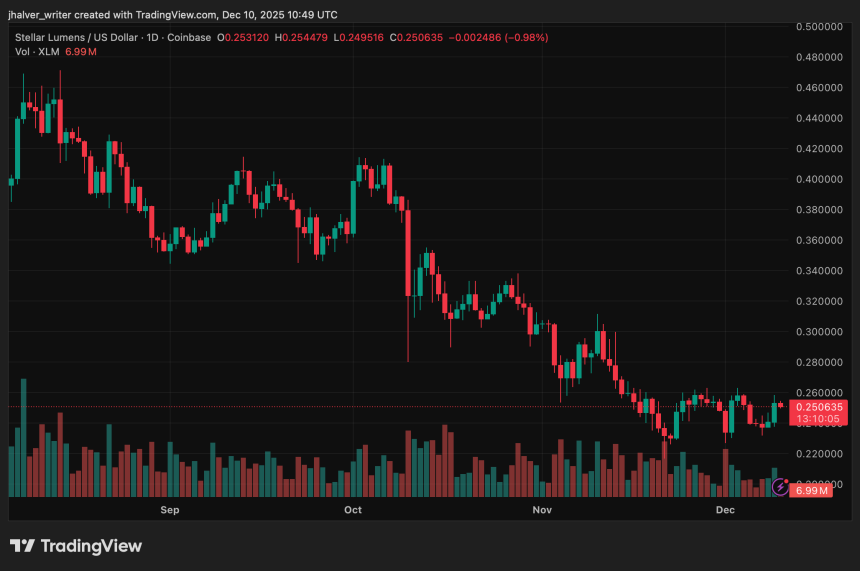
Price Holds Key Support as Traders Watch $0.245

Despite the momentum in utility, XLM continues to sit at one of its most important technical zones. The token has trended downward since November 2024 and now trades just above the $0.245 horizontal support, an area that has repeatedly prevented deeper losses over the past year.

Weekly indicators remain bearish, with RSI below 50 and MACD negative, suggesting that long-term momentum still leans downward. Short-term charts show a contained bounce within an ascending channel, which analysts view as corrective rather than a new uptrend.

A decisive break below $0.245 could open the door to new lows, while holding this level would give bulls another chance to challenge overhead resistance.

Resistance Blocks Cap Upside Expectations

Even with potential catalysts from network growth, analysts remain cautious about XLM’s ability to retest previous highs. Multiple reports highlight the $0.26–$0.27 range as the first major resistance zone, followed by a broader cluster near $0.28–$0.31.

Some forecasts suggest a possible move toward $0.31 by year-end if momentum strengthens, though this outlook carries medium confidence given the broader market’s uncertainty.

Stellar’s December narrative is supported by two opposing forces, rising real-world adoption and a price chart still struggling against long-standing resistance. Whether utility gains translate into market recovery will depend on XLM’s ability to hold its support level and reclaim key technical thresholds in the weeks ahead.

Cover image from ChatGPT, XLMUSD chart from Tradingview

Solana Network Sees 68% Crash In 3 Years, What’s Going On?

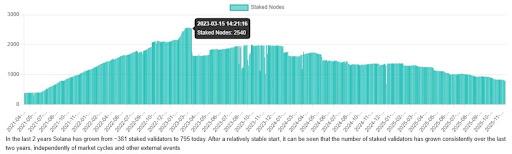
The Solana network has seen its validator count crash by more than 68% over the past three years, falling from thousands of active nodes to just around 800. The massive decline in validators has sparked discussions about whether this could become a threat to the blockchain network or a natural pruning of inactive nodes to increase efficiency. 

Solana loses 68% Of Its Validators In 3 Years

A new report from Criptonocias reveals that Solana has experienced a dramatic decline in the number of its validators, active and non-active, since March 2023. This decrease has raised concerns across the crypto community about the network’s overall health and security

Over the last three years, the Solana network has steadily lost validators, going from 2,500 to 2,100 in November 2022 and now hovering around 800. This decline means the blockchain has lost a total of 1,700 validators. Although this considerable decrease should trigger warning alerts, it could be a result of ledger pruning, which involves removing inactive or redundant nodes to streamline a network and improve its performance without compromising security. 

Notably, validators are crucial for the operation of a blockchain network, as they run nodes, confirm transactions, and help maintain the integrity of the system. Each validator adds to the diversity of the network and reduces the risk of any single entity gaining excessive control.  

Solana

According to the report, some voices in the Solana ecosystem see the reduction of validators in a positive light. They argue that losing “Sybil validators,” which are nodes pretending to be multiple independent operators but are actually controlled by a single party, can be beneficial. Based on this perspective, having a smaller number of reliable and active validators is healthier than maintaining thousands of nodes that do not contribute meaningfully to the blockchain network.

Criptonocias revealed that teams such as Layer 33, which develops infrastructure node tools and provides network services for Solana, point out that many of the validators leaving the blockchain are not Sybils but legitimate node operators. This suggests that the drop in numbers does not automatically equate to improved network quality despite widespread talks about ledge pruning.  

Notably, the potential impact on the Solana network, whether negative or positive, depends on the independence of the remaining validators and the distribution of power among them. An updated report of the validator count reveals that it has dropped again from 800 to 795. 

Solana Faces Liquidity Crunch As Profitability Declines

Amidst its decline in validators, the Solana network is showing signs of strain as liquidity dries up and profitability declines. On-chain data from Glassnode highlights a troubling trend in the network’s trading activity, with the 30-day average realized profit-to-loss ratio remaining below 1 since mid-November. 

This level is typically associated with bear market conditions and points to a growing imbalance between gains and losses among traders. A ratio below 1 also indicates that traders are realizing losses more frequently than profits, underscoring the cryptocurrency’s weakening market sentiment.

Solana

What Ripple’s CEO Appearance At The Banking Committee Means For XRP

Crypto pundit JackTheRippler recently drew the community’s attention to Ripple CEO Brad Garlinghouse’s appearance at the Senate Banking Committee hearing. The CEO spoke about XRP amid his talk on how his company is building the “internet of value.”

Ripple CEO Talks About XRP During Banking Committee Appearance

In an X post, JackTheRippler shared a video of the Ripple CEO at the Banking Committee hearing, where he spoke about Ripple and XRP. Garlinghouse stated that they were building the internet of value, where money moves as easily as information. He added that their payment services were made possible through the use of the XRP Ledger (XRPL) and its native token XRP. 

The Ripple CEO further noted that XRP is built to enable fast, low-cost, and highly scalable transactions, which makes it suitable as the bridge currency for their cross-border payment services. Garlinghouse made these comments in relation to his testimony on the need for “smart” crypto regulations, including market-structure legislation, to eliminate regulatory uncertainty and advance innovation in the U.S. 

The CEO mentioned that his company was among the notable victims of the previous SEC administration’s regulation-by-enforcement approach. The commission had sued the crypto firm, arguing that XRP was a security and that the firm had violated securities laws through institutional sales of the token. 

However, as the CEO noted, Judge Torres ruled that XRP was not a security in itself. Garlinghouse believes that the crypto market structure legislation will help the crypto industry progress while also protecting consumers, like XRP holders, who were affected by the SEC vs. Ripple lawsuit. XRP’s price was affected by uncertainty about its legal status at the time of the lawsuit, which spanned over four years. 

DAS Research Provides Bull Case For XRP

In an X post, market expert Stern Drew highlighted a report from DAS Research, which provided a bull case for XRP. Drew highlighted how the report stated that XRP and Ripple are no longer competing in crypto. Instead, they are evolving into a global payment infrastructure, which will be adopted by banks, fintechs, and cross-border networks that demand speed, scale, and settlement certainty. 

Drew further pointed out three core realities highlighted by the report. The first is that XRP is said to have the structural advantage with fast settlement, low cost, being a neutral bridge asset on a globally distributed ledger, and with institutional-grade reliability. 

The expert noted that this is why adoption is rising among enterprises that need predictable value transfer. The other two realities are Ripple’s integration of the RLUSD stablecoin and its institutional partnerships, which will help boost XRP’s utility. 

At the time of writing, the XRP price is trading at around $2.08, up in the last 24 hours, according to data from CoinMarketCap.

XRP

SpaceX Moves $95M in Bitcoin Ahead of Potential Mega IPO

Bitcoin Magazine

SpaceX Moves $95M in Bitcoin Ahead of Potential Mega IPO

SpaceX moved another 1,021 bitcoin on Wednesday, worth about $94.5 million.

The transfer was split between two unlabeled addresses via Coinbase Prime custody. One address received 614 BTC, the other 407 BTC.

This marks the ninth such transfer by SpaceX this year. Recent movements total around 8,910 BTC, valued near $924 million. Analysts say the company is consolidating its holdings and upgrading from legacy bitcoin addresses. 

SpaceX’s bitcoin holdings were tagged on-chain by Arkham Intelligence. The company currently controls about 3,991 BTC, worth roughly $367 million at current prices. Holdings have fluctuated over the past several years. 

The total once peaked above $1.6 billion during the 2021 bull market. In mid-2022, SpaceX reportedly reduced its stake by about 70% after shocks from the Terra-Luna collapse, FTX bankruptcy, and market-wide turbulence.

SpaceX has made no public statement about the transactions. Tesla, another Elon Musk-run company, currently holds 11,509 BTC, worth about $1.24 billion.

SpaceX IPO? 

The bitcoin reshuffle comes as SpaceX advances plans for a massive initial public offering. Bloomberg reported the company aims to raise more than $30 billion in its IPO. The target valuation is near $1.5 trillion, potentially surpassing Saudi Aramco’s record $29 billion fundraise in 2019.

SpaceX’s IPO could take place as early as mid-to-late 2026. Sources say the timing could slip into 2027 depending on market conditions. If successful, it would be the largest listing in history by valuation.

The offering would give investors exposure not only to rockets, satellites, and Starlink internet services but also to SpaceX’s crypto holdings. Musk’s companies were among the earliest institutional bitcoin adopters. 

SpaceX has also used dogecoin to fund its DOGE-1 lunar mission, highlighting Musk’s influence in crypto markets.

Prediction market data show growing confidence in SpaceX’s valuation. Polymarket traders assign a 67% probability that the IPO will exceed a $1 trillion market cap. 

The IPO could provide capital for Starlink expansion, space-based data centers, and other ventures intersecting with AI and crypto infrastructure, according to Bloomberg.

Analysts note the on-chain reshuffle aligns with the company’s broader treasury strategy. Moving funds to modern addresses can reduce transaction costs, improve security, and consolidate management of multiple wallets.

Most of SpaceX’s remaining bitcoin is expected to be migrated as the consolidation completes.

This post SpaceX Moves $95M in Bitcoin Ahead of Potential Mega IPO first appeared on Bitcoin Magazine and is written by Micah Zimmerman.

❌