A famous member of the XRP community shared a list of macro and crypto-related catalysts that motivated him to increase his XRP position today. The broader crypto market continued its downturn yesterday, plummeting 2.87% over the past 24 hours to $3.05 trillion.
A Bitcoin investor recently shared four reasons he chose to sell all his BTC tokens and re-invest everything in XRP. Pseudonymous market commentator Crypto X AiMan is going all in on XRP.
The Bitcoin price has had a mixed performance over the past week, with both sides of the market divide struggling to establish dominance. In the latest battle between the bulls and bears, the premier cryptocurrency appears to be succumbing to pressure from the latter group.
As this weekend approached, the Bitcoin price retreated from its latest local high of around $94,000 to beneath the psychological $90,000 level. This latest correction has prompted questions in the crowd, with investors wondering whether it is just a brief obstacle or the end of the recovery.
Why $80,500 Could Be The Next Local Low For BTC
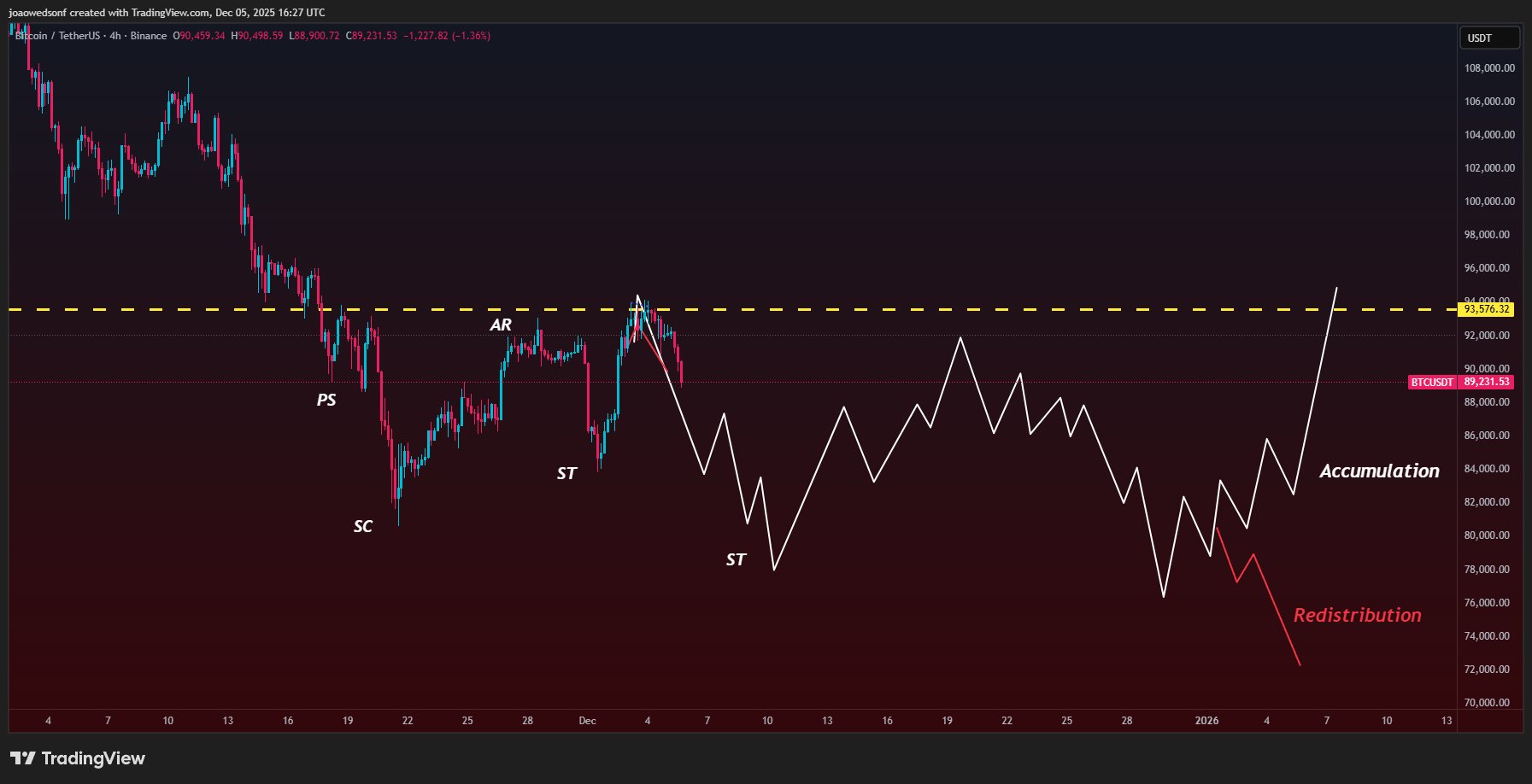
In a December 5 post on the social media platform X, Alphractal CEO and founder shared insight into the latest Bitcoin price decline below $90,000. The on-chain expert revealed that losing the $89,800 level is the more relevant occurrence in the latest price downturn.
In a previous post on X, Wedson evaluated the likely trajectory of the Bitcoin price should it lose the $89,800 level. The crypto pundit revealed that losing this price mark could lead to an accumulation pattern for the bulls or a redistribution phase for the bears.
While the accumulation period for the bulls would initially coincide with lower prices, it eventually leads to a Bitcoin price return to above the latest local high. Meanwhile, a redistribution phase could see the bears push the flagship cryptocurrency to around the $70,000 mark.
According to the Alphractal CEO, the price of BTC also failed to hold the key on-chain levels, strengthening the probability of a broader price sideways phase. “Sideways action is the cause — the big pumps or dumps are just the effect,” Wedson had earlier stated in his previous X post.
Furthermore, Wedson noted that the next level to watch is $86,500, which, if lost, opens the very high possibility for the formation of a new local low around $80,500. This local low could provide a perfect spot for investors to buy the dip and enter the market.
Bitcoin Price Overview
As mentioned earlier, the past week has been one of highs and lows for the premier cryptocurrency, plummeting to as low as $84,600 on Monday, December 1. After a shaky start to the month, the Bitcoin price recovered strongly to around $94,000 on Thursday, December 4.
As of this writing, the market leader is valued at around $89,415, reflecting an over 3% price decline in the past 24 hours. According to data from CoinGecko, the price of Bitcoin has been down by nearly 10% in the past year.
A crypto analyst has made an unexpected declaration, predicting that XRP investors could become extremely rich in just a few months. This bold claim comes with a new technical analysis, suggesting that XRP is now entering a pivotal price area that previously triggered explosive rallies. Despite the cryptocurrency’s low price and recent downtrend, the analyst remains confident that XRP could mirror past trends and skyrocket to new highs.
XRP To Make Holders Wealthy In 3 Months?
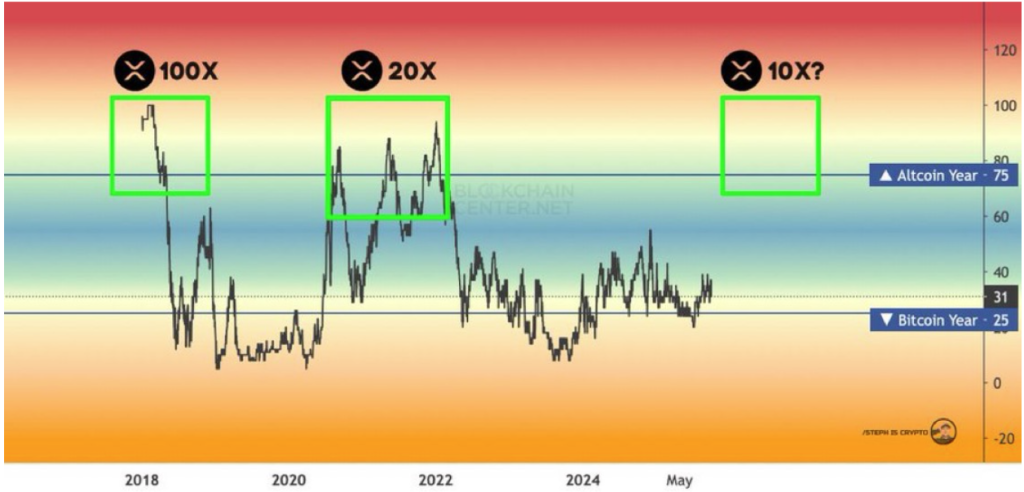
In a recent X post, popular market analyst ‘Steph Is Crypto’ issued a dramatic warning to XRP holders, announcing that investors will become extremely rich within the next three months. The analyst’s bold prediction elicited mixed reactions from the XRP community, with some expressing optimism and others skepticism.
Steph Is Crypto shared a price chart with colored bands to support his ambitious claims, tracking XRP’s performance through multiple past bull cycles. The chart highlights a recurring pattern in which XRP enters a higher-colored zone during periods often associated with altcoin strength. In previous cycles, those moments were followed by unexpected, explosive upward price moves.
During the bull cycle in 2018, XRP skyrocketed by 100x, pushing its price up towards its current all-time high of $3.84. A similar uptrend occurred again during the 2020 to 2022 cycle, with XRP entering a prolonged bull phase that saw its price rally by 20x. According to Steph Is Crypto, the current chart setup appears similar to these past bullish phases.
His chart analysis suggests that XRP is once again approaching the same colored region that previously marked the start of strong price rallies. While the scale of the projected acceleration this time may differ from the peaks seen in the last two cycles, Steph Is Crypto remains confident that it will still be substantial enough to make holders significantly wealthy by March 2026.
XRP Maintains Bullish Monthly SuperTrend
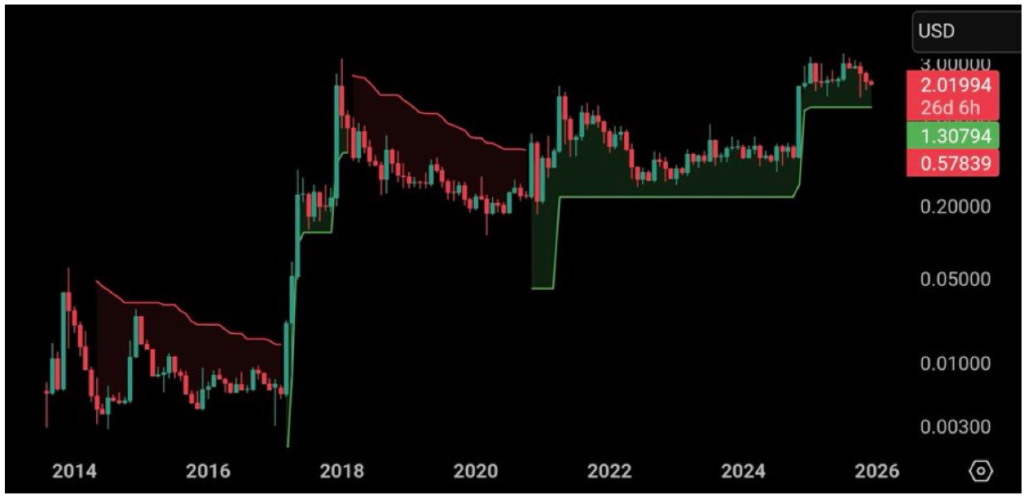
Crypto market analyst ChartNerd has released a fresh technical analysis of XRP, suggesting that the cryptocurrency continues to show strong positive signals. According to him, XRP’s monthly SuperTrend remains firmly bullish. He emphasized that maintaining a price above the green SuperTrend line near $1.30 signals a long-term upward trajectory, with no red trends currently indicating the onset of a bear market.
ChartNerd shared a chart with a SuperTrend overlay where green lines represent bullish conditions and red lines highlight previous bear markets. The current monthly candles for XRP remain well above the green zone, reinforcing the belief that broader market conditions favor an upside. The analyst interprets this as confirmation that XRP’s long-term price trend is still predominantly bullish.
Historical data on the chart also indicate that past declines in XRP coincided with prolonged red SuperTrend phases. This happened before the big 2017 and 2020 breakout, with each recovery triggered once the price moved back above the green SuperTrend line.
Featured image from Unsplash, chart from TradingView
In remarks made on December 4, US Securities and Exchange Commission (SEC) Chair Paul Atkins expressed an optimistic outlook for the cryptocurrency industry. Atkins emphasized the SEC’s intent to modernize its rules to facilitate an on-chain market environment, leveraging distributed ledger technology and the tokenization of financial assets.
SEC Chair Advocates For Crypto Tokenization
Atkins highlighted the transformative potential of these technologies for the capital markets. He stressed that enhancing these markets is essential for US firms and investors to maintain their leadership on a global scale.
The chair underscored that the advancements in blockchain technology could streamline not only trading processes but also the entire issuer-investor relationship, which would enable a more efficient and transparent financial ecosystem.
Tokenization, according to Atkins, goes beyond merely changing the mechanics of trading. He pointed out that it can foster direct connections for various important functions such as proxy voting, dividend payments, and shareholder communications, all while reducing the reliance on multiple intermediaries.
In his address, Atkins acknowledged several innovative models that deserve consideration. He noted that some companies are directly issuing equity on public distributed ledgers in the form of programmable assets.
These assets can integrate compliance features, voting rights, and governance capabilities, allowing investors to hold securities in a digital format that promotes transparency and reduces the number of intermediaries involved.
Additionally, he mentioned that third parties are engaging in the tokenization of equities by generating on-chain security entitlements that represent ownership stakes in traditional equities.
The emergence of synthetic exposures—tokenized products designed to reflect the performance of public equities—was also highlighted. While many of these offerings are currently being developed offshore, they showcase the international interest in US market exposure supported by distributed ledger technology.
Atkins Critiques Past SEC Strategies
However, Atkins cautioned that transitioning to on-chain capital markets entails more than just issuance. He stated that it is essential to address various stages of the securities transaction lifecycle effectively.
For instance, if tokenized shares cannot be traded competitively in liquid on-chain environments, they risk becoming little more than conceptual assets without practical utility.
The chair also criticized the previous SEC’s approach toward the crypto industry under the agency’s former chair Gary Gensler, which attempted to adapt to on-chain markets through an expansive redefinition of “exchange.”
This earlier strategy enforced a broad regulatory framework that ultimately created uncertainty and stifled innovation, Atkins stated. He said that it is vital to avoid repeating such mistakes in order to stimulate innovation, investment, and job creation in the United States.
To foster a conducive environment for growth, Atkins called for compliant pathways that can enable market participants to capitalize on the unique benefits of new technologies like crypto.
In light of this conviction, he has instructed SEC staff to explore recommendations for utilizing the agency’s exemptive authorities, permitting on-chain innovations while the Commission works toward developing long-term, effective crypto regulatory frameworks.
Featured image from DALL-E, chart from TradingView.com
Bitcoin may be holding slightly below $90,000, but data imply that the $100K year-end target is still alive as analysts point out that three Bitcoin Price Prediction indicators are flashing a green signal.
The 3-Key Drivers For Bitcoin $100k Year-end Target
The first and most critical driver is the shift in Federal Reserve monetary policy.
After months of reducing liquidity through quantitative tightening, where the central bank stopped reinvesting proceeds from maturing bonds and Treasury holdings, the Fed ended this program on December 1.
Markets are now positioning for an easing cycle.
QUANTITATIVE TIGHTENING DONE ; WHAT’S NEXT FOR $BTC?
Historically, Bitcoin and altcoins struggle during prolonged Quantitative Tightening (QT = red zone), which lasted three years and just ended on December 1, 2025.
Data from the CME FedWatch Tool reveals that traders see an 87% likelihood of a rate reduction at the upcoming Wednesday meeting, with three additional cuts anticipated by September 2026.
This policy shift comes as tech sector borrowing costs rise amid substantial AI infrastructure debt, creating conditions where investors may seek alternative stores of value.
The combination of these factors could provide the momentum needed for Bitcoin to cross the six-figure threshold in the coming weeks.
The second driver is liquidity structure.
According to order-book data from CoinGlass, Bitcoin currently has two significant liquidity clusters: the downside liquidity around $90,000, which is currently being tested, and upside liquidity near $94,500.
If the latter is breached, a rally toward $100,000 becomes highly probable.
Bitcoin Price Prediction: Rising Channel Points to $100k Breakout
The third driver comes from technical analysis, which suggests a $100,000 recovery if BTC breaches the $95,000 resistance.
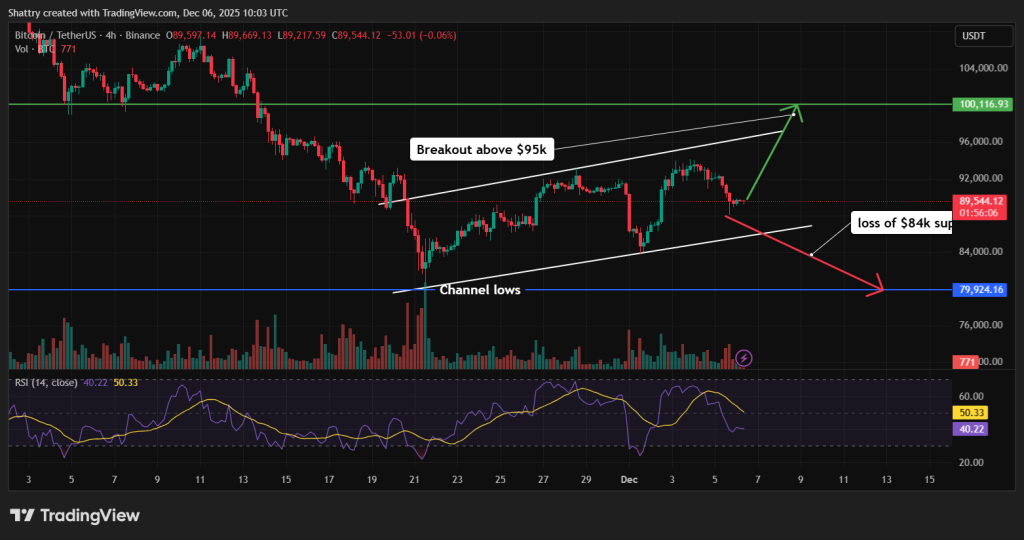
The 4-hour chart shows Bitcoin trading inside a rising channel, though the latest rejection near mid-range has pushed price back toward the lower trendline.
The key support level holding the structure together is $84,000. If BTC stays above that line, the overall channel remains intact, and a rebound toward $95,000 resistance becomes likely.
Source: TradingView
A breakout above $95,000 would flip the structure bullish and open the path toward the $100,000 region, the next major liquidity target.
However, RSI has cooled off sharply and is leaning bearish, indicating weakened momentum.
If Bitcoin loses $84,000, the rising channel breaks down, and price could slide toward longer-term support around $80,000.
Maxi Doge Presale Gains Traction
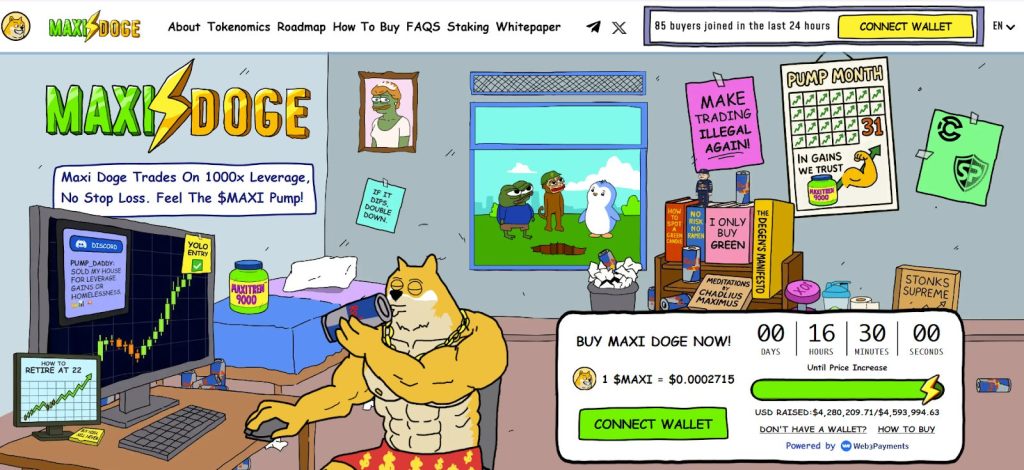
While Bitcoin awaits bullish confirmation, Maxi Doge (MAXI) is emerging as a notable Ethereum-based meme coin with ambitions to replicate Dogecoin’s success story.
MAXI is channeling the community-driven energy that propelled DOGE from $0.00008547 in 2015 to its current $0.138 price, a remarkable +161,800x gain.
While replicating that exact trajectory may be ambitious, analysts believe Maxi Doge can deliver a modest 10-50x return for early adopters.
MAXI has now raised over $4.2 million and is building a vibrant community where holders share trading setups, early opportunities, and alpha insights.
Beyond the meme appeal, 25% of raised funds will be deployed into high-potential plays, with profits reinvested directly into marketing to fuel exponential growth and community rewards.
XRP price has tanked for three consecutive days, erasing the gains made earlier this week, even as the recently launched ETFs gained momentum. Ripple (XRP) token dropped to $2.03 today, Dec. 6, down by over 44% from its highest point…
Bitcoin (BTC) trades just below $90,000 after a fluctuating week of price action resulted in a net loss of 1.8%. Despite initial hopes of a resurgence in late November, the premier cryptocurrency is now 29.16% away from its all-time high. Going by the price action, popular analyst with the X username PlanD postulates BTC is now in consolidation guided by two major price levels.
Bitcoin Moves In Key Range Between $85,000-$93,000, Market Breakout Awaits
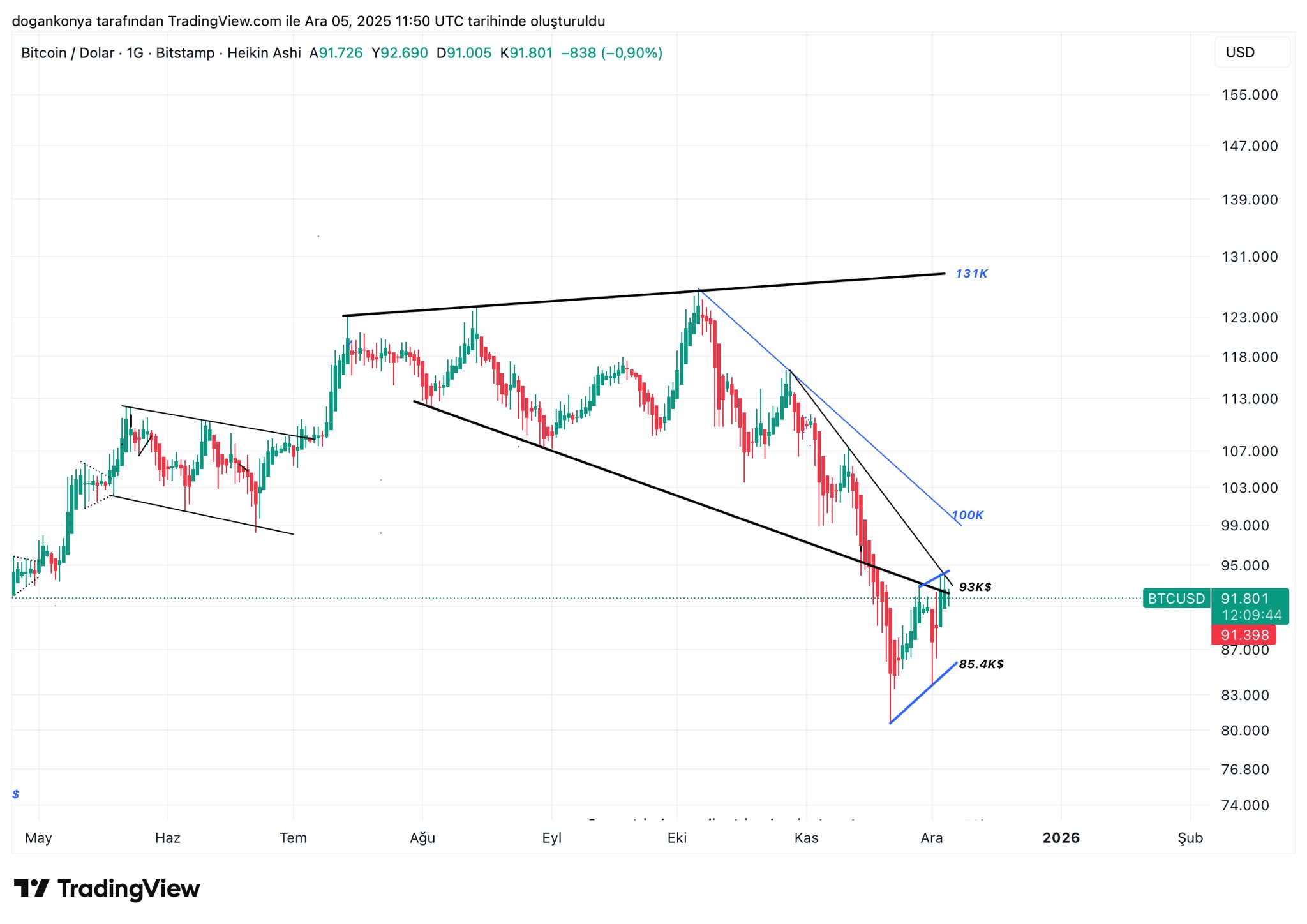
In an X post on December 5, PlanD provides an update on a continued analysis of the Bitcoin market, stating the crypto market leader appears to be building momentum within a set price range. Notably, recent price action has pushed the flagship cryptocurrency below the lower boundary of a broadening ascending channel between $93,000 and $131,000, raising fears of a bear market.
However, Bitcoin has repeatedly rebounded, forming a strong consolidation range between $85,400 and $93,000. PlanD defines the present market condition as Bitcoin being in a decision zone and needing a price breakout to determine its next major direction. The analyst states that if Bitcoin moves to overcome the price resistance at $93,000, its initial price target lies at $100,000. A successful reclaim of this psychological six-figure level would confirm renewed bullish intent and stronger potential for a full market revival.
On the other hand, if Bitcoin breaks below the vital support zone at $85,300, investors should expect steeper losses. In this case, PlanD projects a price drop to around $72,000, representing a potential 19% decline from present market prices. Notably, considering the recent market volatility, the ongoing consolidation may close out sooner than expected, to establish a clear market direction.
Bitcoin Price Overview
According to data from CoinMarketCap, Bitcoin trades at $89,703, reflecting a price loss of 2.99%. Meanwhile, the daily trading volume is up by 4.56% and valued at $63.16 billion.
Following the turbulent price action of the last week, BTC’s price struggles in Q4 continue against previous popular predictions. Still, several bullish indicators could support a rebound before year-end. Key catalysts include a widely anticipated interest rate cut at the upcoming Federal Open Market Committee (FOMC) meeting on December 9–10.
In addition, market sentiment is benefiting from speculation that pro-crypto economist Kevin Hassett could succeed Jerome Powell as Federal Reserve Chair in 2026.
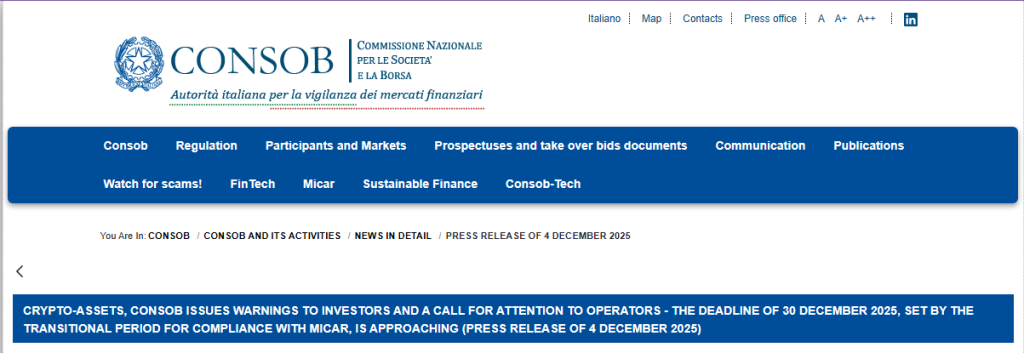
According to a press release from Consob on December 4, 2025, Italy’s securities regulator told crypto and virtual asset service providers (VASPs) that they must secure authorization under the EU’s Markets in Crypto-Assets regime (MiCA) by December 30, 2025, or stop serving Italian clients.
The notice warns operators that those who do not file for a MiCA-compliant license must close out services and return customer funds by the year-end.
Consob’s Deadline And What It Means For Firms
Based on reports, companies that submit an authorization application by the cutoff may keep operating while the application is under review. But that temporary permission will not last beyond June 30, 2026, regulators say. That window gives providers some breathing room, but it also sets a hard date for final approvals.
The regulator singled out platforms that until now have worked under Italy’s lighter national registry system (OAM). Those businesses now face a choice: apply to become fully authorized crypto-asset service providers (CASPs) under MiCA or plan an orderly exit. Operators who plan to leave must notify users clearly and return assets in a safe, verifiable way.
Italy Opens A Broader Risk Review
According to a Reuters report, Italy’s Economy Ministry has also ordered an in-depth review of crypto risks, bringing together the Bank of Italy, Consob and other agencies to check whether current protections are strong enough for investors and the wider financial system. The move came during a committee meeting that flagged rising exposure and the need to monitor spillovers into traditional finance.
What Investors Should Watch For Next
Customers in Italy should confirm whether their chosen platform has lodged a MiCA application or has made clear plans for compliance or exit. If an operator fails to apply by December 30, users could face service interruptions and will need to follow the provider’s instructions for fund returns. Regulators say transparency from firms will be key in the weeks ahead.
Smaller local platforms may find the compliance burden steep. Some operators could seek licenses in other EU states and use passporting rules to serve Italian clients, while others may shut down or merge.
The provisional operating window stretches into mid-2026, but the final shape of the market will depend on how quickly firms meet the tougher requirements and how long authorizations take to process.
Consob’s notice is meant to cut through uncertainty and force a choice before year-end. The combination of a firm deadline, mandatory filings and a parallel review marks a stricter approach to crypto oversight in Italy.
Featured image from Unsplash, chart from TradingView
The cryptocurrency market experienced another wave of liquidations on Friday, with Bitcoin (BTC) prices dipping below the critical support level of $90,000. This decline followed a brief rally that had seen its price rise approximately $3,000 above this threshold earlier in the week.
Crypto Market Faces $430 Million In Liquidations
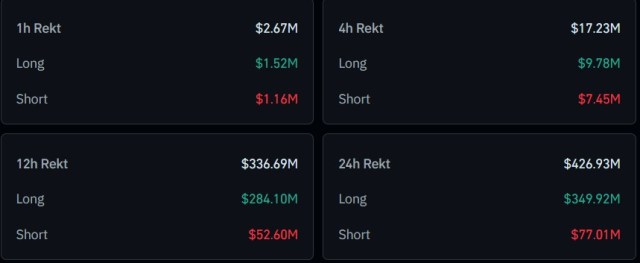
Data from CoinGlass reveals that nearly $430 million in liquidations occurred across the crypto market over the past 24 hours, predominantly affecting leveraged long positions, which accounted for about $350 million.
During this period, Bitcoin underwent a 3.5% retracement, with its price settling at just above $89,120—a stark 29% below its all-time high of over $126,000 reached in October.
Market expert OxNobler recently highlighted the role of both retail and institutional investors in this downturn. In a post on social media platform X, OxNobler detailed the reason behind Bitcoin’s decline: significant sell-offs by major players.
According to the analyst, the world’s largest cryptocurrency exchange, Binance, sold 4,000 BTC; U.S.-based Coinbase (COIN) liquidated 5,675 BTC; and traditional finance giant Fidelity sold 3,288 BTC. Additionally, market maker Wintermute offloaded 1,793 BTC.
Notably, the analyst pointed out that Strategy, formerly MicroStrategy, which is the largest public company holder of Bitcoin with over 650,000 coins, has also sold over 3,820 coins in this same time frame.
The firm’s sell-off comes on the heels of speculation regarding Strategy’s potential to liquidate some of its holdings due to the substantial losses affecting its financial performance amid declining Bitcoin prices.
When Strategy CEO Phong Le was questioned about the possibility of selling off Bitcoin, he acknowledged that while the firm’s former CEO, Michael Saylor, has consistently opposed selling, circumstances may change if the company’s stock trades below the net value of its Bitcoin holdings, which aligns with the recent actions taken by the firm.
Coinbase Analysts Predict December Recovery
Interestingly, while these institutional sell-offs have contributed to the current market dip, Coinbase’s institutional division has projected a potential recovery for the crypto market in December, citing improving liquidity, a 92% probability of the Federal Reserve (Fed) cutting rates, and supportive macroeconomic conditions.
Analysts have pointed out several reasons for optimism, including the recovery of liquidity, the resilience of the “AI bubble,” and the attractiveness of short US dollar trades at current levels.
However, OxNobler warned that the situation may not be so straightforward. Alongside the activities of major institutions, he noted that BlackRock, the world’s largest asset manager, had recently sold $130 million worth of Bitcoin and Ethereum (ETH).
Furthermore, Vitalik Buterin, one of Ethereum’s co-founders, seems to have resumed selling Ethereum, with millions of ETH being moved from the foundation’s wallet through Gnosis Safe.
Ultimately, OxNobler asserts that these institutional activities may have a hand in manipulating crypto prices and preventing them from climbing to higher levels and key resistance points.
Featured image from DALL-E, chart from TradingView.com
Western Union will roll out a “stable card” for high-inflation economies and issue its own coin as part of a multi-pillar stablecoin and digital asset strategy.
With only a few weeks left before the end of 2025, Shiba Inu community members are now considering whether SHIB might reach $0.0001 next year. The broader Shiba Inu community entered 2025 with strong optimism, expecting SHIB to reach a new all-time high of at least $0.0001, in line with the typical four-year market cycle.
Jake Claver, CEO of Digital Ascension Group, has issued a new caution to XRP holders. In his latest disclosure, he noted that while many holders hope for the next major price breakout, only a few are prepared for the real challenges that come after profits appear.
XRP has erased all the gains it made in early December 2024, pushing investors to shift their attention to what 2026 may hold for the token. The prolonged market downturn continues to wreak havoc on the global crypto landscape, and XRP is no exception.
MetaMask, the most widely used Ethereum wallet, is moving directly into the prediction market arena through a new integration with Polymarket, giving users the ability to trade event outcomes from inside their wallets.
Key Takeaways:
MetaMask has integrated Polymarket, allowing users to trade real-world event outcomes.
The integration adds one-tap funding from any EVM chain.
Polymarket’s rapid growth continues amid a potential $15 billion valuation.
“You can now trade on the future outcome of real world events inside your wallet,” Consensys’ Gabriela Helfet wrote, adding that users will also earn MetaMask Rewards points for every prediction placed.
MetaMask Becomes New Gateway to Polymarket With One-Tap Funding
The integration creates a new on-ramp for Polymarket and introduces “one tap funding,” allowing users to deposit with any token from any EVM-compatible chain.
The move further tightens the link between everyday crypto wallets and decentralized betting platforms, positioning MetaMask as a gateway not only to Web3 apps but also to real-world event speculation.
Polymarket has surged in popularity over the past year, fueled in part by heightened attention during the 2024 US election cycle.
Former President Donald Trump’s embrace of crypto and a more relaxed regulatory climate helped push the platform back into the US market.
The company is now reportedly exploring a valuation of up to $15 billion, following a $2 billion strategic investment from Intercontinental Exchange, the parent of the NYSE.
Predicting on MetaMask only takes a few seconds.
We've enabled 1-click funding with any EVM token, or you can get started instantly if you have an existing @polymarket account! pic.twitter.com/zZtrQPDu3m
For MetaMask, the move comes as the wallet expands beyond its Ethereum-focused roots. In October, it launched multichain accounts that support both EVM and non-EVM networks, including Solana.
The move comes as Polymarket is recruiting staff for an internal market-making team that would trade against its own customers, mirroring a controversial feature already used by rival Kalshi that has drawn criticism and legal challenges.
As reported, the New York-based prediction market startup has approached traders, including sports bettors, to join the new unit, people familiar with the matter said, requesting anonymity because the plans remain private.
Prediction Markets Hit $13B in Record Activity
Prediction markets have crossed $13 billion in cumulative trading volume, marking a record high even as broader crypto markets cool.
The surge has drawn in major players across tech and finance, including Fanatics, Coinbase, and MetaMask, all of which have recently launched or expanded event-trading platforms.
Against this backdrop, YZi Labs, the venture firm founded by Binance co-founder Changpeng “CZ” Zhao, has been intensifying its involvement in the sector.
YZi-backed Opinion has emerged as one of the most surprising breakout platforms. Launched on BNB Chain in October, it recorded nearly $1.5 billion in weekly trading volume within its first month, briefly overtaking established names such as Kalshi and Polymarket.
Meanwhile, prediction markets platform Kalshi has secured a major media breakthrough after signing a partnership with CNN, making the company the network’s official prediction markets partner while closing a $1 billion funding round at an $11 billion valuation.
CoinShares head of research James Butterfill has dismissed insolvency concerns surrounding Tether following warnings from BitMEX founder Arthur Hayes, who claimed a 30% drop in the stablecoin issuer’s Bitcoin and gold holdings could wipe out its equity.
Butterfill’s December 5 market update affirmed that Tether maintains over $181 billion in total reserves against roughly $174.45 billion in liabilities, leaving a surplus of approximately $6.78 billion.
The dismissal comes as crypto markets navigate turbulence in Japanese government bonds and softer US employment data that showed a -32,000 print versus forecasts of +10,000.
Hayes sparked controversy on November 30 by arguing Tether is “running a massive interest rate trade” that positions the company for Federal Reserve rate cuts while exposing it to dangerous volatility through its $22.8 billion allocation to gold and Bitcoin.
The Tether folks are in the early innings of running a massive interest rate trade. How I read this audit is they think the Fed will cut rates which crushes their interest income. In response, they are buying gold and $BTC that should in theory moon as the price of money falls.… pic.twitter.com/ZGhQRP4SVF
Tether CEO Counters Insolvency Claims with Financial Data
CEO Paolo Ardoino swiftly refuted Hayes’s assessment with detailed disclosures showing Tether Group’s total assets reach approximately $215 billion.
The executive explained that the company holds roughly $7 billion in excess equity on top of its stablecoin reserves, plus another $23 billion in retained earnings as part of Tether Group equity.
Bitcoin and gold represent just 12.6% of total reserves, with over 70% held in short-term U.S. Treasuries.
“S&P made the same mistake of not considering the additional Group Equity nor the ~$500M in monthly base profits generated by U.S Treasury yields alone,” Ardoino stated, suggesting critics are “either bad at math or have the incentive to push our competitors.“
re: Tether FUD
From latest attestation announcement (Q3 2025):
"Tether will continue to maintain a multi-billion-dollar excess reserve buffer and an overall proprietary Group equity approaching $30 billion."
Tether had (at end of Q3 2025) ~7B in excess equity (on top of the…
The company generated more than $10 billion in profit this year from interest income on reserve assets, making it one of the most efficient cash-generating businesses globally with just 150 employees.
His defense followed S&P Global’s November 26 downgrade of USDT’s peg-stability rating from 4 to 5, citing increased exposure to “high-risk” assets and “persistent gaps in disclosure.”
Ardoino responded defiantly, declaring, “We wear your loathing with pride,” while positioning Tether as “the first overcapitalized company in the financial industry, with no toxic reserves.”
The rating action carries profound implications under MiCA regulations, which prohibit USDT from EU exchanges with a “5” rating, potentially shifting institutional liquidity toward competitors like Circle’s USDC.
Industry Veterans Challenge Hayes’s Fundamental Analysis
Joseph Ayoub, former head of digital asset research at Citi, noted Hayes overlooked critical distinctions between Tether’s disclosed reserves and total corporate holdings.
The analyst explained that Tether maintains a separate equity balance sheet comprising mining operations and corporate reserves that aren’t publicly reported under the company’s “matching philosophy” for reserve disclosure.
“Tether isn’t going insolvent, quite the opposite; they own a money printing machine,” Ayoub concluded, pointing to the company’s roughly $120 billion in interest-yielding Treasuries generating approximately 4% returns since 2023.
I spent 100’s of hours writing research on tether for @Citi. @CryptoHayes missed a few key points.
1) 𝐓𝐡𝐞𝐢𝐫 𝐝𝐢𝐬𝐜𝐥𝐨𝐬𝐞𝐝 𝐚𝐬𝐬𝐞𝐭𝐬 =/ 𝐚𝐥𝐥 𝐜𝐨𝐫𝐩𝐨𝐫𝐚𝐭𝐞 𝐚𝐬𝐬𝐞𝐭𝐬
When tether generates $ they have a separate equity balance sheet which they don’t… https://t.co/pHSRr245Up
Banks operate on significantly lower fractional reserves of 5-15% in liquid assets compared to Tether’s overcollateralized structure. However, traditional institutions benefit from central bank lender-of-last-resort support that Tether lacks.
Hunter Horsley, CEO of Bitwise Invest, characterized Tether’s structure as “better than fractional banking reserves,” while CryptoQuant CEO Ki Young Ju dismissed Hayes’s warning as motivated by trading position management.
Former FT Alphaville editor Izabella Kaminska offered a deeper structural analysis, suggesting Tether’s thick equity buffer and retained earnings model creates “a capital structure that looks a lot like the banking model academic Anat Admati advocates: much thicker equity buffers, far less leverage, and minimal maturity mismatch.“
Kaminska noted that if Tether’s depositor base proves willing to redeem directly in gold during stress situations, the metal becomes “the natural last-resort funding asset for its shadow/grey exposures and a hard-asset substitute for the lender-of-last-resort support that banks get from central banks.”
Analysts are overlooking how stablecoins that retain earnings (aka Tether) are evolving into something structurally unusual.
The reality is, as Tether’s retained earnings accumulate, they operate economically like a very thick equity buffer — far beyond the capitalisation… https://t.co/KXtsrG52kU
The company’s Q3 attestation showed USDT issuance increased by more than $17 billion during the quarter, lifting circulating supply above $174 billion, with October figures surpassing $183 billion.
Federal prosecutors are demanding a 12-year prison sentence for Terraform Labs co-founder Do Kwon for orchestrating the fraud that triggered TerraUSD’s catastrophic $40 billion collapse in 2022.
According to Bloomberg, the government described Kwon’s crimes as “colossal in scope” in a Thursday filing before US District Judge Paul Engelmayer, pointing to cascading market failures that ultimately contributed to FTX’s downfall.
The 34-year-old South Korean entrepreneur pleaded guilty in August to conspiracy and wire fraud charges under an agreement capping prosecutorial recommendations at 12 years.
However, the statutory maximum reaches 25 years for his role in the algorithmic stablecoin fraud.
The Justice Department’s sentencing memorandum emphasizes that Kwon’s fraudulent statements to customers triggered a chain reaction across cryptocurrency markets.
Prosecutors specifically cited the collapse’s contribution to Sam Bankman-Fried’s FTX implosion as evidence of broader systemic damage beyond Terra’s immediate investor losses.
Kwon admitted in court that between 2018 and 2022, he “knowingly agreed to participate in a scheme to defraud purchasers of cryptocurrencies” from Terraform Labs.
He acknowledged making false statements about TerraUSD’s peg restoration mechanisms and concealing Jump Trading’s secret role in propping up the stablecoin during a May 2021 depeg event that foreshadowed the larger catastrophe.
The timing carries added significance, as the Trump administration has largely eased the tough-on-crypto enforcement actions, as the Biden administration did before.
Although the administration defended the pardon, claiming it was reviewed “with the utmost seriousness.”
Defense Cites Montenegro Detention and Dual Prosecution
Kwon’s attorneys argue that nearly three years in what they describe as “brutal conditions in Montenegro” should factor heavily into sentencing calculations.
His legal team emphasizes that more extended imprisonment proves “far greater than necessary” to achieve justice, particularly given the substantial punishment already endured during extended foreign detention.
The defense filing highlights Kwon’s agreement to forfeit over $19 million and multiple properties under the plea deal reached with prosecutors in the Southern District of New York.
His lawyers further note that Kwon still faces trial in South Korea for identical conduct, where prosecutors are seeking a 40-year prison term that creates additional consequences warranting consideration in the American sentence.
Do Kwon seeks a five-year sentence for Terra's $40 billion collapse while facing a separate 40-year prosecution in South Korea.#DoKwon#FTXhttps://t.co/Ex54HALudb
Prosecutors notably aren’t pursuing restitution from the millions of investors who lost $40 billion, citing the excessive complexity of determining individual losses across global markets.
US authorities have indicated they will support Kwon serving the second half of his sentence in South Korea if he complies with the plea terms and qualifies under international transfer programs.
Sentencing Disparities Raise Deterrence Questions
The contrasting approaches to major crypto fraud cases have sparked debate over the consistency of punishment.
Bankman-Fried received 25 years, plus an $11 billion restitution order, after a trial conviction on all counts, though recent reports indicate that four years were later reduced from that sentence.
Kwon’s guilty plea significantly reduced his exposure despite Terra’s larger $40 billion loss compared to FTX’s $8 billion fraud.
Legal experts note that federal sentencing guidelines for fraud at Terra’s magnitude would typically suggest advisory ranges approaching life imprisonment before statutory caps, making Kwon’s five-year request face steep odds.
US agrees to recommend a 12-year prison sentence and a $19m fine for Do Kwon after he has pleaded guilty to wire fraud and conspiracy#DoKwon#TerraUSDhttps://t.co/ktCCrKzob4
The Judge handling his case, Engelmayer, is known for the strict handling of financial fraud cases, and most observers expect sentences of 15 to 20 years, given the massive victim impact.
The December 11 hearing will determine whether cooperation through guilty pleas significantly reduces punishment compared to trial convictions, as in Bankman-Fried’s case.
Kwon was arrested in Montenegro in March 2023 while traveling under a fake passport, triggering a lengthy extradition battle between US and South Korean authorities.
He spent nearly two years detained in the Balkan nation before being sent to America in January, where his case became one of the most closely watched legal battles in cryptocurrency’s brief history.
The much-anticipated altcoin season remains elusive as the Crypto Fear and Greed Index remains in the fear zone and Bitcoin Dominance continues. Altcoin Season Index remains in the red CMC data shows that the closely-watched Altcoin Season Index has moved…
Holy Mining launches an upgraded mobile cloud mining app, letting users activate crypto mining contracts from any smartphone. With just a single smartphone, users can now mine digital assets around the clock, allowing their portfolio to grow effortlessly. Holy Mining…

 Login
Login












 (@MetaMask)
 (@paoloardoino)
  Analysts are overlooking how stablecoins that retain earnings (aka Tether) are evolving into something structurally unusual.

 US agrees to recommend a 12-year prison sentence and a $19m fine for Do Kwon after he has pleaded guilty to wire fraud and conspiracy