The week of November 30 to December 6, 2025, recorded $478.9 million in crypto VC funding across 18 projects. As per the data, Turkish digital asset platform Paribu’s $240 million acquisition of CoinMENA led the funding period. Here’s a comprehensive…
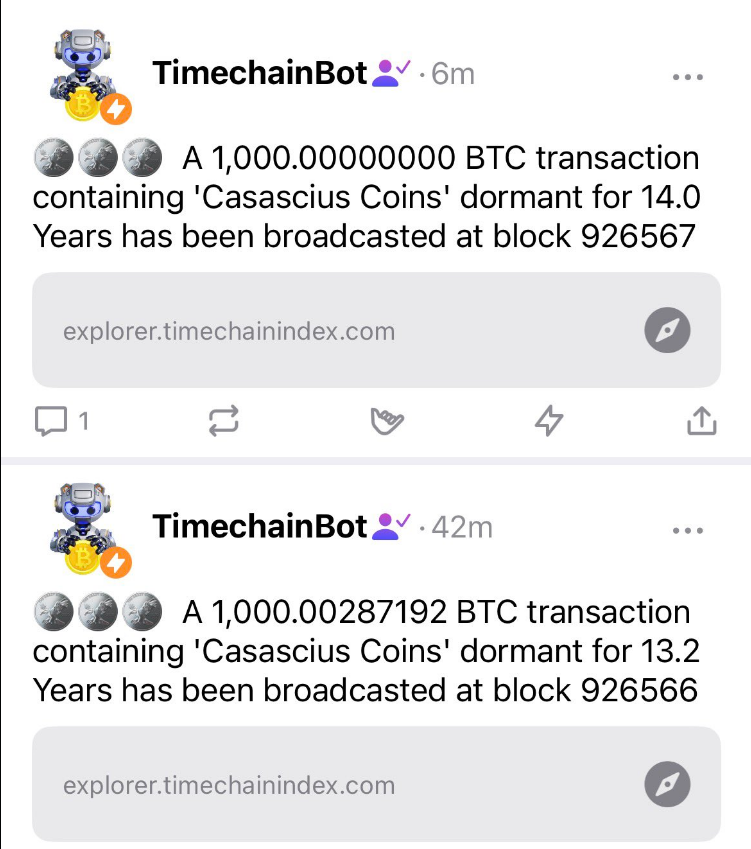
Two long-dormant Casascius coins, each loaded with 1,000 Bitcoin, were activated on Friday, unlocking more than $179 million that had sat untouched for over 13 years.
According to onchain data, one of the coins was minted in October 2012 when Bitcoin traded at $11.69. The other dates back to December 2011, when BTC was worth $3.88, giving that piece a theoretical gain near 2.3 million% since minting.
Historic Physical Coins Activated
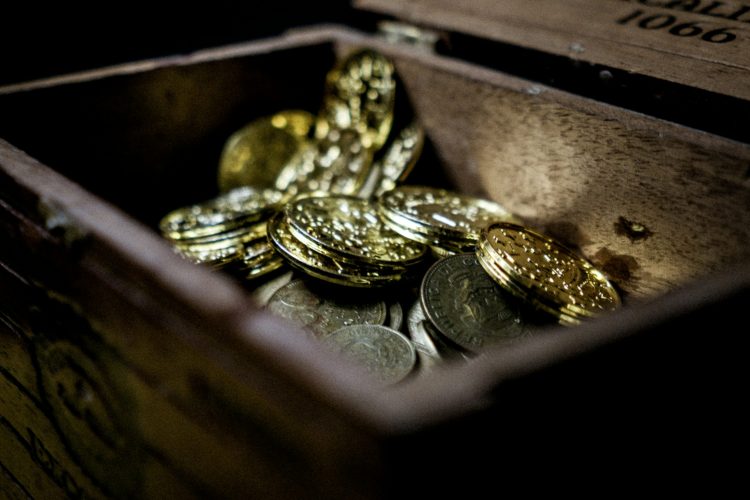
Based on reports, Casascius coins (metal coins) were produced between 2011 and 2013 by Utah entrepreneur Mike Caldwell as physical representations of Bitcoin. Each coin or bar concealed a paper with a private key, and a tamper-resistant hologram covered that key.
Two Casascius coins, each containing 1,000 BTC, have just moved after being dormant for more than 13 years. pic.twitter.com/nlFUy39MkD
Records show only 16 of the 1,000 BTC bars and 6 of the 1,000 BTC coins were ever made, making these items both rare and historically important.
Caldwell shut down the operation after receiving a letter from FinCEN that raised questions about whether his business qualified as an unlicensed money transmitter.
How The Coins Worked
The mechanism was simple in practice but strict in outcome: whoever removed the hologram and revealed the private key could claim the full Bitcoin value stored beneath it.
Once that sticker was lifted and the private key used, the coin no longer carried any Bitcoin value. Based on reports, collectors treat that moment as irreversible. Some owners chose to move funds off the physical coins without cashing out.
Rarity And Returns
Numbers here show why collectors and investors watch these events closely. Two coins at 1,000 BTC each represent a huge hoard when prices are high. Even leaving aside the cost of minting, the December 2011 coin’s rise from $3.88 to current market valuations yields a headline-grabbing multiple.
But experts warn that turning the private key into spendable Bitcoin is only the first step; what happens next depends on the holder’s choices. Some will hold. Others may move funds into cold storage. Selling is not guaranteed.
Derivatives Market Shock
Meanwhile, the spot and derivatives markets are experiencing high volatility. Based on CoinGlass data, today’s derivatives activity showed an 11,588% liquidation imbalance that overwhelmingly wiped out long positions.
Bitcoin, at the time of writing, was trading below $90,000, and more than $20 million in BTC long liquidations occurred in minutes while short positions barely budged. That kind of one-sided pressure happens when many traders are crowded in the same direction and conditions change quickly.
Featured image from Unsplash, chart from TradingView
Crypto firm Ripple recently announced its mission to be the one-stop shop for crypto infrastructure. This came as the firm highlighted the acquisitions it made this year in a bid to achieve this mission.
Ripple Unveils One-Stop Shop For Digital Asset Infrastructure
In a blog post, Ripple touted itself as the one-stop for crypto infrastructure. The firm noted that it had invested almost $4 billion into the crypto ecosystem through strategic investments and acquisitions. It added that 2025 marked its most ambitious year yet with four major acquisitions pointing toward one mission of being the one-stop infrastructure provider for moving value the way information moves today.
Ripple stated that some acquisitions will plug directly into Ripple payments to give its customers a unified, seamless operating environment with even more capabilities and currencies. Meanwhile, others will operate independently while benefiting from shared infrastructure. The firm noted that together, these companies will bring it closer to owning the full financial plumbing behind global value movement.
Furthermore, the company noted that businesses are operating in real time, but their financial infrastructure still isn’t. The firm believes that its unified offering gives companies the ability to bring their money management and movement up to the expectations of the digital world. It then went on to highlight how its newest acquisitions are critical to powering this change.
Highlighting The Role Of Its Latest Acquisitions
The firm stated that its now-closed acquisition of GTreasury marks a significant expansion into the multi-trillion-dollar corporate finance arena, a market that it noted many predict will lead the next phase of crypto adoption. The firm further remarked that through access to the global repo market via Ripple Prime and Ripple Payments’ real-time cross-border rails, corporate treasury teams can unlock idle capital, move money instantly, and open up new growth opportunities.
Ripple then highlighted its $200 million acquisition of Rail, which it stated will make the firm’s Payments the market’s most comprehensive end-to-end stablecoin payments solution. The firm said that it is compliantly connecting the best of fiat and crypto assets so that businesses can move money faster, save costs, and build to grow.
Ripple stated that its acquisition of Palisade broadens the range of customer use cases for custody, which is one of its central product strategies. It noted that Palisade’s “wallet-as-a-service” technology extends the company’s Custody’s inherent appeal to banks and financial institutions that carry out high-frequency transactions.
Lastly, the payment firm highlighted its acquisition of Hidden Road, which is now Ripple Prime. It stated that this completes the liquidity and execution layer of its one-stop shop vision. The Prime offers institutional-grade prime brokerage, clearing, and financing. This enables clients to execute OTC spot trades for major crypto assets, including XRP and RLUSD. While Palisade custodies assets and Rail moves them, Ripple noted that its brokerage business ensures that they can be traded efficiently, financed responsibly, and accessed through regulated channels.
Coinbase predicts a December recovery driven by rising global M2 liquidity and lower interest rates, but Fed Chair Powell’s remarks may limit upside, analysts say.
Industry leader Tom Lee has shared how the Ethereum price could reach $12,000 within the next few months. He based his prediction on the Bitcoin price action and how ETH could match the flagship crypto on a potential run to the upside.
Tom Lee Explains How The Ethereum Price Could Rally To $12,000
Speaking at the Binance Blockchain Week, Tom Lee predicted that the Ethereum price could reach $12,000 as Bitcoin rallies to $250,000 within the next few months. He explained that ETH can reach the $12,000 target if the ETH/BTC ratio returns to its eight-year average of 0.0479. Lee described this potential rally to $12,000 as a “huge move.”
Tom Lee further predicted that the Ethereum price could reach $22,000 if the ETH/BTC ratio gets to its 2021 high of 0.0873. He added that he believes Ethereum will become the future of finance and the payment rails. As such, Lee predicted that the ETH/BTC ratio could reach 0.2500, sparking an Ethereum rally to as high as $62,500. In line with this, the expert declared that ETH at $3,000 is “grossly undervalued.”
Tom Lee also remarked that the bigger the base, the bigger the breakout for the Ethereum price. He noted that ETH spent years building a similar base to its current price action before the move from $90 to its previous all-time high (ATH) of $4,866. The expert added that if the pattern plays out again, the next leg could be larger than what people expect.
It is worth noting that Tom Lee is the chairman of BitMine, which is the largest Ethereum treasury company. According to Strategic ETH Reserve data, the company currently holds 3.73 million ETH, which is just over 3% of the altcoin’s total supply. Lee remains bullish on the Ethereum price, despite his company holding an unrealized loss of $3.3 billion of their ETH investment.
A Rally To $62,000 Is “Ambitious”
Market commentator Milk Road described Tom Lee’s Ethereum price prediction of $62,000 in a few months as being ambitious. The platform stated that an ETH/BTC ratio of 0.25 has never happened. The highest it has ever gone is 0.15, and that was during the 2017 supercycle, which makes it less likely now, given that market conditions have changed.
Tom Lee had based his Ethereum prediction on Bitcoin hitting $250,000, which Milk Road also described as an issue. The market commentator noted that BTC would need to surge 177% from current prices to reach this target. The last time this happened was in 2020 when it surged from $7,000 to $19,000 during the “peak mania.” Notably, BTC didn’t record a 100% gain even when the Bitcoin ETFs launched last year.
At the time of writing, the Ethereum price is trading at around $3,000, down over 4% in the last 24 hours, according to data from CoinMarketCap.
The European Commission has moved to allocate the supervision of crypto companies and their activities under the sole jurisdiction of the European Securities and Markets Authority (ESMA). This move will end the application of different regulatory styles in several member states operating under the EU’s Markets in Crypto-Assets regulation (MiCA).
ESMA’s Single Crypto Authority To Boost Competitiveness, Innovation – EC
In a Thursday announcement, the European Commission, the executive arm of the European Union (EU), rolled out a series of regulatory measures aimed at creating a singular financial service market. This initiative centers around creating a competitive, innovative, and efficient financial system that offers EU citizens better options for wealth growth and business financing.
A statement from the announcement read:
Deeper integration of financial markets is not an end, but a means to create a single market for financial services greater than the sum of its national parts. Simplified access to capital markets reduces costs and makes the markets more appealing for investors and companies across all Member States, irrespective of size.
In particular, the EC’s new regulatory package will move the oversight of Crypto-Asset Service Providers (CASPs), among other groups of businesses to under the sole authority of the ESMA. Interestingly, the EC’s recent move comes just three months after the French, Austrian, and Italian market authorities pushed for a stronger European framework for cryptocurrencies, citing major differences in each national implementation of the MiCA regulations.
Presently, crypto regulation across the 27 EU member states operates under MiCA, resulting in a patchwork of national approaches which the EC claims is hindering competition and effective cross-border operations. The ESMA’s singular regime aims to eliminate these discrepancies in order to provide a better integrated EU financial market.
The EC said:
Improvements to the supervisory framework are closely linked to the removal of regulatory barriers. The package aims to address inconsistencies and complexities from fragmented national supervisory approaches, making supervision more effective and conducive to cross-border activities, while being responsive to emerging risks.
Alongside the new singular regime, the European Commission has also expressed plans to create a friendly environment for the adoption of distributed ledger technology, e.g, blockchains, to spur innovations in the financial sector. However, all these regulatory changes still remain subject to negotiation and approval by the European Parliament and European Council.
Crypto Market Overview
At the time of writing, the total crypto market cap is valued at $3.04 trillion, following a slight 0.25% loss in the past day. Meanwhile, total trading volume is valued at $135.47 billion.
A famous member of the XRP community shared a list of macro and crypto-related catalysts that motivated him to increase his XRP position today. The broader crypto market continued its downturn yesterday, plummeting 2.87% over the past 24 hours to $3.05 trillion.
A Bitcoin investor recently shared four reasons he chose to sell all his BTC tokens and re-invest everything in XRP. Pseudonymous market commentator Crypto X AiMan is going all in on XRP.
The Bitcoin price has had a mixed performance over the past week, with both sides of the market divide struggling to establish dominance. In the latest battle between the bulls and bears, the premier cryptocurrency appears to be succumbing to pressure from the latter group.
As this weekend approached, the Bitcoin price retreated from its latest local high of around $94,000 to beneath the psychological $90,000 level. This latest correction has prompted questions in the crowd, with investors wondering whether it is just a brief obstacle or the end of the recovery.
Why $80,500 Could Be The Next Local Low For BTC
In a December 5 post on the social media platform X, Alphractal CEO and founder shared insight into the latest Bitcoin price decline below $90,000. The on-chain expert revealed that losing the $89,800 level is the more relevant occurrence in the latest price downturn.
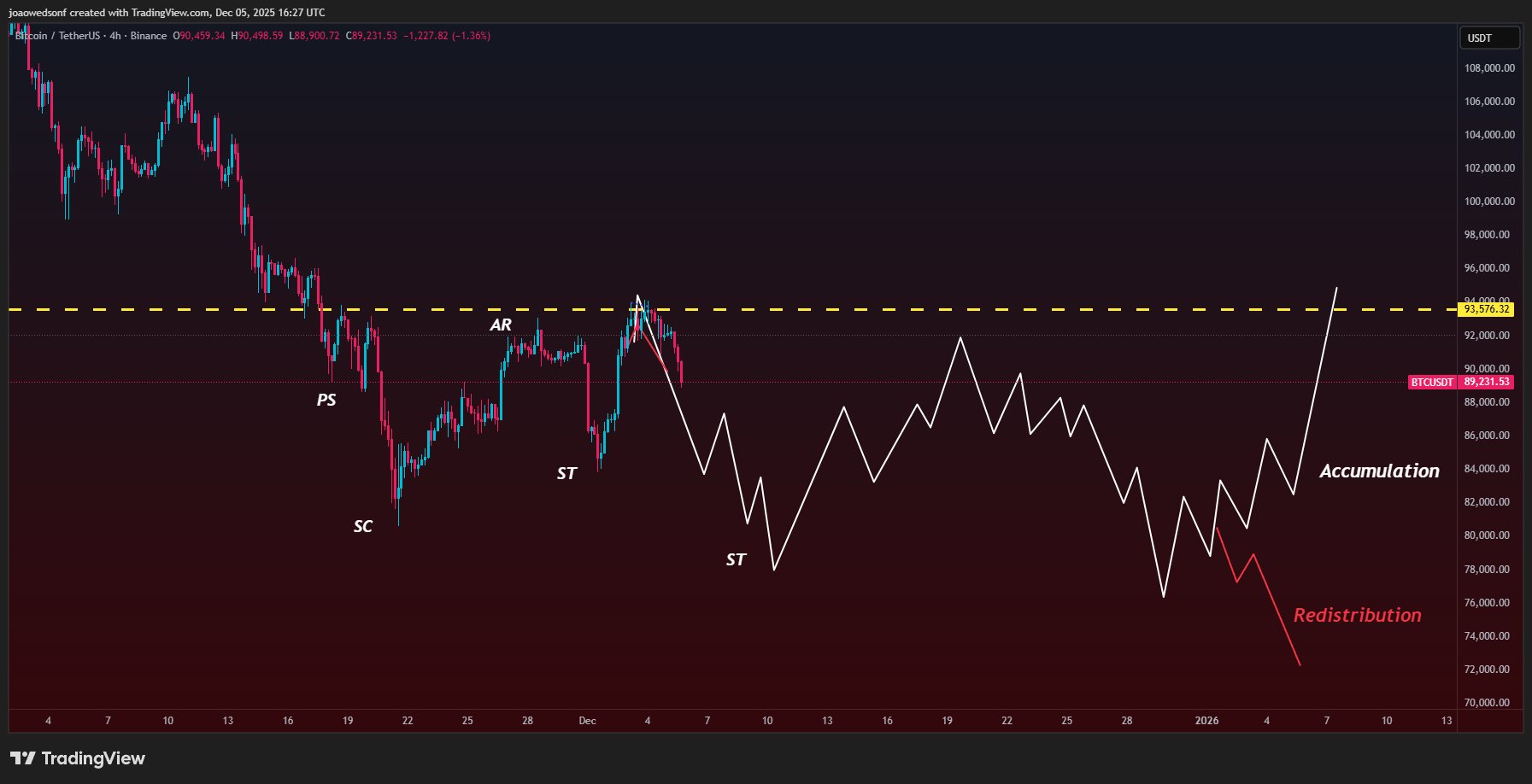
In a previous post on X, Wedson evaluated the likely trajectory of the Bitcoin price should it lose the $89,800 level. The crypto pundit revealed that losing this price mark could lead to an accumulation pattern for the bulls or a redistribution phase for the bears.
While the accumulation period for the bulls would initially coincide with lower prices, it eventually leads to a Bitcoin price return to above the latest local high. Meanwhile, a redistribution phase could see the bears push the flagship cryptocurrency to around the $70,000 mark.
According to the Alphractal CEO, the price of BTC also failed to hold the key on-chain levels, strengthening the probability of a broader price sideways phase. “Sideways action is the cause — the big pumps or dumps are just the effect,” Wedson had earlier stated in his previous X post.
Furthermore, Wedson noted that the next level to watch is $86,500, which, if lost, opens the very high possibility for the formation of a new local low around $80,500. This local low could provide a perfect spot for investors to buy the dip and enter the market.
Bitcoin Price Overview
As mentioned earlier, the past week has been one of highs and lows for the premier cryptocurrency, plummeting to as low as $84,600 on Monday, December 1. After a shaky start to the month, the Bitcoin price recovered strongly to around $94,000 on Thursday, December 4.
As of this writing, the market leader is valued at around $89,415, reflecting an over 3% price decline in the past 24 hours. According to data from CoinGecko, the price of Bitcoin has been down by nearly 10% in the past year.
A crypto analyst has made an unexpected declaration, predicting that XRP investors could become extremely rich in just a few months. This bold claim comes with a new technical analysis, suggesting that XRP is now entering a pivotal price area that previously triggered explosive rallies. Despite the cryptocurrency’s low price and recent downtrend, the analyst remains confident that XRP could mirror past trends and skyrocket to new highs.
XRP To Make Holders Wealthy In 3 Months?
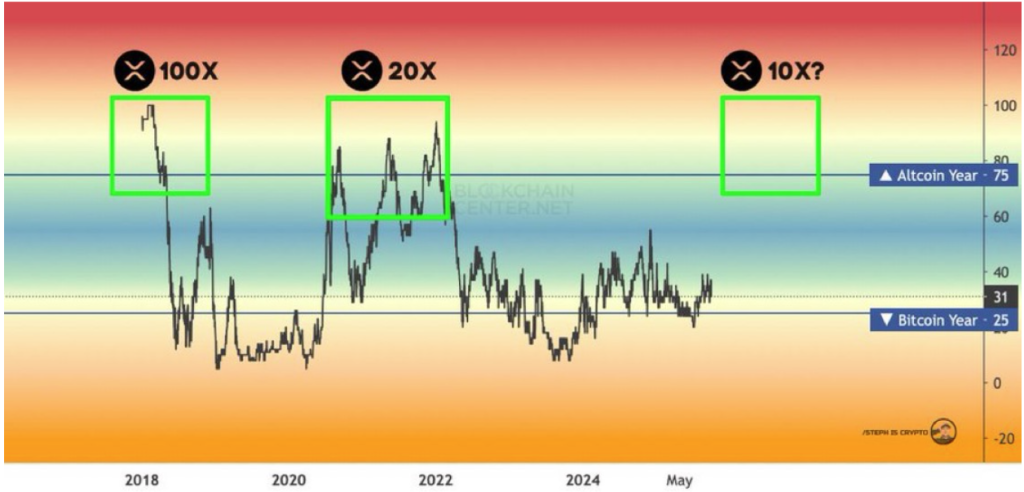
In a recent X post, popular market analyst ‘Steph Is Crypto’ issued a dramatic warning to XRP holders, announcing that investors will become extremely rich within the next three months. The analyst’s bold prediction elicited mixed reactions from the XRP community, with some expressing optimism and others skepticism.
Steph Is Crypto shared a price chart with colored bands to support his ambitious claims, tracking XRP’s performance through multiple past bull cycles. The chart highlights a recurring pattern in which XRP enters a higher-colored zone during periods often associated with altcoin strength. In previous cycles, those moments were followed by unexpected, explosive upward price moves.
During the bull cycle in 2018, XRP skyrocketed by 100x, pushing its price up towards its current all-time high of $3.84. A similar uptrend occurred again during the 2020 to 2022 cycle, with XRP entering a prolonged bull phase that saw its price rally by 20x. According to Steph Is Crypto, the current chart setup appears similar to these past bullish phases.
His chart analysis suggests that XRP is once again approaching the same colored region that previously marked the start of strong price rallies. While the scale of the projected acceleration this time may differ from the peaks seen in the last two cycles, Steph Is Crypto remains confident that it will still be substantial enough to make holders significantly wealthy by March 2026.
XRP Maintains Bullish Monthly SuperTrend
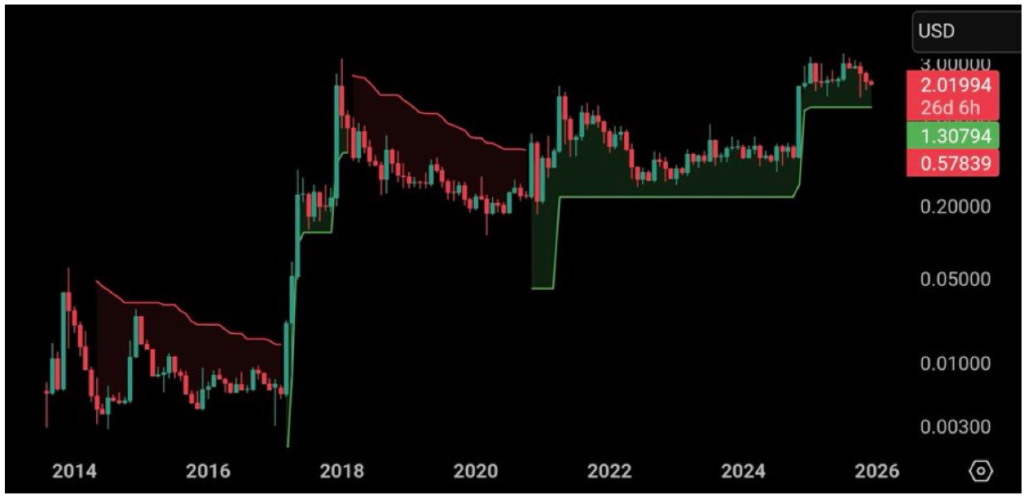
Crypto market analyst ChartNerd has released a fresh technical analysis of XRP, suggesting that the cryptocurrency continues to show strong positive signals. According to him, XRP’s monthly SuperTrend remains firmly bullish. He emphasized that maintaining a price above the green SuperTrend line near $1.30 signals a long-term upward trajectory, with no red trends currently indicating the onset of a bear market.
ChartNerd shared a chart with a SuperTrend overlay where green lines represent bullish conditions and red lines highlight previous bear markets. The current monthly candles for XRP remain well above the green zone, reinforcing the belief that broader market conditions favor an upside. The analyst interprets this as confirmation that XRP’s long-term price trend is still predominantly bullish.
Historical data on the chart also indicate that past declines in XRP coincided with prolonged red SuperTrend phases. This happened before the big 2017 and 2020 breakout, with each recovery triggered once the price moved back above the green SuperTrend line.
Featured image from Unsplash, chart from TradingView
In remarks made on December 4, US Securities and Exchange Commission (SEC) Chair Paul Atkins expressed an optimistic outlook for the cryptocurrency industry. Atkins emphasized the SEC’s intent to modernize its rules to facilitate an on-chain market environment, leveraging distributed ledger technology and the tokenization of financial assets.
SEC Chair Advocates For Crypto Tokenization
Atkins highlighted the transformative potential of these technologies for the capital markets. He stressed that enhancing these markets is essential for US firms and investors to maintain their leadership on a global scale.
The chair underscored that the advancements in blockchain technology could streamline not only trading processes but also the entire issuer-investor relationship, which would enable a more efficient and transparent financial ecosystem.
Tokenization, according to Atkins, goes beyond merely changing the mechanics of trading. He pointed out that it can foster direct connections for various important functions such as proxy voting, dividend payments, and shareholder communications, all while reducing the reliance on multiple intermediaries.
In his address, Atkins acknowledged several innovative models that deserve consideration. He noted that some companies are directly issuing equity on public distributed ledgers in the form of programmable assets.
These assets can integrate compliance features, voting rights, and governance capabilities, allowing investors to hold securities in a digital format that promotes transparency and reduces the number of intermediaries involved.
Additionally, he mentioned that third parties are engaging in the tokenization of equities by generating on-chain security entitlements that represent ownership stakes in traditional equities.
The emergence of synthetic exposures—tokenized products designed to reflect the performance of public equities—was also highlighted. While many of these offerings are currently being developed offshore, they showcase the international interest in US market exposure supported by distributed ledger technology.
Atkins Critiques Past SEC Strategies
However, Atkins cautioned that transitioning to on-chain capital markets entails more than just issuance. He stated that it is essential to address various stages of the securities transaction lifecycle effectively.
For instance, if tokenized shares cannot be traded competitively in liquid on-chain environments, they risk becoming little more than conceptual assets without practical utility.
The chair also criticized the previous SEC’s approach toward the crypto industry under the agency’s former chair Gary Gensler, which attempted to adapt to on-chain markets through an expansive redefinition of “exchange.”
This earlier strategy enforced a broad regulatory framework that ultimately created uncertainty and stifled innovation, Atkins stated. He said that it is vital to avoid repeating such mistakes in order to stimulate innovation, investment, and job creation in the United States.
To foster a conducive environment for growth, Atkins called for compliant pathways that can enable market participants to capitalize on the unique benefits of new technologies like crypto.
In light of this conviction, he has instructed SEC staff to explore recommendations for utilizing the agency’s exemptive authorities, permitting on-chain innovations while the Commission works toward developing long-term, effective crypto regulatory frameworks.
Featured image from DALL-E, chart from TradingView.com
Bitcoin may be holding slightly below $90,000, but data imply that the $100K year-end target is still alive as analysts point out that three Bitcoin Price Prediction indicators are flashing a green signal.
The 3-Key Drivers For Bitcoin $100k Year-end Target
The first and most critical driver is the shift in Federal Reserve monetary policy.
After months of reducing liquidity through quantitative tightening, where the central bank stopped reinvesting proceeds from maturing bonds and Treasury holdings, the Fed ended this program on December 1.
Markets are now positioning for an easing cycle.
QUANTITATIVE TIGHTENING DONE ; WHAT’S NEXT FOR $BTC?
Historically, Bitcoin and altcoins struggle during prolonged Quantitative Tightening (QT = red zone), which lasted three years and just ended on December 1, 2025.
Data from the CME FedWatch Tool reveals that traders see an 87% likelihood of a rate reduction at the upcoming Wednesday meeting, with three additional cuts anticipated by September 2026.
This policy shift comes as tech sector borrowing costs rise amid substantial AI infrastructure debt, creating conditions where investors may seek alternative stores of value.
The combination of these factors could provide the momentum needed for Bitcoin to cross the six-figure threshold in the coming weeks.
The second driver is liquidity structure.
According to order-book data from CoinGlass, Bitcoin currently has two significant liquidity clusters: the downside liquidity around $90,000, which is currently being tested, and upside liquidity near $94,500.
If the latter is breached, a rally toward $100,000 becomes highly probable.
Bitcoin Price Prediction: Rising Channel Points to $100k Breakout
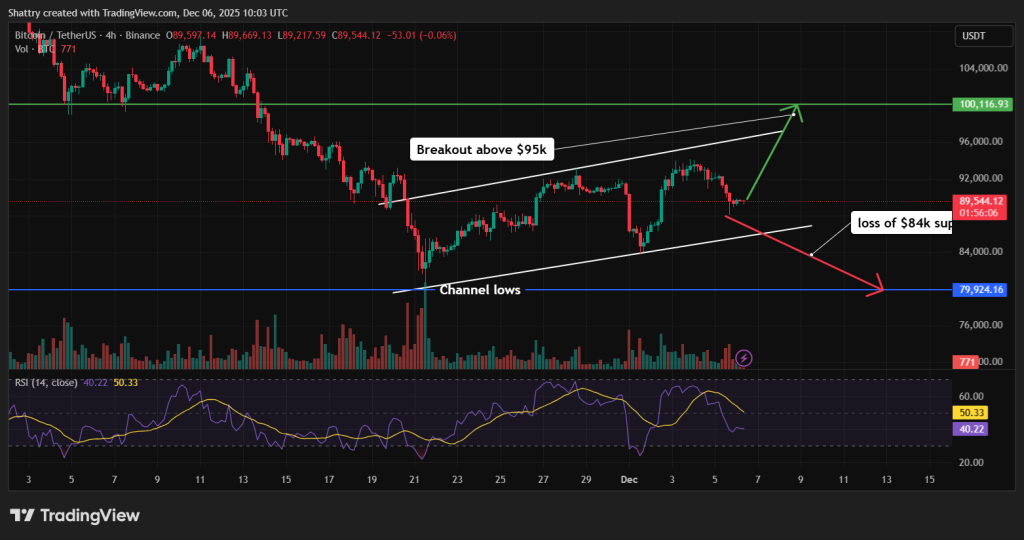
The third driver comes from technical analysis, which suggests a $100,000 recovery if BTC breaches the $95,000 resistance.
The 4-hour chart shows Bitcoin trading inside a rising channel, though the latest rejection near mid-range has pushed price back toward the lower trendline.
The key support level holding the structure together is $84,000. If BTC stays above that line, the overall channel remains intact, and a rebound toward $95,000 resistance becomes likely.
Source: TradingView
A breakout above $95,000 would flip the structure bullish and open the path toward the $100,000 region, the next major liquidity target.
However, RSI has cooled off sharply and is leaning bearish, indicating weakened momentum.
If Bitcoin loses $84,000, the rising channel breaks down, and price could slide toward longer-term support around $80,000.
Maxi Doge Presale Gains Traction
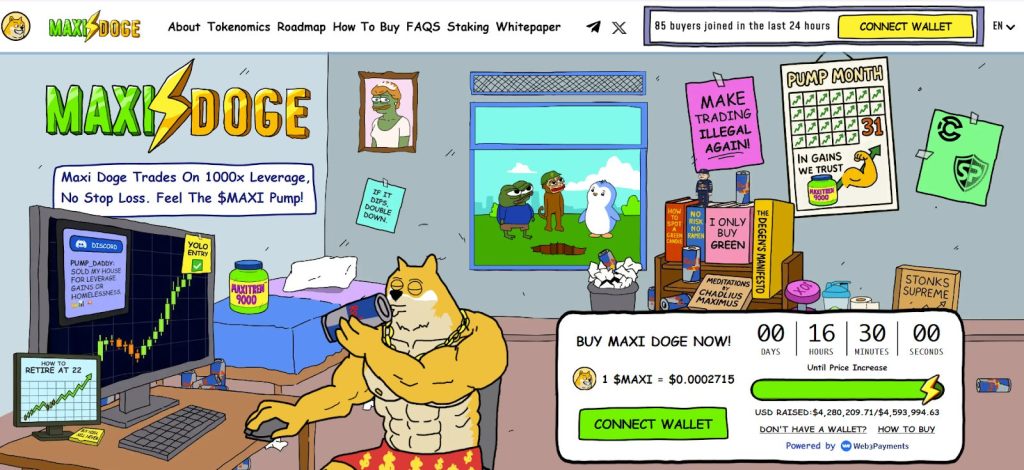
While Bitcoin awaits bullish confirmation, Maxi Doge (MAXI) is emerging as a notable Ethereum-based meme coin with ambitions to replicate Dogecoin’s success story.
MAXI is channeling the community-driven energy that propelled DOGE from $0.00008547 in 2015 to its current $0.138 price, a remarkable +161,800x gain.
While replicating that exact trajectory may be ambitious, analysts believe Maxi Doge can deliver a modest 10-50x return for early adopters.
MAXI has now raised over $4.2 million and is building a vibrant community where holders share trading setups, early opportunities, and alpha insights.
Beyond the meme appeal, 25% of raised funds will be deployed into high-potential plays, with profits reinvested directly into marketing to fuel exponential growth and community rewards.
XRP price has tanked for three consecutive days, erasing the gains made earlier this week, even as the recently launched ETFs gained momentum. Ripple (XRP) token dropped to $2.03 today, Dec. 6, down by over 44% from its highest point…
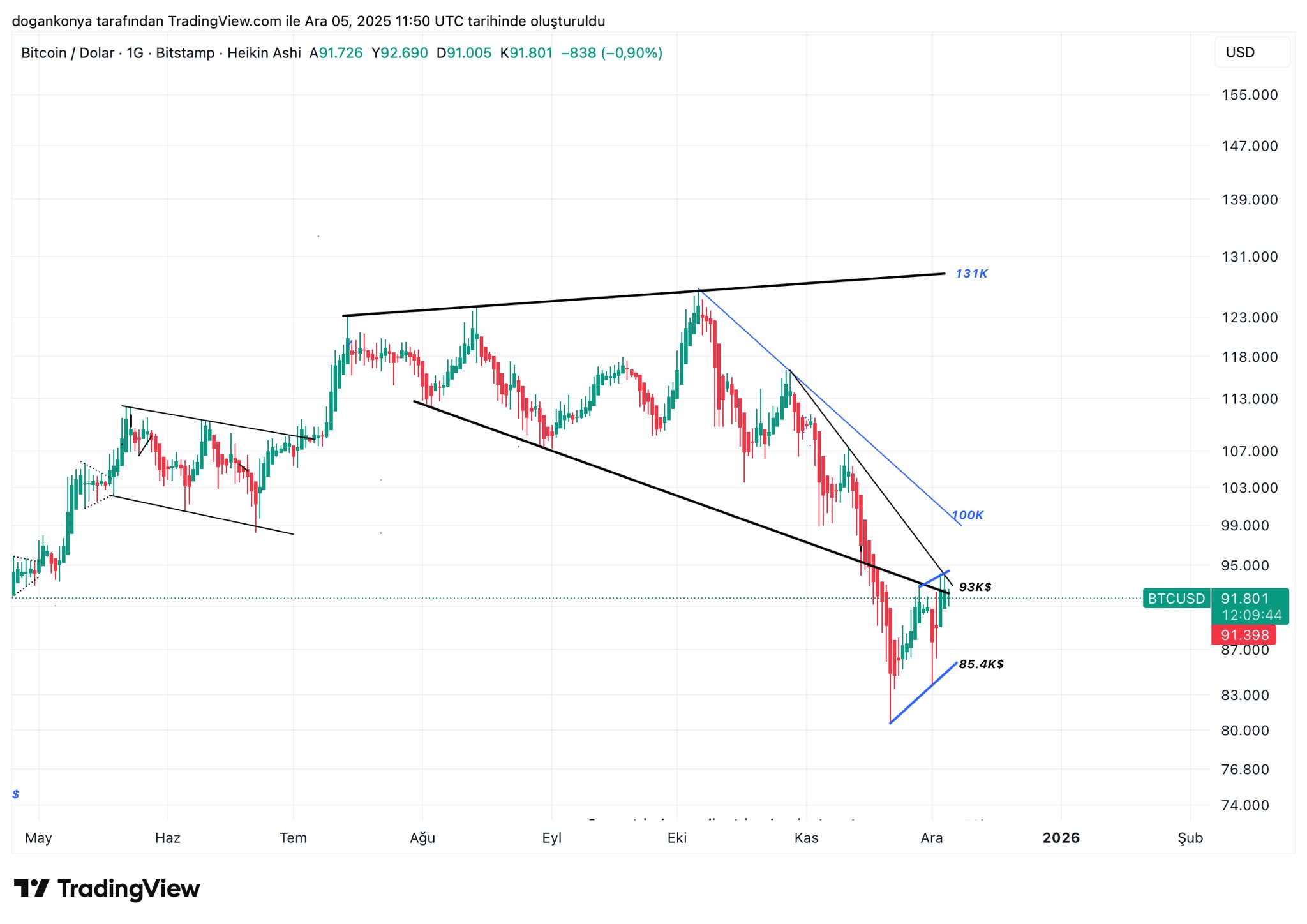
Bitcoin (BTC) trades just below $90,000 after a fluctuating week of price action resulted in a net loss of 1.8%. Despite initial hopes of a resurgence in late November, the premier cryptocurrency is now 29.16% away from its all-time high. Going by the price action, popular analyst with the X username PlanD postulates BTC is now in consolidation guided by two major price levels.
Bitcoin Moves In Key Range Between $85,000-$93,000, Market Breakout Awaits
In an X post on December 5, PlanD provides an update on a continued analysis of the Bitcoin market, stating the crypto market leader appears to be building momentum within a set price range. Notably, recent price action has pushed the flagship cryptocurrency below the lower boundary of a broadening ascending channel between $93,000 and $131,000, raising fears of a bear market.
However, Bitcoin has repeatedly rebounded, forming a strong consolidation range between $85,400 and $93,000. PlanD defines the present market condition as Bitcoin being in a decision zone and needing a price breakout to determine its next major direction. The analyst states that if Bitcoin moves to overcome the price resistance at $93,000, its initial price target lies at $100,000. A successful reclaim of this psychological six-figure level would confirm renewed bullish intent and stronger potential for a full market revival.
On the other hand, if Bitcoin breaks below the vital support zone at $85,300, investors should expect steeper losses. In this case, PlanD projects a price drop to around $72,000, representing a potential 19% decline from present market prices. Notably, considering the recent market volatility, the ongoing consolidation may close out sooner than expected, to establish a clear market direction.
Bitcoin Price Overview
According to data from CoinMarketCap, Bitcoin trades at $89,703, reflecting a price loss of 2.99%. Meanwhile, the daily trading volume is up by 4.56% and valued at $63.16 billion.
Following the turbulent price action of the last week, BTC’s price struggles in Q4 continue against previous popular predictions. Still, several bullish indicators could support a rebound before year-end. Key catalysts include a widely anticipated interest rate cut at the upcoming Federal Open Market Committee (FOMC) meeting on December 9–10.
In addition, market sentiment is benefiting from speculation that pro-crypto economist Kevin Hassett could succeed Jerome Powell as Federal Reserve Chair in 2026.
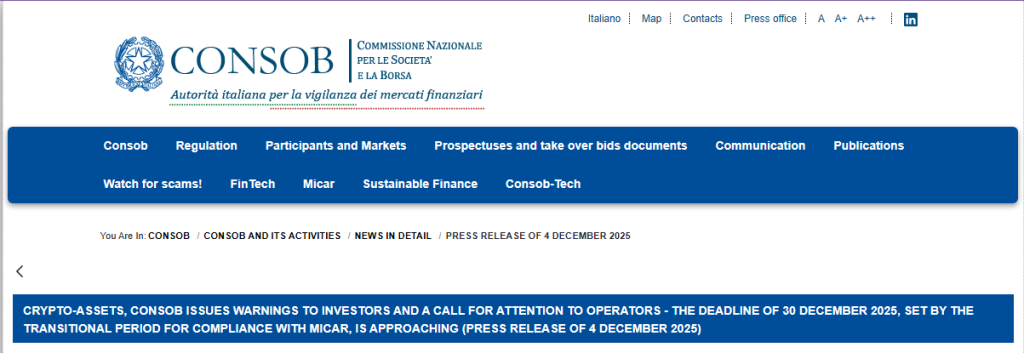
According to a press release from Consob on December 4, 2025, Italy’s securities regulator told crypto and virtual asset service providers (VASPs) that they must secure authorization under the EU’s Markets in Crypto-Assets regime (MiCA) by December 30, 2025, or stop serving Italian clients.
The notice warns operators that those who do not file for a MiCA-compliant license must close out services and return customer funds by the year-end.
Consob’s Deadline And What It Means For Firms
Based on reports, companies that submit an authorization application by the cutoff may keep operating while the application is under review. But that temporary permission will not last beyond June 30, 2026, regulators say. That window gives providers some breathing room, but it also sets a hard date for final approvals.
The regulator singled out platforms that until now have worked under Italy’s lighter national registry system (OAM). Those businesses now face a choice: apply to become fully authorized crypto-asset service providers (CASPs) under MiCA or plan an orderly exit. Operators who plan to leave must notify users clearly and return assets in a safe, verifiable way.
Italy Opens A Broader Risk Review
According to a Reuters report, Italy’s Economy Ministry has also ordered an in-depth review of crypto risks, bringing together the Bank of Italy, Consob and other agencies to check whether current protections are strong enough for investors and the wider financial system. The move came during a committee meeting that flagged rising exposure and the need to monitor spillovers into traditional finance.
What Investors Should Watch For Next
Customers in Italy should confirm whether their chosen platform has lodged a MiCA application or has made clear plans for compliance or exit. If an operator fails to apply by December 30, users could face service interruptions and will need to follow the provider’s instructions for fund returns. Regulators say transparency from firms will be key in the weeks ahead.
Smaller local platforms may find the compliance burden steep. Some operators could seek licenses in other EU states and use passporting rules to serve Italian clients, while others may shut down or merge.
The provisional operating window stretches into mid-2026, but the final shape of the market will depend on how quickly firms meet the tougher requirements and how long authorizations take to process.
Consob’s notice is meant to cut through uncertainty and force a choice before year-end. The combination of a firm deadline, mandatory filings and a parallel review marks a stricter approach to crypto oversight in Italy.
Featured image from Unsplash, chart from TradingView

 Login
Login