Reading view

There are new articles available, click to refresh the page.

Bitcoin Price Prediction: Year-End $100K Target Alive – Here Are the Three Drivers That Matter

Bitcoin may be holding slightly below $90,000, but data imply that the $100K year-end target is still alive as analysts point out that three Bitcoin Price Prediction indicators are flashing a green signal.

The 3-Key Drivers For Bitcoin $100k Year-end Target

The first and most critical driver is the shift in Federal Reserve monetary policy.

After months of reducing liquidity through quantitative tightening, where the central bank stopped reinvesting proceeds from maturing bonds and Treasury holdings, the Fed ended this program on December 1.

Markets are now positioning for an easing cycle.

QUANTITATIVE TIGHTENING DONE ; WHAT’S NEXT FOR $BTC?

Historically, Bitcoin and altcoins struggle during prolonged Quantitative Tightening (QT = red zone), which lasted three years and just ended on December 1, 2025.

What usually follows: an uptrend (black zone).

Once… https://t.co/oosjrrFd0E pic.twitter.com/VzxaTLa4bn

— CryptosRus (@CryptosR_Us) December 6, 2025

Data from the CME FedWatch Tool reveals that traders see an 87% likelihood of a rate reduction at the upcoming Wednesday meeting, with three additional cuts anticipated by September 2026.

This policy shift comes as tech sector borrowing costs rise amid substantial AI infrastructure debt, creating conditions where investors may seek alternative stores of value.

The combination of these factors could provide the momentum needed for Bitcoin to cross the six-figure threshold in the coming weeks.

The second driver is liquidity structure.

According to order-book data from CoinGlass, Bitcoin currently has two significant liquidity clusters: the downside liquidity around $90,000, which is currently being tested, and upside liquidity near $94,500.

If the latter is breached, a rally toward $100,000 becomes highly probable.

Bitcoin Price Prediction: Rising Channel Points to $100k Breakout

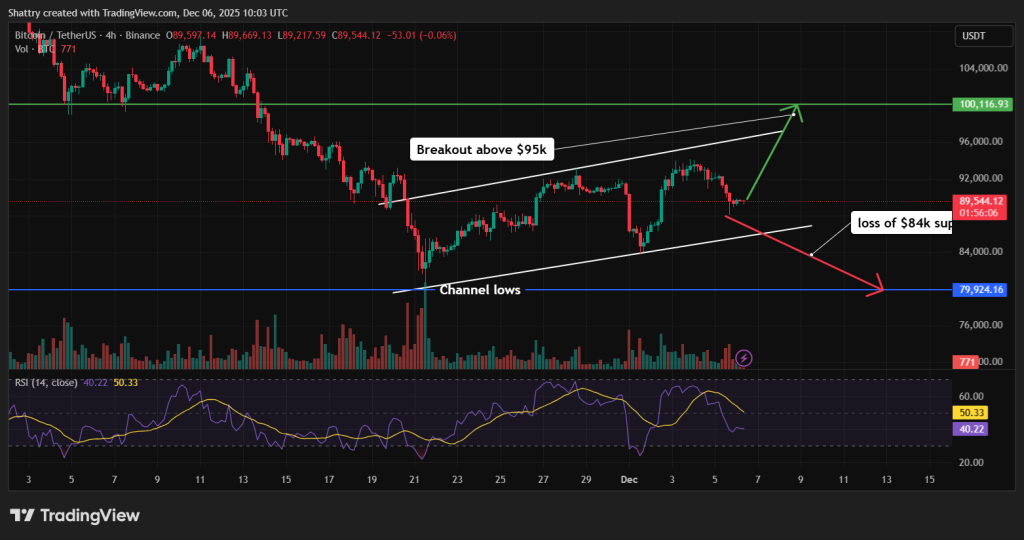
The third driver comes from technical analysis, which suggests a $100,000 recovery if BTC breaches the $95,000 resistance.

The 4-hour chart shows Bitcoin trading inside a rising channel, though the latest rejection near mid-range has pushed price back toward the lower trendline.

The key support level holding the structure together is $84,000. If BTC stays above that line, the overall channel remains intact, and a rebound toward $95,000 resistance becomes likely.
Bitcoin Price Prediction - Bitcoin Price Chart
Source: TradingView

A breakout above $95,000 would flip the structure bullish and open the path toward the $100,000 region, the next major liquidity target.

However, RSI has cooled off sharply and is leaning bearish, indicating weakened momentum.

If Bitcoin loses $84,000, the rising channel breaks down, and price could slide toward longer-term support around $80,000.

Maxi Doge Presale Gains Traction

While Bitcoin awaits bullish confirmation, Maxi Doge (MAXI) is emerging as a notable Ethereum-based meme coin with ambitions to replicate Dogecoin’s success story.

MAXI is channeling the community-driven energy that propelled DOGE from $0.00008547 in 2015 to its current $0.138 price, a remarkable +161,800x gain.

While replicating that exact trajectory may be ambitious, analysts believe Maxi Doge can deliver a modest 10-50x return for early adopters.

MAXI has now raised over $4.2 million and is building a vibrant community where holders share trading setups, early opportunities, and alpha insights.
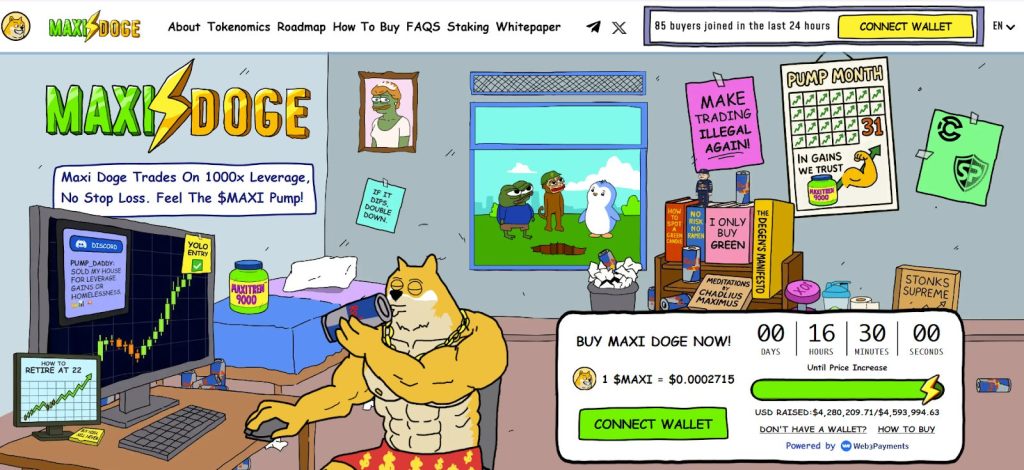
Bitcoin Price Prediction - Maxidoge Banner

Beyond the meme appeal, 25% of raised funds will be deployed into high-potential plays, with profits reinvested directly into marketing to fuel exponential growth and community rewards.

To join the presale at the current $0.0002715 price, visit the official Maxi Doge website.

Then connect an Ethereum-compatible wallet like Best Wallet, and pay with ETH, BNB, or USDT.

You can swap existing crypto or use a bank card to invest in seconds.

The post Bitcoin Price Prediction: Year-End $100K Target Alive – Here Are the Three Drivers That Matter appeared first on Cryptonews.


Bitcoin Settles In Consolidation Zone – Levels To Watch

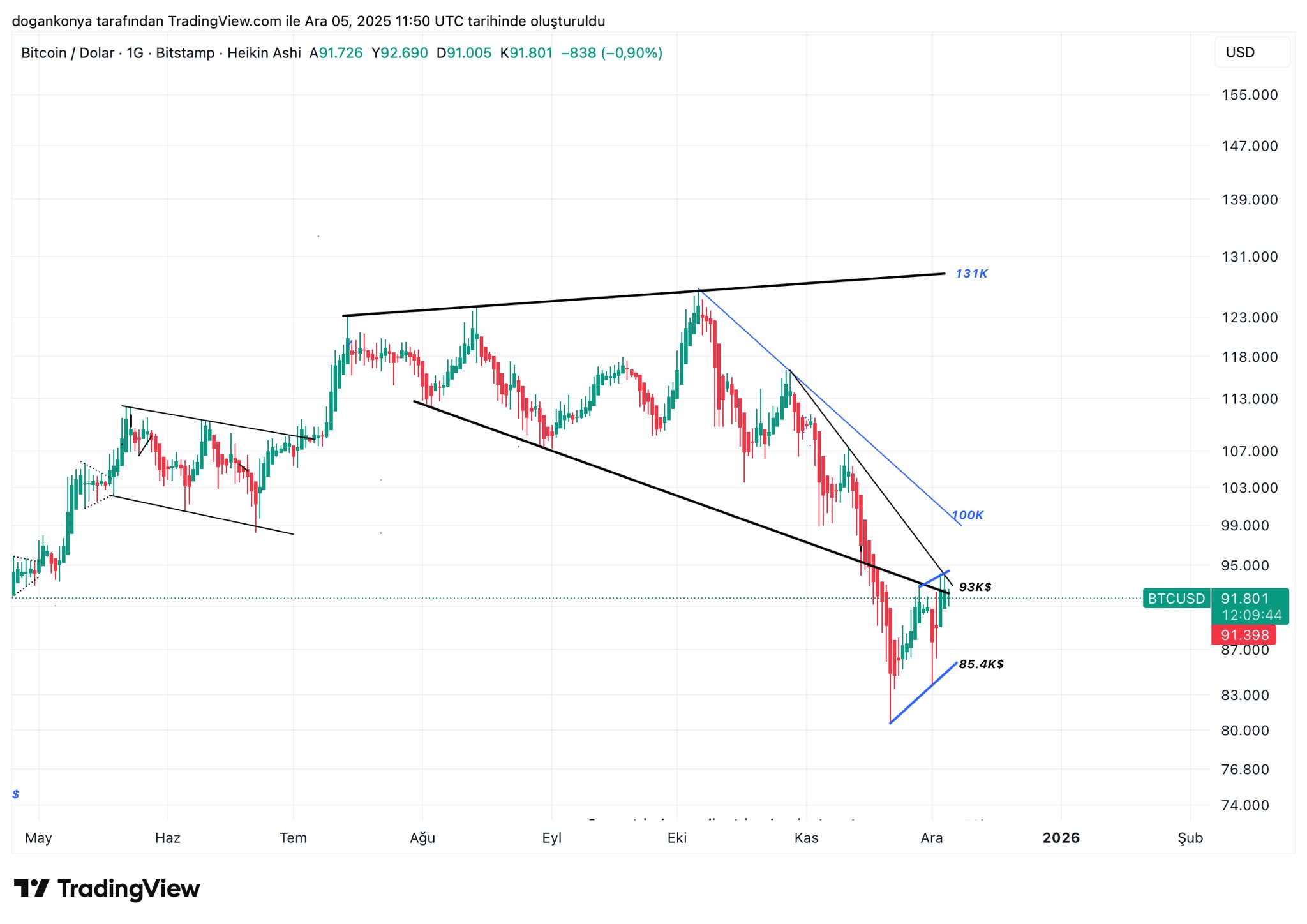
Bitcoin (BTC) trades just below $90,000 after a fluctuating week of price action resulted in a net loss of 1.8%. Despite initial hopes of a resurgence in late November, the premier cryptocurrency is now 29.16% away from its all-time high. Going by the price action, popular analyst with the X username PlanD postulates BTC is now in consolidation guided by two major price levels.

Bitcoin Moves In Key Range Between $85,000-$93,000, Market Breakout Awaits

In an X post on December 5, PlanD provides an update on a continued analysis of the Bitcoin market, stating the crypto market leader appears to be building momentum within a set price range. Notably, recent price action has pushed the flagship cryptocurrency below the lower boundary of a broadening ascending channel between $93,000 and $131,000, raising fears of a bear market. However, Bitcoin has repeatedly rebounded, forming a strong consolidation range between $85,400 and $93,000. PlanD defines the present market condition as Bitcoin being in a decision zone and needing a price breakout to determine its next major direction. The analyst states that if Bitcoin moves to overcome the price resistance at $93,000, its initial price target lies at $100,000. A successful reclaim of this psychological six-figure level would confirm renewed bullish intent and stronger potential for a full market revival.

Bitcoin

On the other hand, if Bitcoin breaks below the vital support zone at $85,300, investors should expect steeper losses. In this case, PlanD projects a price drop to around $72,000, representing a potential 19% decline from present market prices. Notably, considering the recent market volatility, the ongoing consolidation may close out sooner than expected, to establish a clear market direction.

Bitcoin Price Overview

According to data from CoinMarketCap, Bitcoin trades at $89,703, reflecting a price loss of 2.99%. Meanwhile, the daily trading volume is up by 4.56% and valued at $63.16 billion.

Following the turbulent price action of the last week, BTC’s price struggles in Q4 continue against previous popular predictions. Still, several bullish indicators could support a rebound before year-end. Key catalysts include a widely anticipated interest rate cut at the upcoming Federal Open Market Committee (FOMC) meeting on December 9–10.

In addition, market sentiment is benefiting from speculation that pro-crypto economist Kevin Hassett could succeed Jerome Powell as Federal Reserve Chair in 2026.

Bitcoin

Italy’s Market Watchdog Gives Crypto Firms A Clear Order: Act Or Exit

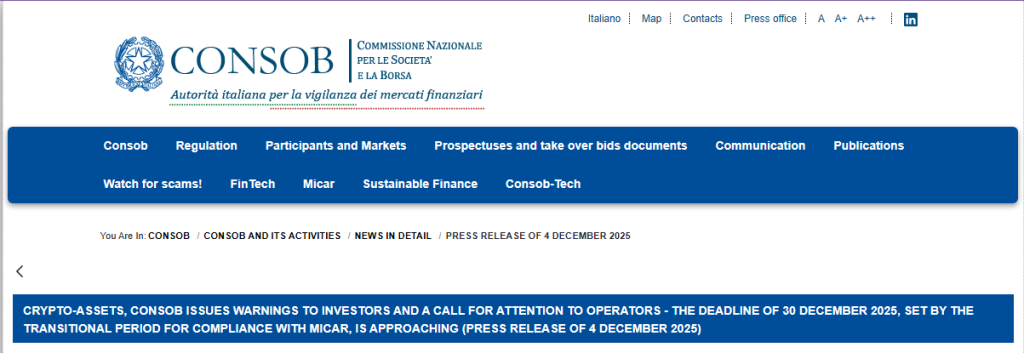
According to a press release from Consob on December 4, 2025, Italy’s securities regulator told crypto and virtual asset service providers (VASPs) that they must secure authorization under the EU’s Markets in Crypto-Assets regime (MiCA) by December 30, 2025, or stop serving Italian clients.

The notice warns operators that those who do not file for a MiCA-compliant license must close out services and return customer funds by the year-end.

Consob’s Deadline And What It Means For Firms

Based on reports, companies that submit an authorization application by the cutoff may keep operating while the application is under review. But that temporary permission will not last beyond June 30, 2026, regulators say. That window gives providers some breathing room, but it also sets a hard date for final approvals.

The regulator singled out platforms that until now have worked under Italy’s lighter national registry system (OAM). Those businesses now face a choice: apply to become fully authorized crypto-asset service providers (CASPs) under MiCA or plan an orderly exit. Operators who plan to leave must notify users clearly and return assets in a safe, verifiable way.

Italy Opens A Broader Risk Review

According to a Reuters report, Italy’s Economy Ministry has also ordered an in-depth review of crypto risks, bringing together the Bank of Italy, Consob and other agencies to check whether current protections are strong enough for investors and the wider financial system. The move came during a committee meeting that flagged rising exposure and the need to monitor spillovers into traditional finance.

What Investors Should Watch For Next

Customers in Italy should confirm whether their chosen platform has lodged a MiCA application or has made clear plans for compliance or exit. If an operator fails to apply by December 30, users could face service interruptions and will need to follow the provider’s instructions for fund returns. Regulators say transparency from firms will be key in the weeks ahead.

Smaller local platforms may find the compliance burden steep. Some operators could seek licenses in other EU states and use passporting rules to serve Italian clients, while others may shut down or merge.

The provisional operating window stretches into mid-2026, but the final shape of the market will depend on how quickly firms meet the tougher requirements and how long authorizations take to process.

Consob’s notice is meant to cut through uncertainty and force a choice before year-end. The combination of a firm deadline, mandatory filings and a parallel review marks a stricter approach to crypto oversight in Italy.

Featured image from Unsplash, chart from TradingView

Crypto Sell-Off: Binance, Coinbase, Dump Over $2 Billion In Bitcoin As Prices Dip Below $90,000

The cryptocurrency market experienced another wave of liquidations on Friday, with Bitcoin (BTC) prices dipping below the critical support level of $90,000. This decline followed a brief rally that had seen its price rise approximately $3,000 above this threshold earlier in the week.

Crypto Market Faces $430 Million In Liquidations 

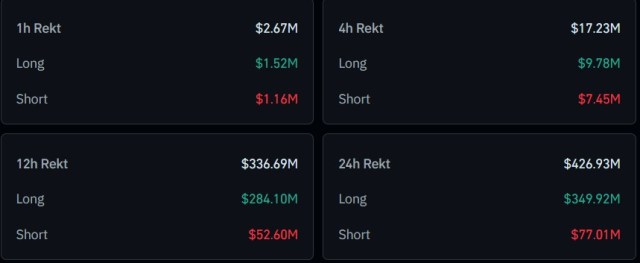
Data from CoinGlass reveals that nearly $430 million in liquidations occurred across the crypto market over the past 24 hours, predominantly affecting leveraged long positions, which accounted for about $350 million. 

During this period, Bitcoin underwent a 3.5% retracement, with its price settling at just above $89,120—a stark 29% below its all-time high of over $126,000 reached in October.

Crypto

Market expert OxNobler recently highlighted the role of both retail and institutional investors in this downturn. In a post on social media platform X, OxNobler detailed the reason behind Bitcoin’s decline: significant sell-offs by major players. 

According to the analyst, the world’s largest cryptocurrency exchange, Binance, sold 4,000 BTC; U.S.-based Coinbase (COIN) liquidated 5,675 BTC; and traditional finance giant Fidelity sold 3,288 BTC. Additionally, market maker Wintermute offloaded 1,793 BTC. 

Notably, the analyst pointed out that Strategy, formerly MicroStrategy, which is the largest public company holder of Bitcoin with over 650,000 coins, has also sold over 3,820 coins in this same time frame.

The firm’s sell-off comes on the heels of speculation regarding Strategy’s potential to liquidate some of its holdings due to the substantial losses affecting its financial performance amid declining Bitcoin prices. 

When Strategy CEO Phong Le was questioned about the possibility of selling off Bitcoin, he acknowledged that while the firm’s former CEO, Michael Saylor, has consistently opposed selling, circumstances may change if the company’s stock trades below the net value of its Bitcoin holdings, which aligns with the recent actions taken by the firm.

Coinbase Analysts Predict December Recovery 

Interestingly, while these institutional sell-offs have contributed to the current market dip, Coinbase’s institutional division has projected a potential recovery for the crypto market in December, citing improving liquidity, a 92% probability of the Federal Reserve (Fed) cutting rates, and supportive macroeconomic conditions.

Analysts have pointed out several reasons for optimism, including the recovery of liquidity, the resilience of the “AI bubble,” and the attractiveness of short US dollar trades at current levels. 

However, OxNobler warned that the situation may not be so straightforward. Alongside the activities of major institutions, he noted that BlackRock, the world’s largest asset manager, had recently sold $130 million worth of Bitcoin and Ethereum (ETH).

Furthermore, Vitalik Buterin, one of Ethereum’s co-founders, seems to have resumed selling Ethereum, with millions of ETH being moved from the foundation’s wallet through Gnosis Safe.

Ultimately, OxNobler asserts that these institutional activities may have a hand in manipulating crypto prices and preventing them from climbing to higher levels and key resistance points. 

Crypto

Featured image from DALL-E, chart from TradingView.com 

MetaMask Enters Prediction Markets With Polymarket Integration

By: Amin Ayan

MetaMask, the most widely used Ethereum wallet, is moving directly into the prediction market arena through a new integration with Polymarket, giving users the ability to trade event outcomes from inside their wallets.

Key Takeaways:

  • MetaMask has integrated Polymarket, allowing users to trade real-world event outcomes.
  • The integration adds one-tap funding from any EVM chain.
  • Polymarket’s rapid growth continues amid a potential $15 billion valuation.

“You can now trade on the future outcome of real world events inside your wallet,” Consensys’ Gabriela Helfet wrote, adding that users will also earn MetaMask Rewards points for every prediction placed.

MetaMask Becomes New Gateway to Polymarket With One-Tap Funding

The integration creates a new on-ramp for Polymarket and introduces “one tap funding,” allowing users to deposit with any token from any EVM-compatible chain.

The move further tightens the link between everyday crypto wallets and decentralized betting platforms, positioning MetaMask as a gateway not only to Web3 apps but also to real-world event speculation.

Polymarket has surged in popularity over the past year, fueled in part by heightened attention during the 2024 US election cycle.

Former President Donald Trump’s embrace of crypto and a more relaxed regulatory climate helped push the platform back into the US market.

The company is now reportedly exploring a valuation of up to $15 billion, following a $2 billion strategic investment from Intercontinental Exchange, the parent of the NYSE.

Predicting on MetaMask only takes a few seconds.🔮

We've enabled 1-click funding with any EVM token, or you can get started instantly if you have an existing @polymarket account! pic.twitter.com/zZtrQPDu3m

— MetaMask.eth 🦊 (@MetaMask) December 5, 2025

For MetaMask, the move comes as the wallet expands beyond its Ethereum-focused roots. In October, it launched multichain accounts that support both EVM and non-EVM networks, including Solana.

The wallet is also preparing for the rollout of a native MASK token, as parent company Consensys gears up for a potential IPO.

The move comes as Polymarket is recruiting staff for an internal market-making team that would trade against its own customers, mirroring a controversial feature already used by rival Kalshi that has drawn criticism and legal challenges.

As reported, the New York-based prediction market startup has approached traders, including sports bettors, to join the new unit, people familiar with the matter said, requesting anonymity because the plans remain private.

Prediction Markets Hit $13B in Record Activity

Prediction markets have crossed $13 billion in cumulative trading volume, marking a record high even as broader crypto markets cool.

The surge has drawn in major players across tech and finance, including Fanatics, Coinbase, and MetaMask, all of which have recently launched or expanded event-trading platforms.

Against this backdrop, YZi Labs, the venture firm founded by Binance co-founder Changpeng “CZ” Zhao, has been intensifying its involvement in the sector.

YZi-backed Opinion has emerged as one of the most surprising breakout platforms. Launched on BNB Chain in October, it recorded nearly $1.5 billion in weekly trading volume within its first month, briefly overtaking established names such as Kalshi and Polymarket.

Meanwhile, prediction markets platform Kalshi has secured a major media breakthrough after signing a partnership with CNN, making the company the network’s official prediction markets partner while closing a $1 billion funding round at an $11 billion valuation.

The post MetaMask Enters Prediction Markets With Polymarket Integration appeared first on Cryptonews.

CoinShares Debunks Tether Collapse Fears After Hayes Warning

CoinShares head of research James Butterfill has dismissed insolvency concerns surrounding Tether following warnings from BitMEX founder Arthur Hayes, who claimed a 30% drop in the stablecoin issuer’s Bitcoin and gold holdings could wipe out its equity.

Butterfill’s December 5 market update affirmed that Tether maintains over $181 billion in total reserves against roughly $174.45 billion in liabilities, leaving a surplus of approximately $6.78 billion.

The dismissal comes as crypto markets navigate turbulence in Japanese government bonds and softer US employment data that showed a -32,000 print versus forecasts of +10,000.

Hayes sparked controversy on November 30 by arguing Tether is “running a massive interest rate trade” that positions the company for Federal Reserve rate cuts while exposing it to dangerous volatility through its $22.8 billion allocation to gold and Bitcoin.

The Tether folks are in the early innings of running a massive interest rate trade. How I read this audit is they think the Fed will cut rates which crushes their interest income. In response, they are buying gold and $BTC that should in theory moon as the price of money falls.… pic.twitter.com/ZGhQRP4SVF

— Arthur Hayes (@CryptoHayes) November 29, 2025

Tether CEO Counters Insolvency Claims with Financial Data

CEO Paolo Ardoino swiftly refuted Hayes’s assessment with detailed disclosures showing Tether Group’s total assets reach approximately $215 billion.

The executive explained that the company holds roughly $7 billion in excess equity on top of its stablecoin reserves, plus another $23 billion in retained earnings as part of Tether Group equity.

Bitcoin and gold represent just 12.6% of total reserves, with over 70% held in short-term U.S. Treasuries.

S&P made the same mistake of not considering the additional Group Equity nor the ~$500M in monthly base profits generated by U.S Treasury yields alone,” Ardoino stated, suggesting critics are “either bad at math or have the incentive to push our competitors.

re: Tether FUD

From latest attestation announcement (Q3 2025):

"Tether will continue to maintain a multi-billion-dollar excess reserve buffer and an overall proprietary Group equity approaching $30 billion."

Tether had (at end of Q3 2025) ~7B in excess equity (on top of the…

— Paolo Ardoino 🤖 (@paoloardoino) November 30, 2025

The company generated more than $10 billion in profit this year from interest income on reserve assets, making it one of the most efficient cash-generating businesses globally with just 150 employees.

His defense followed S&P Global’s November 26 downgrade of USDT’s peg-stability rating from 4 to 5, citing increased exposure to “high-risk” assets and “persistent gaps in disclosure.

Ardoino responded defiantly, declaring, “We wear your loathing with pride,” while positioning Tether as “the first overcapitalized company in the financial industry, with no toxic reserves.

The rating action carries profound implications under MiCA regulations, which prohibit USDT from EU exchanges with a “5” rating, potentially shifting institutional liquidity toward competitors like Circle’s USDC.

Industry Veterans Challenge Hayes’s Fundamental Analysis

Joseph Ayoub, former head of digital asset research at Citi, noted Hayes overlooked critical distinctions between Tether’s disclosed reserves and total corporate holdings.

The analyst explained that Tether maintains a separate equity balance sheet comprising mining operations and corporate reserves that aren’t publicly reported under the company’s “matching philosophy” for reserve disclosure.

Tether isn’t going insolvent, quite the opposite; they own a money printing machine,” Ayoub concluded, pointing to the company’s roughly $120 billion in interest-yielding Treasuries generating approximately 4% returns since 2023.

I spent 100’s of hours writing research on tether for @Citi. @CryptoHayes missed a few key points.

1) 𝐓𝐡𝐞𝐢𝐫 𝐝𝐢𝐬𝐜𝐥𝐨𝐬𝐞𝐝 𝐚𝐬𝐬𝐞𝐭𝐬 =/ 𝐚𝐥𝐥 𝐜𝐨𝐫𝐩𝐨𝐫𝐚𝐭𝐞 𝐚𝐬𝐬𝐞𝐭𝐬

When tether generates $ they have a separate equity balance sheet which they don’t… https://t.co/pHSRr245Up

— Joseph (@JosephA140) November 30, 2025

Banks operate on significantly lower fractional reserves of 5-15% in liquid assets compared to Tether’s overcollateralized structure. However, traditional institutions benefit from central bank lender-of-last-resort support that Tether lacks.

Hunter Horsley, CEO of Bitwise Invest, characterized Tether’s structure as “better than fractional banking reserves,” while CryptoQuant CEO Ki Young Ju dismissed Hayes’s warning as motivated by trading position management.

Former FT Alphaville editor Izabella Kaminska offered a deeper structural analysis, suggesting Tether’s thick equity buffer and retained earnings model creates “a capital structure that looks a lot like the banking model academic Anat Admati advocates: much thicker equity buffers, far less leverage, and minimal maturity mismatch.

Kaminska noted that if Tether’s depositor base proves willing to redeem directly in gold during stress situations, the metal becomes “the natural last-resort funding asset for its shadow/grey exposures and a hard-asset substitute for the lender-of-last-resort support that banks get from central banks.

🫣Analysts are overlooking how stablecoins that retain earnings (aka Tether) are evolving into something structurally unusual.

The reality is, as Tether’s retained earnings accumulate, they operate economically like a very thick equity buffer — far beyond the capitalisation… https://t.co/KXtsrG52kU

— Izabella Kaminska (@izakaminska) November 30, 2025

This cross-border redemption channel operates without dependence on synchronized regulatory frameworks.

The controversy emerges as Tether expands beyond stablecoin issuance into commodity trade lending, having deployed approximately $1.5 billion in credit across oil, cotton, wheat, and agricultural markets.

The company’s Q3 attestation showed USDT issuance increased by more than $17 billion during the quarter, lifting circulating supply above $174 billion, with October figures surpassing $183 billion.

The post CoinShares Debunks Tether Collapse Fears After Hayes Warning appeared first on Cryptonews.

Do Kwon Sentencing: US Wants 12 Years for Terra’s $40 Billion Crash

Federal prosecutors are demanding a 12-year prison sentence for Terraform Labs co-founder Do Kwon for orchestrating the fraud that triggered TerraUSD’s catastrophic $40 billion collapse in 2022.

According to Bloomberg, the government described Kwon’s crimes as “colossal in scope” in a Thursday filing before US District Judge Paul Engelmayer, pointing to cascading market failures that ultimately contributed to FTX’s downfall.

Kwon will face sentencing on December 11, with his own legal team requesting just five years behind bars.

The 34-year-old South Korean entrepreneur pleaded guilty in August to conspiracy and wire fraud charges under an agreement capping prosecutorial recommendations at 12 years.

However, the statutory maximum reaches 25 years for his role in the algorithmic stablecoin fraud.

Do Kwon Sentencing
Source: Financial Times

Prosecutors Highlight Systemic Market Damage

The Justice Department’s sentencing memorandum emphasizes that Kwon’s fraudulent statements to customers triggered a chain reaction across cryptocurrency markets.

Prosecutors specifically cited the collapse’s contribution to Sam Bankman-Fried’s FTX implosion as evidence of broader systemic damage beyond Terra’s immediate investor losses.

Kwon admitted in court that between 2018 and 2022, he “knowingly agreed to participate in a scheme to defraud purchasers of cryptocurrencies” from Terraform Labs.

He acknowledged making false statements about TerraUSD’s peg restoration mechanisms and concealing Jump Trading’s secret role in propping up the stablecoin during a May 2021 depeg event that foreshadowed the larger catastrophe.

The timing carries added significance, as the Trump administration has largely eased the tough-on-crypto enforcement actions, as the Biden administration did before.

Most recently, President Donald Trump pardoned Binance founder Changpeng Zhao on October 23 after his conviction for anti-money laundering program failures at the world’s largest crypto exchange.

Although the administration defended the pardon, claiming it was reviewed “with the utmost seriousness.”

Defense Cites Montenegro Detention and Dual Prosecution

Kwon’s attorneys argue that nearly three years in what they describe as “brutal conditions in Montenegro” should factor heavily into sentencing calculations.

His legal team emphasizes that more extended imprisonment proves “far greater than necessary” to achieve justice, particularly given the substantial punishment already endured during extended foreign detention.

The defense filing highlights Kwon’s agreement to forfeit over $19 million and multiple properties under the plea deal reached with prosecutors in the Southern District of New York.

His lawyers further note that Kwon still faces trial in South Korea for identical conduct, where prosecutors are seeking a 40-year prison term that creates additional consequences warranting consideration in the American sentence.

Do Kwon seeks a five-year sentence for Terra's $40 billion collapse while facing a separate 40-year prosecution in South Korea.#DoKwon #FTXhttps://t.co/Ex54HALudb

— Cryptonews.com (@cryptonews) November 27, 2025

Prosecutors notably aren’t pursuing restitution from the millions of investors who lost $40 billion, citing the excessive complexity of determining individual losses across global markets.

US authorities have indicated they will support Kwon serving the second half of his sentence in South Korea if he complies with the plea terms and qualifies under international transfer programs.

Sentencing Disparities Raise Deterrence Questions

The contrasting approaches to major crypto fraud cases have sparked debate over the consistency of punishment.

Bankman-Fried received 25 years, plus an $11 billion restitution order, after a trial conviction on all counts, though recent reports indicate that four years were later reduced from that sentence.

Kwon’s guilty plea significantly reduced his exposure despite Terra’s larger $40 billion loss compared to FTX’s $8 billion fraud.

Legal experts note that federal sentencing guidelines for fraud at Terra’s magnitude would typically suggest advisory ranges approaching life imprisonment before statutory caps, making Kwon’s five-year request face steep odds.

⚖ US agrees to recommend a 12-year prison sentence and a $19m fine for Do Kwon after he has pleaded guilty to wire fraud and conspiracy#DoKwon #TerraUSD https://t.co/ktCCrKzob4

— Cryptonews.com (@cryptonews) August 12, 2025

The Judge handling his case, Engelmayer, is known for the strict handling of financial fraud cases, and most observers expect sentences of 15 to 20 years, given the massive victim impact.

The December 11 hearing will determine whether cooperation through guilty pleas significantly reduces punishment compared to trial convictions, as in Bankman-Fried’s case.

Kwon was arrested in Montenegro in March 2023 while traveling under a fake passport, triggering a lengthy extradition battle between US and South Korean authorities.

He spent nearly two years detained in the Balkan nation before being sent to America in January, where his case became one of the most closely watched legal battles in cryptocurrency’s brief history.

The post Do Kwon Sentencing: US Wants 12 Years for Terra’s $40 Billion Crash appeared first on Cryptonews.

Bitcoin Bull Season Hinges On Key $82,150 Level – Here’s Why

The Bitcoin market continues to experience high levels of investor uncertainty, as indicated by the unstable price action of the past week. In the last month alone, the leading cryptocurrency has lost about 14% of its value, strengthening fears of an impending bear market. Notably, renowned market expert Ali Martinez has shared some insight on this speculation, highlighting a key technical development that historically precedes an extended downtrend.

Bitcoin Winter Phase To Start Only When Price Loses 730-Day SMA – Analyst 

In an X post on Friday, Martinez presents an on-chain analysis that identifies a key price zone for determining Bitcoin’s price trajectory amid current market volatility. Using data from the Bitcoin Investor Tool metric from Glassnode, the analyst has discovered that extended downtrends in Bitcoin often start once the price falls below its 730-day Simple Moving Average (SMA), a level currently sitting at $82,150. For context, the chart below shows that the 730-day SMA (green), an important long-term indicator, has historically acted as a structural support level during major market cycles. When Bitcoin decisively loses this line, momentum tends to shift, leading to deeper corrections and lengthier bearish periods as seen between 2015-2016, 2019, and 2022-2023.

Bitcoin

However, the chart also presents some bullish insights. Larger cyclical metrics, including the 730-day SMA × 5 band (pink) sitting at $410,771, remain well above the current price, indicating that macro overvaluation is not yet a concern, as the leading cryptocurrency remains far from an overheated zone. According to Ali Martinez, as long as Bitcoin holds above $82,150, the potential for any prolonged downtrend synonymous with a bear market remains minimal, ensuring the bull structure remains intact.

Bitcoin Weekly Net Outflows Hit $800M As Accumulation Rises

In other developments, on-chain analytics firm Sentora reports that the Bitcoin market recorded an $805 million increase in weekly exchange net outflows, indicating that a significant portion of market investors are unfazed by the recent price correction. Instead, they are opting to transfer more of their investment off crypto exchanges, suggesting an intention to hold in anticipation of future price appreciation. Meanwhile, total Bitcoin network fees reached $1.96 million, representing a 7.69% gain from the previous week and indicating an increase in transactions and network activity during this period. At the time of writing, Bitcoin trades at $89,693 following a 2.71% price decline in the last 24 hours.

Bitcoin

Indiana Bill Would Mandate Bitcoin in Pensions and Shield Self-Custody Rights

A newly introduced bill in Indiana would require public retirement programs to offer Bitcoin-related investment options and would also limit how much power local governments have to restrict the use of digital assets.

The proposal was filed on Thursday by State Representative Kyle Pierce, a Republican from Anderson. Known as House Bill 1042, the legislation was presented during a meeting of the House Financial Institutions Committee.

It focuses on giving public workers access to cryptocurrency investments while setting clear legal boundaries around digital asset use, custody, payments, and mining.

Indiana Targets First-in-the-Nation Mandate for Bitcoin in Public Pensions

Under the bill, administrators of several state-run retirement and savings plans would be required to include cryptocurrency exchange-traded funds as standard investment choices.

It would also permit certain public pension funds to invest directly in crypto-linked ETFs and give the state treasurer authority to place funds from specific accounts into stablecoin-based ETFs.

Pierce said the bill is designed to give Indiana residents more financial flexibility as digital assets become a larger part of the broader economy.

He added that the legislation is intended to balance investment choice with regulatory guardrails while allowing the state to explore potential government use of blockchain technology through pilot programs.

Source: Indiana House Republicans

The legislation goes beyond retirement investing and takes aim at local regulation. Cities and counties would be prohibited from passing rules that place “unreasonable” limits on digital assets if similar rules do not apply to traditional financial activity.

That protection would extend to crypto payments, private ownership of digital wallets, and mining operations.

The bill adds clear safeguards for self-custody. It states that private digital asset keys could only be demanded through a court order and only when no other legal method of access is available.

It would also prevent local governments from zoning out mining facilities from industrial zones and would protect properly zoned residential mining activity.

If enacted, Indiana would become the first state in the country to require publicly managed retirement programs to provide Bitcoin exposure as a standard option.

While some states permit limited crypto investment flexibility, none currently mandate it.

U.S. States Expand Crypto Access in Pensions, Payments, and Property Laws

Other states have taken related but narrower steps. Oklahoma passed a law in 2024 protecting residents’ right to hold crypto in self-custody wallets and blocking special taxes on Bitcoin transactions.

In 2025, Kentucky followed by formally recognizing self-custody as a protected property right. Wyoming has also approved laws that allow public pension funds to invest in digital assets.

Elsewhere, Arizona introduced legislation that would allow Bitcoin ETFs in retirement accounts, while Florida outlined legal pathways for holding digital assets through ETFs in certain state funds.

✅ Arizona’s push to integrate digital assets into state financial infrastructure is nearing a critical milestone. #Arizona #Bitcoinhttps://t.co/jNb7UnYvX1

— Cryptonews.com (@cryptonews) April 18, 2025

Indiana’s proposal stands apart by making crypto ETF access a requirement rather than a choice.

Momentum around crypto-linked retirement exposure continues to build nationwide. In August, Michigan’s state retirement system tripled its Bitcoin ETF holdings to 300,000 shares, valued at about $11.4 million, according to regulatory filings.

📈 The State of Michigan Retirement System has increased its exposure to Bitcoin, tripling its holdings in the @ARKInvest 21Shares Bitcoin ETF.#Michigan #Bitcoinhttps://t.co/lUxWycmp4A

— Cryptonews.com (@cryptonews) August 6, 2025

The fund also holds roughly $13.6 million in Ethereum through the Grayscale Ethereum Trust. Wisconsin’s state investment board has also disclosed more than $387 million in Bitcoin ETF exposure.

States are also widening their use of digital assets outside of investing. In September, Ohio finalized plans to accept Bitcoin and other cryptocurrencies for official state payments.

In October, California updated its Unclaimed Property Law to ensure dormant crypto is not automatically converted into cash when

transferred to state custody.

✅ California has become the first US state to formally protect unclaimed crypto from being forcibly converted to cash.#California #Bitcoinhttps://t.co/PoV40lmZi9

— Cryptonews.com (@cryptonews) October 14, 2025

New York City has taken its own steps by setting up a municipal Office of Digital Assets and Blockchain.

The move followed an executive order from Mayor Eric Adams aimed at coordinating crypto policy and encouraging blockchain development.

🗽 Bitcoin NYC Mayor Adams established the “nation’s first-ever” municipal office for crypto and blockchain to position the city as the global crypto hub.#EricAdams #NYCMayor #CryptoOfficehttps://t.co/oVEBRTRp5y

— Cryptonews.com (@cryptonews) October 15, 2025

At the federal level, broader regulatory efforts are also underway. Lawmakers are preparing new frameworks that could shape how states approach crypto policy, including updated guidance on 401(k) crypto exposure expected in 2026.

The post Indiana Bill Would Mandate Bitcoin in Pensions and Shield Self-Custody Rights appeared first on Cryptonews.

Strategy CEO Says $1.44B Cash Reserve Aims to Calm Bitcoin-Slump Fears

By: Amin Ayan

Strategy CEO Phong Le says the company’s newly built $1.44 billion cash reserve is designed to quiet investor anxiety over its ability to withstand a sharp downturn in Bitcoin.

Key Takeaways:

  • Strategy built a $1.44B cash reserve to ease investor fears about its ability to meet dividend and debt obligations.
  • The firm raised the funds in just eight and a half days, aiming to show it can still attract capital without selling any Bitcoin.
  • Strategy says it will only consider selling BTC if its stock falls below NAV.

Speaking on CNBC’s Power Lunch, Le said the move followed weeks of speculation about whether the firm could continue meeting its dividend and debt commitments if market conditions worsened.

“We’re very much a part of the crypto ecosystem and Bitcoin ecosystem,” Le said. “Which is why we decided a couple of weeks ago to start raising capital and putting US dollars on our balance sheet to get rid of this FUD.”

Strategy Builds Cash Buffer to Avoid Selling Bitcoin in Market Slump

The reserve, announced Monday and funded via a stock sale, is intended to secure at least 12 months of dividend payments, with plans to stretch that buffer to 24 months.

The company emphasized that the stock-funded buildup gives Strategy breathing room without having to sell any Bitcoin during a turbulent period for the market.

Concerns over Strategy’s dividend stability had grown louder in recent weeks as Bitcoin retreated from its highs.

Le acknowledged the market chatter but dismissed it as exaggerated. “We weren’t going to have an issue paying dividends, and we weren’t likely going to have to tap into selling our Bitcoin,” he said.

“But there was FUD that was put out there that we wouldn’t be able to meet our dividend obligations, which causes people to pile into a short Bitcoin bet.”

This afternoon, Phong Le, CEO of @Strategy, joined @CNBC @PowerLunch to discuss how $MSTR moves with bitcoin, how our USD reserve addresses recent FUD, the shifting Overton Window, key volatility drivers, and why bitcoin’s long-term outlook remains strong. pic.twitter.com/1t5hsfov0m

— Strategy (@Strategy) December 5, 2025

The CEO said raising $1.44 billion in just eight and a half days was intended as a direct response, showing the firm can still attract capital even in a downcycle.

“We did it to address the FUD, and to show people we’re still able to raise money when Bitcoin is under pressure.”

Last week, Le said Strategy would only consider selling Bitcoin if the stock dropped below net asset value and the company lost the ability to raise additional funds.

Strategy has also introduced a new “BTC Credit” dashboard, which it says shows the company holds enough assets to service dividends for more than 70 years.

Strategy Adopts Dual-Reserve Model as BTC Buying Slows

As reported, Strategy has shifted from its long-standing “buy Bitcoin at all costs” approach to a dual-reserve treasury model that pairs long-term BTC holdings with a growing dollar buffer.

The move follows a dramatic slowdown in the firm’s accumulation pace, from 134,000 BTC per month at its 2024 peak to just 9,100 BTC in November, signaling preparation for a potentially prolonged bear market.

Despite the slowdown, the company remains one of the world’s largest Bitcoin holders, with roughly 650,000 BTC on its balance sheet.

The post Strategy CEO Says $1.44B Cash Reserve Aims to Calm Bitcoin-Slump Fears appeared first on Cryptonews.

Strive Urges MSCI to Scrap Proposal Excluding Major BTC Holders

By: Amin Ayan

Strive, a Nasdaq-listed firm and the 14th-largest public holder of Bitcoin, is pushing back against MSCI’s plan to remove companies with significant digital-asset exposure from its global indexes.

Key Takeaways:

  • Strive says MSCI’s plan to exclude crypto-heavy firms would shut investors out of key growth sectors.
  • JPMorgan warns Strategy could face up to $2.8B in losses under the proposal.
  • Strive argues BTC-focused firms are vital to AI infrastructure and structured finance, making the cutoff unfair.

In a letter addressed to MSCI chairman and CEO Henry Fernandez, the company warned that the proposal, which would exclude firms whose crypto holdings exceed 50% of total assets, risks shutting passive investors out of fast-growing corners of the market.

JPMorgan Warns Strategy Could Lose $2.8B Under MSCI Proposal

JPMorgan analysts recently cautioned that Strategy, a prominent Bitcoin treasury company included in the MSCI World Index, could face as much as $2.8 billion in losses if the exclusion moves forward.

Strategy’s chair, Michael Saylor, has confirmed that discussions with MSCI are ongoing as the company attempts to head off the decision.

Strive CEO Matt Cole argued that the proposal misunderstands the role large Bitcoin-focused firms play in emerging industries, particularly artificial intelligence.

He noted that miners such as MARA Holdings, Riot Platforms, and Hut 8, all potential exclusion targets, are rapidly expanding into AI infrastructure by retooling data centers for high-intensity compute workloads.

“Many analysts argue that the AI race is increasingly limited by access to power, not semiconductors,” Cole wrote, adding that miners are uniquely positioned to meet those needs.

https://t.co/5gdKWpFATh

— Matt Cole (@ColeMacro) December 5, 2025

Even as AI revenue increases, he said, companies will continue holding sizable Bitcoin reserves, meaning MSCI’s exclusion would permanently wall off a sector positioned at the intersection of digital assets and next-generation computing.

Cole also pointed to the rising demand for Bitcoin-linked financial products. Firms such as Strategy and Metaplanet function similarly to banks offering structured BTC notes, providing equity-based access to Bitcoin performance without requiring investors to hold the asset directly.

Excluding these treasury companies, he argued, would give traditional financial institutions, including JPMorgan, Morgan Stanley, and Goldman Sachs, an uneven playing field, as index-linked capital would become biased against firms whose business models center on Bitcoin exposure.

Strive Says MSCI’s 50% Rule Would Cause Index “Whiplash”

Strive further challenged the practicality of MSCI’s 50% threshold, noting that tying index eligibility to a volatile asset would cause companies to drift in and out of benchmarks, increasing tracking errors for funds that follow them.

Cole highlighted Trump Media & Technology Group as an example. Despite holding one of the largest public Bitcoin treasuries, it narrowly avoided MSCI’s preliminary exclusion list because its BTC exposure currently sits just under the cutoff.

Instead of a blanket rule, Strive proposed a parallel “ex-digital asset treasury” version of MSCI’s indexes.

This would allow asset managers who wish to avoid crypto-heavy companies to do so, while others could maintain exposure to the full investable universe.

MSCI has not yet indicated whether it will revise its proposal, but industry pressure is mounting as treasury-heavy firms await a final decision.

The post Strive Urges MSCI to Scrap Proposal Excluding Major BTC Holders appeared first on Cryptonews.

❌