A veteran Bitcoin investor has disclosed plans to invest $1 million in XRP after the founder of PhoenixReborn raised an alarm about an imminent price collapse. Specifically, in a post on X, the PhoenixReborn founder tweeted that an XRP flash crash is “imminent.” The post drew significant attention.
ExtraVod, a market commentator, recently suggested that an XRP flash crash may be imminent, but projects a possible recovery from the lows. Notably, XRP has continued to face downward pressure since hitting a peak of $2.21 on Dec.
As stablecoins continue to gain worldwide momentum, the International Monetary Fund (IMF) has called for global cooperation to avert potential macro financial stability risks related to the rapidly growing sector and to turn the industry “into a force for good.”
Stablecoins To Foster Innovation, Financial Inclusion
On Thursday, the IMF released a 56-page report discussing the growing influence of stablecoins, their potential use cases in mainstream financial markets, and the risks associated with the sector’s varying oversight.
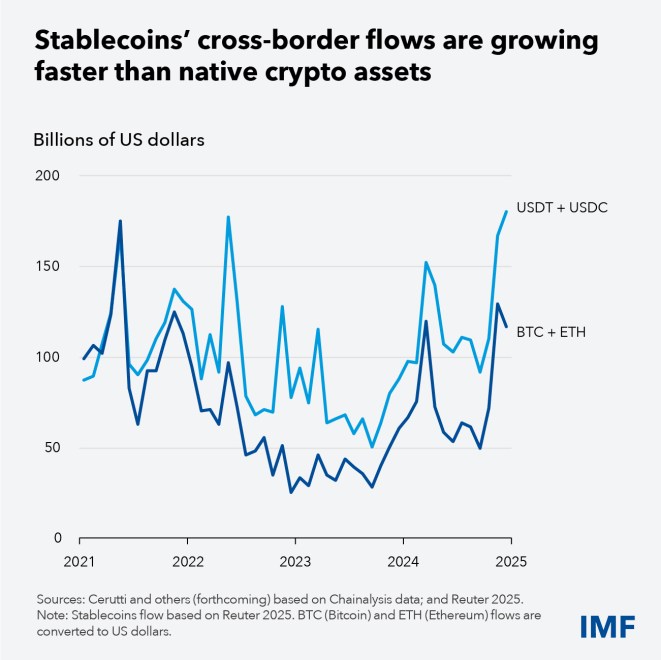
Amid the sector’s rapid growth, the organization highlighted that the two largest stablecoins, USDT and USDC, have tripled their market capitalization since 2023, reaching a combined $260 billion. Meanwhile, their trading volume has increased by around 90% to $23 trillion in 2024, with Asia surpassing North America in stablecoin activity volume.
The IMF noted two major potential benefits from stablecoins. First, they could enable faster and cheaper cross-border payments, especially for remittances, which can cost 20% of the amount being sent and face some delays.
However, “being a single source of information, blockchains can greatly simplify the processes linked with cross-border payments and reduce costs,” the Fund’s economists explained in a blog post.
Second, stablecoins could expand financial access, driving innovation by increasing competition with established payment service providers, therefore, making retail digital payments more accessible to underserved customers.
They could facilitate digital payments in areas where it is costly or not profitable for banks to serve customers. Many developing countries are already leapfrogging traditional banking with the expansion of mobile phones and different forms of digital and tokenized money.
Notably, competition with already established providers could lower costs and lead to enhanced product diversity, “leveraging synergies between digital payments and other digital services.”
IMF Warns Of Fragmented Oversight
Despite their potential benefits, stablecoins also carry significant risks, the IMF explained, including de-pegging and collapsing if the underlying assets lose value or if users lose confidence in the ability to cash out. Per the report, this could also trigger fire sales of the reserve assets and disrupt financial markets.
Stablecoins could also accelerate a “currency substitution” dynamic, where individuals and companies abandon their national currency in favor of a foreign one, like US dollars or euros, due to instability or high inflation.
The organization noted that the dynamic decreases a country’s central bank’s ability to control its monetary policy and serve as the lender of last resort, damaging the financial sovereignty of affected nations.
In addition, the potential to reduce cross-border frictions and make faster and cheaper transactions could be undermined by a lack of interoperability if various networks are unable to connect or are restricted by different regulations and other hurdles.
“Stablecoin regulation is in its infancy, so the ability to mitigate these risks remains uneven across countries,” the organization affirmed, noting that “the IMF and the Financial Stability Board have issued recommendations to safeguard against currency substitution, maintain capital flow controls, address fiscal risks, ensure clear legal treatment and robust regulation, implement financial integrity standards, and strengthen global cooperation.”
As reported by Bitcoinist, the FSB vowed in October to address the evolving threats from private finance and the growing use of stablecoins, promising to increase the global watchdog’s policy response and overhaul its surveillance system to make it more flexible and quicker.
Nonetheless, major jurisdictions have taken different stances in key areas, as the IMF detailed, which could result in the exploitation of gaps between jurisdictions and issuers to locate where oversight is weaker.
All this underscores the need for strong international cooperation to mitigate macrofinancial and spillover risks (…). Tokenization and stablecoins are here to stay. But their future adoption and the outlook for this technology are still mostly unknown.
The organization concluded that “improving the existing global financial infrastructure might be easier than replacing it. Achieving the best possible balance will require close cooperation among policymakers, regulators, and the private sector.”
How much would the XRP price grow if XRP's market cap appreciated by up to $1 trillion? XRP has been the subject of discussions and speculations over the past few days, especially following the launch of its first pure spot-based ETF, the Canary Capital XRP ETF (XRPC).
A widely followed early Bitcoin investor, known as NoLimit on X, has released long-term price targets for top crypto assets like XRP and Bitcoin through 2029. His projections come as Bitcoin trades at $92,370 and XRP sits at $2.09, offering a multi-year outlook amid growing expectations for the next major crypto cycle.
Following the launch of spot XRP ETFs, conversations around whether XRP could face a supply shock have gained momentum. This renewed interest has intensified on the back of a drop in exchange reserves on platforms like Binance.
Coinbase (COIN), the largest cryptocurrency exchange in the US, has experienced a significant decline in its stock valuation, dropping nearly 40% from its peak of $444 in July to its current trading level of around $271 per share. This, amid market fluctuations and heightened volatility in the broader crypto market, impacting the exchange’s stock performance.
Bernstein Forecasts New Bullish Phase For Coinbase
Despite these challenges, analysts at Bernstein hold an optimistic outlook on Coinbase’s stock price, suggesting a potential new bullish phase that could propel COIN to surpass previous all-time highs and reach levels above $500.
Bernstein maintains a price target of $510 on Coinbase, underlining the exchange’s shift from a trading-centric platform to what analysts dub an emerging “everything exchange.”
Analysts led by Gautam Chhugani highlighted the delicate market conditions, citing crypto price fluctuations influencing listed crypto-exposed equities.
However, Bernstein distinguishes the current market environment from past crypto downturns, noting that speculative excess primarily affects what they refer to as “MSTR copycats,” referencing Strategy’s (previously MicroStrategy) stock performance.
Central to Bernstein’s bullish thesis is Coinbase’s strategic diversification away from volatile spot trading revenue. They assert that exchange is evolving into a comprehensive financial platform.
The analysts emphasize that clearer regulatory guidelines in the US could drive a revaluation of these business lines, bridging the gap with offshore competitors benefiting from faster token listings and fundraising fees.
Coinbase’s foray into token issuance through a launchpad-style model, exemplified by Monad’s (MON) recent listing, demonstrates growing market interest. Bernstein notes that these launches, directly influencing trading activity, can stimulate a cycle of issuance, listing, and heightened trading volume.
Confident Ratings For COIN
Looking ahead, one of the exchange’s most notable catalysts is the upcoming product showcase on December 17, anticipated to unveil developments in tokenized equities, prediction markets, and other tools expanding the exchange’s offerings beyond spot crypto trading.
The integration with Deribit is also expected to further bolster Coinbase’s derivatives expansion, positioning the exchange closer to platforms like Robinhood as both entities diversify their product offerings.
On the consumer front, the exchange’s Base app, focusing on wallet services, payments, and social features, acts as a centralized access point for the broader token markets, reaffirming the analysts’ bullish predictions.
Bernstein’s reaffirmed “Buy” rating on Coinbase with a massive $510 price target underscores the firm’s confidence in COIN’s growth trajectory. Monness Crespi’s recent upgrade from “Neutral” to “Buy” with a $375 target further adds to the bullish sentiment surrounding the stock’s valuation amid falling prices.
Featured image from DALL-E, chart from TradingView.com
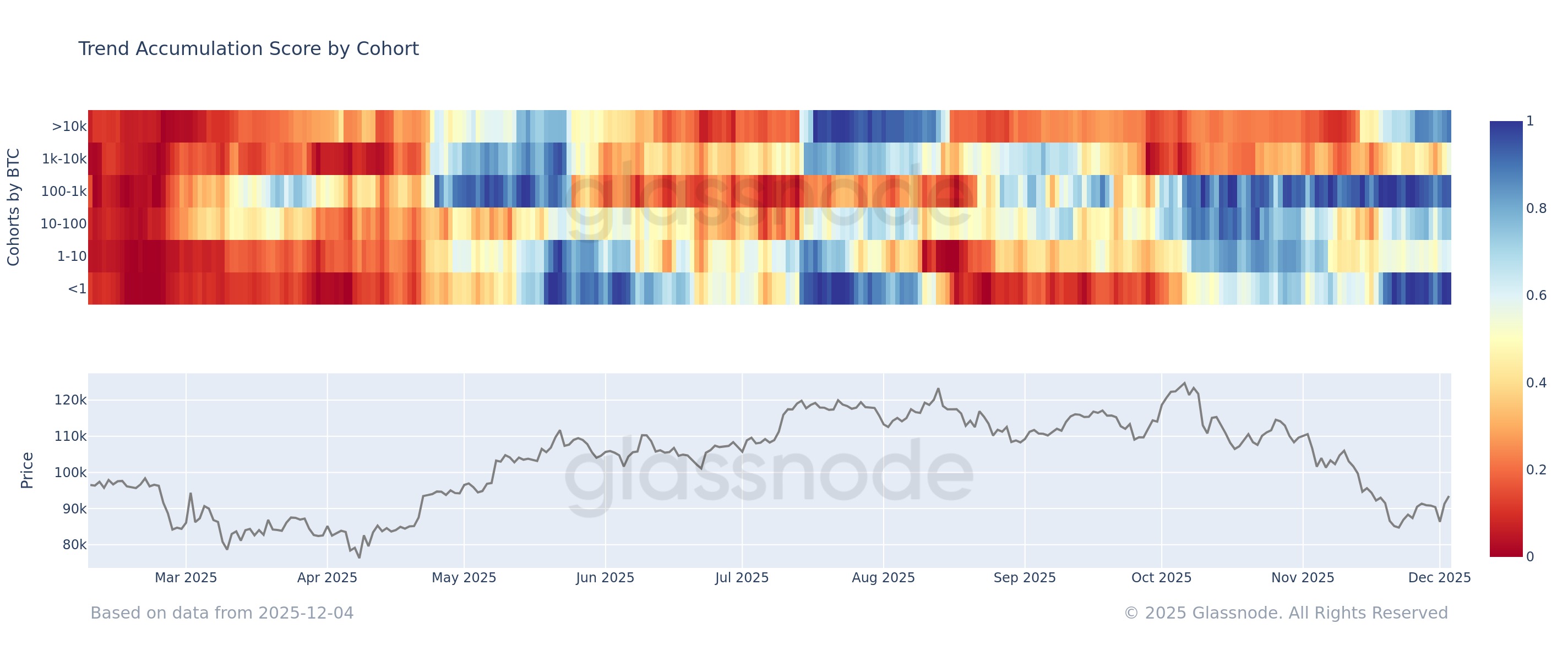
As explained by Glassnode analyst Chris Beamish in an X post, Bitcoin investors have been showing a lot less distribution at the recent price levels. The on-chain indicator of relevance here is the “Accumulation Trend Score,” which tells us about whether BTC holders are buying or selling.
The metric tracks investor behavior using not just the changes happening in their wallet balance, but also accounting for the size of their wallets. This means that larger entities have a higher influence on the score.
When the value of the Accumulation Trend Score is greater than 0.5, it means the investors are displaying a net trend of accumulation. On the other hand, it being under the threshold suggests the dominance of distribution.
Now, here is the chart shared by Beamish that shows how the Accumulation Trend Score has changed for the different Bitcoin investor segments over the last few years:
As displayed in the above graph, the Bitcoin Accumulation Trend Score has reflected a varied behavior for the different investor segments during the last couple of months, but very recently, a uniform picture has started to develop.
The smallest of investors in the market, those holding less than 1 BTC, started participating in aggressive accumulation around the time of BTC’s low in November and have since maintained the indicator nearly at a perfect value of 1. This suggests that retail investors have been buying the dip.
Meanwhile, the 100 to 1,000 BTC traders, popularly called the sharks, have been accumulating throughout the drawdown that has followed since the early October peak, indicating that these investors haven’t lost conviction despite the deep decline.
The story is a bit different for the whale cohorts, however. The 10,000+ BTC holders, corresponding to the largest of hands on the network, were in a phase of distribution between August and November, but they have finally started accumulating since the price low, although the Accumulation Trend Score isn’t as high as the retail investors in their case.
The 1,000 to 10,000 BTC whale group didn’t stop distributing even after the bottom, but very recently, their score has just breached the 0.5 mark. With this, a uniform behavior has begun to appear on the Bitcoin blockchain, with investors as a whole opting to expand their wallet balance.
It now remains to be seen how long this trend of accumulation will continue.
BTC Price
Bitcoin has faced a drop of more than 3% over the last 24 hours that has taken its price to $89,300.
XRP researcher Ripple Bull Winkle has stressed that new XRP ETFs will require millions of XRP to meet demand. In his commentary, he argued that the public “won’t realize what happened until it’s too late”.
Many in the crypto space have echoed a familiar sentiment over recent months: “The four-year crypto market cycle is dead.” Experts from the Bull Theory assert that while the four-year cycle may have come to an end, the Bitcoin bull run itself is merely delayed and could stretch until 2027.
Why The Four-Year Cycle May Be Ending
In a recent post on social media platform X, formerly known as Twitter, the Bull Theory analysts noted that the concept of Bitcoin adhering to a neat four-year cycle is weakening.
They highlighted that significant price movements over the last decade weren’t solely driven by Halving events; rather, they were influenced by shifts in global liquidity.
The analysts pointed to the current landscape of stablecoin liquidity, which remains high despite recent downturns, indicating that larger investors are still engaged in the market, poised to invest when appropriate macroeconomic conditions arise.
In the US, Treasury policies are emerging as pivotal catalysts. The recent buybacks are notable, but the analysts emphasize that the larger narrative lies in the Treasury General Account (TGA) balance, which is currently around $940 billion—almost $90 billion above its normal range.
This surplus cash is likely to flow back into the financial system, enhancing financing conditions and adding liquidity that typically gravitates toward risk assets.
Globally, the trends appear even more promising. China has been injecting liquidity for several months, while Japan recently announced a stimulus package worth approximately $135 billion, alongside efforts to simplify cryptocurrency regulations.
Canada is also moving toward easing its monetary policy, and the US Federal Reserve (Fed) has officially halted its quantitative tightening (QT) measures—a historical precursor to some form of liquidity expansion.
Political And Monetary Factors Align To Create Bullish Condition
The analysts explained that when major economies adopt expansive monetary policies simultaneously, risk assets like Bitcoin tend to respond more rapidly than traditional stocks or broader markets.
Additionally, potential policy tools, such as the Supplementary Leverage Ratio (SLR) exemption—implemented in 2020 to allow banks more flexibility in expanding their balance sheets—could return, resulting in increased credit creation and overall market liquidity.
There is also a political dimension to consider. President Trump has discussed potential tax reforms, including abolishing income tax and distributing $2,000 tariff dividends.
Furthermore, the likelihood of a new Federal Reserve chair who supports liquidity assistance and is constructive toward cryptocurrency could bolster conditions for economic growth.
Extended Bitcoin Uptrend
Historically, whenever the Institute for Supply Management’s Purchasing Managers’ Index (ISM PMI) surpasses 55, it has been followed by periods of altcoin season. The probability of this occurring in 2026 appears high, according to the Bull Theory.
The convergence of rising stablecoin liquidity, the Treasury’s injection of cash back into markets, global quantitative easing, the cessation of QT in the US, potential bank-lending relief, pro-market policy shifts in 2026, and major players entering the crypto sector suggests a very different scenario than the old four-year halving model.
The analysts concluded that if liquidity expands concurrently across the US, Japan, China, Canada, and other significant economies, Bitcoin is unlikely to move counter to that trend.
Therefore, rather than experiencing a sharp rally followed by a prolonged bear market, the current environment indicates a more extended and broader uptrend that could span through 2026 and into 2027.
Featured image from DALL-E, chart from TradingView.com
Do Kwon, the troubled co-founder of Terraform Labs based in Singapore, is facing a possible 12-year prison sentence in the United States due to his role in the collapse of the TerraUSD stablecoin, which resulted in significant losses within the cryptocurrency market.
Do Kwon Seeks Reduced Sentence Of Five Years
Bloomberg reported that in a court filing late Thursday, US prosecutors described the Terraform Labs co-founder’s fraudulent actions as “colossal in scope.”
They emphasized that his “misleading statements to customers” triggered a domino effect of crises across the crypto landscape, culminating in the downfall of notable entities such as Sam Bankman-Fried’s FTX.
This comes amid a regulatory environment that has grown increasingly lenient under the Trump administration. In late October, President Trump pardoned Binance founder Changpeng Zhao (CZ), who had been convicted for failing to uphold proper anti-money laundering measures.
In a recent court filing, Terraform Labs co-founder expressed a desire for a reduced sentence of five years. His legal team asserted that he has already “suffered substantially” for his actions, noting that he has spent nearly three years in detention conditions described as “brutal” in Montenegro.
Kwon’s lawyers argued that a five-year prison term would be sufficient and that the prosecutors’ recommendation of 12 years is “far greater than necessary” for justice to be served.
Potential For Sentence Transfer For Terraform Labs Co-Founder
Initially, Kwon pleaded not guilty in January to a nine-count indictment that charged him with securities fraud, wire fraud, commodities fraud, and conspiracy to commit money laundering. However, he changed his plea in August to guilty for conspiracy to defraud and wire fraud.
During this change, Terraform Labs’ leader acknowledged that his actions included making “false and misleading statements” regarding the restoration of TerraUSD’s peg in 2021, admitting, “What I did was wrong.”
As part of his plea agreement, Kwon has consented to forfeit $19.3 million and some properties. Prosecutors have chosen not to demand restitution for the millions of investors who collectively lost $40 billion, citing that calculating individual losses would be too complicated.
Kwon faces charges in both the US and his native South Korea, where prosecutors are also pursuing a lengthy prison sentence potentially reaching up to 40 years.
He was arrested in Montenegro in 2023 while using a fake passport, and following a protracted legal battle, he was extradited to the United States in January after spending nearly two years in a Balkan jail.
US prosecutors have indicated they would support Kwon’s opportunity to serve the second half of his sentence in South Korea, provided he adheres to the terms of his plea deal and qualifies for a transfer program. Kwon is scheduled for sentencing by US District Judge Paul Engelmayer on December 11.
When writing, Terraform Labs’ native token Luna Classic (LUNC) saw a 75% increase in response to Do Kwon’s probable sentence, trading at $0.000050 and placing it at the helm of the market’s top performers on Friday.
Featured image from DALL-E, chart from TradingView.com
Reports have disclosed that central banks around the globe have stepped up purchases of gold this year, with one month standing out. In October 2025, officials bought 53 tons of gold, a level that analysts say is the highest monthly demand seen this year. These moves reflect growing concern about inflation, weaker currencies and rising geopolitical risk.
Central Bank Buying Surges
According to data cited by financial outlets, 2025 is on track to be the fourth-highest year this century for institutional gold accumulation when measured net year-to-date through October. Analysts at Deutsche Bank put gold’s share of central-bank reserves at about 24%, a level not seen since the 1990s. Those figures help explain why governments that once moved away from bullion are returning to it now.
Bitcoin Enters The Conversation
Some banks and market researchers are now asking whether Bitcoin could play a similar role for national treasuries. Based on reports from major financial firms, Deutsche Bank projects that Bitcoin could appear on central-bank balance sheets by 2030 as a complementary reserve asset.
Central banks are ramping up gold purchases:
Global central banks purchased +53 tonnes of gold in October, the most since November 2024.
This marks a +194% jump compared to July, and the 3rd-straight monthly acceleration.
Bitcoin’s market profile has changed: liquidity has risen, and price swings have been less extreme during recent months even though volatility remains higher than older reserve assets. Bitcoin also reached a record above $123,500 in recent trading, a price point that has captured wide attention.
A Few Banks Are Testing The Idea
A small number of central banks are now at least studying the idea more seriously. The Czech National Bank, for example, has discussed the possibility of a “test allocation” to learn how crypto might behave inside a reserve mix. Those conversations tend to focus on custody, accounting rules and how to report gains or losses, rather than immediate buying.
On Gold & Bitcoin: Why Officials Are Cautious
Risk is the main reason most central banks have not moved faster. Bitcoin still shows larger price swings than standard reserve assets, and global rules for how to hold and audit crypto are not uniform. Based on expert commentary, regulators and auditors would need clear guidance before many central banks felt comfortable adding crypto to official reserves.
What This Could Mean For Markets
If even a handful of national banks were to allocate a small share of reserves to Bitcoin, demand could rise sharply and change how markets view the asset. A modest sovereign allocation would not replace gold or the US dollar, but it could give Bitcoin a stronger role as a hedge for countries facing currency weakness or rising inflation. At the same time, such a move would push more work into custody and compliance services, which would have to scale up quickly.
Gold buying by central banks is already significant — 53 tons in one month and about 24% of reserves in gold for some — and that Bitcoin is being discussed as a possible next step for some policymakers. The path from discussion to adoption is uncertain, and many technical and legal questions remain. Still, the debate has moved from theory to test runs and official reports, making this one of the more closely watched trends in global finance this year.
Featured image from Unsplash, chart from TradingView
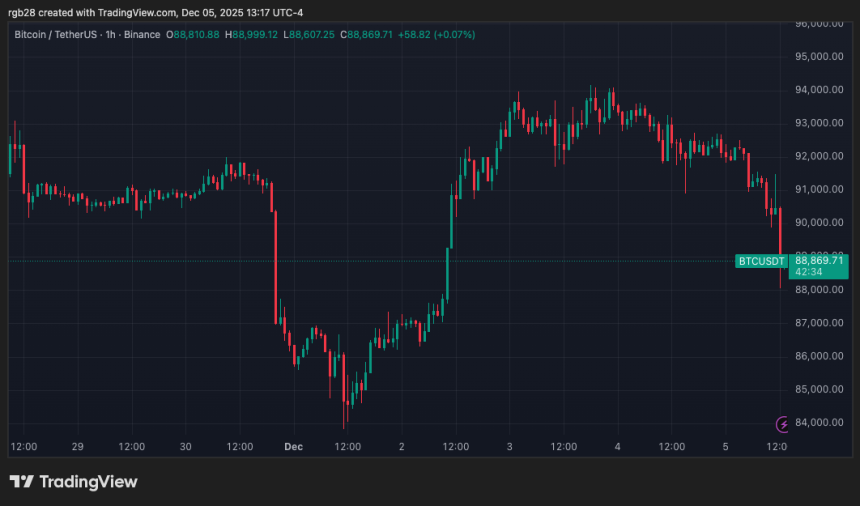
Bitcoin (BTC) is retesting a crucial support area after its price slid 5% from the recent highs and fell below the $90,000 barrier. Some analysts have suggested that the cryptocurrency’s structure remains intact, but warned that it must bounce quickly or risk retesting the November lows.
Bitcoin Retests $88,000 After Rejection
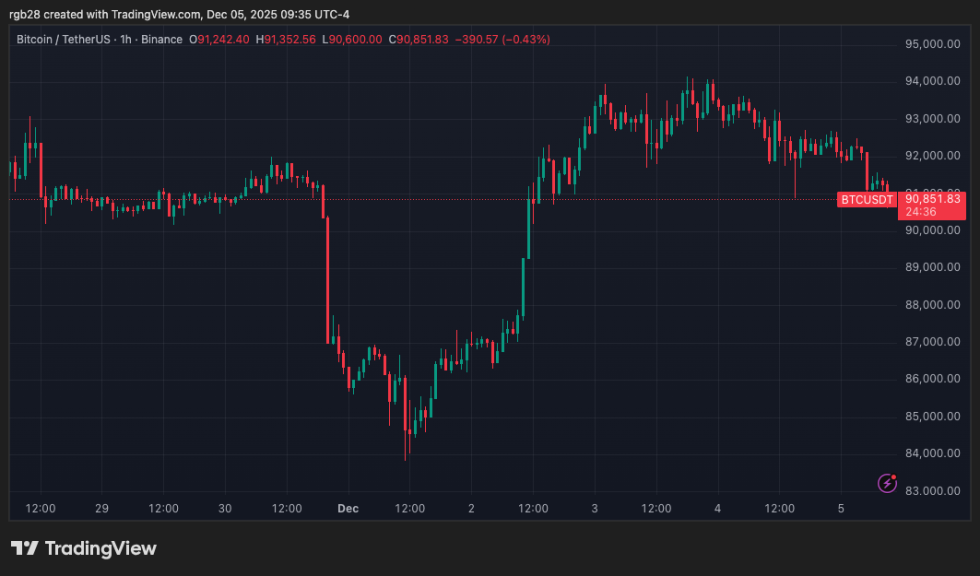
On Friday, Bitcoin lost the recently reclaimed $90,000 level, falling to a key support area before stabilizing. The flagship crypto has been attempting to recover from the November market correction, which sent its price to a seven-month low of $80,600.
Since reaching its local lows two weeks ago, the cryptocurrency has traded within a macro re-accumulation range, between $82,000 and $93,500, attempting to break out of this zone on Wednesday, when it reached a multi-week high of $94,150.
However, as the first week of December approaches its end, BTC has lost the upper area of its local range again, falling below its monthly open and tapping the $88,000 support.
Amid the drop, Analyst Ted Pillows noted that BTC has been struggling to reclaim the $94,000 resistance, adding that price “wants to go lower here before another breakout attempt.” Therefore, he suggested that a bounce back from the $88,000-$89,000 support zone is likely.
Altcoin Sherpa affirmed that the ongoing retest would confirm whether the recent bounce was “just lower highs and price is going lower or if we actually have any juice to bounce to like 100k or something.”
The analyst outlined two potential outcomes. In the first scenario, the flagship crypto would retrace to the $87,000-$89,000 area and bounce above the $93,000-$94,000 resistance levels.
In the second scenario, Bitcoin would continue to move sideways below the local resistance before eventually sliding to the November lows and potentially lower levels. Per the analysis, the leading cryptocurrency must bottom quickly, or it will risk the second outcome.
BTC Shows Shallowing Pullback Tendency
Analyst Rekt Capital also pointed out that Bitcoin continues to face rejection from the range high resistance. However, he considers that investors should not worry as long as the pullback isn’t as big as the previous ones.
If “the rejection is shallower than the previous two, then this resistance will continue to weaken until eventually breached,” he explained, adding that “as long as this weakening continues, BTC should be able to finally breach this resistance over time & try to challenge the multi-week Downtrend above.”
Earlier this week, the analyst affirmed that BTC’s consolidation structure will remain intact as long as Bitcoin closes the week above the range lows. He also noted that its Macro Downtrend, which “has been dictating resistance throughout this phase of the cycle,” remains the dominant structural barrier and the level to break.
As the price stabilized between the $88,500-$89,350 area, the analyst added that today’s retracement “continues to be a shallower pullback than the previous two,” which keeps the range “‘retrace shallowing’ tendency” intact.
He noted that Bitcoin could technically drop into the ascending two-week support trendline, or tap the $86,000 level and still perform a shallower correction than the recent 10% drop.
As of this writing, Bitcoin is trading at $89,400, a 2.9% decline in the daily timeframe.
The anticipated crypto market structure bill, or namely the CLARITY Act, designed to provide essential regulatory clarity for digital assets in the United States, is approaching critical dates in the Senate. However, it faces significant complexities related to stablecoin yield, conflicts of interest, and decentralized finance (DeFi).
Senate Divided On Crypto Market Structure Bill
Legal expert and Chief Legal Officer of Variant Jake Chervinsky, reports that the Senate is divided into two committees: Banking, which is handling the securities law aspect, and Agriculture, responsible for the commodities law portion.
Both committees have published drafts of their work this fall, with the next step being markup, a process where hearings will be held to vote on amendments before sending the bill to the Senate floor for a full vote.
However, both committees are cautious and are unlikely to proceed with markup until they resolve ongoing disputes. Among these, three significant issues stand out.
The first major concern involves stablecoin yield. In the GENIUS Act, banks lobbied for a prohibition on interest payments, meaning stablecoin issuers cannot offer holders any form of interest or yield.
While the current prohibition prevents direct yield payments to holders, it does not address non-yield rewards or yield provided by third parties. Banks consider this gap a “loophole” and are advocating for broader restrictions to be included in the market structure bill.
Conflicts Of Interest And DeFi Regulations Stall Progress
The second issue revolves around conflicts of interest. Some Democratic senators have indicated they would not support the market structure legislation unless it includes provisions that restrict the President’s family from conducting business in the crypto space.
The third and perhaps most crucial issue pertains to DeFi. It is important to note that market structure legislation primarily addresses centralized platforms that exercise custody over user funds and transactions.
Chervinsky believes the bill should primarily focus on protecting DeFi, but traditional finance (TradFi) stakeholders have been pushing Congress to categorize virtually all entities in the crypto sector—developers, validators, and others—as intermediaries.
The expert emphasized that the success of any market structure bill hinges on ensuring robust protections for developers since the viability of the crypto industry relies on their contributions.
Given the intricate nature of these issues and the swiftly approaching holiday break, Chervinsky noted that it is possible that discussions about market structure could extend into January.
Senate Markup Set For December 17-18
Market analyst MartyParty provided another update on December 4, indicating that the bipartisan Digital Asset Market Structure Bill is gaining significant momentum in Congress, with a markup session in the Senate Banking Committee tentatively scheduled for December 17-18, just before the holiday recess
If successfully passed, he states that the bill could establish clearer pathways for tokenized real-world assets (RWAs) and mitigate “debanking” risks, paving the way for compliant exchanges and potentially stimulating market volumes following the Commodity Futures Trading Commission (CFTC) approvals for spot crypto trading.
This “regulatory convergence” is seen as a catalyst that could drive liquidity and energize the next bull market, reinforcing President Trump’s vision for the US to emerge as the “crypto capital of the world.”
Featured image from DALL-E, chart from TradingView.com
BisonFi's launch enhances Solana's DeFi landscape, potentially attracting more institutional capital and fostering innovation in decentralized finance.
Despite the Bitcoin price recovery above the crucial $90,000 threshold—a level that has historically served as a supportive floor for the cryptocurrency—the market is exhibiting signs that a further correction may be imminent.
Bitcoin Price Recovery At Risk?
Market expert Rekt Fencer recently shared insights on social media platform X, formerly known as Twitter, suggesting that the Bitcoin price might be forming what he calls a “massive bull trap.”
This term refers to a deceptive bullish signal in which the price briefly surpasses a resistance level, in this case, the $90,000 mark, only to reverse into a decline. Such movements can entrap investors who bought in during the peak, leading to significant losses.
Fencer pointed out a troubling pattern reminiscent of early 2022 when Bitcoin reclaimed its 50-week moving average (MA)—currently positioned above $102,300—before experiencing a severe decline of roughly 60%, plummeting below $20,000 by June of that year.
He indicated that the recent price recovery following major drops to $84,000 should not be interpreted as a signal of near-term success, especially since the Bitcoin price is currently trading under the 50-week MA.
If historical trends repeat, this could mean that Bitcoin might see a significant drop, potentially reaching around $36,200, which could potentially represent the low point of the bearish cycle for the cryptocurrency. On the other hand, there are analysts who retain a bullish outlook.
BTC Bottom In Sight?
Market researcher and analyst Miles Deutscher expressed a confident sentiment, stating he believes there is a 91.5% likelihood that the Bitcoin price has hit its bottom, based on his analysis of key developments.
He noted that recent weeks have been dominated by negative news stories, including concerns surrounding Tether (USDT) and the implications of China’s actions on crypto, which he asserts often mark local price bottoms.
Moreover, Deutscher pointed out a shift in market flows from predominantly bearish to bullish. He explained that the trading environment has recently seen a resurgence in buying momentum, with large investors, or “OG whales,” ceasing their selling. This change has been reflected in the order books, indicating a possible stabilization in market sentiment.
Additionally, the liquidity landscape appears to be shifting, with market conditions tightening in recent months. The potential appointment of a new Federal Reserve chair known for dovish policies, coupled with the official end of quantitative tightening (QT), could further influence market dynamics in favor of buyers.
Deutscher concluded by emphasizing that given the extreme levels of fear, uncertainty, and doubt (FUD) in the market, combined with improvements in trading flows, he believes that the odds favor the notion that the Bitcoin price has indeed reached its bottom.
Featured image from DALL-E, chart from TradingView.com
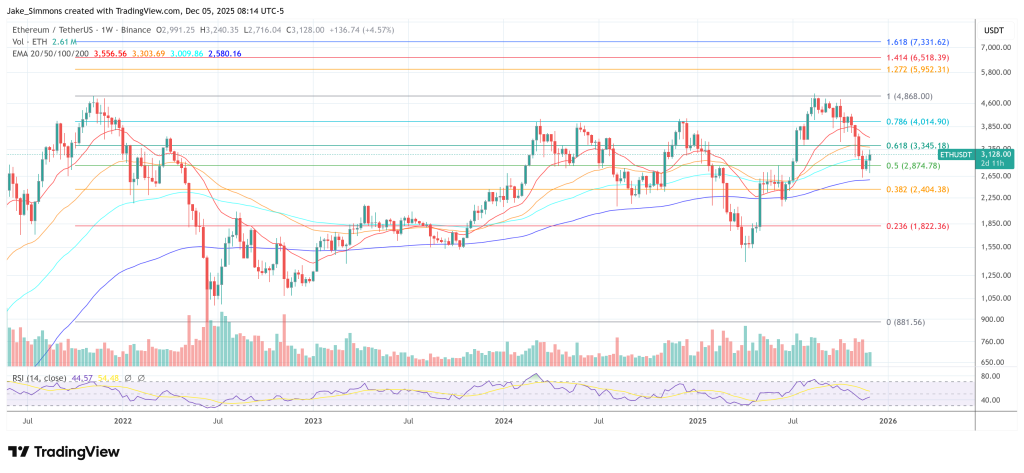
Tom Lee has reiterated one of the most aggressive Ethereum targets in the market, telling attendees at Binance Blockchain Week on 4 December that ETH could eventually trade at $62,000 as it becomes the core infrastructure for tokenized finance.
“Okay, so let me explain to you why Ethereum, now that we’ve talked about crypto, […] is the future of finance,” Lee said on stage. He framed 2025 as Ethereum’s “1971 moment,” drawing a direct analogy to when the US dollar left the gold standard and triggered a wave of financial innovation.
Lee’s Thesis For Ethereum
“In 1971, the dollar went off the gold standard. And in 1971, it galvanized Wall Street to create financial products to make sure the dollar would be the reserve currency,” Lee argued. “Well, in 2025, we’re tokenizing everything. So it’s not just the dollar that’s getting tokenized, but it’s stocks, bonds, real estate.”
In his view, this shift positions ETH as the primary settlement and execution layer for tokenized assets. “Wall Street is, again, going to take advantage of that and create products onto a smart contract platform. And where they’re building this is on Ethereum,” he said. Lee pointed to current real-world asset experiments as early evidence, noting that “the majority of this, the vast majority, is being built on Ethereum,” and adding that “Ethereum has won the smart contract war.”
Lee also stressed that ETH’s market behavior has not yet reflected that structural role. “As you know, ETH has been range bound for five years, as I’ve shaded here. But it’s begun to break out,” he told the audience, explaining why he “got very involved with Ethereum by turning Bitmine into an ETH treasury company, because we saw this breakout coming.”
The core of his valuation case is expressed through the ETH/BTC ratio. Lee expects Bitcoin to move sharply higher in the near term: “I think Bitcoin is going to get to $250,000 within a few months.” From there, he derives two key ETH scenarios.
First, if the ETH/BTC price relationship simply reverts to its historical mean, he sees substantial upside. “If ETH price ratio to Bitcoin gets back to its eight year average, that’s $12,000 for Ethereum,” he said. Second, in a more aggressive case where ETH appreciates to a quarter of Bitcoin’s price, his long-standing $62,000 target emerges: “If it gets to 0.25 relative to Bitcoin, that’s $62,000.”
“I think Ethereum’s going to become the future of finance, the payment rails of the future and if it gets to .25 relative to Bitcoin that’s $62,000. Ethereum at $3,000 is grossly undervalued.” pic.twitter.com/VydvLou9IE
Lee links these ratios directly to the tokenization narrative. “If 2026 is about tokenization, that means Ether’s utility value should be rising. Therefore, you should watch this ratio,” he told the crowd, arguing that valuation should track growing demand for ETH blockspace and its role as “the payment rails of the future.”
He concluded with a pointed assessment of current levels: “I think Ethereum at $3,000, of course, is grossly undervalued.”
Strive CEO Matt Cole has urged the MSCI to “let the market decide” whether they want to include Bitcoin-holding companies in their passive investments.

 Login
Login

















 TOM LEE CALLS FOR $62,000