Jake Claver, CEO of Digital Ascension Group, says ultra-wealthy families are rapidly accumulating XRP, and he believes most XRP holders still don’t realize how rare their position is. In a video posted on X, Claver revealed that his firm has been in recent conversations with large family offices that are now making significant allocations into XRP.
His comments arrive at a moment when XRP’s long-term narrative is witnessing increased interest due to ETFs, and they highlight a shift happening among investors who have always avoided cryptocurrencies altogether.
Wealthy Families Quietly Accumulating XRP
Claver explained that XRP ownership is currently extremely limited relative to the global population, noting that only around 8 million wallets exist on the XRPL. Half of those wallets contain fewer than 100 XRP, which makes existing holders far more uncommon than they may think. He contrasted this with Bitcoin’s widespread ownership, arguing that XRP is still early in its adoption curve.
He said the wealthy families showing interest are not looking for quick profits. According to him, they have already built their fortunes and instead see XRP as a form of insurance. According to his post, these families are buying crypto, not to get richer, but to protect the wealth they already have.
He described their interest in cryptocurrencies as a hedge. These investors want something uncorrelated in their portfolios ahead of any potential shock in traditional markets.
Claver’s $10K Price Target And The Conditions He Outlined
When asked where he sees the price of XRP going, Claver stated that he believes the cryptocurrency could be trading at $10,000 by late 2026 or early 2027. He tied this prediction to how much ecosystem infrastructure becomes active on the XRPL over the next two years.
He said the network would need substantial institutional-grade utilities, including XRP treasury systems, Evernorth’s launch, on-chain borrowing mechanisms, and new amendments to the XRP Ledger that will bring in additional compliance layers and smart-contract features.
His projection assumes that rising network volume will require higher liquidity levels and that price stability at four- and five-figure ranges will only be achievable if the ledger is handling large-scale financial flows. He also pointed to ETFs as a major factor in shaping supply and demand, noting that as ETF adoption grows, more XRP will be locked away in long-term institutional products.
Speaking of ETFs, Spot XRP ETFs are now approaching $1 billion in total net assets and could cross that threshold within the next few days. Since their debut, these funds have taken in about $897.35 million worth of XRP from exchanges and OTC desks, and they have yet to record a single day of outflows.
This growing demand ties directly into a quiet change happening among institutions, a trend Ripple’s CEO Brad Garlinghouse recently highlighted. He explained that Ripple is seeing notable activity through Ripple Prime, where long-watching institutions that once stayed out due to regulatory uncertainty or simple risk aversion are finally beginning to step in.
Featured image from Unsplash, chart from TradingView
A crypto analyst has predicted another devastating Bitcoin price crash that could see the leading cryptocurrency slide back below $85,000. With its weak performance over the past few months and price action showing signs of exhaustion, the analyst has predicted that the next major support level lies more than 33% below all-time highs.
Analyst Breaks Down Chart Signaling Bitcoin Price Crash
TradingView crypto expert ‘EliteGoldAnalysis’ has released a fresh chart study on Bitcoin’s next selling move, warning that the cryptocurrency’s downtrend may not be over yet. The analyst’s breakdown highlights a key support level he believes Bitcoin could crash to if its current downward momentum persists.
EliteGoldAnalysis outlines a price structure on the chart that begins with a weak high, a technical condition that often reflects a liquidity grab before a reversal. The appearance of a weak high near the top of Bitcoin’s most recent rally indicates that buyers may have been swept out before the momentum fully shifted. This pattern is accompanied by a steadily forming lower high, hinting at a developing bearish structure.
From his perspective, the analyst explains that a short bias becomes relevant only after a clear confirmation of a bearish trend. Based on the Bitcoin price chart, such confirmation could include a break of minor support beneath the weak high, followed by a retest of that level. EliteGoldAnalysis also noted that a bearish rejection through wick actions or a strong bearish close would strengthen the case for a temporary Bitcoin price crash.
While the analyst’s breakdown is just an interpretation of the chart rather than a trading call, Bitcoin’s price structure still hints at a possible retracement amid strengthening sell-side pressure.
How Low Bitcoin Price Could Decline
In his TradingView chart, EliteGoldAnalysis outlined critical zones that could dictate Bitcoin’s next bearish moves. The first region to watch is the potential “target level” marked in the purple zone above $85,000. The analyst views this level as a demand or imbalance area. Should Bitcoin reach and hold this target, it may act as the first checkpoint before the market decides whether to correct downwards or push higher.
Just beneath the $85,000 region lies a “strong support level” highlighted in blue at $84,000 on the chart. EliteGoldAnalysis predicts that Bitcoin could decline to as low as this $84,000 support area. The analyst suggests that this level is the final retracement target, potentially representing a significant liquidity pool that could attract buyers if the price declines.
A decisive drop toward this level would reflect a more than 6% decline from current levels above $89,000. Such a move would also mark the completion of the downside move implied by the chart structure. Over the past 24 hours, the price of Bitcoin has fallen roughly 3%, meaning a crash to $84,000 would further prolong the ongoing downtrend.
Featured image from Unsplash, chart from TradingView
An astrophotograph of the interstellar comet known as 3I/ATLAS highlights its green coma and a wandering blue-tinted ion tail. (Copyright Victor Sabet and Julien De Winter, republished with permssion)
Is an interstellar spacecraft zooming through our solar system? That’s the big question for fans of unidentified flying objects — and for a researcher at the University of Washington who analyzed the speculation over the interstellar comet known as 3I/ATLAS.
Mert Bayar, a postdoctoral scholar at the UW Center for an Informed Public, focused on 3I/ATLAS to track how social-media influencers use over-the-top speculation to fill in information gaps.
“I’ve written previously on how expert opinions can fuel conspiracy theorizing through elite-driven rumoring and amplification,” Bayar explained in an email to GeekWire. “My academic interest in philosophy, epistemology and the politics of conspiracy theories, plus a personal interest in space-related conspiracy theories, led me to look more closely at 3I/ATLAS.”
In ancient Greece, those higher powers might have been the gods on Mount Olympus. Bayar argues that a similar process exists today: “Where natural explanations feel incomplete, we substitute a different higher agency, not Zeus this time, but extraterrestrials,” he writes.
Such questions came into the spotlight when 3I/ATLAS was spotted in July. The object’s trajectory suggested that it was only the third known celestial interloper coming into the solar system from far beyond. Even after astronomers built up evidence to classify it as a comet, 3I/ATLAS exhibited enough anomalous behavior to sustain speculation about alien technology.
Exactly how was that speculation sustained? A key figure is Harvard astronomer Avi Loeb. Years before 3I/ATLAS was found, Loeb and a colleague raised the possibility that a previously sighted interstellar object known as ‘Oumuamua “may be a fully operational probe sent intentionally to Earth vicinity by an alien civilization.”
Loeb hit upon the alien-technology theme repeatedly in follow-up research papers and a book published in 2023. This year’s discovery of 3I/ATLAS gave a fresh boost to his speculative musings. To track how such musings influenced online discussions about 3I/ATLAS, Bayar used a media analytics platform called Brandwatch to analyze roughly 700,000 posts about the comet that were published on the X social-media channel between July 1 and Nov. 21.
“Almost 280,000 of the 700,000 posts invoke aliens or ET technology — about 40% of the 3I/ATLAS conversation on X,” Bayar writes. About 130,000 posts reference Loeb by name or by his status as a Harvard scientist. More than 82,000 posts explicitly pair his name with the alien-technology hypothesis.
“To be fair, at times, Avi Loeb states that 3I/ATLAS is most likely a natural interstellar comet,” Bayar says. “But he then spends far more time walking through its supposed ‘anomalies’ and entertaining the alien-technology hypothesis. For most audiences, the volume and emphasis of that speculation effectively buries the initial caveat and recenters the story around the alien frame rather than the natural-comet explanation.”
All that feeds into a broader online ecosystem that Bayar calls the “mystery economy.”
“Our information systems reward the production of mystery and speculation,” he writes. “That reward is amplified by a ready-made ecosystem of websites, content creators across platforms who produce, spread and amplify speculative takes. Those creators need a steady supply of ‘new’ material, and Loeb’s ever-growing list of anomalies, even when indirectly refuted by organizations like NASA, feeds that need for sustained mystery and endlessly recyclable content.”
In case you’re curious about the anomalies, Penn State astronomer Jason Wright, who focuses on studies of extrasolar planets and the search for extraterrestrial intelligence, ticks through Loeb’s list (and offers explanations that don’t involve aliens) in a blog post that was published last month.
But the point behind Bayar’s research has more to do with social-media dynamics than with planetary science. The insights gained from studying the “Alien of the Gaps” could well be applied to other spheres of conspiratorial theorizing, ranging from vaccine denialism to the search for a Jan. 6 pipe-bomb suspect.
Bayar had to limit his statistical analysis to posts about 3I/ATLAS on X, but he saw signs that information was flowing between different online platforms. “One of the most frequently appearing terms in the 3I/ATLAS conversation on X is ‘@YouTube,’ suggesting that many X accounts are reacting to or sharing YouTube videos,” he told GeekWire.
“Because of data-access constraints, we can’t confidently identify a single ‘nexus’ of spread,” Bayar said. “What we can say is that the conversation on X is both widely distributed and largely contained within alien-adjacent communities: Total volume is still under a million posts, which suggests it hasn’t broken out into a truly mass-viral story beyond the UFO/UAP crowd.”
[Michael Lynch] recently decided to delve into the world of off-grid, decentralized communications with MeshCore, because being able to communicate wirelessly with others in a way that does not depend on traditional communication infrastructure is pretty compelling. After getting his hands on a variety of hardware and trying things out, he wrote up his thoughts from the perspective of a hardware-curious software developer.
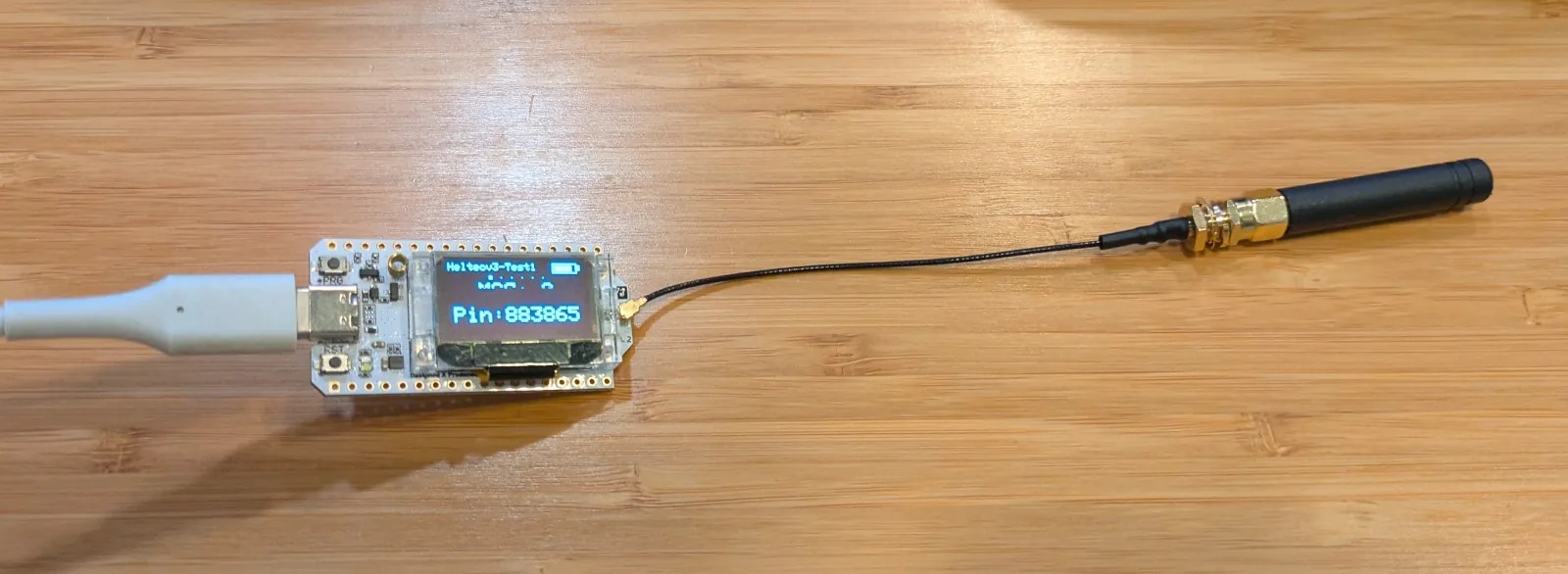
He ends up testing a variety of things: MeshCore firmware installed on a Heltec V3 board (used via an app over Bluetooth), a similar standalone device with antenna and battery built in (SenseCAP T-1000e, left in the header image), and a Lilygo T-Deck+ (right in the header image above). These all use MeshCore, which is built on and reportedly compatible with Meshtastic, a framework we have featured in the past.
The cheapest way to get started is with a board like the Heltec v3, pictured here. It handles the LoRa wireless communications part, and one interfaces to it over Bluetooth.
The first two devices are essentially MeshCore gateways, to which the user connects over Bluetooth. The T-Deck is a standalone device that resembles a Blackberry, complete with screen and keypad. [Michael] dove into what it was like to get them up and running.
Probably his most significant takeaway was that the whole process of onboarding seemed a lot more difficult and much less clear than it could be. This is an experience many of us can relate to: the fragmented documentation that exists seems written both by and for people who are already intimately familiar with the project in its entirety.
Another thing he learned was that while LoRa is a fantastic technology capable of communicating wirelessly over great distances with low power, those results require good antennas and line of sight. In a typical urban-ish environment, range is going to be much more limited. [Michael] was able to get a maximum range of about five blocks between two devices. Range could be improved by purchasing and installing repeaters or by having more devices online and in range of one another, but that’s where [Michael] drew the line. He felt he had gotten a pretty good idea of the state of things by then, and not being a radio expert, he declined to purchase repeater hardware without any real sense of where he should put them, or what performance gains he could expect by doing so.
Probably the most surprising discovery was that MeshCore is not entirely open source, which seems odd for an off-grid decentralized communications framework. Some parts are open, but the official clients (the mobile apps, web app, and T-Deck firmware) are not. [Michael] found this out when, being primarily a software developer, he took a look at the code to see if there was anything he could do to improve the poor user experience on the T-Deck and found that the firmware was proprietary.
[Michael]’s big takeaway as a hardware-curious software developer is that the concept is great and accessible (hardware is not expensive and there is no licensing requirement for LoRa), but it’s not really there yet in terms of whether it’s practical for someone to buy a few to distribute among friends for use in an emergency. Not without getting into setting up enough repeaters to ensure connectivity, anyway.
A feature that we’ve taken for granted since 2020 – the ability to shoot Portrait Mode photos using Night Mode – has quietly vanished from the latest Pro models. Users started noticing something was wrong and flagged it on Reddit and Apple’s forums. Now, Apple has officially confirmed via a support document that Night Mode […]
The Bitcoin market structure is believed to have undergone a massive shift since the significant price downturn seen on October 10, 2025. While the premier cryptocurrency has been on something resembling a recovery path since the market bloodbath, some sectors believe that the bear season has already kicked off.
With BTC sitting beneath its opening price of 2025, it is becoming increasingly difficult to make a bullish case for the world’s largest cryptocurrency. Moreover, an interesting data point about a relevant class of Bitcoin investors has emerged, further adding credence to the beginning of a possible bear market.
Are Bitcoin Treasury Firms Offloading Their Coins?
In a new post on X, CryptoQuant’s Head of Research, Julio Moreno, shared an on-chain insight to support the hypothesis that the Bitcoin bear market has started. This conclusion is based on the Balance Growth of an investor group known as the “dolphins.”
Dolphins refer to a group of crypto investors holding substantial amounts of a coin, placing them between small investors (shrimps) and the largest investors (whales). Specifically, Moreno described dolphins as wallet addresses with significant BTC holdings between 100 – 1,000 coins.
According to the latest data from CryptoQuant, the growth in the Dolphins’ BTC holdings has slowed down in the past year and appears to be in a downward trend. Moreno believes that this negative change points to the emergence of a Bitcoin bear market.
Moreno revealed that these Dolphin addresses had increased year-over-year by roughly 965,000 BTC when the BTC price hit its current all-time high around $125,000. Now that the BTC price is nearly 30% below its record high, the Bitcoin Dolphins’ balance stands at around 694,000 coins.
Moreno wrote on X:
This address cohort includes ETFs and Treasury companies, which have also stopped buying.
More interestingly, the CryptoQuant Head of Research revealed that this investor group consists of ETF issuers and Treasury companies, which have stopped purchasing Bitcoin. According to data from SoSoValue, the US-based Bitcoin exchange-traded funds have posted net outflows in five out of the last six weeks.
Meanwhile, BTC and crypto treasury companies have struggled in the past few months, with retail investors losing tens of billions to the hype. While there have been rarely reports of crypto treasury sell-offs, this decline in these Dolphins’ holdings tells an entirely different story.
Bitcoin Price At A Glance
As of this writing, the price of BTC stands at around $89,151, reflecting an over 3% decline in the past 24 hours.
In need of a little fall pick-me-up? Give your PC a little productivity boost with this Microsoft Office Professional 2021 for Windows lifetime license. This suite of eight helpful apps can give your device a total refresh, and right now it’s only $34.97 (reg. $219.99) — making the apps cost less than $5 each.
These days, purchasing a lifetime subscription to an app sets you back quite a bit. So this deal on Microsoft Office Professional 2021 for Windows is a massive bargain — delivering eight quality Microsoft apps for under $5 each.
Boost your productivity with Microsoft Office Professional 2021
Whether you’ve got a 9-to-5 or you’re still in school, the Microsoft Office apps are here to help. This license includes eight different tools to help you tackle your to-do list, and some of them are old classics you’ve known and loved for decades.
Draft documents in Word, create a spreadsheet in Excel, craft a presentation in PowerPoint, and manage your emails in Outlook. You’ll also have Teams there to keep you connected to your coworkers, OneNote to take good digital notes, Access to help you manage databases, and Publisher to design professional documents.
If the year of this edition gives you pause, don’t worry. All the apps have been redesigned and are built to improve everyone’s workflow — from data analysts to designers. After your purchase, you’ll receive instant delivery and download, meaning the apps will be installed directly on your device, and you won’t need a cloud connection. (Just make sure your device is running Windows 10 or 11 before purchasing.)
"First the penny. Next, paper checks?" asks CNN:
When the U.S. Mint stopped making pennies last month for the first time in 238 years, it drew a lot of attention. But there have been quiet moves to stop using paper checks as well. The government stopped sending out most paper checks to recipients as of the end of September, part of an effort to fully modernize federal benefits payments. And on Thursday the Federal Reserve put out a notice that suggested it is considering — but only considering — the "winding down" of checking services it now provides for banks.
The central bank's statement said that as an alternative to winding down those services, it is mulling more investment in its check processing services, but noted that would come at a higher cost. But it is also considering not making any such investments, in order to keep costs roughly unchanged. That would lead to reduced reliability of those services going forward. "Over time, check use has steadily declined, digital payment methods have grown in availability and use, and check fraud has risen," said the notice from the Fed. "Also, the Reserve Banks will need to make substantial investments in their check infrastructure to continue providing the same level of check services going forward."
A report from the Federal Reserve Bank of Atlanta in June found that as of last year, more than 90% of surveyed consumers said they prefer to use something other than a check for paying bills, and just 6% paid by check. That's a sharp drop from the 18% of bills paid by checks as recently as 2017. Consumers also reported they view checks as second-worst for convenience and speed of payment, ahead of only money orders. And they're ranked as the least secure form of any payment other than cash.
But even if it's true that options such as direct deposit, automatic bill paying and electronic payment systems such as Venmo, PayPal and Zelle have all reduced the need for traditional checks, paper checks are still an important part of the payment system. They make up about 5% of transactions and represent 21% of the value of all those payments, according to a statement from Michelle Bowman, the Fed's vice chair for supervision, who dissented from the Fed's Thursday statement.
Bloomberg reports that Google "must renegotiate any contract to make its search engine or artificial intelligence app the default for smartphones and other devices every year, a federal judge ruled."
Judge Amit Mehta in Washington sided with the US Justice Department on the one year limitation in his final ruling on what changes the search giant must make in the wake of a landmark ruling that the company illegally monopolized online search. The yearly renegotiation will give rivals — particularly those in the burgeoning generative AI field — a chance to compete for key placements.
The final judgment will still allow Google to offer its products to Apple Inc. for use in its popular iPhone and pay other electronics makers like Samsung Electronics Co. for default placement. But the judge said those contracts must be renegotiated annually. Mehta noted in his ruling that both Google and the US government said they could work with the one-year limitation on default contracts. As such, "the court holds that a hard-and-fast termination requirement after one year would best carry out the purpose of the injunctive relief."
Americans will be able to visit national parks for free on Donald Trump's birthday next year, but will no longer be able to do so on Martin Luther King Jr Day or Juneteenth.
Amazon will release its updated Kindle Scribe lineup next week, offering better performance, color capabilities, AI features, and cloud tools designed for reading, writing, and productivity.
The King and Queen have released their Christmas card for this year, featuring a portrait of the royal couple arm in arm as they celebrated their 20th anniversary.
 Login
Login