Data Privacy Services Powered by Privacy Ops: Achieving Global Compliance
Data Privacy Services Powered by Privacy Ops
Achieving Global Compliance Through Automation and AI
Title & Introduction
The modern digital ecosystem demands more than mere compliance; it requires operationalized data privacy. The shift from ad-hoc responses to a systematic **Privacy Operations (Privacy Ops)** framework is essential for organizations dealing with vast amounts of personal information (PI). Privacy Ops integrates people, processes, and technology to manage privacy risks continuously and automatically, transforming the burden of compliance into a strategic asset. With the proliferation of regulations like GDPR, CCPA, and LGPD, manual systems are obsolete, making AI-driven, platform-enabled services the only sustainable path forward.
This article explores a comprehensive Privacy Ops solution, detailing its features, service offerings, and its ability to seamlessly manage global regulatory coverage through automation and integrated data management.
Core Service Features: The Power of Automation
A successful Privacy Ops framework is defined by its ability to reduce human error and scale quickly. The core features leverage technology to automate complex, high-volume tasks, significantly lowering **low people dependency**.
AI-Powered Regulatory Analysis
An **AI powered bot for regulatory obligations analysis** instantly scans changes in global laws. By partnering with **UCF (Unified Compliance Framework) for authority sources**, the platform ensures that compliance requirements are current and accurate, eliminating the manual effort required to track evolving privacy standards.
Unified Data Integration
Handling diverse data environments is crucial. The platform supports **50+ data stores integrated through API**, ensuring a holistic view of all personal information assets. This unified approach facilitates accurate Data Inventory and **Data flow mapping** for comprehensive PI Modelling.
Monitoring & Reporting
The system provides **Automated track and monitor status**, displayed via **Interactive and dynamic dashboards**. These dashboards offer real-time insights into compliance metrics, risk levels, and the status of **Data Subject Rights Management (DSRM)** requests, allowing for proactive intervention.
Beyond these, the offering includes **Customised templates**, website **scan**, full **consent management & reporting**, making the entire compliance lifecycle platform enabled and highly streamlined.
Holistic Service Offerings and Global Coverage
The service architecture addresses the entire privacy spectrum, from proactive readiness to reactive breach management, covering major global laws.
1. Privacy Readiness & Impact Assessment
This is the proactive phase. Services include establishing a culture of **Privacy by Design**, performing **Privacy Maturity Assessment & Procedure blueprinting**. Crucially, it manages **Data Protection Impact Assessment (DPIA)** and **Privacy Impact Assessment (PIA)** processes, which are mandatory under regulations like GDPR. Finally, a robust **Breach Response & Management** protocol is established for rapid and compliant incident handling.
2. Data Subject Rights Management (DSRM)
Managing the rights of data subjects (like access, erasure, and portability) is a major operational challenge under regulations like CCPA and GDPR. The solution provides a dedicated **Data Subject Access rights portal for intake**, implements **Data subject identity validation**, ensures **Individual Request Fulfillment**, and maintains necessary **Records & Reporting** for audit purposes.
3. Consent & Cookie Compliance
Modern compliance requires granular control over user consent. This service handles **Consent categorization and status**, along with **Consent tracking and fulfilment**. It includes **Cookies Assessment & Implementation** and continuous **Consent & Website Scanning** to ensure ongoing legal adherence to cookie policies globally.
4. Global Regulatory Coverage
The complexity of compliance is minimized by covering a wide range of mandates, including:
EU-General Data Protection Regulation (**GDPR**)
California Consumer Privacy Act (**CCPA**), US
Lei Geral de Proteção de Dados (**LGPD**), Brazil
Australian Privacy Principles (**APP**)
Personal Information Protection and Electronic Documents Act (**PIPEDA**), Canada
Personal Data Protection Act (**PDPA**), Singapore
This wide coverage, supported by product partners like **OneTrust** and **BigID**, ensures a single, harmonized approach to multiple regulatory challenges.
Visual Diagram: Privacy Ops Flow
The successful implementation of Privacy Ops follows a continuous loop, driven by data ingestion and AI analysis, leading to automated controls and feedback.
Data Ingestion AI Regulatory Analysis & PI MappingAutomated DSRM & ConsentDashboards & Continuous Monitoring
Exam-Oriented Tips
For certification exams in privacy and data protection, focus on the operational aspects and key regulatory instruments:
Mastering Acronyms and Scope
**DPIA vs. PIA:** Understand the specific triggers for a Data Protection Impact Assessment (GDPR) and the broader Privacy Impact Assessment (general best practice).
**DSRM (Data Subject Rights Management):** Focus on the 7-step process—from intake via portal to final fulfillment and record-keeping.
**Key Global Laws:** Memorize the scope and core rights provided by **GDPR, CCPA, and LGPD**, as they are frequently compared in scenario-based questions.
**Privacy by Design:** Know the 7 foundational principles, especially the proactive and preventative nature of the approach.
Practice questions involving data flow mapping and determining compliance requirements when data crosses international boundaries (e.g., EU data processed in Singapore).
FAQ (Markdown)
**Q1: What is the primary role of the AI-powered bot?**

A1: The AI bot analyzes regulatory updates and obligations from sources like UCF to ensure real-time compliance tracking.

**Q2: How does the platform handle global regulations?**

A2: It provides harmonized controls covering major laws including GDPR, CCPA, LGPD, PIPEDA, and PDPA, allowing for central management.

**Q3: What are the key steps in Data Subject Rights Management?**

A3: Intake via a dedicated portal, identity validation, fulfillment of the request (e.g., erasure), and maintaining audit records and reporting.

**Q4: What is the purpose of Data Flow Mapping?**

A4: To identify where personal data is collected, stored, processed, and shared (data inventory and relationship) across the 50+ integrated data stores.

**Q5: What is 'Privacy by Design'?**

A5: A proactive approach ensuring privacy and security are built into the system architecture and business processes from the start, not added later.
FAQ: Visual Summary
Q1: Primary role of the AI-powered bot?A1: Analyzes regulatory updates from UCF for real-time tracking.Q2: How does the platform handle global regulations?A2: Harmonized controls covering GDPR, CCPA, LGPD, PIPEDA, and PDPA.Q3: Key steps in Data Subject Rights Management?A3: Intake via portal, identity validation, request fulfillment, and audit records.Q4: Purpose of Data Flow Mapping?A4: To identify where PI is collected, stored, processed, and shared (Data Inventory).Q5: What is 'Privacy by Design'?A5: Proactive approach: privacy and security are built into the architecture from the start.
During its half-century of existence, Microsoft has brought forth a plethora of products, but the company also has a number of inventions under its belt. While some are quite popular, you probably wouldn't guess they were invented by the Redmond Giant.
If you’re the type that throws away the packaging your PC parts come in, thinking it’s just fancy cardboard, you’ve come to the right place. I diligently collect the boxes my PC parts come in—and here’s why you should consider doing the same.
Alfa Romeo is making a dramatic statement with the return of its twin-turbo V-6, but this time, exclusivity is the name of the game. The new Giulia and Quadrifoglio Stelvio special editions will be offered only in select markets, and U.S. buyers won’t see a single example. With extremely limited production numbers, these models are shaping up to be some of the rarest Alfa Romeos ever produced, rarer than even some hypercars.
Today America's college professors "struggle to accommodate the many students with an official disability designation," reports the Atlantic, "which may entitle them to extra time, a distraction-free environment, or the use of otherwise-prohibited technology."
Their staff writer argues these accommodations "have become another way for the most privileged students to press their advantage."
[Over the past decade and a half] the share of students at selective universities who qualify for accommodations — often, extra time on tests — has grown at a breathtaking pace. At the University of Chicago, the number has more than tripled over the past eight years; at UC Berkeley, it has nearly quintupled over the past 15 years. The increase is driven by more young people getting diagnosed with conditions such as ADHD, anxiety, and depression, and by universities making the process of getting accommodations easier. The change has occurred disproportionately at the most prestigious and expensive institutions. At Brown and Harvard, more than 20 percent of undergraduates are registered as disabled. At Amherst, that figure is 34 percent. Not all of those students receive accommodations, but researchers told me that most do. The schools that enroll the most academically successful students, in other words, also have the largest share of students with a disability that could prevent them from succeeding academically. "You hear 'students with disabilities' and it's not kids in wheelchairs," one professor at a selective university, who requested anonymity because he doesn't have tenure, told me. "It's just not. It's rich kids getting extra time on tests...."
Recently, mental-health issues have joined ADHD as a primary driver of the accommodations boom. Over the past decade, the number of young people diagnosed with depression or anxiety has exploded. L. Scott Lissner, the ADA coordinator at Ohio State University, told me that 36 percent of the students registered with OSU's disability office have accommodations for mental-health issues, making them the largest group of students his office serves. Many receive testing accommodations, extensions on take-home assignments, or permission to miss class. Students at Carnegie Mellon University whose severe anxiety makes concentration difficult might get extra time on tests or permission to record class sessions, Catherine Samuel, the school's director of disability resources, told me. Students with social-anxiety disorder can get a note so the professor doesn't call on them without warning... Some students get approved for housing accommodations, including single rooms and emotional-support animals. Other accommodations risk putting the needs of one student over the experience of their peers. One administrator told me that a student at a public college in California had permission to bring their mother to class. This became a problem, because the mom turned out to be an enthusiastic class participant. Professors told me that the most common — and most contentious — accommodation is the granting of extra time on exams...
Several of the college students I spoke with for this story said they knew someone who had obtained a dubious diagnosis... The surge itself is undeniable. Soon, some schools may have more students receiving accommodations than not, a scenario that would have seemed absurd just a decade ago. Already, at one law school, 45 percent of students receive academic accommodations. Paul Graham Fisher, a Stanford professor who served as co-chair of the university's disability task force, told me, "I have had conversations with people in the Stanford administration. They've talked about at what point can we say no? What if it hits 50 or 60 percent? At what point do you just say 'We can't do this'?" This year, 38 percent of Stanford undergraduates are registered as having a disability; in the fall quarter, 24 percent of undergraduates were receiving academic or housing accommodations.
Donald Trump's eldest son has said his father may walk away from the Ukraine peace process, claiming the issue is not a priority for Americans, and signalling Europe needs a better plan.
Young people could lose their right to universal credit if they refuse to engage with help from a new scheme without good reason, the government has warned.
Popular genetics tests can’t tell you much about your dog’s personality, according to a recent study.
A team of geneticists recently found no connection between simple genetic variants and behavioral traits in more than 3,200 dogs, even though previous studies suggested that hundreds of genes might predict aspects of a dog’s behavior and personality. That’s despite the popularity of at-home genetic tests that claim they can tell you whether your dog’s genes contain the recipe for anxiety or a fondness for cuddles.
This is Max, and no single genetic variant can explain why he is the way he is.
Credit:
Kiona Smith
Gattaca for dogs, except it doesn’t work
University of Massachusetts genomicist Kathryn Lord and her colleagues compared DNA sequences and behavioral surveys from more than 3,000 dogs whose humans had enrolled them in the Darwin’s Ark project (and filled out the surveys). “Genetic tests for behavioral and personality traits in dogs are now being marketed to pet owners, but their predictive accuracy has not been validated,” wrote Lord and her colleagues in their recent paper.
The FOMC meeting is scheduled for next Tuesday (December 9-10), and the market is almost unanimous on a dovish stance from the Fed.
Polymarket traders are pricing in a 92% probability of a 25-basis-point cut, which has shifted Bitcoin price analysis from a bearish breakdown to a potential comeback.
Powell Expected to Deliver 25bps Cut Despite Inflation Concerns
Federal Reserve Chair Jerome Powell is expected to proceed with another quarter-point rate reduction this week, even as several policymakers express concern about persistent inflation.
The Fed implemented its second consecutive cut in October, responding to unexpected weakness in the summer jobs data.
Following that decision, hawkish voices emerged among officials, including five current voting members, who indicated reluctance to support further easing in December.
The tide turned on November 21 when New York Fed President John Williams suggested conditions warranted a reduction in the “near term.”
Bitcoin “liveliness” is climbing again, a pattern that has historically coincided with bull market phases, suggesting the current cycle may have substantial upside remaining.
Analyst Michaël van de Poppe outlined a bullish scenario, anticipating short-term volatility before a sustained rally.
He expects pre-FOMC selling pressure today and Monday, potentially driving prices down to $87,000 to sweep liquidity at the lows.
This would be my bullish scenario.
Pre-FOMC and on Monday, correction to sweep the lows. Perhaps hitting $87K.
After that, bounce back up, swiftly, in which the uptrend is confirmed for #Bitcoin and it's ready to break $92K and therefore the run towards $100K in the coming 1-2… pic.twitter.com/lQezKkQM5W
“After that, bounce back up, swiftly, in which the uptrend is confirmed for Bitcoin and it’s ready to break $92,000
And therefore the run towards $100,000 in the coming 1-2 weeks as the Fed is reducing QT, doing rate cuts and expanding the money supply to increase the business cycle,” van de Poppe stated.
Technical analysis shows Bitcoin breaking out of a long descending red channel, signalling that the strongest phase of the downtrend has likely ended.
Price is currently hovering around the $89,000 zone, which sits just beneath a key resistance-turned-support area highlighted in orange.
Until BTC closes decisively above this zone, sellers can still create short-term pressure.
Source: TradingView
The breakout attempt already shows early strength, as BTC bounced from the lower channel region near $79,000 and pushed back toward mid-trend.
The next major resistance level is around $94,600, and clearing it would confirm bullish continuation.
If that happens, the chart projects upside targets at $108,000 and eventually $116,000, which align with previous liquidity zones.
Maxi Doge Presale Capitalizes on Market Momentum
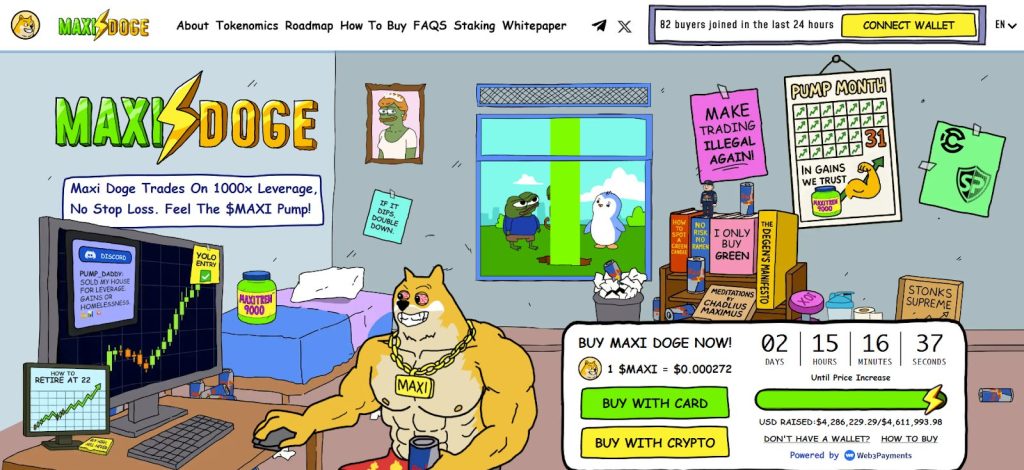
As Bitcoin positions for a potential comeback driven by Fed rate cuts, presale projects like Maxi Doge (MAXI) are attracting investor attention.
MAXI is capturing the grassroots momentum that drove Dogecoin’s extraordinary 161,000x rally.
The project has secured over $4.2 million in funding while building an active community focused on sharing trading strategies and market opportunities.
Notably, 25% of capital raised will be invested in promising plays, with returns recycled into marketing initiatives and community rewards to accelerate growth.
 Login
Login