
❌

Normal view

There are new articles available, click to refresh the page.
Before yesterdayMain stream

Meet The Shape That Cannot Pass Through Itself

17 November 2025 at 14:30

Can a shape pass through itself? That is to say, if one had two identical solids, would it be possible to orient one such that a hole could be cut through it, allowing the other to pass through without breaking the first into separate pieces? It turns out that the answer is yes, at least for certain shapes. Recently, two friends, [Sergey Yurkevich] and [Jakob Steininger], found the first shape proven not to have this property.
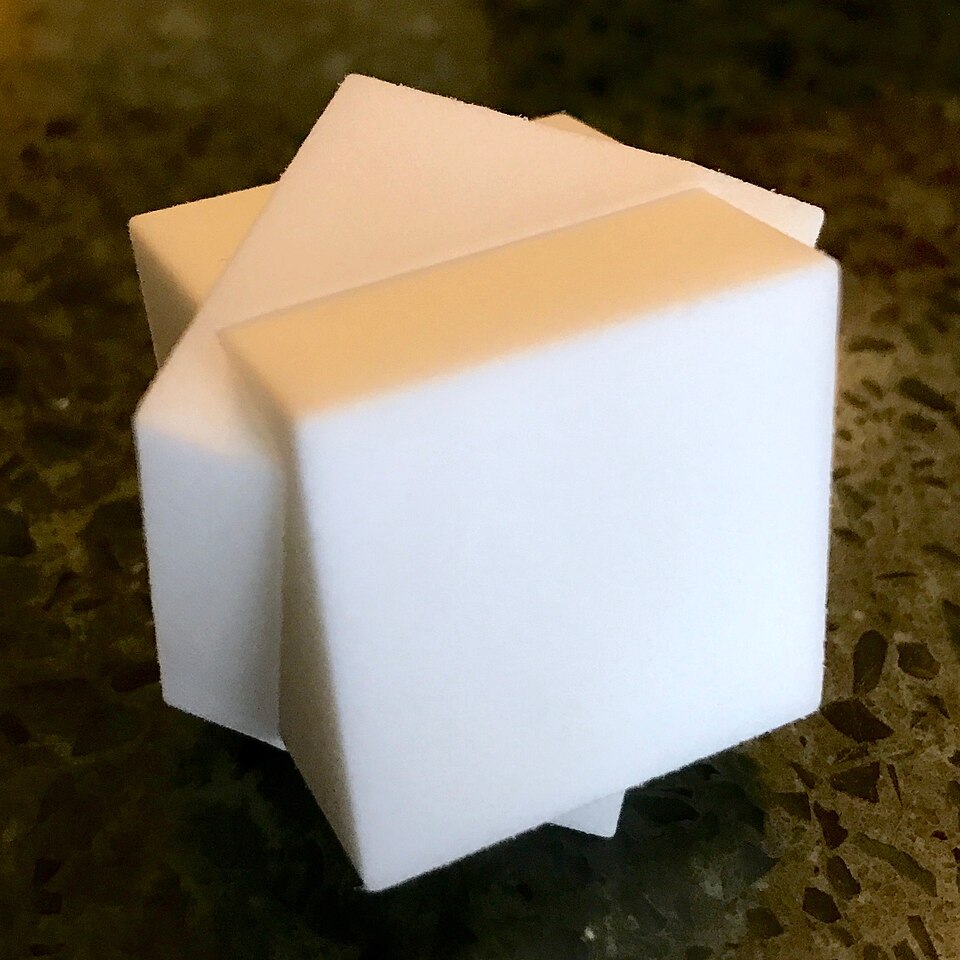
A 3D-printed representation of a cube passing through itself [image: Wikipedia]
Back in the late 1600s, Prince Rupert of the Rhine proved it was possible to accomplish this feat with two identical cubes. One can tilt a cube just so, and the other cube can fit through a tunnel bored through it. A representation is shown here.

Later, researchers showed this was also true of more complex shapes. This ability to pass unbroken through a copy of oneself became known as Rupert’s Property. Sometimes it’s an amazingly tight fit, but it seems to always work.

In fact, it was so difficult to find candidates for exceptions to this that it was generally understood and accepted by mathematicians that every convex polyhedron (that is, every shape with flat sides and no holes, protrusions, or indentations) would have Rupert’s property. Until one was found that did not.
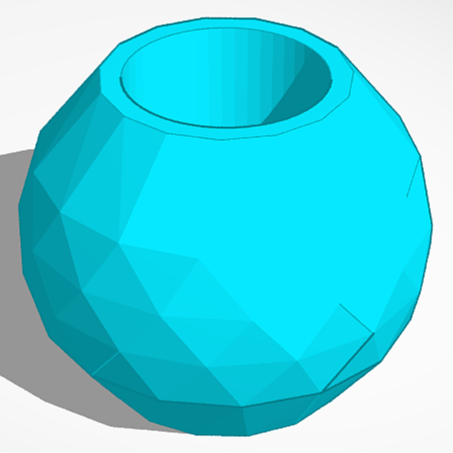
Noperthedron pencil holder

The first shape proven not toΒ be able to pass through itself β€” known as the Noperthedron β€” is a vaguely ball-like shape, with a flat top and bottom. A fan has already added a cavity to create a 3D-printable pencil holder version of the noperthedron (shown here) if you want your own.

There are other promising candidate objects (they are rare) that may also lack Rupert’s property, but so far, this is the only proven one.

Shapes with unusual properties are interesting, and we love how tactile and visual they are. Consider Penrose tiles, a tile set that can cover any size of area without repeating. For decades, the minimum number of tile shapes needed to accomplish this was two. Recently, though, the number has dropped to one thanks to a shape known as β€œthe hat.”

What if the aliens come and we just can’t communicate?

13 November 2025 at 14:54

Science fiction has long speculated about the possibility of first contact with an alien species from a distant world and how we might be able to communicate with them. But what if we simply don’t have enough common ground for that to even be possible? An alien species is bound to be biologically very different, and their language will be shaped by their home environment, broader culture, and even how they perceive the universe. They might not even share the same math and physics. These and other fascinating questions are the focus of an entertaining new book, Do Aliens Speak Physics? And Other Questions About Science and the Nature of Reality.

Co-author Daniel Whiteson is a particle physicist at the University of California, Irvine, who has worked on the ATLAS collaboration at CERN’s Large Hadron Collider. He’s also a gifted science communicator who previously co-authored two books with cartoonist Jorge Cham of PhD Comics fame: 2018’s We Have No Idea and 2021’s Frequently Asked Questions About the Universe. (The pair also co-hosted a podcast from 2018 to 2024, Daniel and Jorge Explain the Universe.) This time around, cartoonist Andy Warner provided the illustrations, and Whiteson and Warner charmingly dedicate their book to β€œall the alien scientists we have yet to meet.”

Whiteson has long been interested in the philosophy of physics. β€œI’m not the kind of physicist who’s like, β€˜whatever, let’s just measure stuff,'” he told Ars. β€œThe thing that always excited me about physics was this implicit promise that we were doing something universal, that we were learning things that were true on other planets. But the more I learned, the more concerned I became that this might have been oversold. None are fundamental, and we don’t understand why anything emerges. Can we separate the human lens from the thing we’re looking at? We don’t know in the end how much that lens is distorting what we see or defining what we’re looking at. So that was the fundamental question I always wanted to explore.”

Read full article

Comments

Β© Andy Warner

❌
❌