The FOMC meeting is scheduled for next Tuesday (December 9-10), and the market is almost unanimous on a dovish stance from the Fed.
Polymarket traders are pricing in a 92% probability of a 25-basis-point cut, which has shifted Bitcoin price analysis from a bearish breakdown to a potential comeback.
Powell Expected to Deliver 25bps Cut Despite Inflation Concerns
Federal Reserve Chair Jerome Powell is expected to proceed with another quarter-point rate reduction this week, even as several policymakers express concern about persistent inflation.
The Fed implemented its second consecutive cut in October, responding to unexpected weakness in the summer jobs data.
Following that decision, hawkish voices emerged among officials, including five current voting members, who indicated reluctance to support further easing in December.
The tide turned on November 21 when New York Fed President John Williams suggested conditions warranted a reduction in the “near term.”
Bitcoin “liveliness” is climbing again, a pattern that has historically coincided with bull market phases, suggesting the current cycle may have substantial upside remaining.
Analyst Michaël van de Poppe outlined a bullish scenario, anticipating short-term volatility before a sustained rally.
He expects pre-FOMC selling pressure today and Monday, potentially driving prices down to $87,000 to sweep liquidity at the lows.
This would be my bullish scenario.
Pre-FOMC and on Monday, correction to sweep the lows. Perhaps hitting $87K.
After that, bounce back up, swiftly, in which the uptrend is confirmed for #Bitcoin and it's ready to break $92K and therefore the run towards $100K in the coming 1-2… pic.twitter.com/lQezKkQM5W
“After that, bounce back up, swiftly, in which the uptrend is confirmed for Bitcoin and it’s ready to break $92,000
And therefore the run towards $100,000 in the coming 1-2 weeks as the Fed is reducing QT, doing rate cuts and expanding the money supply to increase the business cycle,” van de Poppe stated.
Technical analysis shows Bitcoin breaking out of a long descending red channel, signalling that the strongest phase of the downtrend has likely ended.
Price is currently hovering around the $89,000 zone, which sits just beneath a key resistance-turned-support area highlighted in orange.
Until BTC closes decisively above this zone, sellers can still create short-term pressure.
Source: TradingView
The breakout attempt already shows early strength, as BTC bounced from the lower channel region near $79,000 and pushed back toward mid-trend.
The next major resistance level is around $94,600, and clearing it would confirm bullish continuation.
If that happens, the chart projects upside targets at $108,000 and eventually $116,000, which align with previous liquidity zones.
Maxi Doge Presale Capitalizes on Market Momentum
As Bitcoin positions for a potential comeback driven by Fed rate cuts, presale projects like Maxi Doge (MAXI) are attracting investor attention.
MAXI is capturing the grassroots momentum that drove Dogecoin’s extraordinary 161,000x rally.
The project has secured over $4.2 million in funding while building an active community focused on sharing trading strategies and market opportunities.
Notably, 25% of capital raised will be invested in promising plays, with returns recycled into marketing initiatives and community rewards to accelerate growth.
Auditing is a systematic and independent examination of processes, systems, or organizations to ensure compliance with established standards. A structured audit helps organizations identify gaps, mitigate risks, and promote continual improvement.
Auditing Principles & Benefits
Ethical Conduct, Fair Presentation, Due Professional CareVerified conformity, increases awareness & understandingIndependence & Evidence-Based ApproachReduces risks & identifies improvement opportunitiesContinuous ImprovementPerformed regularly ensures system effectiveness
Process Approach in Auditing
Auditors can apply the process approach by ensuring the auditee:
Defines objectives, inputs, outputs, activities, and resources for processes
Analyses, monitors, measures, and improves processes
Understands sequence and interaction of its processes
Individual ProcessInput/Output, PDCA, ResourcesRelationship with Other ProcessesFlow, Interaction, Evidence, Contracts
Managing an Audit Program
Effective audit programs include planning, scheduling, and resource allocation. A well-managed program ensures audits are systematic, consistent, and align with organizational objectives.
Audit Activities
Opening Meeting
Document Review
On-Site Audit / Observation
Interviews & Evidence Collection
Closing Meeting
Auditor Competence & Responsibilities
Auditors must possess:
Knowledge of standards & regulations
Analytical and communication skills
Objectivity and ethical conduct
Ability to report findings accurately
Key Take Aways
Audit management is often perceived merely as a regulatory necessity, but in reality, it is a cornerstone of organizational health and strategic growth. While compliance with standards—whether ISO 27001, ISO 9001, or internal policies—is the baseline, the true value of a robust audit management system lies in its ability to transform raw data into actionable business intelligence. A systematic approach to auditing does not just verify if rules are being followed; it evaluates whether those rules are actually helping the organization achieve its objectives.
The Strategic Value of Audit Management
Audit management is often perceived merely as a regulatory necessity, but in reality, it is a cornerstone of organizational health and strategic growth. While compliance with standards—whether ISO 27001, ISO 9001, or internal policies—is the baseline, the true value of a robust audit management system lies in its ability to transform raw data into actionable business intelligence.
The Lifecycle: From Opening to Closure
The journey from the opening meeting to the closing meeting is where the integrity of the audit is established. This structured lifecycle ensures that there are no surprises and that the audit concludes with a clear roadmap for the future.
Risk Mitigation and Proactive Defense
In today’s volatile digital landscape, waiting for a breach or a failure to occur is not an option. Audit management serves as an organization’s "early warning system." By systematically reviewing controls and processes, auditors identify vulnerabilities and latent risks that might otherwise go unnoticed until they cause significant damage.
Key Insight: Effective audit management shifts an organization’s posture from reactive to proactive. Instead of scrambling to fix issues after a regulatory fine, the audit process highlights weak control environments early.
Driving Continuous Improvement
Perhaps the most critical aspect of audit management is its contribution to Continuous Improvement (CI). An audit that ends with a report filing is a wasted opportunity. By identifying non-conformities and opportunities for improvement (OFIs), audits force organizations to analyze the root causes of their problems, moving away from temporary "band-aid" fixes toward sustainable solutions.
Audit Activities Checklist
Opening Meeting: Confirm scope, criteria, and plan.
Document Review: Verify documented information against standards.
On-Site Audit: Observe processes and interview staff.
Closing Meeting: Present findings and agree on timeline.
FAQ: Visual Summary
Q1: What is Audit Management?A1: Systematic examination from opening meeting to closure ensuring compliance.Q2: What is Process Approach in Auditing?A2: Ensures objectives, inputs, outputs, and interactions are clearly defined.Q3: What are auditor responsibilities?A3: Knowledge, ethics, analytical skills, and accurate reporting of findings.Q4: What activities are included?A4: Opening meeting, document review, observation, interviews, closing meeting.
ISO/IEC 27001 is the global standard for Information Security Management Systems (ISMS). The 2022 revision introduces updates aligning with evolving cybersecurity threats, risk management practices, and digital transformation requirements. Understanding the differences between the 2013 and 2022 versions is critical for professionals preparing for audits or certification exams.
Overview of ISO/IEC 27001:2013 vs 2022
The 2013 version focused on 14 control domains and 114 controls under Annex A. The 2022 version streamlined these into 4 categories with 93 updated controls, emphasizing a risk-based approach, organizational context, and alignment with modern technology practices.
2013: 14 control domains, 114 controls
2022: 4 control categories, 93 controls
New focus on cloud security, privacy, and remote work risk management
Integration with other management systems (ISO 22301, ISO 9001)
Core Clauses and Annex Controls
Both versions follow a high-level structure (Annex SL), but the 2022 update introduces:
Context of the organization
Leadership & commitment
Planning and risk assessment
Support & awareness
Operation and performance evaluation
Improvement
Annex controls are now grouped under 4 categories:
Organizational
People
Physical
Technological
ISMS Process: Step-by-Step
Implementing an ISMS involves several systematic steps:
Define the scope of ISMS
Establish an information security policy
Perform risk assessment & treatment planning
Implement controls
Monitor, measure, and evaluate effectiveness
Conduct internal audits and management review
Continual improvement based on findings
Awareness & Training
Awareness programs and training sessions are essential to:
Ensure all employees understand security policies
Align roles & responsibilities
Promote a security-first culture
Prepare for internal & external audits
Exam-Oriented Tips
Key points for ISO/IEC 27001 exams:
Focus on differences between 2013 vs 2022
Memorize the 4 main control categories and 93 controls (2022)
Understand ISMS PDCA cycle steps
Prepare for scenario-based questions on risk treatment and audit findings
Q1: Differences between ISO/IEC 27001:2013 & 2022?A1: 2022 reduces controls to 93 & groups into 4 categories.Q2: How many clauses in both versions?A2: Both follow Annex SL with 10 clauses (context, leadership, planning, etc.)Q3: What is the PDCA cycle?A3: Plan → Do → Check → Act; ensures continuous improvement.Q4: How to prepare for ISO/IEC 27001 exam?A4: Focus on clauses, controls, ISMS process & scenario-based questions.Q5: Are 2013 controls still valid?A5: Mapped to 2022; transition based on risk assessment & updated controls.
Plotters aren’t as common as they once were. Today, many printers can get high enough resolution with dots that drawing things with a pen isn’t as necessary as it once was. But certainly you’ve at least seen or heard of machines that would draw graphics using a pen. Most of them were conceptually like a 3D printer with a pen instead of a hotend and no real Z-axis. But as [biosrhythm] reminds us, some plotters were suspiciously like typewriters fitted with pens.
Instead of type bars, type balls, or daisy wheels, machines like the Panasonic Penwriter used a pen to draw your text on the page, as you can see in the video below. Some models had direct computer control via a serial port, if you wanted to plot using software. At least one model included a white pen so you could cover up any mistakes.
If you didn’t have a computer, the machine had its own way to input data for graphs. How did that work? Read for yourself.
Panasonic wasn’t the only game in town, either. Silver Reed — a familiar name in old printers — had a similar model that could connect via a parallel port. Other familiar names are Smith Corona, Brother, Sharp, and Sears.
Since all the machines take the same pens, they probably have very similar insides. According to the post, Alps was the actual manufacturer of the internal plotting mechanism, at least.
The video doesn’t show it, but the machines would draw little letters just as well as graphics. Maybe better since you could change font sizes and shapes without switching a ball. They could even “type” vertically or at an angle, at least with external software.
Since plotters are, at heart, close to 3D printers, it is pretty easy to build one these days. If plotting from keystrokes is too mundane for you, try voice control.
One thing that really slowed me down when tinkering with my Raspberry Pi 500+ is not being able to seamlessly copy and paste between it and my MacBook Pro. I went searching for a solution and, after a few failed attempts, found something that works.
I’ve only got one device left running Windows 10. It's an older tablet PC that I mostly use for media playback. It’s been a reliable little workhorse for years, but it isn’t eligible for Windows 11, so it’s stuck where it is. I still use Chrome on it every day, and like a lot of people holding onto older hardware, I’ve started to wonder how much longer that’s going to last.
As Ethereum faces delays, Remittix gains traction with a live wallet and top CertiK security ranking. As Friday trading wraps up the first week of December, breaking Ethereum news suggests a significant pivot in institutional strategy. While the second-largest cryptocurrency…
Bitcoin’s (BTC) ongoing price correction has been accompanied by several other negative developments that continue to grab investors’ attention. Most recently, market analyst Darkfost has observed a significant crash in Bitcoin spot trading volume, while highlighting potential long-term implications of such an event.
Binance Records $40B Loss In BTC Monthly Spot Trading
The spot trading volume refers to the total amount of Bitcoin that is bought and sold for immediate delivery on exchanges within a specific time period. It is a key market indicator used to gauge participation, liquidity, and investor interest. According to Darkfost in an X post on December 6, the Bitcoin market, in November, experienced a major fall in spot trading volume across major crypto exchanges. This development has been attributed to the asset’s price struggles, wherein it recorded a 17.5% devaluation during this period.
On Binance, which accounts for more than half of all Bitcoin spot trading activity, spot volume fell from $198 billion in October to $156 billion in November, representing a 21% decline. The downturn was mirrored across other major exchanges, with ByBit posting a 13.5% drop, Gate.io sliding 33%, and OKX down 18%.
Interestingly, Darkfost explains that Bitcoin’s recent price action, the major negative catalyst, pales in comparison to previous corrections. However, another red reading in December could initiate a market deterioration marked by conditions such as continued selling pressure, low market confidence, and, importantly, further drops in spot activity.
A continuous decline in spot trading volume primarily mirrors a lack of market interest and is accompanied by other concerning factors, such as a weaker demand, high vulnerability to price swings, and limited support for rallies as investors prefer to sit on the sidelines. This dynamic, in turn, weighs on price growth, creating a self-reinforcing bearish loop.
Spot Trading Volume Peak Sees Consistent Regression
In related news, Darkfost also reports that the present market cycle has featured a consistent decline in spot trading volume peaks. Notably, the chart above shows a market high of $333.57 billion on Binance in March 2024, followed by the lower peak of $246.04 billion in November 2024, and then just $198.6 billion last October.
This trend becomes even more concerning when looking at the spot-to-futures volume ratio, which currently sits at 0.23, meaning futures activity now accounts for more than 75% of overall trading. In essence, while the Bitcoin market remains active, investor enthusiasm on the spot side is fading. By contrast, traders appear increasingly willing to speculate in the futures market, likely driven by elevated uncertainty and short-term volatility.
At press time, Bitcoin trades at $89,300, reflecting a 0.21% loss in the past day.
American multinational financial services company Western Union has unveiled a stablecoin strategy to expand its digital business and cross-border remittances. In particular, the money transfer firm is looking to launch a stablecoin card service targeted at nations with high inflation rates.
Western Union Stablecoin Agenda
Matthew Cagwin, chief financial officer and executive vice-president at Western Union, has shared various ideas the financial service giant holds around the adoption and potential offerings of stablecoins. These revelations were made in a presentation at the UBS Global Technology and AI conference on December 2, 2025.
Notably, Cagwin acknowledges that Western Union views stablecoins as a significant opportunity to free the company’s cash flow for other purposes. Due to the instantaneous and predictable nature of these cryptocurrencies, the executive outlines a business model in which Western Union can settle transactions immediately, without needing to hold hundreds of millions of dollars for liquidity, as is typical in the traditional financial system.
Notably, Western Union also aims to offer a “stable card”, modeled on the prepaid card in the US but targeted at users in nations with high inflationary pressure. Cagwin explained the need for this product, referencing Argentina as an example.
The CFO said:
… If you’re — I have a big workforce in Argentina. Can you imagine living in a country where last year, your inflation was 250%, 300%. We gave our employees 4 raises last year because if you didn’t, they made — they couldn’t afford their bills. So imagine a world where your family in the U.S. is sending you $500 home, but by the time you spend it in the next month, it’s only worth $300. So we can see a good utility for our stable card there,…
Cagwin also explains Western Union’s ongoing efforts to establish a digital asset network (DAN). Notably, the financial services firm has established partnerships with four service providers with the intent to offer on-ramp and off-ramp services to users from H1 2026, using the yellow wallets and agents, such as a big box store or check casher.
Western Union Eyes Stablecoin Launch
In addition to the stable card, Cagwin states that Western Union plans to launch a stablecoin, which they believe will scale easily, considering their present business network. In opting against onboarding existing stablecoins, Cagwin explains the firm’s goal of maintaining end-to-end of the proposed coin’s use, economics, and distribution operation.
At press time, the total crypto market cap is valued at $3.05 trillion, after a 0.37% gain in the last day. Meanwhile, total stablecoins are valued at $317.63 billion, representing 10% of circulating digital assets.
The first week of December at The New York Times is known as “Cookie Week.” Every day, for seven days, our cooking team highlights a new holiday cookie recipe. This year’s batch features flavors that aren’t necessarily traditional holiday ones — or even, for that matter, flavors. Instead, they draw inspiration from family night at the movies, drinks like Vietnamese Coffee, and perhaps most surprisingly, an Italian deli meat.
In this edition of the Sunday Special, Gilbert Cruz talks with Melissa Clark and Vaughn Vreeland from New York Times Cooking about this year’s cookies, and they answer questions from readers about how to navigate cooking and baking during the holidays.
Melissa Clark is a food reporter and columnist for The Times.
Vaughn Vreeland is a supervising video producer for NYT Cooking and writes the “Bake Time” newsletter.
Audio produced by Tina Antolini and Alex Barron with Kate LoPresti. Edited by Wendy Dorr. Engineered by Rowan Niemisto. Original music by Daniel Powell and Diane Wong.
Photo credit: Rachel Vanni for The New York Times.
A key on-chain indicator known as Bitcoin “liveliness” is climbing again, a pattern historically associated with bull market activity, raising the possibility that the current cycle still has room to run, according to analysts tracking long-term blockchain metrics.
Analysts say dormant coins are moving at unprecedented scale, suggesting a major capital rotation.
The indicator’s breakout from a years-long range hints the current bull cycle may not be finished.
Technical analyst TXMC said on Sunday that liveliness has been “marching higher despite lower prices,” a divergence that suggests steady underlying demand for spot Bitcoin even as market sentiment remains subdued.
Bitcoin’s Rising “Liveliness” Metric Points to Renewed Bull-Market Demand
The metric, described as an “elegant” long-term gauge of chain activity, measures the ratio of coins being transacted relative to those being held, weighted by their age.
It increases when older coins are spent more frequently, and falls when long-term holders accumulate.
“Liveliness usually rises in bull runs as supply changes hands at higher prices, indicating a flow of newly invested capital,” TXMC explained, noting that the latest upward trend contradicts the muted price action seen in recent weeks.
Glassnode data shows liveliness pushing into a new peak range, breaking out of the corridor it remained stuck in from the 2017 all-time-high through earlier cycles.
Analyst James Check said the current spike in liveliness reflects an unprecedented reactivation of dormant Bitcoin supply, surpassing patterns seen during the 2017 bull run, the first cycle characterized by “widespread participation” and a dramatic parabolic surge.
Liveliness has been range bound since the 2017 peak, up until now.
The 2017 Bull was special in that it was the first epic parabola with widespread participation, but was also when many old coins transacted to capture the BCH dividend.
This time, however, the scale is far larger. While 2017 typically saw transfers measured in the thousands of dollars, Check noted that today’s on-chain value flows often reach into the billions, signaling one of the largest capital rotations Bitcoin has experienced.
“We have seen an extraordinary volume of coin days destroyed,” Check said. “I am of the view we have just watched one of the greatest capital rotations and changing of the guard in Bitcoin history.”
BTC Price Stalls, Analysts Eye Breakout Levels
Bitcoin’s price action remains subdued despite the on-chain strength. BTC briefly dipped below $89,000 early Sunday before recovering to around $89,500, largely unchanged over 24 hours.
Analyst Michaël van de Poppe said the market is stuck in a consolidation band: “Anything between $86,000 and $92,000 is pretty much noise.”
Anything between $86-92K is pretty much noise. Not much will happen for $BTC.
If $92K gets tested, I think we'll break it, but if not, brace yourself for a test at the low $80K range for some sort of double-bottom pattern.
He added that a test of $92,000 could lead to a breakout, while failure could push BTC toward the low $80,000s for a potential double-bottom formation.
“I don’t think we’re far off bottoming for Bitcoin,” van de Poppe said, predicting a stronger rally heading into late Q4 and early Q1.
Last week, Bitfinex said the market is showing “seller exhaustion” following a period of heavy deleveraging and panic-driven exits by short-term holders.
“The combination of extreme deleveraging, capitulation among short-term holders, and early signs of seller exhaustion has created the conditions for a stabilisation phase and a relief bounce,” the firm wrote.
Ether held on centralized exchanges has fallen to its lowest level in history, fueling speculation that a supply squeeze may be forming beneath the surface of the market.
Key Takeaways:
ETH exchange balances have dropped to a record low of 8.7%, a 43% decline since July.
Staking, L2 activity, DATs, and long-term custody are tightening liquid supply.
Analysts see hidden buying strength, hinting at potential upward momentum.
According to Glassnode, exchange balances dropped to 8.7% of total ETH supply last Thursday, the smallest share recorded since Ethereum’s launch in 2015. Levels remained near that low at 8.8% on Sunday.
ETH Exchange Balances Plunge 43% as Supply Tightens to Record Levels
The sharp decline represents a 43% drop in ETH exchange balances since early July, coinciding with the acceleration of digital asset treasury (DAT) purchases and growing activity across the broader Ethereum ecosystem.
Macro research outlet Milk Road said ETH is “quietly entering its tightest supply environment ever,” noting that Bitcoin’s exchange balance remains significantly higher at 14.7%.
Analysts attributed the shift to structural changes in how ETH is being used. More tokens are flowing into staking, restaking protocols, layer-2 networks, DAT balance sheets, collateralized DeFi positions, and long-term self-custody, destinations that historically do not circulate supply back onto exchanges.
“Sentiment feels heavy right now, but sentiment doesn’t dictate supply,” Milk Road wrote. “When that gap closes, price follows.”
Beyond supply metrics, market technicians are spotting signals that buyers may be gaining control. Analyst Sykodelic highlighted an On-Balance Volume (OBV) breakout above resistance late last week, even as price failed to follow.
$ETH is quietly entering its tightest supply environment ever.
Exchange balances just fell to 8.84% of total supply, a level we’ve never seen before.
The divergence, they said, is a classic sign of “hidden buying strength” that sometimes precedes upward moves.
“This is a sign of buying strength, and typically, the price will follow,” the analyst noted, while cautioning that indicators aren’t guarantees.
They added that overall price action “looks bullish,” suggesting ETH may revisit higher levels before any meaningful retracement.
ETH Holds $3,000 as Momentum Builds
Ether has held above the $3,000 mark for nearly a week but continues to face resistance near $3,200. Over the past 24 hours, ETH has consolidated around $3,050, mirroring the broader market’s indecision.
The ETH/BTC pair also drew attention last week after breaking above a long-standing downtrend, a move some traders see as an early sign of capital rotating back into Ethereum.
Meanwhile, BitMine Immersion Technologies, already the largest corporate holder of Ether, has continued aggressively buying the dip even as top traders position for further declines.
BitMine now controls $11.3 billion worth of Ether, roughly 3.08% of the total supply, and is closing in on its long-stated goal of reaching 5%.
Last month, Tom Lee said Ether may be entering the early stages of the type of explosive growth cycle that propelled Bitcoin to a 100x rally since 2017.
Lee said the current Ether market resembles Bitcoin’s setup eight years ago, a period marked by deep volatility that ultimately preceded one of the strongest bull cycles in crypto history.
South Korea is moving to impose bank-level liability standards on crypto exchanges following a $30.1 million hack at Upbit last month, shifting toward treating major platforms with the same regulatory rigor as traditional financial institutions.
According to The Korea Times, the Financial Services Commission is reviewing provisions that would require crypto exchanges to compensate users for losses caused by hacking or system failures, regardless of fault, mirroring rules currently applied only to banks and electronic payment firms under the country’s electronic financial transactions law.
The push follows a Nov. 27 breach at Upbit that saw over 104 billion Solana-based tokens worth 44.5 billion won ($36M) transferred to external wallets in just 54 minutes.
Despite the incident, the exchange faced minimal penalties since regulators cannot order compensation under existing laws.
South Korea’s largest crypto exchange Upbit @Official_Upbit reported a $36m Solana network hack on Thursday, halting withdrawals on the spot and pledging to fully reimburse affected customers.
Mounting System Failures Drive Regulatory Overhaul
The planned reforms come amid a pattern of platform instability across Korea’s crypto sector.
Financial Supervisory Service data shows the five major exchanges, Upbit, Bithumb, Coinone, Korbit, and Gopax, recorded 20 system failures between 2023 and September this year, affecting over 900 users with combined losses of 5 billion won.
Upbit alone accounted for six incidents, with more than 600 victims suffering 3 billion won in damages.
Draft legislation is expected to mandate IT security infrastructure plans, upgraded system standards, and significantly stronger penalties.
Lawmakers are considering revisions that would allow fines of up to 3 percent of annual revenue for hacking incidents, matching standards for traditional financial institutions and replacing the current 5 billion won cap.
The shift would fundamentally reshape accountability in Korea’s crypto industry by making exchanges liable to compensate victims, as banks must respond to security breaches or system failures.
The Upbit breach also exposed reporting failures, with the exchange waiting over six hours after detecting the hack at 5 a.m. to notify regulators at 10:58 a.m.
Ruling party lawmakers alleged that Dunamu deliberately delayed disclosure until after its scheduled merger with Naver Financial, which concluded at 10:50 a.m.
Broader Compliance Crackdown Intensifies Across Industry
The regulatory tightening extends beyond security requirements into comprehensive anti-money laundering enforcement.
The unit has already disciplined Dunamu with a three-month suspension on new customer activity and a 35.2 billion won fine, setting a precedent for penalties expected to reach hundreds of billions of won across the sector.
“We will crack down on crypto money laundering, expanding the Travel Rule to transactions under 1 million won,” Financial Services Commission Chairman Lee Eok-won said during a National Assembly briefing.
The Financial Intelligence Unit will gain pre-emptive account-freezing powers in serious cases, while new rules will bar individuals with convictions for tax crimes or drug offenses from becoming major shareholders in licensed platforms.
Legislative amendments are expected in the first half of 2026 as Korea aligns with global standards through expanded coordination with the Financial Action Task Force.
The enforcement drive unfolds as Korea’s long-delayed crypto tax regime faces potential postponement beyond its January 2027 start date due to persistent infrastructure gaps, with no significant updates to the framework despite multiple deferrals since its 2020 approval.
Financial Supervisory Service Gov. Lee Chan-jin acknowledged the limits of current oversight despite the seriousness of the Upbit incident, stating that “regulatory oversight clearly has limits in imposing penalties” under existing law.
However, with the planned reforms, it aims to close these gaps as Korea positions itself to compete with major economies that have already formalized comprehensive digital asset frameworks.
The euro stablecoin market has staged a sharp rebound in the year since the EU’s Markets in Crypto-Assets Regulation (MiCA) took effect, doubling in size as new rules for issuers came online.
Key Takeaways:
The euro stablecoin market has doubled since MiCA’s rollout, reaching roughly $680 million in market cap.
Growth is concentrated in major issuers like EURS, EURC and EURCV, with transaction volumes surging nearly ninefold.
Public interest is rising across the EU, signaling growing adoption.
According to Decta’s Euro Stablecoin Trends Report 2025, the sector’s market capitalization has surged from last year’s slump, reversing a 48% contraction and outpacing the broader stablecoin market’s 26% growth rate.
Euro Stablecoins Hit $680M After MiCA
Decta’s report says euro-denominated stablecoins climbed to roughly $500 million by May 2025 following MiCA’s June 2024 rollout, a shift credited to clearer issuer obligations and standardized reserve rules.
Today, the market sits at around $680 million, per CoinGecko. However, the market is still tiny compared with the nearly $300 billion locked in US dollar-backed tokens, a space dominated by USDT and USDC.
Much of the growth came from a handful of standout issuers. Stasis’ EURS posted the strongest expansion, soaring 644% to $283.9 million as of October 2025.
Circle’s EURC and Societe Generale’s EURCV also saw meaningful increases as regulated issuers began to capitalize on MiCA’s clarity around custody, reserves and public disclosures.
Activity on-chain grew alongside market cap. Monthly transaction volume for euro stablecoins jumped nearly ninefold to $3.83 billion after MiCA implementation, the report found.
JUST IN: Ten European banks are building a euro stablecoin under Dutch Central Bank oversight.
EURC and EURCV led the surge, with volumes climbing 1,139% and 343%, supported by greater use in cross-border payments, fiat on-ramps and crypto trading pairs, areas previously dominated by dollar stablecoins.
The regulatory shift also appears to be stimulating public interest. Decta recorded sharp spikes in search activity across EU markets, including a 400% jump in Finland and more than tripling in Italy.
Interest rose across smaller economies as well, suggesting broader consumer awareness as euro-denominated tokens begin carving out a clearer role in Europe’s digital-asset landscape.
Poland Remains Last EU State Without MiCA Rules
As reported, Poland’s push to bring its crypto sector in line with the EU’s MiCA framework collapsed after lawmakers failed to overturn President Karol Nawrocki’s veto of a major digital-asset bill.
The vote fell short of the required three-fifths majority, leaving Poland as the only EU member without a national MiCA-style regulatory regime and forcing the government to restart the legislative process.
Prime Minister Donald Tusk had argued that the bill was necessary for national security, warning that unregulated crypto activity had become a channel for money laundering and foreign interference, including covert financing linked to Russia and Belarus.
Authorities have connected these concerns to several recent security incidents, including alleged sabotage plots in Poland reportedly funded through cryptocurrencies.
The veto has intensified political tensions between Nawrocki and Tusk’s pro-EU coalition.
The president rejected the bill on grounds that it overreached EU requirements and posed risks to civil liberties and property rights.
Digital asset treasury companies that rushed to copy Michael Saylor’s Bitcoin strategy are now hemorrhaging shareholder value, with median stock prices down 43% year to date, even as the broader market climbs higher, as per Bloomberg.
Source: Bloomberg
More than 100 publicly traded companies transformed themselves into cryptocurrency-holding vehicles in the first half of 2025, borrowing billions to buy digital tokens while their stock prices initially soared past the value of the underlying assets they purchased.
The strategy seemed unstoppable until market reality delivered a harsh correction.
Strategy’s Model Spawns Industry-Wide Collapse
Strategy Inc.’s Michael Saylor pioneered the approach of converting corporate cash into Bitcoin holdings, transforming his software company into a publicly traded cryptocurrency treasury.
The model worked spectacularly through the mid-2025, attracting high-profile investors, including the Trump family.
Sharplink Gaming added $80M in Ether to its reserves, lifting total holdings to $3.6B and cementing its spot as the second-largest corporate holder of ETH.#Sharplink#Etherhttps://t.co/ADz76OeiCn
Its stock exploded 2,600% within days before crashing 86% from peak levels, leaving total market capitalization below the value of its Ethereum holdings at just 0.9 times crypto reserves.
Bloomberg data tracking 138 U.S. and Canadian digital asset treasuries shows the median share price has fallen 43% year-to-date, dramatically underperforming Bitcoin’s modest 7% decline.
In comparison, the S&P 500 gained 6% and the Nasdaq 100 rose 10%.
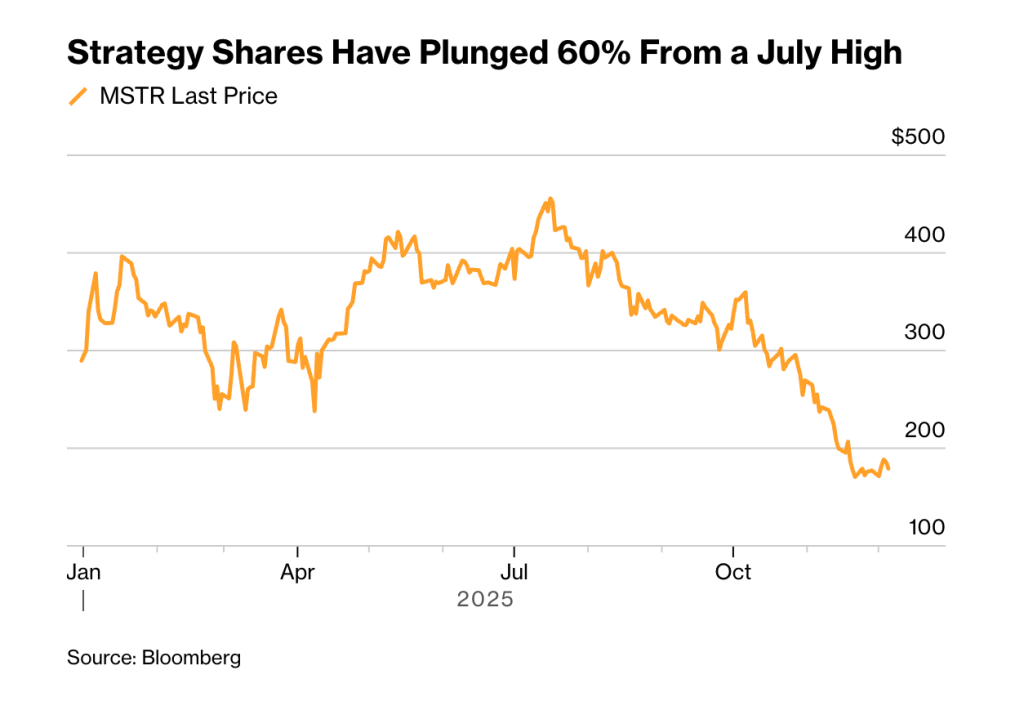
Strategy shares have dropped 60% from their July highs, even as they have risen by more than 1,200% since the company began buying Bitcoin in August 2020.
Source: Bloomberg
“Investors took a look and understood that there’s not much yield from these holdings rather than just sitting on this pile of money,” B. Riley Securities analyst Fedor Shabalin told Bloomberg.
Debt Obligations Expose Structural Flaws
The fundamental problem plaguing these companies stems from how they fund cryptocurrency purchases.
Strategy and its imitators issued massive amounts of convertible bonds and preferred shares, raising over $45 billion across the industry to acquire digital tokens that generate no cash flow.
These debt instruments carry substantial interest and dividend obligations that cryptocurrency holdings cannot service, creating a structural mismatch between liabilities that require regular payments and assets that produce zero income.
Strategy faces annual fixed obligations of approximately $750 million to $800 million tied to preferred shares.
Companies that avoided Bitcoin for smaller, more volatile cryptocurrencies suffered the steepest losses.
Alt5 Sigma, backed by two Trump sons and planning to purchase over $1 billion in World Liberty Financial’s WLFI token, has crashed more than 85% from its June peak.
The industry now faces its defining moment. Strategy CEO Phong Le acknowledged the company would sell Bitcoin if needed to fund dividend payments, specifically if the firm’s market value falls below its cryptocurrency holdings.
Those comments sent shockwaves through the digital asset treasury sector, given Saylor’s repeated insistence that Strategy would never sell, famously joking in February to “sell a kidney if you must, but keep the Bitcoin.“
At December’s Binance Blockchain Week, Saylor outlined the revised approach, stating that “when our equity is trading above the net asset value of the Bitcoin, we just sell the equity,” but “when the equity’s trading below the value of the Bitcoin, we would either sell Bitcoin derivatives, or we would just sell the Bitcoin.“
The reversal raises fears of a downward spiral where forced crypto sales push token prices lower, further pressuring treasury company valuations and potentially triggering additional selling.
Strategy’s monthly Bitcoin accumulation has collapsed from 134,000 BTC at the 2024 peak to just 9,100 BTC in November, with only 135 BTC added so far in December.
Market participants worry that leveraged traders using borrowed money to invest in these companies could face margin calls, forcing broader market selloffs.
Strategy has created a $1.4 billion reserve fund to cover near-term dividend payments, but shares remain on track for a 38% decline this year despite the company’s massive Bitcoin holdings.
 Login
Login