Normal view

There are new articles available, click to refresh the page.
Today — 6 December 2025Main stream

Something New Every Day, Something Relevant Every Week?

6 December 2025 at 10:00

The site is called Hackaday, and has been for 21 years. But it was only for maybe the first half-year that it was literally a hack a day. By the 2010s, we were putting out four or more per day, and in the later 20-teens, we settled into our current cadence of eight hacks per day, plus some original pieces over the top. That’s a lot of hacks per day! (But “Eight-to-Ten-Hacks-a-Day” just isn’t as catchy.)

With that many posts daily, we also tend to reach out to a broader array of interests. Quite simply, not every hack is necessarily going to be just exactly what you are looking for, but we wouldn’t be writing it up if we didn’t think that someone was looking for it. Maybe you don’t like CAN bus hacks, but you’re into biohacking, or retrocomputing. Our broad group of writers helps to make sure that we’ll get you covered sooner or later.

What’s still surprising to me, though, is that a couple of times per week, there is a hack that is actually relevant to a particular project that I’m currently working on. It’s one thing to learn something new every day, and I’d bet that I do, but it’s entirely another to learn something new and relevant.

So I shouldn’t have been shocked when Tom and I were going over the week’s hacks on the podcast, and he picked an investigation of injecting spray foam into 3D prints. I liked that one too, but for me it was just “learn something new”. Tom has been working on an underwater ROV, and it perfectly scratched an itch that he has – how to keep the top of the vehicle more buoyant, while keeping the whole thing waterproof.

That kind of experience is why I’ve been reading Hackaday for 21 years now, and it’s all of our hope that you get some of that too from time to time. There is a lot of “new” on the Internet, and that’s a wonderful thing. But the combination of new and relevant just can’t be beat! So if you’ve got anything you want to hear more about, let us know.

This article is part of the Hackaday.com newsletter, delivered every seven days for each of the last 200+ weeks. It also includes our favorite articles from the last seven days that you can see on the web version of the newsletter. Want this type of article to hit your inbox every Friday morning? You should sign up!
Before yesterdayMain stream

Hacky Thanksgiving

29 November 2025 at 10:00

It’s that time of year when we eat perhaps a little too much food, and have maybe just a few too many sips of red wine. But it’s also when we think about what we’ve been grateful for over the past year. And here at Hackaday, that’s you all: the people out there making the crazy projects that we get the pleasure of writing about, and those of you just reading along. After all, we’re just the hackers in the middle. You are all Hackaday.

And it’s also the time of year, at least in this hemisphere, when the days get far too short for their own good and the weather gets frankly less than pleasant. That means more time indoors, and if we play our cards right, more time in the lab. Supercon is over and Hackaday Europe is still far enough in the future. Time for a good project along with all of the festive duties.

So here we sit, while the weather outside is frightful, wishing you all a pleasant start to the holiday season. May your parts bin overflow and your projects-to-do-list never empty!

This article is part of the Hackaday.com newsletter, delivered every seven days for each of the last 200+ weeks. It also includes our favorite articles from the last seven days that you can see on the web version of the newsletter. Want this type of article to hit your inbox every Friday morning? You should sign up!

Elli Furedy Brings Cyberpunk Games to Life

26 November 2025 at 13:30

When you’re designing a bounty hunter game for a five-day cyberpunk live-action-role-play out in the middle of the Mojave desert, you’ve got to bring something extra cool. But [Elli]’s Hackaday Supercon talk isn’t just about the hardware; it’s as much about the design philosophy behind the game – how you bring something immersive and exciting to hundreds of players.

Sandbox Systems

The game itself is fairly simple: bounty hunters try to find the bounty, and when they do, they have a quick-draw to see who wins. Everyone is issued a color-coded Portable Data Node device, and when a hunter jacks into a bounty’s Node, a countdown begins, and the first to press the button after the display say “Go” wins.

But the simplicity of the game is by design, and [Elli] talks about the philosophy that she and her team followed to make it a success. If you’re designing a conference badge or an immersive game for a large group of people, take note.

The first principle is to focus on the people first before the tech. Here, that essentially means making the experience as simple as possible in order to leave room for the players to put their own spin on it – it’s a role-play event after all.

Next is providing opportunities over demands. In this game, for instance, if you’re playing the bounty hunter role, you have to deliver a “Declaration of Intent to Seize” when you encounter a bounty player, but what deciding on your personal catchphrase for this is left up to you.

Embedding the rules of the game in the hardware is perhaps the most involved of the principles. The Data Nodes decide the winner and the loser, report it automatically over WiFi to a central scoreboard, and has anti-button-mashing provisions. These and many more examples of embedding the rules help make the game both fair and simple – nobody has to break the flow to look things up in a rule book or remember who gives what token to whom.

Selling the story of the game with the tech is also important. For instance, there is a part of the Node that [Elli] calls “the doodad” which is just pure LED and greebles. It doesn’t do anything, but it looks cool.

Finally, [Elli] mentions that her team puts an effort into making the game as accessible for everyone as possible. The onboarding video has cyberpunk-styled closed captioning, for instance. While originally designed for folks who don’t hear well, it ended up providing an aesthetic that everyone can enjoy – an example of the curb-cut effect at work.

The end result? 374 players played 3,838 matches over five days, but that’s just the stats. As [Elli] points out, the real point of the game is as an ice-breaker, to allow people room to explore whatever character they’re playing, and to connect people in real-space. It sounds like it was a complete success on all fronts.

The Sandbox

This is a talk on design principles, but it’s also a talk at Supercon, and [Elli] gets pulled into the hardware side of things many times throughout the talk. The Nodes have OLEDs and haptic motors for feedback, they use and ESP32 with WiFi for the score reporting, and there’s even discussion of the serial protocol that they speak to each other when they get connected up via an audio jack.

[Elli] gets some great questions about ways to expand the game, and you’re just going to have to watch the video to appreciate them all. Or join in: after all, it’s an open-source project and it’s intended to be a sandbox!

There seems to be a lot of room to play along, and [Elli]’s talk is definitely food for thought if you’re designing hardware with the end goal of creating and encouraging human interaction through building up an engaging story.

Why Do We Love Weird Old Tech?

22 November 2025 at 10:00

One of our newer writers, [Tyler August], recently wrote a love letter to plasma TV technology. Sitting between the ubiquitous LCD and the vanishing CRT, the plasma TV had its moment in the sun, but never became quite as popular as either of the other display techs, for all sorts of reasons. By all means, go read his article if you’re interested in the details. I’ll freely admit that it had me thinking that I needed a plasma TV.

I don’t, of course. But why do I, and probably a bunch of you out there, like old and/or odd tech? Take [Tyler]’s plasma fetish, for instance, or many people’s love for VFD or nixie tube displays. At Supercon, a number of people had hit up Apex Electronics, a local surplus store, and came away with some sweet old LED character displays. And I’ll admit to having two handfuls of these displays in my to-hack-on drawer that I bought surplus a decade ago because they’re so cute.

It’s not nostalgia. [Tyler] never had a plasma growing up, and those LED displays were already obsolete before the gang of folks who had bought them were even born. And it’s not simply that it’s old junk – the objects of our desire were mostly all reasonably fancy tech back in their day. And I think that’s part of the key.

My theory is that, as time and tech progresses, we see these truly amazing new developments become commonplace, and get forgotten by virtue of their ever-presence. For a while, having a glowing character display in your car stereo would have been truly futuristic, and then when the VFD went mainstream, it kind of faded into our ambient technological background noise. But now that we all have high-res entertainment consoles in our cars, which are frankly basically just a cheap tablet computer (see what I did there?), the VFD becomes an object of wonder again because it’s rare.

Which is not to say that LCD displays are anything short of amazing. Count up the rows and columns of pixels, and multiply by three for RGB, and that’s how many nanoscale ITO traces there are on the screen of even the cheapest display these days. But we take it for granted because we are surrounded by cheap screens.

I think we like older, odder tech because we see it more easily for the wonder that it is because it’s no longer commonplace. But that doesn’t mean that our current “boring” tech is any less impressive. Maybe the moral of the story is to try to approach and appreciate what we’ve got now with new eyes. Pretend you’re coming in from the future and finding this “old” gear. Maybe try to figure out how it must have worked.

This article is part of the Hackaday.com newsletter, delivered every seven days for each of the last 200+ weeks. It also includes our favorite articles from the last seven days that you can see on the web version of the newsletter. Want this type of article to hit your inbox every Friday morning? You should sign up!

Congratulations to the 2025 Component Abuse Challenge Winners

18 November 2025 at 13:00

For the Component Abuse Challenge, we asked you to do the wrong thing with electrical parts, but nonetheless come out with the right result. It’s probably the most Hackaday challenge we have run in a long time, and you all delivered! The judging was tight, but in the end three projects rose up to the top, and will each be taking home a $150 DigiKey gift certificate, but that doesn’t mean you shouldn’t give all of the projects a look.

So without further ado, let’s check out the winners and all the others that tickled the hacky regions of our judges’ brains.

Prize Winners

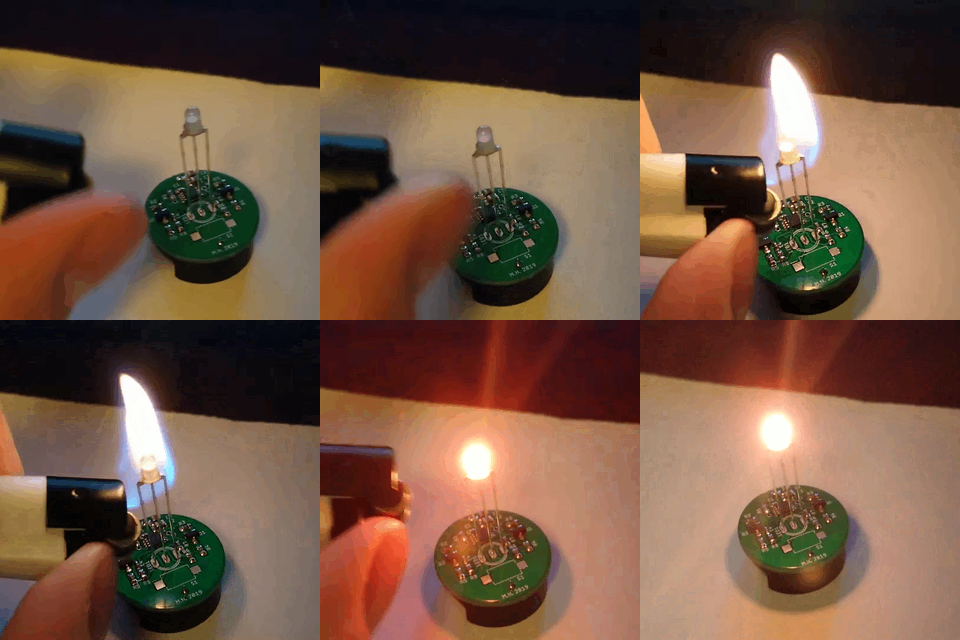
[Miroslav Hancar]’s LED Candles was a shoe-in, at least if you watched the video demo. It presents itself as a simple LED on a round PCB with a coin cell, but then when [Miroslav] lights it with an actual lighter, it starts glowing. (And maybe smoking just a little bit.) He makes both single-LED and quad-LED varieties, and they’re both gems.

The component misuse is an old favorite: the diode’s forward voltage drop depends on the temperature, and if you measure the voltage across the current-limiting resistor, you can read this voltage and determine when someone is setting fire to your LED. A bonus of the single-LED configuration is that if you touch the LED’s leads, your finger shunts some of the current, and you can “snuff” the LEDs out. And while we’ve seen similar LED hacks before, the addition of actual fire to this one seems to have warmed our judges’ hearts.

[Luke J. Barker]’s Need an Electrical Slip Ring? is simplicity itself, and appears to have been born of the mother of invention. [Luke] was making a VertiBird helicopter toy, which spins around on the desk and rises and falls with joystick control. And for that, he needed a slip ring. Enter the humble audio jack, which fills the job nicely, transmitting power to the rotating helicopter without twisting up wires in the process. There’s not much magic here, but it’s a fantastic idea when you need something to spin.

On the other end of the spectrum, [Craig D]’s Boosting voltage with a cable looks like it shouldn’t work at first, but it does. In most step-up-voltage setups, you’re storing the energy in either a capacitor or inductor, and switching it in and out of the circuit to hop the voltage up. Here, the energy isn’t ever really “stored” as much as it’s “in flight”.

A circuit sends a pulse down a long length of coaxial cable that is left open at the other end. The pulse reflects off the open end and heads back toward the voltage driver, which then fires off another pulse at just the right time to make the travelling wave a little bit bigger, and this continues. It’s like pushing a swing – adding a little extra oomph at just the right time can build up. There’s a lot of cool physics here, a nice simulation that actually ends up corresponding very well with reality, and in the end the pulse timing isn’t rocket science, but rather figuring out the resonant frequency along the coax. And it works well enough to light up two neon bulbs in series (~140 V) off of a 15 V power supply.

Honorable Mentions

We got way more cool entries than we have prizes, so we try to round them up into categories and give them a little time in the sun.

Out of Spec

Normally, a 555 timer oscillator circuit relies on filling up a capacitor with a current that’s throttled through a resistor. How can you make it go faster? Make the capacitor smaller and the resistor less resistive. What happens when you get rid of them both entirely, relying on stray capacitance and the resistance of whatever wire you’re using? That’s what [MagicWolfi] aimed to find out with his Ludicrous 555 project.

The IC-Abusing Diode Tester is an absolutely horrible circuit. Nothing in it works like it should. The only reason the IC doesn’t burn up is that it’s more robust than the datasheet promises, and the battery used has such a high internal resistance that it can’t source that much current anyway. Parts are powered by leakage current, and below their minimum voltage. [Joseph Eoff] counts seven values that are out of spec in this single historical circuit, so that’s gotta count for something.

Junk Box Substitutions

You need GPIO lines, but you have a UART. [Ken Yap] proposes repurposing the DSR, DTR, RTS, and CTS lines as inputs and outputs, and he writes code to make them do his bidding.

Or maybe you’re working on self-assembling robots and you need some magic glue to hold different modules together. [Miana]’s Low-melt-solder connected robots is half research project, and half hack. Resistors are used to melt solder, magnets align the parts together, and when it all cools down, it’s as if two modules are brazed together. This one’s a lot more than a hack, but we’re honored to have it entered in the contest anyway!

Bizarro World

We honestly thought we’d get more entries that made use of the duality of most sensors / emitters. Instead, we got two. [Nick]’s Better Than Bluetooth does the LED-as-photosensor trick, and concludes that it’s better than Bluetooth if expense, limited range, and frustration are what you’re looking for in a data link. Meanwhile, [Kauz] proves that electromagnets are also pickups by building a guitar pickup out of six relays.

Side Effects

Everything is a fuse if you run enough current through it. [JohnsonFarms] pushed conductive filament to the melting point, and calibrated it along the way. While roasting a hotdog with mains voltage and a couple forks, [Ian Dunn] discovered that if you stick some LEDs in it, they light up.

Most old op-amps oscillate out of control when given feedback, unless you damp it down a bit with a capacitor. [Adrian Freed] found an op-amp lousy enough that would do this at audio frequencies, and used it to reimagine a classic noisemaker.

Finally, while you should probably avoid the metastable middle-zones between digital one and zero, [SHAOS] combines unbuffered NAND and NOR gates to tease out a third logic state. [Bob Widlar] would be proud.

Thanks All!

As always, we had more great entries that we could feature here, so head on over to Hackaday.io and check them out. And thanks again to DigiKey for providing our top three with $150 gift certificates. If you’re looking for your chance to show off a project that you’re working on, hang on for a while because we’ll be starting up a new contest in early 2026.

2025 Hackaday Component Abuse Challenge

The Value of a Worked Example

15 November 2025 at 10:00

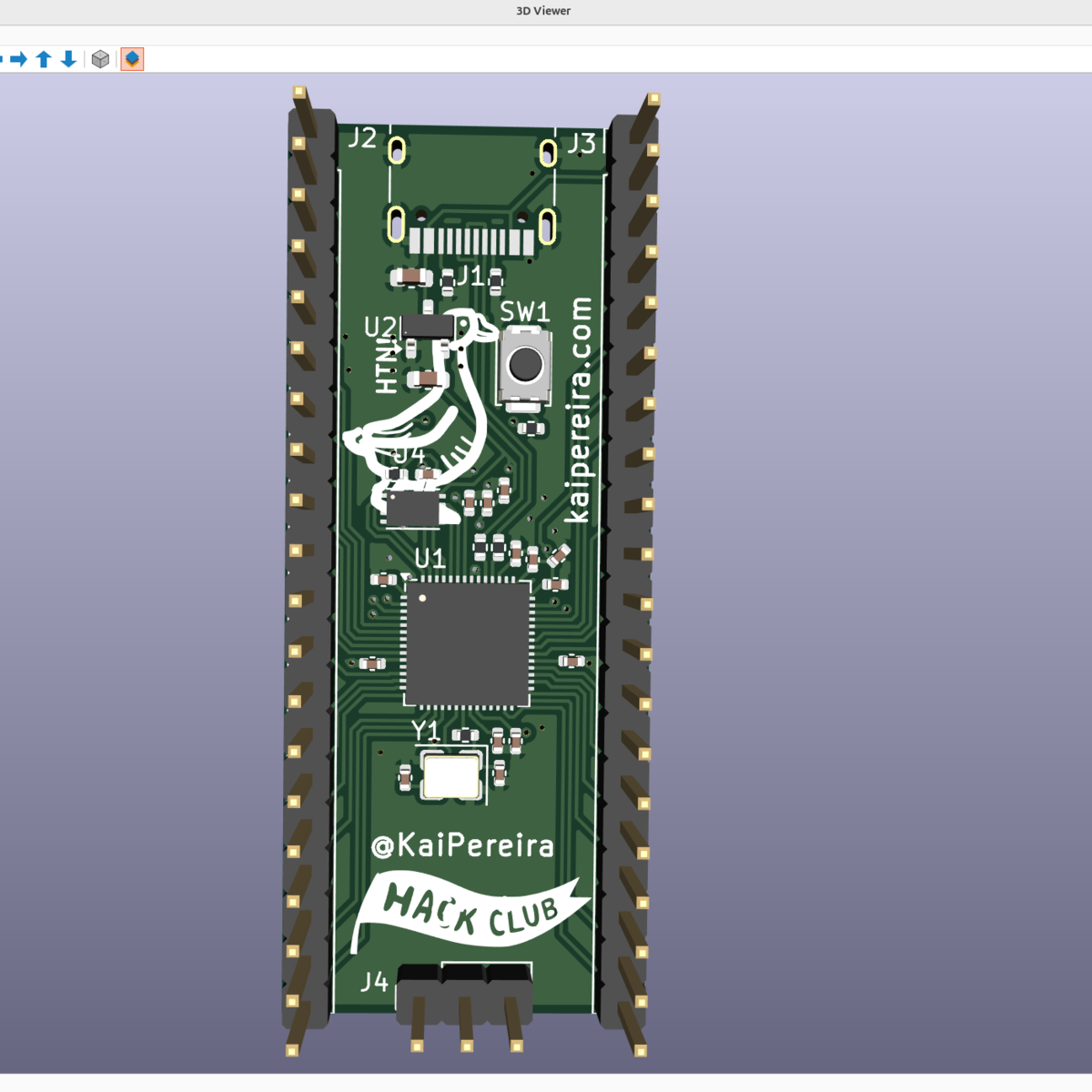
I was looking over the week’s posts on Hackaday – it’s part of my job after all – and this gem caught my eye: a post about how to make your own RP2040 development board from scratch. And I’ll admit that my first thought was “why would you ever want to do that?” (Not a very Hackaday-appropriate question, honestly.) The end result will certainly cost more than just buying a Pi Pico off the shelf!

Then it hit me: this isn’t a project per se, but rather [Kai] was using it as an test run to learn the PCB-production toolchain. And for that, replicating a Pico board is perfect, because the schematics are easily available. While I definitely think that a project like this is a bit complicated for a first PCB project – I’d recommend making something fun like an SAO – the advantage of making something slightly more involved is that you run into all of the accompanying problems learning experiences. What a marvelous post-complete-beginner finger exercise!

And then it hit me again. [Kai]’s documentation of everything learned during the project was absolutely brilliant. It’s part KiCAD tutorial, part journal about all the hurdles of getting a PCB made, and just chock-full of helpful tips along the way. The quality of the write-up turns it from being just a personal project into something that can help other people who are in exactly the same boat, and I’m guessing that’s a number of you out there.

In the end, this was a perfect Hackaday project. Yes, it was “too simple” for those who have made their 30th PCB design. (Although I’d bet you could still pick up a KiCAD tip or two.) And yes, it doesn’t make economic sense to replicate mass-market devices in one-off. And of course, it doesn’t need that fun art on the board either. But wrap all these up together, and you get a superbly documented guide to a useful project that would walk you through 95% of what you’ll need to make more elaborate projects later on. Superb!

Surely you do “finger exercises” too. Why not write them up, and share the learning? And send them our way – we know just the audience who will want to read it.

This article is part of the Hackaday.com newsletter, delivered every seven days for each of the last 200+ weeks. It also includes our favorite articles from the last seven days that you can see on the web version of the newsletter. Want this type of article to hit your inbox every Friday morning? You should sign up!
❌
❌