
Normal view

There are new articles available, click to refresh the page.
Today — 7 December 2025Main stream

Bitcoin “Liveliness” Indicator Rises, Hinting the Bull Cycle May Not Be Over

By: Amin Ayan
7 December 2025 at 05:31

A key on-chain indicator known as Bitcoin “liveliness” is climbing again, a pattern historically associated with bull market activity, raising the possibility that the current cycle still has room to run, according to analysts tracking long-term blockchain metrics.

Key Takeaways:

  • Bitcoin’s “liveliness” metric is rising despite stagnant prices, signaling renewed underlying demand.
  • Analysts say dormant coins are moving at unprecedented scale, suggesting a major capital rotation.
  • The indicator’s breakout from a years-long range hints the current bull cycle may not be finished.

Technical analyst TXMC said on Sunday that liveliness has been “marching higher despite lower prices,” a divergence that suggests steady underlying demand for spot Bitcoin even as market sentiment remains subdued.

Bitcoin’s Rising “Liveliness” Metric Points to Renewed Bull-Market Demand

The metric, described as an “elegant” long-term gauge of chain activity, measures the ratio of coins being transacted relative to those being held, weighted by their age.

It increases when older coins are spent more frequently, and falls when long-term holders accumulate.

“Liveliness usually rises in bull runs as supply changes hands at higher prices, indicating a flow of newly invested capital,” TXMC explained, noting that the latest upward trend contradicts the muted price action seen in recent weeks.

Glassnode data shows liveliness pushing into a new peak range, breaking out of the corridor it remained stuck in from the 2017 all-time-high through earlier cycles.

Analyst James Check said the current spike in liveliness reflects an unprecedented reactivation of dormant Bitcoin supply, surpassing patterns seen during the 2017 bull run, the first cycle characterized by “widespread participation” and a dramatic parabolic surge.

Liveliness has been range bound since the 2017 peak, up until now.

The 2017 Bull was special in that it was the first epic parabola with widespread participation, but was also when many old coins transacted to capture the BCH dividend.

New Liveliness ATHs shows how extreme the… https://t.co/aoVFr2jOsR

— _Checkmate 🟠🔑⚡☢🛢 (@_Checkmatey_) December 6, 2025

This time, however, the scale is far larger. While 2017 typically saw transfers measured in the thousands of dollars, Check noted that today’s on-chain value flows often reach into the billions, signaling one of the largest capital rotations Bitcoin has experienced.

“We have seen an extraordinary volume of coin days destroyed,” Check said. “I am of the view we have just watched one of the greatest capital rotations and changing of the guard in Bitcoin history.”

BTC Price Stalls, Analysts Eye Breakout Levels

Bitcoin’s price action remains subdued despite the on-chain strength. BTC briefly dipped below $89,000 early Sunday before recovering to around $89,500, largely unchanged over 24 hours.

Analyst Michaël van de Poppe said the market is stuck in a consolidation band: “Anything between $86,000 and $92,000 is pretty much noise.”

Anything between $86-92K is pretty much noise. Not much will happen for $BTC.

If $92K gets tested, I think we'll break it, but if not, brace yourself for a test at the low $80K range for some sort of double-bottom pattern.

Again, I don't think we're far off bottoming for… pic.twitter.com/6acTFBAZk4

— Michaël van de Poppe (@CryptoMichNL) December 6, 2025

He added that a test of $92,000 could lead to a breakout, while failure could push BTC toward the low $80,000s for a potential double-bottom formation.

“I don’t think we’re far off bottoming for Bitcoin,” van de Poppe said, predicting a stronger rally heading into late Q4 and early Q1.

Last week, Bitfinex said the market is showing “seller exhaustion” following a period of heavy deleveraging and panic-driven exits by short-term holders.

“The combination of extreme deleveraging, capitulation among short-term holders, and early signs of seller exhaustion has created the conditions for a stabilisation phase and a relief bounce,” the firm wrote.

The post Bitcoin “Liveliness” Indicator Rises, Hinting the Bull Cycle May Not Be Over appeared first on Cryptonews.
Ether Supply on Exchanges Falls to Record Low, Raising Supply Squeeze Hopes

By: Amin Ayan
7 December 2025 at 05:26

Ether held on centralized exchanges has fallen to its lowest level in history, fueling speculation that a supply squeeze may be forming beneath the surface of the market.

Key Takeaways:

  • ETH exchange balances have dropped to a record low of 8.7%, a 43% decline since July.
  • Staking, L2 activity, DATs, and long-term custody are tightening liquid supply.
  • Analysts see hidden buying strength, hinting at potential upward momentum.

According to Glassnode, exchange balances dropped to 8.7% of total ETH supply last Thursday, the smallest share recorded since Ethereum’s launch in 2015. Levels remained near that low at 8.8% on Sunday.

ETH Exchange Balances Plunge 43% as Supply Tightens to Record Levels

The sharp decline represents a 43% drop in ETH exchange balances since early July, coinciding with the acceleration of digital asset treasury (DAT) purchases and growing activity across the broader Ethereum ecosystem.

Macro research outlet Milk Road said ETH is “quietly entering its tightest supply environment ever,” noting that Bitcoin’s exchange balance remains significantly higher at 14.7%.

Analysts attributed the shift to structural changes in how ETH is being used. More tokens are flowing into staking, restaking protocols, layer-2 networks, DAT balance sheets, collateralized DeFi positions, and long-term self-custody, destinations that historically do not circulate supply back onto exchanges.

“Sentiment feels heavy right now, but sentiment doesn’t dictate supply,” Milk Road wrote. “When that gap closes, price follows.”

Beyond supply metrics, market technicians are spotting signals that buyers may be gaining control. Analyst Sykodelic highlighted an On-Balance Volume (OBV) breakout above resistance late last week, even as price failed to follow.

$ETH is quietly entering its tightest supply environment ever.

Exchange balances just fell to 8.84% of total supply, a level we’ve never seen before.

For context, $BTC is still sitting near 14.8%.

ETH keeps getting pulled into places that don’t sell, staking, restaking, L2… pic.twitter.com/T7MW3D2bG1

— Milk Road (@MilkRoad) December 5, 2025

The divergence, they said, is a classic sign of “hidden buying strength” that sometimes precedes upward moves.

“This is a sign of buying strength, and typically, the price will follow,” the analyst noted, while cautioning that indicators aren’t guarantees.

They added that overall price action “looks bullish,” suggesting ETH may revisit higher levels before any meaningful retracement.

ETH Holds $3,000 as Momentum Builds

Ether has held above the $3,000 mark for nearly a week but continues to face resistance near $3,200. Over the past 24 hours, ETH has consolidated around $3,050, mirroring the broader market’s indecision.

The ETH/BTC pair also drew attention last week after breaking above a long-standing downtrend, a move some traders see as an early sign of capital rotating back into Ethereum.

Meanwhile, BitMine Immersion Technologies, already the largest corporate holder of Ether, has continued aggressively buying the dip even as top traders position for further declines.

The firm purchased another $199 million in ETH over the past two days, adding to its rapidly expanding reserves.

BitMine now controls $11.3 billion worth of Ether, roughly 3.08% of the total supply, and is closing in on its long-stated goal of reaching 5%.

Last month, Tom Lee said Ether may be entering the early stages of the type of explosive growth cycle that propelled Bitcoin to a 100x rally since 2017.

Lee said the current Ether market resembles Bitcoin’s setup eight years ago, a period marked by deep volatility that ultimately preceded one of the strongest bull cycles in crypto history.

The post Ether Supply on Exchanges Falls to Record Low, Raising Supply Squeeze Hopes appeared first on Cryptonews.

Euro Stablecoin Market Doubles to $680M A Year After MiCA

By: Amin Ayan
7 December 2025 at 05:12

The euro stablecoin market has staged a sharp rebound in the year since the EU’s Markets in Crypto-Assets Regulation (MiCA) took effect, doubling in size as new rules for issuers came online.

Key Takeaways:

  • The euro stablecoin market has doubled since MiCA’s rollout, reaching roughly $680 million in market cap.
  • Growth is concentrated in major issuers like EURS, EURC and EURCV, with transaction volumes surging nearly ninefold.
  • Public interest is rising across the EU, signaling growing adoption.

According to Decta’s Euro Stablecoin Trends Report 2025, the sector’s market capitalization has surged from last year’s slump, reversing a 48% contraction and outpacing the broader stablecoin market’s 26% growth rate.

Euro Stablecoins Hit $680M After MiCA

Decta’s report says euro-denominated stablecoins climbed to roughly $500 million by May 2025 following MiCA’s June 2024 rollout, a shift credited to clearer issuer obligations and standardized reserve rules.

Today, the market sits at around $680 million, per CoinGecko. However, the market is still tiny compared with the nearly $300 billion locked in US dollar-backed tokens, a space dominated by USDT and USDC.

Much of the growth came from a handful of standout issuers. Stasis’ EURS posted the strongest expansion, soaring 644% to $283.9 million as of October 2025.

Circle’s EURC and Societe Generale’s EURCV also saw meaningful increases as regulated issuers began to capitalize on MiCA’s clarity around custody, reserves and public disclosures.

Activity on-chain grew alongside market cap. Monthly transaction volume for euro stablecoins jumped nearly ninefold to $3.83 billion after MiCA implementation, the report found.

JUST IN: 💶 Ten European banks are building a euro stablecoin under Dutch Central Bank oversight.

They’re targeting regulatory approval in late 2026 pic.twitter.com/8zZv4d8Q5t

— Futures (@FuturesDotNYC) December 3, 2025

EURC and EURCV led the surge, with volumes climbing 1,139% and 343%, supported by greater use in cross-border payments, fiat on-ramps and crypto trading pairs, areas previously dominated by dollar stablecoins.

The regulatory shift also appears to be stimulating public interest. Decta recorded sharp spikes in search activity across EU markets, including a 400% jump in Finland and more than tripling in Italy.

Interest rose across smaller economies as well, suggesting broader consumer awareness as euro-denominated tokens begin carving out a clearer role in Europe’s digital-asset landscape.

Poland Remains Last EU State Without MiCA Rules

As reported, Poland’s push to bring its crypto sector in line with the EU’s MiCA framework collapsed after lawmakers failed to overturn President Karol Nawrocki’s veto of a major digital-asset bill.

The vote fell short of the required three-fifths majority, leaving Poland as the only EU member without a national MiCA-style regulatory regime and forcing the government to restart the legislative process.

Prime Minister Donald Tusk had argued that the bill was necessary for national security, warning that unregulated crypto activity had become a channel for money laundering and foreign interference, including covert financing linked to Russia and Belarus.

Authorities have connected these concerns to several recent security incidents, including alleged sabotage plots in Poland reportedly funded through cryptocurrencies.

The veto has intensified political tensions between Nawrocki and Tusk’s pro-EU coalition.

The president rejected the bill on grounds that it overreached EU requirements and posed risks to civil liberties and property rights.

The post Euro Stablecoin Market Doubles to $680M A Year After MiCA appeared first on Cryptonews.

Michael Saylor’s Bitcoin Playbook Backfires on 100+ Companies

7 December 2025 at 05:10

Digital asset treasury companies that rushed to copy Michael Saylor’s Bitcoin strategy are now hemorrhaging shareholder value, with median stock prices down 43% year to date, even as the broader market climbs higher, as per Bloomberg.

Michael Saylor's Bitcoin Strategy - DAT Returns Chart
Source: Bloomberg

More than 100 publicly traded companies transformed themselves into cryptocurrency-holding vehicles in the first half of 2025, borrowing billions to buy digital tokens while their stock prices initially soared past the value of the underlying assets they purchased.

The strategy seemed unstoppable until market reality delivered a harsh correction.

Strategy’s Model Spawns Industry-Wide Collapse

Strategy Inc.’s Michael Saylor pioneered the approach of converting corporate cash into Bitcoin holdings, transforming his software company into a publicly traded cryptocurrency treasury.

The model worked spectacularly through the mid-2025, attracting high-profile investors, including the Trump family.

SharpLink Gaming epitomized the frenzy. The company pivoted from traditional gaming operations, appointed an Ethereum co-founder as chairman, and announced massive token purchases.

💰Sharplink Gaming added $80M in Ether to its reserves, lifting total holdings to $3.6B and cementing its spot as the second-largest corporate holder of ETH.#Sharplink #Ether https://t.co/ADz76OeiCn

— Cryptonews.com (@cryptonews) October 27, 2025

Its stock exploded 2,600% within days before crashing 86% from peak levels, leaving total market capitalization below the value of its Ethereum holdings at just 0.9 times crypto reserves.

Bloomberg data tracking 138 U.S. and Canadian digital asset treasuries shows the median share price has fallen 43% year-to-date, dramatically underperforming Bitcoin’s modest 7% decline.

In comparison, the S&P 500 gained 6% and the Nasdaq 100 rose 10%.

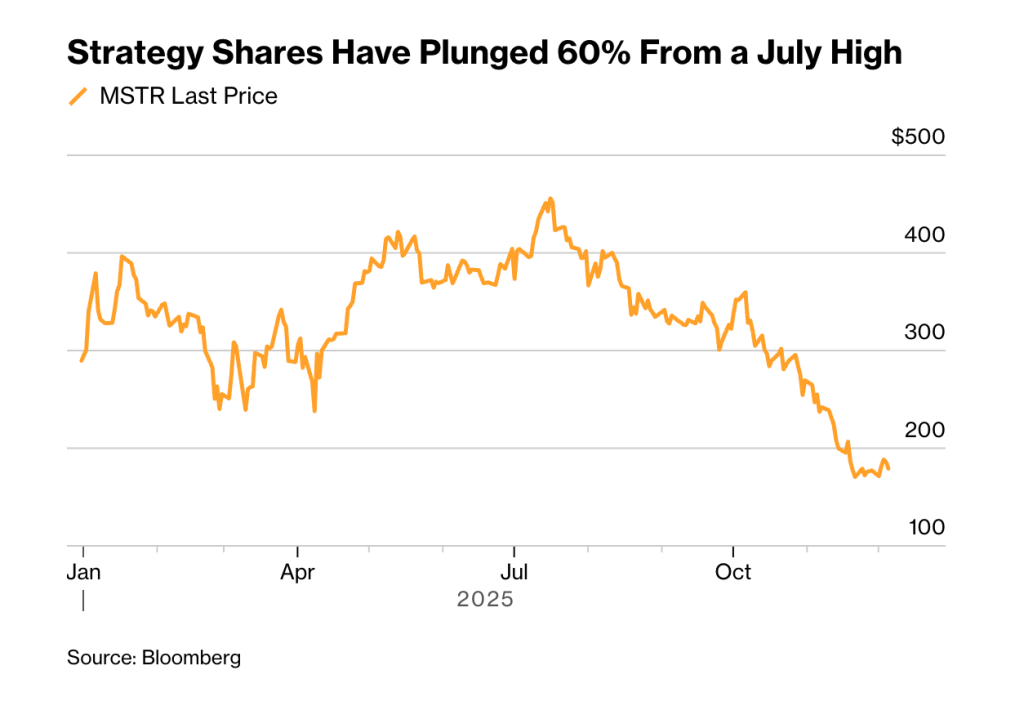
Strategy shares have dropped 60% from their July highs, even as they have risen by more than 1,200% since the company began buying Bitcoin in August 2020.

Michael Saylor's Bitcoin Strategy - Strategy Shares Chart
Source: Bloomberg

Investors took a look and understood that there’s not much yield from these holdings rather than just sitting on this pile of money,” B. Riley Securities analyst Fedor Shabalin told Bloomberg.

Debt Obligations Expose Structural Flaws

The fundamental problem plaguing these companies stems from how they fund cryptocurrency purchases.

Strategy and its imitators issued massive amounts of convertible bonds and preferred shares, raising over $45 billion across the industry to acquire digital tokens that generate no cash flow.

These debt instruments carry substantial interest and dividend obligations that cryptocurrency holdings cannot service, creating a structural mismatch between liabilities that require regular payments and assets that produce zero income.

Strategy faces annual fixed obligations of approximately $750 million to $800 million tied to preferred shares.

Companies that avoided Bitcoin for smaller, more volatile cryptocurrencies suffered the steepest losses.

Alt5 Sigma, backed by two Trump sons and planning to purchase over $1 billion in World Liberty Financial’s WLFI token, has crashed more than 85% from its June peak.

Strategy attempted to address funding concerns by raising $1.44 billion in dollar reserves through stock sales, covering 21 months of dividend payments.

Saylor Admits Potential Bitcoin Sales

The industry now faces its defining moment. Strategy CEO Phong Le acknowledged the company would sell Bitcoin if needed to fund dividend payments, specifically if the firm’s market value falls below its cryptocurrency holdings.

Those comments sent shockwaves through the digital asset treasury sector, given Saylor’s repeated insistence that Strategy would never sell, famously joking in February to “sell a kidney if you must, but keep the Bitcoin.

At December’s Binance Blockchain Week, Saylor outlined the revised approach, stating that “when our equity is trading above the net asset value of the Bitcoin, we just sell the equity,” but “when the equity’s trading below the value of the Bitcoin, we would either sell Bitcoin derivatives, or we would just sell the Bitcoin.

The reversal raises fears of a downward spiral where forced crypto sales push token prices lower, further pressuring treasury company valuations and potentially triggering additional selling.

Strategy’s monthly Bitcoin accumulation has collapsed from 134,000 BTC at the 2024 peak to just 9,100 BTC in November, with only 135 BTC added so far in December.

The company now holds approximately 650,000 BTC, valued at over $56 billion, representing more than 3% of Bitcoin’s maximum supply.

Market participants worry that leveraged traders using borrowed money to invest in these companies could face margin calls, forcing broader market selloffs.

Strategy has created a $1.4 billion reserve fund to cover near-term dividend payments, but shares remain on track for a 38% decline this year despite the company’s massive Bitcoin holdings.

The post Michael Saylor’s Bitcoin Playbook Backfires on 100+ Companies appeared first on Cryptonews.

Bitcoin Market Profitability Hits ‘Complete Reset’ — What’s Next For Price?

7 December 2025 at 04:00

Following a fresh wave of bearish pressure on Friday, December 5, the price of Bitcoin has struggled beneath the psychological 90,000 level for much of the weekend. However, the latest on-chain data suggests that the premier cryptocurrency might be readying for its next healthy upward move.

BTC SOPR Drops To Lowest Level Since Early 2024

In a December 6 post on the X platform, CryptoOnchain hypothesized that a local bottom appears to be forming for the price of Bitcoin. According to the market pundit, the selling pressure, especially amongst long-term holders, seems to be fading off at the moment.

This market observation centers on the Spent Output Profit Ratio (SOPR) metric, which evaluates the profitability ratio of spent outputs for both long-term and short-term holders. This on-chain indicator evaluates whether market participants are selling their assets at a profit or at a loss.

Typically, when the Bitcoin Spent Output Profit Ratio has a value greater than 1, it indicates that the investors are selling at a profit. On the flip side, an SOPR value less than 1 implies that the market participants are offloading their coins while in the red.

Bitcoin

According to CryptoOnchain, the Bitcoin SOPR has now fallen to 1.35, its lowest level since early 2024. The market analyst noted that this metric’s latest movement suggests a complete reset in market profitability, especially as the price of BTC slid beneath the $90,000 mark.

Furthermore, CryptoOnchain highlighted that the heavy profit-taking phase by long-term holders appears to be coming to an end, as exhaustion and fatigue increasingly spread among the bears. From a historical perspective, the SOPR metric falling to this low signals a local bottom is forming for the BTC price, especially as the market cools down.

Ultimately, CryptoOnchain revealed that a price rebound at this point could set the stage for Bitcoin’s next healthy upward rally. 

Bitcoin Price At A Glance

As of this writing, the price of BTC stands at around $89,500, reflecting no significant changes in the past 24 hours. According to data from CoinGecko, the flagship cryptocurrency is down by nearly 2% in the last seven days. 

With the price of Bitcoin down year-to-date and from its all-time high of $126,080 by roughly 5% and 30%, respectively, the market leader looks set to end 2025 in the red—barring a sudden change in market momentum.

Bitcoin

Bitcoin Losses Surge To 3x Profits — Could Relief Be Near?

7 December 2025 at 00:00

The Bitcoin market appears to be riddled with an increasing amount of sell-side pressure, as its recent price action reveals bears’ dominance. Interestingly, another on-chain evaluation suggests that the current market movement may be a direct effect of rising panic-induced sales. 

$1.7B Realized Losses Vs $605M Realized Gains

In a Quicktake post on the CryptoQuant platform, GugaOnChain shared that the Bitcoin market has been in a capitulation phase in recent days. This on-chain observation revolves around the Bitcoin Realized Profit and Loss ($) metric.

For context, this metric tracks the actual profits (in US dollars) and losses investors realize—or lock in—whenever they offload their Bitcoin holdings to exchanges. 

GugaOnChain highlighted that about $1.705 billion worth of BTC has been realized in losses by market participants. On the other hand, a relatively smaller amount, totaling approximately $605 million, was reportedly realized in gains.Bitcoin

Source: CryptoOnchainThis disproportionate distribution in losses, as against the profits acquired, puts the Loss/Gain ratio at a 2.82 reading. This means that, for every dollar made in profit, almost 3 dollars are lost. 

Looking at the bigger picture, the analyst pointed out that 74% of the total realized volume leans towards the red side of the market, leaving a mere 26% of the Bitcoin market in profits. When realized losses surge rapidly to overcome gains, it is often interpreted as a sign of capitulation.

Historically, extreme capitulation events tend to set the pace either for price recovery or even deeper downside movement. These two possibilities, however, remain dependent on the integrity of available inflection points. 

Bulls Must Defend These Price Levels Or Risk Deeper Corrections

Although the market odds currently seem stacked against the bulls, as the price takes on a bearish structure, the analyst also identified a few important zones that may determine Bitcoin’s next direction. GugaOnChain explained that, in the scenario where the bulls continue to bleed, the next price level presenting an opportunity of redemption lies around $71,450.

This specific price level is critical, as it represents the realized price for investors who have acquired Bitcoin for about 12–18 months. 

Citing a more extreme scenario, the online pundit revealed that the next key support sits at $58,940. This zone is important as it is the realized price for investors whose coins are within the 18-month to 2-year age range.  

On the weekly timeframe, however, price zones around $80,000 and $74,000 appear significant enough for a short-term price recovery. A bullish reversal could take place if these price levels were to meet the present downturn with significant opposing strength. 

As of this writing, Bitcoin is valued at around $89,331, reflecting no significant movement in the past 24 hours. 

Bitcoin


Ease Up, Bitcoin Investors – No More Negative Days For BTC In 2025 

7 December 2025 at 04:00

The cryptocurrency market has had a year filled with ups and downs, with most large-cap digital assets turning in mixed performances in 2025. After a rough start to the year, things started to look up for the price of Bitcoin in the second and third quarters, as it set multiple all-time highs across the six-month period.

However, the flagship cryptocurrency has largely struggled in the final months of 2025, looking set to end the year in the red. Interestingly, the latest on-chain data and historical patterns suggest that the price of Bitcoin might be set for a fairly stronger yearly close than expected.

No Negative Days Left In 2025, But 2026 Could Feature A Deep Correction 

On Saturday, December 6, Alphractal CEO and founder Joao Wedson took to the X platform to share what to expect from the Bitcoin price in the last days of 2025. According to the on-chain expert, the market leader is likely to close the year in a sideways price range.

The relevant metric here is the Yearly Accumulated Negative Days, which tracks market resilience by measuring the number of days in a year where an asset’s daily price candlestick closed in the red. 

According to historical data and patterns, Bitcoin typically witnesses an average of 170 days of negative price movement in a year. This mean figure or level provides insight into the stress threshold for the world’s largest cryptocurrency by market cap. 

Bitcoin

When the number of negative days is approaching or exceeds this threshold of 170 days, as Bitcoin already has in 2025, the selling pressure in the market tends to wane as fatigue sets in among the bears. Wedson revealed that the premier cryptocurrency has already accumulated 171 negative days so far in 2025.

The on-chain expert noted that exceeding this threshold “strongly suggests” that the price of Bitcoin might not witness any more negative days in the final few weeks of 2025. Wedson said that if a deeper correction is imminent for the market leader, it will most likely happen in the next year.

However, as the Alphractal founder highlighted, the Bitcoin price is more likely to end the year within a consolidation range. Adding further credence to this postulation is the lack of market demand, as seen with reduced capital influx into spot Bitcoin exchange-traded funds.

Bitcoin Price At A Glance

As of this writing, the price of BTC stands at around $89,397, reflecting a mere 0.3% drop in the past 24 hours. 

Bitcoin

Yesterday — 6 December 2025Main stream

Bitcoin Structure Tightens: One Break Above This Zone Could Ignite A Run To $107,000

6 December 2025 at 21:30

Bitcoin finds itself at a critical crossroads, hovering between two major price zones that could define its next big move. Buyers and sellers are locked in a tight battle, and the market now waits for a decisive break. A push above key resistance could open the door to $107,000, while weakness at support risks a deeper slide toward $71,000.

Bounce Scenario: A Return Toward The Pink Box And Descending Trendline

Kamile Uray, in her latest update on Bitcoin, noted that BTC failed to hold above the $90,720 level on the hourly chart, triggering the expected decline. The first immediate support now sits at $87,644, while the deeper support range lies between $83,822 and $82,477. If buyers defend this zone successfully, Bitcoin could attempt another climb toward the pink box region and retest the descending trendline overhead.

Uray explained that a sustained move above the pink box resistance on the daily timeframe would open the door for Bitcoin to challenge the descending blue trendline. A confirmed breakout from this area could strengthen bullish momentum, pushing the price toward the next major resistance levels at $98,200 and $107,500. A break above $107,500 alongside the descending trendline would serve as a strong signal that the broader uptrend is ready to continue.

Bitcoin

However, she warned that a daily close below $82,477 would shift the market structure toward further weakness, placing Bitcoin at risk of revisiting lower levels. Even so, Uray highlighted one critical area of strength: the $74,496–$71,237 zone. This region represents the key breakout top from November 2024 and is considered a strong historical support. In this area, buyers may step in aggressively, potentially setting the stage for an upward reversal.

Bitcoin Price Rejection At $93,000–$95,000 Zone

According to Crypto Candy, Bitcoin’s latest price action has been unfolding precisely in line with expectations. After facing rejection in the $93,000–$95,000 resistance zone, BTC dipped sharply and nearly touched the anticipated support range at $86,000–$87,500. This move reflects the broader market’s reaction to heavy selling pressure near the upper resistance band.

Crypto Candy emphasized that the $86,000–$87,500 zone now serves as a crucial pivot area. If buyers successfully defend this support and the price stabilizes above it, Bitcoin could once again revisit the $93,000–$95,000 range, or even push beyond it.

Such a rebound would signal renewed bullish momentum and set the stage for another attempt at breaking higher resistance levels. However, the analyst also warned that failure to hold the $86,000–$87,500 support could trigger deeper downside movement. If the level gives way, Bitcoin may slide to lower price zones in the coming days as bearish pressure strengthens.

Bitcoin

Forget Bitcoin, The Uber-Wealthy Are Now Rapidly Buying XRP: CEO

6 December 2025 at 20:00

Jake Claver, CEO of Digital Ascension Group, says ultra-wealthy families are rapidly accumulating XRP, and he believes most XRP holders still don’t realize how rare their position is. In a video posted on X, Claver revealed that his firm has been in recent conversations with large family offices that are now making significant allocations into XRP. 

His comments arrive at a moment when XRP’s long-term narrative is witnessing increased interest due to ETFs, and they highlight a shift happening among investors who have always avoided cryptocurrencies altogether.

Wealthy Families Quietly Accumulating XRP

Claver explained that XRP ownership is currently extremely limited relative to the global population, noting that only around 8 million wallets exist on the XRPL. Half of those wallets contain fewer than 100 XRP, which makes existing holders far more uncommon than they may think. He contrasted this with Bitcoin’s widespread ownership, arguing that XRP is still early in its adoption curve.

He said the wealthy families showing interest are not looking for quick profits. According to him, they have already built their fortunes and instead see XRP as a form of insurance. According to his post, these families are buying crypto, not to get richer, but to protect the wealth they already have. 

He described their interest in cryptocurrencies as a hedge. These investors want something uncorrelated in their portfolios ahead of any potential shock in traditional markets.

Claver’s $10K Price Target And The Conditions He Outlined

When asked where he sees the price of XRP going, Claver stated that he believes the cryptocurrency could be trading at $10,000 by late 2026 or early 2027. He tied this prediction to how much ecosystem infrastructure becomes active on the XRPL over the next two years. 

He said the network would need substantial institutional-grade utilities, including XRP treasury systems, Evernorth’s launch, on-chain borrowing mechanisms, and new amendments to the XRP Ledger that will bring in additional compliance layers and smart-contract features.

His projection assumes that rising network volume will require higher liquidity levels and that price stability at four- and five-figure ranges will only be achievable if the ledger is handling large-scale financial flows. He also pointed to ETFs as a major factor in shaping supply and demand, noting that as ETF adoption grows, more XRP will be locked away in long-term institutional products. 

Speaking of ETFs, Spot XRP ETFs are now approaching $1 billion in total net assets and could cross that threshold within the next few days. Since their debut, these funds have taken in about $897.35 million worth of XRP from exchanges and OTC desks, and they have yet to record a single day of outflows

This growing demand ties directly into a quiet change happening among institutions, a trend Ripple’s CEO Brad Garlinghouse recently highlighted. He explained that Ripple is seeing notable activity through Ripple Prime, where long-watching institutions that once stayed out due to regulatory uncertainty or simple risk aversion are finally beginning to step in. 

Featured image from Unsplash, chart from TradingView

Brace For A Bitcoin Price Crash: How Low Does The Next Major Support Level Lie?

6 December 2025 at 21:00

A crypto analyst has predicted another devastating Bitcoin price crash that could see the leading cryptocurrency slide back below $85,000. With its weak performance over the past few months and price action showing signs of exhaustion, the analyst has predicted that the next major support level lies more than 33% below all-time highs. 

Analyst Breaks Down Chart Signaling Bitcoin Price Crash 

TradingView crypto expert ‘EliteGoldAnalysis’ has released a fresh chart study on Bitcoin’s next selling move, warning that the cryptocurrency’s downtrend may not be over yet. The analyst’s breakdown highlights a key support level he believes Bitcoin could crash to if its current downward momentum persists. 

EliteGoldAnalysis outlines a price structure on the chart that begins with a weak high, a technical condition that often reflects a liquidity grab before a reversal. The appearance of a weak high near the top of Bitcoin’s most recent rally indicates that buyers may have been swept out before the momentum fully shifted. This pattern is accompanied by a steadily forming lower high, hinting at a developing bearish structure

From his perspective, the analyst explains that a short bias becomes relevant only after a clear confirmation of a bearish trend. Based on the Bitcoin price chart, such confirmation could include a break of minor support beneath the weak high, followed by a retest of that level. EliteGoldAnalysis also noted that a bearish rejection through wick actions or a strong bearish close would strengthen the case for a temporary Bitcoin price crash

While the analyst’s breakdown is just an interpretation of the chart rather than a trading call, Bitcoin’s price structure still hints at a possible retracement amid strengthening sell-side pressure

How Low Bitcoin Price Could Decline 

In his TradingView chart, EliteGoldAnalysis outlined critical zones that could dictate Bitcoin’s next bearish moves. The first region to watch is the potential “target level” marked in the purple zone above $85,000. The analyst views this level as a demand or imbalance area. Should Bitcoin reach and hold this target, it may act as the first checkpoint before the market decides whether to correct downwards or push higher. 

Just beneath the $85,000 region lies a “strong support level” highlighted in blue at $84,000 on the chart. EliteGoldAnalysis predicts that Bitcoin could decline to as low as this $84,000 support area. The analyst suggests that this level is the final retracement target, potentially representing a significant liquidity pool that could attract buyers if the price declines. 

A decisive drop toward this level would reflect a more than 6% decline from current levels above $89,000. Such a move would also mark the completion of the downside move implied by the chart structure. Over the past 24 hours, the price of Bitcoin has fallen roughly 3%, meaning a crash to $84,000 would further prolong the ongoing downtrend.  

Featured image from Unsplash, chart from TradingView

Bitcoin ETF, Treasury Firms Might Have Stopped Buying — But How Much Have They Offloaded?

6 December 2025 at 19:30

The Bitcoin market structure is believed to have undergone a massive shift since the significant price downturn seen on October 10, 2025. While the premier cryptocurrency has been on something resembling a recovery path since the market bloodbath, some sectors believe that the bear season has already kicked off.

With BTC sitting beneath its opening price of 2025, it is becoming increasingly difficult to make a bullish case for the world’s largest cryptocurrency. Moreover, an interesting data point about a relevant class of Bitcoin investors has emerged, further adding credence to the beginning of a possible bear market. 

Are Bitcoin Treasury Firms Offloading Their Coins?

In a new post on X, CryptoQuant’s Head of Research, Julio Moreno, shared an on-chain insight to support the hypothesis that the Bitcoin bear market has started. This conclusion is based on the Balance Growth of an investor group known as the “dolphins.”

Dolphins refer to a group of crypto investors holding substantial amounts of a coin, placing them between small investors (shrimps) and the largest investors (whales). Specifically, Moreno described dolphins as wallet addresses with significant BTC holdings between 100 – 1,000 coins. 

According to the latest data from CryptoQuant, the growth in the Dolphins’ BTC holdings has slowed down in the past year and appears to be in a downward trend. Moreno believes that this negative change points to the emergence of a Bitcoin bear market.

Bitcoin

Moreno revealed that these Dolphin addresses had increased year-over-year by roughly 965,000 BTC when the BTC price hit its current all-time high around $125,000. Now that the BTC price is nearly 30% below its record high, the Bitcoin Dolphins’ balance stands at around 694,000 coins.

Moreno wrote on X:

This address cohort includes ETFs and Treasury companies, which have also stopped buying.

More interestingly, the CryptoQuant Head of Research revealed that this investor group consists of ETF issuers and Treasury companies, which have stopped purchasing Bitcoin. According to data from SoSoValue, the US-based Bitcoin exchange-traded funds have posted net outflows in five out of the last six weeks.

Meanwhile, BTC and crypto treasury companies have struggled in the past few months, with retail investors losing tens of billions to the hype. While there have been rarely reports of crypto treasury sell-offs, this decline in these Dolphins’ holdings tells an entirely different story.

Bitcoin Price At A Glance

As of this writing, the price of BTC stands at around $89,151, reflecting an over 3% decline in the past 24 hours.

Bitcoin

Ethereum Shows Strength: Indicators Suggest Bigger Moves Ahead

6 December 2025 at 17:00

Ethereum is gaining momentum, and several technical signals suggest that a significant move could be on the way. With key support levels holding and bullish patterns forming, the market may be setting up for a notable upside.

Golden Pocket Rejection: Confirming The High-Risk Scenario

In a recent update on X, analyst Luca referenced his recent market commentary, noting that Ethereum price action unfolded exactly as he had anticipated, with the price tapping into the lost high-timeframe support range. This range aligned with the golden pocket between the 0.5 and 0.618 Fibonacci retracement levels, and the price rejected there, confirming the high-risk scenario he had highlighted in advance.

Since that rejection, the price has broken below the key 0.618 Fibonacci Point of Interest (POI). However, the asset is still managing to hold above the crucial 1-Day Bull Market Support Band. Luca stressed that this band has historically served as a strong reversal spot over the last couple of months. Thus, he believes the current low-timeframe market structure is not yet fully invalidated.

Ethereum

Despite this technical hold, the analyst reiterated his cautious approach, stating that until he sees clear signs of strength on the low-timeframes, signs that can durably confirm the bottom is in and that key support levels are properly reclaimed, he won’t scale out of his edges.

Luca concluded that until that concrete bullish confirmation materializes, the most likely outcome for the immediate future remains further consolidation. The market needs time to absorb the recent volatility and build a new base before a more durable reversal to the upside can take hold.

ETH/BTC Trendline Breakout: Market Risk Appetite Returns

Crypto analyst Paramatik outlined that a major structural event has occurred on the ETH/BTC charts: a falling trend breakout. This is a highly significant development, although Paramatik suggests that a retest of this broken trendline may occur before the upcoming Federal Reserve meeting.

The analyst provided clarity on what this breakout means for the broader market. First and foremost, this situation is interpreted as a strengthening signal for Ethereum. When ETH begins to gain value relative to Bitcoin, it typically indicates that the market’s overall risk appetite is returning, as investors shift capital from BTC to ETH.

Secondly, the gained strength in Ethereum is often the key trigger for the start of the much-anticipated altcoin season. This is because investors first shift funds from BTC to ETH, and then move capital into the riskier, smaller altcoins in hopes of achieving higher returns.

Paramatik summarized his findings by stating that this breakout in the ETH/BTC pair is not merely a technical line break; it is a harbinger of a market direction change. The analyst concluded with an analogy that the market has reached a state where every external event, even humorously irrelevant ones, could affect crypto prices.

Ethereum

Bitcoin Boost: Fidelity CEO Confirms Personal Holdings, Hails BTC As ‘Gold Standard’

6 December 2025 at 17:00

According to remarks made at the Founders Summit, Fidelity’s chief executive Abigail Johnson offered a rare look at how the firm moved from curiosity to a full crypto business and why she keeps a personal stake in Bitcoin. The account ties early, small bets to later services now offered to advisors and clients.

Early Interest Turned Practical

Around 2013, a small group inside Fidelity began meeting to learn what Bitcoin might mean for the firm. They mapped out 52 possible uses. Most ideas did not survive testing. One early result — accepting Bitcoin donations for charity — gave the team credibility outside the company and opened doors for deeper work.

That early credibility made it easier for the firm to test bigger ideas without waiting for orders from the top.

A Bold Mining Bet Paid Off

Johnson pushed for a $200,000 purchase of Antminer hardware at a time many inside opposed the move. Reports say that mining effort became “probably the single highest IRR business” Fidelity has had.

The decision put staff into Bitcoin’s technical layers, giving them real experience with wallets, security, and the plumbing of the network long before many rivals caught up.

Company Moves Into Custody

Based on reports, demand from financial advisors drove Fidelity toward custody services. Advisors wanted secure ways to help clients hold and pass on Bitcoin, and Fidelity responded by building custody, custody-adjacent products, and support across asset management and research.

Johnson told the audience she owns Bitcoin personally and described it as a core digital asset that could play a role in people’s savings plans. She calls it crypto’s “gold standard.”

Exchange Supply Drops As Accumulation Continues

Market data referenced in the session showed Bitcoin trading above $89,000 while balances on centralized exchanges fell to roughly 1.8 million BTC — a level not seen since 2017, according to aggregated CryptoQuant and Glassnode figures cited by BRN Research.

Realized-cap growth stayed positive on a monthly basis, which analysts interpret as fresh capital entering the market even when price moves stay contained.

Shark Wallets And Network Growth For Ethereum

Reports also pointed to Ethereum strength. ETH climbed past $3,200 as so-called shark wallets holding between 1,000 and 10,000 ETH resumed accumulation.

Daily new addresses briefly neared 190,000 following the Fusaka upgrade, a spike that analysts say often lines up with stronger demand for ETH.

Market Signals And What’s Missing

Analysts quoted in the briefing noted that supply leaving exchanges and steady accumulation point to longer-term holders taking control. What the market lacks, they said, is a decisive push into the roughly $96K to $106K band that would signal a broader breakout. For now, accumulation continues while prices trade in a tighter range.

Based on reports from the conference, Fidelity’s crypto path reads like a slow build: small internal experiments grew into real operations, and a handful of early bets — including a $200,000 mining play — gave the firm practical know-how.

Combined with current on-chain signs of accumulation, the picture suggests established players and patient holders are shaping market supply even as price momentum waits for a clearer trigger.

Featured image from Pexels, chart from TradingView

💾

Every traditional financial institution faces the same dilemma: evolve or fall behind, build or buy. But when safety, predictability, and trust is paramount,...

Western Union plans stablecoin prepaid card for countries battling inflation

6 December 2025 at 13:45
Western Union is building a stablecoin-backed prepaid card targeting countries with high inflation rates. The money transfer giant plans to offer the product in markets where local currency depreciation erodes purchasing power, CFO Matthew Cagwin told the UBS Global Technology…

Analyst Says Dogecoin Price Is Ready To Fly, Here’s Why

6 December 2025 at 14:00

Dogecoin has been bleeding lower in recent days, grinding back toward the mid-$0.13 band. Sellers have been in control of most candles in the past 24 hours, and each attempt at a rebound has faded quickly, leaving Dogecoin stuck near the bottom of a range.

One crypto analyst on X has focused attention on an important technical level on the 2-day chart. Even though price action looks weak, Dogecoin is now sitting right on a long-term support zone inside a descending triangle pattern, and this area could become the launchpad for a strong upside move if buyers react from here. The chart shared with the analysis highlights exactly where Dogecoin is resting and why this region matters.

Dogecoin Sitting On Major Descending Triangle

Technical analysis of Dogecoin’s price action on the 2-day candlestick timeframe chart shows the meme coin has been trading in a clear descending triangle since December 2024. A downward-sloping trendline has capped every rally this year, leading to the creation of a series of lower highs that reflect persistent selling pressure throughout the year. At the same time, a horizontal support zone underneath in the mid-$0.135 to $0.14 region has caught multiple drops and prevented a deeper breakdown.

Right now, Dogecoin is pressing that lower border again. The candles on the 2-day chart cluster just above the dashed support band, and the analyst, who goes by Butterfly on X, circled this cluster in green to show how closely the price is hugging the level. 

Dogecoin

Each prior visit to this zone has produced at least a temporary bounce, which is why the current test is notable. The price action is tightening, and there is less room left for sideways movement before a decisive break happens.

Dogecoin Is “Ready To Fly”

In the post on X, the analyst notes that this support has been “respected multiple times” and that bulls are “getting ready to step in.” The most important thing is for the lower support to hold again, and the descending triangle may flip from a slow grind lower into a springboard for a strong reaction.

A firm defense of this zone would mean that sellers are running out of momentum at these prices. From there, even a modest wave of buying could drive Dogecoin back toward the descending resistance line that cuts across the chart from the $0.25 to $0.26 area. A break and close above that trendline would mark the first clean higher high in months and would confirm that the triangle has resolved to the upside.

The analyst’s green arrow on the chart sketches out this potential path. The path shows Dogecoin lifting from the current support band, breaking above resistance, and reaching as high as $0.4 in one swift move.

Dogecoin

$3.4 Billion In Bitcoin Options Expires, Triggering Market Squeeze — Details

6 December 2025 at 14:00

Bitcoin’s price action has been grossly dramatic throughout the year. After reaching its current all-time-high price of $126,000 in early October, the world’s leading cryptocurrency saw a rapid flip to the downside. Since reaching its October high, Bitcoin spiraled to as low as $80,500, a more than 15% negative deviation in reviewing year on year growth. 

As the market sentiment thus ostensibly leans bearish, an on-chain analysis has recently been published, proffering reasons to believe that the negative sentiment among investors could be growing stronger.

$91,000 Max Pain Point Breached After Friday Options Expiry

In a QuickTake post on CryptoQuant, crypto pundit GugaOnChain brings to light the expiry of about $3.4 billion in Bitcoin options. This expiration event, which took place on Friday, 5th December, is one that typically triggers a “gravitational force” which attracts price to itself. By extension, price tends to move towards a specific price level referred to as the Maximum Pain Point, where option buyers incur the greatest losses, and sellers realize the most profits.

CryptoQuant

In this scenario, the Maximum Pain Point stood at approximately $91,000. As such, the Bitcoin price saw a rapid decline towards this mark. However, by the end of the session, Bitcoin had already slipped beneath its “gravitational force,” reaching as low as $89,500, and entering a range that amplified its buyers’ losses, while also maximizing its sellers’ (market makers) gains.

Negative Funding Rate Further Strengthens Bearish Narrative

GugaOnChain also references readings from the Bitcoin: Funding Rates metric, which tracks the average funding rate across all major perpetual futures exchanges. As the analyst explains, this metric is useful in reading the prevalent market sentiment. For example, negative Funding Rates, such as the current reading of -0.001206, typically indicate the willingness of short traders to pay the longs for their positions. As such, it is evident that the market sentiment is more bearish than bullish.

There appears to be an alignment between the negative funding rates and the sell pressure supplied by the $3.4 billion expired options and breach of the $91,000 Maximum Pain Point. GugaOnChain explains that such a correlation further strengthens the narrative that the Bitcoin market could see an additional significant drop in its price.

While the long-term market direction may be well-defined, its short-term sentiment, however, reflects a more modest stance of utmost caution.  As of press time, Bitcoin is valued at about $89,250. Over the past 24 hours, the premier cryptocurrency has lost approximately 3.38% of its value, per CoinMarketCap data.

Bitcoin

Featured image from Shutterstock, chart from Tradingview

Analyst Points To $82,000 As Most Crucial Bitcoin Price Level — Here’s Why

6 December 2025 at 12:30

In a not-so-surprising turn of events, the bearish orientation of the Bitcoin price has continued into the month of December, suggesting that the premier cryptocurrency could end the year in the red. Interestingly, recent on-chain data has offered insights into the likely direction of Bitcoin based on the integrity of an important price level.

Active Market Participants’ Cost Basis At $82,000

In a December 5 post on the X platform, market analyst Burak Kesmeci shared an interesting outlook on the direction of the Bitcoin price. 

The analyst disclosed that whatever happens around the $82,000 mark could make or mar Bitcoin’s trajectory in the near term. To demonstrate why this price region is so important, Kesmeci pointed out that it appears to be the convergence point of two highly influential cost bases in Bitcoin’s history. 

Kesmeci revealed that the Bitcoin spot exchange-traded funds have an average purchase cost of approximately $82,000. Because ETFs are one of Bitcoin’s strongest demand sources, tracking the values of their average cost-basis could serve as a good means to tell where the market stands institutionally.

Bitcoin

The crypto pundit also referenced the Bitcoin True Market Mean metric, which monitors the cost at which active investors procured their holdings—except for mined or rarely-moved BTC. Notably, in the current market cycle, Bitcoin’s active participants mostly purchased their coins around a valuation of $82,000. 

What Happens If $82,000 Fails? 

Usually, when price slips beneath any major price support, there is, in turn, an increase in overall selling pressure, as buy-side liquidity is converted to bearish momentum via losses incurred by investors. Hence, in the scenario where $82,000 fails to hold, a wave of bearish pressure is expected to ensue, as Bitcoin’s active investors try to cut their losses. 

However, Kesmeci expects something even more specific to follow. According to historical data, whenever Bitcoin falls beneath its active market participant cost basis, it often falls further downwards, as though it is targeting its Realized Price.

At the moment, the Bitcoin Realized Price sits near $56,000 — a price level significantly beneath its investors’ average cost basis. Kesmeci therefore warned that a slip beneath $82,000 could precede Bitcoin’s sharp downturn towards $56,000.

This would represent an almost 40% decline from the current price point. As of this writing, the price of BTC stands at around $89,310, reflecting an over 3% dip in the past 24 hours. 

Bitcoin

Strategy CEO Defends $1.44-B Reserve: “It’s About Protecting Investor Confidence”

6 December 2025 at 12:30

According to remarks made on CNBC’s Power Lunch, Strategy’s CEO Phong Le said the company moved quickly to calm investor fears after Bitcoin fell sharply. The firm announced a $1.44 billion US dollar reserve on Monday, raised through a stock sale.

The reserve is meant to hold enough cash to cover at least 12 months of dividend payments right away, and the company says it will expand that buffer to cover 24 months over time.

Reserve Aimed At Dividend Concerns

Based on reports, Le said the drive was largely about stopping what he called “dividend FUD.” He added that the $1.44 billion was put together in eight and a half days and, by his count, represents about 21 months’ worth of dividend obligations.

“We’re very much are a part of the crypto and Bitcoin ecosystems. Which is why we decided a couple of weeks ago to start raising capital and putting US dollars on our balance sheet to get rid of this FUD,” Le said on Friday.

This afternoon, Phong Le, CEO of @Strategy, joined @CNBC @PowerLunch to discuss how $MSTR moves with bitcoin, how our USD reserve addresses recent FUD, the shifting Overton Window, key volatility drivers, and why bitcoin’s long-term outlook remains strong. pic.twitter.com/1t5hsfov0m

— Strategy (@Strategy) December 5, 2025

The move followed growing questions about whether Strategy could meet its payout and debt commitments if its share price plunged. Company materials also highlight a new “BTC Credit” dashboard that claims the firm now holds enough assets to service dividends for more than 70 years.

Bitcoin’s Drop Tests Crypto Firms

Bitcoin’s slide has been severe. Once trading above $126,000 earlier this year, BTC fell roughly 30% from that high and hit about $88,130 on Friday, after a one-day drop near 4%.

Reports tie the decline to a wave of forced liquidations and dwindling retail interest. At the same time, money has flowed into gold, silver and some large-cap stocks, leaving crypto out of the rally.

Analysts such as Stephane Ouellette of FRNT Financial say the pullback could be a normal reset after a big run, not a sign that crypto is finished.

Short Sellers, Stock Moves, And Market Signals

Investors had been asking whether Strategy would sell Bitcoin if the stock tumbled. Le told CNBC the company would only consider selling its BTC holdings if the stock price fell below net asset value and fresh capital was unavailable.

That stance was meant to reassure holders that the firm was not planning to liquidate core assets on the first sign of trouble. Still, the recent volatility fed narratives that dividend payments and debt service might be at risk, which in turn encouraged some market participants to place bets against the company.

Company Says It Will Avoid Selling Bitcoin

Strategy’s public messaging emphasized access to capital as proof of strength. Raising $1.44 billion in a down cycle, the CEO said, was also designed to show the market that the company could still attract funding.

Based on reports, that was part of an effort to stop short sellers from piling into positions that bet on further declines. The company’s dashboard and the stated runway targets are clear signals aimed at easing investor anxiety.

Featured image from Unsplash, chart from TradingView

Massive Bitcoin Awakening: 2 Physical Coins Unlock $179 Million After 13 Years

6 December 2025 at 11:30

Two long-dormant Casascius coins, each loaded with 1,000 Bitcoin, were activated on Friday, unlocking more than $179 million that had sat untouched for over 13 years.

According to onchain data, one of the coins was minted in October 2012 when Bitcoin traded at $11.69. The other dates back to December 2011, when BTC was worth $3.88, giving that piece a theoretical gain near 2.3 million% since minting.

Historic Physical Coins Activated

Based on reports, Casascius coins (metal coins) were produced between 2011 and 2013 by Utah entrepreneur Mike Caldwell as physical representations of Bitcoin. Each coin or bar concealed a paper with a private key, and a tamper-resistant hologram covered that key.

🚨🚨🚨 Two Casascius coins, each containing 1,000 BTC, have just moved after being dormant for more than 13 years. pic.twitter.com/nlFUy39MkD

— Sani | TimechainIndex.com (@SaniExp) December 5, 2025

Records show only 16 of the 1,000 BTC bars and 6 of the 1,000 BTC coins were ever made, making these items both rare and historically important.

Caldwell shut down the operation after receiving a letter from FinCEN that raised questions about whether his business qualified as an unlicensed money transmitter.

How The Coins Worked

The mechanism was simple in practice but strict in outcome: whoever removed the hologram and revealed the private key could claim the full Bitcoin value stored beneath it.

Once that sticker was lifted and the private key used, the coin no longer carried any Bitcoin value. Based on reports, collectors treat that moment as irreversible. Some owners chose to move funds off the physical coins without cashing out.

Rarity And Returns

Numbers here show why collectors and investors watch these events closely. Two coins at 1,000 BTC each represent a huge hoard when prices are high. Even leaving aside the cost of minting, the December 2011 coin’s rise from $3.88 to current market valuations yields a headline-grabbing multiple.

But experts warn that turning the private key into spendable Bitcoin is only the first step; what happens next depends on the holder’s choices. Some will hold. Others may move funds into cold storage. Selling is not guaranteed.

Derivatives Market Shock

Meanwhile, the spot and derivatives markets are experiencing high volatility. Based on CoinGlass data, today’s derivatives activity showed an 11,588% liquidation imbalance that overwhelmingly wiped out long positions.

Bitcoin, at the time of writing, was trading below $90,000, and more than $20 million in BTC long liquidations occurred in minutes while short positions barely budged. That kind of one-sided pressure happens when many traders are crowded in the same direction and conditions change quickly.

Featured image from Unsplash, chart from TradingView

❌
❌