
Normal view

There are new articles available, click to refresh the page.
Yesterday — 5 December 2025Main stream

Hayli Gubbi’s Explosive First Impression

4 December 2025 at 00:01


November 15, 2025
November 23, 2025

A satellite image shows parts of Ethiopia and Eritrea on the left, the Red Sea in the center, and Yemen on the right. Most of the land appears dry and in shades of light brown. A label indicates the location of the Hayli Gubbi volcano in Ethiopia amid an area of darker volcanic rock.
NASA Earth Observatory

A satellite image shows parts of Ethiopia and Eritrea on the left, the Red Sea in the center, and Yemen on the right. A large plume of volcanic ash drifts east-northeast across the scene from the Hayli Gubbi volcano in Ethiopia.
NASA Earth Observatory

A satellite image shows parts of Ethiopia and Eritrea on the left, the Red Sea in the center, and Yemen on the right. Most of the land appears dry and in shades of light brown. A label indicates the location of the Hayli Gubbi volcano in Ethiopia amid an area of darker volcanic rock.
NASA Earth Observatory
A satellite image shows parts of Ethiopia and Eritrea on the left, the Red Sea in the center, and Yemen on the right. A large plume of volcanic ash drifts east-northeast across the scene from the Hayli Gubbi volcano in Ethiopia.
NASA Earth Observatory

November 15, 2025

November 23, 2025


On November 23, 2025, the Hayli Gubbi volcano in northern Ethiopia erupted in dramatic fashion. The shield volcano in the Danakil (or Afar) Depression began spewing ash and volcanic gases at around 11:30 a.m. local time (8:30 Universal Time) that day, marking its first documented explosive eruption. The plume reached into the upper troposphere and drifted northeast, eventually crossing over northern India and China and disrupting flights.

The MODIS (Moderate Resolution Imaging Spectroradiometer) instrument on NASA’s Aqua satellite acquired the image above (right) of the eruption, about 4 hours after it was first detected. Other satellite data indicated the plume reached 15 kilometers (9 miles) above sea level and contained approximately 0.2 teragrams (220,000 tons) of sulfur dioxide, according to a Global Volcanism Program report. Another light-colored cloud, likely of pyroclastic material, is visible spreading to the north and appears to be on or close to the ground, the report stated. For comparison, the left image was acquired with the same sensor on November 15, before the eruption.

In this remote area of East Africa, tectonic plates are moving away from each other, which allows magma to rise to the surface and feed several active volcanoes. Due in part to Hayli Gubbi’s remote setting, geologists are unsure when Hayli Gubbi last erupted. Geologic evidence suggests it was within the past 8,000 years, though experts speculate it may have been within the past few centuries.

Hayli Gubbi lies about 12 kilometers (7 miles) south-southeast of Ethiopia’s most active volcano, Erta Ale, where a lava lake has roiled for decades. After Erta Ale’s most recent eruption in July 2025, scientists tracked the movement of magma beneath the surface using interferometric synthetic aperture radar (InSAR) measurements and other techniques. They found that magma propagated south from Erta Ale, passing beneath Hayli Gubbi and beyond.
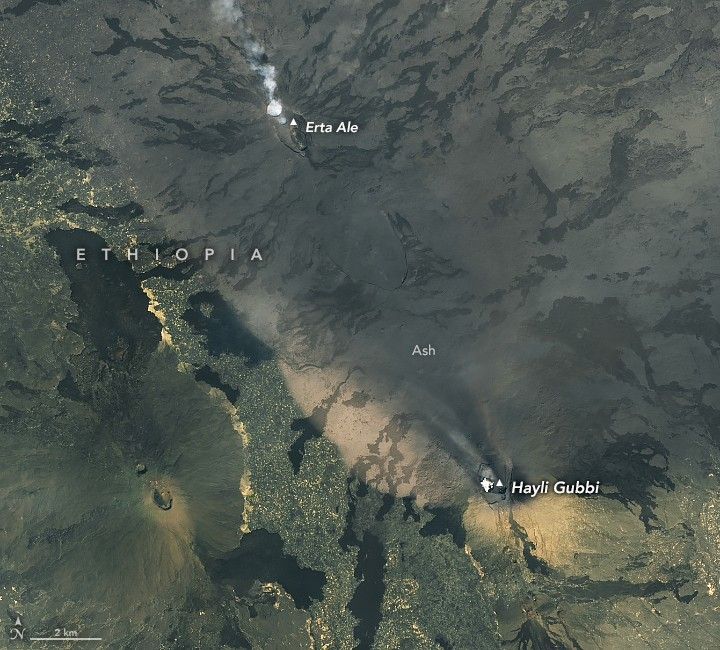
A satellite image shows a volcanic landscape in northern Ethiopia. Small white clouds hover around craters of two shield volcanoes, including Erta Ale toward the top left and Hayli Gubbi in the bottom right. Areas of dark lava are present throughout, and sinuous flows run roughly east and west from the volcanoes. A gray and tan layer of ash covers the ground in the upper right half of the image.
November 24, 2025

Low-level activity was observed at Hayli Gubbi beginning in late July and included sulfur dioxide emissions, lingering white clouds in its summit crater, and upward ground displacement measuring several centimeters, according to the Centre for Observation and Modelling of Earthquakes, Volcanoes and Tectonics (COMET). The magma intrusion following Erta Ale’s eruption likely triggered the activity, said COMET co-director Juliet Biggs in a recorded statement.

Hayli Gubbi’s eruption was brief, subsiding by November 25, but caused visible changes to the land surface. Ash covered large areas, which included nearby villages in Ethiopia’s Afar region. Residents struggled with respiratory issues due to the ash fallout, and grass and water for livestock were contaminated, according to news reports.

The summit area of the volcano also took on a new appearance. The detailed view above, acquired with the OLI-2 (Operational Land Imager-2) on Landsat 9, shows the craters atop Hayli Gubbi and neighboring Erta Ale on November 24, 2025. The eruption enlarged Hayli Gubbi’s existing crater, which is partially filled with a low-lying cloud in the image, and created two new craters to the southeast. Ash deposits cover older lava flows on the volcano’s slopes.

NASA Earth Observatory images by Michala Garrison, using MODIS data from NASA EOSDIS LANCE and GIBS/Worldview, and Landsat data from the U.S. Geological Survey. Story by Lindsey Doermann.

References & Resources

Downloads

A satellite image shows parts of Ethiopia and Eritrea on the left, the Red Sea in the center, and Yemen on the right. Most of the land appears dry and in shades of light brown. A label indicates the location of the Hayli Gubbi volcano in Ethiopia amid an area of darker volcanic rock.

November 15, 2025

JPEG (935.03 KB)

A satellite image shows parts of Ethiopia and Eritrea on the left, the Red Sea in the center, and Yemen on the right. A large plume of volcanic ash drifts east-northeast across the scene from the Hayli Gubbi volcano in Ethiopia.

November 23, 2025

JPEG (847.86 KB)

A satellite image shows a volcanic landscape in northern Ethiopia. Small white clouds hover around craters of two shield volcanoes, including Erta Ale toward the top left and Hayli Gubbi in the bottom right. Areas of dark lava are present throughout, and sinuous flows run roughly east and west from the volcanoes. A gray and tan layer of ash covers the ground in the upper right half of the image.

November 24, 2025

JPEG (4.89 MB)

You may also be interested in:

Stay up-to-date with the latest content from NASA as we explore the universe and discover more about our home planet.

Krasheninnikova Remains Restless

3 min read

The volcano on Russia’s Kamchatka Peninsula continues to erupt after centuries of quiescence.

Article

More Lava Fills Kilauea Crater

2 min read

The latest in a string of episodic eruptions produced voluminous fiery flows at the Hawaiian volcano’s summit.

Article

Ash Streams from Klyuchevskaya Sopka

3 min read

One of the most active volcanoes on the Kamchatka Peninsula is erupting yet again.

Article
Before yesterdayMain stream

Want to Make Smoke Rings? Quickest Guide to Master Vaping Tricks (2023)

27 January 2023 at 05:10
Make Smoke Rings

Image credit: Dominik Kempf via Unsplash

Making smoke rings is one of the most impressive vaping tricks you can learn. If you’re looking for an easy and fun way to impress your friends and take your vaping game to the next level, this guide has everything you need to start mastering this trick.


What do You need to Know Before Attempting Vape Tricks?

If you want to master vape tricks, it’s important that you know what you’re getting into. Vaping is a lot like riding a bike or riding a skateboard: the more experience you have with it, the easier it will be for you to perform tricks.

However, there are some things that can make vape tricks harder than they seem at first glance.

  1. Breath control is key.
  2. Practice makes the rings more perfect.
  3. Make sure not to burn your mouth, throat, or lungs by blowing out too fast or too hard.


Quick Guide: How to Make Smoke Rings?

Thanks to vaping, it’s now possible to make smoke rings. A smoke ring is a thin, round stream of vapor by a dry herb vaporizer that you blow out and then shape into a ring by slightly moving your mouth or hand.

Before we go any further no matter how cool this trick makes you feel it’s important to remember that blowing smoke rings can get really expensive really fast if you’re not careful.

The more fog juice or e-juice there is in your bottle (and therefore the more vapor), the bigger each ring will be when blown out through your nostrils or mouth. And if one does get too big for comfort? You may end up with a painfully dry throat or an awful cough until your throat muscles heal themselves again!

Practice moderation when practicing this vape trick at home, only use small amounts of juice per session so as not to overdo it while learning this new skill set!


Practice Makes the Rings More Perfect

To get the hang of vaping tricks, you’re going to need some practice with vapes like the firefly 2 vaporizer. It may take a few days or even weeks of practicing in front of a mirror and with a video camera until you can pull off your first trick.

Once you’re ready to try them in public, it’s important that you do so on a windy day to avoid any potential accidents. You’ll also want to make sure that the e-juice used in your atomizer is fresh. Otherwise, it could cause dry hits or other problems while trying out new tricks like blowing smoke rings or making an O-face (a popular trick with many vapers).

The best way to learn how to do these tricks is by watching others who have already mastered them! While this might seem counterintuitive at first glance, there are several reasons why this is helpful:

  1. It shows exactly what goes into making each move successful so that newbies can emulate those same movements until they’ve got them down pat.
  2. It allows vapers who have watched these videos before but haven’t yet learned all these techniques firsthand yet still want some pointers on improving their skills quickly.


Master Vaping Tricks

Image credit: Max Kleinen via Unsplash


The O – The First Trick for Beginners

If you’re new to vaping, the O is one of the first tricks you should learn. It’s simple and easy to master, and it helps you develop a good foundation for more advanced vaping tricks later on. What Is The O?

The O is when you exhale smoke into a ring shape as opposed to just letting it come out in front of your mouth like normal. To do this, use your free hand (or other) to squeeze down gently on the sides of your mouth while exhaling so that only part of the smoke comes out at first.

Then open up slightly so that all of the smoke gets squeezed through into an even circle before opening up wide again for another exhalation. This ensures that all of your vapor gets sent outwards rather than being wasted inside your body where it can’t be seen by others!

Once you get comfortable doing The O consistently try some different methods with different-sized rings until finding one that suits both what works best with how long it takes before burning out completely while also allowing enough time to make sure everyone knows exactly who did such an amazing job at showing off their skills.


How to Improve Your O’s – Bigger and Faster Rings, Volcanoes, and Waterfalls

  1. A volcano is made by inhaling the smoke into your mouth and cheeks, then exhaling it through your nose.
  2. To make a waterfall, inhale through your mouth with the same amount of smoke as you would for a regular O. Then exhale through your nose. Inhale again and repeat until there’s no more vapor left in your mouth (or at least not enough to make an O).
  3. For big O’s: The biggest part of improving how big an O you can make is learning how to hold it longer! It takes practice but if you keep at it, eventually it will be second nature. And don’t forget about good breath control. That helps too!


Wrapping Up

The more you practice, the better you’ll get at it. The goal here is to improve your vaping experience, not just show off for your friends. If you want to learn some tricks that are a little more advanced than the ones we talked about earlier in this article, check out our guide on how to vape like an expert!

❌
❌