Normal view

There are new articles available, click to refresh the page.
Yesterday — 5 December 2025Main stream

Senyar Swamps Sumatra

5 December 2025 at 00:01
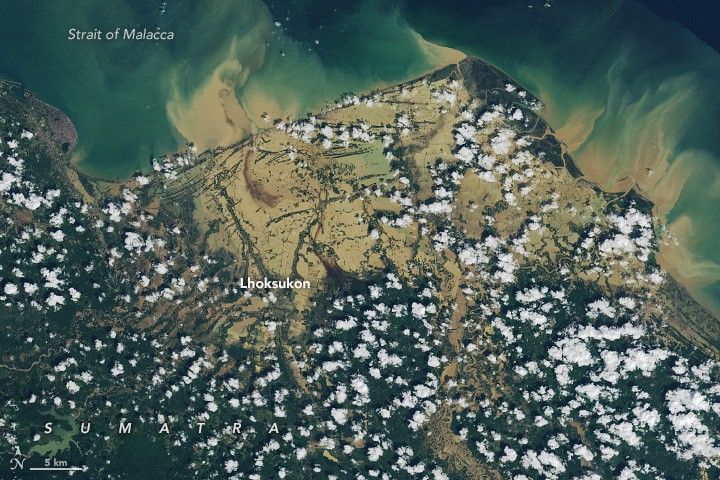
A satellite image centered on the town of Lhoksukon in Sumatra shows brown, muddy floodwater covering much of a coastal plain near the town. Plumes of brown water are visible mixing with the bluer waters of the Strait of Malacca in the upper part of the image. The lower part of the image is greener, more mountainous, and speckled with small clouds.
November 30, 2025

Tropical cyclones almost never form over the Strait of Malacca. The narrow waterway separating Peninsular Malaysia from the Indonesian island of Sumatra sits so close to the equator that the Coriolis effect is usually too weak to allow storms to rotate enough to organize into cyclones. But on November 25, 2025, meteorologists watched as a tropical depression intensified into Cyclone Senyar—just the second documented case of a tropical cyclone forming in the strait.

Hemmed in by land on both sides, Senyar made landfall in Sumatra later that day as it made a U-turn and headed east toward Malaysia. As the slow-moving storm passed over Sumatra’s mountainous terrain, it dropped nearly 400 millimeters (16 inches) of rain in many areas, according to satellite-based estimates from NASA’s Global Precipitation Measurement (GPM) mission. (Due to the averaging of the satellite data, local rainfall amounts may differ when measured from the ground.)

The torrent caused extensive flash floods and landslides in Sumatra’s rugged terrain. Streams and rivers rapidly overflowed with sediment-laden, debris-filled waters that swept through villages, cities, and towns. News reports suggest that the damage was worsened by an earthquake that struck on November 27 and the abundance of loose piles of timber in the region that became destructive battering rams in high water. As of December 4, Indonesian authorities reported several hundred deaths and more than 700,000 displaced people.

The OLI-2 (Operational Land Imager-2) on Landsat 9 captured this image of flooding in Aceh and North Sumatra provinces on November 30, 2025. Muddy sediment-filled water appears to have swamped much of Lhoksukon, a town of 40,000 people, and several surrounding villages. 

Other tropical cyclones and monsoon rains hitting Sri Lanka, Thailand, Malaysia, and Vietnam at roughly the same time have also caused extensive destruction in the broader region. According to one estimate from the United Nations Office for the Coordination of Humanitarian Affairs, flooding has affected more than 10.8 million people in the region and displaced more than 1.2 million.

NASA Earth Observatory image by Lauren Dauphin, using Landsat data from the U.S. Geological Survey. Story by Adam Voiland.

References & Resources

Downloads

A satellite image centered on the town of Lhoksukon in Sumatra shows brown, muddy floodwater covering much of a coastal plain near the town. Plumes of brown water are visible mixing with the bluer waters of the Strait of Malacca in the upper part of the image. The lower part of the image is greener, more mountainous, and speckled with small clouds.

November 30, 2025

JPEG (8.43 MB)

You may also be interested in:

Stay up-to-date with the latest content from NASA as we explore the universe and discover more about our home planet.

Monsoon Rains Flood Pakistan
3 min read

Heavy rains and flooding across the country since June 2025 have displaced millions of people, devastated infrastructure, and submerged farmland.

Article
Imelda and Humberto Crowd the Atlantic
3 min read

The tropical cyclones are close enough in proximity that they may influence one another.

Article
Rokan River Painted by the Tides
2 min read

Tides and sediment form brushstroke-like patterns across the river estuary in eastern Sumatra.
Article

Hayli Gubbi’s Explosive First Impression

4 December 2025 at 00:01


November 15, 2025
November 23, 2025

A satellite image shows parts of Ethiopia and Eritrea on the left, the Red Sea in the center, and Yemen on the right. Most of the land appears dry and in shades of light brown. A label indicates the location of the Hayli Gubbi volcano in Ethiopia amid an area of darker volcanic rock.
NASA Earth Observatory

A satellite image shows parts of Ethiopia and Eritrea on the left, the Red Sea in the center, and Yemen on the right. A large plume of volcanic ash drifts east-northeast across the scene from the Hayli Gubbi volcano in Ethiopia.
NASA Earth Observatory

A satellite image shows parts of Ethiopia and Eritrea on the left, the Red Sea in the center, and Yemen on the right. Most of the land appears dry and in shades of light brown. A label indicates the location of the Hayli Gubbi volcano in Ethiopia amid an area of darker volcanic rock.
NASA Earth Observatory
A satellite image shows parts of Ethiopia and Eritrea on the left, the Red Sea in the center, and Yemen on the right. A large plume of volcanic ash drifts east-northeast across the scene from the Hayli Gubbi volcano in Ethiopia.
NASA Earth Observatory

November 15, 2025

November 23, 2025


On November 23, 2025, the Hayli Gubbi volcano in northern Ethiopia erupted in dramatic fashion. The shield volcano in the Danakil (or Afar) Depression began spewing ash and volcanic gases at around 11:30 a.m. local time (8:30 Universal Time) that day, marking its first documented explosive eruption. The plume reached into the upper troposphere and drifted northeast, eventually crossing over northern India and China and disrupting flights.

The MODIS (Moderate Resolution Imaging Spectroradiometer) instrument on NASA’s Aqua satellite acquired the image above (right) of the eruption, about 4 hours after it was first detected. Other satellite data indicated the plume reached 15 kilometers (9 miles) above sea level and contained approximately 0.2 teragrams (220,000 tons) of sulfur dioxide, according to a Global Volcanism Program report. Another light-colored cloud, likely of pyroclastic material, is visible spreading to the north and appears to be on or close to the ground, the report stated. For comparison, the left image was acquired with the same sensor on November 15, before the eruption.

In this remote area of East Africa, tectonic plates are moving away from each other, which allows magma to rise to the surface and feed several active volcanoes. Due in part to Hayli Gubbi’s remote setting, geologists are unsure when Hayli Gubbi last erupted. Geologic evidence suggests it was within the past 8,000 years, though experts speculate it may have been within the past few centuries.

Hayli Gubbi lies about 12 kilometers (7 miles) south-southeast of Ethiopia’s most active volcano, Erta Ale, where a lava lake has roiled for decades. After Erta Ale’s most recent eruption in July 2025, scientists tracked the movement of magma beneath the surface using interferometric synthetic aperture radar (InSAR) measurements and other techniques. They found that magma propagated south from Erta Ale, passing beneath Hayli Gubbi and beyond.

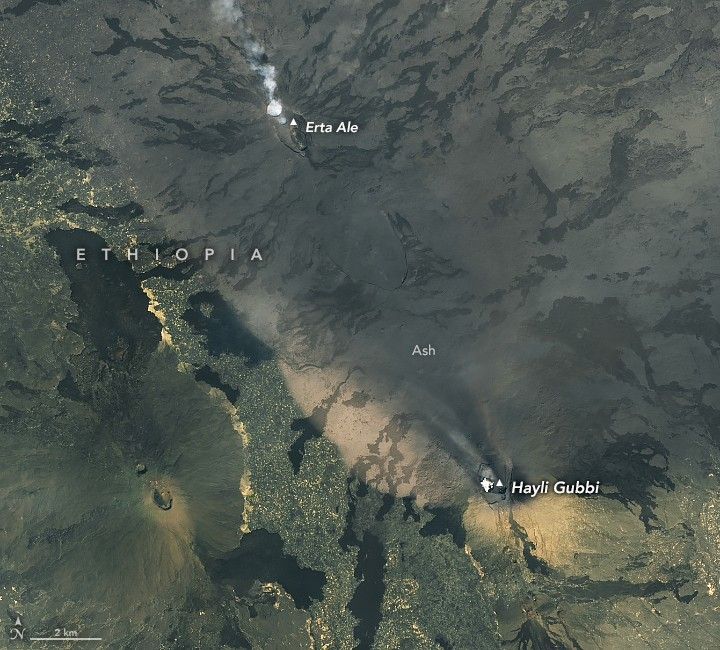
A satellite image shows a volcanic landscape in northern Ethiopia. Small white clouds hover around craters of two shield volcanoes, including Erta Ale toward the top left and Hayli Gubbi in the bottom right. Areas of dark lava are present throughout, and sinuous flows run roughly east and west from the volcanoes. A gray and tan layer of ash covers the ground in the upper right half of the image.
November 24, 2025

Low-level activity was observed at Hayli Gubbi beginning in late July and included sulfur dioxide emissions, lingering white clouds in its summit crater, and upward ground displacement measuring several centimeters, according to the Centre for Observation and Modelling of Earthquakes, Volcanoes and Tectonics (COMET). The magma intrusion following Erta Ale’s eruption likely triggered the activity, said COMET co-director Juliet Biggs in a recorded statement.

Hayli Gubbi’s eruption was brief, subsiding by November 25, but caused visible changes to the land surface. Ash covered large areas, which included nearby villages in Ethiopia’s Afar region. Residents struggled with respiratory issues due to the ash fallout, and grass and water for livestock were contaminated, according to news reports.

The summit area of the volcano also took on a new appearance. The detailed view above, acquired with the OLI-2 (Operational Land Imager-2) on Landsat 9, shows the craters atop Hayli Gubbi and neighboring Erta Ale on November 24, 2025. The eruption enlarged Hayli Gubbi’s existing crater, which is partially filled with a low-lying cloud in the image, and created two new craters to the southeast. Ash deposits cover older lava flows on the volcano’s slopes.

NASA Earth Observatory images by Michala Garrison, using MODIS data from NASA EOSDIS LANCE and GIBS/Worldview, and Landsat data from the U.S. Geological Survey. Story by Lindsey Doermann.

References & Resources

Downloads

A satellite image shows parts of Ethiopia and Eritrea on the left, the Red Sea in the center, and Yemen on the right. Most of the land appears dry and in shades of light brown. A label indicates the location of the Hayli Gubbi volcano in Ethiopia amid an area of darker volcanic rock.

November 15, 2025

JPEG (935.03 KB)

A satellite image shows parts of Ethiopia and Eritrea on the left, the Red Sea in the center, and Yemen on the right. A large plume of volcanic ash drifts east-northeast across the scene from the Hayli Gubbi volcano in Ethiopia.

November 23, 2025

JPEG (847.86 KB)

A satellite image shows a volcanic landscape in northern Ethiopia. Small white clouds hover around craters of two shield volcanoes, including Erta Ale toward the top left and Hayli Gubbi in the bottom right. Areas of dark lava are present throughout, and sinuous flows run roughly east and west from the volcanoes. A gray and tan layer of ash covers the ground in the upper right half of the image.

November 24, 2025

JPEG (4.89 MB)

You may also be interested in:

Stay up-to-date with the latest content from NASA as we explore the universe and discover more about our home planet.

Krasheninnikova Remains Restless

3 min read

The volcano on Russia’s Kamchatka Peninsula continues to erupt after centuries of quiescence.

Article

More Lava Fills Kilauea Crater

2 min read

The latest in a string of episodic eruptions produced voluminous fiery flows at the Hawaiian volcano’s summit.

Article

Ash Streams from Klyuchevskaya Sopka

3 min read

One of the most active volcanoes on the Kamchatka Peninsula is erupting yet again.

Article
Before yesterdayMain stream

A Glimpse of History in Benin City

1 December 2025 at 00:01
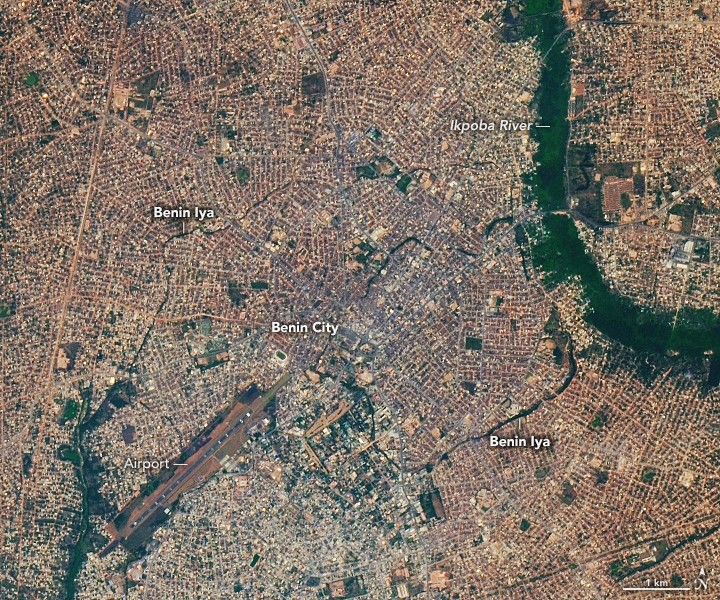
A satellite image centers on Benin City in Nigeria. Networks of neighborhoods, roads, and other development appear gray and span much of the image. Thin arcing strips of green are visible amid the development. These are forested remnants of ancient earthworks built several hundred years ago by the Kingdom of Benin.
January 11, 2025

In some ways, Benin City is like dozens of other fast-growing cities in Nigeria. Buoyed by burgeoning industrial and agricultural sectors, the city’s population rose by 1.7 million people over the past four decades as its footprint on the West African landscape expanded several times over.

Amid bustling new networks of roads, residential neighborhoods, markets, and workshops, lie signs of a much earlier era, when the city was the seat of a powerful pre-colonial kingdom. Remnants of ancient earthworks, thought to be among the longest in the world, can even be seen in images of the city captured from space.

Benin Iya (sometimes called the Benin Earthworks, the Walls of Benin, and the Benin Moat) is a vast, cellular network of interlocking earthen walls, ramparts, and ditches that radiate outward from a central moat at the heart of the city. Built in sections over hundreds of years between the 7th and 14th centuries, the system was key to marking defensive, political, and economic boundaries and played an important role in maintaining order and stability in the Kingdom of Benin.

The OLI-2 (Operational Land Imager-2) on Landsat 9 captured this image of the remains of earthworks on January 11, 2025. The features appear as dark green lines that trace arcing patterns in a densely settled area near the airport on the west bank of the Ikpoba River. Trees and vegetation growing in the moats give the features a dark green color.

Most of the earthworks consisted of relatively narrow and shallow linear ramparts and ditches that spread widely across the landscape. Many sections have been destroyed or are too small or too obscured by modern development to be easily detected by satellites or astronauts in orbit. However, some inner sections that run through the modern Oredo, Egor, and Ikpoba-Okha areas of the city had true walls and moats and are among the most visible in Landsat imagery.

Archaeological research indicates that the earthworks spanned more than 16,000 kilometers (10,000 miles) and enclosed roughly 6,500 square kilometers (2,500 square miles)—an area as large as the U.S. state of Delaware. Such length means the features hold the Guinness World Record for being the “longest earthworks of the pre-mechanical era.” By some measures, the features were together significantly longer than the Great Wall of China.

NASA Earth Observatory image by Lauren Dauphin, using Landsat data from the U.S. Geological Survey. Story by Adam Voiland.

References & Resources

Downloads

A satellite image centers on Benin City in Nigeria. Networks of neighborhoods, roads, and other development appear gray and span much of the image. Thin arcing strips of green are visible amid the development. These are forested remnants of ancient earthworks built several hundred years ago by the Kingdom of Benin.

January 11, 2025

JPEG (5.09 MB)

You may also be interested in:

Stay up-to-date with the latest content from NASA as we explore the universe and discover more about our home planet.

Breaking New Ground in Mekele  
5 min read

Researchers are using satellites to study development patterns in this fast-growing city in Ethiopia.

Article
From Forest to Field in Pará
2 min read

The Santarem plateau in the northern Brazilian state displays a patchwork of cleared and uncleared land bordering a densely forested…

Article
The First Labor Day Parade
3 min read

New York City’s Manhattan Island was the site of the nation’s first Labor Day parade on September 5, 1882.

Article

Rings of Rock in the Sahara 

28 November 2025 at 00:01
A top-down view shows circular rocky formations rising from a flat, sandy-brown landscape. Darker brown sand encircles the rocky rings, with lighter patches of outwash spreading across the terrain.
September 13, 2025

In northeastern Africa, within the driest part of the Sahara, dark rocky outcrops rise above pale desert sands. Several of these formations, including Jabal Arakanū, display striking ring-shaped structures.  

Jabal Arkanū (also spelled Arkenu) lies in southeastern Libya, near the border with Egypt. Several other massifs are clustered nearby, including Jabal Al Awaynat (or Uweinat), located about 20 kilometers (12 miles) to the southeast. Roughly 90 kilometers to the west are the similarly named Arkenu structures. These circular features were once thought to have formed by meteorite impacts, but later fieldwork suggested they resulted from terrestrial geological processes.   

Arkanū’s ring-shaped structures also have an earthly origin. They are thought to have formed as magma rose toward the surface and intruded into the surrounding rock. Repeated intrusion events produced a series of overlapping rings, their centers roughly aligned toward the southwest. The resulting ring complex—composed of igneous basalt and granite—is bordered to the north by a hat-shaped formation made of sandstone, limestone, and quartz layers. 

This photograph, taken by an astronaut aboard the International Space Station on September 13, 2025, shows the massif casting long shadows across the desert. The ridges stand nearly 1,400 meters above sea level, or about 800 meters above the surrounding sandy plains. Notice several outwash fans of boulders, gravel, and sand spreading from the mountain’s base toward the bordering longitudinal dunes.   

Two wadis, or typically dry riverbeds, wind through the structure. However, water is scarce in this part of the Sahara. Past research using data from NASA and JAXA’s now-completed Tropical Rainfall Measuring Mission (TRMM) indicated that southeastern Libya, along with adjacent regions of Egypt and northern Sudan, receives only about 1 to 5 millimeters of rain per year. Slightly higher accumulations, around 5 to 10 millimeters per year, occur near Jabal Arkanū and neighboring massifs, suggesting a modest orographic effect from the mountains.  

Astronaut photograph ISS073-E-698446 was acquired on September 13, 2025, with a Nikon Z9 digital camera using a focal length of 800 millimeters. It is provided by the ISS Crew Earth Observations Facility and the Earth Science and Remote Sensing Unit, Johnson Space Center. The image was taken by a member of the Expedition 73 crew. The image has been cropped and enhanced to improve contrast, and lens artifacts have been removed. The International Space Station Program supports the laboratory as part of the ISS National Lab to help astronauts take pictures of Earth that will be of the greatest value to scientists and the public, and to make those images freely available on the Internet. Additional images taken by astronauts and cosmonauts can be viewed at the NASA/JSC Gateway to Astronaut Photography of Earth. Story by Kathryn Hansen.  

References & Resources

Downloads

A top-down view shows circular rocky formations rising from a flat, sandy-brown landscape. Darker brown sand encircles the rocky rings, with lighter patches of outwash spreading across the terrain.

September 13, 2025

JPEG (4.54 MB)

You may also be interested in:

Stay up-to-date with the latest content from NASA as we explore the universe and discover more about our home planet.

Nighttime Over the Eastern Pacific

2 min read

A long-exposure photo taken from low Earth orbit captured the brilliant illumination coming from airglow, lightning, and stars.

Article

A Northwest Night Awash in Light

3 min read

The glow of city lights, the aurora, and a rising Moon illuminate the night along the northwest coast of North…

Article

A Halo Above the Horizon

3 min read

A subtle arc, formed by the bending of light through high-altitude ice crystals, cradles the Moon above the darkened Earth.

Article

Cranberry Country, Wisconsin

27 November 2025 at 00:01
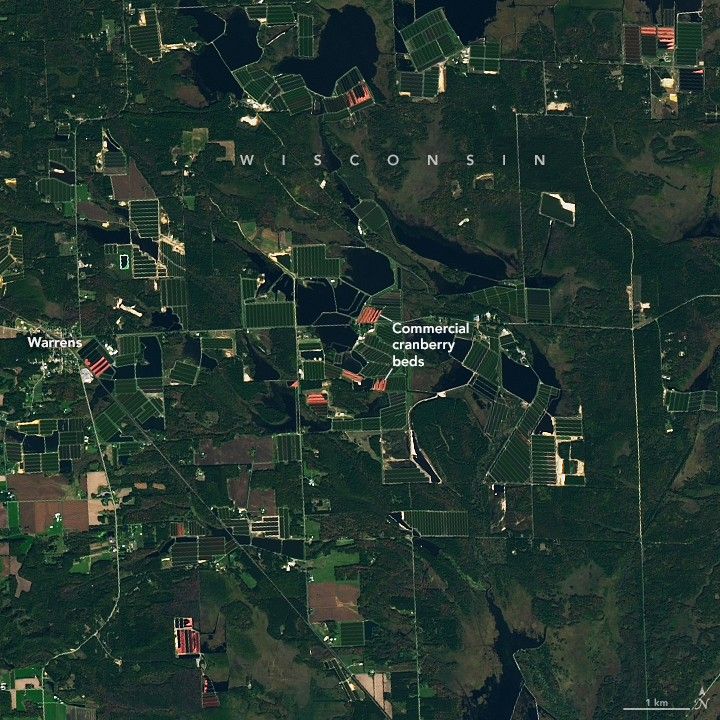
A satellite image of central Wisconsin shows a smattering of cultivated cranberry beds, which are mostly rectangular in shape and adjacent to small lakes. The beds have well defined parallel rows. Most are green, but some appear pink. Dark green vegetation and other agricultural fields cover the rest of the land, and the small town of Warrens is visible on the left side of the image.
October 13, 2025

Known as America’s Dairyland, Wisconsin produces the most cheese of any state and trails only California in the production of milk. Less famously, the state outpaces all others in a key part of many Thanksgiving menus. Wisconsin is the leading producer of cranberries in the U.S., with its annual hauls accounting for more than half of the country’s total yield.

The wetlands, cool climate, and sandy, acidic soils of central and northern Wisconsin provide the foundation for raising the tart berry successfully. This satellite image shows geometric networks of cranberry beds alongside small lakes near the town of Warrens, the “Cranberry Capital of Wisconsin.” It was acquired with the OLI-2 (Operational Land Imager-2) on Landsat 9 on October 13, 2025, during the autumn harvest season.

When berries are ripe, growers flood fields with up to a foot of water and then use specialized machines to knock fruit off the vines. Because cranberries contain pockets of air, they float to the surface—turning entire fields red—to be corralled and removed. Beds are not all flooded at once; satellite images acquired throughout the fall show different areas appearing red at different times.

Cranberries are native to Wisconsin marshes, and Native Americans have harvested the fruit for centuries. Commercial production in Wisconsin began in the mid-19th century and expanded as technology and cultivation methods improved. Around 1950, harvesting largely shifted from hand rakes to machines. By 1956, Wisconsin was the second-largest cranberry producer in the U.S. after Massachusetts, and in 1994 it took over the top spot. Today, cranberries in Wisconsin are an approximately $1 billion industry that employs nearly 4,000 people.

In mid-November, as Thanksgiving approaches, the brilliant red berries are on their way to be sold in markets or processed for use in sauces, juices, and other products. Meanwhile, the vines turn deep purple and go dormant. Growers prepare the beds for winter by again flooding the fields to cover plants in a protective layer of ice. They also coat the ice in sand, which will become part of the substrate and rejuvenate growth in the spring. With the right care, a cranberry plant can produce fruit for 50 years or more.

NASA Earth Observatory image by Lauren Dauphin, using Landsat data from the U.S. Geological Survey. Story by Lindsey Doermann.

References & Resources

Downloads

A satellite image of central Wisconsin shows a smattering of cultivated cranberry beds, which are mostly rectangular in shape and adjacent to small lakes. The beds have well defined parallel rows. Most are green, but some appear pink. Dark green vegetation and other agricultural fields cover the rest of the land, and the small town of Warrens is visible on the left side of the image.

October 13, 2025

JPEG (4.09 MB)

You may also be interested in:

Stay up-to-date with the latest content from NASA as we explore the universe and discover more about our home planet.

Flooding Along the Uruguay and Ibicuí Rivers

3 min read

Astronaut photos captured the aftermath of torrential rainfall in Rio Grande do Sul, Brazil’s southernmost state.

Article

Greenland Ice Sheet Gets a Refresh

3 min read

A moderately intense season of surface melting left part of the ice sheet dirty gray in summer 2025, but snowfall…

Article

Greenland’s Bejeweled Ice Sheet

2 min read

In early July 2025, around halfway through the island’s annual melting season, blue meltwater ponds dotted the western side of…

Article
❌
❌