Normal view

There are new articles available, click to refresh the page.
Today — 7 December 2025Cryptonews

Bitcoin Price Analysis: 92% Fed Rate Cut Probability Sparks Bitcoin Comeback Talk

7 December 2025 at 07:08

The FOMC meeting is scheduled for next Tuesday (December 9-10), and the market is almost unanimous on a dovish stance from the Fed.

Polymarket traders are pricing in a 92% probability of a 25-basis-point cut, which has shifted Bitcoin price analysis from a bearish breakdown to a potential comeback.

Powell Expected to Deliver 25bps Cut Despite Inflation Concerns

Federal Reserve Chair Jerome Powell is expected to proceed with another quarter-point rate reduction this week, even as several policymakers express concern about persistent inflation.

The Fed implemented its second consecutive cut in October, responding to unexpected weakness in the summer jobs data.

Following that decision, hawkish voices emerged among officials, including five current voting members, who indicated reluctance to support further easing in December.

The tide turned on November 21 when New York Fed President John Williams suggested conditions warranted a reduction in the “near term.”

Recent Bitcoin price analysis from Cryptonews highlights a critical on-chain metric gaining momentum.

Bitcoin “liveliness” is climbing again, a pattern that has historically coincided with bull market phases, suggesting the current cycle may have substantial upside remaining.

Analyst Michaël van de Poppe outlined a bullish scenario, anticipating short-term volatility before a sustained rally.

He expects pre-FOMC selling pressure today and Monday, potentially driving prices down to $87,000 to sweep liquidity at the lows.

This would be my bullish scenario.

Pre-FOMC and on Monday, correction to sweep the lows. Perhaps hitting $87K.

After that, bounce back up, swiftly, in which the uptrend is confirmed for #Bitcoin and it's ready to break $92K and therefore the run towards $100K in the coming 1-2… pic.twitter.com/lQezKkQM5W

— Michaël van de Poppe (@CryptoMichNL) December 7, 2025

“After that, bounce back up, swiftly, in which the uptrend is confirmed for Bitcoin and it’s ready to break $92,000

And therefore the run towards $100,000 in the coming 1-2 weeks as the Fed is reducing QT, doing rate cuts and expanding the money supply to increase the business cycle,” van de Poppe stated.

Bitcoin Price Analysis: Technical Setup Favors $94k Breakout

Technical analysis shows Bitcoin breaking out of a long descending red channel, signalling that the strongest phase of the downtrend has likely ended.

Price is currently hovering around the $89,000 zone, which sits just beneath a key resistance-turned-support area highlighted in orange.

Until BTC closes decisively above this zone, sellers can still create short-term pressure.

Bitcoin Price Analysis - Bitcoin Chart
Source: TradingView

The breakout attempt already shows early strength, as BTC bounced from the lower channel region near $79,000 and pushed back toward mid-trend.

The next major resistance level is around $94,600, and clearing it would confirm bullish continuation.

If that happens, the chart projects upside targets at $108,000 and eventually $116,000, which align with previous liquidity zones.

Maxi Doge Presale Capitalizes on Market Momentum

As Bitcoin positions for a potential comeback driven by Fed rate cuts, presale projects like Maxi Doge (MAXI) are attracting investor attention.

MAXI is capturing the grassroots momentum that drove Dogecoin’s extraordinary 161,000x rally.

The project has secured over $4.2 million in funding while building an active community focused on sharing trading strategies and market opportunities.
Bitcoin Price Analysis - Maxidoge Banner

Notably, 25% of capital raised will be invested in promising plays, with returns recycled into marketing initiatives and community rewards to accelerate growth.

Investors can join the presale at $0.000272 by visiting the official Maxi Doge website.

Then connect an Ethereum-compatible wallet like Best Wallet, and purchase MAXI with ETH, BNB, or USDT.

Bank card payments are also supported for instant access.

The post Bitcoin Price Analysis: 92% Fed Rate Cut Probability Sparks Bitcoin Comeback Talk appeared first on Cryptonews.
Bitcoin “Liveliness” Indicator Rises, Hinting the Bull Cycle May Not Be Over

By: Amin Ayan
7 December 2025 at 05:31

A key on-chain indicator known as Bitcoin “liveliness” is climbing again, a pattern historically associated with bull market activity, raising the possibility that the current cycle still has room to run, according to analysts tracking long-term blockchain metrics.

Key Takeaways:

  • Bitcoin’s “liveliness” metric is rising despite stagnant prices, signaling renewed underlying demand.
  • Analysts say dormant coins are moving at unprecedented scale, suggesting a major capital rotation.
  • The indicator’s breakout from a years-long range hints the current bull cycle may not be finished.

Technical analyst TXMC said on Sunday that liveliness has been “marching higher despite lower prices,” a divergence that suggests steady underlying demand for spot Bitcoin even as market sentiment remains subdued.

Bitcoin’s Rising “Liveliness” Metric Points to Renewed Bull-Market Demand

The metric, described as an “elegant” long-term gauge of chain activity, measures the ratio of coins being transacted relative to those being held, weighted by their age.

It increases when older coins are spent more frequently, and falls when long-term holders accumulate.

“Liveliness usually rises in bull runs as supply changes hands at higher prices, indicating a flow of newly invested capital,” TXMC explained, noting that the latest upward trend contradicts the muted price action seen in recent weeks.

Glassnode data shows liveliness pushing into a new peak range, breaking out of the corridor it remained stuck in from the 2017 all-time-high through earlier cycles.

Analyst James Check said the current spike in liveliness reflects an unprecedented reactivation of dormant Bitcoin supply, surpassing patterns seen during the 2017 bull run, the first cycle characterized by “widespread participation” and a dramatic parabolic surge.

Liveliness has been range bound since the 2017 peak, up until now.

The 2017 Bull was special in that it was the first epic parabola with widespread participation, but was also when many old coins transacted to capture the BCH dividend.

New Liveliness ATHs shows how extreme the… https://t.co/aoVFr2jOsR

— _Checkmate 🟠🔑⚡☢🛢 (@_Checkmatey_) December 6, 2025

This time, however, the scale is far larger. While 2017 typically saw transfers measured in the thousands of dollars, Check noted that today’s on-chain value flows often reach into the billions, signaling one of the largest capital rotations Bitcoin has experienced.

“We have seen an extraordinary volume of coin days destroyed,” Check said. “I am of the view we have just watched one of the greatest capital rotations and changing of the guard in Bitcoin history.”

BTC Price Stalls, Analysts Eye Breakout Levels

Bitcoin’s price action remains subdued despite the on-chain strength. BTC briefly dipped below $89,000 early Sunday before recovering to around $89,500, largely unchanged over 24 hours.

Analyst Michaël van de Poppe said the market is stuck in a consolidation band: “Anything between $86,000 and $92,000 is pretty much noise.”

Anything between $86-92K is pretty much noise. Not much will happen for $BTC.

If $92K gets tested, I think we'll break it, but if not, brace yourself for a test at the low $80K range for some sort of double-bottom pattern.

Again, I don't think we're far off bottoming for… pic.twitter.com/6acTFBAZk4

— Michaël van de Poppe (@CryptoMichNL) December 6, 2025

He added that a test of $92,000 could lead to a breakout, while failure could push BTC toward the low $80,000s for a potential double-bottom formation.

“I don’t think we’re far off bottoming for Bitcoin,” van de Poppe said, predicting a stronger rally heading into late Q4 and early Q1.

Last week, Bitfinex said the market is showing “seller exhaustion” following a period of heavy deleveraging and panic-driven exits by short-term holders.

“The combination of extreme deleveraging, capitulation among short-term holders, and early signs of seller exhaustion has created the conditions for a stabilisation phase and a relief bounce,” the firm wrote.

The post Bitcoin “Liveliness” Indicator Rises, Hinting the Bull Cycle May Not Be Over appeared first on Cryptonews.

Ether Supply on Exchanges Falls to Record Low, Raising Supply Squeeze Hopes

By: Amin Ayan
7 December 2025 at 05:26

Ether held on centralized exchanges has fallen to its lowest level in history, fueling speculation that a supply squeeze may be forming beneath the surface of the market.

Key Takeaways:

  • ETH exchange balances have dropped to a record low of 8.7%, a 43% decline since July.
  • Staking, L2 activity, DATs, and long-term custody are tightening liquid supply.
  • Analysts see hidden buying strength, hinting at potential upward momentum.

According to Glassnode, exchange balances dropped to 8.7% of total ETH supply last Thursday, the smallest share recorded since Ethereum’s launch in 2015. Levels remained near that low at 8.8% on Sunday.

ETH Exchange Balances Plunge 43% as Supply Tightens to Record Levels

The sharp decline represents a 43% drop in ETH exchange balances since early July, coinciding with the acceleration of digital asset treasury (DAT) purchases and growing activity across the broader Ethereum ecosystem.

Macro research outlet Milk Road said ETH is “quietly entering its tightest supply environment ever,” noting that Bitcoin’s exchange balance remains significantly higher at 14.7%.

Analysts attributed the shift to structural changes in how ETH is being used. More tokens are flowing into staking, restaking protocols, layer-2 networks, DAT balance sheets, collateralized DeFi positions, and long-term self-custody, destinations that historically do not circulate supply back onto exchanges.

“Sentiment feels heavy right now, but sentiment doesn’t dictate supply,” Milk Road wrote. “When that gap closes, price follows.”

Beyond supply metrics, market technicians are spotting signals that buyers may be gaining control. Analyst Sykodelic highlighted an On-Balance Volume (OBV) breakout above resistance late last week, even as price failed to follow.

$ETH is quietly entering its tightest supply environment ever.

Exchange balances just fell to 8.84% of total supply, a level we’ve never seen before.

For context, $BTC is still sitting near 14.8%.

ETH keeps getting pulled into places that don’t sell, staking, restaking, L2… pic.twitter.com/T7MW3D2bG1

— Milk Road (@MilkRoad) December 5, 2025

The divergence, they said, is a classic sign of “hidden buying strength” that sometimes precedes upward moves.

“This is a sign of buying strength, and typically, the price will follow,” the analyst noted, while cautioning that indicators aren’t guarantees.

They added that overall price action “looks bullish,” suggesting ETH may revisit higher levels before any meaningful retracement.

ETH Holds $3,000 as Momentum Builds

Ether has held above the $3,000 mark for nearly a week but continues to face resistance near $3,200. Over the past 24 hours, ETH has consolidated around $3,050, mirroring the broader market’s indecision.

The ETH/BTC pair also drew attention last week after breaking above a long-standing downtrend, a move some traders see as an early sign of capital rotating back into Ethereum.

Meanwhile, BitMine Immersion Technologies, already the largest corporate holder of Ether, has continued aggressively buying the dip even as top traders position for further declines.

The firm purchased another $199 million in ETH over the past two days, adding to its rapidly expanding reserves.

BitMine now controls $11.3 billion worth of Ether, roughly 3.08% of the total supply, and is closing in on its long-stated goal of reaching 5%.

Last month, Tom Lee said Ether may be entering the early stages of the type of explosive growth cycle that propelled Bitcoin to a 100x rally since 2017.

Lee said the current Ether market resembles Bitcoin’s setup eight years ago, a period marked by deep volatility that ultimately preceded one of the strongest bull cycles in crypto history.

The post Ether Supply on Exchanges Falls to Record Low, Raising Supply Squeeze Hopes appeared first on Cryptonews.

Korea to Treat Crypto Exchanges Like Banks After Upbit Hack

7 December 2025 at 05:23

South Korea is moving to impose bank-level liability standards on crypto exchanges following a $30.1 million hack at Upbit last month, shifting toward treating major platforms with the same regulatory rigor as traditional financial institutions.

According to The Korea Times, the Financial Services Commission is reviewing provisions that would require crypto exchanges to compensate users for losses caused by hacking or system failures, regardless of fault, mirroring rules currently applied only to banks and electronic payment firms under the country’s electronic financial transactions law.

The push follows a Nov. 27 breach at Upbit that saw over 104 billion Solana-based tokens worth 44.5 billion won ($36M) transferred to external wallets in just 54 minutes.

Despite the incident, the exchange faced minimal penalties since regulators cannot order compensation under existing laws.

🚨 South Korea’s largest crypto exchange Upbit @Official_Upbit reported a $36m Solana network hack on Thursday, halting withdrawals on the spot and pledging to fully reimburse affected customers.

The incident comes on the same date as its 2019 breach l…https://t.co/o0VLiqKin7

— Cryptonews.com (@cryptonews) November 27, 2025

Mounting System Failures Drive Regulatory Overhaul

The planned reforms come amid a pattern of platform instability across Korea’s crypto sector.

Financial Supervisory Service data shows the five major exchanges, Upbit, Bithumb, Coinone, Korbit, and Gopax, recorded 20 system failures between 2023 and September this year, affecting over 900 users with combined losses of 5 billion won.

Upbit alone accounted for six incidents, with more than 600 victims suffering 3 billion won in damages.

Draft legislation is expected to mandate IT security infrastructure plans, upgraded system standards, and significantly stronger penalties.

Lawmakers are considering revisions that would allow fines of up to 3 percent of annual revenue for hacking incidents, matching standards for traditional financial institutions and replacing the current 5 billion won cap.

The shift would fundamentally reshape accountability in Korea’s crypto industry by making exchanges liable to compensate victims, as banks must respond to security breaches or system failures.

The Upbit breach also exposed reporting failures, with the exchange waiting over six hours after detecting the hack at 5 a.m. to notify regulators at 10:58 a.m.

Ruling party lawmakers alleged that Dunamu deliberately delayed disclosure until after its scheduled merger with Naver Financial, which concluded at 10:50 a.m.

Broader Compliance Crackdown Intensifies Across Industry

The regulatory tightening extends beyond security requirements into comprehensive anti-money laundering enforcement.

Korea’s Financial Intelligence Unit is preparing sanctions against major exchanges following on-site inspections that examined compliance with Know Your Customer checks and suspicious transaction reporting.

The unit has already disciplined Dunamu with a three-month suspension on new customer activity and a 35.2 billion won fine, setting a precedent for penalties expected to reach hundreds of billions of won across the sector.

Authorities are simultaneously expanding the crypto travel rule to apply to transactions under 1 million won, closing a loophole that allowed users to evade identity checks by splitting transfers into smaller amounts.

We will crack down on crypto money laundering, expanding the Travel Rule to transactions under 1 million won,” Financial Services Commission Chairman Lee Eok-won said during a National Assembly briefing.

The Financial Intelligence Unit will gain pre-emptive account-freezing powers in serious cases, while new rules will bar individuals with convictions for tax crimes or drug offenses from becoming major shareholders in licensed platforms.

Legislative amendments are expected in the first half of 2026 as Korea aligns with global standards through expanded coordination with the Financial Action Task Force.

🇰🇷 South Korean crypto tax may face a fourth delay to 2027 as proposed amendments fail to address framework issues. #CryptoTax #SouthKoreahttps://t.co/L0vuIlvbSu

— Cryptonews.com (@cryptonews) November 18, 2025

The enforcement drive unfolds as Korea’s long-delayed crypto tax regime faces potential postponement beyond its January 2027 start date due to persistent infrastructure gaps, with no significant updates to the framework despite multiple deferrals since its 2020 approval.

Recently, lawmakers also set a December 10 deadline for the government to deliver a stablecoin regulatory framework, or face legislative action, with debates centering on whether banks should lead issuance or whether fintech firms should participate more actively.

Financial Supervisory Service Gov. Lee Chan-jin acknowledged the limits of current oversight despite the seriousness of the Upbit incident, stating that “regulatory oversight clearly has limits in imposing penalties” under existing law.

However, with the planned reforms, it aims to close these gaps as Korea positions itself to compete with major economies that have already formalized comprehensive digital asset frameworks.

The post Korea to Treat Crypto Exchanges Like Banks After Upbit Hack appeared first on Cryptonews.

Euro Stablecoin Market Doubles to $680M A Year After MiCA

By: Amin Ayan
7 December 2025 at 05:12

The euro stablecoin market has staged a sharp rebound in the year since the EU’s Markets in Crypto-Assets Regulation (MiCA) took effect, doubling in size as new rules for issuers came online.

Key Takeaways:

  • The euro stablecoin market has doubled since MiCA’s rollout, reaching roughly $680 million in market cap.
  • Growth is concentrated in major issuers like EURS, EURC and EURCV, with transaction volumes surging nearly ninefold.
  • Public interest is rising across the EU, signaling growing adoption.

According to Decta’s Euro Stablecoin Trends Report 2025, the sector’s market capitalization has surged from last year’s slump, reversing a 48% contraction and outpacing the broader stablecoin market’s 26% growth rate.

Euro Stablecoins Hit $680M After MiCA

Decta’s report says euro-denominated stablecoins climbed to roughly $500 million by May 2025 following MiCA’s June 2024 rollout, a shift credited to clearer issuer obligations and standardized reserve rules.

Today, the market sits at around $680 million, per CoinGecko. However, the market is still tiny compared with the nearly $300 billion locked in US dollar-backed tokens, a space dominated by USDT and USDC.

Much of the growth came from a handful of standout issuers. Stasis’ EURS posted the strongest expansion, soaring 644% to $283.9 million as of October 2025.

Circle’s EURC and Societe Generale’s EURCV also saw meaningful increases as regulated issuers began to capitalize on MiCA’s clarity around custody, reserves and public disclosures.

Activity on-chain grew alongside market cap. Monthly transaction volume for euro stablecoins jumped nearly ninefold to $3.83 billion after MiCA implementation, the report found.

JUST IN: 💶 Ten European banks are building a euro stablecoin under Dutch Central Bank oversight.

They’re targeting regulatory approval in late 2026 pic.twitter.com/8zZv4d8Q5t

— Futures (@FuturesDotNYC) December 3, 2025

EURC and EURCV led the surge, with volumes climbing 1,139% and 343%, supported by greater use in cross-border payments, fiat on-ramps and crypto trading pairs, areas previously dominated by dollar stablecoins.

The regulatory shift also appears to be stimulating public interest. Decta recorded sharp spikes in search activity across EU markets, including a 400% jump in Finland and more than tripling in Italy.

Interest rose across smaller economies as well, suggesting broader consumer awareness as euro-denominated tokens begin carving out a clearer role in Europe’s digital-asset landscape.

Poland Remains Last EU State Without MiCA Rules

As reported, Poland’s push to bring its crypto sector in line with the EU’s MiCA framework collapsed after lawmakers failed to overturn President Karol Nawrocki’s veto of a major digital-asset bill.

The vote fell short of the required three-fifths majority, leaving Poland as the only EU member without a national MiCA-style regulatory regime and forcing the government to restart the legislative process.

Prime Minister Donald Tusk had argued that the bill was necessary for national security, warning that unregulated crypto activity had become a channel for money laundering and foreign interference, including covert financing linked to Russia and Belarus.

Authorities have connected these concerns to several recent security incidents, including alleged sabotage plots in Poland reportedly funded through cryptocurrencies.

The veto has intensified political tensions between Nawrocki and Tusk’s pro-EU coalition.

The president rejected the bill on grounds that it overreached EU requirements and posed risks to civil liberties and property rights.

The post Euro Stablecoin Market Doubles to $680M A Year After MiCA appeared first on Cryptonews.

Michael Saylor’s Bitcoin Playbook Backfires on 100+ Companies

7 December 2025 at 05:10

Digital asset treasury companies that rushed to copy Michael Saylor’s Bitcoin strategy are now hemorrhaging shareholder value, with median stock prices down 43% year to date, even as the broader market climbs higher, as per Bloomberg.

Michael Saylor's Bitcoin Strategy - DAT Returns Chart
Source: Bloomberg

More than 100 publicly traded companies transformed themselves into cryptocurrency-holding vehicles in the first half of 2025, borrowing billions to buy digital tokens while their stock prices initially soared past the value of the underlying assets they purchased.

The strategy seemed unstoppable until market reality delivered a harsh correction.

Strategy’s Model Spawns Industry-Wide Collapse

Strategy Inc.’s Michael Saylor pioneered the approach of converting corporate cash into Bitcoin holdings, transforming his software company into a publicly traded cryptocurrency treasury.

The model worked spectacularly through the mid-2025, attracting high-profile investors, including the Trump family.

SharpLink Gaming epitomized the frenzy. The company pivoted from traditional gaming operations, appointed an Ethereum co-founder as chairman, and announced massive token purchases.

💰Sharplink Gaming added $80M in Ether to its reserves, lifting total holdings to $3.6B and cementing its spot as the second-largest corporate holder of ETH.#Sharplink #Ether https://t.co/ADz76OeiCn

— Cryptonews.com (@cryptonews) October 27, 2025

Its stock exploded 2,600% within days before crashing 86% from peak levels, leaving total market capitalization below the value of its Ethereum holdings at just 0.9 times crypto reserves.

Bloomberg data tracking 138 U.S. and Canadian digital asset treasuries shows the median share price has fallen 43% year-to-date, dramatically underperforming Bitcoin’s modest 7% decline.

In comparison, the S&P 500 gained 6% and the Nasdaq 100 rose 10%.

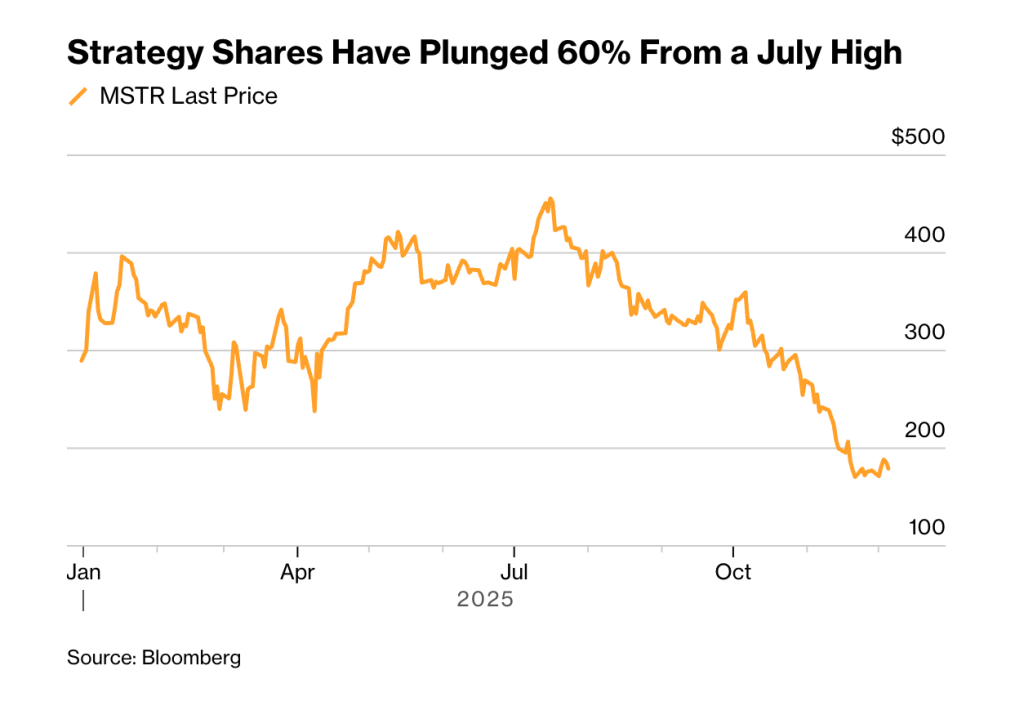
Strategy shares have dropped 60% from their July highs, even as they have risen by more than 1,200% since the company began buying Bitcoin in August 2020.

Michael Saylor's Bitcoin Strategy - Strategy Shares Chart
Source: Bloomberg

Investors took a look and understood that there’s not much yield from these holdings rather than just sitting on this pile of money,” B. Riley Securities analyst Fedor Shabalin told Bloomberg.

Debt Obligations Expose Structural Flaws

The fundamental problem plaguing these companies stems from how they fund cryptocurrency purchases.

Strategy and its imitators issued massive amounts of convertible bonds and preferred shares, raising over $45 billion across the industry to acquire digital tokens that generate no cash flow.

These debt instruments carry substantial interest and dividend obligations that cryptocurrency holdings cannot service, creating a structural mismatch between liabilities that require regular payments and assets that produce zero income.

Strategy faces annual fixed obligations of approximately $750 million to $800 million tied to preferred shares.

Companies that avoided Bitcoin for smaller, more volatile cryptocurrencies suffered the steepest losses.

Alt5 Sigma, backed by two Trump sons and planning to purchase over $1 billion in World Liberty Financial’s WLFI token, has crashed more than 85% from its June peak.

Strategy attempted to address funding concerns by raising $1.44 billion in dollar reserves through stock sales, covering 21 months of dividend payments.

Saylor Admits Potential Bitcoin Sales

The industry now faces its defining moment. Strategy CEO Phong Le acknowledged the company would sell Bitcoin if needed to fund dividend payments, specifically if the firm’s market value falls below its cryptocurrency holdings.

Those comments sent shockwaves through the digital asset treasury sector, given Saylor’s repeated insistence that Strategy would never sell, famously joking in February to “sell a kidney if you must, but keep the Bitcoin.

At December’s Binance Blockchain Week, Saylor outlined the revised approach, stating that “when our equity is trading above the net asset value of the Bitcoin, we just sell the equity,” but “when the equity’s trading below the value of the Bitcoin, we would either sell Bitcoin derivatives, or we would just sell the Bitcoin.

The reversal raises fears of a downward spiral where forced crypto sales push token prices lower, further pressuring treasury company valuations and potentially triggering additional selling.

Strategy’s monthly Bitcoin accumulation has collapsed from 134,000 BTC at the 2024 peak to just 9,100 BTC in November, with only 135 BTC added so far in December.

The company now holds approximately 650,000 BTC, valued at over $56 billion, representing more than 3% of Bitcoin’s maximum supply.

Market participants worry that leveraged traders using borrowed money to invest in these companies could face margin calls, forcing broader market selloffs.

Strategy has created a $1.4 billion reserve fund to cover near-term dividend payments, but shares remain on track for a 38% decline this year despite the company’s massive Bitcoin holdings.

The post Michael Saylor’s Bitcoin Playbook Backfires on 100+ Companies appeared first on Cryptonews.

Yesterday — 6 December 2025Cryptonews

Bitcoin Price Prediction: Year-End $100K Target Alive – Here Are the Three Drivers That Matter

6 December 2025 at 06:52

Bitcoin may be holding slightly below $90,000, but data imply that the $100K year-end target is still alive as analysts point out that three Bitcoin Price Prediction indicators are flashing a green signal.

The 3-Key Drivers For Bitcoin $100k Year-end Target

The first and most critical driver is the shift in Federal Reserve monetary policy.

After months of reducing liquidity through quantitative tightening, where the central bank stopped reinvesting proceeds from maturing bonds and Treasury holdings, the Fed ended this program on December 1.

Markets are now positioning for an easing cycle.

QUANTITATIVE TIGHTENING DONE ; WHAT’S NEXT FOR $BTC?

Historically, Bitcoin and altcoins struggle during prolonged Quantitative Tightening (QT = red zone), which lasted three years and just ended on December 1, 2025.

What usually follows: an uptrend (black zone).

Once… https://t.co/oosjrrFd0E pic.twitter.com/VzxaTLa4bn

— CryptosRus (@CryptosR_Us) December 6, 2025

Data from the CME FedWatch Tool reveals that traders see an 87% likelihood of a rate reduction at the upcoming Wednesday meeting, with three additional cuts anticipated by September 2026.

This policy shift comes as tech sector borrowing costs rise amid substantial AI infrastructure debt, creating conditions where investors may seek alternative stores of value.

The combination of these factors could provide the momentum needed for Bitcoin to cross the six-figure threshold in the coming weeks.

The second driver is liquidity structure.

According to order-book data from CoinGlass, Bitcoin currently has two significant liquidity clusters: the downside liquidity around $90,000, which is currently being tested, and upside liquidity near $94,500.

If the latter is breached, a rally toward $100,000 becomes highly probable.

Bitcoin Price Prediction: Rising Channel Points to $100k Breakout

The third driver comes from technical analysis, which suggests a $100,000 recovery if BTC breaches the $95,000 resistance.

The 4-hour chart shows Bitcoin trading inside a rising channel, though the latest rejection near mid-range has pushed price back toward the lower trendline.

The key support level holding the structure together is $84,000. If BTC stays above that line, the overall channel remains intact, and a rebound toward $95,000 resistance becomes likely.

Bitcoin Price Prediction - Bitcoin Price Chart
Source: TradingView

A breakout above $95,000 would flip the structure bullish and open the path toward the $100,000 region, the next major liquidity target.

However, RSI has cooled off sharply and is leaning bearish, indicating weakened momentum.

If Bitcoin loses $84,000, the rising channel breaks down, and price could slide toward longer-term support around $80,000.

Maxi Doge Presale Gains Traction

While Bitcoin awaits bullish confirmation, Maxi Doge (MAXI) is emerging as a notable Ethereum-based meme coin with ambitions to replicate Dogecoin’s success story.

MAXI is channeling the community-driven energy that propelled DOGE from $0.00008547 in 2015 to its current $0.138 price, a remarkable +161,800x gain.

While replicating that exact trajectory may be ambitious, analysts believe Maxi Doge can deliver a modest 10-50x return for early adopters.

MAXI has now raised over $4.2 million and is building a vibrant community where holders share trading setups, early opportunities, and alpha insights.

Bitcoin Price Prediction - Maxidoge Banner

Beyond the meme appeal, 25% of raised funds will be deployed into high-potential plays, with profits reinvested directly into marketing to fuel exponential growth and community rewards.

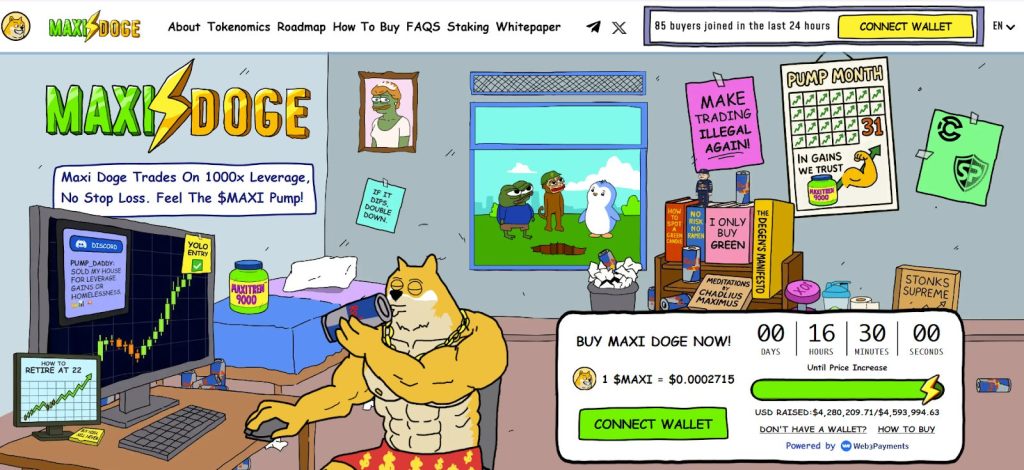
To join the presale at the current $0.0002715 price, visit the official Maxi Doge website.

Then connect an Ethereum-compatible wallet like Best Wallet, and pay with ETH, BNB, or USDT.

You can swap existing crypto or use a bank card to invest in seconds.

The post Bitcoin Price Prediction: Year-End $100K Target Alive – Here Are the Three Drivers That Matter appeared first on Cryptonews.

MetaMask Enters Prediction Markets With Polymarket Integration

By: Amin Ayan
6 December 2025 at 05:12

MetaMask, the most widely used Ethereum wallet, is moving directly into the prediction market arena through a new integration with Polymarket, giving users the ability to trade event outcomes from inside their wallets.

Key Takeaways:

  • MetaMask has integrated Polymarket, allowing users to trade real-world event outcomes.
  • The integration adds one-tap funding from any EVM chain.
  • Polymarket’s rapid growth continues amid a potential $15 billion valuation.

“You can now trade on the future outcome of real world events inside your wallet,” Consensys’ Gabriela Helfet wrote, adding that users will also earn MetaMask Rewards points for every prediction placed.

MetaMask Becomes New Gateway to Polymarket With One-Tap Funding

The integration creates a new on-ramp for Polymarket and introduces “one tap funding,” allowing users to deposit with any token from any EVM-compatible chain.

The move further tightens the link between everyday crypto wallets and decentralized betting platforms, positioning MetaMask as a gateway not only to Web3 apps but also to real-world event speculation.

Polymarket has surged in popularity over the past year, fueled in part by heightened attention during the 2024 US election cycle.

Former President Donald Trump’s embrace of crypto and a more relaxed regulatory climate helped push the platform back into the US market.

The company is now reportedly exploring a valuation of up to $15 billion, following a $2 billion strategic investment from Intercontinental Exchange, the parent of the NYSE.

Predicting on MetaMask only takes a few seconds.🔮

We've enabled 1-click funding with any EVM token, or you can get started instantly if you have an existing @polymarket account! pic.twitter.com/zZtrQPDu3m

— MetaMask.eth 🦊 (@MetaMask) December 5, 2025

For MetaMask, the move comes as the wallet expands beyond its Ethereum-focused roots. In October, it launched multichain accounts that support both EVM and non-EVM networks, including Solana.

The wallet is also preparing for the rollout of a native MASK token, as parent company Consensys gears up for a potential IPO.

The move comes as Polymarket is recruiting staff for an internal market-making team that would trade against its own customers, mirroring a controversial feature already used by rival Kalshi that has drawn criticism and legal challenges.

As reported, the New York-based prediction market startup has approached traders, including sports bettors, to join the new unit, people familiar with the matter said, requesting anonymity because the plans remain private.

Prediction Markets Hit $13B in Record Activity

Prediction markets have crossed $13 billion in cumulative trading volume, marking a record high even as broader crypto markets cool.

The surge has drawn in major players across tech and finance, including Fanatics, Coinbase, and MetaMask, all of which have recently launched or expanded event-trading platforms.

Against this backdrop, YZi Labs, the venture firm founded by Binance co-founder Changpeng “CZ” Zhao, has been intensifying its involvement in the sector.

YZi-backed Opinion has emerged as one of the most surprising breakout platforms. Launched on BNB Chain in October, it recorded nearly $1.5 billion in weekly trading volume within its first month, briefly overtaking established names such as Kalshi and Polymarket.

Meanwhile, prediction markets platform Kalshi has secured a major media breakthrough after signing a partnership with CNN, making the company the network’s official prediction markets partner while closing a $1 billion funding round at an $11 billion valuation.

The post MetaMask Enters Prediction Markets With Polymarket Integration appeared first on Cryptonews.

CoinShares Debunks Tether Collapse Fears After Hayes Warning

6 December 2025 at 04:13

CoinShares head of research James Butterfill has dismissed insolvency concerns surrounding Tether following warnings from BitMEX founder Arthur Hayes, who claimed a 30% drop in the stablecoin issuer’s Bitcoin and gold holdings could wipe out its equity.

Butterfill’s December 5 market update affirmed that Tether maintains over $181 billion in total reserves against roughly $174.45 billion in liabilities, leaving a surplus of approximately $6.78 billion.

The dismissal comes as crypto markets navigate turbulence in Japanese government bonds and softer US employment data that showed a -32,000 print versus forecasts of +10,000.

Hayes sparked controversy on November 30 by arguing Tether is “running a massive interest rate trade” that positions the company for Federal Reserve rate cuts while exposing it to dangerous volatility through its $22.8 billion allocation to gold and Bitcoin.

The Tether folks are in the early innings of running a massive interest rate trade. How I read this audit is they think the Fed will cut rates which crushes their interest income. In response, they are buying gold and $BTC that should in theory moon as the price of money falls.… pic.twitter.com/ZGhQRP4SVF

— Arthur Hayes (@CryptoHayes) November 29, 2025

Tether CEO Counters Insolvency Claims with Financial Data

CEO Paolo Ardoino swiftly refuted Hayes’s assessment with detailed disclosures showing Tether Group’s total assets reach approximately $215 billion.

The executive explained that the company holds roughly $7 billion in excess equity on top of its stablecoin reserves, plus another $23 billion in retained earnings as part of Tether Group equity.

Bitcoin and gold represent just 12.6% of total reserves, with over 70% held in short-term U.S. Treasuries.

S&P made the same mistake of not considering the additional Group Equity nor the ~$500M in monthly base profits generated by U.S Treasury yields alone,” Ardoino stated, suggesting critics are “either bad at math or have the incentive to push our competitors.

re: Tether FUD

From latest attestation announcement (Q3 2025):

"Tether will continue to maintain a multi-billion-dollar excess reserve buffer and an overall proprietary Group equity approaching $30 billion."

Tether had (at end of Q3 2025) ~7B in excess equity (on top of the…

— Paolo Ardoino 🤖 (@paoloardoino) November 30, 2025

The company generated more than $10 billion in profit this year from interest income on reserve assets, making it one of the most efficient cash-generating businesses globally with just 150 employees.

His defense followed S&P Global’s November 26 downgrade of USDT’s peg-stability rating from 4 to 5, citing increased exposure to “high-risk” assets and “persistent gaps in disclosure.

Ardoino responded defiantly, declaring, “We wear your loathing with pride,” while positioning Tether as “the first overcapitalized company in the financial industry, with no toxic reserves.

The rating action carries profound implications under MiCA regulations, which prohibit USDT from EU exchanges with a “5” rating, potentially shifting institutional liquidity toward competitors like Circle’s USDC.

Industry Veterans Challenge Hayes’s Fundamental Analysis

Joseph Ayoub, former head of digital asset research at Citi, noted Hayes overlooked critical distinctions between Tether’s disclosed reserves and total corporate holdings.

The analyst explained that Tether maintains a separate equity balance sheet comprising mining operations and corporate reserves that aren’t publicly reported under the company’s “matching philosophy” for reserve disclosure.

Tether isn’t going insolvent, quite the opposite; they own a money printing machine,” Ayoub concluded, pointing to the company’s roughly $120 billion in interest-yielding Treasuries generating approximately 4% returns since 2023.

I spent 100’s of hours writing research on tether for @Citi. @CryptoHayes missed a few key points.

1) 𝐓𝐡𝐞𝐢𝐫 𝐝𝐢𝐬𝐜𝐥𝐨𝐬𝐞𝐝 𝐚𝐬𝐬𝐞𝐭𝐬 =/ 𝐚𝐥𝐥 𝐜𝐨𝐫𝐩𝐨𝐫𝐚𝐭𝐞 𝐚𝐬𝐬𝐞𝐭𝐬

When tether generates $ they have a separate equity balance sheet which they don’t… https://t.co/pHSRr245Up

— Joseph (@JosephA140) November 30, 2025

Banks operate on significantly lower fractional reserves of 5-15% in liquid assets compared to Tether’s overcollateralized structure. However, traditional institutions benefit from central bank lender-of-last-resort support that Tether lacks.

Hunter Horsley, CEO of Bitwise Invest, characterized Tether’s structure as “better than fractional banking reserves,” while CryptoQuant CEO Ki Young Ju dismissed Hayes’s warning as motivated by trading position management.

Former FT Alphaville editor Izabella Kaminska offered a deeper structural analysis, suggesting Tether’s thick equity buffer and retained earnings model creates “a capital structure that looks a lot like the banking model academic Anat Admati advocates: much thicker equity buffers, far less leverage, and minimal maturity mismatch.

Kaminska noted that if Tether’s depositor base proves willing to redeem directly in gold during stress situations, the metal becomes “the natural last-resort funding asset for its shadow/grey exposures and a hard-asset substitute for the lender-of-last-resort support that banks get from central banks.

🫣Analysts are overlooking how stablecoins that retain earnings (aka Tether) are evolving into something structurally unusual.

The reality is, as Tether’s retained earnings accumulate, they operate economically like a very thick equity buffer — far beyond the capitalisation… https://t.co/KXtsrG52kU

— Izabella Kaminska (@izakaminska) November 30, 2025

This cross-border redemption channel operates without dependence on synchronized regulatory frameworks.

The controversy emerges as Tether expands beyond stablecoin issuance into commodity trade lending, having deployed approximately $1.5 billion in credit across oil, cotton, wheat, and agricultural markets.

The company’s Q3 attestation showed USDT issuance increased by more than $17 billion during the quarter, lifting circulating supply above $174 billion, with October figures surpassing $183 billion.

The post CoinShares Debunks Tether Collapse Fears After Hayes Warning appeared first on Cryptonews.

Do Kwon Sentencing: US Wants 12 Years for Terra’s $40 Billion Crash

6 December 2025 at 04:04

Federal prosecutors are demanding a 12-year prison sentence for Terraform Labs co-founder Do Kwon for orchestrating the fraud that triggered TerraUSD’s catastrophic $40 billion collapse in 2022.

According to Bloomberg, the government described Kwon’s crimes as “colossal in scope” in a Thursday filing before US District Judge Paul Engelmayer, pointing to cascading market failures that ultimately contributed to FTX’s downfall.

Kwon will face sentencing on December 11, with his own legal team requesting just five years behind bars.

The 34-year-old South Korean entrepreneur pleaded guilty in August to conspiracy and wire fraud charges under an agreement capping prosecutorial recommendations at 12 years.

However, the statutory maximum reaches 25 years for his role in the algorithmic stablecoin fraud.

Do Kwon Sentencing
Source: Financial Times

Prosecutors Highlight Systemic Market Damage

The Justice Department’s sentencing memorandum emphasizes that Kwon’s fraudulent statements to customers triggered a chain reaction across cryptocurrency markets.

Prosecutors specifically cited the collapse’s contribution to Sam Bankman-Fried’s FTX implosion as evidence of broader systemic damage beyond Terra’s immediate investor losses.

Kwon admitted in court that between 2018 and 2022, he “knowingly agreed to participate in a scheme to defraud purchasers of cryptocurrencies” from Terraform Labs.

He acknowledged making false statements about TerraUSD’s peg restoration mechanisms and concealing Jump Trading’s secret role in propping up the stablecoin during a May 2021 depeg event that foreshadowed the larger catastrophe.

The timing carries added significance, as the Trump administration has largely eased the tough-on-crypto enforcement actions, as the Biden administration did before.

Most recently, President Donald Trump pardoned Binance founder Changpeng Zhao on October 23 after his conviction for anti-money laundering program failures at the world’s largest crypto exchange.

Although the administration defended the pardon, claiming it was reviewed “with the utmost seriousness.”

Defense Cites Montenegro Detention and Dual Prosecution

Kwon’s attorneys argue that nearly three years in what they describe as “brutal conditions in Montenegro” should factor heavily into sentencing calculations.

His legal team emphasizes that more extended imprisonment proves “far greater than necessary” to achieve justice, particularly given the substantial punishment already endured during extended foreign detention.

The defense filing highlights Kwon’s agreement to forfeit over $19 million and multiple properties under the plea deal reached with prosecutors in the Southern District of New York.

His lawyers further note that Kwon still faces trial in South Korea for identical conduct, where prosecutors are seeking a 40-year prison term that creates additional consequences warranting consideration in the American sentence.

Do Kwon seeks a five-year sentence for Terra's $40 billion collapse while facing a separate 40-year prosecution in South Korea.#DoKwon #FTXhttps://t.co/Ex54HALudb

— Cryptonews.com (@cryptonews) November 27, 2025

Prosecutors notably aren’t pursuing restitution from the millions of investors who lost $40 billion, citing the excessive complexity of determining individual losses across global markets.

US authorities have indicated they will support Kwon serving the second half of his sentence in South Korea if he complies with the plea terms and qualifies under international transfer programs.

Sentencing Disparities Raise Deterrence Questions

The contrasting approaches to major crypto fraud cases have sparked debate over the consistency of punishment.

Bankman-Fried received 25 years, plus an $11 billion restitution order, after a trial conviction on all counts, though recent reports indicate that four years were later reduced from that sentence.

Kwon’s guilty plea significantly reduced his exposure despite Terra’s larger $40 billion loss compared to FTX’s $8 billion fraud.

Legal experts note that federal sentencing guidelines for fraud at Terra’s magnitude would typically suggest advisory ranges approaching life imprisonment before statutory caps, making Kwon’s five-year request face steep odds.

⚖ US agrees to recommend a 12-year prison sentence and a $19m fine for Do Kwon after he has pleaded guilty to wire fraud and conspiracy#DoKwon #TerraUSD https://t.co/ktCCrKzob4

— Cryptonews.com (@cryptonews) August 12, 2025

The Judge handling his case, Engelmayer, is known for the strict handling of financial fraud cases, and most observers expect sentences of 15 to 20 years, given the massive victim impact.

The December 11 hearing will determine whether cooperation through guilty pleas significantly reduces punishment compared to trial convictions, as in Bankman-Fried’s case.

Kwon was arrested in Montenegro in March 2023 while traveling under a fake passport, triggering a lengthy extradition battle between US and South Korean authorities.

He spent nearly two years detained in the Balkan nation before being sent to America in January, where his case became one of the most closely watched legal battles in cryptocurrency’s brief history.

The post Do Kwon Sentencing: US Wants 12 Years for Terra’s $40 Billion Crash appeared first on Cryptonews.

Indiana Bill Would Mandate Bitcoin in Pensions and Shield Self-Custody Rights

6 December 2025 at 03:31

A newly introduced bill in Indiana would require public retirement programs to offer Bitcoin-related investment options and would also limit how much power local governments have to restrict the use of digital assets.

The proposal was filed on Thursday by State Representative Kyle Pierce, a Republican from Anderson. Known as House Bill 1042, the legislation was presented during a meeting of the House Financial Institutions Committee.

It focuses on giving public workers access to cryptocurrency investments while setting clear legal boundaries around digital asset use, custody, payments, and mining.

Indiana Targets First-in-the-Nation Mandate for Bitcoin in Public Pensions

Under the bill, administrators of several state-run retirement and savings plans would be required to include cryptocurrency exchange-traded funds as standard investment choices.

It would also permit certain public pension funds to invest directly in crypto-linked ETFs and give the state treasurer authority to place funds from specific accounts into stablecoin-based ETFs.

Pierce said the bill is designed to give Indiana residents more financial flexibility as digital assets become a larger part of the broader economy.

He added that the legislation is intended to balance investment choice with regulatory guardrails while allowing the state to explore potential government use of blockchain technology through pilot programs.

Source: Indiana House Republicans

The legislation goes beyond retirement investing and takes aim at local regulation. Cities and counties would be prohibited from passing rules that place “unreasonable” limits on digital assets if similar rules do not apply to traditional financial activity.

That protection would extend to crypto payments, private ownership of digital wallets, and mining operations.

The bill adds clear safeguards for self-custody. It states that private digital asset keys could only be demanded through a court order and only when no other legal method of access is available.

It would also prevent local governments from zoning out mining facilities from industrial zones and would protect properly zoned residential mining activity.

If enacted, Indiana would become the first state in the country to require publicly managed retirement programs to provide Bitcoin exposure as a standard option.

While some states permit limited crypto investment flexibility, none currently mandate it.

U.S. States Expand Crypto Access in Pensions, Payments, and Property Laws

Other states have taken related but narrower steps. Oklahoma passed a law in 2024 protecting residents’ right to hold crypto in self-custody wallets and blocking special taxes on Bitcoin transactions.

In 2025, Kentucky followed by formally recognizing self-custody as a protected property right. Wyoming has also approved laws that allow public pension funds to invest in digital assets.

Elsewhere, Arizona introduced legislation that would allow Bitcoin ETFs in retirement accounts, while Florida outlined legal pathways for holding digital assets through ETFs in certain state funds.

✅ Arizona’s push to integrate digital assets into state financial infrastructure is nearing a critical milestone. #Arizona #Bitcoinhttps://t.co/jNb7UnYvX1

— Cryptonews.com (@cryptonews) April 18, 2025

Indiana’s proposal stands apart by making crypto ETF access a requirement rather than a choice.

Momentum around crypto-linked retirement exposure continues to build nationwide. In August, Michigan’s state retirement system tripled its Bitcoin ETF holdings to 300,000 shares, valued at about $11.4 million, according to regulatory filings.

📈 The State of Michigan Retirement System has increased its exposure to Bitcoin, tripling its holdings in the @ARKInvest 21Shares Bitcoin ETF.#Michigan #Bitcoinhttps://t.co/lUxWycmp4A

— Cryptonews.com (@cryptonews) August 6, 2025

The fund also holds roughly $13.6 million in Ethereum through the Grayscale Ethereum Trust. Wisconsin’s state investment board has also disclosed more than $387 million in Bitcoin ETF exposure.

States are also widening their use of digital assets outside of investing. In September, Ohio finalized plans to accept Bitcoin and other cryptocurrencies for official state payments.

In October, California updated its Unclaimed Property Law to ensure dormant crypto is not automatically converted into cash when

transferred to state custody.

✅ California has become the first US state to formally protect unclaimed crypto from being forcibly converted to cash.#California #Bitcoinhttps://t.co/PoV40lmZi9

— Cryptonews.com (@cryptonews) October 14, 2025

New York City has taken its own steps by setting up a municipal Office of Digital Assets and Blockchain.

The move followed an executive order from Mayor Eric Adams aimed at coordinating crypto policy and encouraging blockchain development.

🗽 Bitcoin NYC Mayor Adams established the “nation’s first-ever” municipal office for crypto and blockchain to position the city as the global crypto hub.#EricAdams #NYCMayor #CryptoOfficehttps://t.co/oVEBRTRp5y

— Cryptonews.com (@cryptonews) October 15, 2025

At the federal level, broader regulatory efforts are also underway. Lawmakers are preparing new frameworks that could shape how states approach crypto policy, including updated guidance on 401(k) crypto exposure expected in 2026.

The post Indiana Bill Would Mandate Bitcoin in Pensions and Shield Self-Custody Rights appeared first on Cryptonews.

Strategy CEO Says $1.44B Cash Reserve Aims to Calm Bitcoin-Slump Fears

By: Amin Ayan
6 December 2025 at 03:28

Strategy CEO Phong Le says the company’s newly built $1.44 billion cash reserve is designed to quiet investor anxiety over its ability to withstand a sharp downturn in Bitcoin.

Key Takeaways:

  • Strategy built a $1.44B cash reserve to ease investor fears about its ability to meet dividend and debt obligations.
  • The firm raised the funds in just eight and a half days, aiming to show it can still attract capital without selling any Bitcoin.
  • Strategy says it will only consider selling BTC if its stock falls below NAV.

Speaking on CNBC’s Power Lunch, Le said the move followed weeks of speculation about whether the firm could continue meeting its dividend and debt commitments if market conditions worsened.

“We’re very much a part of the crypto ecosystem and Bitcoin ecosystem,” Le said. “Which is why we decided a couple of weeks ago to start raising capital and putting US dollars on our balance sheet to get rid of this FUD.”

Strategy Builds Cash Buffer to Avoid Selling Bitcoin in Market Slump

The reserve, announced Monday and funded via a stock sale, is intended to secure at least 12 months of dividend payments, with plans to stretch that buffer to 24 months.

The company emphasized that the stock-funded buildup gives Strategy breathing room without having to sell any Bitcoin during a turbulent period for the market.

Concerns over Strategy’s dividend stability had grown louder in recent weeks as Bitcoin retreated from its highs.

Le acknowledged the market chatter but dismissed it as exaggerated. “We weren’t going to have an issue paying dividends, and we weren’t likely going to have to tap into selling our Bitcoin,” he said.

“But there was FUD that was put out there that we wouldn’t be able to meet our dividend obligations, which causes people to pile into a short Bitcoin bet.”

This afternoon, Phong Le, CEO of @Strategy, joined @CNBC @PowerLunch to discuss how $MSTR moves with bitcoin, how our USD reserve addresses recent FUD, the shifting Overton Window, key volatility drivers, and why bitcoin’s long-term outlook remains strong. pic.twitter.com/1t5hsfov0m

— Strategy (@Strategy) December 5, 2025

The CEO said raising $1.44 billion in just eight and a half days was intended as a direct response, showing the firm can still attract capital even in a downcycle.

“We did it to address the FUD, and to show people we’re still able to raise money when Bitcoin is under pressure.”

Last week, Le said Strategy would only consider selling Bitcoin if the stock dropped below net asset value and the company lost the ability to raise additional funds.

Strategy has also introduced a new “BTC Credit” dashboard, which it says shows the company holds enough assets to service dividends for more than 70 years.

Strategy Adopts Dual-Reserve Model as BTC Buying Slows

As reported, Strategy has shifted from its long-standing “buy Bitcoin at all costs” approach to a dual-reserve treasury model that pairs long-term BTC holdings with a growing dollar buffer.

The move follows a dramatic slowdown in the firm’s accumulation pace, from 134,000 BTC per month at its 2024 peak to just 9,100 BTC in November, signaling preparation for a potentially prolonged bear market.

Despite the slowdown, the company remains one of the world’s largest Bitcoin holders, with roughly 650,000 BTC on its balance sheet.

The post Strategy CEO Says $1.44B Cash Reserve Aims to Calm Bitcoin-Slump Fears appeared first on Cryptonews.

Strive Urges MSCI to Scrap Proposal Excluding Major BTC Holders

By: Amin Ayan
6 December 2025 at 03:23

Strive, a Nasdaq-listed firm and the 14th-largest public holder of Bitcoin, is pushing back against MSCI’s plan to remove companies with significant digital-asset exposure from its global indexes.

Key Takeaways:

  • Strive says MSCI’s plan to exclude crypto-heavy firms would shut investors out of key growth sectors.
  • JPMorgan warns Strategy could face up to $2.8B in losses under the proposal.
  • Strive argues BTC-focused firms are vital to AI infrastructure and structured finance, making the cutoff unfair.

In a letter addressed to MSCI chairman and CEO Henry Fernandez, the company warned that the proposal, which would exclude firms whose crypto holdings exceed 50% of total assets, risks shutting passive investors out of fast-growing corners of the market.

JPMorgan Warns Strategy Could Lose $2.8B Under MSCI Proposal

JPMorgan analysts recently cautioned that Strategy, a prominent Bitcoin treasury company included in the MSCI World Index, could face as much as $2.8 billion in losses if the exclusion moves forward.

Strategy’s chair, Michael Saylor, has confirmed that discussions with MSCI are ongoing as the company attempts to head off the decision.

Strive CEO Matt Cole argued that the proposal misunderstands the role large Bitcoin-focused firms play in emerging industries, particularly artificial intelligence.

He noted that miners such as MARA Holdings, Riot Platforms, and Hut 8, all potential exclusion targets, are rapidly expanding into AI infrastructure by retooling data centers for high-intensity compute workloads.

“Many analysts argue that the AI race is increasingly limited by access to power, not semiconductors,” Cole wrote, adding that miners are uniquely positioned to meet those needs.

https://t.co/5gdKWpFATh

— Matt Cole (@ColeMacro) December 5, 2025

Even as AI revenue increases, he said, companies will continue holding sizable Bitcoin reserves, meaning MSCI’s exclusion would permanently wall off a sector positioned at the intersection of digital assets and next-generation computing.

Cole also pointed to the rising demand for Bitcoin-linked financial products. Firms such as Strategy and Metaplanet function similarly to banks offering structured BTC notes, providing equity-based access to Bitcoin performance without requiring investors to hold the asset directly.

Excluding these treasury companies, he argued, would give traditional financial institutions, including JPMorgan, Morgan Stanley, and Goldman Sachs, an uneven playing field, as index-linked capital would become biased against firms whose business models center on Bitcoin exposure.

Strive Says MSCI’s 50% Rule Would Cause Index “Whiplash”

Strive further challenged the practicality of MSCI’s 50% threshold, noting that tying index eligibility to a volatile asset would cause companies to drift in and out of benchmarks, increasing tracking errors for funds that follow them.

Cole highlighted Trump Media & Technology Group as an example. Despite holding one of the largest public Bitcoin treasuries, it narrowly avoided MSCI’s preliminary exclusion list because its BTC exposure currently sits just under the cutoff.

Instead of a blanket rule, Strive proposed a parallel “ex-digital asset treasury” version of MSCI’s indexes.

This would allow asset managers who wish to avoid crypto-heavy companies to do so, while others could maintain exposure to the full investable universe.

MSCI has not yet indicated whether it will revise its proposal, but industry pressure is mounting as treasury-heavy firms await a final decision.

The post Strive Urges MSCI to Scrap Proposal Excluding Major BTC Holders appeared first on Cryptonews.

Before yesterdayCryptonews

Best Altcoin to Buy Now – 5 December

5 December 2025 at 18:30

The crypto market has dipped by 1.5% today, as investors remain nervous ahead of the Federal Reserve’s next FOMC meeting on Tuesday and Wednesday.

Bitcoin and Ethereum are down by just under 2% in 24 hours, while XRP and Solana have suffered falls of around 4%.

Yet the market’s total capitalization ($3.2 trillion) has risen by 5.5% since Tuesday and by 7% since November 23, as the mood warms after a period of AI-bubble-related fears.

Now may therefore be a very good time to buy again, just as coins begin regaining strength, but before they rise too much.

We’ve therefore picked the best altcoin to buy now, a new ERC-20 token called PEPENODE ($PEPENODE) that’s aiming to make mining much more accessible.

Best Altcoin to Buy Now – 5 December

PEPENODE’s approach to mining is simple: give users the ability to build their own virtual mining rigs, which they can run in order to earn rewards in external tokens, such as Fartcoin and Pepe (it will add other coins in the future).

Upgrading Nodes is like leveling up in life.

Suddenly everything feels easier. 🔥⛏https://t.co/FaKIaBpf4I pic.twitter.com/FHs8HwglBs

— PEPENODE (@pepenode_io) December 5, 2025

Users can build their rigs by spending PEPENODE tokens to buy more virtual nodes, which they can upgrade and combine in order to earn more mining rewards.

The more nodes they have and the more they’ve upgraded them, the more rewarding PEPENODE’s mining system will be for users.

This creates a huge incentive to acquire more PEPENODE, which users can also stake for a passive income, with its current APY at 570%.

Demand for the new token could therefore be substantial, pushing its price up over time.

What’s also attractive about PEPENODE’s mining system is its flexibility: users can make their mining rigs as large as they like, but they can also sell off their nodes if they wish to scale down.

PEPENODE website - best altcoin to buy.

Such features help to explain why the coin is already proving so popular, with its presale having raised $2.27 million.

This is a very positive figure for such a new token and offers some sign of its future potential.

How to Join the PEPENODE Presale Before It Ends

Investors can tap into this future potential by going to the official PEPENODE website, where the coin is currently selling $0.0011778.

This price will rise later today and will continue to rise until the sale enters its final phase, just before PEPENODE lists.

Potential buyers should therefore act quickly, since the available signs suggest that PEPENODE has the potential to be one of 2026’s biggest new alts.

It will have a max supply of 210 billion PEPENODE, with allocations divided between node rewards, liquidity, development, marketing, and its treasury.

Its unique mining system is the main reason why it’s our best altcoin to buy now, and its upcoming launch could coincide with a major market recovery and rally.

Visit the Official Pepenode Website Here

The post Best Altcoin to Buy Now – 5 December appeared first on Cryptonews.

Cardano Price Prediction: Crypto Researcher Says New Hydra Upgrade Not 100% Secure – Could All Wallets Get Drained?

5 December 2025 at 18:22

A prominent Cardano supporter just warned the community that the layer-2 scaling solution Hydra may not be as safe as they think. Are investors’ funds at risk, and does this justify a bearish Cardano price prediction?

If you want to use Hydra, you trust the operators of Hydra Head.

You are only in control of your funds if you are one of the Hydra Head operators.

When you lock ADA into a Hydra Head, you sign a transaction with your private key. The transaction sends ADA into an on-chain… pic.twitter.com/hbh78guPLY

— Cardano YOD₳ (@JaromirTesar) December 4, 2025

In a lengthy X post, a pseudonymous user named YODA, known for his support of the Cardano network for years, highlighted a potential flaw in the design of Hydra. This technical weakness would supposedly allow node operators to have a say on what happens with users’ tokens.

He clarified that the funds locked up in the L2 and delegated to third-party Hydra Heads (validators) are fully in control of the latter, not the owner.

In theory, if Hydra Heads collude and introduce false transactions, they would be able to sign them without necessarily having access to the private keys of the original owner of the ADA tokens.

“Every update requires signatures from all Hydra Head operators. Those signatures are made using the private keys of the operators, not the users,” YODA emphasized.

He added: “If they collude, they can ALL sign a malicious snapshot that splits all the funds between them.”

Cardano Price Prediction: ADA Finds Support at $0.40 But Bearish Trend Persists

Aside from Dogecoin (DOGE), Cardano (ADA) has been one of the worst-performing top 10 tokens this year, with total losses now reaching 49%.

Source: TradingView

The daily chart shows that the token has found support temporarily at $0.40.

However, ADA has been on a strong downtrend and is not yet showing signs of a trend reversal. The price needs to climb above $0.52 to reverse this downtrend.

Otherwise, ADA may face a much more dramatic correction to $0.32, meaning a total downside risk of 25%.

Well-established tokens like ADA have struggled to reach higher highs during this cycle. However, a new crypto presale called Maxi Doge ($MAXI) has managed to raise over $4 million in just a few weeks to launch its community-centered meme coin.

Maxi Doge ($MAXI) is The New Dogecoin-Themed Meme Coin

Maxi Doge ($MAXI) is an Ethereum meme coin that aims to bring together an army of like-minded ‘degens’ who are not afraid to make YOLO trades to get out of mom’s basement.

Through fun competitions like Maxi Gains and Maxi Ripped, token holders will compete by showcasing their highest-yielding traders to earn rewards and bragging rights.

They also get exclusive access to a hub through which they can share ideas, insights, setups, and more.

This is a vibrant community that fully embraces the energy that comes with bull markets.

Finally, up to 25% of the presale’s proceeds will be used to invest in high-potential projects.

The gains will be used to fund the project’s marketing efforts to make $MAXI known.

To buy $MAXI before the presale ends, simply head to the official Maxi Doge website and link up a compatible wallet like Best Wallet.

Either swap USDT or ETH to get this token or use a bank card instead.

Visit the Official Maxi Doge Website Here

The post Cardano Price Prediction: Crypto Researcher Says New Hydra Upgrade Not 100% Secure – Could All Wallets Get Drained? appeared first on Cryptonews.

Pepe Price Prediction: Official PEPE Website Hacked and Infects Visitors With Malware – Is PEPE About to Go to Zero?

5 December 2025 at 18:21

A cybersecurity firm just identified malicious code on the official Pepe website that could drain visitors’ wallets.

This development threatens to undermine investor trust and favors a bearish Pepe price prediction. But could it really go to zero?

According to Blockaid, a firm dedicated to detecting fraud in the crypto space, the site contains code known as “Inferno Drainer,” designed to immediately siphon funds from any connected wallet.

🚨Blockaid's system has identified a front-end attack on @pepecoineth.

The sites contain a code of inferno drainer. pic.twitter.com/ugor0Um1jU

— Blockaid (@blockaid_) December 4, 2025

The firm told Cointelegraph: “Blockaid detected Inferno drainer code on the Pepe front end, matching a known drainer family we regularly identify.

This is a front-end compromise, where users are redirected to a fake site that injects malicious code to drain wallets.”

The site reportedly auto-downloads malicious code onto users’ computers or mobile phones, which will execute automatically.

Pepe Price Prediction: Lead Team Fails to Address the Threat – How Low Can PEPE Go?

Meme coins have experienced big losses in 2025 as the market has shunned this entire category despite the May-October altseason.

pepe price chart
Source: TradingView

The token has lost more than three-quarters of its value since the start of the year. This reflects the market’s lack of appetite for PEPE.

The meme coin has temporarily found support at $0.0000040 following a robust jobs report in the United States. Although the Relative Strength Index (RSI) shows a mild bullish divergence, the price still needs to climb above $0.0000055 to reverse its latest downtrend.

PEPE may not hit zero after the news, as the website does not compromise the token’s smart contract.

However, the lack of coordination from the lead team does favor a bearish outlook as Pepe’s community engagement seems weak.

In contrast, a new crypto presale inspired by the Pepe viral meme called Pepenode ($PEPENODE) has managed to raise nearly $2.3 million to launch its fun mine-to-earn (M2E) game.

Pepenode ($PEPENODE) Makes Meme Coin Mining Fun and Hardware-Free

Crypto mining has commonly been associated with expensive hardware, complex algorithms, and so on.

Pepenode ($PEPENODE) is here to change that by introducing an M2E model that allows users to easily launch virtual mining servers.

pepenode crypto presale

By buying $PEPENODE, players can launch as many mining rigs as they want to earn points and compete to make it to the leaderboard.

Top miners receive airdrops of popular meme coins like Bonk ($BONK) and Fartcoin ($FARTCOIN) from the project’s rewards pool.

In addition, they can upgrade their setup to increase their output by investing additional $PEPENODE tokens. Up to 70% of the tokens used will be burned forever to reduce the circulating supply.

Mining has never been this easy, and the crypto community will soon start to notice. As such, the demand for $PEPENODE should skyrocket as more users join the platform.

To buy $PEPENODE at its presale price, simply head to the official Pepenode website and link up a compatible wallet (e.g. Best Wallet).

You can either swap USDT or ETH for this token or use a bank card to invest in seconds.

Visit the Official Pepenode Website Here

The post Pepe Price Prediction: Official PEPE Website Hacked and Infects Visitors With Malware – Is PEPE About to Go to Zero? appeared first on Cryptonews.

XRP Price Prediction: Ripple CEO Says Bitcoin Will Double by 2026 – How High Can XRP Go?

5 December 2025 at 18:03

Brad Garlinghouse argues that Bitcoin has yet to realise its full bullishness this cycle, and with it, bullish XRP price predictions may still be on track.

Speaking at Binance Blockchain Week 2025, he dismissed the current bearish mood around crypto as temporary and completely out of sync with the fundamentals supporting the market.

2026 has the potential to be “the most bullish year in crypto yet,” with institutions paving the way for a $180,000 Bitcoin.

💥BREAKING:

RIPPLE $XRP CEO BRAD GARLINGHOUSE PREDICTS BITCOIN WILL HIT $180,000 BY THE END OF 2026. pic.twitter.com/uIRgKm7zIr

— Crypto Rover (@cryptorover) December 3, 2025

The pro-crypto regulatory shift in the U.S. has unlocked one-fifth of global GDP, with institutional-level demand only just being tapped into with the introduction of ETFs.

And they have only just permeated the mainstream with traditional asset manager giants outside of digital-native firms playing “catch-up,” introducing their vast clientele.

Garlinghouse rejects the idea that ETF demand has peaked, noting the few crypto offerings represent just 1–2% of all ETF assets, a tiny fraction that leaves enormous upside.

XRP is a standout beneficiary with steps towards regulation, like the GENIUS stablecoin Act, paving the way for its infrastructure, like stablecoins, to become mainstream.

Ripple’s stablecoin approvals in Abu Dhabi and Dubai reinforce that point; stablecoins are no longer experimental, they’re becoming embedded in real financial systems.

XRP Price Prediction: How High Can XRP go in 2026?

December is shaping a strong launchpad into 2026 with a strong confluence of support laying the groundwork for a 4-month descending channel breakout.

The lower boundary of this consolidation is about to be retested, aligning with the level that has provided a firm bottom market throughout the bullish phase of the market cycle at $1.90.

A strong technical setup for a launchpad, and momentum indicators could support it.

XRP USD 1-day chart, descending channel. Source: TradingView.

While its most recent attempt has ended in rejection, the RSI is now testing the 50 neutral line after weeks in deep oversold territory. Strength is building towards a bullish shift.

While the MACD verges on a death cross below the signal line, it may prove short-lived as XRP nears the confluence zone.

The key breakout threshold lies at $2.70, a former strong support level that recently flipped to resistance. Reclaiming this zone could confirm a breakout targeting an 80% upside move to $3.70.

And with further U.S. interest rate easing expected into and growing institutional involvement, the setup could extend much higher, eyeing $5 in the approach of past all-time highs for a 150% run.

SUBBD: Strong Fundamentals at Their Earliest

With market conditions shaping up for a 2026 bull run, capital is rotating into the next high-upside contender, and increasingly, SUBBD ($SUBBD).

Positioned as an AI-powered content platform, SUBBD is redefining the $85 billion subscriber economy by giving creators true ownership and fans genuine access.

Never miss a sale again.

As a top creator, your audience is global. It's just not possible to cater to everyone – you can't be online 24/7 🫠

That's where your personal AI Assistant comes in, to handle requests and secure payments. Sleep peacefully knowing you're making money… pic.twitter.com/ju9VjLBmea

— SUBBD (@SUBBDofficial) March 26, 2025

By cutting out the middlemen, $SUBDD puts control back in the hands of those who create real value.

Creators can monetize directly, while fans gain access to exclusive content, early releases, and meaningful interactions through token-gated perks.

The concept is already gaining traction. $SUBBD nears $1.4 million in presale, as investors back the shift toward a decentralized creator economy.

With SUBBD, both sides of the community win — creators earn more, and fans get closer while embracing the decentralization use cases crypto was built for.

Visit the Official SUBBD Website Here

The post XRP Price Prediction: Ripple CEO Says Bitcoin Will Double by 2026 – How High Can XRP Go? appeared first on Cryptonews.

Best Crypto to Buy Today 5 December – XRP, Solana, PEPE

By: Tim Hakki
5 December 2025 at 17:35

Bitcoin is currently holding the fort above $91k after a prolonged downturn sent the world’s favourite crypto down to a seven-month low of $82,000 by November 21, not long after Bitcoin notched a new all-time high (ATH) of $126,080 on October 6.

The wider crypto market jumped 6% yesterday, lifting total capitalization to about $3.24 trillion. Today, momentum has cooled with a near 2% drop to $3.18 trillion. Bulls remain optimistic that this pause is consolidation, not capitulation.

Additionally, with crypto entering maturity, Bitcoin dominance is generally falling, indicating that the next substantial bull market may well be powered by altcoins. With that in mind, here’s why XRP, Solana, and Pepe are the best crypto to buy right now.

XRP ($XRP): Transforming Global Cross-Border Payments

Ripple’s XRP ($XRP) continues to dominate the international value-transfer niche thanks to its fast settlement speeds and minimal fees. The XRP Ledger (XRPL) serves as Ripple’s answer to slow, expensive legacy systems like SWIFT.

Major institutions, including the UN Capital Development Fund and U.S. government agencies, have highlighted the XRPL’s utility, while Ripple’s expanding network of fintech partners has helped XRP secure its position as the third-largest non-stablecoin, now capitalizing over $124 billion.

Ripple’s rollout of RLUSD, a dollar-backed stablecoin, marks a strategic move to capture the next generation of global payments infrastructure. Every RLUSD transaction burns a small amount of XRP, gradually reducing supply and reinforcing XRP’s long-term value proposition.

best crypto: xrp

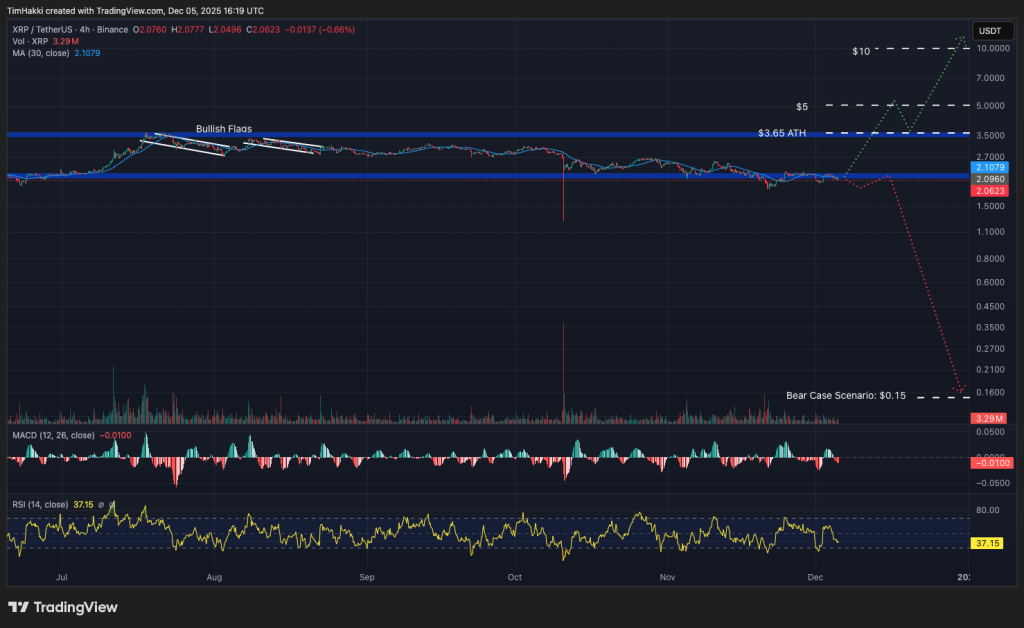
Following the resolution of its five-year legal battle with the SEC, XRP rallied to a July high of $3.65. Its current price near $2.09 represents a 43% retracement, but indicators suggest resilience. Furthermore, the relative strength index (RSI) sits at 36, indicating the token is likely to conclude today’s -2.8% selloff over the weekend and swing back into green.

The recent introduction of nine U.S.-based XRP ETFs is expected to accelerate institutional inflows throughout the holiday season. Additional ETF approvals may follow, and if Congress successfully passes comprehensive crypto legislation before year-end, XRP could target $15 or more by 2026.

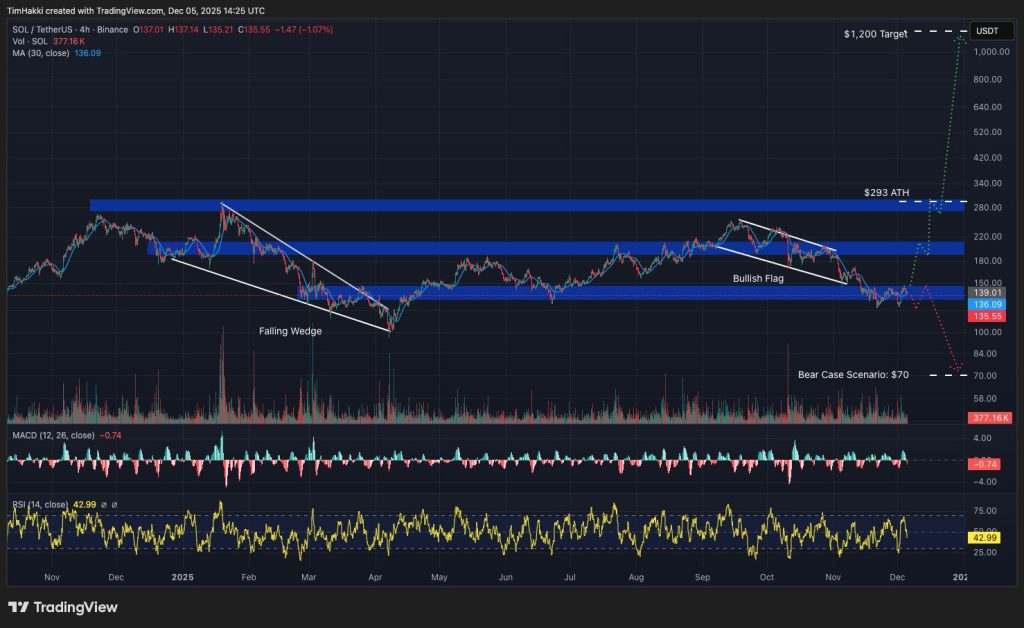
Solana (SOL): The Speed Leader Closing In on a Potential $1,200 Target

Solana ($SOL) has cemented itself as a top-tier smart-contract network, prized for its lightning-fast transactions and low fees. With a market cap surpassing $76 billion and almost $9 billion in total value locked across its DeFi protocols, Solana remains Ethereum’s most formidable competitor.

New Solana spot ETFs from Grayscale and Bitwise, launched late last month, could open the door to significant capital inflows, echoing earlier institutional waves that propelled Bitcoin and Ethereum to new heights.

After dipping near $100 earlier this year, SOL now trades around $136, holding firm at a critical support zone. A bullish flag pattern has taken shape since mid-September, signaling a potential breakout.

best crypto sol

The next major resistance sits near $250; a decisive move above that level could propel SOL beyond its prior ATH of $293.31, with a 4x up to $1,200 emerging as an ambitious yet attainable stretch target if the festive season turns into a bull market.

At the same time, Solana has become a leading hub for Real World Asset (RWA) tokenization, with giants like BlackRock and Franklin Templeton choosing the network to deploy tokenized financial products.

Pepe (PEPE): The Internet’s Favorite Frog Prepares for a Potential Upswing

Launched in April 2023, Pepe ($PEPE) quickly rose through the meme-token ranks, capitalizing on the global popularity of Matt Furie’s iconic character. Now boasting a market cap above $1.9 billion, PEPE enjoys an unmatched cultural presence, amplified when Elon Musk briefly switched his X profile picture to a Pepe meme, fueling speculation about his meme coin interests. Musk is publicly known to hold Bitcoin and Dogecoin.

Currently priced near $0.000004554, PEPE sits roughly 84% below its late-2024 high of $0.00002803 after a quiet summer and subdued fourth quarter.

Its RSI is now around 45, which indicates the token is neither overbought nor oversold and has plenty of headroom for further gains over the weekend.

With the token hovering near its lowest valuation in nearly two years, PEPE offers traders a high-upside entry point ahead of the next major market run. Clearer U.S. regulatory guidance could revive risk appetite and fuel a meme coin gold rush, potentially giving PEPE the momentum to retest its all-time high before year-end.

Bitcoin Hyper (HYPER): A Meme-Powered Bitcoin Layer-2 Built for 2026 and Beyond

One emerging project generating buzz ahead of 2026 is Bitcoin Hyper ($HYPER), a Bitcoin layer-2 solution wrapped in meme-culture branding. Despite its playful façade, HYPER targets real technical improvements with high-speed throughput, ultra-low fees, and smart-contract functionality.

Developed using the Solana Virtual Machine (SVM), HYPER features decentralized governance and a Canonical Bridge designed for seamless Bitcoin movement across multiple chains.

The presale has already raised around $29 million, and prominent analyst Borch Crypto forecasts the token could surge up to 100× upon exchange listing.

A recent Coinsult audit revealed zero contract vulnerabilities, boosting investor confidence. HYPER tokens power transaction fees, governance, and staking, with presale users able to earn up to 40% APY.

With the project’s full platform release planned for 2026, both seasoned Bitcoin users and newcomers have the chance to position themselves early in what may evolve into a major enhancement of Bitcoin’s utility landscape.

Visit the official presale website or follow Bitcoin Hyper on X and Telegram for more information.

Visit the Official Website Here

The post Best Crypto to Buy Today 5 December – XRP, Solana, PEPE appeared first on Cryptonews.

China’s Alibaba AI Predicts the Price of XRP, Cardano, Dogecoin by the End of 2025

By: Tim Hakki
5 December 2025 at 17:30

The newest iteration of Alibaba’s so-called “ChatGPT rival,” Qwen3-MAX, has rolled out fresh AI-driven price forecasts for XRP, Cardano, and Dogecoin as the month draws to a close. The model warns that all three cryptocurrencies could experience heightened turbulence over the coming weeks, with major moves possible in either direction.

Below are Qwen3-MAX’s two-track predictions showing both the potential upside and the risks each asset may face throughout December.

XRP (XRP): Alibaba AI Sees Either a Drop to $0.15 or a Run Toward $10 by Year-End

In its pessimistic projection, Alibaba’s model suggests Ripple’s XRP ($XRP) could retreat from its current $2.06 level to around $0.15, a drop of roughly 93%, should bearish sentiment continue dominating the market.

alibaba ai predicts xrp
Source: Alibaba

Such a correction would contrast sharply with XRP’s powerful performance earlier this year, when the token soared to a new seven-year high of $3.65 in July following Ripple’s pivotal legal win over the U.S. Securities and Exchange Commission.

Throughout most of 2025, XRP has hovered between $2 and $3. Its relative strength index (RSI) now sits at a neutral 37 and is downtrending as traders cash in on profits today from a brief price bounce yesterday.

However, Alibaba’s bullish outlook paints a very different picture, one in which XRP surges 385% to touch $10 before New Year’s Eve, almost tripling its all-time high.

The recent debut of nine U.S. spot XRP ETFs could fuel a wave of institutional interest this holiday season, echoing the early inflows seen when Bitcoin and Ethereum ETFs first launched.

More ETF approvals are anticipated in the coming months, increasing the probability that 2026 becomes a transformative year for XRP. Investors who accumulate now may find themselves well-positioned ahead of that shift.

Cardano (ADA): Alibaba Predicts a Potential 2,274% Explosion in December

Cardano ($ADA) remains one of the most academically rigorous and research-driven blockchain ecosystems. Launched by Ethereum co-founder Charles Hoskinson, the network prioritizes peer-reviewed development, security, scalability, and long-term sustainability.

With a market cap exceeding $15.6 billion and more than $189 million in TVL, Cardano continues to stand out among layer-1 networks thanks to its active development community and expanding suite of decentralized applications.

According to Alibaba AI, ADA could surge to approximately $10 by early 2026, an extraordinary 2,274% climb from its current price at $0.4212 and more than triple its 2021 peak of $3.09.

Analysts note that Cardano’s carefully paced upgrades and robust fundamentals could position it as a major winner in the next DeFi-centric bull cycle.

Still, Alibaba’s bearish prediction warns that ADA could slip toward $0.10 if macro weakness worsens, representing a downside of just over 76% from today’s price.

Dogecoin (DOGE): Alibaba AI Targets $2.50 in Moonshot Scenario and $0.02 in Potential Collapse

Dogecoin ($DOGE), initially created in 2013 as a parody of the crypto boom, now accounts for roughly $21.7 billion in market value, representing nearly half of the $45.8 billion meme-coin sector.

The token formed several bullish chart setups in late summer and early autumn, but momentum has since cooled. In Alibaba’s more negative scenario, DOGE could sink to $0.02, a drop of about 86% from its current price of $0.1387.

Dogecoin’s all-time high of $0.7316 came during the retail-driven mania of 2021, and its long-discussed $1 milestone remains elusive. Yet Alibaba’s bullish case suggests DOGE could actually rally 1,700% to $2.50, or 18x its current price.

Meanwhile, real-world adoption continues to grow: Tesla accepts DOGE for merchandise, and payment platforms including PayPal and Revolut support DOGE transactions.

Maxi Doge (MAXI): A Rapidly Emerging Meme Coin Overlooked by Alibaba’s Forecasts

While Alibaba AI highlights the upside potential for major blue-chip cryptocurrencies, early-stage presale tokens potentially deliver far larger percentage gains. One fast-growing contender is Maxi Doge ($MAXI), which has already brought in nearly $4.3 million as it positions itself as the next breakout Doge-themed meme coin.

MAXI’s narrative follows Maxi Doge, a canine crypto bro and degen distant relative to the original Dogecoin. Maxi is obsessed with lifting weights, trading meme coins with 1,000x leverage, and cultivating a degen community across social media to help him usurp Dogecoin’s throne.

As an ERC-20 token, MAXI benefits from Ethereum’s energy-efficient proof-of-stake network and its massive developer ecosystem, advantages that Dogecoin’s older Bitcoin-style proof-of-work consensus mechanism does not offer.

The ongoing presale includes staking rewards of up to 72% APY, although yields decrease as more participants join in.

MAXI is currently priced at $0.0002715 in its active presale phase, with automated price increases scheduled in upcoming rounds. Buyers can participate using MetaMask or Best Wallet.

Dogecoin stands no chance!

Stay updated through Maxi Doge’s official X and Telegram pages.

Visit the Official Website Here

The post China’s Alibaba AI Predicts the Price of XRP, Cardano, Dogecoin by the End of 2025 appeared first on Cryptonews.

Poland Stalls MiCA-Style Crypto Rules as Lawmakers Fail to Override Presidential Veto

5 December 2025 at 17:28

Poland’s efforts to align its crypto market with the European Union’s Markets in Crypto-Assets framework have hit a major political roadblock after lawmakers failed to override a presidential veto on a sweeping digital-asset bill.

This leaves the country as the last EU member without a national MiCA-style regime.

According to a Bloomberg report, the vote was held in the lower house of parliament on Friday, falling short of the three-fifths majority required to overturn President Karol Nawrocki’s decision to reject the legislation.

The outcome halts Prime Minister Donald Tusk’s push to place Poland’s crypto sector under tight regulatory control and forces the government to restart the legislative process from scratch.

Tusk Flags Crypto as National Security Threat Amid Russia Sabotage Claims

Tusk had framed the bill as a national security measure in the days leading up to the vote.

Addressing parliament, he said the unregulated crypto market had become a conduit for money laundering and foreign interference, including activity linked to Russia and Belarus.

He told lawmakers that Polish authorities had identified “several hundred” foreign entities operating in the domestic crypto market and warned that Russian intelligence and organized crime groups were exploiting digital assets for covert financing.

Government officials have tied those concerns to recent security incidents.

Last month, Warsaw blamed Russia for a blast on a key railway route used for supply traffic to Ukraine, an allegation Moscow dismissed.

Polish security services have also cited cases of underground groups allegedly paid in cryptocurrencies to carry out sabotage activities inside the country.

⚔ Russia is using cryptocurrencies to pay saboteurs carrying out hybrid attacks across the European Union, according to a Polish security official. #Russia #Cryptohttps://t.co/MsOjIZjSfu

— Cryptonews.com (@cryptonews) October 14, 2025

The veto has deepened an already sharp political confrontation between Nawrocki, a nationalist conservative, and Tusk’s pro-European coalition.

The president rejected the bill earlier this month, arguing that it went far beyond EU requirements and threatened civil liberties, property rights, and the stability of the state.

📜 Polish President Karol Nawrocki vetoed a sweeping crypto law, saying it threatens property rights and personal freedoms.#Crypto #Regulationhttps://t.co/BXYSh74MPF

— Cryptonews.com (@cryptonews) December 2, 2025

The blocked law would have implemented MiCA-style rules in Poland, introducing licensing for crypto-asset service providers, investor protection standards, stablecoin reserve requirements, market abuse bans, and strict anti-money laundering controls.

It also proposed granting authorities the power to block crypto-related websites through administrative orders, a provision the president described as opaque and vulnerable to abuse.

Political Tensions Rise After Poland Blocks Sweeping Crypto Oversight Bill

Nawrocki also criticized the scale of the bill, which exceeded 100 pages, contrasting it with far shorter implementing laws in neighboring Czechia and Slovakia.

He warned that heavy supervisory fees and added domestic restrictions would drive Polish crypto firms to register in other EU countries, costing Poland tax revenue and talent.

His chief of staff, Zbigniew Bogucki, said on Friday that the president is open to regulation as long as future proposals are not excessively restrictive.

The failure to override the veto leaves crypto companies operating in Poland without a clear national legal framework ahead of the EU’s July 1, 2026, MiCA compliance deadline.

The political dispute has increasingly drawn in industry players.

Nawrocki has portrayed himself as a defender of the crypto sector and was endorsed before his election by Kristi Noem, a senior U.S. official, at a conference in southeast Poland sponsored by trading platform Zondacrypto.

🇵🇱 Poland has elected Karol Nawrocki, a conservative who says crypto should be “born in freedom, not buried in red tape.”#poland #cryptohttps://t.co/BVJXhQBnrK

— Cryptonews.com (@cryptonews) June 2, 2025

The exchange later stated that it accepts no Russian clients and fully complies with anti-money laundering rules.

Foreign Minister Radosław Sikorski added another dimension to the dispute on Friday, saying on radio RMF FM that the crypto industry sponsors figures across the right wing of Polish politics, explaining the sharp resistance to tighter oversight.

The veto follows months of turbulence around crypto regulation in Poland. In September, lawmakers had initially passed the bill, triggering strong backlash from industry leaders who warned that Poland’s version of MiCA amounted to overregulation.

Zondacrypto’s chief executive at the time described it as a “step backwards” that risked criminalizing core blockchain development activity.

The post Poland Stalls MiCA-Style Crypto Rules as Lawmakers Fail to Override Presidential Veto appeared first on Cryptonews.

❌
❌