Maine election officials have approved a ballot initiative that, if passed, would eliminate the state’s roughly $250 million adult-use cannabis industry and impose strict new testing standards on medical cannabis to begin collecting signatures.
It’s the second ongoing citizen campaign to cancel a legal cannabis industry in New England.
Maine medical marijuana would remain but with new rules
The Maine Secretary of State on Dec. 8 approved the Act to Amend the Cannabis Legalization Act and the Maine Medical Use of Cannabis Act to begin collecting signatures.
If it qualifies for the ballot and is approved by a majority
While attention within the cannabis community is largely focused on a potentially historic rescheduling decision by Trump, the Senate Banking Subcommittee on Financial Institutions and Consumer Protection on Tuesday discussed the adjacent issue for the marijuana industry: The lack of banking access for cannabis companies under federal prohibition.
Tyler Klimas—who served as executive director of the Nevada Cannabis Compliance Board (CCB) and was a founding member of the Cannabis Regulators Association (CANNRA) before becoming the founder of Leaf Street Strategies—testified before the panel as the Democratic minority’s witness.
Sen. Catherine Cortez Masto (D-NV), the Democratic ranking member of the panel, said that “we want to make sure that all Americans have a fair access to banking,” and that includes state-regulated marijuana businesses such as those in her state.
“There are so many Nevada business owners who have opened legal cannabis businesses and created jobs across our state,” the senator said, adding that she also hopes Congress will pass
However, retail prices in the limited-license state remain twice as high as in neighboring Massachusetts – and falling prices aren’t translating to increased sales, according to state data.
ADVERTISEMENT
The average price for a gram of cannabis in Connecticut fell to $7.94, down from $8.43 in October.
Cannabis prices in Connecticut’s adult-use market peaked at $12.51 per gram in March 2024. Adult-use sales began in January 2023.
But the decline in retail prices isn’t boosting legal Connecticut cannabis sales, according to state data.
Connecticut cannabis sales decline
In November, when most cannabis retailers see a brief spike in sales before Thanksgiving, medical and adult-use cannabis sales in Connecticut totaled $23.9 million, according to the state
A GOP senator attended a ribbon cutting ceremony for a Kentucky hemp business on Monday, where he again previewed a forthcoming bill to regulate the crop as an alternative to its pending recriminalization under legislation that President Donald Trump signed last month.
Sen. Rand Paul (R-KY) spoke about hemp policy issues and his plan to avert the new federal ban, which is set to take effect next November, at an event marking the opening of a Cornbread Hemp location in Louisville.
When hemp’s potential federal legalization was being considered as part of the 2018 Farm Bill that Trump signed in his first term, Paul said he thought that’d be “great,” particularly for Kentucky farmers who’ve seen losses as demand for tobacco has decreased. Creating a cannabis industry would also support ancillary businesses that aren’t plant-touching, he said.
Hemp legalization has been a “great success,” Paul added, “and I don’t want government to stifle this”
He also addressed arguments supporting the hemp ban that he described as “untrue,” including the idea that all cannabinoid products are being sold at gas stations and marketed in a way that targets youth. Kentucky—which enacted a regulatory framework for hemp that aims to mitigate those
The state is hoping to put a stop to the turnover through proposed rules that will be open for public comment starting Monday through January 14.
Regulators first introduced the rules last December and have since held two opportunities for public input, before submitting them to the Missouri Secretary of State in November.
The microbusiness program—sometimes called the social-equity cannabis program—was designed to boost opportunities in the industry for people in disadvantaged communities that have been most impacted by the war on drugs. It began in 2023, after passing as part of the constitutional amendment to legalize recreational marijuana in 2022.
For the last two years, The Independent has documented a pattern of well-connected groups and individuals flooding the microbusiness lottery by recruiting people to submit applications and then offering them contracts that limit their profit and control of the business.
Of the 105 microbusiness licenses issued so far, 35 have been revoked, including 22 that involved contracts drafted by St. Louis-based Armstrong Teasdale law
A GOP congressman says President Donald Trump would “wrong” to move forward with a plan to reschedule marijuana, which he described as a “gateway drug” that leads to the use of “harder substances”—despite numerous studies contradicting that theory.
The cannabis community is waiting with bated breath for Trump to make a decision on a proposal to move cannabis from Schedule I to Schedule III of the Controlled Substances Act (CSA). He said in August that there’d be a decision within weeks, and on Monday he said the administration was looking “very strongly” at the issue.
Rep. Mike Lawler (R-NY) was asked about the potentially imminent reform during an interview with NewsNation’s “The Hill” that aired on Monday. And the congressman said it would be a bad idea, even though rescheduling would not federally legalize cannabis.
Part of his thinking is rooted in the debunked “gateway drug” theory. Lawler also argued that there’s a policy disconnect between the administration’s aggressive anti-drug campaign ostensibly focused on fentanyl and the reported plans to reschedule marijuana, which Trump said on Monday would remove research barriers to study the plant.
“If you look at the reason that we went after the cartels and labeled them
In an amicus brief submitted to justices on Monday for a marijuana and firearms case, U.S. v. Hemani, Smart Approaches to Marijuana (SAM) and 21 other prohibitionist groups said that while cannabis is “marketed as a ‘chill’ drug by its peddlers,” today’s product has “become increasingly known for its relationship with violence.”
“Given the shared national work amici are doing to stop the flow of drugs and their harms to society, they have a strong interest in laws restricting drug users’ access to firearms,” the brief said. “The evidence is clear: today’s highly potent marijuana causes psychosis, schizophrenia, other forms of severe mental illness, and violent behavior.”
It added that if the federal statute known as 922(g)(3) is deemed unconstitutional—as multiple federal courts have determined in the lead-up to SCOTUS taking the Hemani case—would “magnify these harms exponentially and devastate America’s families.”
The overarching argument of the brief is the idea that marijuana is strongly linked to mental illness,
The New Zealand Medicinal Cannabis Council (NZMCC) hosted its Industry Day on Oct. 29, 2025 at the EMA in Auckland, bringing together patients, clinicians, researchers, cultivators, advocates and policymakers for a full-day program centered on connection. The agenda was designed to strengthen links across a sector spanning prescribing, cultivation, compliance, research, and policy, with sessions focused on practical collaboration and knowledge sharing.
NZMCC Chair Carmen Doran opened the day and positioned connection as a deliberate focus for the Council, particularly as NZMCC’s membership has expanded to include clinicians, emerging cultivators and the wider support system around the sector, including government, suppliers and academics. The program moved from a Leaders’ Roundtable on the state of medicinal cannabis in New Zealand into regulatory and policy briefings, before splitting into clinical and industry breakout session pathways in the afternoon.
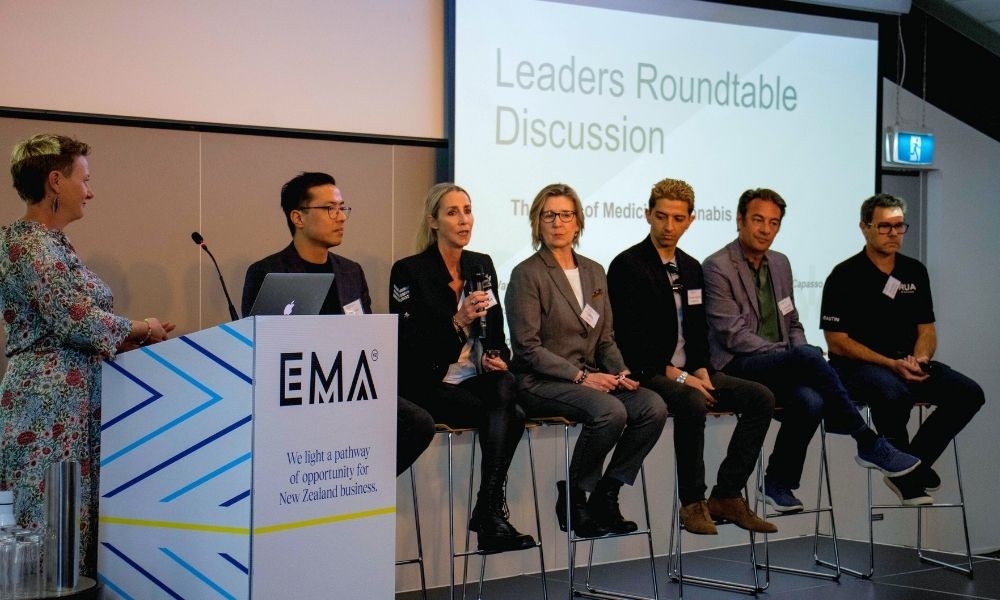
The Industry Day began with a Leaders’ Roundtable discussion examining where the medicinal cannabis sector currently stands.
Leaders’ Roundtable: The State of Medicinal Cannabis in New Zealand
Following a Mihi Whakatau, a Māori welcoming ceremony, the Industry Day began with a Leaders’ Roundtable discussion examining where the medicinal cannabis sector currently stands. The panel brought together senior figures from across healthcare, regulation and business, including Terry Teoh, business growth partner at New Zealand Trade and Enterprise (NZTE); Tara Creaven-Capasso, director of regulatory affairs ANZ at MedReleaf Australia; Paul Naske, CEO at Rua Bioscience, a Māori-founded pharmaceutical company that specializes in the research, development and sale of medicinal cannabis products both domestically and internationally; and Natalie Lowe, CEO of Green Doctors, a New Zealand medicinal cannabis clinic network.
The discussion covered regulatory maturity, patient access, prescribing trends and the challenges of operating in a tightly regulated environment. Teoh described the Industry Day as “a great connection point, particularly given NZMCC’s recent broadening of membership.” He also reflected on New Zealand’s presence at European Medicinal Cannabis Week earlier in the year. “From conversations with the NZ attendees and partners, themes that resonated particularly well included a responsible and ethical ecosystem that puts people first, NZ’s agricultural leadership heritage, and companies that are responsive and scalable,” he says.
Regulatory and Policy Briefings: Roles, Responsibilities and Reform
The morning continued with a session called Inside the Regulatory Framework: Roles, Responsibilities and Compliance, presented by Tania Jones from the Medicinal Cannabis Agency. Jones outlined how the Agency oversees New Zealand’s medicinal cannabis system, walking through licensing requirements, compliance obligations and the responsibilities of operators across cultivation, manufacture and supply.
Tara Creaven-Capasso of MedReleaf Australia discusses market alignment, product pathways and future opportunities.
This was followed by TGA Consultation Underway in Australia: Implications for the New Zealand Market, led by Tara Creaven-Capasso, director of regulatory affairs for ANZ of MedReleaf Australia. Drawing on her regulatory experience across the Tasman, Creaven-Capasso explained the scope of the Therapeutic Goods Administration’s consultation process and discussed what potential changes could mean for market alignment, product pathways and future opportunities for New Zealand companies.
The final morning session was delivered by Dr Jacek Kolodziej, policy director at the New Zealand Drug Foundation, who examined safer drug laws, lived experience and alternative policy approaches. His presentation placed medicinal cannabis within a broader public health and drug policy context.
Afternoon Breakouts: Clinical and Industry Pathways
After lunch, delegates chose between two breakout streams, with many moving between sessions as discussions progressed.
Clinical Pathway
The clinical stream opened with James Yu, pharmacist and co-founder of Ngā Hua Pharmacy, New Zealand’s leading independent specialist pharmacy focused on medicinal cannabis, who presented The Importance of Terpene Tailoring. Yu shared patient case studies drawn from dispensing practice, highlighting how different terpene profiles and chemovar selection can influence treatment outcomes.
This was followed by a panel discussion titled Cannabis Challenges in Practice, moderated by Dr Rick Acland. The panel included Dr William Parkyn, Dr Afram Adam, and James Yu, and focused on prescribing confidence, clinical responsibility and real-world barriers to access.
“I was impressed with the level of knowledge and understanding of appropriate prescription amongst delegates,” Acland says. “Sadly, the wider medical fraternity struggles to understand this complex pharmacology and its wide-ranging effects through modulation of the Endocannabinoid System (ECS). Hopefully, the pool of advocates continues to grow and hence enhances patient wellbeing. There is a good understanding of the adverse effects that always need to be appreciated.”
Acland also highlighted agreement within the panel on professional standards. “I was impressed with the consensus regarding the need to adhere to agreed prescription protocols,” he says. He noted concern about the future regulatory environment, referencing legal expertise present in the room. “I was also impressed that we had a barrister, Adam Holloway, in the audience who works in the area of medical discipline. There is concern that specific prescribers may get ‘targeted’ by Registration bodies or Colleges in the future.”
The clinical pathway concluded with Dr Michael Murphy, Medical Advisor at CannaPlus+ and Board Member of the ANZCCP, presenting The ANZCCP Prescribing Guidelines, an update on current best practice and emerging evidence.
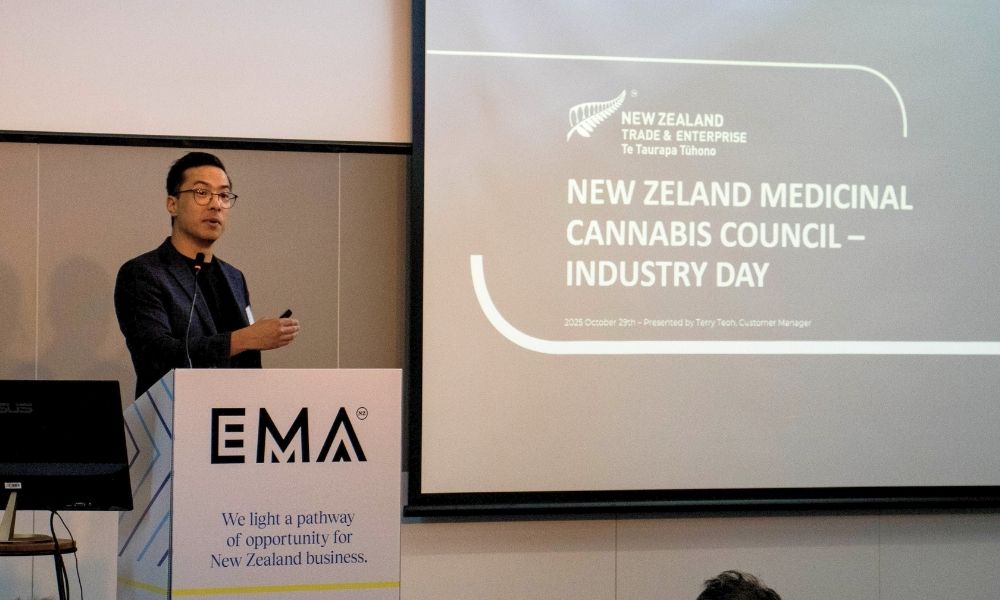
Terry Teoh of New Zealand Trade and Enterprise doscussed international market expectations.
Industry Pathway
The industry stream focused on innovation, sustainability and long-term planning.
Tua Waaku of Bluelab opened the pathway with Research and New Knowledge for Cultivation, presenting findings on light spectrum and plant development. Drawing on Bluelab’s experience designing monitoring and control tools for growers, the session explored how precision measurement can support consistent outcomes.
Dr Sam Baldwin of the Bioresource Institute followed with Indoor Crops 30 Years in the Future, examining how advances in technology, environmental constraints and resource efficiency may reshape cultivation models over the coming decades.
Energy considerations were addressed by Karan Tikku of Genesis Energy in Electricity: Challenges and Opportunities, where he outlined cost pressures facing cultivators and practical pathways to reduce energy use.
The industry pathway concluded with Terry Teoh of New Zealand Trade and Enterprise presenting Building an Export-Ready Business, focusing on scalability, regulatory preparedness and international market expectations.
As the clinician who championed the introduction of Sativex in 2006, Dr Rick Acland has played a central role in New Zealand’s medicinal cannabis sector for nearly two decades.
Sector Reflections: Experience From the Early Days
Although now retired from clinical practice, Dr Rick Acland says he remains closely connected to the medicinal cannabis sector. His involvement dates back to the early 2000s.“Despite being a retired practitioner, I still feel very much connected with this industry,” he says. “My history with medicinal cannabis goes back to the early 2000s when I was a member of the Medicines Assessment Advisory Committee (MAAC) of the Ministry of Health.”
Acland described his role in assessing Sativex in 2006. “At my last meeting (2006), I was responsible for the assessment of Sativex for registration,” he says. “I managed to persuade my fellow committee members that there was enough convincing data to approve it for spasticity of MS. There were a number of sceptics who did take some cajoling to get Sativex ‘across the line’.”
Looking back nearly two decades later, he said the decision had held up. “I think that with the passage of almost 20 years, our decision was correct, and pleasingly, any fears that had been raised at that meeting have not eventuated, apart from the prohibitive cost of the agent,” he says.
Acland also reflected on his clinical background. “Throughout my medical career, I have worked in pain and latterly in spinal cord injury rehabilitation,” he says. “Frequently, I noted the many patients who gained useful symptom relief from recreational use.”
He described the shift that followed legal prescribing. “Interestingly, once medicinal cannabis became available through prescription, I was ‘banned’ by one of the organizations I consulted for from having any conversation regarding cannabis,” Acland says. “It has concerned me that the Pain Society has taken such a negative approach, probably because of the opioid epidemic in the USA, despite there being a growing level of evidence showing a reduction in opioid use with the introduction of prescription cannabis.”
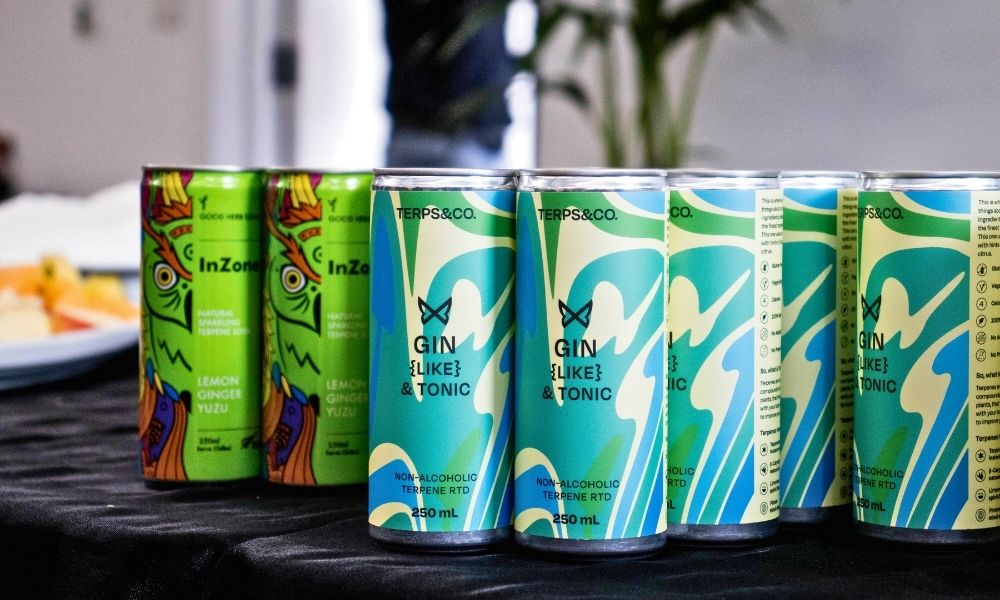
Event sponsor Terps & Co, a New Zealand beverage company that uses terpenes to power its functional sodas.
Sponsor Perspective
From a sponsor perspective, Arjun Bhargava, co-founder of innovative beverage brand Terps & Co, says the Industry Day reflected a broader shift in how the sector is thinking about cannabis formulation and patient experience.
“It was heartening to see that terpenes, beyond just THC and CBD, are finally getting the attention they deserve,” Bhargava says. “Across the value chain, from pharmacists to manufacturers, there is a growing appreciation for how pivotal they are and how profoundly they shape the cannabis experience.”
Looking Ahead
In reflecting on the day, Doran pointed to the connections formed across the room as the most meaningful outcome. “For me, the standout moment was seeing groups of people talking together after lunch who wouldn’t usually meet in their day-to-day work,” she says. “Being able to connect cultivators choosing which strains to commercialize with prescribing doctors who hear directly from patients about what works was incredibly powerful.”
Doran also noted that NZMCC held its AGM as part of the Industry Day, including the election of new board members intended to reflect the Council’s expanded membership base. Looking ahead, she said NZMCC plans to establish working groups in 2026 focused on priority areas for the sector, including export markets and patient access. “We’ll be diving into issues that shape the industry here at home, but also as we look to export markets and support patients in New Zealand and internationally,” she says.
As the peak representative organization for the medicinal cannabis sector focused on equitable and affordable access to cannabinoid-based medicines, the NZMCC Industry Day was the perfect opportunity to reinforce collaboration as the foundation for future progress.
Elite athletes find cannabidiol, or CBD, useful for soreness and recovery, a new study shows.
Researchers found that top competitors use CBD to manage pain, improve sleep and ease the stress of training at the highest level. But the results suggest that even as many athletes believe the cannabis compound helps them recover, they also worry that using it could jeopardize their careers under international anti-doping rules.
The study, conducted between late 2021 and mid-2023 and published this month in the journal Frontiers in Nutrition, surveyed 80 elite Canadian athletes across 27 national sport organizations. To be included, athletes needed to have experience as part of the country’s Olympic or Paralympic team program.
About 38 percent reported using CBD at some point, and nearly a third of those said they were still using it at the time of the survey.
The participants’ motivations reflect a broader societal trend of relying on CBD for therapeutic benefit. The study found that 96 percent of CBD users said they believed the substance was safe, 93 percent said it improved their sleep, 90 percent said it helped them relax and 77 percent credited it with reducing pain from training.
Rep. Gus Bilirakis (R-FL) filed the Kids Online Safety Act (KOSA) earlier this month, and the House Energy and Commerce Subcommittee on Commerce, Manufacturing, and Trade approved an amended version of the legislation on Thursday on a party-line vote of 13-10, with Republicans in support and Democrats in opposition.
Bipartisan senators introduced a version of the measure earlier this year, but it has not advanced in that chamber this Congress even though a prior iteration was passed by the body in 2024.
Under the new legislation, online platforms would be prohibited from facilitating the “advertising of narcotic drugs, cannabis products, tobacco products, gambling, or alcohol to an individual that the covered platform knows is a minor.”
The provision around drug use lists the “distribution, sale, or use of narcotic drugs, tobacco products, cannabis products, gambling, or alcohol” as risks that platforms would need to actively guard minors against.
One section that was in prior iterations of the bill that seems to have been omitted from this latest version had stipulated that video streaming
SCOTUS rejects marijuana case; DOJ: Cannabis users are “greater danger” than alcohol users; Dems push legalization; Senate marijuana banking testimony
Subscribe to receive Marijuana Moment’s newsletter in your inbox every weekday morning. It’s the best way to make sure you know which cannabis stories are shaping the day.
Your support makes Marijuana Moment possible…
Your good deed for the day: donate to an independent publisher like Marijuana Moment and ensure that as many voters as possible have access to the most in-depth cannabis reporting out there.
However, supply at The Post Dispensary in Beaver Dam was limited and expected to run out on the same day as the state’s slow rollout of medical cannabis continues, according to the Lexington Herald Leader.
ADVERTISEMENT
Four cultivators have also been approved to grow medical marijuana in Kentucky, and nearly 24,000 residents have been issued MMJ cards, according to Gov. Andy Beshear.
Beshear signed medical marijuana legalization into law in 2023. The program launched on Jan. 1, 2025 – but with no medical cannabis available.
Another 48 licensed MMJ dispensaries in the process of opening. One additional dispensary, has been approved to operate, the newspaper reported.
The latest iteration of a quarterly presidential approval tracking poll from NuggMD and Marijuana Moment also found that 51 percent of respondents would be more likely to embrace the current administration if it rescheduled or legalized marijuana.
While some are bullish on recent news that President Donald Trump may move forward with plans to reclassify cannabis as a Schedule III, rather than Schedule I, drug under the Controlled Substances Act, marijuana users’ support for the president’s marijuana “actions” took a dip over the last quarter.
Just 1.6 percent of respondents said they “strongly approve” of the actions, 4.5 percent said they approve, a plurality of 38.4 percent were neutral, 26.1 percent disapproved and 29.5 percent strongly disapproved.
“Do you approve or disapprove of the presidential administration’s actions on cannabis?” n: % Strongly approve 7 1.6% Approve 20 4.5% No opinion/Neutral 172 38.4% Disapprove 117 26.1% Strongly disapprove
President Donald Trump on Monday confirmed that the administration is “very strongly” considering a proposal to federally reschedule marijuana because it would boost research into the effects of cannabis.
“We are” weighing rescheduling, Trump told reporters after being asked about the issue at an unrelated signing ceremony. He added that “a lot of people want to see it—the reclassification—because it leads to tremendous amounts of research that can’t be done unless you reclassify.”
“So we are looking at that very strongly,” he said.
The question to the president came amid heightened speculation about a possibly imminent rescheduling decision. CNBC reported it could come as early as Monday, but so far that has not materialized.
.@POTUS on marijuana rescheduling: “A lot of people want to see it — the reclassification — because it leads to tremendous amounts of research that can’t be done unless you reclassify, so we are looking at that very strongly.” pic.twitter.com/Ugych6rLCQ
It remains to be seen whether Trump will fulfill his campaign promise to move cannabis from Schedule I to Schedule III of the Controlled Substances Act (CSA), which would not legalize the plant but would
The winter solstice marks the longest night of the year. Across cultures, this moment has always symbolized rest, reflection, and a gradual return of light. It's a natural pause in the calendar that invites people to reset before heading into a new season.
For many cannabis consumers, this night has also become an ideal moment to create intentional rituals, whether that is journaling, connecting with friends, or simply getting comfortable at home.
Kush strains fit that mood well. Known for their body-centered and calming qualities, they often support the quiet atmosphere that many people seek during the solstice.
We highlighted the best kush cultivars that pair naturally with how you might want to spend the longest night of the year — whether you are seeking introspection, cozy creativity, warm connection, or full winter hibernation.
Kush genetics trace back to the Hindu Kush mountain region, renowned for its hardy landrace strains that have adapted to cold nights and rugged conditions. These plants typically express dense buds, earthy or pine-leaning aromas, and effects that users often describe as grounding and relaxing.
Those qualities match the themes of the solstice. When the intention is to slow down or reflect, many users report that kush strains create a calm physical baseline and a steady mental space.
Kush strains for your winter solstice ritual
Here are eight kush strains that align with different solstice intentions. Each includes a quick look at genetics, sensory notes, and user-reported effects so you can choose the right flower for your festive night.
Lineage: Refined from early '90s kush genetics by Josh D
Known for its blend of citrus, pine, and gas, OG Kush remains one of the most influential strains in modern cannabis. Users often describe a balanced experience that feels both relaxing and social, which makes it a good choice for solstice nights spent with friends. If your evening involves conversation, cooking together, or reconnecting, OG Kush tends to support that warm energy.
Hindu Kush carries sweet, woody, and hashy notes. Users often report a steady, relaxing body feel and a calm mental state, making this a natural choice for meditation, intention setting, or quiet personal rituals. It matches well with a solstice focused on stillness and reflection.
Purple Kush often shows rich coloration and a sweet, earthy aroma. Users describe deeply relaxing body effects and a peaceful overall mood. It's an excellent strain for leaning fully into comfort on the solstice, whether that means blankets, movies, or a slow night in.
Triangle Kush has an earthy, almost spicy aroma and a long-standing reputation among legacy consumers. Users often report introspective or creatively stimulating effects, which makes this a good match for journaling, mapping out goals, or reflecting on the past year.
Kosher Kush is known for its robust, earthy profile and a heavy, calming effect. Users commonly associate it with deep relaxation, which pairs well with meaningful evening rituals, such as writing, gratitude practices, or simply settling into the atmosphere of the solstice.
Lineage: OG Kush phenotype from the San Fernando Valley
SFV OG offers pine and citrus notes along with a smoother body feel than many heavier kush varieties. Users often describe a relaxed yet focused mood, making it a solid option for reading, sketching, or working on personal projects at a leisurely pace.
Lineage: Afghan Kush phenotype crossed with Northern Lights
Bubba Kush is known for its sweet, earthy flavor and introspective calm. Users often report full body relaxation and a sense of mental quiet, which works well for long baths, slow cooking, or any ritual centered on rest.
Platinum Kush blends earthy and floral notes with a steady soothing presence. Users often describe a relaxing experience that lends itself to reflection or light ritual work, like pulling cards or writing intentions for the year ahead.
Bottom line
The winter solstice is a natural moment to unwind and prepare for the return of light. Kush strains can support that atmosphere with grounding and calming effects that many users find helpful for reflection or rest.
Whether your ritual is introspective, social, or simply relaxing, choosing a kush cultivar that aligns with your intention can make the longest night of the year feel a little more meaningful.
If you want to explore more strains or learn how different cultivars shape your experience, you can find additional guides in our Learn section.

 Login
Login