Normal view

There are new articles available, click to refresh the page.
Today — 8 December 2025Cryptocurrency

Dogecoin Price Prediction: Network Just Hit 3-Month High – Why Isn’t Anyone Talking About What Happens Next?

8 December 2025 at 17:58

On-chain data for DOGE shows a spike in a key metric that recently predicted a trend reversal. As the top meme coin bounces off a key support, could this favor a bullish Dogecoin price prediction?

According to data from BitInfoCharts, the number of daily active addresses (DAAs) within the Dogecoin blockchain spiked to its second highest level in three months on December 3 at 67,511.

dogecoin on-chain data

The highest reading during this period occurred on September 15, back when DOGE hit a local top of $0.30 and started retreating to its current levels.

What this metric may have indicated back then is that a significant number of wallets were both buying and selling, as the price hit a high level.

This time, following a 50% retreat from those highs, this could be evidence that this is a highly contested area for both bulls and bears again.

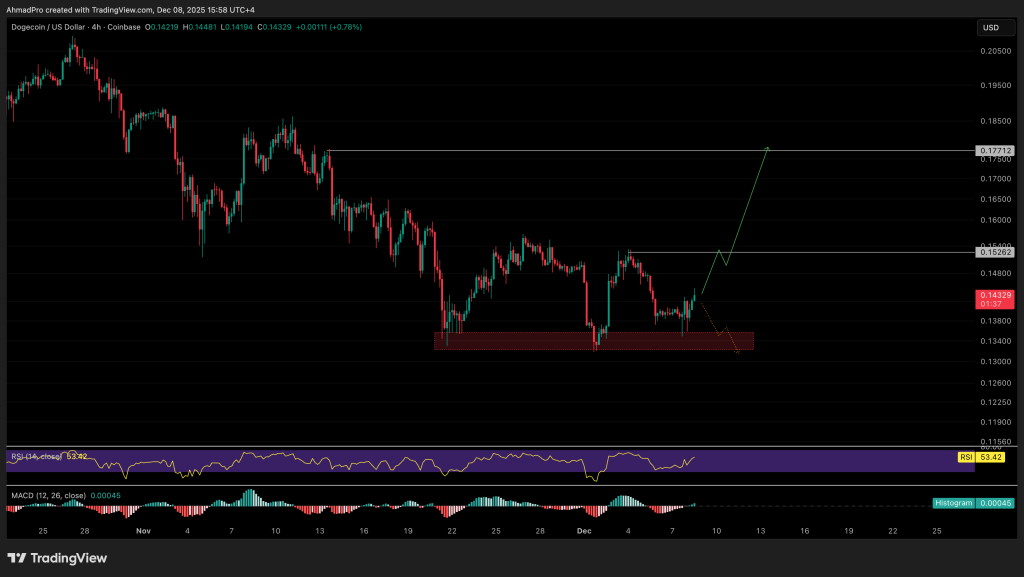
Interestingly, DOGE has gone up by 3.5% in the past 24 hours and currently stands at $0.14. This has been a key area of support for the token from which it has bounced three times already.

Trading volumes have more than doubled, further confirming that buying pressure is increasing rapidly. Paired with higher wallet usage, could Dogecoin be getting ready to reverse its downtrend?

Dogecoin Price Prediction: Key Levels to Watch as $0.14 Holds Strong

Dogecoin has gone up today, and trading volumes are accompanying the move as the token bounces from the $0.14 level.
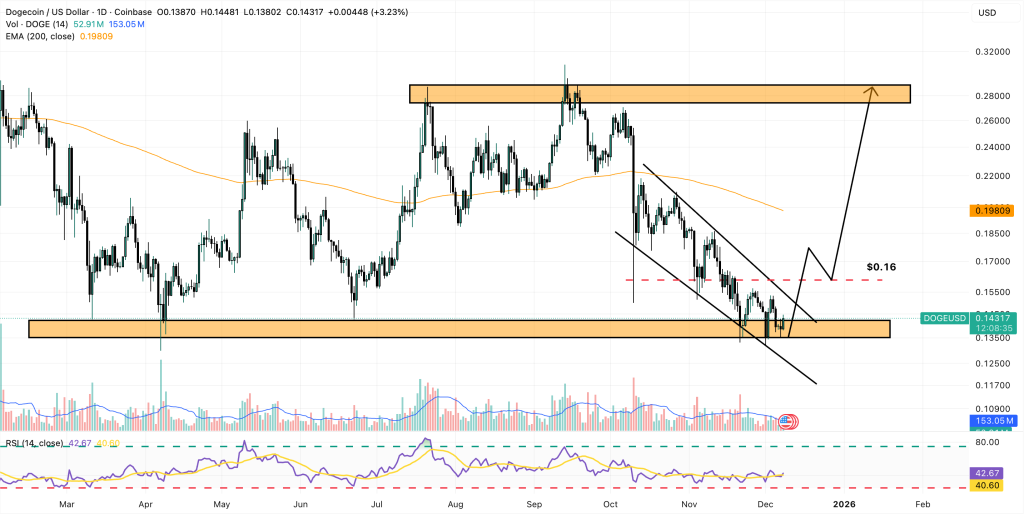
dogecoin price chart
Source: TradingView

The pivotal area for DOGE is the $0.16 mark, as a move above this area would confirm a trend reversal and finally break the token’s bearish structure.

The first and most likely target if this happens would be the 200-day exponential moving average (EMA), as this is typically a high-volume price zone.

Meanwhile, a bullish breakout above this key line would confirm a positive mid-term outlook for Dogecoin. If that’s the case, we could see the token spiking back to its September 2025 levels, back when daily active addresses reached their 3-month peak.

This week is critical for the markets as the Federal Reserve will convene on Wednesday to make a decision on interest rates. A rate cut could be exactly what the market needs to propel crypto prices back to their recent highs.

As the meme coin market gears up for a potential breakout, all eyes are shifting to early-stage presales with the highest upside.

Maxi Doge ($MAXI) is one of the most talked-about presales in the space right now, and with momentum building fast, it could be the next major gainer once listings go live.

Maxi Doge ($MAXI) Raises Over $4 Million Despite the Market’s Turmoil

The latest wave of selling has not deterred investors from piling into Maxi Doge ($MAXI).

This new meme coin embodies the hype that comes with bull markets and aims to build a thriving community of ‘degen’ traders who love taking big risks in exchange for big gains.

Through fun competitions like Maxi Ripped and Maxi Gains, $MAXI holders can earn top rewards and bragging rights by showcasing the ROI of their wildest YOLO trades.

They also gain exclusive access to a hub where they can share early opportunities, trading setups, and insights to enhance their trading journey.

Finally, Maxi Doge will invest up to 25% of the presale’s proceeds in a handful of YOLO trades, with the resulting gains used to boost Maxi’s treasury and continue investing in marketing.

To buy $MAXI and join the pump, simply head to the official Maxi Doge website and link up a compatible wallet like Best Wallet.

You can swap USDT or ETH or use a bank card to buy $MAXI in seconds.

Visit the Official Maxi Doge Website Here

The post Dogecoin Price Prediction: Network Just Hit 3-Month High – Why Isn’t Anyone Talking About What Happens Next? appeared first on Cryptonews.
Leading AI Claude Predicts the Price of XRP, Solana, PEPE by the End of 2025

8 December 2025 at 17:30

The market is recovering as one of the worst months for crypto comes to an end. Heading into Christmas, we asked leading Claude AI for his predictions for XRP, Solana, and Pepe toward the end of 2025, and he delivered a dramatic outlook.

2025 has been a negative year for Bitcoin. At the time of writing, year-to-date performance shows BTC down more than 7%, starting the year near 99K and now looking likely to finish below that level.

Even so, the bigger picture stays constructive. Analysts still expect durable altcoins such as XRP, Solana, and Pepe to perform well over the long term. Once market conditions settle, each project could regain upward momentum, and below is how Claude expects it to play out.

Ripple (XRP): Claude AI Highlights the Potential for a 200% Rally

Claude says the regulatory victory that came with ETF launches, along with accelerated adoption in Asia, could set XRP up for a historical move.

Claude has set a price target of 5 to 8 dollars for XRP by the end of 2026, which would mean more than a three times rally. Such a reversal would contrast sharply with XRP’s strong run earlier this year, when it climbed to a seven-year peak of 3.65 dollars in July after Ripple secured a major legal win against the United States Securities and Exchange Commission.

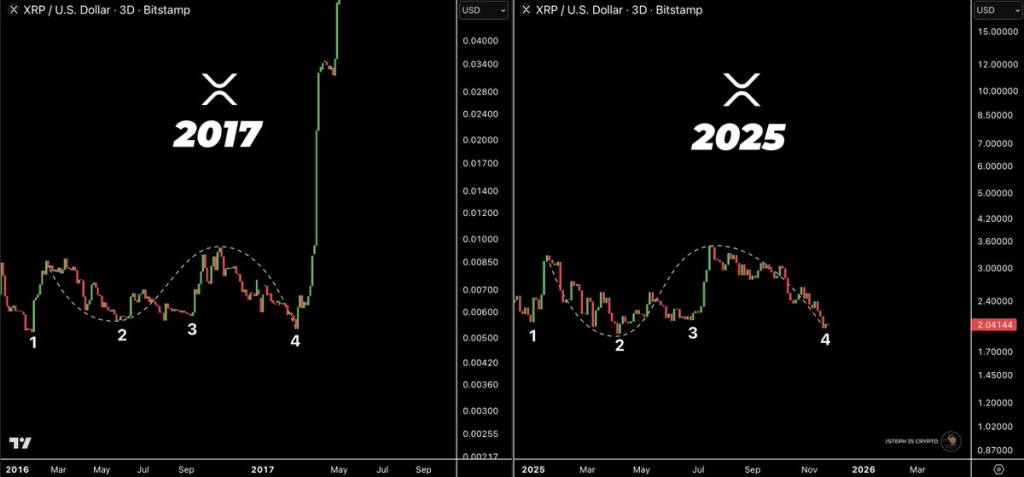
The recent bearish sentiment around XRP has pushed the price into a pattern similar to what happened before the explosive 2017 pump. If XRP manages to hold the $2.00 support level, a new all-time high could form by 2026, just as CZ predicted.

Source: Steph On X

Solana (SOL): The Real Ethereum Killer, $600 Could Be Sooner Than Expected

Claude AI expects Solana to be the Ethereum killer and has set a price target of $600 by 2026.

The reason is clear because Solana is having one of its strongest years in terms of adoption, with major partnerships such as the one with Western Union.

It is becoming the preferred chain for institutions when it comes to stablecoins, and even PayPal has launched one on it. The total Solana stablecoin market cap has now passed 1$5 billion, the highest level it has reached.

Solana has failed to break the wall at $144 multiple times. As the market recovers, it seems ready for another attempt. If it manages to push through, the next resistance level sits near $160.

It is important for price to hold the demand zone shown on the chart in order to keep the bullish scenario intact. If that zone fails, the setup can be invalidated.

Pepe ($PEPE): Claude AI Predicts Memecoin Comeback With 200% Surge For Pepe

Claude AI crowns PEPE as the undisputed king of this cycle and sets a price target of more than a 200 percent surge from the current level. This view is driven by its massive community, cultural relevance, and the idea that the current low price is attracting more holders.

As shown in the chart, whenever PEPE created a wide dispersion from its 21 EMA on the 3D timeframe and then returned to test it, the low was already in.

This could already be the low for memecoins in 2025. The sector has started to recover, jumping from a $38 billion market cap to more than $42 billion in the past few days. If the bottom is in, then Maxi Doge could be one of the best coins to buy next.

Maxi Doge Could Be The Best Memecoin To Buy

Maxi Doge is starting to heat up again. Fresh off the growing memecoin recovery, the project has already pulled in more than $4.29 million in its presale and is positioning itself as one of the strongest contenders for the next wave of retail hype.

Maxi Doge leans fully into meme culture, built around a jacked, high-leverage, obsessed Doge that captures the humor and chaos traders love. No fake utility pitch, no overpromised roadmap. The project keeps its identity simple while building real incentives around staking and community-driven contests to keep engagement high.

One of the strongest points behind Maxi Doge is the token distribution. Nearly 40% of the entire supply went directly to the public presale, with zero insider or private rounds. That structure reduces the risk of whale sell-offs when MAXI begins listing on major exchanges, which is something early investors always look for.

The team is also rolling out a staking program offering up to 72% annual yield for MAXI holders. This allows presale participants to lock up their tokens and earn rewards even before the presale ends, creating strong early momentum.

Visit the Maxi Doge website to join the presale and follow what smart traders are moving into. You can buy using ETH, USDT, BNB, or even a credit card.

Stay updated through Maxi Doge’s official X and Telegram pages.

Visit the Official Website Here

The post Leading AI Claude Predicts the Price of XRP, Solana, PEPE by the End of 2025 appeared first on Cryptonews.

Solana Price Prediction: “Zero Risk” Turns Out to Be Wrong – Did This Exchange Expose a Hidden Danger in Crypto?

8 December 2025 at 17:25

Jupiter has admitted it overstated claims about “zero risk” lending, denting Solana price predictions as one of its key DeFi drivers gets pushed to the sidelines.

The altcoin is wrapped up in a controversy, stemming from now-deleted posts that described Jupiter Lend vaults as carrying “isolated risk.”

Example deleted post of “isolated risk” claims. Source: X, @JupiterExchange.

Jupiter COO Kash Dhanda clarified on X that while the vaults are isolated, the use of rehypothecated assets exposes users to risk as shocks in one part of the system can still pass through those reused assets.

The vaults are designed to limit contagion, but Dhanda acknowledged the team should not have implied they were completely insulated.

The correction has not stopped the crypto community from sidelining Jupiter. Lending protocol Kamino has blocked users from migrating funds to Jupiter Lend, citing the misrepresentation.

As a contributor to over $616 million in network activity, an exodus of Jupiter Lends could weigh on Solana through weaker adoption and decreased usage of SOL as a utility token.

Solana Price Prediction: Can Solana Survive Without Jupiter Lends?

While Jupiter Lends has weakened as a contributor of inflows into the Solana ecosystem, the market reaction has not derailed a potential launchpad setup.

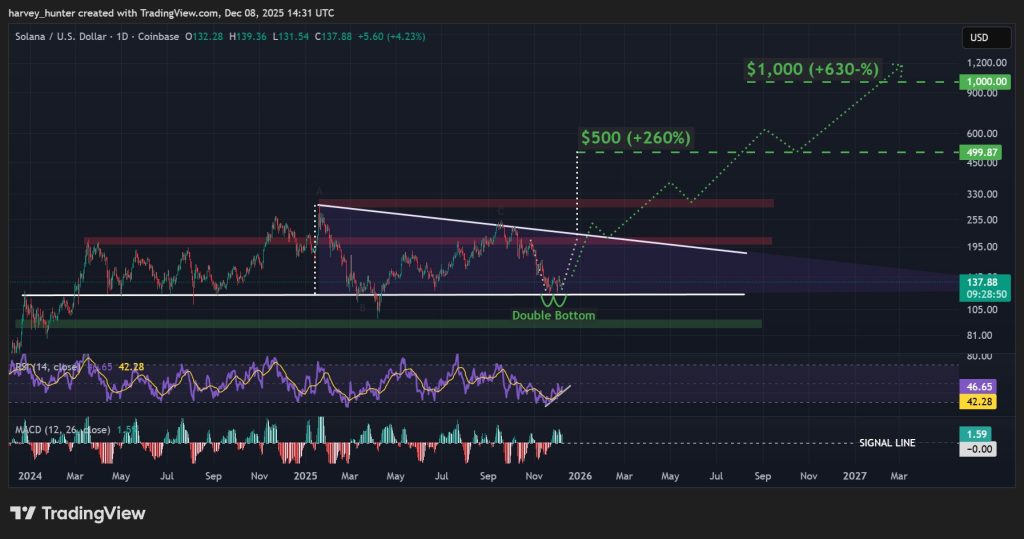
The formation of a higher low solidifies the $120 level as the base of a double-bottom pattern, a reversal setup that is now being reflected by momentum indicators.

SOL USD 1-day chart, double bottom fuels descending triangle. Source: TradingView.

The MACD is no longer declining, but holding a wide lead above the signal line, while the RSI continues to form higher lows as it approaches the 50 neutral line. Both are strong indicators of a bullish shift.

Still, the Solana price has yet to surpass the double-bottom neckline around $145, a level it must reclaim as support for the $210 target to play out.

Such a shift would set up a retest of the wider year-long descending triangle resistance, creating a breakout scenario targeting levels near $500 for a potential 260% gain.

A target that stands to extend much higher as the bull run matures in 2026, with anticipated U.S. interest rate cuts stimulating demand and a potential 630% $1,000 run.

Solana appears more in tune with wider market narratives than the Jupiter controversy.

Bitcoin Hyper: Solana Might Be The Wrong Coin to Watch

Those who jumped to Solana as an alternative Layer 1 to the leading crypto may be forced to reconsider, as the Bitcoin ecosystem finally addresses its biggest limitation: ecosystem growth.

Bitcoin Hyper ($HYPER) is bridging Bitcoin’s security and stability with Solana’s speed, creating a new Layer-2 network that unlocks scalable and efficient use cases Bitcoin couldn’t support alone.

The project has already raised over $30 million in presale, and post-launch, even a small share of Bitcoin’s trading volume could push its valuation significantly higher.

Bitcoin Hyper is fixing the slow transactions, high fees, and limited programmability that have capped Bitcoin’s potential – just as the market turns bullish.

Visit the Official Bitcoin Hyper Website Here

The post Solana Price Prediction: “Zero Risk” Turns Out to Be Wrong – Did This Exchange Expose a Hidden Danger in Crypto? appeared first on Cryptonews.

Trump to name new Fed chair soon? Crypto bulls hope so — Here are the candidates

8 December 2025 at 17:48
Trump is expected to announce Jerome Powell’s successor before Christmas, accelerating uncertainty around future Federal Reserve policy.

💾

Trump is expected to announce Jerome Powell’s successor before Christmas, accelerating uncertainty around future Federal Reserve policy.

Solana Price Faces Critical Test Near $140 While Analysts Track KOL Indicators and Liquidity Shifts

8 December 2025 at 18:00

The Solana price is entering a decisive phase as its action tightens below the $140 barrier, a level that has repeatedly capped attempts at recovery. After months of sustained selling pressure and increased whale activity, the market is now watching whether Solana can hold its recent gains or slip back toward lower support zones.

Related Reading: What’s Happening With XRP And Why Did Its Spot ETF Crash 20%?

This comes at a time when analysts, on-chain trackers, and market participants are also assessing the broader influence of KOL (Key Opinion Leader) predictions, many of which have dramatically misaligned with Solana’s actual price trajectory over the past two months.

Solana SOLUSD_2025-12-08_13-43-26

Solana Price Stalls Below Key Resistance

SOL is currently trading just under $138 after a modest recovery from the $128 low. Technical data indicates that the Solana price is struggling beneath a dense cluster of moving averages, with the 20-day EMA at $138 repeatedly rejecting upward attempts.

The intraday structure remains corrective, as rallies tend to fade before gaining traction. A sustained close above $140 remains the key threshold. Clearing it could open immediate targets near $142 and later $150. However, failure at this level risks renewed pullbacks toward $132, and deeper weakness could revisit $128 region.

Short-term indicators offer mixed signals. The hourly RSI remains above 50, while the MACD leans slightly bullish, suggesting that momentum exists but lacks conviction.

KOL Predictions Scrutinized as Market Cap Declines

Solana’s market cap has fallen roughly 40.5% over the past two months, contradicting bullish influencer claims made earlier in the quarter. Data from Santiment shows how traders predict a near-term all-time high, only for SOL to continue its downward slide.

This divergence is leading analysts to lean more heavily on tools like the KOLs_Tracker, which ranks influencer performance and helps identify when certain calls may function as contrarian signals.

The gap between predictions and actual performance has added an extra layer of volatility to Solana’s narrative, as traders use social sentiment data alongside traditional indicators to gauge market direction. With network activity and flows still subdued, traders are approaching such predictions with increased caution.

Liquidity Shifts Highlight Whale Influence

On-chain activity shows notable movement from large holders, including a whale that recently transferred 100,000 SOL to Binance, part of a broader trend that has seen over 600,000 SOL moved to exchanges since April.

While not enough to move the market on its own, such consistent selling reinforces resistance zones and limits recovery momentum. The address still holds more than 700,000 SOL, meaning additional liquidity could enter the market if the Solana price approaches previously favored selling levels.

Related Reading: Ethereum Founder Breaks Silence With Major Upgrade Proposal

As the Solana price deals with this tight range, market participants remain focused on whether buyers can establish a base above $138–$140. Until then, resistance remains firm, sentiment remains cautious, and the path forward depends on both technical confirmation and the broader crypto market direction.

Cover image from ChatGPT, SOLUSD chart from Tradingview

Bitcoin RSI Shows Shocking Similarities To 2012-2015, But What Happened Last Time?

8 December 2025 at 17:00

A crypto analyst has revisited long-term charts from 2012-2015, noting that the current Bitcoin (BTC) cycle shows striking similarities to this timeline, in terms of the Relative Strength Index (RSI) and price action. During the 2017-2015 bull run, BTC experienced one of the strongest multi-year advances before bottoming out. The market expert claims that the same sequence of peaks and pullbacks observed in that timeline is now unfolding again in this cycle. 

Bitcoin RSI Comparison Signals Bottoming Structure

Bitcoin’s latest momentum study by crypto analyst Tony Severino has drawn significant attention from market watchers. In his X post on December 6, Severino highlighted surprising similarities between the RSI trend and price movements of the 2023-2026 cycle and those observed from 2012 to 2015. 

His comparison focuses on the timing of several major points that appeared in both cycles. These include the moment a price bottom began to form, the first price peak, a subsequent momentum peak, and finally a Bearish Divergence that typically precedes deeper corrective phases.

Severino shared a chart from the 2012-2015 cycle showing that Bitcoin’s RSI had gradually climbed, with several short bursts of sharper upward momentum along the way. Eventually, momentum faded, and the indicator declined for an extended period before settling in a mid-range zone at the 44 level. 

Bitcoin

In the current cycle, which began in 2023, the RSI also climbed sharply before reaching a notable peak. Since then, the indicator has been gradually declining, currently sitting around 38. This level is similar to the mid-range RSI values observed in the former cycle before Bitcoin advanced again. 

Sharing a second chart, Severino also pointed to Bitcoin’s price action relative to its RSI performance across both cycles. During the earlier cycle, Bitcoin’s price sat around $233.54, while in the recent cycle, it has declined to $89,352. The analyst argues that the alignment between the RSI movements and price action in both timelines strengthens his theory that Bitcoin may be approaching a meaningful bottom soon. 

Severino also suggested that if history repeats in the 2023-2026 cycle, traders could be looking at the early stages of a year-long accumulation phase, similar to what played out a decade ago. Nevertheless, he acknowledged that there is no guarantee that the current cycle will mirror past patterns completely. 

Analyst Flags New BTC Bullish Crossover

Crypto analyst AO has shared a more optimistic outlook for Bitcoin, highlighting the formation of a Bullish Crossover—a key technical signal that has historically preceded significant price surges. According to him, each time the Stochastic RSI on US10Y*CN10Y experiences a Bullish Crossover, Bitcoin enters a significant bull run.

AO presented a chart showcasing four previous Bullish Crossovers, each followed by a massive price increase. The first crossover appeared in 2013 and coincided with an early surge. The second came in 2017, marking the start of a multi-month bull run. The third occurred in late 2020, shortly before BTC’s record-breaking run in 2021. The most recent signal has not emerged in 2025, suggesting the potential for a similar upward move.

Bitcoin

South Korea Tightens Grip On Crypto Exchanges, Imposes Bank-Level Standards

8 December 2025 at 17:30

South Korea moved to tighten rules for cryptocurrency platforms after a major breach at Upbit that sent shockwaves through the local market and government halls.

Government Pushes Bank-Level Rules

According to government and industry reports, the Upbit breach on November 27, 2025 involved the transfer of about 104 billion tokens on the Solana network in roughly 54 minutes.

The value of the tokens was reported at about 44.5 billion won, equal to roughly $30–36 million. Upbit said it would cover customer losses from its own funds, but officials say current law does not force exchanges to reimburse users automatically.

The Financial Services Commission (FSC) and the Financial Supervisory Service (FSS) have begun drafting rules that would hold virtual asset service providers to bank-level liability standards, requiring compulsory compensation for customers hit by hacks or system failures.

Past Failures Put Pressure On Regulators

Reports have disclosed that the five biggest exchanges in Korea — Upbit, Bithumb, Coinone, Korbit and Gopax — were cited in official data showing 20 system failures between 2023 and September 2025.

Those incidents affected more than 900 users and caused combined losses of about 5 billion won. Regulators say those prior problems, plus the recent Solana transfers, highlighted gaps in consumer protection and operational stability that current rules don’t close.

Exchanges Face Higher Costs And Fines

Under the proposed measures, exchanges would need to meet stronger IT security and custody standards, submit to regular audits, and maintain clearer recovery plans.

Penalties are also being rethought. Current maximum fines were a fixed 5 billion won in earlier regulations; new drafts reportedly include fines up to 3% of an exchange’s annual revenue for serious breaches.

That kind of exposure could push firms to raise spending on security and insurance, and it may change how they price services.

What It Means For Users And Markets

According to industry analysts, forcing mandatory compensation would boost consumer confidence. That is the stated aim. But restoring trust will likely take time.

Some exchanges have already promised voluntary payouts after the Upbit incident, yet a legal requirement would mark a big shift in how crypto platforms are treated compared with banks and electronic payment firms under the Electronic Financial Transactions Act.

Timeline And Lawmaking Steps

Based on reports, the draft rules are currently under internal review within the FSC and will need to pass through formal legislative processes before becoming law.

Lawmakers and regulators are deliberating exactly which parts of bank rules should apply to crypto firms, and how to avoid stifling competition or innovation while protecting customers.

Featured image from Unsplash, chart from TradingView

CFTC Launches Pilot Program Allowing Bitcoin To Be Used as Collateral In Derivatives Markets

8 December 2025 at 17:12

Bitcoin Magazine

CFTC Launches Pilot Program Allowing Bitcoin To Be Used as Collateral In Derivatives Markets

The Commodity Futures Trading Commission announced the launch of a U.S. digital assets pilot program that will allow bitcoin, ethereum and the stablecoin USDC to be used as collateral in regulated derivatives markets, marking another major policy shift in how U.S. regulators approach tokenized assets.

The move includes new guidance for tokenized collateral, a limited no-action framework for futures commission merchants (FCMs), and the withdrawal of legacy restrictions that the agency said are no longer relevant following passage of the GENIUS Act.

Acting CFTC Chair Caroline Pham said the program is designed to expand the use of digital assets in regulated markets while maintaining oversight and customer protections.

“Americans deserve safe U.S. markets as an alternative to offshore platforms,” Pham said in a statement. “Today, I am launching a U.S. digital assets pilot program for tokenized collateral that establishes clear guardrails to protect customer assets and provides enhanced CFTC monitoring and reporting.”

Bitcoin and other crypto as a pilot

Under the pilot, FCMs will be temporarily allowed to accept a narrow set of digital assets like Bitcoin as customer margin, according to a CFTC announcement. 

During the first three months of participation, firms will be required to submit weekly reports to the CFTC detailing the total amount of digital assets held in customer accounts, broken out by asset and account class. 

Companies must also notify regulators of any material incident involving the use of digital collateral.

The agency said the reporting requirement is intended to give staff real-time insight into operational risks while allowing firms controlled access to tokenized collateral.

Last week, the CFTC allowed federally regulated spot crypto trading in the U.S. for the first time, with Bitnomial set to launch its exchange next week under CFTC oversight. 

Pham said CFTC-registered venues will list spot crypto products, enabling retail and institutional traders to access spot, futures, options, and perpetuals on a single regulated platform.

Alongside the pilot program, the CFTC’s Market Participants Division, Division of Market Oversight and Division of Clearing and Risk issued formal guidance on how tokenized assets should be evaluated within existing regulatory frameworks.

The guidance emphasizes that CFTC rules are “technology neutral” and that tokenized assets should be assessed individually under existing policies rather than treated as a separate asset class.

The framework applies to tokenized real-world assets such as U.S. Treasuries and money market funds. It outlines standards for legal enforceability and things like custody and control.

The agency also issued a no-action position for FCMs that accept non-securities digital assets as margin, including payment stablecoins. 

The relief allows firms to incorporate qualifying digital assets into customer accounts while clarifying how capital and segregation rules apply under the new regime.

Crypto industry applause

The CFTC formally withdrew Staff Advisory No. 20-34, which previously restricted how virtual currencies could be held in customer accounts. The advisory had been in place since 2020 and had limited the operational use of digital assets as collateral.

The agency said developments in digital markets and the enactment of the GENIUS Act made the advisory obsolete.

Crypto and fintech firms quickly welcomed the decision, saying the changes offer long-awaited regulatory certainty.

Coinbase Chief Legal Officer Paul Grewal said the move confirms the industry’s belief that stablecoins and digital assets can reduce risk and improve efficiency in financial markets, according to a CFTC announcement. 

Circle President Heath Tarbert also chimed in and said the changes would reduce settlement risk and friction in derivatives trading by enabling near real-time margin settlement.

Crypto.com CEO Kris Marszalek said the announcement would allow tokenized collateral to be used in U.S. markets for the first time at scale, adding that it would support 24/7 trading in regulated derivatives products.

This post CFTC Launches Pilot Program Allowing Bitcoin To Be Used as Collateral In Derivatives Markets first appeared on Bitcoin Magazine and is written by Micah Zimmerman.

Best Crypto to Buy Today 8 December – XRP, Dogecoin, Shiba Inu

8 December 2025 at 16:55

Crypto is bouncing nicely with BTC pushing back above 92K today, which is a solid bullish signal as we head into the usual pre-FOMC chop until Wednesday. These are the conditions where altcoins usually suffer the most.

Kevin O’Leary came out saying Bitcoin and Ethereum are the only real plays when big money enters. That takes added fresh FUD around alts, but he does not realize that altcoins have actually been holding up way better than expected.

Kevin O’Leary said that #Bitcoin and ETH are the only crypto assets countries and institutions will actually buy, not the PooPoo coins. pic.twitter.com/I5vekoYN0J

— Bitcoin Library (@BTC_Library21) December 7, 2025

XRP, Dogecoin, and Shiba Inu might end up being some of the best buys right now because these price levels may not stick around. The next bull run could easily be powered by altcoins.

XRP Could Repeat History After Testing a Multi-Month Low

XRP price recently hit $1.90, a level it has not reached since April. What stood out is the bounce and recovery that pushed XRP back above the key $2.00 support level.

XRP ETFs are now on 13 consecutive days of positive inflows, bringing total ETF-held net assets to $861.23 million. This signals rising institutional interest in the coin.

That said, XRP is currently showing one of the strongest short positions among major assets. Most traders are leaning heavily toward the short side, and the data shows very little long support right now. The odds of a new all-time high by December 31, 2025, have dropped to 3%.

Source: Steph On X

This bearish sentiment around XRP has pushed the price into a pattern similar to what happened before the explosive 2017 pump. If XRP manages to hold the $2.00 support level, a new all-time high could form by 2026, just like CZ predicted.

Shiba Inu And Dogecoin Could Lead The Next Memecoin Bullwave

Retail interest in memecoins is at an all-time low, and the sector has lost more than 20% of its market cap in November alone. Trading volume tells an even bigger story, dropping more than 50% over the same period.

This decline across risk assets comes from growing uncertainty about what is ahead, especially around interest rates and broader economic stress.

What we know historically about memecoins is that they stay extremely volatile and do not always need the perfect environment to rally. Dogecoin and Shiba Inu both just hit new yearly lows. They follow the same narrative, so when one begins to move, the other usually follows.

Source: DOGEUSD / TradingView

DOGE recently dropped back into the same weekly demand zone that sparked every major rally in the past. History shows buyers consistently step in at this level, and price has tapped it again. If the zone holds, a push toward the $0.30 mark becomes the next major move because it would signal a strong recovery across the memecoin sector.

Bitcoin Hyper Could Be The Best Coin To Buy In December

One of the standout projects building serious momentum into the next cycle is Bitcoin Hyper (HYPER), a Bitcoin-focused layer 2 that blends meme culture with real infrastructure upgrades. The branding is lighthearted, but the tech aims to solve major Bitcoin limitations by delivering high-speed execution, minimal fees, and full smart contract capability.

Built with the Solana Virtual Machine, HYPER introduces decentralized governance and a Canonical Bridge that allows smooth Bitcoin movement across multiple chains without the usual friction. The design targets a future where Bitcoin is not only a store of value but a fully programmable network.

The presale has already pulled in roughly $29.17 million, and analysts such as Borch Crypto believe the token could rally as much as 100 times once it lists. A fresh Coinsult audit reported zero contract risks, which helped strengthen investor confidence. HYPER tokens handle staking, governance, and gas fees, and presale participants can earn up to forty percent APY.

With a full platform rollout scheduled for 2026, Bitcoin Hyper gives early adopters and long-term Bitcoin users a chance to position themselves ahead of what could become a meaningful expansion of Bitcoin’s utility layer.

Visit the official presale website or follow Bitcoin Hyper on X and Telegram for more information.

Visit the Official Website Here

The post Best Crypto to Buy Today 8 December – XRP, Dogecoin, Shiba Inu appeared first on Cryptonews.

OKX CEO Star Xu Says 50% of Global Economy Will Run On Blockchain

8 December 2025 at 15:47

During Abu Dhabi Finance Week, OKX Chief Executive Star Xu said, “approximately 50% of global economic activities will operate on blockchain” in the coming decades.

He framed the shift as demand from a generation raised on digital services, mobility, and artificial intelligence. Xu described blockchains as programmable financial rails that move value “freely, instantly, and globally, 24/7.”

He positioned the trend as infrastructure, not a trading call, pointing to stablecoin settlement growth, multi-trillion on-chain asset values, and expanding wallet counts. He also noted ongoing regulatory work in major markets that is building channels for compliant activity.

The next chapter of an onchain economy begins with trust.

Our Founder & CEO @Star_okx takes the stage at @ADFinanceWeek to discuss how blockchain can drive global economic empowerment.

🗓 8 Dec | 1:35pm
📍 Mainstage, ADQ Arena pic.twitter.com/jgq6MchLZz

— OKX (@okx) December 8, 2025

Why OKX’s Xu Sees Demand For On-Chain Finance

Xu linked the moment to past cycles in internet, mobile, and cloud, arguing the next step is a “financial internet” where storage, transfer, and settlement are software-driven and auditable.

He said current infrastructure can meet institutional needs, citing account integrations, low-friction user flows without gas fees, and throughput targets measured in millions of transactions per second.

Security goals mirror bank accounts, while on-chain identity, analysis, and audit features are intended to raise transparency. His view is that open and efficient systems tend to win over time, and that the internet generation is pressing finance toward an always-on standard.

He added that regulators in jurisdictions such as the United States and Singapore are building frameworks that move activity from pilots to production.

Bitcoin, Stablecoins, And Tokenization In Practice

Xu called Bitcoin “digital gold” for younger holders and pointed to institutions adding exposure on balance sheets. He portrayed stablecoins as a parallel payment channel that allows near real-time cross-border settlement, including units tied to the U.S. dollar and regional fiat.

He placed tokenization at the center of market structure change, with funds and government bonds entering continuous on-chain venues that offer transparent pricing and compliance controls.

Looking ahead, he outlined a model where users hold self-custody wallets, identity is portable, and issuance and settlement run on a single base layer.

“More open, transparent, and efficient systems will ultimately prevail,” Xu said, adding that the internet generation is already building toward that outcome.

The post OKX CEO Star Xu Says 50% of Global Economy Will Run On Blockchain appeared first on Cryptonews.

Ethereum Loses Momentum While OI Holds Steady: Binance Data Shows A Market Reset

8 December 2025 at 16:00

Ethereum has reclaimed the $3,150 level after a volatile Sunday session that left traders divided on what comes next. Some analysts warn that ETH’s recent bounce is nothing more than a temporary pause before the downtrend resumes, while others see signs of a potential bullish reversal forming at current levels.

Fresh data from Binance reveals that Ethereum is now entering a delicate phase. Price momentum has clearly weakened, yet open interest remains relatively high despite the decline from the $3,900 region. This disconnect highlights a major shift in futures market behavior: traders are holding positions, but not aggressively increasing them.

The 30-day open interest Z-Score currently sits at 0.50, indicating that OI is just slightly above its 30-day average—well within normal volatility bands. Unlike previous corrections, where open interest surged during heavy selling, the current reading suggests neither extreme leverage buildup nor panic-driven position closures.

This unusual combination—weakening momentum paired with stable open interest—underscores a market in transition. Whether Ethereum resumes its downtrend or begins carving out a recovery will depend on how quickly momentum returns to spot and futures markets in the days ahead.

Open Interest Stability Signals a Market in Repositioning

According to the Arab Chain report on CryptoQuant, Ethereum’s $6.61 billion in open interest highlights that traders are still holding a substantial share of their positions despite the sharp decline from $3,900 to below $3,200. This divergence—falling price but steady OI—is characteristic of market repositioning phases, where traders reduce activity without fully exiting the market.

The supporting metrics reinforce this view: the OI avg30 sits at $6.44 billion, and the OI std30 at $329 million, indicating that current fluctuations remain well within normal volatility ranges. There is no sign of aggressive position buildup or liquidation pressure.

Binance Ethereum Open Interest Z-Score | Source: CryptoQuant

With the Z-Score at 0.50, the modest rise in open interest does not suggest overwhelming bearish leverage. Instead, it shows that traders are still engaging with the market and selectively building new positions as price declines. This level of participation is important: it signals that the derivatives market is active but not overheated.

Ethereum’s price weakness, driven by fading momentum after failing to sustain its previous highs, leaves the market at an inflection point. If large traders are predominantly short, stable OI could support the continuation of downward pressure. However, if long positions dominate, this same stability may lay the groundwork for a rebound once momentum returns.

Testing Momentum as Bulls Attempt to Reclaim Control

Ethereum is attempting to stabilize above the $3,150–$3,160 zone after a volatile multi-week decline. The chart shows ETH rebounding from a local low near $2,750, forming a short-term rising structure. However, momentum remains fragile. The 50-day SMA continues to slope downward and sits well above current price action, reinforcing the broader downtrend. Until ETH can break and close above this moving average, upside attempts will likely face resistance.

ETH conolidates around key level | Source: ETHUSDT chart on TradingView

The 100-day SMA is also declining, converging with the $3,350–$3,400 region—an area that could act as the next major ceiling for any bullish continuation. Meanwhile, the 200-day SMA remains flat but sits just above price, creating an additional barrier around $3,250–$3,300. This cluster of resistance levels confirms that Ethereum is still operating within a corrective structure despite the recent bounce.

Volume has tapered off noticeably compared to the heavy sell-side spikes seen in November. This suggests that the rebound may be driven more by diminishing selling pressure than strong spot demand. If volume remains weak, ETH may struggle to build enough momentum for a sustained recovery.

Featured image from ChatGPT, chart from TradingView.com

Ripple Secures 4 Groundbreaking Wins That Mark An Exciting Phase For XRP

8 December 2025 at 16:00

Ripple and the XRP ecosystem have entered one of their most important weeks to date. A series of regulatory and market-structure breakthroughs has pushed the token deeper into the core of federally supervised financial infrastructure, and this carries implications far beyond short-term sentiment, starting with its advancement into new territory under the Commodity Futures Trading Commission.

A New Regulatory Alignment Surrounds XRP

Bitnomial, a CFTC-regulated derivatives and spot-crypto platform, secured approval to include XRP within its market structure of the first US-regulated spot-crypto market. This allowed the Chicago-based exchange to activate a supervised spot-XRP contract in the United States, as well as accept the token as margin collateral across its derivatives products. 

The move placed XRP in the same operational category as traditional commodities that must meet liquidity and settlement standards before entering federally regulated markets.

Behind these approvals sits a story that many observers initially missed. An market participant who goes by the name SonOfaRichard on the social media platform pointed out the significance of what had unfolded. 

He noted that the Commodity Futures Trading Commission (CTFC), the Securities and Exchange Commission (SEC), and the Depository Trust & Clearing Corporation (DTCC), three agencies with entirely different remits, moved in the same direction in the same week. 

According to him, the altcoin effectively transitioned into a commodity-grade collateral asset within a federally regulated derivatives ecosystem, and he described this not as a narrative but as plumbing. This is the same standard applied to gold, FX, treasuries, and LME metals.

Secondly, the SEC did not object to the CFTC’s move with Bitnomial, and that silence carried far more weight than a formal statement, because it pointed to an unusual moment of alignment between agencies that typically operate with different mandates on XRP. 

Thirdly, Bitnomial itself became the quiet kingmaker in this entire development, not because of its brand presence or daily trading volume, but because its regulatory position places it in integration with clearing flows that plug directly into institutional pipes. A platform like that does not list XRP unless regulators have already determined what it is.

An Exciting Phase For The Token’s Outlook

Lastly, the DTCC moved toward 24×5 settlement windows. According to the commentator, this move was about interoperability with digital collateral, tokenized treasuries, and real-time clearing.

Taken together, these milestones are not surface-level headlines. They represent a change in how XRP is being integrated. The asset is now accepted as a collateral currency, listed under CFTC oversight, and actively trading inside the country’s first regulated spot-crypto framework.

Other examples of the change in XRP integration on a global scale include the Singapore MPI license for Ripple and Vanguard, allowing XRP ETF access, among a few others.

All these recent advancements by Ripple now point to the ecosystem entering a phase that investors have waited years to witness. The question now may no longer be whether institutions will adopt the token, but how quickly they integrate it into the flows of modern digital finance.

XRP

JPMorgan CEO Drops Debanking Bombshell: “We Cut Republicans and Democrats” – No One’s Safe

8 December 2025 at 15:41

JPMorgan Chase CEO Jamie Dimon has rejected claims that the bank engages in politically motivated “debanking,” saying the firm does not target customers based on their political views and only acts under strict legal and regulatory obligations.

His remarks come as fresh accusations from political and crypto figures keep the debate over bank account closures at the center of U.S. financial and political scrutiny.

Operation Chokepoint 2.0 Debate Flares as Dimon Defends JPMorgan

Dimon addressed the issue during an appearance on Fox News’ “Sunday Morning Futures,” where host Maria Bartiromo asked him about allegations from Devin Nunes, the CEO of Trump Media Group.

Nunes previously claimed that Trump Media’s bank records were subpoenaed during the federal investigation into President Donald Trump’s efforts to overturn the 2020 election results and suggested the company was effectively debanked.

Dimon rejected the political framing of the claim, saying JPMorgan follows government subpoenas when required but does not close accounts based on political affiliation.

He emphasized that the bank’s actions are guided by federal law and regulatory expectations, not ideology.

The comments arrive against the backdrop of wider political tension over access to banking services, especially for crypto firms, conservative figures, and controversial industries.

The debate intensified in November after Strike CEO Jack Mallers said JPMorgan abruptly closed his personal accounts without explanation.

🚫 Strike CEO @jackmallers says JPMorgan @Chase abruptly terminated his personal bank accounts in September without offering any explanation.#Strike #JPMorganhttps://t.co/nia2Vj4dYV

— Cryptonews.com (@cryptonews) November 24, 2025

Mallers said the bank cited “concerning activity” under the Bank Secrecy Act while refusing to provide specific details.

Mallers’ disclosure reignited concern over what the crypto industry calls “Operation Chokepoint 2.0,” an alleged extension of the Obama-era initiative that discouraged banks from serving high-risk sectors.

Crypto executives and Republican lawmakers argue that the modern version has been used to quietly restrict crypto firms’ access to the U.S. banking system.

Democrats and regulators have repeatedly denied that such a coordinated campaign exists, saying enforcement actions are driven by anti-money-laundering and fraud risks.

Trump Allies, Lawmakers Clash With Banks as Debanking Probes Continue

The issue took on new political weight after President Donald Trump signed an executive order in August intended to prevent financial institutions from denying services solely on the basis of crypto-related activity.

📜 A White House draft order may fine banks for cutting clients over politics, amid claims of bias against conservatives and crypto firms.#CryptoPolicy #debanking https://t.co/Jk5Wuvc3lk

— Cryptonews.com (@cryptonews) August 5, 2025

After Mallers went public, Bo Hines, a former adviser to Trump’s digital assets council and now a strategic adviser to Tether, publicly criticized JPMorgan, suggesting that the end of Operation Chokepoint had not translated into meaningful change on the ground.

Trump has previously said he was personally affected by debanking due to his politics, while his son Eric Trump has also claimed that several major banks cut ties with the family at the end of Trump’s first term.

Other conservative figures, including MyPillow CEO Mike Lindell and several religious and nonprofit groups, have made similar claims.

At the same time, Democratic lawmakers have raised concerns that some account closures disproportionately affect Muslim Americans and minority communities due to broad “de-risking” policies.

Regulators and banks continue to maintain that these decisions are based on compliance demands.

Under U.S. law, banks are required to monitor customer activity, report suspicious transactions, and comply with subpoenas under frameworks such as the Bank Secrecy Act and anti-money-laundering rules.

Banks argue that failure to do so exposes them to severe penalties.

Dimon, during the same Fox News appearance, also addressed broader economic and national security issues, including JPMorgan’s newly launched $1.5 trillion security and resiliency investment initiative and the bank’s cautious approach to China-related business.

However, his comments on debanking drew the most immediate political attention. The controversy continues as congressional investigations remain active.

Republican lawmakers on the House Financial Services Committee previously released a report alleging that dozens of crypto firms and individuals lost banking access under regulatory pressure.

Federal agencies have pushed back, saying supervision is risk-based, not political.

The post JPMorgan CEO Drops Debanking Bombshell: “We Cut Republicans and Democrats” – No One’s Safe appeared first on Cryptonews.

Mantra CEO Issues Urgent Warning: “Withdraw Your OM From OKX Now” – Migration Crisis Escalates

8 December 2025 at 15:28

Tensions between blockchain platform Mantra and the crypto exchange OKX escalated sharply this week after Mantra CEO John Patrick Mullin accused the exchange of publishing “incorrect and misleading” information about the project’s upcoming token migration.

In a strongly worded statement posted on X, Mullin urged OM holders on the exchange to withdraw their tokens immediately and complete migration independently through official Mantra channels.

On December 5, 2025, OKX published a statement entitled “OKX to support OM crypto migration”. This statement contained multiple factual errors and misrepresentations not present in official MANTRA governance proposals. We are incredibly concerned by this development, which shows…

— JP Mullin (🕉, 🏘) (@jp_mullin888) December 8, 2025

Mantra Accuses OKX of Publishing “False” OM Migration Dates

The conflict surfaced on Monday after OKX released an announcement outlining its support for the OM migration, including a detailed schedule that placed the conversion window between December 22 and December 25, 2025.

The exchange said it planned to delist OM spot pairs, halt deposits and withdrawals, conduct an account snapshot, and process the conversion at a 1:4 ratio in line with what it described as Mantra’s Proposal 17 and Proposal 26.

OKX also said it would suspend futures, margin trading, and related services ahead of the migration.

Mullin disputed nearly every part of OKX’s timeline. He said the exchange had published dates that were “technically impossible.

He added that official governance documents state the migration can only begin after the ERC-20 OM token is fully deprecated on January 15, 2026.

According to him, this makes any December 2025 migration window unworkable.

He also argued that the exchange had rearranged the intended process by placing the token split ahead of deprecation, reversing the sequence outlined in Proposal 26.

He described the exchange’s timeline as “arbitrary,” noting that no final launch date has been announced because it depends on a pending technical review.

The CEO said the publication of what he called “demonstrably false information” raises concerns about negligence or possible malicious intent.

He added that OKX has not communicated with Mantra since April 13, the date of OM’s extreme market collapse that saw the token fall more than 90% in a single day.

📉 Mantra lost 90% of its value in just one hour — $6B gone. No hack, no clear reason. Just “liquidations,” team silence, and big wallet moves. What really happened, and which red flags did investors ignore?https://t.co/2HeL1ZiMhG

— Cryptonews.com (@cryptonews) April 14, 2025

He argued that the communication breakdown has now resulted in market confusion during a period in which other exchanges have coordinated closely with Mantra on migration details.

After $6B Collapse, OM Holders Face New Uncertainty Amid Exchange Frictions

The April collapse, which erased more than $6 billion from OM’s market capitalization within 24 hours, continues to cast a long shadow over the project.

Some traders described the crash as a rug pull, though Mantra denied wrongdoing and blamed the event on sudden liquidations during low-liquidity weekend trading.

A later post-mortem attributed the crash partly to aggressive leverage policies on centralized exchanges and said the incident exposed wider structural risks in the industry.

In its response at the time, the project pledged more transparency, reduced internal validator control, and a 150 million OM token burn by Mullin himself.

Since then, several exchanges have taken action around the token. INDODAX delisted OM during the initial shift away from ERC-20.

Meanwhile, Binance temporarily suspended OM deposits and withdrawals during network upgrades before relisting the redenominated MANTRA token.

Other platforms paused trading as part of broader migration adjustments.

In the same period, OKX removed multiple unrelated assets, such as BAL, PERP, FLM, PSTAKE, CLV, and RACA, because of low activity or listing-criteria issues, a trend that has raised wider questions about the exchange’s handling of assets undergoing structural changes.

The current dispute has left many OM holders trying to determine the safest migration path.

Mullin called on users to avoid depending on OKX during this phase and to maintain direct custody to ensure they do not act on incorrect timelines.

He said Mantra will continue coordinating with all other major exchanges and will support retail holders through the transition.

OKX, for its part, has indicated that its schedule may face delays due to coordination requirements, but it has not publicly addressed Mullin’s accusations or clarified its interpretation of the governance proposals.

The post Mantra CEO Issues Urgent Warning: “Withdraw Your OM From OKX Now” – Migration Crisis Escalates appeared first on Cryptonews.

❌
❌