
Normal view

There are new articles available, click to refresh the page.
Today — 9 December 2025Cryptocurrency

The Unbanked Billion: Why AGI Will Choose Bitcoin Over Dollars

9 December 2025 at 14:26

Software agents now plan travel, shop online, and negotiate subscriptions; the next step extends that autonomy from clicks to settlement, since a wallet can be created in code and funded without manual steps.

That shift recasts payments as an API call, and it places public chains and stablecoins in the centre of a new transaction layer that never sleeps.

The idea is not science fiction for distant horizons; it follows directly from how agents already fetch data, route tasks, and make bounded choices, which means a wallet simply gives those choices a way to clear. Once an agent can hold value, it can pay for compute, storage, and data, and it can accept income for work completed, such as labeling, scraping, modelling, or orchestration.

The practical consequence lands in market microstructure rather than marketing slogans, because autonomous clients transact in small bursts at high frequency, and that behaviour rewards always-on rails with low fees, programmable controls, and finality that does not depend on banking hours.

AI Agents and On-Chain Wallets

An agent that operates through a browser or a scripted environment can generate an address, set spending rules, and move funds under policy constraints defined by its owner, and that capability removes the need for a traditional account in many machine contexts.

Bitcoin and major stablecoins already settle value at any hour, and they provide deterministic outcomes that agents can reason about, which reduces operational risk for machine workflows.

In this setting, the wallet becomes a permissions system as much as a purse, since owners can impose daily limits, permitted counterparties, and audit trails, while services can demand proof of funds, time-locked payments, or escrow before fulfilling requests.

Machine wallets then pay other machines for access to GPUs, curated datasets, retrieval bandwidth, or specialised tools, with pricing expressed in tokens that settle quickly and atomically.

A parallel economy can emerge from these loops, because agents often trade with other agents rather than with people, which creates a constant order flow that ties token liquidity to the cost of compute and the value of data.

🚀 Nansen launches @Nansen_AI a mobile agent bringing onchain data, portfolio insights & soon trading—AI-driven markets. #Crypto #AIhttps://t.co/IEk2JBvVUV

— Cryptonews.com (@cryptonews) September 25, 2025

Policy, KYC, and the Fiat-Crypto Bridge

Rules will decide the shape of this market as surely as code will, since financial regulators must map identity, liability, and records to transactions that no banker keys in by hand.

A workable pattern places a verified human or company at the perimeter, delegates spend authority to an agent, and binds the wallet to controls that can be inspected, suspended, or revoked when thresholds or alerts trigger.

Consumer protection fits into that model through disclosures and limits that mirror card frameworks, while anti-abuse controls track flows without forcing every low-value machine payment through manual review.

Payment companies can bridge fiat and crypto by linking fiat balances to on-chain rails for settlement, and by allowing agents to draw against prefunded sources that are tied to known principals.

The result is a system where Bitcoin and major stablecoins clear routine tasks and periodic invoices, banks remain central for fiat entry and exit, and auditability improves because policies live in code rather than policy binders.

The post The Unbanked Billion: Why AGI Will Choose Bitcoin Over Dollars appeared first on Cryptonews.

Crypto Market Consolidates as Funds Rotate to BTC and ETH After $2B Liquidations: Wintermute

9 December 2025 at 13:34

After two months dominated by uncertainty, global markets are showing greater tolerance toward negative macro inputs, according to research commentary from Wintermute.

https://t.co/GcIe5KH1NC

— Wintermute (@wintermute_t) December 9, 2025

Concerns surrounding central bank policy pivots, uneven macroeconomic data, and questions around the sustainability of AI-driven capex remain, but they are no longer triggering the same reflexive risk-off reaction seen earlier in the quarter.

The result is a consolidation phase marked by choppy but more resilient trading patterns as price action settles into a range-bound structure. Wintermute notes that the market has shifted from reactive liquidation to a more measured environment of digestion and recalibration.

Crypto Sees Rotation Into Majors as Fragility Meets Resilience

In crypto, the shift has been one of consolidation rather than breakout. Bitcoin has recovered toward $92,000, while overall crypto market capitalization has rebounded to $3.25 trillion.

Last Friday’s sharp $4,000 intraday drawdown, triggered by cascading liquidations totaling $2 billion in just over an hour, showed the lingering fragility of the recovery.

However, the key takeaway for Wintermute was that the market absorbed the shock without follow-through selling, indicating growing resilience.

Fading momentum in the Nasdaq is pushing investors toward more selective risk-taking. Wintermute’s desk notes a rotation into majors, with rare simultaneous inflows into BTC and ETH from both retail and institutional participants.

Yet despite increased spot flows, the compressed basis reflects low conviction in leveraged positioning, as participants await clarity on the macro front.

Focus Turns to the Fed and BOJ as Altcoin Appetite Stalls

A packed central bank calendar is now driving positioning. Market attention is fixed on the Federal Reserve decision this Wednesday, followed by the Bank of Japan next week.

With CME basis compressed, interest has shifted toward delta-neutral strategies in lower-cap assets, where carry opportunities remain attractive, reports Wintermute.

This trend shows a lack of appetite for directional altcoin risk, with the market prioritizing yield capture and capital efficiency over speculative exposure—a posture consistent with consolidation rather than breakout.

Outlook: Consolidation Remains the Base Case

Wintermute’s research concludes that the market is consolidating without conviction, and major macro events are likely to dictate the next directional move. Activity has narrowed around the most liquid assets, while subdued funding and muted leverage reflect caution.

Absent a decisive macro surprise, crypto is expected to remain range-bound, with volatility driven more by liquidity and structural positioning than fundamentals. Rising interest in delta-neutral and carry strategies reinforces consolidation as the prevailing regime into year-end.

The post Crypto Market Consolidates as Funds Rotate to BTC and ETH After $2B Liquidations: Wintermute appeared first on Cryptonews.

Tassat Secures U.S. Patent for ‘Yield-in-Transit’ On-chain Settlement Technology

9 December 2025 at 13:28

Tassat Group, Inc. announced on Tuesday that it has secured a U.S. patent for its on-chain Yield-in-Transit (YIT) technology, marking an advancement in programmable interest-bearing settlement infrastructure.

Proud to share that Tassat has been granted a U.S. patent for Yield-in-Transit, enabling continuous on-chain interest accrual across settlement, collateral, and treasury operations. It’s live on Lynq, with 50+ institutions onboarding. https://t.co/6BK3DUve4f

— Tassat Group (@tassatgroup) December 9, 2025

The patent is part of Tassat’s mission to modernize financial transaction systems for regulated institutions and supports the company’s role in allowing Lynq to deliver end-to-end integrated interest-bearing settlement at scale.

Developed in collaboration with Arca Labs and tZERO Group and launched in July 2025 with the backing of U.S. Bank, Avalanche, B2C2, Crypto.com, Fireblocks, Galaxy, FalconX, and Wintermute, Lynq allows digital asset institutions to accrue and receive on-chain interest continuously throughout settlement, collateral, and reserve processes.

Yield-in-Transit: Intraday Interest Without Friction

Tassat’s patented YIT technology covers the intraday accrual and distribution of on-chain interest, addressing a longstanding challenge in high-velocity settlement environments.

By allowing interest distribution proportionate to the time assets are held, the YIT model removes the ambiguity, manual reconciliation, and economic inefficiency typically associated with 24/7, cross-platform settlement.

“The award of this key patent validates Tassat’s continued innovation in tokenization and real-time programmable settlement platforms,” said Glen Sussman, Chief Executive Officer of Tassat.

“Yield-in-Transit has the potential to transform how digital asset institutions such as market makers, exchanges, custodians, and stablecoin issuers think about on-chain capital efficiency,” Sussman added.

Driving Capital Productivity in a 24/7 Financial Landscape

YIT will make sure that liquidity is never idle. The technology keeps capital productive throughout the settlement process—positioning on-chain assets to continuously generate returns in ways traditional systems cannot without batch-based cycles, cutoffs, or multi-day delays.

“This IP embodies our commitment to building next-generation blockchain solutions that meet the real-time needs of leading digital asset firms,” added Andre Frank, Chief Operating Officer of Tassat. “It opens the door to YIT-enabled features, including collateral pledging, delivery vs. payment, and stablecoin reserve management.”

Real-World Deployment Through Lynq

The real-time impact of Yield-in-Transit is already being demonstrated within Lynq’s institutional network.

“Through the incorporation of Yield-in-Transit into Lynq, our users are able to accrue on-chain intraday interest and receive distributions the same day,” said Jerald David, Chief Executive Officer at Lynq. “Tassat and Lynq are redefining how institutions optimize settlement, collateral, and liquidity operations.”

The post Tassat Secures U.S. Patent for ‘Yield-in-Transit’ On-chain Settlement Technology appeared first on Cryptonews.

Bitcoin In An Opportunity Zone? Hash Ribbons Flash New Buy Signal

9 December 2025 at 14:00

On-chain data shows the popular Bitcoin Hash Ribbons indicator has just given a miner capitulation signal. Here’s what this could mean.

Bitcoin Hash Ribbons Now Signaling Miner Stress

As pointed out by CryptoQuant author Darkfrost in an X post, the Bitcoin Hash Ribbons have shown a crossover that has historically corresponded to rising stress among the miners. The Hash Ribbons indicator aims to gauge the situation of the miners by comparing the 30-day and 60-day moving averages (MAs) of the BTC Hashrate, a metric that measures the total amount of computing power that the validators as a whole have connected to the blockchain.

The trend in the Hashrate can act as a representation of the sentiment among the miners, as they usually expand computing power (an increase in the Hashrate) when mining is profitable and/or they believe BTC is heading toward a bullish outcome, while they decommission mining rigs (a drop in the Hashrate) when they are having a hard time breaking even.

The Hash Ribbons indicator basically captures shifts between these two behaviors. When the 30-day ribbon falls below the 60-day one, it means miners are reducing power at a fast rate. This can be a sign that this group is going through capitulation.

Such a crossover has recently formed again for Bitcoin, as the chart below shared by Darkfrost shows.

Bitcoin Hash Ribbons

Thus, it would appear that miners are once again in a phase of capitulation. “Historically, these periods of mining stress have been profitable for Bitcoin investors, with one exception during the 2021 mining ban in China,” noted the analyst.

The signal doesn’t act as a straightforward buy indicator, however, as mining capitulation often doesn’t directly coincide with a bottom. “In the short term, these periods tend to be bearish because miners may need to increase their selling to cover production costs,” explained Darkfrost.

In general, miner capitulation periods have tended to lead into profitable buying windows for the cryptocurrency, although it’s unpredictable how long such a phase would last. From the chart, it’s apparent that sometimes the Hash Ribbons signal has been quite brief, while other times it has been maintained for weeks.

As for what has forced miners to turn off Hashrate recently, the answer likely lies in the bearish trajectory that Bitcoin has witnessed. Miners obtain their reward in BTC denomination, so how the USD value of the coin fluctuates directly affects their dollar revenue.

Before this, miners had been in a phase of rapid expansion alongside the bull rally, which had led to an explosion in the network’s mining Difficulty. With the price plummeting and Difficulty being at extraordinary levels, miners have faced a double whammy during the past month.

BTC Price

Bitcoin saw a recovery above $92,000 on Monday, but it would appear that the asset wasn’t able to maintain it, as its price is now back at $90,300.

Bitcoin Price Chart

How Does Ripple’s XRP Enable The Trillion-Dollar Tokenization Market?

9 December 2025 at 14:00

Crypto pundit Pumpius has provided insights into Ripple’s XRP’s role to enable the trillion-dollar tokenization market on the XRP Ledger (XRPL). He also explained how the altcoin and Ripple’s RLUSD stablecoin work hand in hand rather than being competitors on the network. 

Ripple XRP’s Role In Enabling Tokenization On The XRPL

In an X post, Pumpius stated that XRP handles cross-border liquidity and deep global routing while Ripple’s RLUSD supports domestic flows, tokenized assets, and institutional balance sheets. This came as he noted that pairing XRP with RLUSD creates a two-asset settlement engine in the push for tokenization on the XRPL. 

The crypto pundit further stated that both XRP and Ripple’s RLUSD unlock instant settlement for tokenized assets, atomic swaps, capital-efficient markets, and unified liquidity across the entire XRPL ecosystem. He asserted that without instant, programmable, and compliant settlement, tokenized assets are nothing more than digital placeholders. 

Pumpius remarked that this is where Ripple’s RLUSD becomes transformative. He explained that the stablecoin is the operational backbone for real-world assets on the XRP Ledger. The crypto pundit added that it is the first dollar that settles at XRPL speed with institutional-grade transparency and regulatory alignment.  

In line with this, Pumpius reiterated that tokenization is useless without settlement. While RLUSD fixes the settlement problem, he stated that XRP amplifies it and that the emerging ZK layer will protect it. Regarding the ZK layer, the pundit stated that as private ZK infrastructure begins to anchor the XRPL identity, privacy and compliance layers will slot into this model, making settlement fast, verifiable, and shielded when needed. 

He declared that settlement, privacy, and compliant identity are the final form institutions have been waiting for before they begin tokenizing on the XRP Ledger. Notably, Ripple has already included introducing privacy features on the network into its roadmap. 

Ripple CTO Defends XRP And XRPL

In an X post, Ripple CTO David Schwartz defended XRP and the XRPL after the altcoin was described as being “extremely centralized” because it is permissioned. Schwartz rebutted the statement that it was permissioned, noting that no one needs, or could have, any special permission to issue or execute XRPL transactions.

He further stated that XRP is unpermissioned for the same reason Bitcoin is. He added that if anyone were to exercise control over the network in a way that is perceived as unfair, everyone else would change whatever was needed to regain fairness. The Ripple CTO also mentioned that, over more than a decade, no XRP transaction has been censored. At the same time, he claimed that Bitcoin miners routinely delay transactions they disfavor for any reason. 

At the time of writing, the XRP price is trading at around $2.05, down in the last 24 hours, according to data from CoinMarketCap.

Ripple

US Banks Cleared For ‘Riskless’ Crypto Transactions Following OCC Letter

9 December 2025 at 13:37

In a new major breakthrough for the digital asset industry in the United States, the Office of the Comptroller of the Currency (OCC) announced on Tuesday that national banks are permitted to engage in “riskless principal transactions” involving crypto-assets. 

This confirmation comes through the issuance of Interpretive Letter 1188, which outlines the guidelines for such activities.

OCC’s New Framework

According to the OCC’s guidance, acting as a riskless principal for crypto-assets aligns with the services that national banks already offer to custody customers. 

National banks are now allowed to buy and sell both financial and non-financial assets held in custody based on customer directions, adhering to existing agreements and legal requirements. 

Therefore, facilitating the buying and selling of digital assets for custody customers in a riskless principal capacity is essentially the same as acting as an agent for those customers, and it is acknowledged as a legitimate banking activity.

This new framework means that customers can transact in crypto-assets through established national banks, providing a more regulated environment compared to exchanges that operate outside the purview of strict financial oversight. 

Key Concern For Banks In Crypto Transactions

The OCC also distinguished between riskless principal transactions in digital assets and those in traditional securities. The primary differences lie in the underlying assets and the technology used to facilitate these transactions. 

The main concern associated with riskless principal transactions is counterparty credit risk, especially settlement risk. Similarly, in customer-driven, perfectly matched derivative transactions that utilize transitory title transfer, credit risk is the predominant factor. In the letter, the OCC concluded the following:

As with any activity, a bank that conducts riskless principal crypto-asset transactions must do so in a safe and sound manner and in compliance with applicable law. The OCC will examine riskless principal crypto-asset activities as part of its ongoing supervisory process.

Crypto

Featured image from DALL-E, chart from TradingView.com 

OCC Confirms Banks Can Act as Intermediaries in Crypto Transactions

9 December 2025 at 14:22

Bitcoin Magazine

OCC Confirms Banks Can Act as Intermediaries in Crypto Transactions

The Office of the Comptroller of the Currency (OCC) has clarified that national banks may engage in “riskless principal” transactions involving crypto-assets.

In its new Interpretive Letter 1188, the OCC explained that such transactions allow a bank to act as a principal between two customers, buying crypto from one while simultaneously selling it to another. 

The bank does not hold the assets in inventory, effectively serving as a broker acting on behalf of clients.

This guidance follows a broader regulatory trend to ease restrictions on crypto activities within the traditional banking sector. In March, the OCC removed prior requirements for banks to seek advance approval before engaging in certain crypto operations, signaling growing acceptance of digital assets in mainstream finance.

In other words, U.S. banks can now offer crypto services in a manner similar to traditional brokerage activities. 

Last week, Bank of America announced it would allow wealth management clients to allocate 1%–4% of their portfolios to digital assets.

The guidance applied across Merrill, Bank of America Private Bank, and Merrill Edge, enabling more than 15,000 advisers—previously restricted—to recommend crypto proactively. 

Also, earlier today, PNC Bank became the first major U.S. bank to offer eligible Private Bank clients direct bitcoin trading through its own platform, powered by Coinbase’s infrastructure. The service allowed qualified clients to buy, hold, and sell bitcoin without using an external exchange. 

The launch followed a strategic partnership with Coinbase announced in July.

Full OCC letter details

In essence, the letter basically confirmed that national banks may engage in ‘riskless principal transactions’ in crypto-assets. 

Per the letter, a riskless principal transaction occurs when a bank buys an asset from one counterparty with the simultaneous agreement to sell it immediately to another, without holding the asset in inventory except in rare cases like settlement failures. 

In this role, the bank functions similarly to a broker, taking on limited settlement, market, and credit risk.

The letter made a distinction between crypto-assets that are securities and those that are not. Riskless principal transactions in crypto-assets classified as securities are already permissible under existing law, as the bank acts without recourse, meaning it does not assume customer risk.

The OCC extends this reasoning to crypto-assets that are not securities, framing the activity as part of the broader “business of banking.” 

Under U.S. law, the business of banking is not narrowly defined, allowing banks to engage in new activities that logically extend their traditional functions.

The OCC analyzed the activity using four factors: its similarity to recognized banking activities, its benefit to banks and customers, the nature of the risks involved, and whether state-chartered banks are authorized to perform it. 

Riskless principal crypto-asset transactions align with traditional brokerage and custody services, benefit customers by providing regulated access to crypto-assets, and carry risks familiar to banks, such as settlement risk. 

State regulatory frameworks do not prohibit similar activity, supporting the federal permissibility.

This post OCC Confirms Banks Can Act as Intermediaries in Crypto Transactions first appeared on Bitcoin Magazine and is written by Micah Zimmerman.

Jack Mallers’ Twenty One Capital Vows to Buy ‘As Much Bitcoin as Possible’

9 December 2025 at 13:52

Bitcoin Magazine

Jack Mallers’ Twenty One Capital Vows to Buy ‘As Much Bitcoin as Possible’

Twenty One Capital, the Bitcoin-native company co-founded by Jack Mallers, officially began trading on the New York Stock Exchange today under the ticker XXI, following a business combination with Cantor Equity Partners.

The firm debuted with a BTC treasury of 43,514 BTC, valued at roughly $3.9 billion, immediately making it the world’s third-largest publicly traded Bitcoin holder.

Speaking live on CNBC, Mallers said the company plans to “buy as much Bitcoin as [they] possibly can”. He emphasized that the firm is not simply a treasury holder but intends to build businesses around BTC, including capital markets advisory, lending models, and educational media. 

JUST IN: 🇺🇸 Public company Twenty One Capital CEO Jack Mallers says: We're going to buy "as much Bitcoin as we possibly can" 🚀 pic.twitter.com/7jdRAiOZjr

— Bitcoin Magazine (@BitcoinMagazine) December 9, 2025

Mallers described Bitcoin as “honest money” and said Twenty One aims to give it “the place it deserves in global markets.”

The NYSE launch is backed by major institutional players, including Tether, Bitfinex, Cantor Fitzgerald, and SoftBank, reflecting a growing wave of institutional adoption of BTC.

Twenty One’s PIPE financing included $486.5 million in senior convertible notes and roughly $365 million in common equity commitments.

Analysts note the launch signals a new model for public Bitcoin companies. Mitchell Askew, head of Blockware Intelligence, said the firm’s institutional connections could position Twenty One as “a major player not only in Bitcoin, but in the grand arc of financial history.”

Twenty One plans to pair its treasury with operating businesses that generate recurring revenue while supporting BTC adoption. 

Shareholders will have access to on-chain verification of holdings, ensuring transparency. Mallers highlighted that the firm’s value comes not only from its BTC holdings but also from the cash flows and infrastructure it builds around the asset.

Shares of XXI opened with volatility, trading down over 23% at $10.97 following the debut, reflecting typical market reactions to new listings. Since opening, shares have stabilized to 

With this launch, Twenty One Capital aims to establish itself as both a leading institutional BTC holder and a financial ecosystem around the cryptocurrency, offering investors direct exposure to BTC alongside innovative business models built on the asset.

Bitcoin as money, not just an asset

At Bitcoin Amsterdam, Jack Mallers reaffirmed his belief that BTC’s ultimate purpose is to function as money, not just as an asset. 

He criticized traditional financial narratives, saying, “People have convoluted the concept of money to benefit them… The dollar is money? No, how about f*** you?” 

For Mallers, money is what you save to later exchange for goods and services, and BTC fulfills that role regardless of whether merchants directly accept it. 

“What I used as money was Bitcoin because I exchanged the work I’m doing for those around me for Bitcoin and later exchange it for the things I want,” he explained.

Mallers also addressed external pressures from powerful figures and media outlets to temper his message. He recalled being advised, “Don’t say that on CNBC,” but emphasized, “Sorry, good thing I’m me and you’re you… you say whatever you want.” 

He framed his stance as a matter of integrity and honesty, saying, “I was born to love others, to contribute to something bigger than myself.”

This post Jack Mallers’ Twenty One Capital Vows to Buy ‘As Much Bitcoin as Possible’ first appeared on Bitcoin Magazine and is written by Micah Zimmerman.

Malaysia’s Crown Prince Launches $121M Crypto Treasury – Despite Bubble Fears

9 December 2025 at 13:13

Malaysia’s Crown Prince has formally stepped into the digital-asset sector with a new state-backed stablecoin initiative and a large crypto-treasury plan, even as concerns grow over whether the global digital-asset treasury boom has already entered a fragile phase.

Bullish Aim Sdn. Bhd., chaired and owned by His Royal Highness Tunku Ismail Ibni Sultan Ibrahim, the Regent of Johor, announced the launch of RMJDT, a ringgit-backed stablecoin issued on Zetrix, the Layer-1 blockchain that powers Malaysia’s national Malaysia Blockchain Infrastructure.

The rollout took place under the supervision of the country’s regulated sandbox, which is overseen by both the Securities Commission and Bank Negara Malaysia, to test financial innovations ranging from stablecoins to programmable payment systems.

🇲🇾 Malaysia's central bank will explore asset tokenization and digital assets, collaborating with the private sector on potential use cases for tokenized deposits and CBDCs.#BankNegaraMalaysia #CBDChttps://t.co/FAnsrg2yY6

— Cryptonews.com (@cryptonews) March 24, 2025

Crown Prince Drives RMJDT Rollout With $121M Digital Asset Reserve

RMJDT is intended to strengthen the ringgit’s profile in cross-border settlements and attract foreign direct investment, echoing Malaysia’s broader push into tokenization and digital-asset modernization.

The Crown Prince said the initiative is part of Johor’s effort to align with the country’s Digital Asset National Policy, which encourages real-world asset tokenization and experiments in supply-chain finance.

Alongside the stablecoin launch, Bullish Aim confirmed plans to establish a Digital Asset Treasury Company with an initial allocation of 500 million ringgit, roughly $121 million, in Zetrix tokens.

The firm intends to expand the treasury to one billion ringgit over time. The treasury will be used to stabilize gas fees for RMJDT transactions and to support up to 10% of validator nodes within the national blockchain infrastructure.

The move draws inspiration from high-profile corporate treasury strategies such as those employed by Strategy, which has accumulated more than 660,000 Bitcoin since 2020.

Additionally, Ismail’s reported $2.7 billion bid for a land deal in Singapore back in August shows how some well-capitalized players are still willing to take major swings, even as worries grow about others mimicking the same strategies.

The Regent of Johor said the Zetrix reserve was necessary to ensure predictable operations and tighter alignment with the national blockchain.

Source: CoinGecko

The launch comes at a time when Zetrix trades around $12.60, well below its peak above $20 recorded roughly a year earlier, according to CoinGecko data.

Malaysia Ramps Up Crypto Treasuries Even as Global Inflows Slow

The timing also places Johor’s initiative inside a broader regional shift. In recent months, Malaysia has seen a series of digital-asset treasury announcements.

On November 12, VCI Global said it would acquire $100 million worth of OOB tokens in a deal that will make Tether the company’s largest shareholder.

🛒 VCI Global has announced plans to acquire $100 million worth of OOB tokens, the native asset of Tether-backed crypto payments company Oobit.#Malaysia #Cryptohttps://t.co/OLLT57dQ9T

— Cryptonews.com (@cryptonews) November 12, 2025

VCI Global plans to fold the token into its AI and fintech platforms and establish its own digital treasury division.

The firm had already purchased $50 million worth of tokens through a restricted share issuance and intends to buy another $50 million on the secondary market after Oobit completes its migration from Ethereum to Solana.

These developments are unfolding as Malaysia’s regulators accelerate reforms to support a more active digital-asset ecosystem.

🔍 @SecComMalaysia proposes regulatory enhancements to the digital asset exchange framework by accelerating token listings. #DigitalAssets #Malaysiahttps://t.co/EV3L8ir6m1

— Cryptonews.com (@cryptonews) July 1, 2025

The Securities Commission has proposed an overhaul of exchange rules after trading volumes more than doubled in 2024 to nearly 14 billion ringgit.

The new framework would allow certain tokens to be listed without prior approval, provided they meet strict criteria, while requiring operators to adopt tighter governance and risk controls.

Source: DefiLlama

But the broader digital-asset treasury sector is showing signs of fatigue. Data from DefiLlama shows corporate crypto treasuries recorded their slowest month of the year in November, with inflows dropping to $1.32 billion, down sharply from September’s peak.

Galaxy Research described the market as entering a “Darwinian phase,” with leverage unraveling and several treasury-backed stocks trading at deep discounts.

Even major players like Strategy, despite adding nearly $1 billion in Bitcoin last week, have seen their equity fall more than 35% over the past month.

The post Malaysia’s Crown Prince Launches $121M Crypto Treasury – Despite Bubble Fears appeared first on Cryptonews.

Bitcoin Price Prediction: BlackRock Doubles Down on Crypto with New ETF Filing – Is a Full-Scale Wall Street Invasion About to Begin?

9 December 2025 at 12:46

The world’s largest asset manager, BlackRock, has submitted an S-1 application to launch a staked Ethereum ETF, and analysts believe this Wall Street expansion could permanently alter the Bitcoin price prediction landscape.

BlackRock’s new SEC filing proposes a staking-enabled Ethereum trust that differs from its existing iShares Ethereum Trust (ETHA).

While institutional interest in crypto continues to grow, all eyes are now on where BTC is heading next.

BlackRock Shifts Toward Yield-Bearing Crypto Products

While ETHA tracks spot price movements, the proposed fund would capture both price appreciation and staking yields generated from the trust’s ETH holdings.

The official prospectus filing for ishares Staked Ethereum ETF, their fourth crypto filing. Spot btc, eth, btc income and now this. pic.twitter.com/M6vRxiGm78

— Eric Balchunas (@EricBalchunas) December 8, 2025

This filing represents a significant evolution in institutional crypto strategy.

Investors are increasingly demanding exposure beyond simple price tracking, seeking tokenized financial instruments that generate returns.

If regulators approve the application, it could establish important precedents for how staking rewards are classified.

BlackRock’s dominance in crypto ETFs is undeniable.

Its iShares Bitcoin Trust (IBIT) has become the largest crypto ETF globally and the most successful ETF launch in history, commanding approximately $70 billion in assets.

BlackRock CEO Larry Fink recently revealed that multiple sovereign wealth funds are quietly accumulating BTC “incrementally” despite the recent 30%+ correction.

Bitcoin Price Prediction: BTC Holds $90K as Bulls Eye Return to All-Time Highs

Bitcoin has bounced strongly from the $90,000 zone and is now pushing into key resistance inside a long-term descending channel.

The latest move marks a potential shift in momentum, especially with price reclaiming the $93,000 level and targeting a breakout from this downward structure.

Source: TradingView

Buyers are currently defending the $90,000 support with confidence, and if BTC holds this zone, the chart shows two possible bullish scenarios.

In the short term, Bitcoin could sweep down to retest $80,000 or even $70,000 liquidity before making a sharp reversal to the upside.

Alternatively, a clean breakout above the channel could send BTC surging directly toward $112,000, with a longer-term path toward $126,000 if momentum holds.

RSI continues to trend upward, showing early strength, and MACD histogram bars have flipped green, suggesting short-term bullish pressure.

As the week begins, price action favors the bulls, but traders will want to watch for a strong daily close above $94,500 to confirm upside continuation.

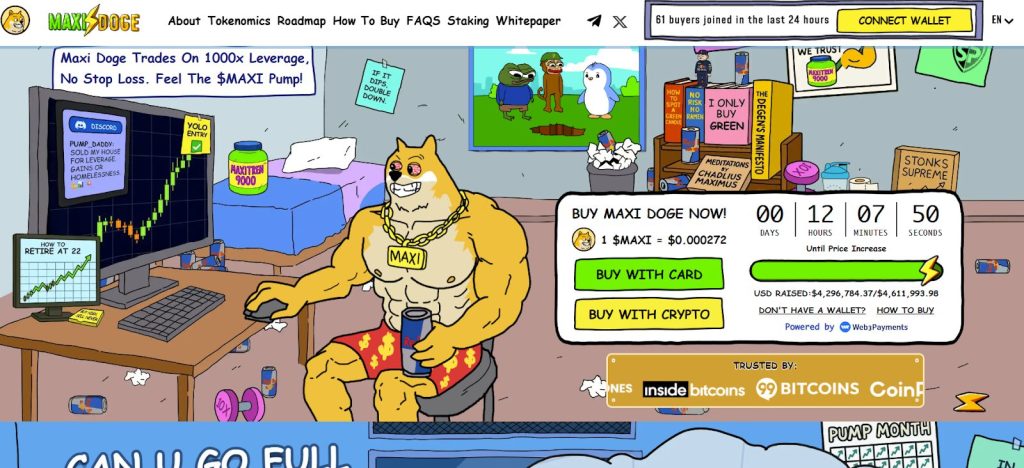
Maxi Doge Presale Builds Momentum as Market Eyes Next Breakout

With Bitcoin on the verge of a breakout, investor attention is quickly shifting toward early-stage opportunities with even bigger potential.

Maxi Doge ($MAXI) has emerged as a top contender.

Built around the high-energy ethos of gym culture and trader discipline, $MAXI is more than just a meme coin.

MAXI is creating a hub where early adopters can share trading setups, alpha leaks, and early opportunities in a fast-moving market.

Bitcoin Price Prediction - Maxi doge banner

Tapping into the same speculative momentum that drove Dogecoin’s historic 1,000x rally, the Maxi Doge presale has already surpassed $4.3 million in funding.

With daily price increases and 72% APY staking rewards for early holders, the window to secure a strong position is quickly narrowing.

To purchase MAXI at the current price, visit the official Maxi Doge presale website and connect an Ethereum-compatible wallet, such as Best Wallet.

You can pay using existing crypto or a bank card in seconds.

Visit the Official Maxi Doge Website Here

The post Bitcoin Price Prediction: BlackRock Doubles Down on Crypto with New ETF Filing – Is a Full-Scale Wall Street Invasion About to Begin? appeared first on Cryptonews.

❌
❌